Recognition: unknown
Neural Encoding Detection is Not All You Need for Synthetic Speech Detection
Pith reviewed 2026-05-10 06:39 UTC · model grok-4.3
The pith
Focusing synthetic speech detection solely on neural encoding risks approaches that may not endure as generation methods advance.
A machine-rendered reading of the paper's core claim, the machinery that carries it, and where it could break.
Core claim
The paper establishes that while neural encoding detection offers strong results on existing data, dedicating future research exclusively to it carries the risk of overcommitting to methods that may not stand the test of time against evolving synthetic speech generators, and it recommends pursuing a broader set of promising research avenues instead.
What carries the argument
The analysis of advantages and drawbacks of neural encoding detection relative to other data-driven synthetic speech detection approaches.
If this is right
- Detection research should incorporate multiple complementary techniques to improve resilience.
- Evaluations must extend beyond current datasets to anticipate unknown synthesis advances.
- Hybrid systems combining neural features with other signal characteristics may offer more stable performance.
- Attention to generalizable artifacts rather than model-specific ones will support longer-term effectiveness.
Where Pith is reading between the lines
- The field could benefit from systematic testing of detectors against successive waves of new synthesis tools to measure generalization.
- Cross-pollination with traditional signal-processing methods might uncover features that neural-only pipelines overlook.
- Anticipatory design of detection strategies, informed by likely future generator improvements, could reduce the need for reactive updates.
Load-bearing premise
The strengths and limitations seen in today's neural encoding detectors will continue to hold as future synthetic speech generators are developed.
What would settle it
Development of a new synthetic speech generator that evades current neural encoding detectors but remains detectable by other established methods.
Figures

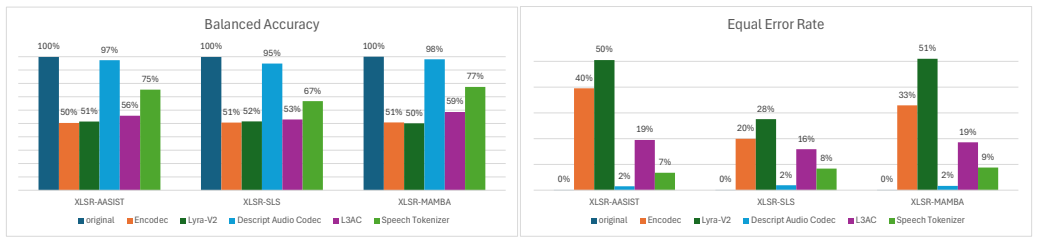
read the original abstract
This paper reviews the current state and emerging trends in synthetic speech detection. It outlines the main data-driven approaches, discusses the advantages and drawbacks of focusing future research solely on neural encoding detection, and offers recommendations for promising research directions. Unlike works that introduce new detection methods or datasets, this paper aims to guide future state-of-the-art research in the field and to highlight the risk of overcommitting to approaches that may not stand the test of time.
Editorial analysis
A structured set of objections, weighed in public.
Referee Report
Summary. The paper reviews the current state of synthetic speech detection, outlining main data-driven approaches and specifically analyzing the advantages and drawbacks of focusing future research solely on neural encoding detection. It argues that overcommitting to this paradigm risks approaches that may not generalize or endure, and provides recommendations for broader research directions to guide the field.
Significance. If the qualitative assessment of limitations holds, the paper could usefully steer the community away from narrow focus on neural encoding methods toward more diverse paradigms, potentially improving long-term robustness in synthetic speech detection. The review format itself is a strength in synthesizing trends without introducing new empirical claims.
major comments (1)
- [§3–4] §3–4: The central claim that neural encoding detection carries long-term viability risks rests on listed drawbacks (e.g., generalization failures and vulnerability to unseen synthesis methods) being structural rather than transient. However, the section provides only qualitative enumeration without quantitative projections, sensitivity analyses, or explicit comparisons to alternative paradigms that would demonstrate these issues cannot be resolved within the neural encoding framework.
minor comments (2)
- [Abstract] The abstract and introduction could more explicitly state the scope (e.g., time period of reviewed literature) to help readers assess the currency of the trend analysis.
- [§4] Some citations in the drawbacks discussion appear to rely on older benchmarks; adding a brief note on whether recent works have addressed specific limitations would strengthen the extrapolation argument.
Simulated Author's Rebuttal
We thank the referee for their constructive feedback and positive evaluation of the manuscript's potential to steer the community toward more robust research directions. We provide a point-by-point response to the major comment below.
read point-by-point responses
-
Referee: [§3–4] §3–4: The central claim that neural encoding detection carries long-term viability risks rests on listed drawbacks (e.g., generalization failures and vulnerability to unseen synthesis methods) being structural rather than transient. However, the section provides only qualitative enumeration without quantitative projections, sensitivity analyses, or explicit comparisons to alternative paradigms that would demonstrate these issues cannot be resolved within the neural encoding framework.
Authors: We acknowledge that our discussion in sections 3 and 4 relies on a qualitative synthesis of the existing literature rather than new quantitative analyses, which aligns with the scope of a review paper. The drawbacks we highlight, such as generalization failures and vulnerabilities to unseen synthesis methods, are drawn from a range of published studies that demonstrate these issues persisting across various neural encoding approaches. We interpret these as structural because they arise from the fundamental challenge of matching detector training data to the rapidly evolving distribution of synthetic speech generators, a pattern repeatedly observed in the field. Our central claim is not that these limitations are permanently irresolvable within neural encoding frameworks but that over-reliance on this paradigm alone carries risks for long-term robustness, motivating the exploration of complementary methods. To address the referee's point, we will revise the manuscript to include more explicit comparisons with alternative paradigms (e.g., traditional signal processing and hybrid approaches) and additional citations that provide quantitative evidence of generalization gaps. This will strengthen the argument without altering the review's qualitative nature. revision: partial
Circularity Check
No circularity: qualitative review with no derivations or self-referential reductions
full rationale
This is a literature review paper that summarizes existing data-driven approaches to synthetic speech detection, lists drawbacks of neural encoding methods in sections 3-4, and offers forward-looking recommendations. It contains no equations, no fitted parameters, no claimed derivations, and no load-bearing self-citations that reduce the central claim to its own inputs by construction. The argument that sole focus on neural encoding detection risks overcommitment rests on external literature trends rather than any internal tautology or renaming of known results.
Axiom & Free-Parameter Ledger
Reference graph
Works this paper leans on
-
[1]
Publications Office of the European Union, 2022
Europol,Facing reality? Law enforcement and the challenge Unm of deepfakes, an observatory report from the Europol Innovation Lab. Publications Office of the European Union, 2022
2022
-
[2]
The International Criminal Police Organization, 2024
Interpol,Beyond Illusions: Unmasking the Threat of Synthetic Media for Law Enforcement. The International Criminal Police Organization, 2024
2024
-
[3]
ASVspoof 2019: A large-scale public database of synthesized, converted and replayed speech,
X. Wang et al., “ASVspoof 2019: A large-scale public database of synthesized, converted and replayed speech,”Computer Speech & Language, vol. 64, pp. 101 114–101 140, 2020
2019
-
[4]
ASVspoof 2021: Accelerating progress in spoofed and deepfake speech detection,
J. Yamagishi et al., “ASVspoof 2021: Accelerating progress in spoofed and deepfake speech detection,” inAutomatic Speaker Verification and Spoofing Countermeasures Challenge (ASVspoof), 2021, pp. 47–54
2021
-
[5]
ASVspoof 5: Crowdsourced speech data, deepfakes, and adversarial attacks at scale,
X. Wang et al., “ASVspoof 5: Crowdsourced speech data, deepfakes, and adversarial attacks at scale,” inAutomatic Speaker Verification and Spoofing Countermeasures Challenge (ASVspoof), 2024, pp. 1–8
2024
-
[6]
ADD 2022: The first audio deep synthesis detection challenge,
J. Yi et al., “ADD 2022: The first audio deep synthesis detection challenge,” inIEEE International Conference on Acoustics, Speech and Signal Processing (ICASSP), 2022, pp. 9216–9220
2022
-
[7]
SAFE: Synthetic audio forensics evaluation challenge,
T. Kirill et al., “SAFE: Synthetic audio forensics evaluation challenge,” inACM Workshop on Information Hiding and Multimedia Security (IH&MMSEC), 2025, pp. 174–180
2025
-
[8]
Open challenges in synthetic speech detection,
L. Cuccovillo et al., “Open challenges in synthetic speech detection,” inIEEE International Workshop on Information Forensics and Security (WIFS), 2022, pp. 1–6
2022
-
[9]
European Union regulations on algo- rithmic decision-making and a ‘right to explanation’,
B. Goodman and S. Flaxman, “European Union regulations on algo- rithmic decision-making and a ‘right to explanation’,”AI magazine, vol. 38, no. 3, pp. 50–57, 2017
2017
-
[10]
[Online]
European Union,Regulation (EU) 2024/1689 of the European Parlia- ment and of the Council of 13 June 2024 laying down harmonised rules on artificial intelligence (Artificial Intelligence Act), 2024. [Online]. Available: http://data.europa.eu/eli/reg/2024/1689/ojj
2024
-
[11]
The impact of silence on speech anti-spoofing,
Y . Zhang et al., “The impact of silence on speech anti-spoofing,” IEEE/ACM Transactions on Audio, Speech, and Language Processing (TASLP), vol. 31, pp. 3374–3389, 2023
2023
-
[12]
Towards frequency band explainability in synthetic speech detection,
D. Salvi et al., “Towards frequency band explainability in synthetic speech detection,” inEuropean Signal Processing Conference (EU- SIPCO), 2023, pp. 620–624
2023
-
[13]
Listening between the lines: Synthetic speech detection disregarding verbal content,
D. Salvi et al., “Listening between the lines: Synthetic speech detection disregarding verbal content,” inIEEE International Conference on Acoustics, Speech, and Signal Processing Workshops (ICASSPW), 2024, pp. 883–887
2024
-
[14]
Spoofed training data for speech spoofing countermeasure can be efficiently created using neural vocoders,
X. Wang and J. Yamagishi, “Spoofed training data for speech spoofing countermeasure can be efficiently created using neural vocoders,” inIEEE International Conference on Acoustics, Speech and Signal Processing (ICASSP), 2023, pp. 1–5
2023
-
[15]
CodecFake: Enhancing anti-spoofing models against deepfake audios from codec-based speech synthesis systems,
H. Wu et al., “CodecFake: Enhancing anti-spoofing models against deepfake audios from codec-based speech synthesis systems,” inISCA Interspeech, 2024, pp. 1770–1774
2024
-
[16]
Codecfake: An initial dataset for detecting LLM-based deepfake audio,
Y . Lu et al., “Codecfake: An initial dataset for detecting LLM-based deepfake audio,” inISCA Interspeech, 2024, pp. 1390–1394
2024
-
[17]
Speaker recognition from raw waveform with SincNet,
M. Ravanelli and Y . Bengio, “Speaker recognition from raw waveform with SincNet,” inIEEE Spoken Language Technology Workshop (SLT), 2018, pp. 1021–1028
2018
-
[18]
End-to-end anti-spoofing with RawNet2,
H. Tak et al., “End-to-end anti-spoofing with RawNet2,” inIEEE International Conference on Acoustics, Speech and Signal Processing (ICASSP), 2021, pp. 6369–6373
2021
-
[19]
End-to-end spectro-temporal graph attention networks for speaker verification anti-spoofing and speech deepfake detection,
H. Tak et al., “End-to-end spectro-temporal graph attention networks for speaker verification anti-spoofing and speech deepfake detection,” inAutomatic Speaker Verification and Spoofing Countermeasures Chal- lenge (ASVspoof), 2021, pp. 1–8
2021
-
[20]
AASIST: Audio anti-spoofing using integrated spectro-temporal graph attention networks,
J.-w. Jung et al., “AASIST: Audio anti-spoofing using integrated spectro-temporal graph attention networks,” inIEEE International Conference on Acoustics, Speech and Signal Processing (ICASSP), 2022, pp. 6367–6371
2022
-
[21]
Automatic speaker verification spoofing and deepfake detection using wav2vec 2.0 and data augmentation,
H. Tak et al., “Automatic speaker verification spoofing and deepfake detection using wav2vec 2.0 and data augmentation,” inThe Speaker and Language Recognition Workshop (Odyssey), 2022, pp. 112–119
2022
-
[22]
wav2vec 2.0: A framework for self-supervised learning of speech representations,
A. Baevski et al., “wav2vec 2.0: A framework for self-supervised learning of speech representations,” inAnnual Conference on Neural Information Processing Systems (NeurIPS), 2020, pp. 12 449–12 460
2020
-
[23]
XLS-R: Self-supervised cross-lingual speech represen- tation learning at scale,
A. Babu et al., “XLS-R: Self-supervised cross-lingual speech represen- tation learning at scale,” inISCA Interspeech, 2022
2022
-
[24]
Audio deepfake detection with self-supervised XLS-R and SLS classifier,
Q. Zhang et al., “Audio deepfake detection with self-supervised XLS-R and SLS classifier,” inACM International Conference on Multimedia, 2024, pp. 6765–6773
2024
-
[25]
XLSR-Mamba: A dual-column bidirectional state space model for spoofing attack detection,
Y . Xiao and R. K. Das, “XLSR-Mamba: A dual-column bidirectional state space model for spoofing attack detection,”IEEE Signal Process- ing Letters, vol. 32, pp. 1276–1280, 2025
2025
-
[26]
AI-synthesized voice detection using neural vocoder artifacts,
C. Sun et al., “AI-synthesized voice detection using neural vocoder artifacts,” inIEEE/CVF Conference on Computer Vision and Pattern Recognition Workshops (CVPRW), 2023, pp. 904–912
2023
-
[27]
Unmasking neural codecs: Forensic identification of AI-compressed speech,
D. Moussa et al., “Unmasking neural codecs: Forensic identification of AI-compressed speech,” inISCA Interspeech, 2024, pp. 2260–2264
2024
-
[28]
Shortcut learning in deep neural networks,
R. Geirhos et al., “Shortcut learning in deep neural networks,”Nature Machine Intelligence, vol. 2, pp. 665–673, 11 2020
2020
-
[29]
Tackling shortcut learning in deep neural networks: An iterative approach with interpretable models,
S. Ghosh et al., “Tackling shortcut learning in deep neural networks: An iterative approach with interpretable models,” inInternational Conference on Machine Learning Workshops (ICMLW), 2023
2023
-
[30]
Hirst,Speech Prosody: From Acoustics to Interpretation(Prosody, Phonology and Phonetics)
D. Hirst,Speech Prosody: From Acoustics to Interpretation(Prosody, Phonology and Phonetics). Springer, 2024
2024
-
[31]
Combining automatic speaker verification and prosody analysis for synthetic speech detection,
L. Attorresi et al., “Combining automatic speaker verification and prosody analysis for synthetic speech detection,” inInternational Con- ference on Pattern Recognition (ICPR), 2022, pp. 247–263
2022
-
[32]
Do deepfakes feel emotions? A semantic approach to detecting deepfakes via emotional inconsistencies,
B. Hosler et al., “Do deepfakes feel emotions? A semantic approach to detecting deepfakes via emotional inconsistencies,” inIEEE/CVF Conference on Computer Vision and Pattern Recognition Workshops (CVPRW), 2021, pp. 1013–1022
2021
-
[33]
Deepfake speech detection through emotion recog- nition: A semantic approach,
E. Conti et al., “Deepfake speech detection through emotion recog- nition: A semantic approach,” inIEEE International Conference on Acoustics, Speech and Signal Processing (ICASSP), 2022
2022
-
[34]
Contributions of jitter and shimmer in the voice for fake audio detection,
K. Li et al., “Contributions of jitter and shimmer in the voice for fake audio detection,”IEEE Access, vol. 11, pp. 84 689–84 698, 2023
2023
-
[35]
Deepfake speech detection: Approaches from acoustic features to deep neural networks,
M. Unoki et al., “Deepfake speech detection: Approaches from acoustic features to deep neural networks,”IEICE Transactions on Information and Systems, vol. E108.D, no. 4, pp. 300–310, 2025
2025
-
[36]
Audio transformer for synthetic speech detection via multi-formant analysis,
L. Cuccovillo et al., “Audio transformer for synthetic speech detection via multi-formant analysis,” inIEEE/CVF Conference on Computer Vision and Pattern Recognition Workshops (CVPRW), 2024
2024
-
[37]
Spoofprint: A new paradigm for spoofing attacks detection,
T. Chen and E. Khoury, “Spoofprint: A new paradigm for spoofing attacks detection,” inIEEE Spoken Language Technology Workshop (SLT), 2021, pp. 538–543
2021
-
[38]
Deepfake audio detection by speaker verification,
A. Pianese et al., “Deepfake audio detection by speaker verification,” inIEEE International Workshop on Information Forensics and Security (WIFS), 2022, pp. 1–6
2022
-
[39]
Training-free deepfake voice recognition by leverag- ing large-scale pre-trained models,
A. Pianese et al., “Training-free deepfake voice recognition by leverag- ing large-scale pre-trained models,” inACM Workshop on Information Hiding and Multimedia Security (IH&MMSec), 2024, pp. 289–294
2024
-
[40]
Towards explainable person-of-interest-based audio synthesis detection,
A. Pianese et al., “Towards explainable person-of-interest-based audio synthesis detection,” inInternational Joint Conference on Neural Networks (IJCNN), 2024, pp. 1–8
2024
-
[41]
Phoneme-level analysis for person-of-interest speech deepfake detection,
D. Salvi et al., “Phoneme-level analysis for person-of-interest speech deepfake detection,” inIEEE/CVF International Conference on Com- puter Vision Workshops (ICCVW), 2025, pp. 1586–1595
2025
-
[42]
Retrieval-augmented audio deepfake detection,
Z. Kang et al., “Retrieval-augmented audio deepfake detection,” inACM International Conference on Multimedia Retrieval (ICMR), 2024
2024
-
[43]
Calibrating POI-based synthetic speech detection,
T. Le Roux et al., “Calibrating POI-based synthetic speech detection,” inACM International Workshop on Multimedia AI against Disinforma- tion (MAD), 2025, pp. 55–62
2025
-
[44]
Watermarking for AI content detection: A review on text, visual, and audio modalities,
L. Cao, “Watermarking for AI content detection: A review on text, visual, and audio modalities,” inICLR Workshop on GenAI Watermark- ing, 2025
2025
-
[45]
Deep audio watermarks are shallow: Limitations of post-hoc watermarking techniques for speech,
P. O’Reilly et al., “Deep audio watermarks are shallow: Limitations of post-hoc watermarking techniques for speech,” inICLR Workshop on GenAI Watermarking, 2025
2025
discussion (0)
Sign in with ORCID, Apple, or X to comment. Anyone can read and Pith papers without signing in.