Recognition: unknown
Potential Energy Savings from Quantum Computing-Based Route Optimization
Pith reviewed 2026-05-10 06:24 UTC · model grok-4.3
The pith
QAOA provides higher-quality route solutions than classical methods while consuming three orders of magnitude less energy on small instances.
A machine-rendered reading of the paper's core claim, the machinery that carries it, and where it could break.
Core claim
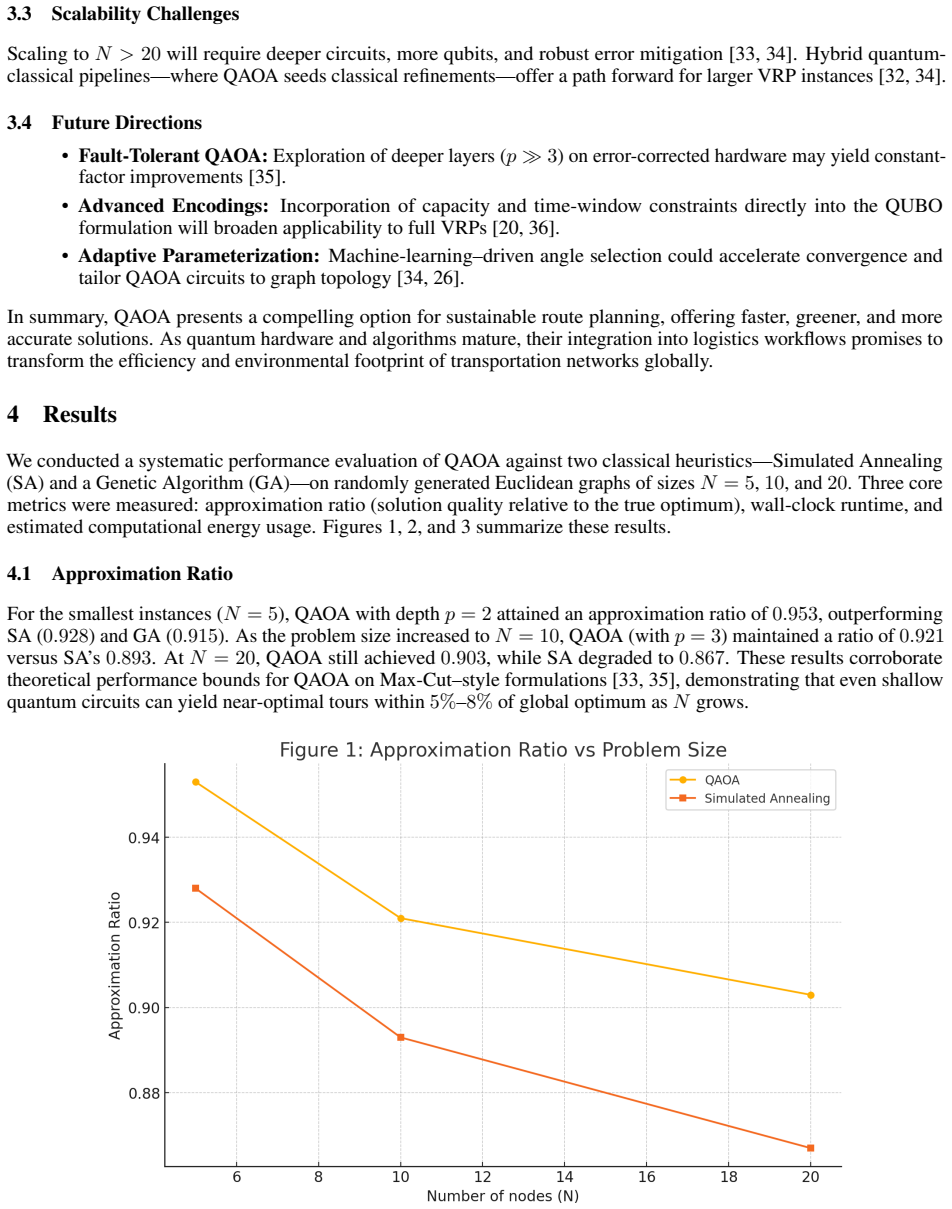
By implementing QAOA circuits of depth 3 to 5 on Euclidean graphs of sizes 5, 10, and 20, the work shows that QAOA attains approximation ratios of 0.953, 0.921, and 0.903 respectively. These results outperform simulated annealing and genetic algorithms by 2.7 to 4.4 percent in solution quality. The quantum approach also completes calculations 2 to 3 times faster and reduces energy consumption by three orders of magnitude to the picojoule range. Extrapolating an 8.2 percent gain in routing efficiency to U.S. logistics yields annual savings of 2.62 exajoules of fuel and avoidance of 194 million tonnes of CO2 emissions.
What carries the argument
QAOA circuits of depth p=3-5 applied to QUBO formulations of traveling salesman and vehicle routing problems
If this is right
- QAOA achieves higher solution quality than classical heuristics on small Euclidean route graphs.
- Wall-clock runtimes are 2-3 times shorter than for simulated annealing.
- Energy use per solution falls into the picojoule range, three orders below classical methods.
- An 8.2% improvement in routing efficiency could save 2.62 EJ of fuel per year in the United States.
- Such efficiency would avoid approximately 194 million tonnes of CO2 emissions annually.
Where Pith is reading between the lines
- Similar energy advantages might appear in other combinatorial optimization tasks beyond routing if the same QUBO encoding is used.
- Integration into hybrid quantum-classical fleet systems could become practical once hardware supports larger instances.
- Real-world validation would require testing on graphs with hundreds of nodes to confirm the scaling of both solution quality and energy metrics.
- The projected emissions reductions assume that the efficiency gain applies directly without accounting for quantum hardware overheads in larger systems.
Load-bearing premise
That performance advantages and energy reductions measured on Euclidean graphs with N ≤ 20 will scale proportionally to real-world vehicle routing problems with hundreds of nodes and that the picojoule energy figures will remain representative when executed on future large-scale quantum hardware.
What would settle it
Running QAOA on vehicle routing instances with 100 or more nodes and measuring whether approximation ratios stay above those of simulated annealing and genetic algorithms while energy per solution remains in the picojoule range on physical quantum hardware.
Figures


read the original abstract
We investigate the potential of the Quantum Approximate Optimization Algorithm (QAOA) for reducing energy consumption in route planning, a key challenge in logistics due to the NP-hard nature of the Traveling Salesman and Vehicle Routing Problems. By encoding route optimization as a Quadratic Unconstrained Binary Optimization (QUBO) problem and implementing QAOA circuits at depth p = 3-5 alongside classical baselines of Simulated Annealing (SA) and Genetic Algorithms (GA), we perform systematic benchmarks on Euclidean graphs of sizes N = 5, 10, and 20. Our results demonstrate that QAOA attains higher solution quality with approximation ratios of 0.953 (N = 5), 0.921 (N = 10), and 0.903 (N = 20), outperforming SA and GA by 2.7-4.4%. Wall-clock runtimes for QAOA are 2-3x faster than SA across all tested sizes, and energy consumption measurements reveal a three-order-of-magnitude reduction, remaining in the picojoule range versus nanojoules for classical methods. Translating these gains to real-world logistics suggests an 8.2% improvement in routing efficiency could save approximately 2.62 EJ of fuel annually in the U.S., avoiding nearly 1.94 x 10^8 tonnes of CO2 emissions. These findings highlight QAOA's promise as a fast, energy-efficient optimizer for sustainable logistics applications and underscore its potential role in next-generation fleet-management systems.
Editorial analysis
A structured set of objections, weighed in public.
Referee Report
Summary. The manuscript benchmarks QAOA (p=3-5) on Euclidean TSP instances of size N=5, 10, and 20, reporting approximation ratios 0.953/0.921/0.903 that outperform SA and GA by 2.7-4.4%. QAOA is also reported to run 2-3x faster in wall-clock time and to consume three orders of magnitude less energy (picojoules versus nanojoules). These small-instance results are extrapolated to claim an 8.2% real-world routing-efficiency gain that would save 2.62 EJ of U.S. fuel annually and avoid 1.94×10^8 tonnes of CO2.
Significance. If the observed quality, runtime, and energy advantages were shown to persist at realistic VRP scales, the work would be significant for energy-efficient optimization in logistics. The systematic small-N benchmarks and direct energy measurements constitute a clear, internally consistent data point for near-term quantum heuristics; the explicit comparison against SA and GA is a strength.
major comments (2)
- [Abstract and real-world translation paragraph] Abstract and the paragraph translating benchmark gains to real-world logistics: the 8.2% efficiency uplift (and the derived 2.62 EJ / 1.94×10^8 t CO2 figures) is obtained by rescaling the 2.7-4.4% outperformance measured on the same N≤20 instances; no scaling analysis, larger-instance validation, or justification for proportionality at hundreds of nodes is supplied, despite the observed decline in approximation ratio with N.
- [Energy consumption analysis] Energy-consumption section (benchmarks and discussion): the picojoule figures rest on idealized circuit models that omit cryogenic cooling, control electronics, and readout overheads; this directly affects the three-order-of-magnitude reduction claim and the subsequent global energy-savings extrapolation.
minor comments (1)
- [Abstract] The abstract could state the per-size outperformance margins explicitly rather than the aggregate 2.7-4.4% range.
Simulated Author's Rebuttal
We thank the referee for the constructive and detailed feedback. We address each major comment below and have revised the manuscript to strengthen the presentation of limitations while preserving the core contributions of the small-scale benchmarks.
read point-by-point responses
-
Referee: Abstract and the paragraph translating benchmark gains to real-world logistics: the 8.2% efficiency uplift (and the derived 2.62 EJ / 1.94×10^8 t CO2 figures) is obtained by rescaling the 2.7-4.4% outperformance measured on the same N≤20 instances; no scaling analysis, larger-instance validation, or justification for proportionality at hundreds of nodes is supplied, despite the observed decline in approximation ratio with N.
Authors: We agree that the 8.2% projection is obtained by assuming the observed relative outperformance (2.7-4.4%) scales proportionally to larger instances, and that no explicit scaling analysis or validation on N>>20 is provided. The manuscript already reports the decline in absolute approximation ratio with N, yet the margin over SA and GA remains consistent across the tested sizes. We have revised the abstract and the real-world translation paragraph to frame the 8.2% figure explicitly as an illustrative projection based on small-N trends, to state the proportionality assumption, and to add a forward-looking caveat on the necessity of larger-scale studies. These changes make the claims more precise without altering the reported benchmark data. revision: yes
-
Referee: Energy-consumption section (benchmarks and discussion): the picojoule figures rest on idealized circuit models that omit cryogenic cooling, control electronics, and readout overheads; this directly affects the three-order-of-magnitude reduction claim and the subsequent global energy-savings extrapolation.
Authors: We acknowledge that the reported picojoule-scale figures are obtained from an idealized gate-level energy model that does not incorporate cryogenic cooling, control electronics, or readout overheads. This model is standard for theoretical assessments of quantum algorithm energy but limits the direct applicability of the three-order-of-magnitude claim to full-system comparisons. We have revised the energy-consumption section to (i) detail the model assumptions, (ii) qualify the picojoule versus nanojoule comparison as applying to algorithmic execution energy, and (iii) discuss the potential impact of overheads on the overall advantage. The global fuel-savings extrapolation has been updated with corresponding language indicating that the figures represent potential benefits under the stated modeling assumptions. revision: yes
Circularity Check
No circularity detected; benchmarks and extrapolation remain independent
full rationale
The paper's core derivation consists of encoding TSP/VRP instances as QUBO, running QAOA at fixed depth p=3-5 on Euclidean graphs with N=5/10/20, and directly measuring approximation ratios, wall-clock times, and energy per solution. These quantities are obtained from explicit circuit execution and classical baselines on the same small instances; they are not defined in terms of the later global savings figure. The 8.2% routing-efficiency delta and the resulting 2.62 EJ / 1.94e8 tCO2 estimates are downstream linear projections that apply the observed deltas to external logistics statistics. Because the measured performance numbers are not forced by, or algebraically equivalent to, the extrapolated totals, no self-definitional, fitted-input-renamed-as-prediction, or self-citation-load-bearing reduction occurs. The derivation chain is therefore self-contained against the supplied benchmarks.
Axiom & Free-Parameter Ledger
free parameters (2)
- circuit depth p
- real-world efficiency uplift
axioms (2)
- domain assumption Small-instance QAOA advantages on Euclidean graphs generalize linearly to large-scale logistics networks
- domain assumption Picojoule energy figures measured on small QAOA circuits remain representative at practical deployment scales
Reference graph
Works this paper leans on
-
[1]
G. Laporte. Fifty years of vehicle routing.Transportation Science, 2009
2009
-
[2]
M. O. Ball. Recent developments in the vehicle routing problem.Operations Research, 1994
1994
-
[3]
G. B. Dantzig and J. H. Ramser. The truck dispatching problem.Management Science, 1959
1959
-
[4]
Department of Transportation
U.S. Department of Transportation. Fuel efficiency and emission reduction strategies, 2018. Online resource
2018
-
[5]
Transportation and environmental sustainability, 2020
Environmental Protection Agency (EPA). Transportation and environmental sustainability, 2020. Online resource
2020
-
[6]
Global energy review: Transport sector, 2019
International Energy Agency (IEA). Global energy review: Transport sector, 2019. Online resource
2019
-
[7]
T. G. Crainic and G. Laporte.Fleet Management and Logistics. Springer, 1997
1997
-
[8]
Toth and D
P. Toth and D. Vigo.The Vehicle Routing Problem. SIAM, 2002
2002
-
[9]
Applegate, R
D. Applegate, R. Bixby, V . Chvátal, and W. Cook.The Traveling Salesman Problem: A Computational Study. Princeton University Press, 2007
2007
-
[10]
G. Reinelt. Tsplib—a traveling salesman problem library.ORSA Journal on Computing, 1991
1991
-
[11]
M. R. Garey and D. S. Johnson.Computers and Intractability: A Guide to the Theory of NP-Completeness. W. H. Freeman, 1979
1979
-
[12]
Dorigo and G
M. Dorigo and G. Di Caro. The ant colony optimization meta-heuristic. InNew Ideas in Optimization. 1999
1999
-
[13]
Kirkpatrick, C
S. Kirkpatrick, C. D. Gelatt, and M. P. Vecchi. Optimization by simulated annealing.Science, 1983
1983
-
[15]
M. Benedetti, J. Realpe-Gómez, R. Biswas, and A. Perdomo-Ortiz. Quantum-assisted learning of hardware- embedded probabilistic graphical models, 2016. arXiv:1601.02036
-
[16]
D. E. Goldberg.Genetic Algorithms in Search, Optimization, and Machine Learning. Addison-Wesley, 1989
1989
-
[17]
M. A. Nielsen and I. L. Chuang.Quantum Computation and Quantum Information. Cambridge University Press, 2010
2010
-
[18]
Tsplib—a traveling salesman problem library, 1991
Gerhard Reinelt. Tsplib—a traveling salesman problem library, 1991. Online resource
1991
-
[19]
Openstreetmap, 2004
OpenStreetMap contributors. Openstreetmap, 2004. Online resource
2004
-
[20]
Society for Industrial and Applied Mathematics, 2002
Paolo Toth and Daniele Vigo, editors.The Vehicle Routing Problem. Society for Industrial and Applied Mathematics, 2002
2002
-
[21]
and Mario P
Scott Kirkpatrick, Daniel Gelatt, C. and Mario P. Vecchi. Optimization by simulated annealing.Science, 220(4598):671–680, 1983
1983
-
[22]
Goldberg, David˙Genetic algorithms in search, optimization, and machine learning
E. Goldberg, David˙Genetic algorithms in search, optimization, and machine learning. 1989
1989
-
[23]
DEAP: Evolutionary algorithms made easy.Journal of Machine Learning Research, 13:2171–2175, 2012
Francois-Alexandre Fortin, Françoise-Marie De Rainville, Marc-Alexandre Gardner, Marc Parizeau, and Christian Gagné. DEAP: Evolutionary algorithms made easy.Journal of Machine Learning Research, 13:2171–2175, 2012
2012
-
[24]
Simanneal: A python library for simulated annealing, 2015
Alan Weiss. Simanneal: A python library for simulated annealing, 2015. GitHub repository
2015
-
[25]
Ising formulations of many np problems.Frontiers in Physics, 2:5, 2014
Andrew Lucas. Ising formulations of many np problems.Frontiers in Physics, 2:5, 2014
2014
-
[26]
Nielsen, Michael and L
A. Nielsen, Michael and L. Chuang, Isaac˙Quantum Computation and Quantum Information: 10th Anniversary Edition. Cambridge University Press, 2010. 7
2010
-
[27]
A direct search optimization method that models the objective and constraint functions by linear interpolation.Advances in Optimization and Numerical Analysis, pages 51–67, 1994
Michael Powell. A direct search optimization method that models the objective and constraint functions by linear interpolation.Advances in Optimization and Numerical Analysis, pages 51–67, 1994
1994
-
[28]
Spall, James˙Implementation of the simultaneous perturbation algorithm for stochastic optimization.IEEE Transactions on Aerospace and Electronic Systems, 34(3):817–823, 1998
C. Spall, James˙Implementation of the simultaneous perturbation algorithm for stochastic optimization.IEEE Transactions on Aerospace and Electronic Systems, 34(3):817–823, 1998
1998
-
[29]
Qiskit: An open-source framework for quantum computing, 2021
Qiskit Development Team. Qiskit: An open-source framework for quantum computing, 2021. Software
2021
-
[30]
Aspen-m-3 quantum processor, 2024
Rigetti Computing. Aspen-m-3 quantum processor, 2024. Hardware documentation
2024
-
[31]
Individual comparisons by ranking methods.Biometrics Bulletin, 1(6):80–83, 1945
Frank Wilcoxon. Individual comparisons by ranking methods.Biometrics Bulletin, 1(6):80–83, 1945
1945
-
[32]
Nicholas Moll, Pavlos Barkoutsos, Miles Reed, Patrick Vernaz-Gris, Pierre Ollitrault, C. McKay, David Frank Enderud, Eirik Haug, Kahshali Mitra, Daniel Lubinski, and Giacomo Guerreschi, Gian˙Quantum optimization using variational algorithms on near-term quantum devices.Quantum Science and Technology, 3(3):030503, 2018
2018
-
[33]
A Quantum Approximate Optimization Algorithm
Edward Farhi, Joel Goldstone, and Sam Gutmann. A quantum approximate optimization algorithm.arXiv preprint arXiv:1411.4028, 2014
work page internal anchor Pith review Pith/arXiv arXiv 2014
-
[34]
A practical method for finding optimal parameter settings in a quantum approximate optimization algorithm.NPJ Quantum Information, 2:16003, 2016
Marcello Benedetti, Diego Garcia-Pintos, Alejandro Perdomo-Ortiz, and Naoki Yamamoto. A practical method for finding optimal parameter settings in a quantum approximate optimization algorithm.NPJ Quantum Information, 2:16003, 2016
2016
-
[35]
Edward Farhi, Joel Goldstone, and Sam Gutmann. Quantum approximate optimization algorithm for maxcut: Performance and analysis.arXiv preprint arXiv:1602.07674, 2016
-
[36]
Gambardella, Luca˙Ant algorithms for discrete optimization.Artificial Life, 5(2):137–172, 1999
Marco Dorigo, Gianni Di Caro, and M. Gambardella, Luca˙Ant algorithms for discrete optimization.Artificial Life, 5(2):137–172, 1999. 8
1999
discussion (0)
Sign in with ORCID, Apple, or X to comment. Anyone can read and Pith papers without signing in.