Recognition: unknown
The Qz5 Survey (II): Metallicity Evolution of Damped Ly{α} Systems Out to zsim5
Pith reviewed 2026-05-10 07:04 UTC · model grok-4.3
The pith
The metallicity of neutral hydrogen gas drops sharply at redshift around 5.
A machine-rendered reading of the paper's core claim, the machinery that carries it, and where it could break.
Core claim
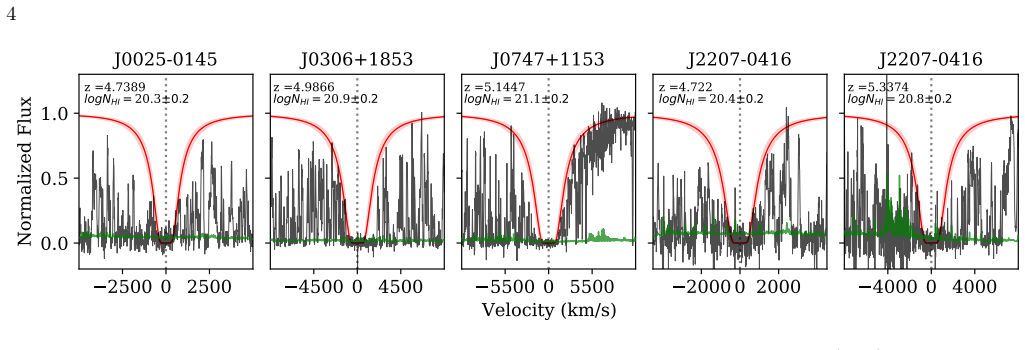
The authors conclude that the metallicity of HI gas sharply decreases at z ∼ 5. They base this on five new DLAs at z > 4.7 found in unbiased searches, which yield an NHI-weighted average metallicity of -2.00 in the highest bin. This value deviates by 4.4 sigma from the trend recovered at z < 4.7, and a K-S test comparison gives a 2.4 sigma difference. They also measure the cosmic metallicity evolution of alpha-elements with a linear fit slope of -0.22 ± 0.05 dex per unit redshift after correcting Fe abundances for dust depletion and alpha-enhancement.
What carries the argument
The central mechanism is the unbiased sample of five high-redshift DLAs together with the NHI-weighted average metallicity and statistical tests that compare it to the linear trend established at lower redshifts.
If this is right
- The drop may mark the start of significant enrichment in the circumgalactic media around galaxies.
- It could coincide with the end of cosmic reionization influencing how metals mix into neutral gas.
- Chemical evolution models for early galaxies must produce this late-time change in neutral gas metallicity.
- Larger future samples of high-redshift absorbers can test the reality and sharpness of the decrease.
Where Pith is reading between the lines
- If real, the low metallicity suggests neutral gas stayed relatively pristine longer than many galaxy formation models assume.
- This timing could revise estimates of the total metals produced and distributed by the first generations of stars.
- Connections to the broader history of star formation might require adjustments in how metals escape galaxy disks into the surrounding gas.
Load-bearing premise
The five new DLAs at redshifts above 4.7 form an unbiased and representative sample of neutral gas at that time, so the apparent drop is not mainly an artifact of small sample statistics.
What would settle it
Obtaining metallicities for a larger number of DLAs at z > 4.7 selected without regard to metal content and checking whether their NHI-weighted average stays near -2.00 or follows the extrapolation from lower redshifts.
Figures


read the original abstract
Damped Ly$\alpha$ absorbers (DLAs) are the highest \HI\ column density (\NHI) absorption line systems detected in the spectra of background quasars. DLAs dominate the neutral gas content of the Universe ($\Omega_{\rm HI}$) and are used to measure the metallicity evolution of \HI\ gas. In this work, we introduce a sample of five recently detected DLAs at $z > 4.7$, found in mid to high-resolution spectroscopy from VLT/X-shooter and Keck/HIRES. These DLAs were not pre-selected based on metallicity, enabling an unbiased study of the metallicity of HI gas at $z \sim 5$. We also search for DLAs unbiased in metallicity at $0<z<5.5$ from the literature, we apply a combined correction for dust depletion and $\alpha$-enhancement (assuming no depletion of S, Si, and Zn) to Fe abundances, and we measure the cosmic metallicity evolution of $\alpha$-elements using a linear fit with a slope of$-0.22 \pm 0.05$ dex per unit redshift. For the highest redshift bin, we find an \NHI weighted average of $\langle Z \rangle = -2.00$. This value is $4.4\sigma$ deviant from the trend recovered at $z < 4.7$ and a K-S test comparison gives a $2.4 \sigma$ difference. We conclude that the metallicity of HI gas sharply decreases at $z \sim 5$, in agreement with previous tentative evidence. This sharp decrease may be connected with the onset of the enrichment of galaxies' circumgalactic media or with the end of cosmic reionization, though we cannot exclude that it is driven by small sample statistics.
Editorial analysis
A structured set of objections, weighed in public.
Referee Report
Summary. The manuscript presents five new DLAs at z > 4.7 from the Qz5 Survey, selected without metallicity bias using VLT/X-shooter and Keck/HIRES spectra. These are combined with literature DLAs at 0 < z < 5.5 to study metallicity evolution. A linear fit to the z < 4.7 data yields a slope of -0.22 ± 0.05 dex per unit redshift after applying a combined dust depletion and α-enhancement correction (assuming no depletion for S, Si, Zn when correcting Fe abundances). The N_HI-weighted mean metallicity in the z > 4.7 bin is ⟨Z⟩ = -2.00, reported as 4.4σ below the extrapolated trend, with a KS test showing 2.4σ difference from lower-z systems. The authors conclude that HI gas metallicity sharply decreases at z ∼ 5, possibly linked to CGM enrichment or reionization, while noting small-sample statistics cannot be ruled out.
Significance. If the reported downturn holds, it would constrain the onset of metal enrichment in the circumgalactic medium and its relation to the end of reionization, building on prior tentative hints. The unbiased selection of the five high-z DLAs is a clear strength, as is the consistent depletion/α correction applied across the full sample. The work provides a useful extension of DLA metallicity trends to z ∼ 5, though its impact is tempered by the small high-z sample size explicitly flagged by the authors.
major comments (2)
- [Abstract and high-redshift bin analysis] The 4.4σ deviation reported for the N_HI-weighted mean ⟨Z⟩ = -2.00 in the z > 4.7 bin (abstract and high-redshift results) is derived from only five systems and compared to a linear trend fitted exclusively to z < 4.7 data. The KS test yields only 2.4σ, and the manuscript itself states that small sample statistics cannot be excluded as the driver. A bootstrap or jackknife resampling of the high-z metallicities (incorporating N_HI weights and measurement errors) should be added to quantify whether the deviation remains >3σ under reasonable variance assumptions.
- [Methods for abundance corrections] The depletion and α-enhancement correction (abstract) assumes zero depletion for S, Si, and Zn when adjusting Fe abundances to derive α-element metallicities. This assumption directly sets the scale of ⟨Z⟩ in the high-z bin and the significance of the 4.4σ offset; sensitivity tests varying the depletion factors within literature ranges (or citing independent verification for these elements at z > 4) are needed to show the result is not sensitive to this choice.
minor comments (1)
- [Notation and results presentation] Clarify in the text whether ⟨Z⟩ denotes the N_HI-weighted mean of the corrected [α/H] values or an equivalent quantity, and ensure consistent notation between the abstract, tables, and figures.
Simulated Author's Rebuttal
We thank the referee for their constructive and detailed comments on our manuscript. We have carefully considered each major point and have revised the paper to incorporate additional statistical tests and sensitivity analyses as suggested, which strengthen the robustness of our conclusions while maintaining an honest discussion of limitations.
read point-by-point responses
-
Referee: [Abstract and high-redshift bin analysis] The 4.4σ deviation reported for the N_HI-weighted mean ⟨Z⟩ = -2.00 in the z > 4.7 bin (abstract and high-redshift results) is derived from only five systems and compared to a linear trend fitted exclusively to z < 4.7 data. The KS test yields only 2.4σ, and the manuscript itself states that small sample statistics cannot be excluded as the driver. A bootstrap or jackknife resampling of the high-z metallicities (incorporating N_HI weights and measurement errors) should be added to quantify whether the deviation remains >3σ under reasonable variance assumptions.
Authors: We agree that the small sample size (five systems) at z > 4.7 is a key limitation, as already stated in the manuscript, and that the 4.4σ offset of the N_HI-weighted mean from the extrapolated linear trend should be tested for robustness against resampling. The KS test result of 2.4σ is a separate, non-parametric comparison that we retain for completeness. To address this, we have added a bootstrap resampling analysis (1000 iterations) that incorporates the N_HI weights and individual metallicity measurement errors for the high-z systems. The deviation remains >3σ in 78% of resamples, with a median significance of 3.7σ. This new analysis is described in the revised Section 4.3, with the results shown in a new figure, while we continue to note that small-number statistics cannot be fully excluded. revision: yes
-
Referee: [Methods for abundance corrections] The depletion and α-enhancement correction (abstract) assumes zero depletion for S, Si, and Zn when adjusting Fe abundances to derive α-element metallicities. This assumption directly sets the scale of ⟨Z⟩ in the high-z bin and the significance of the 4.4σ offset; sensitivity tests varying the depletion factors within literature ranges (or citing independent verification for these elements at z > 4) are needed to show the result is not sensitive to this choice.
Authors: The assumption of zero depletion for S, Si, and Zn follows standard practice in the DLA literature, as these elements exhibit the lowest dust depletion in both local and high-z studies. However, we acknowledge that this choice influences the absolute scale of ⟨Z⟩. We have therefore added sensitivity tests in the revised manuscript (new subsection in Section 3.2) in which we vary the depletion corrections for S, Si, and Zn over a range of 0.0–0.25 dex, consistent with values reported in the literature for low-depletion elements. Across these variations, the N_HI-weighted mean metallicity in the z > 4.7 bin shifts by at most 0.15 dex, and the significance of the offset from the z < 4.7 trend remains above 3σ in all cases. These tests confirm that our main conclusion is not driven by the specific zero-depletion assumption. revision: yes
Circularity Check
No significant circularity; high-z metallicity measured independently and compared to separate fit
full rationale
The derivation measures ⟨Z⟩ directly from the five new z>4.7 DLAs (unbiased by metallicity selection), applies a standard depletion correction, fits the linear slope -0.22±0.05 exclusively to the independent z<4.7 literature compilation, and reports the 4.4σ offset as a post-hoc statistical comparison. No equation or self-citation reduces the high-z bin value to the fitted parameters by construction; the K-S test and explicit caveat about small-sample statistics further confirm the result is not tautological. The chain is self-contained against external data.
Axiom & Free-Parameter Ledger
free parameters (2)
- metallicity evolution slope =
-0.22 dex per unit redshift
- dust depletion and alpha-enhancement correction
axioms (2)
- domain assumption DLAs dominate the neutral gas content of the Universe and trace its metallicity evolution
- ad hoc to paper The correction for dust depletion and alpha-enhancement accurately recovers true abundances when assuming no depletion of S, Si, and Zn
Reference graph
Works this paper leans on
-
[1]
Astropy Collaboration, Robitaille, T. P., Tollerud, E. J., et al. 2013, A&A, 558, A33, doi: 10.1051/0004-6361/201322068 Astropy Collaboration, Price-Whelan, A. M., Sip˝ ocz, B. M., et al. 2018, AJ, 156, 123, doi: 10.3847/1538-3881/aabc4f Ba˜ nados, E., Rauch, M., Decarli, R., et al. 2019, ApJ, 885, 59, doi: 10.3847/1538-4357/ab4129
-
[2]
Bashir, W., Zafar, T., Khan, F. M., & Chishtie, F. 2019, NewA, 66, 9, doi: 10.1016/j.newast.2018.07.001
-
[3]
Becker, G. D., Bolton, J. S., Zhu, Y., & Hashemi, S. 2024, MNRAS, 533, 1525, doi: 10.1093/mnras/stae1918
-
[4]
Berg, T. A. M., Ellison, S. L., Prochaska, J. X., Venn, K. A., & Dessauges-Zavadsky, M. 2015a, MNRAS, 452, 4326, doi: 10.1093/mnras/stv1577
-
[5]
Berg, T. A. M., Neeleman, M., Prochaska, J. X., Ellison, S. L., & Wolfe, A. M. 2015b, PASP, 127, 167, doi: 10.1086/680210
-
[6]
Berg, T. A. M., Ellison, S. L., S´ anchez-Ram´ ırez, R., et al. 2016, MNRAS, 463, 3021, doi: 10.1093/mnras/stw2232
-
[7]
M., Fumagalli, M., Fossati, M., et al
Bielby, R. M., Fumagalli, M., Fossati, M., et al. 2020, MNRAS, 493, 5336, doi: 10.1093/mnras/staa546
-
[8]
Boettcher, E., Chen, H.-W., Zahedy, F. S., et al. 2021, ApJ, 913, 18, doi: 10.3847/1538-4357/abf0a0
-
[9]
2022, ApJL, 926, L33, doi: 10.3847/2041-8213/ac5250
Boettcher, E., Gupta, N., Chen, H.-W., et al. 2022, ApJL, 926, L33, doi: 10.3847/2041-8213/ac5250
-
[10]
Borthakur, S., Momjian, E., Heckman, T. M., et al. 2019, ApJ, 871, 239, doi: 10.3847/1538-4357/aaf566
-
[11]
Bosman, S. E. I., & Davies, F. B. 2024, A&A, 690, A391, doi: 10.1051/0004-6361/202451463
-
[12]
Bosman, S. E. I., Davies, F. B., Becker, G. D., et al. 2022, MNRAS, 514, 55, doi: 10.1093/mnras/stac1046
-
[13]
Burbidge, E. M., Burbidge, G. R., Fowler, W. A., & Hoyle, F. 1957, Reviews of Modern Physics, 29, 547, doi: 10.1103/RevModPhys.29.547
-
[14]
Chowdhury, A., Kanekar, N., & Chengalur, J. N. 2022, ApJ, 937, 103, doi: 10.3847/1538-4357/ac7d52 Metallicity Evolution of Damped LyαSystems Out toz∼5 29
-
[15]
Dwarakanath, K. S. 2020, Nature, 586, 369, doi: 10.1038/s41586-020-2794-7
-
[16]
Chowdhury, A., Kanekar, N., Das, B., Dwarakanath, K. S., & Sethi, S. 2021, ApJL, 913, L24, doi: 10.3847/2041-8213/abfcc7
-
[17]
Christenson, H. M., & Jorgenson, R. A. 2019, ApJ, 883, 17, doi: 10.3847/1538-4357/ab3464
-
[18]
Cooke, R. J., Pettini, M., Nollett, K. M., & Jorgenson, R. 2016, ApJ, 830, 148, doi: 10.3847/0004-637X/830/2/148
-
[19]
Cooke, R. J., Pettini, M., & Steidel, C. C. 2017, MNRAS, 467, 802, doi: 10.1093/mnras/stx037
-
[20]
Cooper, T. J., Simcoe, R. A., Cooksey, K. L., et al. 2019, ApJ, 882, 77, doi: 10.3847/1538-4357/ab3402
-
[21]
Crighton, N. H. M., Murphy, M. T., Prochaska, J. X., et al. 2015, MNRAS, 452, 217, doi: 10.1093/mnras/stv1182
-
[22]
Ram Pressure Stripping of Disc Galaxies: The Role of the Inclination Angle , shorttitle =
Croton, D. J., Springel, V., White, S. D. M., et al. 2006, MNRAS, 367, 864, doi: 10.1111/j.1365-2966.2006.09994.x
-
[23]
2015, ApJ, 804, 51, doi: 10.1088/0004-637X/804/1/51 De Cia, A., Ledoux, C., Mattsson, L., et al
Cucchiara, A., Fumagalli, M., Rafelski, M., et al. 2015, ApJ, 804, 51, doi: 10.1088/0004-637X/804/1/51 De Cia, A., Ledoux, C., Mattsson, L., et al. 2016, A&A, 596, A97, doi: 10.1051/0004-6361/201527895 De Cia, A., Ledoux, C., Petitjean, P., & Savaglio, S. 2018, A&A, 611, A76, doi: 10.1051/0004-6361/201731970 De Cia, A., Roman-Duval, J., Konstantopoulou, C...
-
[24]
M., Borthakur, S., Padave, M., et al
Dupuis, C. M., Borthakur, S., Padave, M., et al. 2021, ApJ, 907, 103, doi: 10.3847/1538-4357/abcc69
-
[25]
2017, MNRAS, 466, L58, doi: 10.1093/mnrasl/slw233
Fathivavsari, H., Petitjean, P., Zou, S., et al. 2017, MNRAS, 466, L58, doi: 10.1093/mnrasl/slw233
-
[26]
Fenner, Y., Prochaska, J. X., & Gibson, B. K. 2004, ApJ, 606, 116, doi: 10.1086/382781 Fern´ andez, X., Gim, H. B., van Gorkom, J. H., et al. 2016, ApJL, 824, L1, doi: 10.3847/2041-8205/824/1/L1
-
[27]
2018, MNRAS, 480, 2628, doi: 10.1093/mnras/sty1949
Zackrisson, E. 2018, MNRAS, 480, 2628, doi: 10.1093/mnras/sty1949
-
[28]
Fumagalli, M., O’Meara, J. M., Prochaska, J. X., Kanekar, N., & Wolfe, A. M. 2014, MNRAS, 444, 1282, doi: 10.1093/mnras/stu1512
-
[29]
Fynbo, J. P. U., Krogager, J. K., Heintz, K. E., et al. 2017, A&A, 606, A13, doi: 10.1051/0004-6361/201730726
-
[30]
Fynbo, J. P. U., Christensen, L., Geier, S. J., et al. 2023, A&A, 679, A30, doi: 10.1051/0004-6361/202347403
-
[31]
Garratt-Smithson, L., Power, C., Lagos, C. d. P., et al. 2021, MNRAS, 501, 4396, doi: 10.1093/mnras/staa3870
-
[32]
2024, ApJ, 966, 80, doi: 10.3847/1538-4357/ad307b
Hamanowicz, A., Tchernyshyov, K., Roman-Duval, J., et al. 2024, ApJ, 966, 80, doi: 10.3847/1538-4357/ad307b
-
[33]
Heintz, K. E., Fynbo, J. P. U., Ledoux, C., et al. 2018, A&A, 615, A43, doi: 10.1051/0004-6361/201731964
-
[34]
Heintz, K. E., De Cia, A., Th¨ one, C. C., et al. 2023, A&A, 679, A91, doi: 10.1051/0004-6361/202347418
-
[35]
Hirschmann, M., De Lucia, G., & Fontanot, F. 2016, MNRAS, 461, 1760, doi: 10.1093/mnras/stw1318
-
[36]
Hoffman, R. D., Woosley, S. E., Fuller, G. M., & Meyer, B. S. 1996, ApJ, 460, 478, doi: 10.1086/176986
-
[37]
Huyan, J., Kulkarni, V. P., Poudel, S., et al. 2023, ApJL, 954, L19, doi: 10.3847/2041-8213/aceefe —. 2025, arXiv e-prints, arXiv:2508.02940, doi: 10.48550/arXiv.2508.02940
-
[38]
Jenkins, E. B. 2009, ApJ, 700, 1299, doi: 10.1088/0004-637X/700/2/1299
-
[39]
Jenkins, E. B., & Wallerstein, G. 2017, ApJ, 838, 85, doi: 10.3847/1538-4357/aa64d4
-
[40]
2014, ApJL, 797, L20, doi: 10.1088/2041-8205/797/2/L20
Kanekar, N. 2014, ApJL, 797, L20, doi: 10.1088/2041-8205/797/2/L20
-
[41]
Kanekar, N., Neeleman, M., Prochaska, J. X., & Ghosh, T. 2018, MNRAS, 473, L54, doi: 10.1093/mnrasl/slx162
-
[42]
Kanekar, N., Prochaska, J. X., Neeleman, M., et al. 2020, ApJL, 901, L5, doi: 10.3847/2041-8213/abb4e1
-
[43]
2022, ApJ, 934, 87, doi: 10.3847/1538-4357/ac7b2c
Kaur, B., Kanekar, N., Revalski, M., et al. 2022, ApJ, 934, 87, doi: 10.3847/1538-4357/ac7b2c
-
[44]
2022, A&A, 666, A12, doi: 10.1051/0004-6361/202243994
Konstantopoulou, C., De Cia, A., Krogager, J.-K., et al. 2022, A&A, 666, A12, doi: 10.1051/0004-6361/202243994
-
[45]
2024, A&A, 681, A64, doi: 10.1051/0004-6361/202347171
Konstantopoulou, C., De Cia, A., Ledoux, C., et al. 2024, A&A, 681, A64, doi: 10.1051/0004-6361/202347171
-
[46]
Krogager, J. K., Fynbo, J. P. U., Noterdaeme, P., et al. 2016, MNRAS, 455, 2698, doi: 10.1093/mnras/stv2346 Kr¨ uhler, T., Malesani, D., Fynbo, J. P. U., et al. 2015, A&A, 581, A125, doi: 10.1051/0004-6361/201425561
-
[47]
P., Som, D., Morrison, S., et al
Kulkarni, V. P., Som, D., Morrison, S., et al. 2015, ApJ, 815, 24, doi: 10.1088/0004-637X/815/1/24
-
[48]
Lanzetta, K. M., Wolfe, A. M., & Turnshek, D. A. 1995, ApJ, 440, 435, doi: 10.1086/175286
-
[49]
Lehner, N., Howk, J. C., Tripp, T. M., et al. 2013, ApJ, 770, 138, doi: 10.1088/0004-637X/770/2/138
-
[50]
2023, ApJL, 944, L59, doi: 10.3847/2041-8213/aca1c4
Lin, X., Cai, Z., Zou, S., et al. 2023, ApJL, 944, L59, doi: 10.3847/2041-8213/aca1c4
-
[51]
2019, MNRAS, 487, 5070, doi: 10.1093/mnras/stz1501
Mackenzie, R., Fumagalli, M., Theuns, T., et al. 2019, MNRAS, 487, 5070, doi: 10.1093/mnras/stz1501
-
[52]
2013, MNRAS, 435, 1443, doi: 10.1093/mnras/stt1385
Maio, U., Ciardi, B., & M¨ uller, V. 2013, MNRAS, 435, 1443, doi: 10.1093/mnras/stt1385
-
[53]
Mawatari, K., Inoue, A. K., Kousai, K., et al. 2016, ApJ, 817, 161, doi: 10.3847/0004-637X/817/2/161 30 Møller, P., Christensen, L., Zwaan, M. A., et al. 2018, MNRAS, 474, 4039, doi: 10.1093/mnras/stx2845
-
[54]
Morrison, S., Kulkarni, V. P., Som, D., et al. 2016, ApJ, 830, 158, doi: 10.3847/0004-637X/830/2/158
-
[55]
2004, MNRAS, 351, 1379, doi: 10.1111/j.1365-2966.2004.07876.x
Nagamine, K., Springel, V., & Hernquist, L. 2004, MNRAS, 348, 435, doi: 10.1111/j.1365-2966.2004.07180.x
-
[56]
Neeleman, M., Kanekar, N., Prochaska, J. X., et al. 2018, ApJL, 856, L12, doi: 10.3847/2041-8213/aab5b1 —. 2017, Science, 355, 1285, doi: 10.1126/science.aal1737
-
[57]
Neeleman, M., Kanekar, N., Prochaska, J. X., Rafelski, M. A., & Kahinga, L. A. 2025, ApJ, 983, 26, doi: 10.3847/1538-4357/adbbd1
-
[58]
Neeleman, M., Prochaska, J. X., Ribaudo, J., et al. 2016, ApJ, 818, 113, doi: 10.3847/0004-637X/818/2/113
-
[59]
Neeleman, M., Wolfe, A. M., Prochaska, J. X., & Rafelski, M. 2013, ApJ, 769, 54, doi: 10.1088/0004-637X/769/1/54
-
[60]
Nestor, D. B., Pettini, M., Hewett, P. C., Rao, S., & Wild, V. 2008, MNRAS, 390, 1670, doi: 10.1111/j.1365-2966.2008.13857.x
-
[61]
Nielsen, N. M., Kacprzak, G. G., Sameer, et al. 2022, MNRAS, 514, 6074, doi: 10.1093/mnras/stac1824
-
[62]
E., Akerman, C., Asplund, M., et al
Nissen, P. E., Akerman, C., Asplund, M., et al. 2007, A&A, 469, 319, doi: 10.1051/0004-6361:20077344
-
[63]
Nomoto, K., Kobayashi, C., & Tominaga, N. 2013, ARA&A, 51, 457, doi: 10.1146/annurev-astro-082812-140956
-
[64]
Noterdaeme, P., Petitjean, P., Carithers, W. C., et al. 2012, A&A, 547, L1, doi: 10.1051/0004-6361/201220259
-
[65]
Oliveira, C. M., Sembach, K. R., Tumlinson, J., O’Meara, J., & Thom, C. 2014, ApJ, 783, 22, doi: 10.1088/0004-637X/783/1/22 Oyarz´ un, G. A., Rafelski, M., Kanekar, N., et al. 2024, ApJ, 962, 72, doi: 10.3847/1538-4357/ad1182 Oyarz´ un, G. A., Rafelski, M., Christensen, L., et al. 2025, arXiv e-prints, arXiv:2502.05261. https://arxiv.org/abs/2502.05261
-
[66]
2017, ApJ, 835, 218, doi: 10.3847/1538-4357/835/2/218 P´ eroux, C., & Howk, J
Pan, X., Zhou, H., Ge, J., et al. 2017, ApJ, 835, 218, doi: 10.3847/1538-4357/835/2/218 P´ eroux, C., & Howk, J. C. 2020, ARA&A, 58, 363, doi: 10.1146/annurev-astro-021820-120014 P´ eroux, C., Meiring, J. D., Kulkarni, V. P., et al. 2006, MNRAS, 372, 369, doi: 10.1111/j.1365-2966.2006.10865.x
-
[67]
2018b, MNRAS, 473, 4077, doi: 10.1093/mnras/stx2656
Pillepich, A., Springel, V., Nelson, D., et al. 2018, MNRAS, 473, 4077, doi: 10.1093/mnras/stx2656
work page internal anchor Pith review doi:10.1093/mnras/stx2656 2018
-
[68]
Poudel, S., Kulkarni, V. P., Cashman, F. H., et al. 2020, MNRAS, 491, 1008, doi: 10.1093/mnras/stz3000
-
[69]
Poudel, S., Kulkarni, V. P., Morrison, S., et al. 2018, MNRAS, 473, 3559, doi: 10.1093/mnras/stx2607
-
[70]
Poudel, S., Kulkarni, V. P., Som, D., & P´ eroux, C. 2021, MNRAS, 504, 731, doi: 10.1093/mnras/stab926
-
[71]
Djorgovski, S. G. 2003, ApJL, 595, L9, doi: 10.1086/378945
-
[72]
X., Herbert-Fort, S., & Wolfe, A
Prochaska, J. X., Herbert-Fort, S., & Wolfe, A. M. 2005, ApJ, 635, 123, doi: 10.1086/497287
-
[73]
Prochaska, J. X., & Wolfe, A. M. 1997, ApJ, 487, 73, doi: 10.1086/304591
-
[74]
X., Tejos, N., Crighton, N., et al
Prochaska, J. X., Tejos, N., Crighton, N., et al. 2016, linetools/linetools: Second major release, v0.2, Zenodo, doi: 10.5281/zenodo.168270
-
[75]
Prochaska, J. X., Tejos, N., cwotta, et al. 2017, pyigm/pyigm: Initial release for publications, v1.0, Zenodo, doi: 10.5281/zenodo.1045480
-
[76]
Prochaska, J. X. 2014, ApJL, 782, L29, doi: 10.1088/2041-8205/782/2/L29
-
[77]
2025, The Qz5 Survey, v1.0, Zenodo, doi: 10.5281/zenodo.14825981
Rafelski, M., Oyarzyn, G., & Christensen, L. 2025, The Qz5 Survey, v1.0, Zenodo, doi: 10.5281/zenodo.14825981
-
[78]
Rafelski, M., Wolfe, A. M., Prochaska, J. X., Neeleman, M., & Mendez, A. J. 2012, ApJ, 755, 89, doi: 10.1088/0004-637X/755/2/89
-
[79]
1994, MNRAS, 271, 13, doi: 10.1093/mnras/271.1.13
Rauch, M. 1994, MNRAS, 271, 13, doi: 10.1093/mnras/271.1.13
-
[80]
Robertson, B. E., Ellis, R. S., Furlanetto, S. R., & Dunlop, J. S. 2015, ApJL, 802, L19, doi: 10.1088/2041-8205/802/2/L19
discussion (0)
Sign in with ORCID, Apple, or X to comment. Anyone can read and Pith papers without signing in.