Recognition: unknown
Adaptive Forensic Feature Refinement via Intrinsic Importance Perception
Pith reviewed 2026-05-10 07:54 UTC · model grok-4.3
The pith
I2P selects the VFM layer most useful for forgery cues and restricts fine-tuning to low-sensitivity parameters.
A machine-rendered reading of the paper's core claim, the machinery that carries it, and where it could break.
Core claim
VFM adaptation for synthetic image detection is best treated as a joint problem of identifying the critical representational layer that carries the most transferable forgery information and then confining task-driven parameter changes to a low-sensitivity subspace; I2P implements this by adaptive layer selection followed by subspace-constrained updates, thereby raising task specificity while keeping as much of the original pretrained structure intact as possible.
What carries the argument
Intrinsic importance perception: the mechanism that first ranks layers by how discriminative their representations are for the detection task and then locates the low-sensitivity parameter subspace in which updates can occur with minimal disturbance to pretrained knowledge.
If this is right
- Detectors achieve higher accuracy on synthetic images from previously unseen sources.
- The pretrained cross-modal structure remains available for generalization instead of being overwritten.
- Multi-layer information is used more precisely than simple concatenation or final-layer-only strategies.
- Task adaptation becomes possible with smaller risk of degrading open-set behavior.
Where Pith is reading between the lines
- The same selection-plus-subspace pattern could be tested on video or audio forensic tasks that also rely on foundation-model backbones.
- If low-sensitivity subspaces prove stable across different foundation models, the method might reduce the need for full retraining when switching backbones.
- A practical next check is whether the identified critical layer stays the same when the set of training generators is expanded.
Load-bearing premise
An optimal hierarchy of layer representations for transferable forgery cues exists and can be located adaptively without the subspace constraint itself harming open-set performance on unseen generators.
What would settle it
Measure detection accuracy on images produced by a generator model never encountered during training or layer selection; if I2P does not outperform both final-layer baselines and full fine-tuning on this held-out set, the joint-optimization claim fails.
Figures




read the original abstract
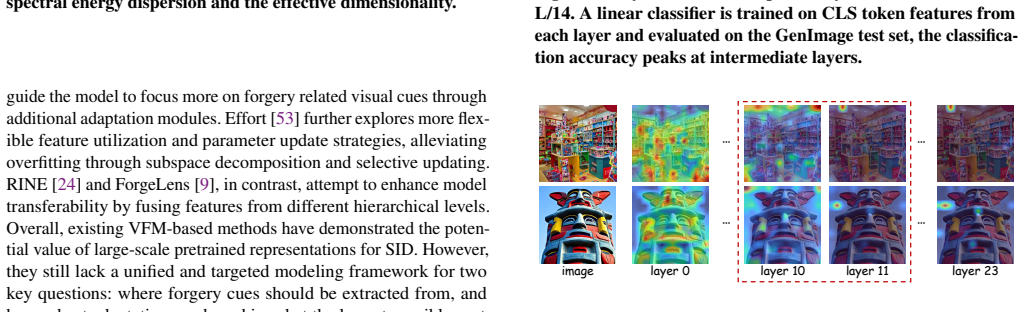
With the rapid development of generative models and multimodal content editing technologies, the key challenge faced by synthetic image detection (SID) lies in cross-distribution generalization to unknown generation sources. In recent years, visual foundation models (VFM), which acquire rich visual priors through large scale image-text alignment pretraining, have become a promising technical route for improving the generalization ability of SID. However, existing VFM-based methods remain relatively coarse-grained in their adaptation strategies. They typically either directly use the final layer representations of VFM or simply fuse multi layer features, lacking explicit modeling of the optimal representational hierarchy for transferable forgery cues. Meanwhile, although directly fine-tuning VFM can enhance task adaptation, it may also damage the cross-modal pretrained structure that supports open-set generalization. To address this task specific tension, we reformulate VFM adaptation for SID as a joint optimization problem: it is necessary both to identify the critical representational layer that is more suitable for carrying forgery discriminative information and to constrain the disturbance caused by task knowledge injection to the pretrained structure. Based on this, we propose I2P, an SID framework centered on intrinsic importance perception. I2P first adaptively identifies the critical layer representations that are most discriminative for SID, and then constrains task-driven parameter updates within a low sensitivity parameter subspace, thereby improving task specificity while preserving the transferable structure of pretrained representations as much as possible.
Editorial analysis
A structured set of objections, weighed in public.
Referee Report
Summary. The manuscript proposes I2P, an SID framework for adapting visual foundation models (VFMs) to synthetic image detection. It reformulates the adaptation task as a joint optimization problem: adaptively identifying critical layer representations most discriminative for forgery cues via intrinsic importance perception, while constraining task-driven parameter updates to a low-sensitivity subspace to preserve cross-modal pretrained structure and improve generalization to unknown generators.
Significance. If empirically validated, the approach could offer a more targeted alternative to existing coarse VFM adaptation strategies (final-layer use or simple multi-layer fusion) and direct fine-tuning, by explicitly addressing the tension between task specificity and retention of transferable features. This framing of SID adaptation as joint layer selection plus subspace constraint is conceptually coherent and relevant to open-set forensic detection challenges.
major comments (2)
- [Abstract] Abstract: The headline claim that I2P 'adaptively identifies the critical layer representations that are most discriminative for SID' rests on the unverified existence of an optimal representational hierarchy for transferable forgery cues. No derivation, bound, or preliminary analysis is supplied showing that the intrinsic importance perception metric recovers such a hierarchy rather than fitting training-domain artifacts; this is load-bearing for the cross-distribution generalization argument.
- [Abstract] Abstract: The second pillar—that constraining updates 'within a low sensitivity parameter subspace' preserves the transferable pretrained structure 'as much as possible'—is asserted without any sensitivity analysis, ablation, or proof that the masking avoids damaging the very cross-modal features enabling open-set transfer. This directly undermines the claimed advantage over direct fine-tuning.
minor comments (1)
- [Abstract] Abstract: The phrase 'intrinsic importance perception' is introduced without a concise mathematical definition or pointer to the precise importance metric used; this notation should be clarified early.
Simulated Author's Rebuttal
We thank the referee for the constructive review and for acknowledging the conceptual relevance of framing SID adaptation as joint layer selection and subspace constraint. We address each major comment below and will revise the manuscript accordingly to strengthen the supporting analyses.
read point-by-point responses
-
Referee: [Abstract] Abstract: The headline claim that I2P 'adaptively identifies the critical layer representations that are most discriminative for SID' rests on the unverified existence of an optimal representational hierarchy for transferable forgery cues. No derivation, bound, or preliminary analysis is supplied showing that the intrinsic importance perception metric recovers such a hierarchy rather than fitting training-domain artifacts; this is load-bearing for the cross-distribution generalization argument.
Authors: We agree that the abstract claim would benefit from explicit supporting analysis. While the manuscript presents empirical evidence of improved cross-generator performance, it does not include a dedicated preliminary study of the importance metric. In the revised version we will add a new subsection (or appendix) that reports layer-wise importance scores on held-out generators, quantifies correlation with forgery discriminability, and provides ablations comparing the selected layers against random, final-layer, and multi-layer baselines. This will help verify that the metric captures transferable cues rather than training-domain artifacts. revision: yes
-
Referee: [Abstract] Abstract: The second pillar—that constraining updates 'within a low sensitivity parameter subspace' preserves the transferable pretrained structure 'as much as possible'—is asserted without any sensitivity analysis, ablation, or proof that the masking avoids damaging the very cross-modal features enabling open-set transfer. This directly undermines the claimed advantage over direct fine-tuning.
Authors: We concur that the abstract would be strengthened by direct evidence on this point. The current manuscript contains comparative results against direct fine-tuning, but lacks a targeted sensitivity analysis of the masked subspace. We will add an ablation in the revision that measures the impact of subspace-constrained updates on pretrained feature stability (e.g., via cosine similarity or transfer performance on auxiliary tasks) relative to full fine-tuning. This will provide concrete support for the preservation claim. revision: yes
Circularity Check
No significant circularity; proposal is a heuristic reformulation without self-referential reduction
full rationale
The paper's abstract and description contain no equations, derivations, or first-principles results that reduce to inputs by construction. It reformulates SID adaptation as identifying critical layers via intrinsic importance perception and constraining updates to a low-sensitivity subspace, but presents this as a proposed framework (I2P) rather than a derived prediction. No self-citations, fitted parameters renamed as predictions, or ansatzes smuggled via prior work are evident. The central claim rests on the existence of an identifiable optimal hierarchy, which is an assumption rather than a tautological output. This matches the default expectation of non-circularity for methodological proposals without load-bearing self-referential steps.
Axiom & Free-Parameter Ledger
Reference graph
Works this paper leans on
-
[1]
Midjourney
2022. Midjourney. https://www.midjourney.com/home/
2022
-
[2]
2022. Wukong. https://xihe.mindspore.cn/modelzoo/wukong
2022
-
[3]
Muhammad Awais, Muzammal Naseer, Salman Khan, Rao Muhammad Anwer, Hisham Cholakkal, Mubarak Shah, Ming-Hsuan Yang, and Fahad Shahbaz Khan
-
[4]
Foundation models defining a new era in vision: a survey and outlook.IEEE Transactions on Pattern Analysis and Machine Intelligence(2025)
2025
-
[5]
black forest labs. 2024. FLUX.1: A new era of creation. https://blackforestlabs.ai/
2024
-
[6]
Daniel Bolya, Po-Yao Huang, Peize Sun, Jang Hyun Cho, Andrea Madotto, Chen Wei, Tengyu Ma, Jiale Zhi, Jathushan Rajasegaran, Hanoona Rasheed, et al. 2025. Perception encoder: The best visual embeddings are not at the output of the network.arXiv preprint arXiv:2504.13181(2025)
work page internal anchor Pith review arXiv 2025
-
[7]
Andrew Brock, Jeff Donahue, and Karen Simonyan. 2018. Large scale GAN training for high fidelity natural image synthesis.arXiv preprint arXiv:1809.11096 (2018)
work page internal anchor Pith review arXiv 2018
-
[8]
Yihan Cao, Siyu Li, Yixin Liu, Zhiling Yan, Yutong Dai, Philip Yu, and Lichao Sun. 2025. A survey of ai-generated content (aigc).Comput. Surveys57, 5 (2025), 1–38
2025
- [9]
- [10]
-
[11]
Siyuan Cheng, Lingjuan Lyu, Zhenting Wang, Xiangyu Zhang, and Vikash Sehwag
-
[12]
InProceedings of the Computer Vision and Pattern Recognition Conference
CO-SPY: Combining Semantic and Pixel Features to Detect Synthetic Images by AI. InProceedings of the Computer Vision and Pattern Recognition Conference. 13455–13465
-
[13]
Yunjey Choi, Minje Choi, Munyoung Kim, Jung-Woo Ha, Sunghun Kim, and Jaegul Choo. 2018. Stargan: Unified generative adversarial networks for multi- domain image-to-image translation. InProceedings of the IEEE conference on computer vision and pattern recognition. 8789–8797
2018
- [14]
-
[15]
Prafulla Dhariwal and Alexander Nichol. 2021. Diffusion models beat gans on image synthesis.Advances in neural information processing systems34 (2021), 8780–8794
2021
-
[16]
Elias Frantar and Dan Alistarh. 2023. Sparsegpt: Massive language models can be accurately pruned in one-shot. InInternational conference on machine learning. PMLR, 10323–10337
2023
-
[17]
Shuyang Gu, Dong Chen, Jianmin Bao, Fang Wen, Bo Zhang, Dongdong Chen, Lu Yuan, and Baining Guo. 2022. Vector quantized diffusion model for text-to-image synthesis. InProceedings of the IEEE/CVF conference on computer vision and pattern recognition. 10696–10706
2022
- [18]
-
[19]
Babak Hassibi, David G Stork, and Gregory J Wolff. 1993. Optimal brain surgeon and general network pruning. InIEEE international conference on neural networks. IEEE, 293–299
1993
-
[20]
Jonathan Ho, Ajay Jain, and Pieter Abbeel. 2020. Denoising diffusion probabilistic models.Advances in neural information processing systems33 (2020), 6840– 6851
2020
- [21]
-
[22]
Dimitrios Karageorgiou, Symeon Papadopoulos, Ioannis Kompatsiaris, and Ef- stratios Gavves. 2025. Any-resolution ai-generated image detection by spectral learning. InProceedings of the Computer Vision and Pattern Recognition Confer- ence. 18706–18717
2025
-
[23]
Tero Karras, Timo Aila, Samuli Laine, and Jaakko Lehtinen. 2017. Progressive growing of gans for improved quality, stability, and variation.arXiv preprint arXiv:1710.10196(2017)
work page internal anchor Pith review arXiv 2017
-
[24]
Tero Karras, Samuli Laine, and Timo Aila. 2019. A style-based generator ar- chitecture for generative adversarial networks. InProceedings of the IEEE/CVF conference on computer vision and pattern recognition. 4401–4410
2019
-
[25]
Tero Karras, Samuli Laine, Miika Aittala, Janne Hellsten, Jaakko Lehtinen, and Timo Aila. 2020. Analyzing and improving the image quality of stylegan. InPro- ceedings of the IEEE/CVF conference on computer vision and pattern recognition. 8110–8119
2020
-
[26]
Christos Koutlis and Symeon Papadopoulos. 2024. Leveraging representations from intermediate encoder-blocks for synthetic image detection. InEuropean Conference on Computer Vision. Springer, 394–411
2024
- [27]
-
[28]
Ouxiang Li, Jiayin Cai, Yanbin Hao, Xiaolong Jiang, Yao Hu, and Fuli Feng
-
[29]
InProceedings of the 31st ACM SIGKDD Conference on Knowledge Discovery and Data Mining V
Improving synthetic image detection towards generalization: An image transformation perspective. InProceedings of the 31st ACM SIGKDD Conference on Knowledge Discovery and Data Mining V . 1. 2405–2414
- [30]
-
[31]
Huan Liu, Zichang Tan, Chuangchuang Tan, Yunchao Wei, Jingdong Wang, and Yao Zhao. 2024. Forgery-aware adaptive transformer for generalizable synthetic image detection. InProceedings of the IEEE/CVF Conference on Computer Vision and Pattern Recognition. 10770–10780
2024
- [32]
-
[33]
Hengrui Lou, Zunlei Feng, Jinsong Geng, Erteng Liu, Jie Lei, Lechao Cheng, Jie Song, Mingli Song, and Yijun Bei. 2025. STD-FD: Spatio-Temporal Distribution Fitting Deviation for AIGC Forgery Identification. InForty-second International Conference on Machine Learning
2025
-
[34]
Yunpeng Luo, Junlong Du, Ke Yan, and Shouhong Ding. 2024. LaREˆ 2: La- tent reconstruction error based method for diffusion-generated image detection. InProceedings of the IEEE/CVF Conference on Computer Vision and Pattern Recognition. 17006–17015
2024
-
[35]
Wenpeng Mu, Zheng Li, Qiang Xu, Xinghao Jiang, and Tanfeng Sun. 2025. ExDA: Towards Universal Detection and Plug-and-Play Attribution of AI-Generated Ex- Regulatory Images. InProceedings of the 33rd ACM International Conference on Multimedia. 11512–11521
2025
-
[36]
Alex Nichol, Prafulla Dhariwal, Aditya Ramesh, Pranav Shyam, Pamela Mishkin, Bob McGrew, Ilya Sutskever, and Mark Chen. 2021. Glide: Towards photorealistic image generation and editing with text-guided diffusion models.arXiv preprint arXiv:2112.10741(2021)
work page internal anchor Pith review arXiv 2021
-
[37]
Alexander Quinn Nichol and Prafulla Dhariwal. 2021. Improved denoising dif- fusion probabilistic models. InInternational conference on machine learning. PMLR, 8162–8171
2021
-
[38]
Utkarsh Ojha, Yuheng Li, and Yong Jae Lee. 2023. Towards universal fake image detectors that generalize across generative models. InProceedings of the IEEE/CVF Conference on Computer Vision and Pattern Recognition. 24480– 24489
2023
-
[39]
Taesung Park, Ming-Yu Liu, Ting-Chun Wang, and Jun-Yan Zhu. 2019. Semantic image synthesis with spatially-adaptive normalization. InProceedings of the IEEE/CVF conference on computer vision and pattern recognition. 2337–2346
2019
-
[40]
Alan Perotti, Marco Nurisso, and Mirko Zaffaroni. 2025. No Detector to Rule Them All. InProceedings of the 1st on Deepfake Forensics Workshop: Detection, Attribution, Recognition, and Adversarial Challenges in the Era of AI-Generated Media. 65–72
2025
-
[41]
Alec Radford, Jong Wook Kim, Chris Hallacy, Aditya Ramesh, Gabriel Goh, Sandhini Agarwal, Girish Sastry, Amanda Askell, Pamela Mishkin, Jack Clark, et al. 2021. Learning transferable visual models from natural language supervision. InInternational conference on machine learning. PmLR, 8748–8763
2021
-
[42]
Aditya Ramesh, Mikhail Pavlov, Gabriel Goh, Scott Gray, Chelsea V oss, Alec Radford, Mark Chen, and Ilya Sutskever. 2021. Zero-shot text-to-image generation. InInternational conference on machine learning. Pmlr, 8821–8831
2021
-
[43]
Robin Rombach, Andreas Blattmann, Dominik Lorenz, Patrick Esser, and Björn Ommer. 2022. High-resolution image synthesis with latent diffusion models. InProceedings of the IEEE/CVF conference on computer vision and pattern recognition. 10684–10695
2022
-
[44]
Olivier Roy and Martin Vetterli. 2007. The effective rank: A measure of effective dimensionality. In2007 15th European signal processing conference. IEEE, 606– 610
2007
-
[45]
Oriane Siméoni, Huy V V o, Maximilian Seitzer, Federico Baldassarre, Maxime Oquab, Cijo Jose, Vasil Khalidov, Marc Szafraniec, Seungeun Yi, Michaël Rama- monjisoa, et al. 2025. Dinov3.arXiv preprint arXiv:2508.10104(2025)
work page internal anchor Pith review Pith/arXiv arXiv 2025
- [46]
-
[47]
Chuangchuang Tan, Yao Zhao, Shikui Wei, Guanghua Gu, Ping Liu, and Yunchao Wei. 2024. Frequency-aware deepfake detection: Improving generalizability through frequency space domain learning. InProceedings of the AAAI Conference on Artificial Intelligence, V ol. 38. 5052–5060
2024
-
[48]
Chuangchuang Tan, Yao Zhao, Shikui Wei, Guanghua Gu, Ping Liu, and Yunchao Wei. 2024. Rethinking the up-sampling operations in cnn-based generative network for generalizable deepfake detection. InProceedings of the IEEE/CVF Conference on Computer Vision and Pattern Recognition. 28130–28139
2024
-
[49]
Chuangchuang Tan, Yao Zhao, Shikui Wei, Guanghua Gu, and Yunchao Wei. 2023. Learning on gradients: Generalized artifacts representation for gan-generated images detection. InProceedings of the IEEE/CVF Conference on Computer Vision and Pattern Recognition. 12105–12114
2023
-
[50]
Naftali Tishby, Fernando C Pereira, and William Bialek. 2000. The information bottleneck method.arXiv preprint physics/0004057(2000). MM ’26, November 10-14, 2026, Rio de Janeiro, Brazil Y ang et al
work page Pith review arXiv 2000
-
[51]
Michael Tschannen, Alexey Gritsenko, Xiao Wang, Muhammad Ferjad Naeem, Ibrahim Alabdulmohsin, Nikhil Parthasarathy, Talfan Evans, Lucas Beyer, Ye Xia, Basil Mustafa, Olivier Hénaff, Jeremiah Harmsen, Andreas Steiner, and Xiaohua Zhai. 2025. SigLIP 2: Multilingual Vision-Language Encoders with Improved Semantic Understanding, Localization, and Dense Featur...
work page internal anchor Pith review arXiv 2025
-
[52]
Jiarui Wang, Huiyu Duan, Juntong Wang, Ziheng Jia, Woo Yi Yang, Xiaorong Zhu, Yu Zhao, Jiaying Qian, Yuke Xing, Guangtao Zhai, et al. 2025. Dfbench: Benchmarking deepfake image detection capability of large multimodal models. InProceedings of the 33rd ACM International Conference on Multimedia. 12666– 12673
2025
-
[53]
Sheng-Yu Wang, Oliver Wang, Richard Zhang, Andrew Owens, and Alexei A Efros. 2020. CNN-generated images are surprisingly easy to spot... for now. InProceedings of the IEEE/CVF conference on computer vision and pattern recognition. 8695–8704
2020
-
[54]
Zhendong Wang, Jianmin Bao, Wengang Zhou, Weilun Wang, Hezhen Hu, Hong Chen, and Houqiang Li. 2023. Dire for diffusion-generated image detection. InProceedings of the IEEE/CVF International Conference on Computer Vision. 22445–22455
2023
- [55]
- [56]
-
[57]
Haifeng Zhang, Qinghui He, Xiuli Bi, Weisheng Li, Bo Liu, and Bin Xiao. 2025. Towards Universal AI-Generated Image Detection by Variational Information Bot- tleneck Network. InProceedings of the Computer Vision and Pattern Recognition Conference. 23828–23837
2025
-
[58]
Jiehua Zhang, Liang Li, Chenggang Yan, Wei Ke, and Yihong Gong. 2025. Frequency-aware Correlation Discovering and Spatial Forgery Clue Distilling for Synthetic Image Detection. InProceedings of the 33rd ACM International Conference on Multimedia. 11726–11735
2025
- [59]
- [60]
-
[61]
Jun-Yan Zhu, Taesung Park, Phillip Isola, and Alexei A Efros. 2017. Unpaired image-to-image translation using cycle-consistent adversarial networks. InPro- ceedings of the IEEE international conference on computer vision. 2223–2232
2017
-
[62]
Mingjian Zhu, Hanting Chen, Qiangyu Yan, Xudong Huang, Guanyu Lin, Wei Li, Zhijun Tu, Hailin Hu, Jie Hu, and Yunhe Wang. 2023. Genimage: A million-scale benchmark for detecting ai-generated image.Advances in Neural Information Processing Systems36 (2023), 77771–77782. Received 20 February 2007; revised 12 March 2009; accepted 5 June 2009
2023
discussion (0)
Sign in with ORCID, Apple, or X to comment. Anyone can read and Pith papers without signing in.