Recognition: unknown
On the Energy Dissipation in the Landau-Lifshitz-Gilbert Equation
Pith reviewed 2026-05-10 06:47 UTC · model grok-4.3
The pith
The quality factor of ferromagnetic resonance deviates from the standard 1/2α approximation near bifurcation points in the magnetic energy landscape.
A machine-rendered reading of the paper's core claim, the machinery that carries it, and where it could break.
Core claim
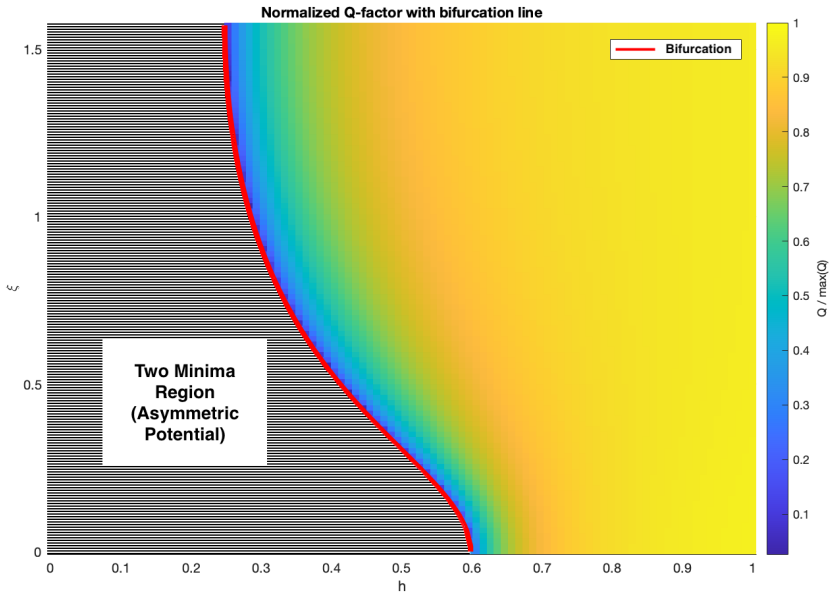
Near bifurcation points where the number of metastable energy minima changes, the FMR decay time in the LLG dynamics deviates from the commonly used approximation Q ≃ 1/2α because the local curvature around the free-energy minimum no longer supports the standard relation between frequency and damping.
What carries the argument
The local curvature of the free-energy minimum around stable equilibria, which sets the effective FMR frequency and damping constant in the small-angle precession regime.
If this is right
- The FMR frequency is set by the eigenvalues of the curvature at the energy minimum.
- Effective damping and thus resonance lifetime vary continuously with the curvature parameters.
- The simple Q ≃ 1/2α relation holds only away from points where the number of minima changes.
- Decay time measurements can reveal changes in the global energy landscape topology through local dynamics.
Where Pith is reading between the lines
- Device designs that operate close to bifurcations may achieve tunable effective damping without changing material properties.
- Numerical integration of the LLG equation in specific geometries could test whether decay-time anomalies appear at predicted bifurcation fields.
Load-bearing premise
The analysis assumes small-angle precession remains valid near a stable equilibrium and that the local curvature of the free-energy minimum can be treated independently of global landscape features or higher-order damping terms.
What would settle it
Direct measurement of FMR decay time in a nanomagnet while sweeping an applied field across a known bifurcation point that merges two metastable minima, checking whether the observed decay matches or deviates from the 1/2α prediction.
Figures


read the original abstract
The dynamics of magnetization near a stable equilibrium in ferromagnetic nanomagnets are examined within the Landau--Lifshitz--Gilbert (LLG) framework. For a small angle precession, the dependence of ferromagnetic resonance (FMR) frequency, the damping constant and the resulting quality factor $Q$ of the resonance on the local curvature around the free-energy minimum is systematically analyzed. Special attention is devoted to the behavior of the FMR decay time in the vicinity of bifurcation points, where the number of metastable energy minima changes and the commonly used approximation for the quality factor $Q\simeq 1/2\alpha$ (where $\alpha$ denotes the Gilbert damping) fails.
Editorial analysis
A structured set of objections, weighed in public.
Referee Report
Summary. The manuscript examines magnetization dynamics near stable equilibria in ferromagnetic nanomagnets within the Landau-Lifshitz-Gilbert (LLG) framework. For small-angle precession, it systematically analyzes the dependence of ferromagnetic resonance (FMR) frequency, effective damping constant, and quality factor Q on the local curvature of the free-energy minimum. Special attention is given to FMR decay times near bifurcation points, where the number of metastable energy minima changes and the standard approximation Q ≃ 1/2α fails.
Significance. If the derivations hold, the work would usefully highlight limitations of the common Q ≃ 1/2α approximation in regimes where local curvature vanishes, with potential relevance to resonance behavior in nanomagnetic devices near critical points. The focus on bifurcation vicinities addresses a practically important regime, though the absence of explicit derivations, error bounds, or validation in the abstract limits immediate assessment of impact.
major comments (2)
- [Abstract and vicinity-of-bifurcation analysis] Abstract and analysis of small-angle precession: The conclusion that Q ≃ 1/2α fails near bifurcation points rests on linearization of LLG around the free-energy minimum via the local Hessian. As the smallest Hessian eigenvalue approaches zero at the bifurcation, the quadratic approximation's validity range collapses proportionally to the distance to criticality; quartic or higher-order terms in the energy expansion then enter at leading order for any finite precession amplitude. This directly affects the claimed FMR decay-time behavior and requires a scaling analysis or explicit inclusion of nonlinear corrections to substantiate the breakdown.
- [Abstract] Abstract: No derivations, error estimates, or numerical checks are supplied for the expressions relating FMR frequency, damping, and Q to local curvature. This absence prevents evaluation of whether the reported failure of Q ≃ 1/2α is rigorously derived or merely asserted, undermining in the central claim.
minor comments (1)
- [Notation and definitions] Clarify the precise definition of the effective damping constant extracted from the linearized LLG and its relation to the Gilbert parameter α in the curvature-dependent expressions.
Simulated Author's Rebuttal
We thank the referee for the careful reading and constructive comments, which have helped clarify points where the manuscript can be improved. We address each major comment below, providing the strongest honest defense of the work while acknowledging where additional analysis strengthens the presentation. We plan revisions accordingly.
read point-by-point responses
-
Referee: [Abstract and vicinity-of-bifurcation analysis] Abstract and analysis of small-angle precession: The conclusion that Q ≃ 1/2α fails near bifurcation points rests on linearization of LLG around the free-energy minimum via the local Hessian. As the smallest Hessian eigenvalue approaches zero at the bifurcation, the quadratic approximation's validity range collapses proportionally to the distance to criticality; quartic or higher-order terms in the energy expansion then enter at leading order for any finite precession amplitude. This directly affects the claimed FMR decay-time behavior and requires a scaling analysis or explicit inclusion of nonlinear corrections to substantiate the breakdown.
Authors: Our analysis is explicitly restricted to the small-angle precession regime, where the LLG equation is linearized about the energy minimum using the Hessian. Within this regime, the FMR frequency scales with the square root of the curvature eigenvalues and the effective damping acquires a curvature-dependent factor, yielding an explicit expression for Q that deviates from 1/(2α) as the smallest eigenvalue approaches zero. This deviation is a direct consequence of the linear dynamics and holds for amplitudes small enough that higher-order terms remain negligible. We agree, however, that the basin of validity for the linearization shrinks near the bifurcation. In the revised manuscript we will add a scaling analysis that quantifies the maximum precession amplitude (scaling as the square root of the distance to criticality) for which the linear results remain accurate, thereby confirming that the reported failure of Q ≃ 1/(2α) occurs inside the linear regime before nonlinear corrections dominate. revision: yes
-
Referee: [Abstract] Abstract: No derivations, error estimates, or numerical checks are supplied for the expressions relating FMR frequency, damping, and Q to local curvature. This absence prevents evaluation of whether the reported failure of Q ≃ 1/2α is rigorously derived or merely asserted, undermining in the central claim.
Authors: The explicit derivations of the FMR frequency, effective damping constant, and quality factor as functions of the Hessian eigenvalues are given in Sections II and III, obtained by linearizing the LLG equation about a stable equilibrium and solving the resulting eigenvalue problem. Error estimates follow from the small-angle assumption, with the neglected terms being O(θ³) where θ is the precession angle. While the abstract is a concise summary and conventionally omits full derivations, we will revise it to include a brief statement of the linearization procedure and the resulting curvature dependence. We will also add a short numerical validation subsection (or supplementary figure) comparing the analytic expressions to direct integration of the LLG equation for representative curvatures, including near the bifurcation. revision: partial
Circularity Check
No circularity: standard LLG linearization around energy minima
full rationale
The paper derives FMR frequency, effective damping, and Q directly from the LLG equation by linearizing small-angle precession around a local free-energy minimum using the Hessian curvature. The focus on bifurcation points where the lowest eigenvalue vanishes and Q ≃ 1/2α fails follows immediately from the same linearized equations as the curvature approaches zero; this is an explicit breakdown of the approximation rather than a redefinition or fitted input. No self-citations, ansatzes, or uniqueness theorems are invoked as load-bearing steps in the abstract or described chain. The analysis remains self-contained within the standard LLG framework and local quadratic approximation without reducing any claimed result to its own inputs by construction.
Axiom & Free-Parameter Ledger
Reference graph
Works this paper leans on
-
[1]
Farle, M., ``Ferromagnetic resonance of ultrathin metallic layers,'' Reports on progress in physics 61 (7), 755 (1998)
1998
-
[2]
Landau, L. D. and Lifshitz, L. M., ``On the theory of the dispersion of magnetic permeability in ferromagnetic bodies,'' Physik. Zeits. Sowjetunion 8 , 153--169 (1935)
1935
-
[3]
Lakshmanan, M., ``The fascinating world of the landau--lifshitz--gilbert equation: an overview,'' Philosophical Transactions of the Royal Society A: Mathematical, Physical and Engineering Sciences 369 (1939), 1280--1300 (2011)
1939
-
[4]
Salikhov, R., Alekhin, A., Parpiiev, T., Pezeril, T., Makarov, D., Abrudan, R., Meckenstock, R., Radu, F., Farle, M., Zabel, H., et al., ``Gilbert damping in nifegd compounds: Ferromagnetic resonance versus time-resolved spectroscopy,'' Physical Review B 99 (10), 104412 (2019)
2019
-
[5]
V., Vlasov, V
Besse, V., Golov, A. V., Vlasov, V. S., Alekhin, A., Kuzmin, D., Bychkov, I. V., Kotov, L. N., and Temnov, V. V., ``Generation of exchange magnons in thin ferromagnetic films by ultrashort acoustic pulses,'' J. Magn. Magn. Mater. 502 , 166320 (2020)
2020
-
[6]
M., Kim, J., Kovalenko, O., Vavassori, P., and Temnov, V
Ghita, A., Mocioi, T.-G., Lomonosov, A. M., Kim, J., Kovalenko, O., Vavassori, P., and Temnov, V. V., ``Anatomy of ultrafast quantitative magnetoacoustics in freestanding nickel thin films,'' Physical Review B 107 (13), 134419 (2023)
2023
-
[7]
Gurevich, A. G. and Melkov, G. A., [ Magnetization oscillations and waves 0.1em ] , CRC press (2020)
2020
-
[8]
M., Leo, N., Ludwig, M., Vlasov, V
Alekhin, A., Lomonosov, A. M., Leo, N., Ludwig, M., Vlasov, V. S., Kotov, L., Leitenstorfer, A., Gaal, P., Vavassori, P., and Temnov, V., ``Quantitative ultrafast magnetoacoustics at magnetic metasurfaces,'' Nano Letters 23 (20), 9295--9302 (2023)
2023
-
[9]
A., ``Demagnetizing factors of the general ellipsoid,'' Phys
Osborn, J. A., ``Demagnetizing factors of the general ellipsoid,'' Phys. Rev. 67 (11 and 12), 351 (1945)
1945
-
[10]
F., Pla, O., and Chubykalo, O., ``Quasiperiodicity, bistability, and chaos in the landau-lifshitz equation,'' Physical Review B 61 (17), 11613 (2000)
Alvarez, L. F., Pla, O., and Chubykalo, O., ``Quasiperiodicity, bistability, and chaos in the landau-lifshitz equation,'' Physical Review B 61 (17), 11613 (2000)
2000
-
[11]
write newline
" write newline "" before.all 'output.state := FUNCTION blank.sep after.quote 'output.state := FUNCTION fin.entry output.state after.quoted.block = 'skip 'add.period if write newline FUNCTION new.block output.state before.all = 'skip output.state after.quote = after.quoted.block 'output.state := after.block 'output.state := if if FUNCTION new.sentence out...
discussion (0)
Sign in with ORCID, Apple, or X to comment. Anyone can read and Pith papers without signing in.