Intelligent Drill-Down: Large Language Model-Driven Drill-Down Technique for Human-AI Collaborative Visual Exploration
Pith reviewed 2026-05-10 06:34 UTC · model grok-4.3
The pith
Large language models recommend drill-down paths in visual analytics by being trained to approximate a validated greedy algorithm.
A machine-rendered reading of the paper's core claim, the machinery that carries it, and where it could break.
Core claim
In the Intelligent Drill-Down Framework a large language model is used to generate visual insights, interpret user intent from interaction data, and produce suitable drill-down paths. The key technique trains the LLM to approximate a validated greedy algorithm for path recommendation. Additional components construct charts that reflect detected user intent and maintain a set of parallel exploration branches. These elements are realized in a hybrid interface that offers hierarchical navigation, a visualization panel for direct data interaction, and an insight panel that displays analytical results together with the generated recommendations. Effectiveness is illustrated through a concrete use
What carries the argument
The LLM-based drill-down path recommendation method, which is trained to approximate a validated greedy algorithm while also incorporating user-interaction data to infer intent and manage parallel branches.
Load-bearing premise
An LLM trained to approximate the greedy algorithm will reliably generate appropriate drill-down paths that match user intent and produce higher-value insights in real multidimensional data.
What would settle it
A side-by-side comparison on held-out multidimensional datasets in which the LLM-generated paths are measured against the paths the original greedy algorithm would have chosen, or a user study in which insight quality and task completion time show no reliable improvement over a non-LLM baseline interface.
Figures



read the original abstract
In visual analytics, applying filters to drill-down and extract higher-value insights is a common and important data analysis method. When the drill-down space becomes excessively large, analysts may lose orientation, leading to decreased efficiency in the drill-down process. To tackle these challenges, we propose the Intelligent Drill-Down Framework, in which a large language model (LLM) facilitates the generation of visual insights, leverages user interaction data to interpret user intent, and generates appropriate drill-down paths. Our method is designed to assist users in identifying valuable drill-down paths when exploring multidimensional data, thereby reducing the cognitive burden of data interpretation and facilitating the generation of insights. Specifically, we propose a drill-down path recommendation method, in which the LLM is trained to approximate a validated greedy algorithm. Secondly, we analyze the user's intent to construct a drill-down chart. Finally, we design a branch management method. Building upon this framework, we designed a system that includes a hybrid interface providing hierarchical navigation to monitor users and manage parallel branches, a visualization panel for interactive data exploration, and an insight panel to present analytical findings and generate drill-down recommendations. We evaluated the effectiveness of our method through a demonstrative use case and a user study.
Editorial analysis
A structured set of objections, weighed in public.
Referee Report
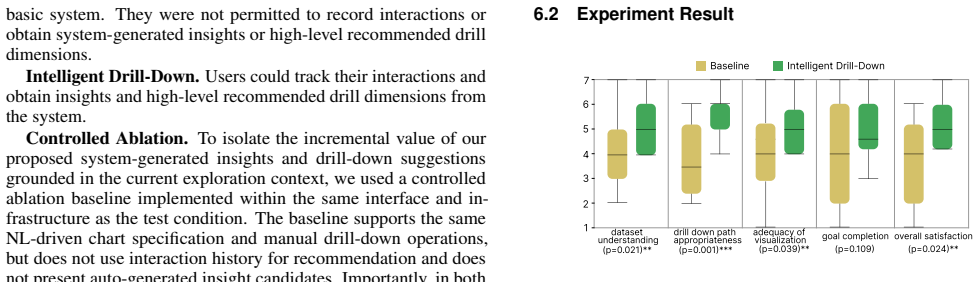
Summary. The manuscript presents the Intelligent Drill-Down Framework for human-AI collaborative visual exploration of multidimensional data. It uses a large language model trained via supervised fine-tuning to approximate a validated greedy algorithm for recommending drill-down paths, while also analyzing user intent to construct charts and managing exploration branches. The system includes a hybrid interface with hierarchical navigation, a visualization panel, and an insight panel. Evaluation consists of a demonstrative use case and a within-subjects user study with 12 participants that reports reduced task completion times and higher self-reported insight quality compared to unaided exploration.
Significance. If the central claims hold, this work offers a practical method to mitigate disorientation in large drill-down spaces, enhancing efficiency and insight generation in visual analytics. The explicit training of the LLM to mimic a greedy baseline, achieving over 85% path agreement on held-out synthetic cubes, provides a solid foundation. The inclusion of a user study adds empirical support for improved human-AI collaboration. This could influence the design of future intelligent visual exploration tools.
major comments (1)
- [User study section] User study section: The within-subjects study with n=12 reports reduced task time and higher self-reported insight quality, but provides no statistical significance tests, effect sizes, or breakdown of quantitative metrics (e.g., exact time savings or insight counts). This makes it difficult to assess whether the results robustly support the claim that the LLM-driven paths yield higher-value insights than unaided exploration.
minor comments (2)
- [Abstract] The abstract mentions the user study and use case but omits key quantitative findings such as the >85% path-agreement rate; adding these would improve the summary of contributions.
- [Method description] The description of the supervised fine-tuning procedure (greedy paths augmented with interaction logs) would benefit from explicit details on training set size and validation splits to support reproducibility.
Simulated Author's Rebuttal
We thank the referee for the constructive feedback and the recommendation of minor revision. We agree that the user study section would benefit from additional statistical details to strengthen the claims, and we will incorporate these in the revised manuscript.
read point-by-point responses
-
Referee: [User study section] User study section: The within-subjects study with n=12 reports reduced task time and higher self-reported insight quality, but provides no statistical significance tests, effect sizes, or breakdown of quantitative metrics (e.g., exact time savings or insight counts). This makes it difficult to assess whether the results robustly support the claim that the LLM-driven paths yield higher-value insights than unaided exploration.
Authors: We acknowledge this limitation in the current draft. The manuscript reports aggregate observations of reduced task completion times and higher self-reported insight quality, but does not include inferential statistics. In the revision, we will add: (1) appropriate statistical tests (e.g., paired t-tests or Wilcoxon signed-rank tests given the within-subjects design and small n), (2) effect sizes (Cohen's d or rank-biserial correlation), (3) descriptive breakdowns including means, standard deviations, exact time savings per participant or condition, and counts of insights generated. These additions will allow readers to evaluate the robustness of the results more rigorously. We note that n=12 is modest and the study is primarily demonstrative, but the requested quantitative details are feasible to include from the collected data. revision: yes
Circularity Check
No significant circularity detected
full rationale
The paper's core proposal is a system design in which an LLM is trained via supervised fine-tuning to approximate a separately validated greedy algorithm for drill-down path recommendation. This approximation is then embedded in a hybrid interface and evaluated via path-agreement metrics on held-out data plus a within-subjects user study. No equations, definitions, or self-citations reduce the claimed performance gains to a fitted parameter, a self-referential loop, or an unverified uniqueness theorem imported from the authors' prior work. The derivation chain remains self-contained against external benchmarks (the greedy baseline and user-study outcomes) and does not collapse any prediction back into its own training inputs by construction.
Axiom & Free-Parameter Ledger
axioms (2)
- domain assumption LLMs can be trained to approximate a validated greedy algorithm for drill-down path recommendation
- domain assumption User interaction data can be used by the LLM to accurately interpret intent for constructing drill-down charts
Reference graph
Works this paper leans on
- [1]
-
[2]
J. Achiam, S. Adler, S. Agarwal, L. Ahmad, I. Akkaya, F. L. Aleman, D. Almeida, J. Altenschmidt, S. Altman, S. Anadkat, et al. Gpt-4 technical report.arXiv preprint arXiv:2303.08774, 2023
work page internal anchor Pith review Pith/arXiv arXiv 2023
-
[3]
P. A. Boncz, T. Rühl, and F. Kwakkel. The drill down benchmark. In VLDB, pp. 628–632, 1998
work page 1998
-
[4]
M. Brehmer and T. Munzner. A multi-level typology of abstract vi- sualization tasks.IEEE transactions on visualization and computer graphics, 19(12):2376–2385, 2013
work page 2013
- [5]
-
[6]
S. Chaudhuri and U. Dayal. An overview of data warehousing and olap technology.ACM Sigmod record, 26(1):65–74, 1997
work page 1997
-
[7]
W. S. Cleveland and R. McGill. Graphical perception: Theory, ex- perimentation, and application to the development of graphical meth- ods.Journal of the American statistical association, 79(387):531–554, 1984
work page 1984
-
[8]
N. Conklin, S. Prabhakar, and C. North. Multiple foci drill-down through tuple and attribute aggregation polyarchies in tabular data. In IEEE Symposium on Information Visualization, 2002. INFOVIS 2002., pp. 131–134. IEEE, 2002
work page 2002
-
[9]
Ç. Demiralp, P. J. Haas, S. Parthasarathy, and T. Pedapati. Foresight: Recommending visual insights.arXiv preprint arXiv:1707.03877, 2017
-
[10]
M. Derthick and S. F. Roth. Data exploration across temporal contexts. InProceedings of the 5th international conference on Intelligent user interfaces, pp. 60–67, 2000
work page 2000
- [11]
-
[12]
E. Dimara and C. Perin. What is interaction for data visualization? IEEE transactions on visualization and computer graphics, 26(1):119– 129, 2019
work page 2019
-
[13]
N. Elmqvist and J.-D. Fekete. Hierarchical aggregation for information visualization: Overview, techniques, and design guidelines.IEEE transactions on visualization and computer graphics, 16(3):439–454, 2009
work page 2009
- [14]
-
[15]
A. Favero, L. Zancato, M. Trager, S. Choudhary, P. Perera, A. Achille, A. Swaminathan, and S. Soatto. Multi-modal hallucination control by visual information grounding. InProceedings of the IEEE/CVF Conference on Computer Vision and Pattern Recognition, pp. 14303– 14312, 2024
work page 2024
- [16]
- [17]
-
[18]
L. Gao, A. Madaan, S. Zhou, U. Alon, P. Liu, Y . Yang, J. Callan, and G. Neubig. Pal: Program-aided language models. InInternational Conference on Machine Learning, pp. 10764–10799. PMLR, 2023
work page 2023
-
[19]
T. Gao, M. Dontcheva, E. Adar, Z. Liu, and K. G. Karahalios. Data- tone: Managing ambiguity in natural language interfaces for data visualization. InProceedings of the 28th annual acm symposium on user interface software & technology, pp. 489–500, 2015
work page 2015
-
[20]
D. Gotz and M. X. Zhou. Characterizing users’ visual analytic activity for insight provenance.Information Visualization, 8(1):42–55, 2009
work page 2009
-
[21]
J. P. Hansen, A. S. Johansen, D. W. Hansen, K. Itoh, and S. Mashino. Command without a click: Dwell time typing by mouse and gaze selections. In10th International Conference on Human-Computer Interaction, pp. 121–128. IOS Press, 2003
work page 2003
-
[22]
J. Heer, J. Mackinlay, C. Stolte, and M. Agrawala. Graphical histories for visualization: Supporting analysis, communication, and evaluation. IEEE transactions on visualization and computer graphics, 14(6):1189– 1196, 2008
work page 2008
- [23]
-
[24]
M. Joglekar, H. Garcia-Molina, and A. Parameswaran. Interactive data exploration with smart drill-down.IEEE Transactions on Knowledge and Data Engineering, 31(1):46–60, 2017
work page 2017
- [25]
-
[26]
H. Khosravi, S. Shabaninejad, A. Bakharia, S. Sadiq, M. Indulska, and D. Gasevic. Intelligent learning analytics dashboards: Automated drill- down recommendations to support teacher data exploration.Journal of Learning Analytics, 8(3):133–154, 2021
work page 2021
-
[27]
H. Lam. A framework of interaction costs in information visualization. IEEE transactions on visualization and computer graphics, 14(6):1149– 1156, 2008
work page 2008
- [28]
-
[29]
B. Lee, P. Isenberg, N. H. Riche, and S. Carpendale. Beyond mouse and keyboard: Expanding design considerations for information visual- ization interactions.IEEE Transactions on Visualization and Computer Graphics, 18(12):2689–2698, 2012
work page 2012
-
[30]
D. J.-L. Lee, H. Dev, H. Hu, H. Elmeleegy, and A. Parameswaran. Avoiding drill-down fallacies with vispilot: Assisted exploration of data subsets. InProceedings of the 24th International Conference on Intelligent User Interfaces, pp. 186–196, 2019
work page 2019
- [31]
- [32]
-
[33]
Y . Li, Y . Qi, Y . Shi, Q. Chen, N. Cao, and S. Chen. Diverse interaction recommendation for public users exploring multi-view visualization using deep learning.IEEE transactions on visualization and computer graphics, 29(1):95–105, 2022
work page 2022
-
[34]
L. Lins, J. T. Klosowski, and C. Scheidegger. Nanocubes for real- time exploration of spatiotemporal datasets.IEEE Transactions on Visualization and Computer Graphics, 19(12):2456–2465, 2013
work page 2013
-
[35]
C. Liu, L. Xie, Y . Han, D. Wei, and X. Yuan. Autocaption: An approach to generate natural language description from visualization automati- cally. In2020 IEEE Pacific visualization symposium (PacificVis), pp. 191–195. IEEE, 2020
work page 2020
-
[36]
R. Luo, L. Sun, Y . Xia, T. Qin, S. Zhang, H. Poon, and T.-Y . Liu. Biogpt: generative pre-trained transformer for biomedical text generation and mining.Briefings in bioinformatics, 23(6):bbac409, 2022
work page 2022
- [37]
-
[38]
P. Maddigan and T. Susnjak. Chat2vis: Generating data visualizations via natural language using chatgpt, codex and gpt-3 large language models.Ieee Access, 11:45181–45193, 2023
work page 2023
- [39]
- [40]
- [41]
-
[42]
T. Qiu, F. Wang, S. Huang, M. Guo, Y . Zhao, J. Li, and S. Chen. Smartmlvs: Llm-enabled multiple linked views generation for interac- tive visualization. In2025 IEEE 18th Pacific Visualization Conference (PacificVis), pp. 58–68. IEEE, 2025
work page 2025
-
[43]
E. D. Ragan, A. Endert, J. Sanyal, and J. Chen. Characterizing prove- nance in visualization and data analysis: an organizational framework of provenance types and purposes.IEEE transactions on visualization and computer graphics, 22(1):31–40, 2015
work page 2015
- [44]
-
[45]
S. Sarawagi, R. Agrawal, and N. Megiddo. Discovery-driven explo- ration of olap data cubes. InInternational Conference on Extending Database Technology, pp. 168–182. Springer, 1998
work page 1998
-
[46]
A. Satyanarayan, D. Moritz, K. Wongsuphasawat, and J. Heer. Vega- lite: A grammar of interactive graphics.IEEE transactions on visual- ization and computer graphics, 23(1):341–350, 2016
work page 2016
- [47]
-
[48]
J. Shanmugasundaram, U. Fayyad, and P. S. Bradley. Compressed data cubes for olap aggregate query approximation on continuous dimensions. InProceedings of the fifth ACM SIGKDD international conference on Knowledge discovery and data mining, pp. 223–232, 1999
work page 1999
-
[49]
B. Shneiderman. Human-centered artificial intelligence: Reliable, safe & trustworthy.International Journal of Human–Computer Interaction, 36(6):495–504, 2020
work page 2020
-
[50]
T. Siddiqui, A. Kim, J. Lee, K. Karahalios, and A. Parameswaran. Ef- fortless data exploration with zenvisage: an expressive and interactive visual analytics system.arXiv preprint arXiv:1604.03583, 2016
-
[51]
K. Singhal, T. Tu, J. Gottweis, R. Sayres, E. Wulczyn, M. Amin, L. Hou, K. Clark, S. R. Pfohl, H. Cole-Lewis, et al. Toward expert- level medical question answering with large language models.Nature Medicine, 31(3):943–950, 2025
work page 2025
- [52]
-
[53]
F. Tan, P. Cascante-Bonilla, X. Guo, H. Wu, S. Feng, and V . Ordonez. Drill-down: Interactive retrieval of complex scenes using natural lan- guage queries.Advances in neural information processing systems, 32, 2019
work page 2019
-
[54]
M. Terry and E. D. Mynatt. Side views: persistent, on-demand pre- views for open-ended tasks. InProceedings of the 15th annual ACM symposium on User interface software and technology, pp. 71–80, 2002
work page 2002
-
[55]
Y . Tian, W. Cui, D. Deng, X. Yi, Y . Yang, H. Zhang, and Y . Wu. Chartgpt: Leveraging llms to generate charts from abstract natural language.IEEE Transactions on Visualization and Computer Graphics, 31(3):1731–1745, 2024
work page 2024
- [56]
- [57]
-
[58]
F. Wang, B. Wang, X. Shu, Z. Liu, Z. Shao, C. Liu, and S. Chen. Chartinsighter: An approach for mitigating hallucination in time-series chart summary generation with a benchmark dataset.IEEE Transac- tions on Visualization and Computer Graphics, 2025
work page 2025
-
[59]
S. Won, H. Kwak, J. Shin, J. Han, and K. Jung. Break: Breaking the dialogue state tracking barrier with beam search and re-ranking. InProceedings of the 61st Annual Meeting of the Association for Computational Linguistics (Volume 1: Long Papers), pp. 2832–2846, 2023
work page 2023
-
[60]
K. Wongsuphasawat, D. Moritz, A. Anand, J. Mackinlay, B. Howe, and J. Heer. V oyager: Exploratory analysis via faceted browsing of visualization recommendations.IEEE transactions on visualization and computer graphics, 22(1):649–658, 2015
work page 2015
-
[61]
K. Wongsuphasawat, D. Moritz, A. Anand, J. Mackinlay, B. Howe, and J. Heer. Towards a general-purpose query language for visualization recommendation. InProceedings of the workshop on human-in-the- loop data analytics, pp. 1–6, 2016
work page 2016
-
[62]
K. Wongsuphasawat, Z. Qu, D. Moritz, R. Chang, F. Ouk, A. Anand, J. Mackinlay, B. Howe, and J. Heer. V oyager 2: Augmenting visual analysis with partial view specifications. InProceedings of the 2017 chi conference on human factors in computing systems, pp. 2648–2659, 2017
work page 2017
-
[63]
Y . Wu, Y . Wan, H. Zhang, Y . Sui, W. Wei, W. Zhao, G. Xu, and H. Jin. Automated data visualization from natural language via large language models: An exploratory study.Proceedings of the ACM on Management of Data, 2(3):1–28, 2024
work page 2024
- [64]
-
[65]
S. Yao, J. Zhao, D. Yu, N. Du, I. Shafran, K. R. Narasimhan, and Y . Cao. React: Synergizing reasoning and acting in language models. InThe eleventh international conference on learning representations, 2022
work page 2022
- [66]
- [67]
-
[68]
Y . Zhao, J. Wang, L. Xiang, X. Zhang, Z. Guo, C. Turkay, Y . Zhang, and S. Chen. Lightva: Lightweight visual analytics with llm agent- based task planning and execution.IEEE Transactions on Visualization and Computer Graphics, 2024
work page 2024
-
[69]
Y . Zhao, Y . Zhang, Y . Zhang, X. Zhao, J. Wang, Z. Shao, C. Turkay, and S. Chen. Leva: Using large language models to enhance visual analytics.IEEE transactions on visualization and computer graphics, 31(3):1830–1847, 2024
work page 2024
discussion (0)
Sign in with ORCID, Apple, or X to comment. Anyone can read and Pith papers without signing in.