Recognition: unknown
Net Load Forecasting Using Machine Learning with Growing Renewable Power Capacity Features: A Comparative Study of Direct and Indirect Methods
Pith reviewed 2026-05-10 06:57 UTC · model grok-4.3
The pith
Indirect LSTM method outperforms direct forecasting and FCNN for net load when renewable capacity is added as a feature.
A machine-rendered reading of the paper's core claim, the machinery that carries it, and where it could break.
Core claim
Training on historical load and generation data augmented with renewable capacity features shows that deriving net load from separate LSTM predictions of total load and renewable generation produces lower errors than direct net load prediction or the use of fully connected networks.
What carries the argument
Indirect net load calculation via separate LSTM forecasts of load and renewables, with renewable power capacity included as an input feature.
If this is right
- Recurrent architectures such as LSTM are better suited than fully connected networks for net load forecasting tasks.
- The indirect approach improves results for LSTM but the advantage depends on the chosen network architecture.
- Including renewable capacity as a feature allows models to better capture the effects of growing clean energy.
- Grid operators can obtain more accurate day-ahead or short-term forecasts by separating load and renewable predictions in LSTM models.
Where Pith is reading between the lines
- Accurate forecasts of this type could lower the amount of fast-ramping reserves needed to handle renewable variability.
- The same indirect structure might be tested on multi-hour ahead horizons or on data from different climate zones.
- Operational deployment would require checking performance on live data streams that include sudden weather changes.
Load-bearing premise
That the training data and renewable capacity feature will continue to represent future grid conditions as renewable penetration keeps increasing beyond the levels seen in the dataset.
What would settle it
A new test on data from a grid with substantially higher renewable share where either the direct method or the FCNN indirect method shows lower forecast error than the LSTM indirect method.
Figures



read the original abstract
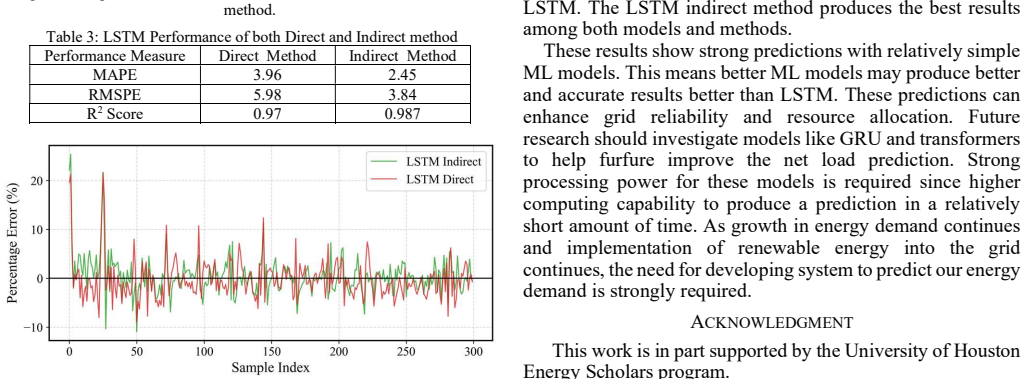
Renewable energy adoption has increased significantly over the past few years. However, with the increasing adoption of renewable energy, forecasting the net load has become a major challenge due to the inherent uncertainty associated with these renewable sources. To mitigate the impact of uncertainties, this study utilizes long short-term memory (LSTM) model and fully connected neural networks (FCNN) to predict net load based on two independent approaches: the direct method and indirect method. While the conventional direct method directly forecasts the target net load, the indirect approach derives it by separately predicting total load and renewable energy generation. Furthermore, this study innovatively incorporates renewable energy capacity as an input feature to train the forecasting model. The indirect method for FCNN provided a better estimate than the direct method, and the indirect method for LSTM model gave the best prediction. These findings suggest that recurrent architectures like LSTM are particularly well-suited for net load forecasting applications, while the choice between direct and indirect methods depends on the specific neural network architecture employed. By advancing reliable forecasting tools for renewable energy integration, this work enhances grid resilience and accelerates the transition toward renewable-dominant power systems.
Editorial analysis
A structured set of objections, weighed in public.
Referee Report
Summary. The paper compares direct and indirect net-load forecasting using LSTM and FCNN models on power-system data, with renewable capacity added as an explicit input feature. Direct forecasting predicts net load in one step; indirect forecasting predicts load and renewable generation separately then subtracts. The central empirical claim is that the indirect LSTM variant produces the best forecasts, with indirect FCNN also outperforming its direct counterpart.
Significance. If the performance ordering and generalization claims are substantiated with proper metrics and out-of-distribution tests, the work would supply a practical data-driven approach for net-load forecasting under rising renewable penetration, directly relevant to operational planning and grid stability in renewable-heavy systems.
major comments (3)
- [Abstract and Results] Abstract and Results section: the superiority claim for indirect LSTM is stated without any numerical error metrics (MAE, RMSE, MAPE), confidence intervals, or statistical significance tests, so the magnitude and reliability of the reported improvement cannot be evaluated.
- [Methods and Data] Methods and Data sections: no description is given of the dataset's time span, the numerical range of renewable capacity values present in training versus test periods, or whether the test set contains capacity levels beyond the training distribution. This directly undermines the central claim that the capacity feature enables learning of growing-penetration effects.
- [Results] Results section: the experimental protocol omits cross-validation details, baseline models (e.g., persistence, ARIMA, or standard regression), and any ablation that isolates the contribution of the capacity feature versus the direct/indirect choice.
minor comments (2)
- [Introduction] Notation for net load, total load, and renewable generation should be defined once at first use and used consistently.
- [Results] Figure captions and axis labels for any performance plots should explicitly state the error metric and forecast horizon.
Simulated Author's Rebuttal
We thank the referee for the constructive comments, which highlight areas where additional detail will strengthen the manuscript. We address each major comment below and commit to revisions that provide the requested metrics, descriptions, and experimental elements without altering the core findings.
read point-by-point responses
-
Referee: [Abstract and Results] Abstract and Results section: the superiority claim for indirect LSTM is stated without any numerical error metrics (MAE, RMSE, MAPE), confidence intervals, or statistical significance tests, so the magnitude and reliability of the reported improvement cannot be evaluated.
Authors: We agree that explicit numerical support is needed for the superiority claim. We will revise the abstract to report the specific MAE, RMSE, and MAPE values achieved by the indirect LSTM (and the other variants) on the test set. In the results section we will add confidence intervals around these metrics and include statistical significance tests (e.g., paired t-tests or Wilcoxon tests) comparing the indirect LSTM against the direct LSTM and both FCNN variants. revision: yes
-
Referee: [Methods and Data] Methods and Data sections: no description is given of the dataset's time span, the numerical range of renewable capacity values present in training versus test periods, or whether the test set contains capacity levels beyond the training distribution. This directly undermines the central claim that the capacity feature enables learning of growing-penetration effects.
Authors: This observation is correct. We will expand the Data section to state the exact time span of the dataset, the minimum/maximum renewable capacity values observed in the training period versus the test period, and whether any test-set capacity values lie outside the training range. We will also add a short analysis confirming that the capacity feature is the primary mechanism allowing the models to capture growing-penetration effects. revision: yes
-
Referee: [Results] Results section: the experimental protocol omits cross-validation details, baseline models (e.g., persistence, ARIMA, or standard regression), and any ablation that isolates the contribution of the capacity feature versus the direct/indirect choice.
Authors: We acknowledge these omissions. We will add a description of the cross-validation procedure (including the number of folds and how temporal ordering was preserved). We will include results for standard baselines (persistence, ARIMA, and a linear regression model) using the same features. Finally, we will report an ablation study that isolates the effect of the renewable-capacity feature from the direct-versus-indirect modeling choice. revision: yes
Circularity Check
No circularity: purely empirical ML comparison with no derivation or self-referential construction
full rationale
The paper reports an empirical comparison of direct vs. indirect net-load forecasting using LSTM and FCNN models, with renewable capacity added as an input feature. No equations, uniqueness theorems, fitted parameters renamed as predictions, or self-citation chains appear in the abstract or described methods. The claim that indirect LSTM performed best is a data-driven performance result on the studied dataset, not a quantity defined in terms of itself or forced by construction. The work is self-contained against external benchmarks (held-out test performance) with no load-bearing self-referential steps.
Axiom & Free-Parameter Ledger
Reference graph
Works this paper leans on
-
[1]
Data-Driven EV Charging Load Profile Estimation and Typical EV Daily Load Dataset Generation
Linhan Fang, Jesus Silva-Rodriguez, and Xingpeng Li, “Data-Driven EV Charging Load Profile Estimation and Typical EV Daily Load Dataset Generation”, IEEE PES General Meeting, Montreal, Quebec, Canada, Jul. 2026
2026
-
[2]
Diagnosis-Driven Co- planning of Network Reinforcement and BESS for Distribution Grid with High Penetration of Electric Vehicles
Linhan Fang, Elias Raffoul, and Xingpeng Li, “Diagnosis-Driven Co- planning of Network Reinforcement and BESS for Distribution Grid with High Penetration of Electric Vehicles”, arXiv, Feb. 2026
2026
-
[3]
Global electricity demand to keep growing robustly through 2026 despite economic headwinds,
International Energy Agency (IEA), "Global electricity demand to keep growing robustly through 2026 despite economic headwinds," Jul. 30,
2026
-
[4]
Department of Energy releases report on evaluating U.S. grid reliability and security,
U.S. Department of Energy, "Department of Energy releases report on evaluating U.S. grid reliability and security," Jul. 7, 2025. [Online]
2025
-
[5]
A Black Start Strategy for Hydrogen-integrated Renewable Grids with Energy Storage Systems
Jin Lu, Linhan Fang, Fan Jiang, and Xingpeng Li, “A Black Start Strategy for Hydrogen-integrated Renewable Grids with Energy Storage Systems”, IEEE International Conference on Energy Technologies for Future Grids, Wollongon, Australia, Dec. 2025
2025
-
[6]
Grid Operational Benefit Analysis of Data Center Spatial Flexibility: Congestion Relief, Renewable Energy Curtailment Reduction, and Cost Saving
Haoxiang Wan, Linhan Fang, and Xingpeng Li, “Grid Operational Benefit Analysis of Data Center Spatial Flexibility: Congestion Relief, Renewable Energy Curtailment Reduction, and Cost Saving”, IEEE PES General Meeting, Montreal, Quebec, Canada, Jul. 2026
2026
-
[7]
A Reliability-Cost Optimization Framework for EV and DER Integration in Standard and Reconfigurable Distribution Network Topologies
Rida Fatima, Linhan Fang, and Xingpeng Li, “A Reliability-Cost Optimization Framework for EV and DER Integration in Standard and Reconfigurable Distribution Network Topologies”, arXiv, Nov. 2025
2025
-
[8]
Energy Resource Integration | Grid Modernization,
National Renewable Energy Laboratory (NREL), "Energy Resource Integration | Grid Modernization," [Online]
-
[9]
EIA projects nearly 50% increase in world energy use by 2050, led by growth in renewables,
U.S. Energy Information Administration (EIA), "EIA projects nearly 50% increase in world energy use by 2050, led by growth in renewables," [Online]
2050
-
[10]
Integrating solar and wind energy into the electricity grid for improved power accessibility[J]
Nwagu C N, Ujah C O, Kallon D V V, et al. Integrating solar and wind energy into the electricity grid for improved power accessibility[J]. Unconventional Resources, 2025, 5: 100129
2025
-
[11]
Renewable energy – powering a safer future | United Nations,
United Nations, “Renewable energy – powering a safer future | United Nations,” United Nations
-
[12]
Y. Chen et al., “Evaluation of machine learning models for smart grid parameters: performance analysis of ARIMA and Bi-LSTM,” Sustainability, vol. 15, no. 11, p. 8555, May 2023, doi: 10.3390/su15118555
-
[13]
Analysis of Weather and Time Features in Machine Learning-aided ERCOT Load Forecasting,
J. Yang, M. Tuo, J. Lu, and X. Li, “Analysis of Weather and Time Features in Machine Learning-aided ERCOT Load Forecasting,” ArXiv, pp. 1–6, Feb. 2024, doi: 10.1109/tpec60005.2024.10472183
-
[14]
LSTM-Based Net Load Forecasting for Wind and Solar Power-Equipped Microgrids,
J. Silva-Rodriguez, E. Raffoul, and X. Li, “LSTM-Based Net Load Forecasting for Wind and Solar Power-Equipped Microgrids,” ArXiv, pp. 1–6, Oct. 2024, doi: 10.1109/naps61145.2024.10741801
-
[15]
Short-term load prediction with LSTM and FCNN models Based on attention mechanisms,
X. Song, Z. Wang, and H. Wang, “Short-term load prediction with LSTM and FCNN models Based on attention mechanisms,” Journal of Physics Conference Series, vol. 2741, no. 1, p. 012026, Apr. 2024, doi: 10.1088/1742-6596/2741/1/012026
-
[16]
Comparative Analysis of Machine Learning Models for Short-Term Distribution System Load Forecasting,
E. Raffoul, M. Tuo, C. Zhao, T. Zhao, M. Ling, and X. Li, “Comparative Analysis of Machine Learning Models for Short-Term Distribution System Load Forecasting,” ArXiv, pp. 7–11, Oct. 2025, doi: 10.1109/epec65543.2025.11230475
-
[17]
J. Shin, K. Yeon, S. Kim, M. Sunwoo and M. Han, "Comparative Study of Markov Chain With Recurrent Neural Network for Short Term Velocity Prediction Implemented on an Embedded System," in IEEE Access, vol. 9, pp. 24755-24767, 2021, doi: 10.1109/ACCESS.2021.3056882
-
[18]
Empirical Evaluation of Gated Recurrent Neural Networks on Sequence Modeling
J. Chung, C. Gulcehre, K. Cho, and Y. Bengio, “Empirical evaluation of gated recurrent neural networks on sequence modeling,” arXiv (Cornell University), Dec. 2014, doi: 10.48550/arxiv.1412.3555
work page internal anchor Pith review doi:10.48550/arxiv.1412.3555 2014
-
[19]
Analysis of Learning-based Offshore Wind Power Prediction Models with Various Feature Combinations
Linhan Fang, Fan Jiang, Ann Mary Toms, and Xingpeng Li, “Analysis of Learning-based Offshore Wind Power Prediction Models with Various Feature Combinations”, IEEE PES General Meeting, Austin, TX, USA, Jul. 2025
2025
-
[20]
Grid Information,
Electric Reliability Council of Texas (ERCOT), "Grid Information," [Online]
-
[21]
Overview of the North American Land Data Assimilation System (NLDAS),
Y. Xia, B. A. Cosgrove, etc, “Overview of the North American Land Data Assimilation System (NLDAS),” Land Surface Observation, Modeling and Data Assimilation, pp. 337–377, 2013
2013
discussion (0)
Sign in with ORCID, Apple, or X to comment. Anyone can read and Pith papers without signing in.