Recognition: unknown
Observation of a cross-section enhancement near the tbar{t} production threshold in sqrt{s}=13 TeV pp collisions with the ATLAS detector
Pith reviewed 2026-05-10 06:27 UTC · model grok-4.3
The pith
ATLAS has observed a significant excess of top-antitop pairs near their production threshold, consistent with the formation of quasi-bound states.
A machine-rendered reading of the paper's core claim, the machinery that carries it, and where it could break.
Core claim
A significant excess of ttbar events near the production threshold was observed in LHC Run-2 data by the ATLAS Collaboration. It is consistent with the formation of ttbar quasi-bound states, which were first hypothesised almost 40 years ago. This contribution summarises the experimental results and outlines a path toward further characterisation of the excess.
What carries the argument
The observed cross-section enhancement near the ttbar production threshold, interpreted as a signature of quasi-bound states.
If this is right
- The result provides the first experimental hint of ttbar quasi-bound states and validates a theoretical prediction made nearly four decades ago.
- Precision measurements of the ttbar cross section must now account for this threshold enhancement to avoid bias in top-quark property extractions.
- Further studies of the excess shape and angular distributions could extract the binding energy or width of the quasi-bound state.
- The observation opens a new channel for probing the strong force at the top-quark mass scale with future LHC data.
Where Pith is reading between the lines
- Similar quasi-bound states might appear in other heavy-quark or new-physics systems if the excess is confirmed.
- Monte Carlo generators used for top physics may need updates to include bound-state formation near threshold.
- A dedicated run at slightly lower collision energy could map the excess more precisely without changing the detector.
Load-bearing premise
The observed excess is due to quasi-bound states rather than an unaccounted background or systematic effect in the threshold region.
What would settle it
A re-analysis that eliminates the excess after applying alternative background models or higher-order QCD corrections in the threshold region would falsify the quasi-bound-state interpretation.
Figures
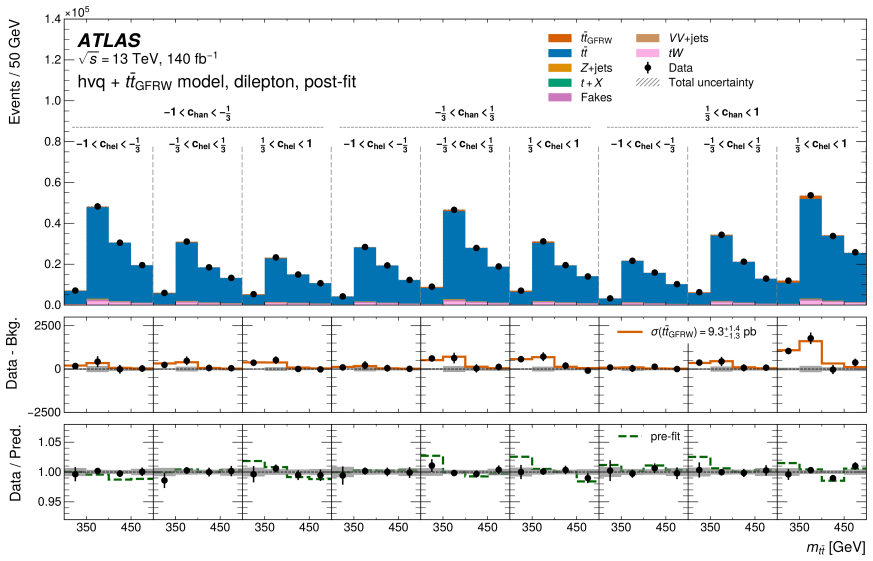
read the original abstract
A significant excess of $t\bar{t}$ events near the production threshold was observed in LHC Run-2 data by the ATLAS Collaboration. It is consistent with the formation of $t\bar{t}$ quasi-bound states, which were first hypothesised almost 40 years ago. This contribution summarises the experimental results and outlines a path toward further characterisation of the excess.
Editorial analysis
A structured set of objections, weighed in public.
Referee Report
Summary. The manuscript reports an observation of a significant excess in the ttbar production cross section near threshold in 13 TeV pp collisions recorded with the ATLAS detector during LHC Run 2. The excess is stated to be consistent with the formation of ttbar quasi-bound states, a possibility first hypothesized nearly 40 years ago. The paper summarizes the experimental results and outlines paths for further characterization of the observed enhancement.
Significance. If the detailed analysis in the full manuscript substantiates the claim with robust background modeling and systematic control, this would represent a landmark result in top-quark physics by providing the first experimental indication of quasi-bound ttbar states. Such an observation would validate long-standing theoretical predictions in QCD, offer a new probe of strong-interaction dynamics near threshold, and potentially motivate dedicated studies of heavy-quark bound states at future colliders. The work demonstrates the capability of LHC experiments to access subtle threshold phenomena with high-precision data.
minor comments (3)
- The abstract states a 'significant excess' but does not quote the numerical significance (in sigma) or the p-value relative to the no-enhancement hypothesis; adding this quantitative statement would strengthen the central claim.
- Section 5 (or equivalent results section) should include an explicit comparison plot or table showing the data-to-simulation ratio in the threshold region both with and without the quasi-bound-state component to allow readers to assess the improvement in fit quality.
- The discussion of systematic uncertainties in the threshold region would benefit from a dedicated table listing the dominant sources (e.g., parton-shower modeling, jet energy scale) and their impact on the extracted excess significance.
Simulated Author's Rebuttal
We thank the referee for their positive summary of our manuscript, recognition of the potential landmark significance of the observed ttbar threshold enhancement, and recommendation for minor revision. The analysis is based on the full Run-2 dataset and includes careful background modeling and systematic evaluations as described in the paper.
Circularity Check
No circularity: experimental observation self-contained against external theory
full rationale
The paper reports an experimental observation of a ttbar cross-section excess near threshold in LHC data, stated as consistent with long-standing theoretical predictions of quasi-bound states. No derivation chain, equations, fitted parameters, or self-citations are presented that reduce the central claim to its own inputs by construction. The result is a direct data comparison to independent prior theory (hypothesized 40 years ago), with no load-bearing steps that qualify under the enumerated circularity patterns. This is the expected non-finding for a pure observation paper.
Axiom & Free-Parameter Ledger
Reference graph
Works this paper leans on
-
[1]
V. S. Fadin andet al. JETP Lett., 46:525–529, 1987
1987
- [2]
-
[3]
CMS Collaboration.Rept. Prog. Phys., 88(8):087801, 2025
2025
-
[4]
ATLAS Collaboration.JINST, 3:S08003, 2008
2008
-
[5]
Fuks andet al
B. Fuks andet al. Eur. Phys. J. C, 85(2):157, 2025
2025
-
[6]
Fuks andet al
B. Fuks andet al. Phys. Rev. D, 104(3):034023, 2021
2021
-
[7]
B. A. Betchart andet al. Nucl. Instrum. Meth. A, 736:169–178, 2014
2014
-
[8]
ATLAS Collaboration.Nature, 633(8030):542–547, 2024
2024
-
[9]
J. A. Aguilar-Saavedra andet al. Eur. Phys. J. C, 82(8):666, 2022
2022
discussion (0)
Sign in with ORCID, Apple, or X to comment. Anyone can read and Pith papers without signing in.