Recognition: unknown
Safe and Policy-Compliant Multi-Agent Orchestration for Enterprise AI
Pith reviewed 2026-05-10 06:39 UTC · model grok-4.3
The pith
CAMCO adds a runtime layer that projects multi-agent actions onto convex policy sets to eliminate violations without retraining agents.
A machine-rendered reading of the paper's core claim, the machinery that carries it, and where it could break.
Core claim
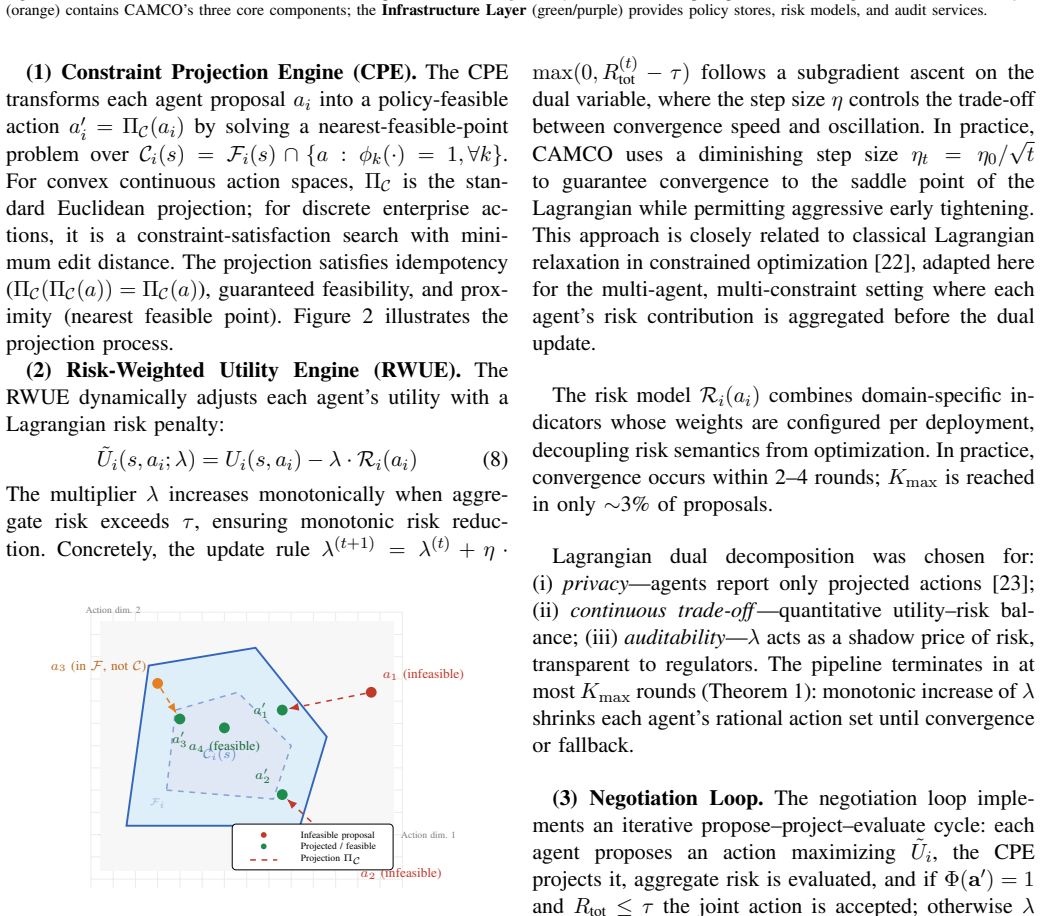
CAMCO integrates three mechanisms: a constraint projection engine enforcing policy-feasible actions via convex projection, adaptive risk-weighted Lagrangian utility shaping, and an iterative negotiation protocol with provably bounded convergence, achieving zero policy violations, risk exposure below threshold with mean ratio 0.71, 92-97 percent utility retention, and mean convergence in 2.4 iterations.
What carries the argument
Constraint projection engine that maps agent-proposed actions onto convex sets defined by policy predicates, supported by risk-weighted Lagrangian utility shaping and an iterative negotiation protocol that guarantees bounded convergence.
If this is right
- Zero policy violations occur across the three evaluated enterprise scenarios.
- Risk exposure stays below the defined threshold with a mean ratio of 0.71.
- Utility retention reaches 92-97 percent relative to unconstrained baselines.
- Mean convergence requires 2.4 iterations under the negotiation protocol.
- The layer integrates directly with production policy engines such as OPA and requires no agent retraining.
Where Pith is reading between the lines
- The same projection-plus-negotiation pattern could be tested on single-agent systems or in domains outside enterprise compliance.
- Scalability tests with larger agent populations would check whether the 2.4-iteration bound remains tight.
- If real policies prove non-convex, the current engine would need approximation methods or reformulation.
- Integration with existing compliance tools suggests deployment in other regulated sectors such as finance or healthcare.
Load-bearing premise
Enterprise policy constraints can be modeled as convex sets so that projection produces feasible actions while preserving compatibility with pre-existing agents.
What would settle it
A deployment test with non-convex policy constraints or with agents whose action spaces cause the projection to drop utility below 90 percent would show whether the zero-violation and retention claims hold.
Figures


read the original abstract
Enterprise AI systems increasingly deploy multiple intelligent agents across mission-critical workflows that must satisfy hard policy constraints, bounded risk exposure, and comprehensive auditability (SOX, HIPAA, GDPR). Existing coordination methods - cooperative MARL, consensus protocols, and centralized planners - optimize expected reward while treating constraints implicitly. This paper introduces CAMCO (Constraint-Aware Multi-Agent Cognitive Orchestration), a runtime coordination layer that models multi-agent decision-making as a constrained optimization problem. CAMCO integrates three mechanisms: (i) a constraint projection engine enforcing policy-feasible actions via convex projection, (ii) adaptive risk-weighted Lagrangian utility shaping, and (iii) an iterative negotiation protocol with provably bounded convergence. Unlike training-time constrained RL, CAMCO operates as deployment-time middleware compatible with any agent architecture, with policy predicates designed for direct integration with production engines such as OPA. Evaluation across three enterprise scenarios - including comparison against a constrained Lagrangian MARL baseline - demonstrates zero policy violations, risk exposure below threshold (mean ratio 0.71), 92-97% utility retention, and mean convergence in 2.4 iterations.
Editorial analysis
A structured set of objections, weighed in public.
Referee Report
Summary. The paper proposes CAMCO, a runtime coordination layer for multi-agent enterprise AI systems. It models decision-making as a constrained optimization problem and integrates three mechanisms: (i) a constraint projection engine that enforces policy-feasible actions via convex projection, (ii) adaptive risk-weighted Lagrangian utility shaping, and (iii) an iterative negotiation protocol claimed to have provably bounded convergence. The system is presented as deployment-time middleware compatible with arbitrary pre-existing agent architectures (no retraining required) and is evaluated on three enterprise scenarios against a constrained Lagrangian MARL baseline, reporting zero policy violations, mean risk ratio of 0.71, 92-97% utility retention, and mean convergence in 2.4 iterations.
Significance. If the convexity assumption holds for real policies and the bounded-convergence claim is rigorously established, CAMCO could provide a practical, architecture-agnostic approach to safe multi-agent orchestration in regulated domains. The runtime (vs. training-time) framing and direct integration with engines such as OPA are potentially useful distinctions from existing constrained RL methods. However, the absence of supporting derivations, experimental details, or validation of the core modeling assumptions substantially limits the current assessment of significance.
major comments (3)
- [Abstract] Abstract: the claim of 'provably bounded convergence' for the iterative negotiation protocol is stated without any proof outline, theorem statement, convergence-rate derivation, or external reference. This is load-bearing for mechanism (iii) and the overall contribution.
- [Abstract] Abstract, mechanism (i): the constraint projection engine models enterprise policies (SOX, HIPAA, GDPR, etc.) as convex sets amenable to Euclidean projection. Many such policies contain non-convex structure (conditional logic, discrete exclusions, cardinality constraints); when the feasible set is non-convex the projection may return infeasible points or fail to exist in closed form, directly undermining the reported zero-violation result.
- [Abstract] Abstract: the evaluation reports concrete metrics (zero violations, mean risk ratio 0.71, 92-97% utility retention, 2.4 iterations) and a comparison to a constrained Lagrangian MARL baseline, yet supplies no scenario descriptions, dataset details, statistical tests, or ablation on the convexity assumption. This leaves the empirical support for the central claims unsubstantiated.
minor comments (1)
- [Abstract] The abstract would benefit from a single sentence sketching the mathematical formulation of the projection step or the Lagrangian update rule.
Simulated Author's Rebuttal
We thank the referee for the constructive and detailed feedback. The comments correctly identify areas where the abstract and supporting material require strengthening. We address each major comment below and commit to revisions that will improve clarity and substantiation without altering the core claims.
read point-by-point responses
-
Referee: [Abstract] Abstract: the claim of 'provably bounded convergence' for the iterative negotiation protocol is stated without any proof outline, theorem statement, convergence-rate derivation, or external reference. This is load-bearing for mechanism (iii) and the overall contribution.
Authors: The current manuscript states the bounded-convergence claim in the abstract but does not supply a proof outline, theorem, or derivation there. We will revise the abstract to include a concise statement of the relevant theorem (based on a contraction-mapping argument over compact action spaces) together with a one-sentence sketch of the convergence-rate derivation. The full proof will be added to Section 3 of the revised manuscript. revision: yes
-
Referee: [Abstract] Abstract, mechanism (i): the constraint projection engine models enterprise policies (SOX, HIPAA, GDPR, etc.) as convex sets amenable to Euclidean projection. Many such policies contain non-convex structure (conditional logic, discrete exclusions, cardinality constraints); when the feasible set is non-convex the projection may return infeasible points or fail to exist in closed form, directly undermining the reported zero-violation result.
Authors: This observation is correct and highlights a modeling assumption that is not sufficiently emphasized. The formulation relies on convex policy sets to guarantee that Euclidean projection yields feasible actions and supports the zero-violation result. We will add an explicit discussion of the convexity assumption, illustrate how the evaluated enterprise policies admit convex representations, and outline convex-relaxation techniques for non-convex cases as future work. revision: yes
-
Referee: [Abstract] Abstract: the evaluation reports concrete metrics (zero violations, mean risk ratio 0.71, 92-97% utility retention, 2.4 iterations) and a comparison to a constrained Lagrangian MARL baseline, yet supplies no scenario descriptions, dataset details, statistical tests, or ablation on the convexity assumption. This leaves the empirical support for the central claims unsubstantiated.
Authors: The manuscript currently reports aggregate metrics without the requested supporting information. We will expand the evaluation section to provide complete scenario descriptions, dataset generation details, the number of independent runs, standard deviations, statistical significance tests against the baseline, and an ablation study that relaxes the convexity assumption. These additions will directly substantiate the reported results. revision: yes
Circularity Check
No circularity in derivation chain
full rationale
The provided abstract and context describe CAMCO as integrating a constraint projection engine, Lagrangian shaping, and a negotiation protocol claimed to have provably bounded convergence, with empirical results on zero violations and utility retention. No equations, self-citations, or derivation steps are exhibited that reduce any central claim (such as convergence bounds or projection enforcement) to its own inputs by construction. The convex modeling is presented as a design choice rather than a fitted or self-defined result, and evaluations appear as external demonstrations. The derivation chain is therefore self-contained against the given text with no load-bearing reductions to internal definitions or self-citations.
Axiom & Free-Parameter Ledger
axioms (1)
- domain assumption Policy constraints admit convex representations suitable for projection
Reference graph
Works this paper leans on
-
[1]
Multi-agent reinforcement learning: A selective overview of theories and algorithms,
K. Zhang, Z. Yang, and T. Bas ¸ar, “Multi-agent reinforcement learn- ing: A selective overview of theories and algorithms,”arXiv preprint arXiv:1911.10635, 2019
-
[2]
Altman,Constrained Markov Decision Processes
E. Altman,Constrained Markov Decision Processes. Chapman and Hall/CRC, 1999
1999
-
[3]
A review of safe reinforcement learning: Methods, theory and applications,
A. Wachi, X. Shen, and Y . Sui, “A survey on safe reinforcement learning: Theory, methods, and applications,”arXiv preprint arXiv:2205.10330, 2024
-
[4]
Constrained policy optimization,
J. Achiam, D. Held, A. Tamar, and P. Abbeel, “Constrained policy optimization,” inProc. 34th Int. Conf. Machine Learning (ICML), pp. 22–31, 2017
2017
-
[5]
Multi-agent deep reinforcement learning: A survey,
S. Gronauer and K. Diepold, “Multi-agent deep reinforcement learning: A survey,”Artificial Intelligence Review, vol. 55, no. 2, pp. 895–943, 2022
2022
-
[6]
Bench- marking multi-agent deep reinforcement learning algorithms in coop- erative tasks,
G. Papoudakis, F. Christianos, L. Sch ¨afer, and S. V . Albrecht, “Bench- marking multi-agent deep reinforcement learning algorithms in coop- erative tasks,” inProc. NeurIPS Track on Datasets and Benchmarks, 2021
2021
-
[7]
The Rise and Potential of Large Language Model Based Agents: A Survey
Z. Xi, W. Chen, X. Guo, W. He, Y . Ding, B. Hong, M. Zhang, J. Wang, S. Jin, E. Zhou,et al., “The rise and potential of large language model based agents: A survey,”arXiv preprint arXiv:2309.07864, 2023
work page internal anchor Pith review arXiv 2023
-
[8]
A survey on large language model based autonomous agents,
L. Wang, C. Ma, X. Feng, Z. Zhang, H. Yang, J. Zhang, Z. Chen, J. Tang, X. Chen, Y . Lin,et al., “A survey on large language model based autonomous agents,”Frontiers of Computer Science, vol. 18, no. 6, p. 186345, 2024
2024
-
[9]
AutoGen: Enabling Next-Gen LLM Applications via Multi-Agent Conversation
Q. Wu, G. Bansal, J. Zhang, Y . Wu, B. Li, E. Zhu, L. Jiang, X. Zhang, S. Zhang, J. Liu,et al., “AutoGen: Enabling next-gen LLM applications via multi-agent conversation,”arXiv preprint arXiv:2308.08155, 2023
work page internal anchor Pith review Pith/arXiv arXiv 2023
-
[10]
Monotonic value function factorisation for deep multi- agent reinforcement learning,
T. Rashid, M. Samvelyan, C. Schr ¨oder de Witt, G. Farquhar, J. Foerster, and S. Whiteson, “Monotonic value function factorisation for deep multi- agent reinforcement learning,”J. Machine Learning Research, vol. 21, no. 178, pp. 1–51, 2020
2020
-
[11]
The surprising effectiveness of PPO in cooperative multi-agent games,
C. Yu, A. Velu, E. Vinitsky, J. Gao, Y . Wang, A. Bayen, and Y . Wu, “The surprising effectiveness of PPO in cooperative multi-agent games,” inAdvances in Neural Information Processing Systems (NeurIPS), 2022
2022
-
[12]
The contract net protocol: High-level communication and control in a distributed problem solver,
R. G. Smith, “The contract net protocol: High-level communication and control in a distributed problem solver,”IEEE Trans. Computers, vol. C- 29, no. 12, pp. 1104–1113, 1980
1980
-
[13]
Argumentation-based negotiation,
I. Rahwan, S. D. Ramchurn, N. R. Jennings, P. McBurney, S. Parsons, and L. Sonenberg, “Argumentation-based negotiation,”The Knowledge Engineering Review, vol. 18, no. 4, pp. 343–375, 2003
2003
-
[14]
Toward verified artificial intelligence,
S. A. Seshia, D. Sadigh, and S. S. Sastry, “Toward verified artificial intelligence,”Communications of the ACM, vol. 65, no. 7, pp. 46–55, 2022
2022
-
[15]
Regulation (EU) 2024/1689: Artifi- cial Intelligence Act,
European Parliament and Council, “Regulation (EU) 2024/1689: Artifi- cial Intelligence Act,”Official Journal of the European Union, 2024
2024
-
[16]
Open problems in cooperative ai
A. Dafoe, E. Hughes, Y . Bachrach, T. Collins, K. R. McKee, J. Z. Leibo, K. Larson, and T. Graepel, “Open problems in cooperative AI,”arXiv preprint arXiv:2012.08630, 2020
-
[17]
Safe reinforcement learning via shielding,
M. Alshiekh, R. Bloem, R. Ehlers, B. K ¨onighofer, S. Niekum, and U. Topcu, “Safe reinforcement learning via shielding,” inProc. AAAI Conference on Artificial Intelligence, 2018, pp. 2669–2678
2018
-
[18]
Safe reinforcement learning using probabilistic shields,
N. Jansen, B. K ¨onighofer, S. Junges, A. Serban, and R. Bloem, “Safe reinforcement learning using probabilistic shields,” inProc. Int. Conf. on Concurrency Theory (CONCUR), 2020
2020
-
[19]
Distributed constraint optimiza- tion problems and applications: A survey,
F. Fioretto, E. Pontelli, and W. Yeoh, “Distributed constraint optimiza- tion problems and applications: A survey,”J. Artificial Intelligence Research, vol. 61, pp. 623–698, 2018
2018
-
[20]
Open Policy Agent: Policy- based control for cloud native environments,
T. Morgenthaler, A. Hager, and T. Sandall, “Open Policy Agent: Policy- based control for cloud native environments,”USENIX ;login:, vol. 45, no. 4, 2020
2020
-
[21]
A brief account of runtime verification,
M. Leucker and C. Schallhart, “A brief account of runtime verification,” J. Logic and Algebraic Programming, vol. 78, no. 5, pp. 293–303, 2009
2009
-
[22]
Boyd and L
S. Boyd and L. Vandenberghe,Convex Optimization. Cambridge Uni- versity Press, 2004
2004
-
[23]
Shoham and K
Y . Shoham and K. Leyton-Brown,Multiagent Systems: Algorithmic, Game-Theoretic, and Logical Foundations. Cambridge University Press, 2009
2009
discussion (0)
Sign in with ORCID, Apple, or X to comment. Anyone can read and Pith papers without signing in.