Recognition: unknown
Scalable DDPM-Polycube: An Extended Diffusion-Based Method for Hexahedral Mesh and Volumetric Spline Construction
Pith reviewed 2026-05-10 05:58 UTC · model grok-4.3
The pith
Adding a blind-hole primitive, a larger 3D grid, and hierarchical verification extends diffusion-based polycube generation to more complex CAD geometries.
A machine-rendered reading of the paper's core claim, the machinery that carries it, and where it could break.
Core claim
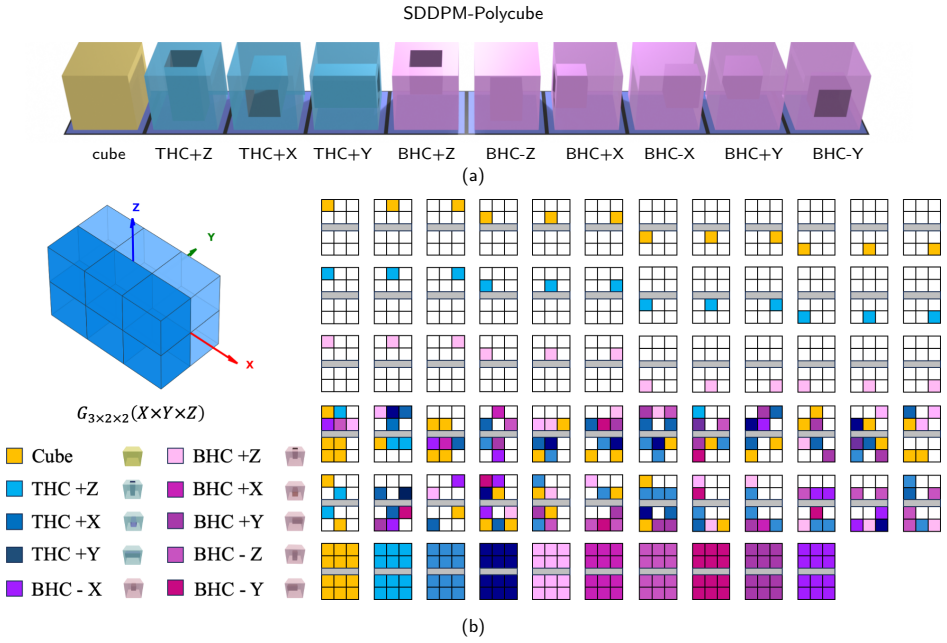
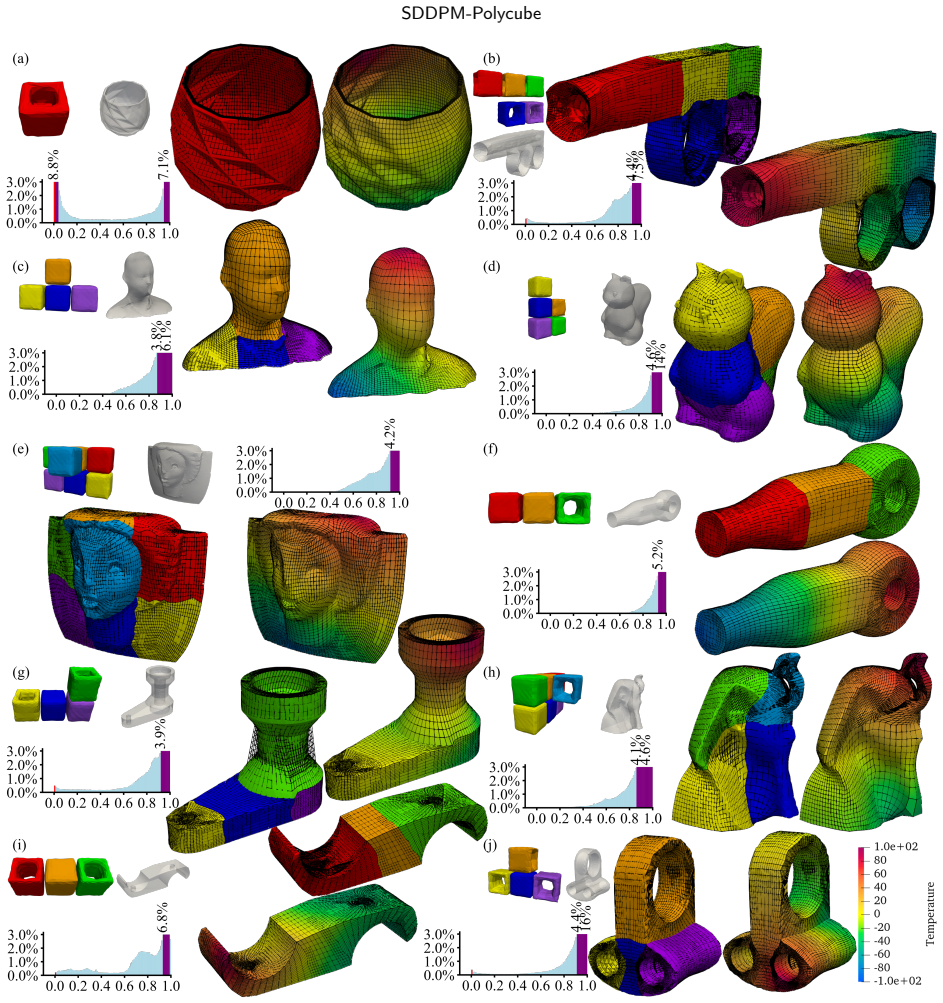
The paper claims that the Scalable DDPM-Polycube method overcomes prior limits on primitive diversity, grid size, and inference cost by introducing a blind-hole cube primitive, switching to an enlarged three-dimensional grid configuration, and implementing a genus-guided context generation strategy together with hierarchical verification. Once a valid polycube is obtained, it is mapped to the input geometry to produce an all-hex control mesh and an analysis-suitable volumetric spline for isogeometric analysis.
What carries the argument
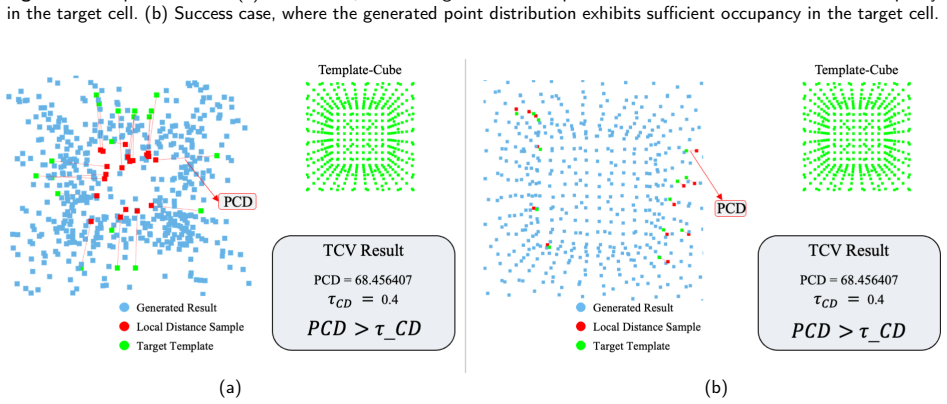
The genus-guided hierarchical verification procedure, which uses the input geometry's topology to generate and validate polycube contexts inside the enlarged grid while incorporating the new blind-hole primitive.
If this is right
- Polycube generation becomes possible for geometries containing blind holes that do not alter global genus.
- Larger grid configurations reduce mapping distortion on intricate shapes while preserving scalability.
- The same pipeline supports both user-guided and fully automated modes for downstream hex-mesh and spline construction.
- Once generated, the polycube directly enables parametric mapping, all-hex control meshes, and volumetric splines for IGA.
Where Pith is reading between the lines
- The approach may lower the expert time currently required to prepare complex CAD assemblies for hexahedral meshing.
- Integration into existing CAD-to-analysis workflows could become practical if the verification step runs at acceptable speed on large models.
- Further primitives or adaptive grid refinement might be needed if the current fixed enlargement still fails on certain feature combinations.
Load-bearing premise
The three specific extensions will be enough to represent every local feature and topological variation found in arbitrary complex CAD geometries without creating new mapping distortions or invalid polycube structures.
What would settle it
Running the method on a set of industrial CAD models containing multiple blind holes, high-genus features, and sharp local details, then checking whether any resulting polycube produces self-intersecting mappings or invalid hexahedral elements.
Figures





read the original abstract
Polycube structures provide parametric domains for all-hexahedral (all-hex) mesh generation and analysis-suitable volumetric spline construction in isogeometric analysis (IGA). Recent learning-based polycube pipelines have improved automation, yet several challenges remain when handling complex CAD geometries. These challenges include the limited diversity of primitive geometries, restricted grid configurations, and the increasing cost of genus-guided context search during inference as both the primitive set and the grid size grow. In this paper, we present {Scalable DDPM-Polycube}, an extended diffusion-based polycube construction method that addresses these limitations. First, we expand the primitive set from two primitive geometries to three by introducing a blind-hole cube primitive, thereby improving the representation of local hole-like features that do not change the global genus. Second, we extend the grid configuration from the previous $2\times 1$ setting to an enlarged three-dimensional grid configuration, which increases representational capacity and reduces mapping distortion for complex geometries. Third, we develop a genus-guided context generation strategy together with a hierarchical verification procedure, enabling robust context generation in both user-guided and automated modes. Once a valid polycube structure is generated, it is used for parametric mapping, all-hex control mesh generation, and volumetric spline construction. Experimental results demonstrate that scalable DDPM-Polycube improves the generality, scalability, and automation of diffusion-based polycube generation, and supports hex mesh generation and volumetric spline construction for IGA applications on complex geometries.
Editorial analysis
A structured set of objections, weighed in public.
Referee Report
Summary. The paper presents Scalable DDPM-Polycube as an extension of prior diffusion-based polycube generation. It adds a blind-hole cube primitive to the set of geometries, enlarges the grid configuration from 2x1 to full 3D, and introduces a genus-guided context generation strategy paired with hierarchical verification. These changes are intended to increase representational capacity for local hole-like features and topological variations in complex CAD models. The resulting polycubes are then mapped to support all-hex control mesh generation and volumetric spline construction for isogeometric analysis (IGA) applications. The central claim is that experimental results confirm gains in generality, scalability, and automation over previous diffusion pipelines.
Significance. If the experimental claims are supported by detailed quantitative evidence, the work could advance automated polycube construction for hexahedral meshing and IGA on complex geometries by directly targeting limitations in primitive diversity and grid size. The hierarchical verification procedure provides a concrete mechanism for robust context handling in both automated and user-guided modes. No parameter-free derivations or machine-checked proofs are offered, but the targeted addition of the blind-hole primitive represents a focused, incremental improvement over the base DDPM-Polycube pipeline.
major comments (2)
- [Experimental Results] Experimental Results section: the central claim that the three extensions improve generality and scalability rests on assertions of experimental success, yet no quantitative metrics (mapping distortion values, validity rates, success rates on test geometries), baseline comparisons to the original DDPM-Polycube, error bars, or details on measurement protocols for distortion and validity are reported. This directly undermines verification that the blind-hole primitive, 3D grid, and hierarchical verification suffice for arbitrary complex CAD without new distortions or invalid structures.
- [Method] Method section on primitive set and grid extension: the addition of only a single blind-hole cube primitive and the switch to an enlarged 3D grid are presented as sufficient to capture local hole-like features and reduce distortion, but the manuscript provides no analysis, examples, or ablation of cases with multiple interacting blind holes, higher-genus transitions, or feature combinations absent from the three-primitive set. This is load-bearing for the generality claim, as the diffusion process could still generate polycubes that induce large mapping distortions or fail downstream hex-mesh and spline construction.
minor comments (1)
- [Abstract] Abstract: the statement that 'experimental results demonstrate' improvements would be strengthened by a brief indication of the number and topological complexity of tested geometries.
Simulated Author's Rebuttal
We thank the referee for the detailed and constructive feedback on our manuscript. We have carefully considered each major comment and provide point-by-point responses below. Where revisions are needed to strengthen the presentation of our results, we have indicated the changes to be made in the revised version.
read point-by-point responses
-
Referee: [Experimental Results] Experimental Results section: the central claim that the three extensions improve generality and scalability rests on assertions of experimental success, yet no quantitative metrics (mapping distortion values, validity rates, success rates on test geometries), baseline comparisons to the original DDPM-Polycube, error bars, or details on measurement protocols for distortion and validity are reported. This directly undermines verification that the blind-hole primitive, 3D grid, and hierarchical verification suffice for arbitrary complex CAD without new distortions or invalid structures.
Authors: We agree that the current Experimental Results section lacks the detailed quantitative metrics mentioned. The section primarily presents qualitative examples of polycube generation and downstream applications on complex CAD models. To strengthen the verification of our claims, we will revise the manuscript to include quantitative metrics including mapping distortion values, validity rates, success rates, baseline comparisons to the original DDPM-Polycube, error bars from multiple runs, and explicit details on the measurement protocols. These will be added to the revised version. revision: yes
-
Referee: [Method] Method section on primitive set and grid extension: the addition of only a single blind-hole cube primitive and the switch to an enlarged 3D grid are presented as sufficient to capture local hole-like features and reduce distortion, but the manuscript provides no analysis, examples, or ablation of cases with multiple interacting blind holes, higher-genus transitions, or feature combinations absent from the three-primitive set. This is load-bearing for the generality claim, as the diffusion process could still generate polycubes that induce large mapping distortions or fail downstream hex-mesh and spline construction.
Authors: We acknowledge that the manuscript does not include dedicated ablations or examples specifically for multiple interacting blind holes or all possible feature combinations. The three-primitive set with the blind-hole addition, combined with the 3D grid and hierarchical verification, is shown to handle complex geometries in our experiments. However, to better support the generality claim and address potential concerns about the diffusion process generating invalid structures, we will include additional analysis and examples of multiple blind-hole cases and higher-genus transitions in the revised manuscript. revision: partial
Circularity Check
No significant circularity in claimed extensions or experimental validation
full rationale
The paper describes an engineering extension to prior diffusion-based polycube methods via three additive changes (blind-hole primitive, enlarged 3D grid, genus-guided hierarchical verification) followed by experimental demonstration on complex geometries for hex meshing and IGA splines. No first-principles derivation, mathematical prediction, or uniqueness theorem is claimed that reduces to its own inputs by construction. The base model is referenced as prior work but the new components and results are presented as independent; success is asserted via experiments rather than any self-definitional loop or fitted parameter renamed as output. This is a standard incremental ML method paper with external empirical benchmarks.
Axiom & Free-Parameter Ledger
invented entities (1)
-
blind-hole cube primitive
no independent evidence
Reference graph
Works this paper leans on
-
[1]
Acomparisonofallhexagonalandalltetrahedralfiniteelementmeshes for elastic and elasto-plastic analysis
Benzley,S.E.,Perry,E.,Merkley,K.,Clark,B.,Sjaardama,G.,1995. Acomparisonofallhexagonalandalltetrahedralfiniteelementmeshes for elastic and elasto-plastic analysis. 4th International Meshing Roundtable 17, 179–191
1995
-
[2]
Volumeparametrizationquantizationforhexahedralmeshing
Brückler,H.,Bommes,D.,Campen,M.,2022. Volumeparametrizationquantizationforhexahedralmeshing. ACMTransactionsonGraphics 41, 1–19
2022
-
[3]
Integer-sheet-pumpquantizationforhexahedralmeshing
Brückler,H.,Bommes,D.,Campen,M.,2024. Integer-sheet-pumpquantizationforhexahedralmeshing. ComputerGraphicsForum43,1–13
2024
-
[4]
arXiv preprint arXiv:2406.10163 , year=
Chen, Y., He, T., Huang, D., Ye, W., Chen, S., Tang, J., Chen, X., Cai, Z., Yang, L., Yu, G., Lin, G., Zhang, C., 2024. MeshAnything: Artist-created mesh generation with autoregressive transformers. arXiv:2406.10163, 1–19
-
[5]
HexGen and Hex2Spline: Polycube-based hexahedral mesh generation and spline modeling for isogeometric analysis applications in LS-DYNA
CMU-CBML, 2024. HexGen and Hex2Spline: Polycube-based hexahedral mesh generation and spline modeling for isogeometric analysis applications in LS-DYNA. https://github.com/CMU-CBML/HexGen_Hex2Spline.git
2024
-
[6]
Density estimation using Real NVP
Dinh, L., Jascha, S.D., Bengio, S., 2016. Density estimation using Real NVP. arXiv:1605.08803, 1–32
work page internal anchor Pith review arXiv 2016
-
[7]
Linearcomplexityhexahedralmeshgeneration
Eppstein,D.,1996. Linearcomplexityhexahedralmeshgeneration. Proceedingsofthe12thAnnualSymposiumonComputationalGeometry, 58–67
1996
-
[8]
All-hex meshing using closed-form induced polycube
Fang, X., Xu, W., Bao, H., Huang, J., 2016. All-hex meshing using closed-form induced polycube. ACM Transactions on Graphics 35, 1–9
2016
-
[9]
Locking-proof tetrahedra
Frâncu, M., Asgeirsson, A., Erleben, K., Rønnow, M.J., 2021. Locking-proof tetrahedra. ACM Transactions on Graphics 40, 1–17
2021
-
[10]
Efficient volumetric polycube-map construction
Fu, X., Bai, C., Liu, Y., 2016. Efficient volumetric polycube-map construction. Computer Graphics Forum 35, 97–106
2016
-
[11]
Learning deformable tetrahedral meshes for 3D reconstruction
Gao, J., Chen, W., Xiang, T., Jacobson, A., McGuire, M., Fidler, S., 2020. Learning deformable tetrahedral meshes for 3D reconstruction. Advances in Neural Information Processing Systems 33, 9936–9947
2020
-
[12]
Generative adversarial nets
Goodfellow, I., Jean, P.A., Mirza, M., Xu, B., David, W.F., Ozair, S., Courville, A., Bengio, Y., 2014. Generative adversarial nets. Advances in Neural Information Processing Systems 28, 2672–2680
2014
-
[13]
Cut-enhanced polycube-maps for feature-aware all-hex meshing
Guo, H., Liu, X., Yan, D., Liu, Y., 2020. Cut-enhanced polycube-maps for feature-aware all-hex meshing. ACM Transactions on Graphics 39, 1–14
2020
-
[14]
Denoising diffusion probabilistic models
Ho, J., Jain, A., Abbeel, P., 2020. Denoising diffusion probabilistic models. Advances in Neural Information Processing Systems 33, 6840– 6851
2020
-
[15]
Surface segmentation for polycube construction based on generalized centroidal Voronoi tessellation
Hu, K., Zhang, Y., Liao, T., 2017. Surface segmentation for polycube construction based on generalized centroidal Voronoi tessellation. Computer Methods in Applied Mechanics and Engineering 316, 280–296
2017
-
[16]
CentroidalVoronoitessellationbasedpolycubeconstructionforadaptiveall-hexahedralmeshgeneration
Hu,K.,Zhang,Y.J.,2016. CentroidalVoronoitessellationbasedpolycubeconstructionforadaptiveall-hexahedralmeshgeneration. Computer Methods in Applied Mechanics and Engineering 305, 405–421
2016
-
[17]
ACM Transactions on Graphics 33, 1–11
Huang, J., Jiang, T., Shi, Z., Tong, Y., Bao, H., Desbrun, M., 2014.𝓁1-based construction of polycube maps from complex shapes. ACM Transactions on Graphics 33, 1–11
2014
-
[18]
Isogeometricanalysis:CAD,finiteelements,NURBS,exactgeometry,andmeshrefinement
Hughes,T.J.R.,Cottrell,J.A.,Bazilevs,Y.,2005. Isogeometricanalysis:CAD,finiteelements,NURBS,exactgeometry,andmeshrefinement. Computer Methods in Applied Mechanics and Engineering 194, 4135–4195
2005
-
[19]
Deep unsupervised learning using nonequilibrium thermodynamics
Jascha, S.D., Weiss, E., Maheswaranathan, N., Ganguli, S., 2015. Deep unsupervised learning using nonequilibrium thermodynamics. International Conference on Machine Learning, 2256–2265
2015
-
[20]
A large language model and denoising diffusion framework for targeted design of microstructures with commands in natural language
Kartashov, N., Vlassis, N.N., 2025. A large language model and denoising diffusion framework for targeted design of microstructures with commands in natural language. Computer Methods in Applied Mechanics and Engineering 437, 117742
2025
-
[21]
Glow: Generative flow with invertible 1x1 convolutions
Kingma, D.P., Dhariwal, P., 2018. Glow: Generative flow with invertible 1x1 convolutions. Advances in Neural Information Processing Systems 32, 10236–10245
2018
-
[22]
Auto-Encoding Variational Bayes
Kingma, D.P., Welling, M., 2013. Auto-encoding variational bayes. arXiv:1312.6114, 1–14
work page internal anchor Pith review Pith/arXiv arXiv 2013
-
[23]
Surface mesh to volumetric spline conversion with generalized polycubes
Li, B., Li, X., Wang, K., Qin, H., 2013. Surface mesh to volumetric spline conversion with generalized polycubes. IEEE Transactions on Visualization and Computer Graphics 99, 1–14
2013
-
[24]
Interactiveall-hexmeshingviacuboiddecomposition
Li,L.,Zhang,P.,Smirnov,D.,Abulnaga,S.M.,Solomon,J.,2021. Interactiveall-hexmeshingviacuboiddecomposition. ACMTransactions on Graphics 40, 1–17
2021
-
[25]
All-hexmeshingusingsingularity-restrictedfield
Li,Y.,Liu,Y.,Xu,W.,Wang,W.,Guo,B.,2012. All-hexmeshingusingsingularity-restrictedfield. ACMTransactionsonGraphics31,1–11
2012
-
[26]
Automatic polycube-maps
Lin, J., Jin, X., Fan, Z., Wang, C., 2008. Automatic polycube-maps. Advances in Geometric Modeling and Processing 4975, 3–16
2008
-
[27]
Intrinsic mixed-integer polycubes for hexahedral meshing
Mandad, M., Chen, R., Bommes, D., Campen, M., 2022. Intrinsic mixed-integer polycubes for hexahedral meshing. Computer Aided Geometric Design 94, 102078
2022
-
[28]
Improved denoising diffusion probabilistic models
Nichol, A.Q., Dhariwal, P., 2021. Improved denoising diffusion probabilistic models. International Conference on Machine Learning, 8162– 8171
2021
-
[29]
Cubecover - parameterization of 3D volumes
Nieser, M., Reitebuch, U., Polthier, K., 2011. Cubecover - parameterization of 3D volumes. Computer Graphics Forum 30, 1397–1406
2011
-
[30]
Hex-mesh generation and processing: A survey
Pietroni, N., Campen, M., Sheffer, A., Cherchi, G., Bommes, D., Gao, X., Scateni, R., Ledoux, F., Remacle, J., Livesu, M., 2023. Hex-mesh generation and processing: A survey. ACM Transactions on Graphics 42, 1–44. :Preprint submitted to Elsevier Page 24 of 25 SDDPM-Polycube
2023
-
[31]
International Journal for Numerical Methods in Engineering 82, 1406–1423
Qian,J.,Zhang,Y.,Wang,W.,Lewis,A.C.,Qidwai,M.A.S.,Geltmacher,A.B.,2010.Qualityimprovementofnon-manifoldhexahedralmeshes for critical feature determination of microstructure materials. International Journal for Numerical Methods in Engineering 82, 1406–1423
2010
-
[32]
Automatic unstructured all-hexahedral mesh generation from B-Reps for non-manifold CAD assemblies
Qian, J., Zhang, Y.J., 2012. Automatic unstructured all-hexahedral mesh generation from B-Reps for non-manifold CAD assemblies. Engineering with Computers 28, 345–359
2012
-
[33]
A grid-based algorithm for the generation of hexahedral element meshes
Schneiders, R., 1996. A grid-based algorithm for the generation of hexahedral element meshes. Engineering with Computers 12, 168–177
1996
-
[34]
MeshGPT: Generating triangle meshes with decoder-only transformers
Siddiqui, Y., Alliegro, A., Artemov, A., Tommasi, T., Sirigatti, D., Rosov, V., Dai, A., Nießner, M., 2024. MeshGPT: Generating triangle meshes with decoder-only transformers. IEEE/CVF Conference on Computer Vision and Pattern Recognition, 19615–19625
2024
-
[35]
Score-Based Generative Modeling through Stochastic Differential Equations
Song,Y.,Jascha,S.D.,Kingma,D.P.,Kumar,A.,Ermon,S.,Poole,B.,2020. Score-basedgenerativemodelingthroughstochasticdifferential equations. arXiv:2011.13456, 1–36
work page internal anchor Pith review Pith/arXiv arXiv 2020
-
[36]
Sequence to sequence learning with neural networks
Sutskever, I., Vinyals, O., Le, Q.V., 2014. Sequence to sequence learning with neural networks. Advances in Neural Information Processing Systems 27, 3104–3112
2014
-
[37]
Polycube-maps
Tarini, M., Hormann, K., Cignoni, P., Montani, C., 2004. Polycube-maps. ACM Transactions on Graphics 23, 853–860
2004
-
[38]
HybridOctree_hex: Hybrid octree-based adaptive all-hexahedral mesh generation with Jacobian control
Tong, H., Halilaj, E., Zhang, Y.J., 2024. HybridOctree_hex: Hybrid octree-based adaptive all-hexahedral mesh generation with Jacobian control. Journal of Computational Science 78, 102278
2024
-
[39]
SRL-assisted AFM: Generating planar unstructured quadrilateral meshes with supervised and reinforcement learning-assisted advancing front method
Tong, H., Qian, K., Halilaj, E., Zhang, Y.J., 2023. SRL-assisted AFM: Generating planar unstructured quadrilateral meshes with supervised and reinforcement learning-assisted advancing front method. Journal of Computational Science 72, 102109
2023
-
[40]
Fast and robust hexahedral mesh optimization via augmented lagrangian, L-BFGS, and line search
Tong, H., Zhang, Y.J., 2025. Fast and robust hexahedral mesh optimization via augmented lagrangian, L-BFGS, and line search. SIAM International Meshing Roundtable. Fort Worth, TX. March 3-6, 2025
2025
-
[41]
HexOpt: Efficient and robust hexahedral mesh optimization using rectified hybrid quadratic Jacobian and geometry-aware mapping
Tong, H., Zhang, Y.J., 2026. HexOpt: Efficient and robust hexahedral mesh optimization using rectified hybrid quadratic Jacobian and geometry-aware mapping. Computer-Aided Design, 104073
2026
-
[42]
Polycube splines
Wang, H., He, Y., Li, X., Gu, X., Qin, H., 2007. Polycube splines. Symposium on Solid and Physical Modeling, 241–251
2007
-
[43]
Trivariate solid T-spline construction from boundary triangulations with arbitrary genus topology
Wang, W., Zhang, Y., Liu, L., Hughes, T.J., 2013. Trivariate solid T-spline construction from boundary triangulations with arbitrary genus topology. Computer-Aided Design 45, 351–360
2013
-
[44]
Truncated hierarchical tricubic C0 spline construction on unstructured hexahedral meshes for isogeometric analysis applications
Wei, X., Zhang, Y., Hughes, T.J.R., 2017. Truncated hierarchical tricubic C0 spline construction on unstructured hexahedral meshes for isogeometric analysis applications. Computers and Mathematics with Applications 74, 2203–2220
2017
-
[45]
DDPM-Polycube: A denoising diffusion probabilistic model for polycube-based hexahedral mesh generation and volumetric spline construction
Yu, Y., Fang, Y., Tong, H., Liu, J., Zhang, Y.J., 2026. DDPM-Polycube: A denoising diffusion probabilistic model for polycube-based hexahedral mesh generation and volumetric spline construction. Engineering with Computers 42, 1
2026
-
[46]
DL-Polycube:Deeplearningenhancedgeneralizedpolycubemethodforhigh-qualityhexahedral mesh generation and volumetric spline construction
Yu,Y.,Fang,Y.,Tong,H.,Zhang,Y.J.,2025. DL-Polycube:Deeplearningenhancedgeneralizedpolycubemethodforhigh-qualityhexahedral mesh generation and volumetric spline construction. Engineering with Computers 41, 2069–2092
2025
-
[47]
HexDom: Polycube-based hexahedral-dominant mesh generation
Yu, Y., Liu, J., Zhang, Y.J., 2022. HexDom: Polycube-based hexahedral-dominant mesh generation. SEMA SIMAI Springer Series: Mesh Generation and Adaptation, 137–155
2022
-
[48]
Geometric Challenges in Isogeometric Analysis
Yu, Y., Wei, X., Li, A., Liu, J., He, J., Zhang, Y.J., 2022. HexGen and Hex2Spline: Polycube-based hexahedral mesh generation and spline modeling for isogeometric analysis applications in LS-DYNA. Springer INdAM Series: Proceedings of INdAM Workshop “Geometric Challenges in Isogeometric Analysis”, 333–363
2022
-
[49]
Anatomically realistic lumen motion representation in patient-specific space–timeisogeometricflowanalysisofcoronaryarterieswithtime-dependentmedical-imagedata
Yu, Y., Zhang, Y.J., Takizawa, K., Tezduyar, T.E., Sasaki, T., 2020. Anatomically realistic lumen motion representation in patient-specific space–timeisogeometricflowanalysisofcoronaryarterieswithtime-dependentmedical-imagedata. ComputationalMechanics65,395–404
2020
-
[50]
Surface smoothing and quality improvement of quadrilateral/hexahedral meshes with geometric flow
Zhang, Y., Bajaj, C.L., Xu, G., 2009. Surface smoothing and quality improvement of quadrilateral/hexahedral meshes with geometric flow. Communications in Numerical Methods in Engineering 25, 1–18
2009
-
[51]
Solid T-spline construction from boundary representations for genus-zero geometry
Zhang, Y., Wang, W., Hughes, T.J., 2012. Solid T-spline construction from boundary representations for genus-zero geometry. Computer Methods in Applied Mechanics and Engineering 249, 185–197
2012
-
[52]
Challenges and advances in image-based geometric modeling and mesh generation
Zhang, Y.J., 2013. Challenges and advances in image-based geometric modeling and mesh generation. Image-Based Geometric Modeling and Mesh Generation, 1–10
2013
-
[53]
Geometric Modeling and Mesh Generation from Scanned Images
Zhang, Y.J., 2016. Geometric Modeling and Mesh Generation from Scanned Images. Chapman and Hall/CRC, New York
2016
-
[54]
Adaptive and quality quadrilateral/hexahedral meshing from volumetric data
Zhang, Y.J., Bajaj, C.L., 2006. Adaptive and quality quadrilateral/hexahedral meshing from volumetric data. Computer Methods in Applied Mechanics and Engineering 195, 942–960
2006
-
[55]
Patient-specificvascularNURBSmodelingforisogeometricanalysis of blood flow
Zhang,Y.J.,Bazilevs,Y.,Goswami,S.,Bajaj,C.L.,Hughes,T.J.R.,2007. Patient-specificvascularNURBSmodelingforisogeometricanalysis of blood flow. Computer Methods in Applied Mechanics and Engineering 196, 2943–2959. :Preprint submitted to Elsevier Page 25 of 25
2007
discussion (0)
Sign in with ORCID, Apple, or X to comment. Anyone can read and Pith papers without signing in.