Recognition: unknown
Neural Adjoint Method for Meta-optics: Accelerating Volumetric Inverse Design via Fourier Neural Operators
Pith reviewed 2026-05-10 07:10 UTC · model grok-4.3
The pith
A Fourier Neural Operator predicts 3D adjoint gradient fields to replace repeated Maxwell solves in meta-optic inverse design.
A machine-rendered reading of the paper's core claim, the machinery that carries it, and where it could break.
Core claim
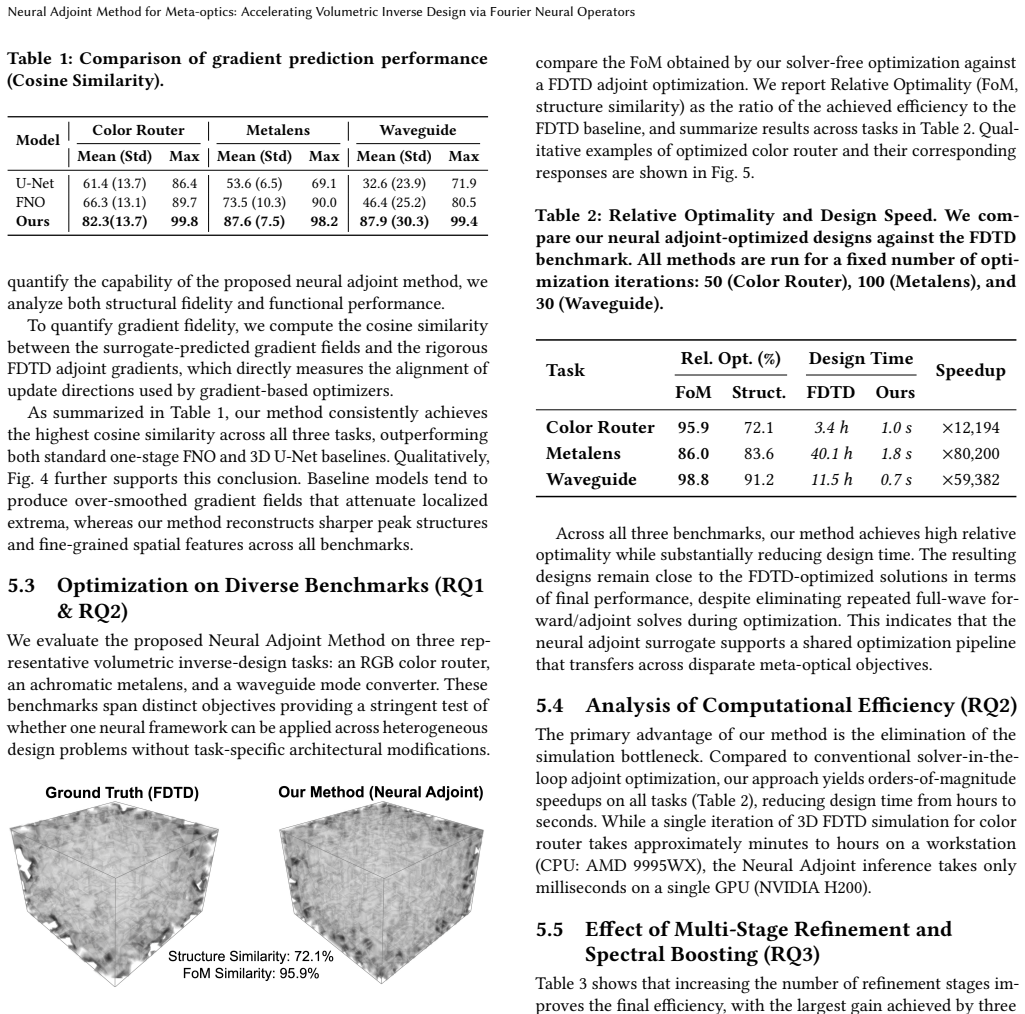
Training a stage-wise Fourier Neural Operator on paired forward and adjoint FDTD data allows the network to output accurate 3D adjoint gradient fields from permittivity inputs, so that the iterative refinement loop can proceed with fast neural predictions instead of repeated full-wave solves while still converging to functional devices.
What carries the argument
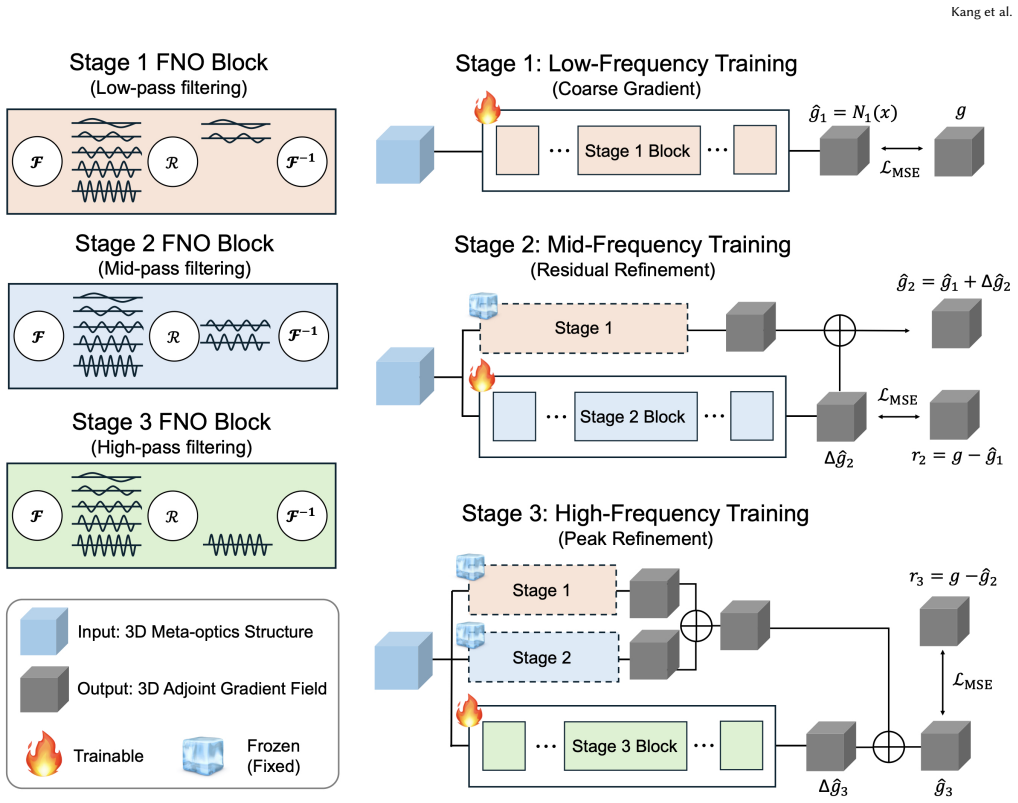
Stage-wise Fourier Neural Operator that progressively refines residual errors with increasing weight on higher-frequency components to predict sharp per-voxel adjoint sensitivity maps from 3D permittivity distributions.
If this is right
- Broadband meta-optic tasks that once required hours of simulation can finish in seconds.
- Optimization loops can include far more iterations or larger design spaces without prohibitive cost.
- The same trained surrogate applies across color routers, metalenses, and waveguide converters.
- Industrial-scale volumetric meta-optical design becomes feasible on ordinary compute hardware.
Where Pith is reading between the lines
- The surrogate could serve as a drop-in accelerator for other adjoint-based inverse problems in electromagnetics or acoustics.
- A hybrid loop that uses the fast predictor for most steps and occasional exact solves for verification might further improve robustness.
- Interactive design tools for photonics engineers could become practical once the model is sufficiently general.
- Extension to time-domain or multi-physics adjoint problems would require only new paired training data.
Load-bearing premise
The trained model must accurately predict sharp sensitivity peaks for permittivity structures that were never seen during training.
What would settle it
Perform identical inverse-design runs on the same initial structures using both the neural surrogate and standard adjoint optimization, then compare final device performance metrics; substantial degradation in the neural case would disprove the claim.
Figures



read the original abstract
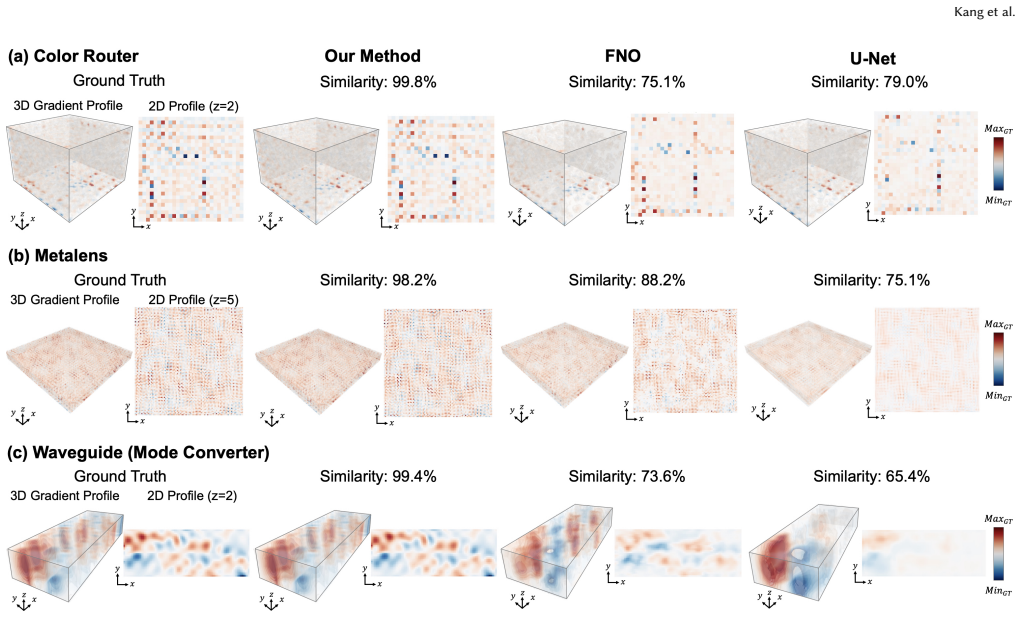
Meta-optics promises compact, high-performance imaging and color routing. However, designing high-performance structures is a high-dimensional optimization problem: mapping a desired optical output back to a physical 3D structure requires solving computationally expensive Maxwell's equations iteratively. Even with adjoint optimization, broadband design can require thousands of Maxwell solves, making industrial-scale optimization slow and costly. To overcome this challenge, we propose the Neural Adjoint Method, a solver-supervised surrogate that predicts 3D adjoint gradient fields from a voxelized permittivity volume using a Fourier Neural Operator (FNO). By learning the dense, per-voxel sensitivity field that drives gradient-based updates, our method can replace per-iteration adjoint solves with fast predictions, greatly reducing the computational cost of full-wave simulations required during iterative refinement. To better preserve sensitivity peaks, we introduce a stage-wise FNO that progressively refines residual errors with increasing emphasis on higher-frequency components. We curate a meta-optics dataset from paired forward/adjoint FDTD simulations and evaluate it across three tasks: spectral sorting (color routers), achromatic focusing (metalenses), and waveguide mode conversion. Our method reduces design time from hours to seconds. These results suggest a practical route toward fast, large-scale volumetric meta-optical design enabled by AI-accelerated scientific computing.
Editorial analysis
A structured set of objections, weighed in public.
Referee Report
Summary. The manuscript proposes the Neural Adjoint Method, which trains a Fourier Neural Operator (FNO) on paired forward and adjoint FDTD simulations to predict 3D adjoint gradient fields for meta-optical structures. This surrogate is intended to accelerate gradient-based inverse design by replacing expensive Maxwell solves during iterative optimization. A stage-wise refinement strategy is used to better capture high-frequency sensitivity features. The approach is tested on spectral sorting, achromatic focusing, and waveguide mode conversion tasks, with reported reductions in design time from hours to seconds.
Significance. If the FNO surrogate maintains sufficient accuracy on sharp per-voxel sensitivity peaks for structures generated during optimization, the method could meaningfully accelerate large-scale volumetric meta-optics design. The supervised training on external FDTD data is a standard and non-circular approach, and the stage-wise FNO addresses a relevant technical challenge in preserving high-frequency gradient information.
major comments (2)
- [Abstract] Abstract: The reported speedups on three tasks are presented without quantitative error metrics on adjoint-field predictions (e.g., L2 or peak-sensitivity error), generalization tests to optimization-generated structures, or ablation results on the stage-wise refinement. This directly affects verification of whether the surrogate preserves correct optimization trajectories.
- [Results] Results/Evaluation section: No experiments are reported that embed the trained FNO surrogate inside the iterative optimization loop and compare convergence behavior or final figures of merit against full FDTD adjoint solves on evolving permittivity volumes. This is load-bearing for the central claim that per-iteration adjoint solves can be replaced without compromising design quality.
minor comments (2)
- The description of the FNO architecture hyperparameters and training schedule could be expanded for reproducibility.
- Figure captions for the meta-optics dataset and optimization examples would benefit from explicit mention of the number of training/validation samples and the frequency content emphasized in each stage.
Simulated Author's Rebuttal
We thank the referee for their constructive comments, which have helped us improve the manuscript. We provide detailed responses to each major comment below and have updated the manuscript to address the concerns raised.
read point-by-point responses
-
Referee: [Abstract] Abstract: The reported speedups on three tasks are presented without quantitative error metrics on adjoint-field predictions (e.g., L2 or peak-sensitivity error), generalization tests to optimization-generated structures, or ablation results on the stage-wise refinement. This directly affects verification of whether the surrogate preserves correct optimization trajectories.
Authors: We agree with the referee that quantitative error metrics, generalization tests, and ablation studies are essential to verify the surrogate's performance. In the revised manuscript, we have added L2 and peak-sensitivity error metrics for the predicted adjoint fields across the test dataset. We also include generalization experiments evaluating the FNO on permittivity volumes encountered during optimization iterations, as well as an ablation study on the stage-wise refinement strategy. These additions confirm that the surrogate accurately captures the necessary gradient information to maintain correct optimization trajectories. revision: yes
-
Referee: [Results] Results/Evaluation section: No experiments are reported that embed the trained FNO surrogate inside the iterative optimization loop and compare convergence behavior or final figures of merit against full FDTD adjoint solves on evolving permittivity volumes. This is load-bearing for the central claim that per-iteration adjoint solves can be replaced without compromising design quality.
Authors: We acknowledge that embedding the surrogate within the full optimization loop is critical for validating the central claim. Accordingly, we have revised the Results section to include such experiments for all three design tasks. Specifically, we perform optimizations using the FNO surrogate for adjoint predictions and compare the convergence behavior, number of iterations, and final figures of merit (such as focusing efficiency and mode conversion fidelity) against equivalent optimizations using full FDTD adjoint solves. The results demonstrate that the surrogate-based approach achieves comparable design quality while reducing computation time from hours to seconds, thereby supporting the feasibility of replacing per-iteration solves. revision: yes
Circularity Check
No circularity: supervised FNO surrogate trained on external FDTD data
full rationale
The paper's core derivation trains a Fourier Neural Operator on curated pairs of voxelized permittivity volumes and their corresponding adjoint gradient fields obtained from independent FDTD simulations. The Neural Adjoint Method then substitutes the learned operator for per-iteration Maxwell solves inside gradient-based optimization. This mapping is learned from external data rather than defined in terms of the optimization outputs themselves; no equation reduces the predicted adjoint field to a fitted parameter or self-referential quantity by construction. Stage-wise refinement of high-frequency residuals is an architectural choice, not a redefinition of the target. No load-bearing self-citations or uniqueness theorems imported from prior author work appear in the derivation chain. The approach remains a standard supervised surrogate whose validity rests on generalization to unseen structures, which is an empirical question separate from circularity.
Axiom & Free-Parameter Ledger
free parameters (1)
- FNO network weights and stage-wise refinement schedule
axioms (1)
- domain assumption Adjoint method yields accurate per-voxel sensitivity fields for gradient-based optimization of Maxwell's equations
Reference graph
Works this paper leans on
-
[1]
Sensong An, Bowen Zheng, Hong Tang, Mikhail Y Shalaginov, Li Zhou, Hang Li, Myungkoo Kang, Kathleen A Richardson, Tian Gu, Juejun Hu, et al. 2021. Multi- functional metasurface design with a generative adversarial network.Advanced optical materials9, 5 (2021), 2001433
2021
-
[2]
Kamyar Azizzadenesheli, Nikola Kovachki, Zongyi Li, Miguel Liu-Schiaffini, Jean Kossaifi, and Anima Anandkumar. 2024. Neural operators for accelerating scientific simulations and design.Nature Reviews Physics6, 5 (2024), 320–328
2024
-
[3]
Toby Bi, Shuangyou Zhang, Egemen Bostan, Danxian Liu, Aditya Paul, Olga Ohletz, Irina Harder, Yaojing Zhang, Alekhya Ghosh, Abdullah Alabbadi, Masoud Kheyri, Tianyi Zeng, Jesse Lu, Kiyoul Yang, and Pascal Del’Haye. 2025. Inverse- Designed Silicon Nitride Nanophotonics. arXiv:2505.13383 [physics.optics] https: //arxiv.org/abs/2505.13383
-
[4]
Mingkun Chen, Robert Lupoiu, Chenkai Mao, Der-Han Huang, Jiaqi Jiang, Philippe Lalanne, and Jonathan A Fan. 2022. High speed simulation and freeform optimization of nanophotonic devices with physics-augmented deep learning. ACS Photonics9, 9 (2022), 3110–3123
2022
-
[5]
Minseok Choi, Junkyeong Park, Jehyeon Shin, Harit Keawmuang, Hongyoon Kim, Jooyeong Yun, Junhwa Seong, and Junsuk Rho. 2024. Realization of high- performance optical metasurfaces over a large area: a review from a design perspective.npj Nanophotonics1, 1 (2024), 31
2024
-
[6]
Tianxiang Dai, Yixuan Shao, Chenkai Mao, Yu Wu, Sara Azzouz, You Zhou, and Jonathan A Fan. 2025. Shaping freeform nanophotonic devices with geometric neural parameterization.npj Computational Materials11, 1 (2025), 259
2025
- [7]
- [8]
-
[9]
Jiaqi Gu, Zhengqi Gao, Chenghao Feng, Hanqing Zhu, Ray Chen, Duane Boning, and David Pan. 2022. Neurolight: A physics-agnostic neural operator enabling parametric photonic device simulation.Advances in Neural Information Processing Systems35 (2022), 14623–14636
2022
-
[10]
Tian Gu, Hyun Jung Kim, Clara Rivero-Baleine, and Juejun Hu. 2023. Reconfig- urable metasurfaces towards commercial success.Nature Photonics17, 1 (2023), 48–58
2023
-
[11]
Kaiming He, Xiangyu Zhang, Shaoqing Ren, and Jian Sun. 2016. Deep residual learning for image recognition. InProceedings of the IEEE conference on computer vision and pattern recognition. 770–778
2016
-
[12]
Jiaqi Jiang and Jonathan A Fan. 2019. Global optimization of dielectric metasur- faces using a physics-driven neural network.Nano letters19, 8 (2019), 5366–5372
2019
-
[13]
Jiaqi Jiang, David Sell, Stephan Hoyer, Jason Hickey, Jianji Yang, and Jonathan A Fan. 2019. Free-form diffractive metagrating design based on generative adver- sarial networks.ACS Nano13, 8 (2019), 8872–8878
2019
- [14]
-
[15]
Dae Eon Jung, Jonas Amann, Vincent J Einck, Justas Baltrukonis, Lucas D Verras- tro, Alex Dawicki, Mohammad Pasdarikia, Amir Arbabi, Gerhard Liedl, Andreas Otto, et al. 2026. All-Inorganic TiO2 Nanoparticle-Based Metalenses Manufac- tured by Direct Nanoimprint Lithography for High Energy Applications: Fem- tosecond Laser-Induced Damage Threshold Testing.A...
2026
-
[16]
Chanik Kang, Chaejin Park, Myunghoo Lee, Joonho Kang, Min Seok Jang, and Haejun Chung. 2024. Large-scale photonic inverse design: computational chal- lenges and breakthroughs.Nanophotonics(2024). doi:doi:10.1515/nanoph-2024- 0127
-
[17]
Chanik Kang, Dongjin Seo, Svetlana V Boriskina, and Haejun Chung. 2024. Ad- joint method in machine learning: a pathway to efficient inverse design of pho- tonic devices.Materials & Design239 (2024), 112737
2024
-
[18]
Chanik Kang, Joonhyuk Seo, Ikbeom Jang, and Haejun Chung. 2025. Adjoint method-based Fourier neural operator surrogate solver for wavefront shaping in tunable metasurfaces.iScience28, 1 (2025)
2025
-
[19]
Arseniy I Kuznetsov, Mark L Brongersma, Jin Yao, Mu Ku Chen, Uriel Levy, Din Ping Tsai, Nikolay I Zheludev, Andrei Faraon, Amir Arbabi, Nanfang Yu, et al
-
[20]
Roadmap for optical metasurfaces.ACS photonics11, 3 (2024), 816–865
2024
-
[21]
Sangbin Lee, Jaehyun Hong, Joonho Kang, Junjeong Park, Jaesung Lim, Taeho Lee, Min Seok Jang, and Haejun Chung. 2024. Inverse design of color routers in CMOS image sensors: toward minimizing interpixel crosstalk.Nanophotonics13, 20 (2024), 3895–3914
2024
-
[22]
Zongyi Li, Nikola Kovachki, Kamyar Azizzadenesheli, Burigede Liu, Kaushik Bhattacharya, Andrew Stuart, and Anima Anandkumar. 2020. Fourier neural oper- ator for parametric partial differential equations.arXiv preprint arXiv:2010.08895 (2020)
work page internal anchor Pith review arXiv 2020
-
[23]
Ruotian Lin, Cheng Zhang, Wangqi Mao, Jiahao Ge, Hongxing Dong, and Long Zhang. 2025. Diffusion model-based inverse design of photonic crystals for customized refraction.Nanophotonics14, 27 (2025), 5537–5544
2025
-
[24]
Xinliang Liu, Bo Xu, Shuhao Cao, and Lei Zhang. 2024. Mitigating spectral bias for the multiscale operator learning.J. Comput. Phys.506 (2024), 112944
2024
-
[25]
Chenkai Mao, Sandra S Leuthold, and Jonathan A Fan. 2025. Metamaterial inverse design using diffusion models. InAI and Optical Data Sciences VI. SPIE, PC1337516
2025
-
[26]
Reza Marzban, Ali Adibi, and Raphaël Pestourie. 2026. Inverse design in nanopho- tonics via representation learning.Advanced Optical Materials14, 1 (2026), e02062
2026
-
[27]
2012.Photonic Design: From Fundamental Solar Cell Physics to Computational Inverse Design
Owen Miller. 2012.Photonic Design: From Fundamental Solar Cell Physics to Computational Inverse Design. Ph. D. Dissertation. EECS Department, University of California, Berkeley. http://www2.eecs.berkeley.edu/Pubs/TechRpts/2012/ EECS-2012-115.html
2012
- [28]
-
[29]
Oskooi, David Roundy, Mihai Ibanescu, Peter Bermel, J.D
Ardavan F. Oskooi, David Roundy, Mihai Ibanescu, Peter Bermel, J.D. Joannopou- los, and Steven G. Johnson. 2010. Meep: A flexible free-software package for electromagnetic simulations by the FDTD method.Computer Physics Communi- cations181, 3 (2010), 687–702
2010
-
[30]
Chanhyung Park, Sangbin Lee, Taeho Lee, Jiwon Kang, Jaehyun Jeon, Chaejin Park, Sanmun Kim, Haejun Chung, and Min Seok Jang. 2024. Towards sub- wavelength pixels: nanophotonic color routers for ultra-compact high-efficiency CMOS image sensors.Journal of Optics26, 9 (2024), 093002
2024
-
[31]
Phillippe Pearson, Gregory Roberts, and Andrei Faraon. 2025. Inverse-designed metasurfaces for multifunctional spatial frequency filtering.Optica12, 7 (2025), 1090–1099
2025
-
[32]
Raphaël Pestourie, Carlos Pérez-Arancibia, Zin Lin, Wonseok Shin, Federico Capasso, and Steven G Johnson. 2018. Inverse design of large-area metasurfaces. Optics express26, 26 (2018), 33732–33747
2018
-
[33]
Shaoxiang Qin, Fuyuan Lyu, Wenhui Peng, Dingyang Geng, Ju Wang, Naiping Gao, Xue Liu, and Liangzhu Leon Wang. 2024. Toward a better understanding of fourier neural operators: Analysis and improvement from a spectral perspective. CoRR(2024)
2024
-
[34]
Nasim Rahaman, Aristide Baratin, Devansh Arpit, Felix Draxler, Min Lin, Fred Hamprecht, Yoshua Bengio, and Aaron Courville. 2019. On the spectral bias of neural networks. InInternational conference on machine learning. PMLR, 5301– 5310
2019
-
[35]
Joonhyuk Seo, Chanik Kang, Dongjin Seo, and Haejun Chung. 2024. Wave interpolation neural operator: Interpolated prediction of electric fields across un- trained wavelengths. InNeurIPS 2024 Workshop on Data-driven and Differentiable Simulations, Surrogates, and Solvers
2024
-
[36]
Sunae So and Junsuk Rho. 2019. Designing nanophotonic structures using condi- tional deep convolutional generative adversarial networks.Nanophotonics8, 7 (2019), 1255–1261
2019
-
[37]
Haoyu Wang, Zongliang Du, Fuyong Feng, Zhong Kang, Shan Tang, and Xu Guo
-
[38]
DiffMat: Data-driven inverse design of energy-absorbing metamaterials using diffusion model.Computer Methods in Applied Mechanics and Engineering 432 (2024), 117440
2024
-
[39]
Jiahui Wang, Yu Shi, Tyler Hughes, Zhexin Zhao, and Shanhui Fan. 2018. Adjoint- based optimization of active nanophotonic devices.Optics Express26, 3 (2018), 3236–3248
2018
-
[40]
Yujie Wang, Qinmiao Chen, Wenhong Yang, Ziheng Ji, Limin Jin, Xing Ma, Qinghai Song, Alexandra Boltasseva, Jiecai Han, Vladimir M Shalaev, et al. 2021. Kang et al. High-efficiency broadband achromatic metalens for near-IR biological imaging window.Nature communications12, 1 (2021), 5560
2021
-
[41]
Zezhou Zhang, Chuanchuan Yang, Yifeng Qin, Hao Feng, Jiqiang Feng, and Hongbin Li. 2023. Diffusion probabilistic model based accurate and high-degree- of-freedom metasurface inverse design.Nanophotonics12, 20 (2023), 3871–3881
2023
-
[42]
Xiujuan Zou, Youming Zhang, Ruoyu Lin, Guangxing Gong, Shuming Wang, Shining Zhu, and Zhenlin Wang. 2022. Pixel-level Bayer-type colour router based on metasurfaces.Nature Communications13, 1 (2022), 3288. Received 19 April 2026
2022
discussion (0)
Sign in with ORCID, Apple, or X to comment. Anyone can read and Pith papers without signing in.