Recognition: unknown
Testing α-attractor P-model of inflation by Cosmic Microwave Background radiation
Pith reviewed 2026-05-10 05:46 UTC · model grok-4.3
The pith
Polynomial α-attractor models can fit the observed CMB values of the spectral index and tensor ratio.
A machine-rendered reading of the paper's core claim, the machinery that carries it, and where it could break.
Core claim
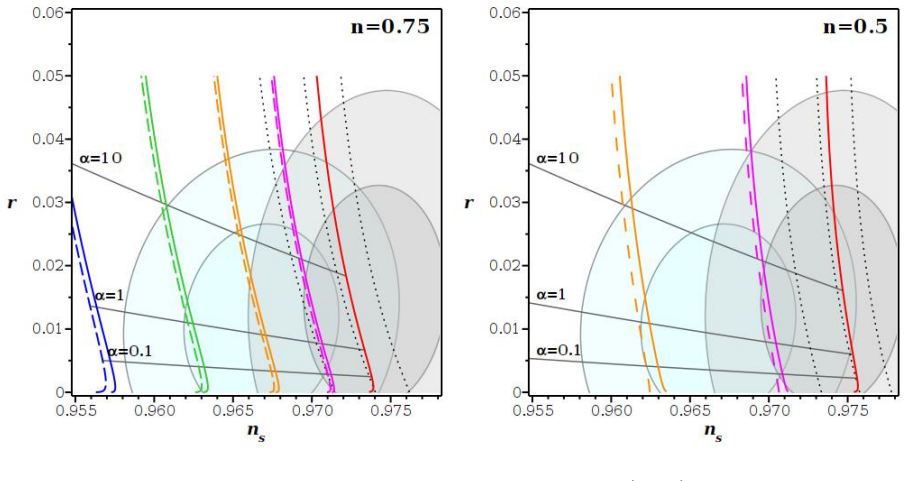
In the polynomial class of α-attractor inflaton potential models, accounting for inflaton decays and fragmentation during reheating produces predictions for ns and r that lie within the ranges allowed by Planck and Planck plus ACT CMB observations.
What carries the argument
The direct mapping from model-independent reheating-temperature bounds to narrow ranges of CMB observables ns and r in a specific model.
If this is right
- The allowed bands for ns and r become narrow and depend on the reheating temperature.
- Both Planck-only and Planck+ACT data can be accommodated within the P-model class.
- Results are sensitive to the value of the reheating temperature and to the upper bound on r.
Where Pith is reading between the lines
- Similar reheating-based constraints could narrow the viable parameter space for other families of inflation models.
- Improved future measurements of r could exclude large portions of the polynomial α-attractor models.
- The importance of including fragmentation in reheating calculations suggests that more detailed post-inflation dynamics should be modeled for other scenarios.
Load-bearing premise
Model-independent bounds on the reheating temperature can be translated into narrow ranges for the CMB observables ns and r once the inflaton decay and fragmentation processes are specified.
What would settle it
A future measurement of ns and r that falls outside every narrow band predicted by the P-models for any reasonable reheating temperature would falsify the claim that this class accommodates the data.
Figures


read the original abstract
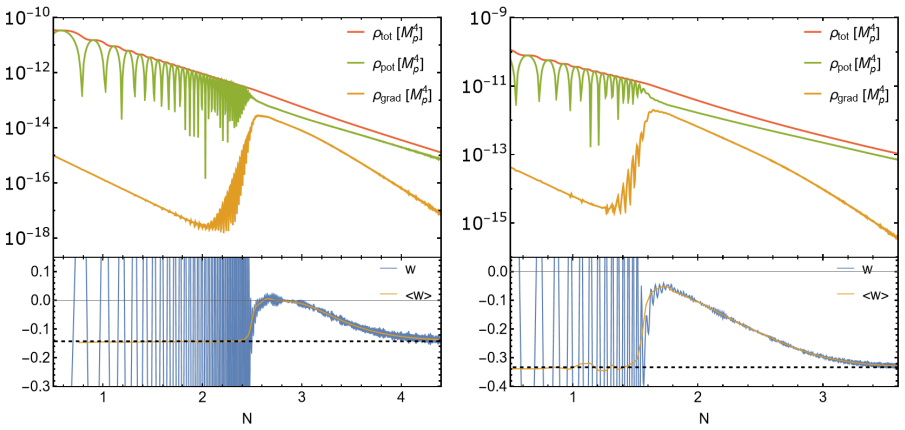
In a recently proposed approach to testing models of inflation by Cosmic Microwave Background (CMB) radiation the reheating temperature is directly expressed in terms of the CMB observables. Its model independent bounds translate in a given model into narrow ranges of those observables. In that approach we analyse the polynomial class of the $\alpha$-attractor inflaton potential models (P-models), in a broad range of polynomials and with the inflaton decays and fragmentation in the reheating period taken into account. The predictions for the CMB observables, the scalar spectral index $n_s$ and tensor-to-scalar ratio $r$, are compared with the Planck and Planck combined with ACT data. Both can be accommodated by that class of the $\alpha$ attractor models. The sensitivity of the results of that comparison to the reheating temperature and to the upper bound on the ratio $r$ is clearly demonstrated.
Editorial analysis
A structured set of objections, weighed in public.
Referee Report
Summary. The paper applies a recently proposed method in which the reheating temperature is expressed directly in terms of the CMB observables ns and r. Model-independent bounds on Trh (incorporating inflaton decays and fragmentation) are mapped onto narrow ranges of ns and r for the polynomial class of α-attractor P-models over a broad range of polynomial degrees. The resulting bands are compared with Planck and Planck+ACT constraints; both datasets are found to be accommodated, with explicit sensitivity to Trh and the r upper bound demonstrated.
Significance. If the mapping holds, the work supplies a practical route for constraining α-attractor models with current CMB data by folding in reheating physics. Credit is due for performing the explicit translation across a wide polynomial range, showing the resulting observable bands overlap the data contours, and demonstrating sensitivity to Trh and the r bound in figures. These elements make the central claim falsifiable and reproducible within the stated framework.
minor comments (2)
- [Abstract] The abstract states that a 'broad range of polynomials' is considered but does not quote the exact interval of degrees or the sampling used; adding this detail (or a reference to the relevant table/figure) would improve clarity for readers unfamiliar with the prior work on the method.
- [§2] Notation for the polynomial coefficients and the precise definition of the α-attractor potential (e.g., the form of V(φ) in the P-model) should be stated once in the main text before the numerical results, even if referenced from earlier papers.
Simulated Author's Rebuttal
We thank the referee for the positive and constructive assessment of our manuscript. The report accurately summarizes our approach of mapping model-independent reheating bounds (including inflaton decays and fragmentation) onto narrow ranges of ns and r for the polynomial α-attractor P-models, and correctly notes that both Planck and Planck+ACT data are accommodated with demonstrated sensitivity to Trh and the r upper bound. We appreciate the recognition that the central claim is falsifiable and reproducible within the stated framework. No specific major comments were raised requiring clarification or correction.
Circularity Check
No significant circularity identified
full rationale
The paper's central derivation applies externally derived, model-independent bounds on reheating temperature (Trh) to the α-attractor P-models by computing the explicit mapping from Trh to the observables ns and r, incorporating inflaton decays and fragmentation for a broad range of polynomial potentials. This mapping is performed directly from the model's equations and shown with sensitivity to Trh and r bounds; the resulting narrow ranges are then compared to Planck and Planck+ACT data contours. No step reduces a prediction to a fitted input by construction, no load-bearing premise rests solely on overlapping-author self-citation without independent content, and the translation uses standard inflationary relations without smuggling ansatze or renaming known results. The derivation remains self-contained against external benchmarks.
Axiom & Free-Parameter Ledger
free parameters (2)
- α parameter
- polynomial degree and coefficients
axioms (1)
- domain assumption Reheating temperature can be directly expressed in terms of CMB observables with model-independent bounds that translate to narrow ranges in a given model
Forward citations
Cited by 1 Pith paper
-
New Exponential and Polynomial $\xi$-attractors
New family of ξ-attractors yields ns in the interval 1-2/N ≤ ns < 1-1/N with r approaching zero as ξ grows large, plus a supergravity embedding.
Reference graph
Works this paper leans on
- [1]
-
[2]
R. Kallosh, A. Linde, and D. Roest,Atacama Cosmology Telescope, South Pole Telescope, and Chaotic Inflation, Phys. Rev. Lett.135(2025), no. 16 161001, [arXiv:2503.21030]
- [3]
- [4]
-
[5]
S. Brahma and J. Calderón-Figueroa,Is the CMB revealing signs of pre-inflationary physics?,arXiv:2504.02746
-
[6]
C. Dioguardi, A. J. Iovino, and A. Racioppi,Fractional attractors in light of the latest ACT observations, Phys. Lett. B868(2025) 139664, [arXiv:2504.02809]
- [7]
-
[8]
Independent connection in action during inflation,
A. Salvio,Independent connection in action during inflation, Phys. Rev. D112 (2025), no. 6 L061301, [arXiv:2504.10488]
- [9]
-
[10]
How accidental was inflation?,
I. Antoniadis, J. Ellis, W. Ke, D. V. Nanopoulos, and K. A. Olive,How accidental was inflation?, JCAP08(2025) 090, [arXiv:2504.12283]
-
[11]
C. Dioguardi and A. Karam,Palatini linear attractors are back in action, Phys. Rev. D111(2025), no. 12 123521, [arXiv:2504.12937]
- [12]
- [13]
-
[14]
M. Drees and Y. Xu,Refined predictions for Starobinsky inflation and post-inflationary constraints in light of ACT, Phys. Lett. B867(2025) 139612, [arXiv:2504.20757]. 20
- [15]
- [16]
-
[17]
L. Liu, Z. Yi, and Y. Gong,Reconciling Higgs Inflation with ACT Observations through Reheating,arXiv:2505.02407
work page internal anchor Pith review Pith/arXiv arXiv
-
[18]
Yin, [arXiv:2505.03004 [hep-ph]]
W. Yin,Higgs-like inflation ACTivated mass, JCAP09(2025) 062, [arXiv:2505.03004]
- [19]
- [20]
-
[21]
Yogesh, A. Mohammadi, Q. Wu, and T. Zhu,Starobinsky like inflation and EGB Gravity in the light of ACT, JCAP10(2025) 010, [arXiv:2505.05363]
- [22]
- [23]
- [24]
-
[25]
S. Maity,ACT-ing on inflation: Implications of non bunch-Davies initial condition and reheating on single-field slow roll models, Phys. Lett. B870(2025) 139913, [arXiv:2505.10534]
work page internal anchor Pith review Pith/arXiv arXiv 2025
-
[26]
Z.-Z. Peng, Z.-C. Chen, and L. Liu,Polynomial potential inflation in the ACT era: From CMB to primordial black holes, Phys. Rev. D113(2026), no. 6 063527, [arXiv:2505.12816]
- [27]
-
[28]
R. Kallosh and A. Linde,On the present status of inflationary cosmology, Gen. Rel. Grav.57(2025), no. 10 135, [arXiv:2505.13646]. 21
- [29]
-
[30]
Pallis, [arXiv:2505.23243 [hep-ph]]
C. Pallis,Kinetically modified Palatini inflation meets ACT data, Phys. Lett. B868 (2025) 139739, [arXiv:2505.23243]
-
[31]
What new physics can we extract from inflation using the
S. Choudhury, G. Bauyrzhan, S. K. Singh, and K. Yerzhanov,What new physics can we extract from inflation using the ACT DR6 and DESI DR2 Observations?, arXiv:2506.15407
- [32]
- [33]
-
[34]
A. Ghoshal, P. Kozów, M. Olechowski, and S. Pokorski,CMB observables and reheat temperature as a window to models of inflation and freeze-in dark matter production,arXiv:2510.27587
-
[35]
Superconformal generalizations of the Starobinsky model,
R. Kallosh and A. Linde,Superconformal generalizations of the Starobinsky model, JCAP06(2013) 028, [arXiv:1306.3214]
-
[36]
Universality Class in Conformal Inflation
R. Kallosh and A. Linde,Universality Class in Conformal Inflation, JCAP07 (2013) 002, [arXiv:1306.5220]
work page Pith review arXiv 2013
-
[37]
Superconformal Inflationary $\alpha$-Attractors
R. Kallosh, A. Linde, and D. Roest,Superconformal Inflationaryα-Attractors, JHEP11(2013) 198, [arXiv:1311.0472]
work page Pith review arXiv 2013
-
[38]
R. Kallosh and A. Linde,Superconformal generalization of the chaotic inflation model λ 4 ϕ4 − ξ 2 ϕ2R, JCAP06(2013) 027, [arXiv:1306.3211]
-
[39]
Non-minimal Inflationary Attractors,
R. Kallosh and A. Linde,Non-minimal Inflationary Attractors, JCAP10(2013) 033, [arXiv:1307.7938]
-
[40]
The Unity of Cosmological Attractors
M. Galante, R. Kallosh, A. Linde, and D. Roest,Unity of Cosmological Inflation Attractors, Phys. Rev. Lett.114(2015), no. 14 141302, [arXiv:1412.3797]
work page Pith review arXiv 2015
-
[41]
R. Kallosh and A. Linde,Polynomialα-attractors, JCAP04(2022), no. 04 017, [arXiv:2202.06492]
-
[42]
E. W. Kolb and M. S. Turner,The Early Universe, vol. 69. Taylor and Francis, 5, 2019
2019
-
[43]
Weinberg,Cosmology
S. Weinberg,Cosmology. Oxford University Press, 2008
2008
- [44]
- [45]
- [46]
-
[47]
S. Antusch, D. G. Figueroa, K. Marschall, and F. Torrenti,Characterizing the postinflationary reheating history: Single daughter field with quadratic-quadratic interaction, Phys. Rev. D105(2022), no. 4 043532, [arXiv:2112.11280]
-
[48]
S. Antusch, K. Marschall, and F. Torrenti,Characterizing the post-inflationary reheating history. Part II. Multiple interacting daughter fields, JCAP02(2023) 019, [arXiv:2206.06319]. [59]LiteBIRDCollaboration, E. Allyset. al.,Probing Cosmic Inflation with the LiteBIRD Cosmic Microwave Background Polarization Survey, PTEP2023(2023), no. 4 042F01, [arXiv:22...
- [49]
discussion (0)
Sign in with ORCID, Apple, or X to comment. Anyone can read and Pith papers without signing in.