Recognition: unknown
Low-dimensional platforms for single photon detection
Pith reviewed 2026-05-10 05:54 UTC · model grok-4.3
The pith
Low-dimensional platforms including quantum dots, superconducting nanowires and layered materials are key to advancing single-photon detector performance for quantum technologies.
A machine-rendered reading of the paper's core claim, the machinery that carries it, and where it could break.
Core claim
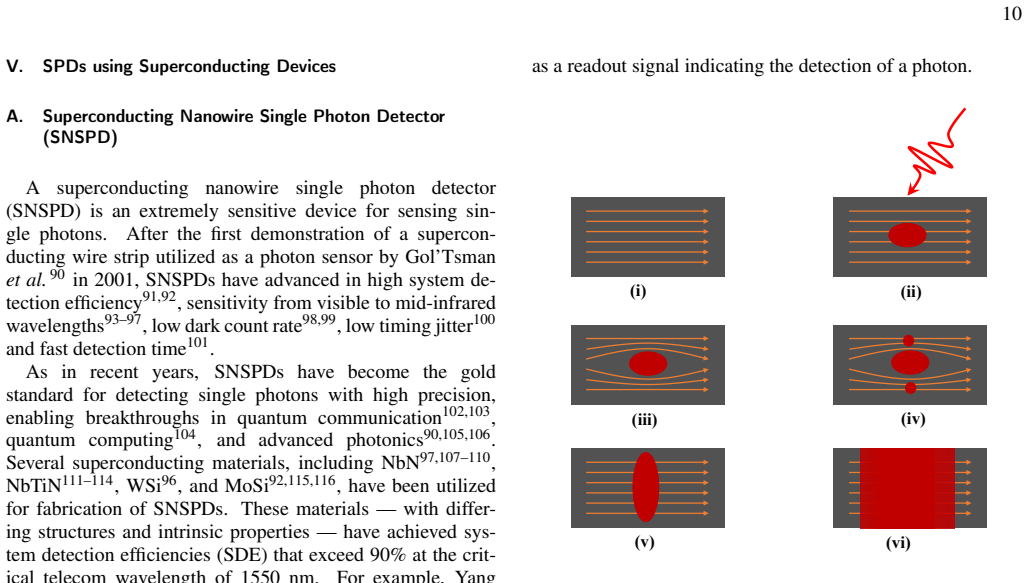
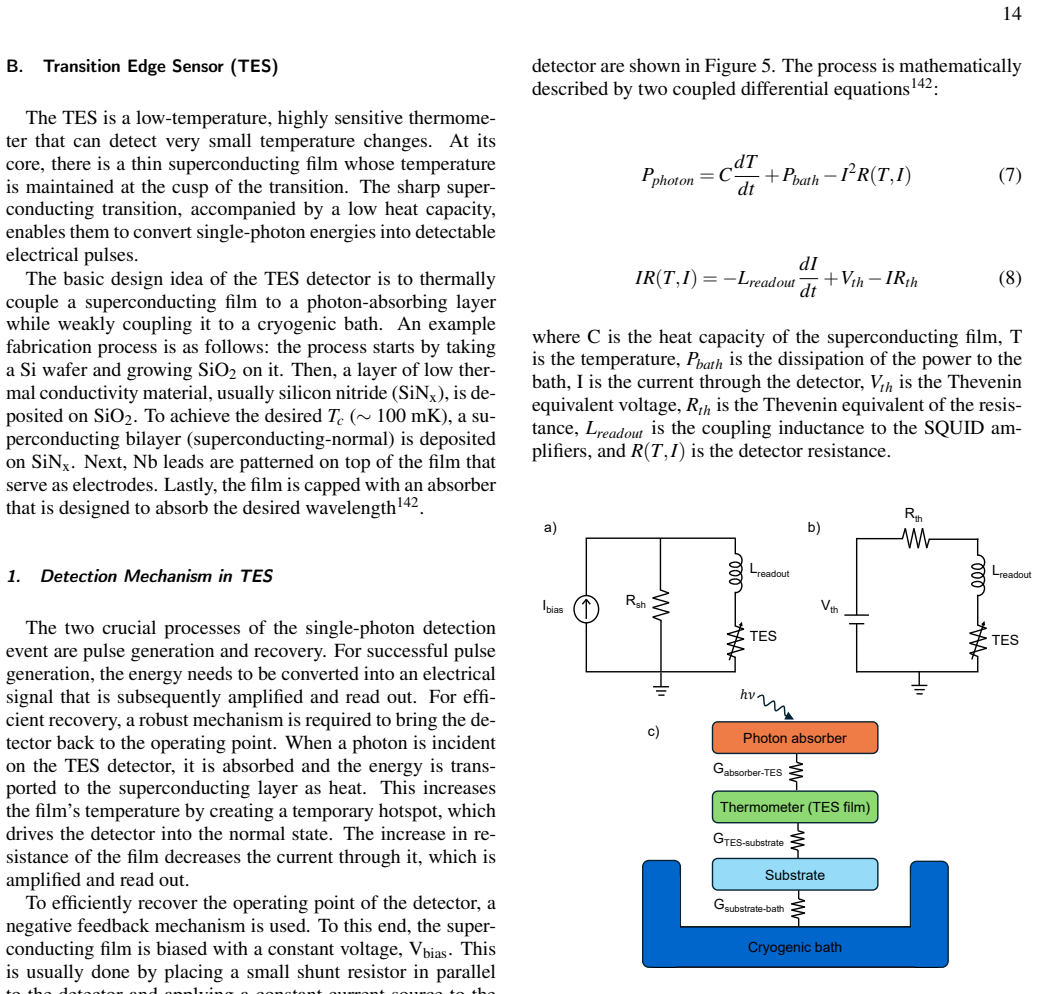
Low-dimensional platforms, including quantum dots, superconducting nanowires and layered materials, have emerged as crucial frontiers for single-photon detectors. The review maps the engineering physics of their architectures, compares performance parameters across platforms, addresses inherent challenges, and outlines future research directions needed to advance next-generation technologies driven by quantum information science and low-light sensing demands.
What carries the argument
Critical comparison of performance parameters and engineering physics across device architectures of quantum dots, superconducting nanowires, and layered materials.
If this is right
- Targeted engineering of each platform can raise detection efficiency while lowering noise for quantum communication links.
- Hybrid devices that combine strengths of different low-dimensional materials become a logical next step.
- Scalable fabrication routes identified in the review can accelerate integration into practical systems.
- Application-specific optimization, such as timing resolution for quantum computing, follows directly from the performance comparisons.
- Addressing platform-specific challenges will expand the range of usable wavelengths and operating temperatures.
Where Pith is reading between the lines
- Integration of these detectors with photonic chips could enable compact on-chip quantum processors.
- The performance maps may inform material selection for sensing in astronomy or biological imaging where single-photon sensitivity matters.
- Experimental tests of the suggested future directions, such as new heterostructures, would provide direct validation of the review's guidance.
Load-bearing premise
The reviewed platforms comprehensively represent the main frontiers and that the performance comparisons accurately reflect the current state without major omissions.
What would settle it
Publication of a high-performing single-photon detector based on a material system or architecture omitted from the review, or new experimental data that contradict the stated performance trade-offs between the covered platforms.
Figures




read the original abstract
A Single-Photon Detector (SPD) can detect extremely low intensity of electromagnetic wave - down to a single photon. Driven by the rapid developments in quantum information science and an increasing demand for ultra-low-light sensing across various domains, there is a need for transformative advancements in the design and development of SPDs. In this context, low-dimensional platforms, including quantum dots, superconducting nanowires and layered materials have emerged as crucial frontiers of research. This review explores the state-of-the-art of different low-dimensional SPD platforms, focusing on the engineering physics across their device architectures, performance parameters and application potential. By critically comparing the performance and addressing current challenges inherent to each low-dimensional platform, the review aims to outline future research directions to advance next-generation SPD technologies.
Editorial analysis
A structured set of objections, weighed in public.
Referee Report
Summary. The manuscript is a review article surveying low-dimensional platforms for single-photon detectors (SPDs), focusing on quantum dots, superconducting nanowires, and layered materials. It covers device architectures, engineering physics, performance parameters, challenges, application potential, and suggests future research directions to advance next-generation SPD technologies for quantum information and ultra-low-light sensing.
Significance. If the comparisons of performance parameters are accurate and comprehensive, the review could serve as a useful synthesis for researchers working on SPDs, highlighting trade-offs across platforms and identifying open challenges. The critical approach to comparing platforms and outlining directions is a strength for guiding experimental efforts in the field.
minor comments (3)
- [Abstract] Abstract: The claim of a 'critical comparison' of performance parameters would be strengthened by briefly naming the key metrics (e.g., detection efficiency, dark count rate, timing jitter) and the time window of literature covered.
- [Conclusions] The review would benefit from a summary table in the conclusions section that directly juxtaposes the best-reported values for each platform across the main performance metrics, with citations.
- [Figures] Some figure captions could be expanded to include the specific device parameters or operating conditions shown, to aid readers who may not consult the original references.
Simulated Author's Rebuttal
We thank the referee for their constructive review and recommendation of minor revision. The manuscript provides a critical synthesis of low-dimensional SPD platforms, and we have verified that all performance comparisons are accurate and comprehensive based on the cited literature.
Circularity Check
No significant circularity: review paper with no derivations or predictions
full rationale
This is a review article summarizing existing literature on low-dimensional single-photon detectors (quantum dots, superconducting nanowires, layered materials). It presents no original equations, models, fitted parameters, predictions, or theorems. All content draws from prior published work without internal reduction of claims to self-defined inputs or self-citations that bear the central load. The reader's assessment of score 0.0 is confirmed; the paper is self-contained as a descriptive survey.
Axiom & Free-Parameter Ledger
Reference graph
Works this paper leans on
-
[1]
Planck, ¨Uber das Gesetz der Energieverteilung im Normalspektrum, Ann
Arrays of SPDs are becom- ing increasingly popular for various ultra-low signal optical spectroscopy261 and metrology262techniques. VIII. Conclusion In summary, while conventional SPADs remain a ma- ture technology with room temperature operation, low- dimensional platforms offer pathways to innovate and im- prove SPDs in other aspects of performance for ...
-
[2]
Bolometer noise: nonequilibrium theory,
44J. C. Mather, “Bolometer noise: nonequilibrium theory,” Applied optics 21, 1125–1129 (1982). 45E. D. Walsh, D. K. Efetov, G.-H. Lee, M. Heuck, J. Crossno, T. A. Ohki, P. Kim, D. Englund, and K. C. Fong, “Graphene-based josephson-junction single-photon detector,” Physical Review Applied8, 024022 (2017). 46A. Fleischmann, A. Reiser, and C. Enss, “Noise th...
-
[3]
Demonstration of a thermally coupled row- column snspd imaging array,
pp. 1–3. 71J. P. Allmaras, E. E. Wollman, A. D. Beyer, R. M. Briggs, B. A. Korzh, B. Bumble, and M. D. Shaw, “Demonstration of a thermally coupled row- column snspd imaging array,” Nano letters20, 2163–2168 (2020). 72Q. Li, J. Lu, P. Gupta, and M. Qiu, “Engineering optical absorption in graphene and other 2d materials: advances and applications,” Advanced...
2020
-
[4]
High- efficiency superconducting nanowire single-photon detectors fabricated from mosi thin-films,
pp. 1–2. 116V . B. Verma, B. Korzh, F. Bussieres, R. D. Horansky, S. D. Dyer, A. E. Lita, I. Vayshenker, F. Marsili, M. D. Shaw, H. Zbinden,et al., “High- efficiency superconducting nanowire single-photon detectors fabricated from mosi thin-films,” Optics express23, 33792–33801 (2015). 117X. Yang, L. You, L. Zhang, C. Lv, H. Li, X. Liu, H. Zhou, and Z. Wa...
2015
-
[5]
Design of a polarization- insensitive and high-efficiency coplanar edge coupler for silicon photonics by using a polished conical silicon-cored-fiber,
pp. 1–8. 138S.-P. Yang, C.-H. Wu, and L. A. Wang, “Design of a polarization- insensitive and high-efficiency coplanar edge coupler for silicon photonics by using a polished conical silicon-cored-fiber,” IEEE Photonics Journal 16, 1–4 (2023). 139G. Son, R. A. Pradono, J.-B. You, Y . Jeong, K. Kwon, J. Park, S. Han, D. S. Han, Y . Jung, and K. Yu, “Highly e...
2023
-
[6]
An application of electrothermal feedback for high resolu- tion cryogenic particle detection,
pp. 63–150, series Title: Topics in Applied Physics. 143K. D. Irwin, “An application of electrothermal feedback for high resolu- tion cryogenic particle detection,” Applied Physics Letters66, 1998–2000 (1995). 144B. Cabrera, R. M. Clarke, P. Colling, A. J. Miller, S. Nam, and R. W. Romani, “Detection of single infrared, optical, and ultraviolet photons us...
1998
-
[7]
Compact cryogenic self-aligning fiber-to-detector coupling with losses below one percent,
pp. 60–69. 150A. J. Miller, A. E. Lita, B. Calkins, I. Vayshenker, S. M. Gruber, and S. W. Nam, “Compact cryogenic self-aligning fiber-to-detector coupling with losses below one percent,” Optics Express19, 9102–9110 (2011). 151R. Kobayashi, K. Hattori, S. Inoue, and D. Fukuda, “Development of a Fast Response Titanium-Gold Bilayer Optical TES With an Optic...
2011
-
[8]
SCUBA-2: the 10 000 pixel bolometer camera on the James Clerk Maxwell Telescope,
p. 70200N. 159W. S. Holland, D. Bintley, E. L. Chapin, A. Chrysostomou, G. R. Davis, J. T. Dempsey, W. D. Duncan, M. Fich, P. Friberg, M. Halpern, K. D. Irwin, T. Jenness, B. D. Kelly, M. J. MacIntosh, E. I. Robson, D. Scott, P. A. R. Ade, E. Atad-Ettedgui, D. S. Berry, S. C. Craig, X. Gao, A. G. Gibb, G. C. Hilton, M. I. Hollister, J. B. Kycia, D. W. Lun...
2013
-
[9]
Accurate unsupervised photon counting from transition- edge-sensor signals,
p. 76810D. 165N. Dalbec-Constant, G. Thekkadath, D. England, B. Sussman, T. Gerrits, and N. Quesada, “Accurate unsupervised photon counting from transition- edge-sensor signals,” Physical Review Applied24, 034018 (2025). 166M. Eaton, A. Hossameldin, R. J. Birrittella, P. M. Alsing, C. C. Gerry, H. Dong, C. Cuevas, and O. Pfister, “Resolution of 100 photon...
2025
-
[10]
Spcm-aqrh-1x single photon counting module – specifications,
(2005). 195Excelitas Technologies, “Spcm-aqrh-1x single photon counting module – specifications,”https://www.excelitas.com/product/spcm-aqrh (2025), accessed: 2025-12-10. 196ID Quantique SA, “Id230 infrared single-photon detector – specifications,” https://www.idquantique.com/quantum-detection-systems/ products/id230/(2025), accessed: 2025-12-10. 197N. Na...
2005
-
[11]
Single photon detectors for auto- motive lidar applications: State-of-the-art and research challenges,
pp. ATu3A–3. 227X. Qian, W. Jiang, and M. J. Deen, “Single photon detectors for auto- motive lidar applications: State-of-the-art and research challenges,” IEEE Journal of Selected Topics in Quantum Electronics30, 1–20 (2023). 228J. S. Massa, G. S. Buller, A. C. Walker, S. Cova, M. Umasuthan, and A. M. Wallace, “Time-of-flight optical ranging system based...
2023
-
[12]
Spectral photon-counting computed tomography (spcct): in-vivo single- acquisition multi-phase liver imaging with a dual contrast agent protocol,
pp. 17–45. 246S. Si-Mohamed, V . Tatard-Leitman, A. Laugerette, M. Sigovan, D. Pfeif- fer, E. J. Rummeny, P. Coulon, Y . Yagil, P. Douek, L. Boussel,et al., “Spectral photon-counting computed tomography (spcct): in-vivo single- acquisition multi-phase liver imaging with a dual contrast agent protocol,” Scientific reports9, 8458 (2019). 247F. Pajot, D. Bar...
2019
-
[13]
Background imaging of cosmic extragalactic polariza- tion (bicep): An experimental probe of inflation,
p. 590401. 253A. E. Lange, “Background imaging of cosmic extragalactic polariza- tion (bicep): An experimental probe of inflation,” NSF Award Number 0230438. Directorate for Geosciences2, 30438 (2003). 254T. Essinger-Hileman, A. Ali, M. Amiri, J. W. Appel, D. Araujo, C. L. Bennett, F. Boone, M. Chan, H.-M. Cho, D. T. Chuss,et al., “Class: the cosmology la...
2003
-
[14]
Aqueye+: a new ultrafast single photon counter for optical high time resolution astro- physics,
pp. 130–140. 258L. Zampieri, G. Naletto, C. Barbieri, E. Verroi, M. Barbieri, G. Ceribella, M. D’Alessandro, G. Farisato, A. Di Paola, and P. Zoccarato, “Aqueye+: a new ultrafast single photon counter for optical high time resolution astro- physics,” inPhoton Counting Applications 2015, V ol. 9504 (SPIE,
2015
-
[15]
Spectral correlation measurements at the hong-ou-mandel interference dip,
pp. 229–238. 260T. Gerrits, F. Marsili, V . B. Verma, L. K. Shalm, M. Shaw, R. Mirin, and S. W. Nam, “Spectral correlation measurements at the hong-ou-mandel interference dip,” Physical Review A91, 013830 (2015). 261C. S. Tye, A. Kufcsák, C. A. Ross, K. Ehrlich, R. K. Henderson, and M. G. Tanner, “Time-resolved raman spectroscopy using a cmos spad array t...
2015
discussion (0)
Sign in with ORCID, Apple, or X to comment. Anyone can read and Pith papers without signing in.