Recognition: unknown
Electron-Impact Quasi-Resonant Ion-Pair Dissociation of OCS: A Velocity Slice Imaging Study with Partial Wave Analysis
Pith reviewed 2026-05-10 05:51 UTC · model grok-4.3
The pith
Electron-impact ion-pair dissociation in OCS proceeds via quasi-resonant hybrid Rydberg-ion-pair states rather than direct dipole excitation.
A machine-rendered reading of the paper's core claim, the machinery that carries it, and where it could break.
Core claim
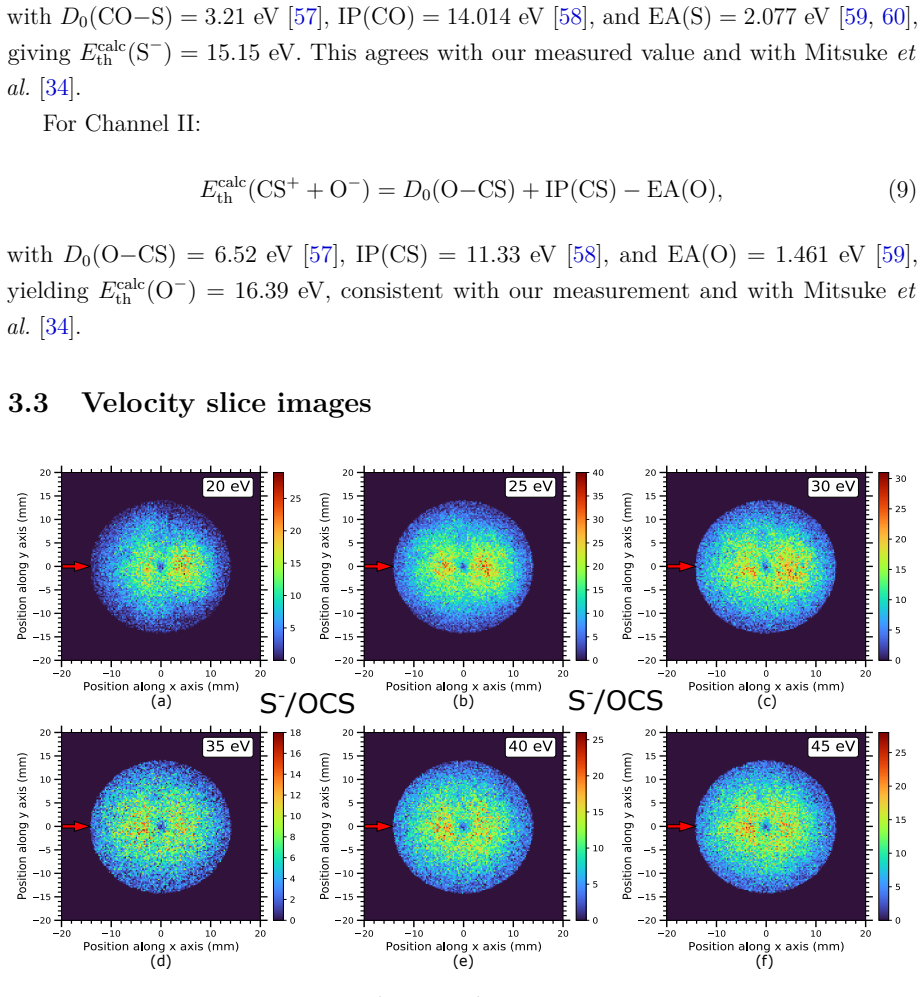
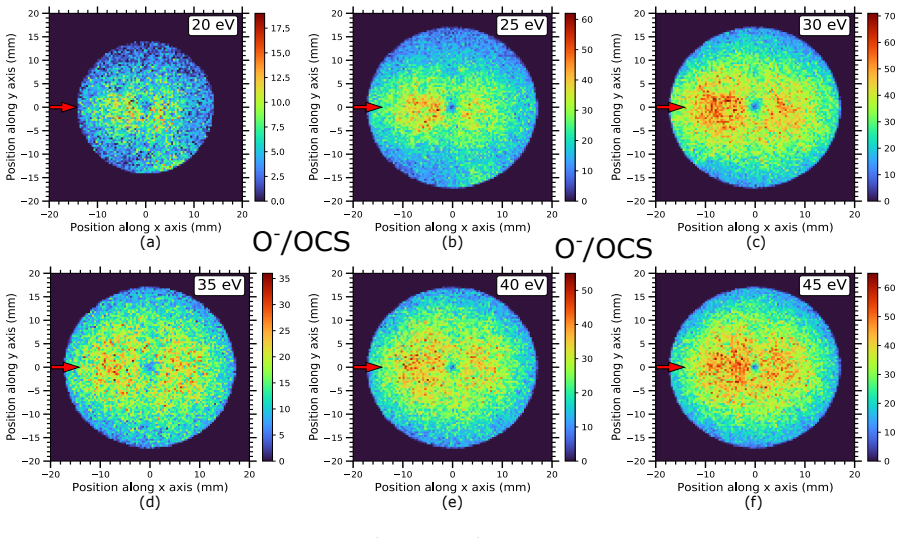
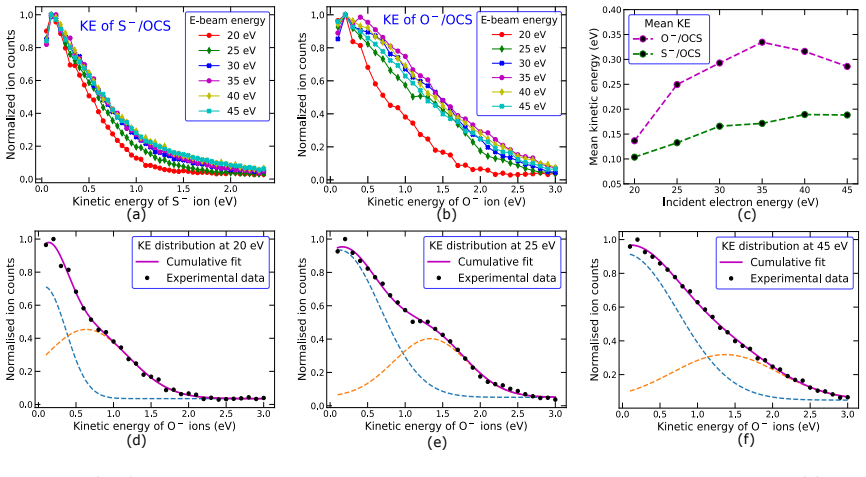
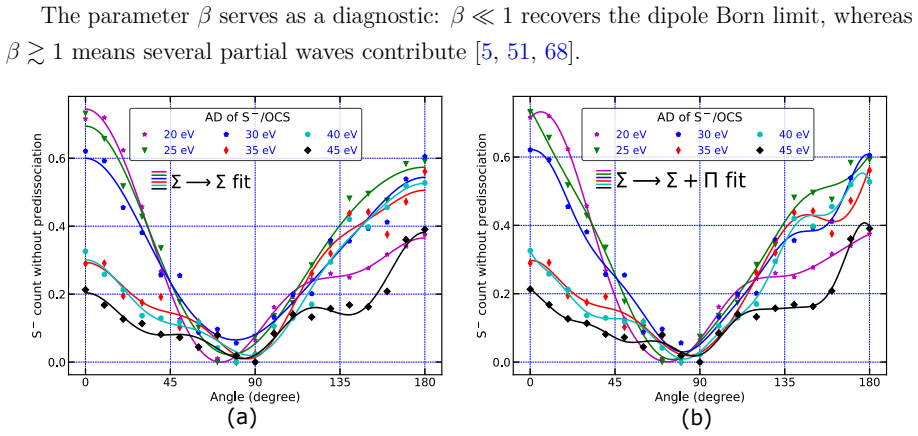
Electron impact on OCS populates hybrid Rydberg-ion-pair superexcited states that subsequently dissociate unimolecularly along nonadiabatic pathways. This is shown by the leveling of maximum kinetic-energy release above 30 eV in both CO+ + S- and CS+ + O- channels and by the momentum-transfer parameter beta exceeding unity at all studied energies, which forces the dominant partial-wave contributions to shift systematically with incident energy and invalidates the dipole-Born approximation.
What carries the argument
Partial-wave decomposition of the measured fragment angular distributions, which yields the momentum-transfer parameter beta and its energy-dependent dominant wave character.
If this is right
- The dipole-Born approximation cannot be used to predict angular distributions or cross sections for this process.
- Dissociation occurs through state-specific unimolecular pathways on nonadiabatic surfaces.
- Reactive anion and cation pairs are generated without photon emission, redistributing molecular energy in electron-rich environments.
- The same quasi-resonant pathway supplies a non-radiative channel relevant to astrochemistry and radiation biophysics.
Where Pith is reading between the lines
- The observed partial-wave shifts may appear in other triatomic molecules under low-energy electron bombardment.
- Velocity slice imaging plus partial-wave analysis offers a route to map similar superexcited-state landscapes in larger polyatomics.
- If the hybrid states are long-lived enough, laser preparation of specific initial states could modulate the branching between the two ion-pair channels.
Load-bearing premise
The leveling of maximum kinetic energies above 30 eV together with beta values greater than 1 directly signals population of discrete hybrid Rydberg-ion-pair superexcited states followed by nonadiabatic dissociation.
What would settle it
A measurement showing beta less than or equal to 1 at any energy between 20 and 45 eV, or a maximum kinetic-energy release that continues to rise with beam energy above 30 eV, would disprove the quasi-resonant discrete-state mechanism.
Figures



read the original abstract
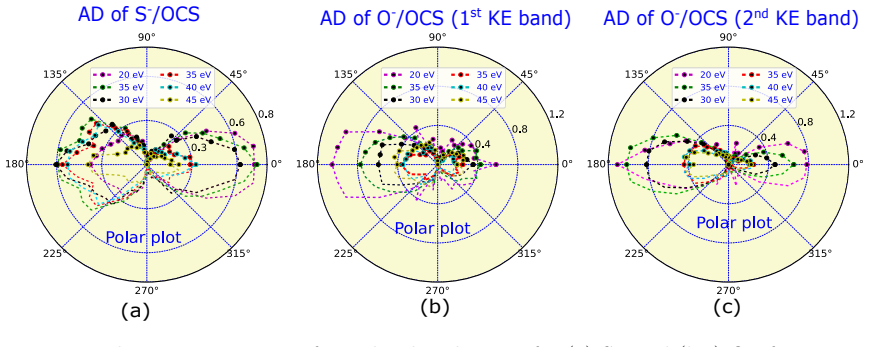
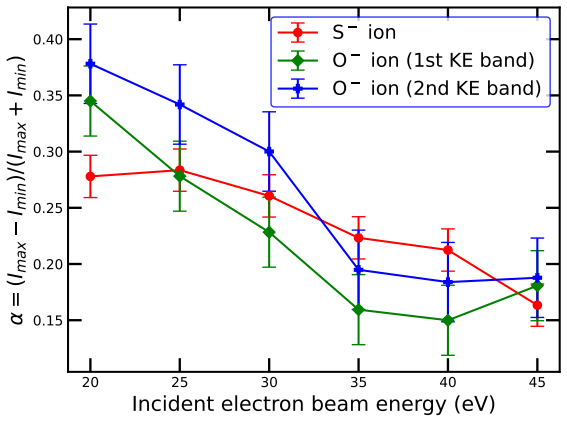
We present velocity map imaging data on intramolecular ion-pair dissociation (IPD) of carbonyl sulfide (OCS) induced by electron impact over the 20 eV to 45 eV energy range. Two distinct IPD pathways were resolved: CO+ + S- (threshold 14.8 +- 0.7 eV) and CS+ + O- (threshold 16.8 +- 0.7 eV). The kinetic energy release spectra display a single peak for S- but split into two components for O-; in both channels the maximum kinetic energies level off once the beam energy exceeds roughly 30 eV, pointing to excitation through discrete superexcited states of quasi-resonant character. Partial wave decomposition of the fragment angular distributions reveals that the momentum-transfer parameter (beta) surpasses unity at every energy studied, invalidating the dipole-Born approximation, and that the dominant partial wave character shifts systematically with beam energy. These patterns are consistent with a mechanism in which the incident electron deposits energy through inelastic scattering, populating hybrid Rydberg-ion-pair superexcited configurations that subsequently undergo state-specific unimolecular dissociation along nonadiabatic pathways. From an applied standpoint, intramolecular ion-pair dissociation matters for astrochemistry and radiation biophysics because it generates reactive anions and cations without photon emission, redistributing excess molecular energy nonadiabatically in environments ranging from interstellar clouds to biological systems.
Editorial analysis
A structured set of objections, weighed in public.
Referee Report
Summary. The manuscript presents velocity slice imaging measurements of electron-impact intramolecular ion-pair dissociation (IPD) of OCS over 20–45 eV. Two channels are resolved: CO⁺ + S⁻ (threshold 14.8 ± 0.7 eV) and CS⁺ + O⁻ (threshold 16.8 ± 0.7 eV). Kinetic-energy release spectra exhibit a single peak for S⁻ and two components for O⁻; in both channels the maximum kinetic energies level off above ~30 eV. Partial-wave analysis of fragment angular distributions yields a momentum-transfer parameter β > 1 at all studied energies and a systematic shift in dominant partial-wave character with beam energy. These observations are interpreted as evidence for quasi-resonant population of hybrid Rydberg–ion-pair superexcited states followed by state-specific nonadiabatic dissociation.
Significance. If the mechanistic assignment holds, the work supplies direct experimental constraints on electron-driven nonadiabatic dissociation pathways in a triatomic molecule, with relevance to astrochemistry and radiation biophysics. The velocity-map imaging data, resolved channel thresholds, and partial-wave decomposition constitute a solid experimental contribution that challenges the dipole-Born regime and documents energy-dependent angular distributions.
major comments (2)
- [Discussion of kinetic-energy spectra and mechanism] The central mechanistic claim—that the KE plateau above ~30 eV and β > 1 arise specifically from discrete hybrid Rydberg–ion-pair superexcited states—rests on qualitative consistency rather than quantitative state matching. No comparison is presented to computed vertical excitation energies, potential curves, or tabulated spectroscopic features of OCS in the 15–45 eV window (see discussion of superexcited-state assignment). Alternative valence or core-excited resonances could produce similar KE cutoffs and angular distributions.
- [Partial-wave decomposition of angular distributions] The statement that β surpasses unity at every energy, thereby invalidating the dipole-Born approximation, lacks the explicit functional form of the partial-wave decomposition and propagated uncertainties on β. It is therefore unclear whether the values definitively exceed the dipole-Born regime or merely indicate non-negligible higher multipoles (see partial-wave analysis section).
minor comments (2)
- [Figure 4 and associated text] Figure captions should explicitly state the number of shots or events contributing to each angular distribution to allow assessment of statistical precision.
- [Experimental thresholds paragraph] The thresholds are given with ±0.7 eV uncertainty; the manuscript should clarify whether this includes only beam-energy calibration or also the fitting procedure for the onset.
Simulated Author's Rebuttal
We thank the referee for the careful and constructive review of our manuscript. We address each major comment below and have revised the manuscript to improve clarity and address the concerns raised.
read point-by-point responses
-
Referee: [Discussion of kinetic-energy spectra and mechanism] The central mechanistic claim—that the KE plateau above ~30 eV and β > 1 arise specifically from discrete hybrid Rydberg–ion-pair superexcited states—rests on qualitative consistency rather than quantitative state matching. No comparison is presented to computed vertical excitation energies, potential curves, or tabulated spectroscopic features of OCS in the 15–45 eV window (see discussion of superexcited-state assignment). Alternative valence or core-excited resonances could produce similar KE cutoffs and angular distributions.
Authors: We appreciate the referee's emphasis on strengthening the mechanistic interpretation. The observed plateau in maximum kinetic energy release above ~30 eV is a key experimental signature pointing to excitation of discrete superexcited states, as opposed to direct access to the ionization continuum. While the present study is experimental and does not include new ab initio computations of vertical excitation energies or potential curves, we have cited existing electron energy-loss and photoabsorption data on OCS superexcited states in the 15–45 eV range. In the revised manuscript we have expanded the discussion section to include these references explicitly, clarified that the assignment to hybrid Rydberg–ion-pair states is based on consistency with the KE and angular data, and stated that alternative valence or core-excited resonances cannot be ruled out without further theoretical input. This makes the interpretation appropriately cautious while preserving the experimental constraints provided by the data. revision: partial
-
Referee: [Partial-wave decomposition of angular distributions] The statement that β surpasses unity at every energy, thereby invalidating the dipole-Born approximation, lacks the explicit functional form of the partial-wave decomposition and propagated uncertainties on β. It is therefore unclear whether the values definitively exceed the dipole-Born regime or merely indicate non-negligible higher multipoles (see partial-wave analysis section).
Authors: We thank the referee for noting the need for greater transparency in the partial-wave analysis. The angular distributions were fitted using a partial-wave expansion expressed in Legendre polynomials, with the anisotropy parameter β extracted from the fit coefficients. We have now added the explicit functional form of the decomposition (including the relation to momentum transfer) and the propagated uncertainties on β to the revised partial-wave analysis section. The updated values confirm that β exceeds 1 outside the fitting uncertainties at all energies studied, indicating significant higher-multipole contributions beyond the pure dipole-Born limit. We have also revised the text to clarify that this demonstrates deviations from the dipole-Born regime rather than a wholesale invalidation of the Born approximation. revision: yes
Circularity Check
No significant circularity; experimental observations and standard analysis stand independently
full rationale
The paper reports direct experimental measurements of kinetic energy release spectra and angular distributions from velocity slice imaging, followed by standard partial-wave decomposition to extract the momentum-transfer parameter beta. These quantities are obtained from data fitting and do not reduce by the paper's own equations to prior fitted inputs or self-citations. The mechanistic interpretation is explicitly framed as qualitative consistency with the observed trends (KE leveling above ~30 eV and beta > 1) rather than a deductive derivation. No load-bearing steps match the enumerated circularity patterns; the central claims rest on measured spectra and external physical principles (e.g., dipole-Born limits) without self-referential closure.
Axiom & Free-Parameter Ledger
Reference graph
Works this paper leans on
-
[1]
Ion pair dissociation: spectroscopy and dynamics.Annu
Arthur G Suits and John W Hepburn. Ion pair dissociation: spectroscopy and dynamics.Annu. Rev. Phys. Chem., 57:431–465, 2006. URLhttps://doi.org/10. 1146/annurev.physchem.56.092503.141209
-
[2]
Eyler, Phillip L
Adam Kirrander, Seth Rittenhouse, Marco Ascoli, Edward E. Eyler, Phillip L. Gould, and H. R. Sadeghpour. Approach to form long-range ion-pair molecules in an ultracold rb gas.Phys. Rev. A, 87:031402, 03 2013. URL https://link.aps.org/doi/10. 1103/PhysRevA.87.031402
2013
-
[3]
Heavy rydberg states: large amplitude vibrations.Faraday discussions, 212:175–190, 2018
Adam Kirrander, Christian Jungen, Robert J Donovan, and Kenneth P Lawley. Heavy rydberg states: large amplitude vibrations.Faraday discussions, 212:175–190, 2018. URLhttps://doi.org/10.1039/C8FD00096D
-
[4]
Molecular ion-pair states in ungerade h2.Phys
Adam Kirrander and Christian Jungen. Molecular ion-pair states in ungerade h2.Phys. Rev. A, 84:052512, 2011. URLhttps://link.aps.org/doi/10.1103/PhysRevA.84. 052512
-
[5]
Resonant scattering of electrons by molecules
James Norman Bardsley and F Mandl. Resonant scattering of electrons by molecules. Reports on progress in physics, 31(2):471–531, 1968. URLhttps://doi.org/10. 1088/0034-4885/31/2/302
1968
-
[6]
Thomas F O’Malley and Howard S Taylor. Angular dependence of scattering products in electron-molecule resonant excitation and in dissociative attachment.Phys. Rev., 176(1):207, 1968. URLhttps://doi.org/10.1103/PhysRev.176.207
-
[8]
Chris H. Greene, A. S. Dickinson, and H. R. Sadeghpour. Creation of polar and nonpolar ultra-long-range rydberg molecules.Phys. Rev. Lett., 85:2458–2461, 09 2000. URLhttps://link.aps.org/doi/10.1103/PhysRevLett.85.2458. 17
-
[9]
P. Giannakeas, Matthew T. Eiles, F. Robicheaux, and Jan M. Rost. Dressed ion-pair states of an ultralong-range rydberg molecule.Phys. Rev. Lett., 125:123401, 2020. URLhttps://link.aps.org/doi/10.1103/PhysRevLett.125.123401
-
[10]
Christian Fey, Frederic Hummel, and Peter Schmelcher. Ultralong-range rydberg molecules.Mol. Phys., 118(2):e1679401, 2020. URL https://doi.org/10.1080/ 00268976.2019.1679401
-
[11]
Enrico Fermi. Sopra lo spostamento per pressione delle righe elevate delle serie spettrali.Il Nuovo Cimento (1924-1942), 11(3):157–166, 1934. URLhttps://doi. org/10.1007/BF02959829
-
[12]
Elmar Reinhold and Wim Ubachs. Heavy rydberg states.Mol. Phys., 103(10): 1329–1352, 2005. URLhttps://doi.org/10.1080/00268970500050621
-
[13]
Yoshihiko Hatano. Interaction of vuv photons with molecules: Spectroscopy and dynamics of molecular superexcited states.J. Electron. Spectrosc. Relt. Phenom., 119 (2-3):107–125, 2001. URLhttps://doi.org/10.1016/S0368-2048(01)00285-7
-
[14]
Superexcited states of molecules.Rad
Robert L Platzman. Superexcited states of molecules.Rad. Re., 17(3):419–425, 1962. URLhttps://doi.org/10.2307/3571104
-
[15]
Qiaoli Hao, Jinyou Long, Xulan Deng, Ying Tang, Bumaliya Abulimiti, and Bing Zhang. Superexcited state dynamics of ocs: An experimental identification of three competing decay channels among autoionization, internal conversion, and neutral predissociation.J. Phys. Chem. A, 121(20):3858–3863, 2017. URL https://doi. org/10.1021/acs.jpca.7b01895
-
[16]
N Kouchi. Fundamentals of mass spectrometry, chapter-5, superexcited states of molecules.Fundamentals of mass spectrometry, chapter-5, Springer, pages 81–87, 2013. URLhttps://link.springer.com/chapter/10.1007/978-1-4614-7233-9_5
-
[17]
Molecularapplicationsofquantumdefecttheory
ChJungen. Molecularapplicationsofquantumdefecttheory. InMolecular Applications of Quantum Defect Theory, pages 7–14. Routledge, CRC, 2019. URLhttps://doi. org/10.1201/9780203746608
-
[18]
Molecules in high rydberg states.Annual review of physical chemistry, 48(1):675–709, 1997
Frédéric Merkt. Molecules in high rydberg states.Annual review of physical chemistry, 48(1):675–709, 1997. URL https://doi.org/10.1146/annurev.physchem.48.1. 675
-
[19]
Frédéric Merkt, Andreas Osterwalder, Robert Seiler, Ruth Signorell, Hartmut Palm, Hansjürg Schmutz, and René Gunzinger. High rydberg states of argon: Stark effect and field-ionization properties.Journal of Physics B: Atomic, Molecular and Optical 18 Physics, 31(8):1705–1724, 1998. URLhttps://doi.org/10.1088/0953-4075/31/8/ 020
-
[20]
James DD Martin and JW Hepburn. Electric field induced dissociation of molecules in rydberg-like highly vibrationally excited ion-pair states.Physical review letters, 79 (17):3154, 1997. URLhttps://doi.org/10.1103/PhysRevLett.79.3154
-
[21]
Charge-transfer-induced predissociation in rydberg states of molecular cations: Mgar+.J
Dominik Wehrli, Matthieu Génévriez, Stefan Knecht, Markus Reiher, and Frédéric Merkt. Charge-transfer-induced predissociation in rydberg states of molecular cations: Mgar+.J. Phys. Chem. A, 125(31):6681–6696, 2021. URLhttps://doi.org/10. 1021/acs.jpca.1c03859
2021
-
[22]
Clarence Zener. Non-adiabatic crossing of energy levels.Proceedings of the Royal Society of London, 137(833):696–702, 1932. URLhttps://doi.org/10.1098/rspa. 1932.0165
-
[23]
Beyond born-oppenheimer: Molecular dynamics through a conical intersection.Annu
Graham A Worth and Lorenz S Cederbaum. Beyond born-oppenheimer: Molecular dynamics through a conical intersection.Annu. Rev. Phys. Chem., 55:127–158, 2004. URLhttps://doi.org/10.1146/annurev.physchem.55.091602.094335
work page doi:10.1146/annurev.physchem.55.091602.094335 2004
-
[24]
Nonadiabatic quantum chemistry past, present, and future.Chem- ical reviews, 112(1):481–498, 2012
David R Yarkony. Nonadiabatic quantum chemistry past, present, and future.Chem- ical reviews, 112(1):481–498, 2012. URLhttps://doi.org/10.1021/cr2001299
-
[25]
Joseph Berkowitz.Photoabsorption, photoionization, and photoelectron spectroscopy. Academic press, 2012. URL https://doi.org/10.1016/B978-0-12-091650-4. X5001-4
-
[26]
Kirk A. Larsen, Robert R. Lucchese, Daniel S. Slaughter, and Thorsten Weber. Dis- tinguishing resonance symmetries with energy-resolved photoion angular distributions from ion-pair formation in o2 following two-photon absorption of a 9.3 ev femtosecond pulse.The Journal of Chemical Physics, 153(2):021103, 07 2020. ISSN 0021-9606. URLhttps://doi.org/10.106...
-
[27]
M. A. Khakoo, C. P. Malone, P. V. Johnson, B. R. Lewis, R. Laher, S. Wang, V. Swaminathan, D. Nuyujukian, and I. Kanik. Electron-impact excitation of x 1Σ + g (v ′′ = 0)to the a ′′1Σ + g , b 1Πu, c3 1Πu, o3 1Πu, b ′1Σ + u, c ′ 4 1Σ + u, g 3Πu, and f 3Πu states of molecular nitrogen.Phys. Rev. A, 77:012704, 2008. URL https: //link.aps.org/doi/10.1103/PhysR...
-
[28]
RN Compton, RH Huebner, PW Reinhardt, and LG Christophorou. Threshold electron impact excitation of atoms and molecules: Detection of triplet and temporary negative ion states.The Journal of Chemical Physics, 48(2):901–909, 1968. URL https://doi.org/10.1063/1.1668733. 19
-
[29]
Excitationofopticallyforbidden states in the ionization continuum by electron impact.Physical Review, 139(4A): A1039, 1965
JArolSimpson, GEChamberlain, andSRMielczarek. Excitationofopticallyforbidden states in the ionization continuum by electron impact.Physical Review, 139(4A): A1039, 1965. URL https://harvest.aps.org/v2/journals/articles/10.1103/ PhysRev.139.A1039/fulltext
1965
-
[30]
Nonadi- abatic bending dissociation in 16 valence electron system ocs.J
Toshinori Suzuki, Hideki Katayanagi, Shinkoh Nanbu, and Mutsumi Aoyagi. Nonadi- abatic bending dissociation in 16 valence electron system ocs.J. Chem. Phys., 109 (14):5778–5794, 1998. URLhttps://doi.org/10.1063/1.477200
-
[31]
Christel M Marian. Spin–orbit coupling and intersystem crossing in molecules.Wiley Interdisciplinary Reviews: Computational Molecular Science, 2(2):187–203, 2012. URL https://doi.org/10.1002/wcms.83
-
[32]
Ultrafast spin coherence reveals ion-pairing–mediated molecular dynamics in solution.Chem
Jacob O Rothbaum, Juliette C Whiteside, Erica Sutcliffe, Jonathan P Aalto, Nathanael P Kazmierczak, and Ryan G Hadt. Ultrafast spin coherence reveals ion-pairing–mediated molecular dynamics in solution.Chem. Archive, 2026. URL https://chemrxiv.org/doi/pdf/10.26434/chemrxiv.15000874/v1
-
[33]
Electronic spectoscopy of isoelectronic molecules
Sean P McGlynn, John W Rabalais, Jimmie R McDonald, and VM Scherr. Electronic spectoscopy of isoelectronic molecules. ii. linear triatomic groupings containing sixteen valence electrons.Chem. Rev., 71(1):73–108, 1971. URLhttps://doi.org/10.1021/ cr60269a004
1971
-
[34]
Negative-ion mass spectrometric study of ion-pair formation in the vacuum ultraviolet
Koichiro Mitsuke, Shinzo Suzuki, Takashi Imamura, and Inosuke Koyano. Negative-ion mass spectrometric study of ion-pair formation in the vacuum ultraviolet. ii. ocs→s-+ co+, o-+ cs+, and co2→o-+ co+.The Journal of chemical physics, 93(3):1710–1719,
-
[35]
URLhttps://doi.org/10.1063/1.459098
-
[36]
Dissociative electron attachment to ocs.J
I Iga and SK Srivastava. Dissociative electron attachment to ocs.J. Mole. Struc.: THEOCHEM, 335(1-3):31–36, 1995. URL https://doi.org/10.1016/ 0166-1280(94)03979-U
1995
-
[38]
R Abouaf and F Fiquet-Fayard. Dissociative attachment in so2 and ocs: evidence for vibrational excitation of the so, o2 and co fragments.J. Phys. B: At. Mol. Opt. Phys., 9(11):L323, 1976. URLhttps://doi.org/10.1088/0022-3700/9/11/006
-
[39]
Soumya Ghosh, Narayan Kundu, Aryya Ghosh, and Dhananjay Nandi. Electron- impact fragmentation dynamics of carbonyl sulfide: A combined experimental and theoretical study.Phys. Rev. A, 112:062817, 2025. URL https://link.aps.org/ doi/10.1103/cmws-ps5b. 20
-
[40]
Yuichiro Ueno, Matthew S Johnson, Sebastian O Danielache, Carsten Eskebjerg, Antra Pandey, and Naohiro Yoshida. Geological sulfur isotopes indicate elevated ocs in the archean atmosphere, solving faint young sun paradox.Proceedings of the National Academy of Sciences, 106(35):14784–14789, 2009. URLhttps://doi.org/ 10.1073/pnas.0903518106
-
[41]
Shohei Hattori, Kazuki Kamezaki, and Naohiro Yoshida. Constraining the atmospheric ocs budget from sulfur isotopes.Proceedings of the National Academy of Sciences, 117(34):20447–20452, 2020. URLhttps://doi.org/10.1073/pnas.2007260117
-
[42]
André TJB Eppink and David H Parker. Velocity map imaging of ions and electrons using electrostatic lenses: Application in photoelectron and photofragment ion imaging of molecular oxygen.Rev. Sci. Instrum., 68(9):3477–3484, 1997. URLhttps://doi. org/10.1063/1.1148310
-
[43]
Cambridge university press.Imaging in molecular dynam- ics: technology and applications, page 22, 2003
Benjamin J Whitaker. Cambridge university press.Imaging in molecular dynam- ics: technology and applications, page 22, 2003. URLhttps://doi.org/10.1017/ CBO9780511535437
2003
-
[44]
Breakdown of the dipole-born approximation for predicting angular distributions of dissociation fragments.J
Richard J Van Brunt. Breakdown of the dipole-born approximation for predicting angular distributions of dissociation fragments.J. Chem. Phys., 60(8):3064–3070,
-
[45]
URLhttps://doi.org/10.1063/1.1681491
-
[46]
Angular distribution of protons and deuterons produced by dissociative ionization of h 2 and d 2 near threshold.Phys
RJ Van Brunt and LJ Kieffer. Angular distribution of protons and deuterons produced by dissociative ionization of h 2 and d 2 near threshold.Phys. Rev. A, 2(4):1293,
-
[47]
URLhttps://doi.org/10.1103/PhysRevA.2.1293
-
[48]
Complete data acquisition and analysis system for low-energy electron–molecule collision studies.Mea
Pamir Nag and Dhananjay Nandi. Complete data acquisition and analysis system for low-energy electron–molecule collision studies.Mea. Sci. Tech., 26(9):095007, 2015. URLhttps://iopscience.iop.org/article/10.1088/0957-0233/26/9/095007
-
[49]
Velocity slice imaging for dissociative electron attachment.Rev
Dhananjay Nandi, Vaibhav S Prabhudesai, E Krishnakumar, and A Chatterjee. Velocity slice imaging for dissociative electron attachment.Rev. Sci. Instrum, 76(5): 053107, 2005. URLhttps://doi.org/10.1063/1.1899404
-
[50]
Multi- ple hit readout of a microchannel plate detector with a threelayer delayline anode
Ottmar Jagutzki, Alfred Cerezo, Achim Czasch, R Dorner, M Hattas, Min Huang, Volker Mergel, Uwe Spillmann, Klaus Ullmann-Pfleger, Thorsten Weber, et al. Multi- ple hit readout of a microchannel plate detector with a threelayer delayline anode. IEEE Trans. Nuc. Sci., 49(5):2477–2483, 2002. URLhttps://doi.org/10.1109/ TNS.2002.803889
-
[51]
Slice imaging: A new approach to ion imaging 21 and velocity mapping.Rev
Christoph R Gebhardt, T Peter Rakitzis, Peter C Samartzis, Vlassis Ladopoulos, and Theofanis N Kitsopoulos. Slice imaging: A new approach to ion imaging 21 and velocity mapping.Rev. Sci. Instrum., 72(10):3848–3853, 2001. URL https: //doi.org/10.1063/1.1403010
-
[52]
A. Moradmand, D. S. Slaughter, A. L. Landers, and M. Fogle. Dissociative-electron- attachment dynamics near the 8-ev feshbach resonance of co2.Phys. Rev. A, 88: 022711, 2013. URLhttps://link.aps.org/doi/10.1103/PhysRevA.88.022711
-
[53]
Effect of slicing in velocity map imaging for the study of dissociation dynamics
Narayan Kundu, Dipayan Biswas, Vikrant Kumar, Anirban Paul, and Dhananjay Nandi. Effect of slicing in velocity map imaging for the study of dissociation dynamics. arXiv preprint arXiv:2111.07168, 2021. URLhttps://arxiv.org/abs/2111.07168
-
[54]
Narayan Kundu, Vikrant Kumar, and Dhananjay Nandi. Breakdown of dipole born approximation and the role of rydberg’s predissociation for the electron-induced ion-pair dissociation to oxygen in the presence of background gases.J. Chem. Phys., 158(15), 2023. URLhttps://doi.org/10.1063/5.0141973
-
[55]
Chris Sparling and Dave Townsend. Tomographic reconstruction techniques optimized for velocity-map imaging applications.The Journal of Chemical Physics, 157(11): 114201, 09 2022. ISSN 0021-9606. URLhttps://doi.org/10.1063/5.0101789
-
[56]
Chuan Cheng, Gönenç Moğol, Thomas Weinacht, Andrei Nomerotski, and Carlos Trallero-Herrero. 3d velocity map imaging of electrons with tpx3cam.Review of Scientific Instruments, 93(1):013003, 01 2022. ISSN 0034-6748. URLhttps://doi. org/10.1063/5.0071804
-
[57]
Application of time-sliced ion velocity imaging to crossed molecular beam experiments.Rev
Jim J Lin, Jingang Zhou, Weicheng Shiu, and Kopin Liu. Application of time-sliced ion velocity imaging to crossed molecular beam experiments.Rev. Sci. Instrum., 74 (4):2495–2500, 2003. URLhttps://doi.org/10.1063/1.1561604
-
[58]
Time-of-flight mass spectrometer with improved resolution.Rev
WC Wiley and Ii H McLaren. Time-of-flight mass spectrometer with improved resolution.Rev. Sci. Instrum., 26(12):1150–1157, 1955. URLhttps://doi.org/10. 1063/1.1715212
1955
-
[59]
Narayan Kundu and Dhananjay Nandi. Observation of renner–teller and predissocia- tion coupled vibronic intensity borrowing in dissociative electron attachment to ocs. J. Chem. Phys., 160(11):114315, 2024. URLhttps://doi.org/10.1063/5.0188833
-
[60]
Nsrds-nbs 31
B.deB.Darwent. Nsrds-nbs 31. washington, dc: U.s. national bureau of standards. lccn 70602101.Bond Dissociation Energies in Simple Molecules, page 24, 1970. URL https://srd.nist.gov/NSRDS/NSRDS-NBS31.pdf
1970
-
[61]
P Erman, A Karawajczyk, E Rachlew-Källne, C Strömholm, Jörgen Larsson, Anders Persson, and R Zerne. Direct determination of the ionization potential of co by 22 resonantly enhanced multiphoton ionization mass spectroscopy.Chem. phys. lett., 215(1-3):173–178, 1993. URLhttps://doi.org/10.1016/0009-2614(93)89283-N
-
[62]
Christophe Blondel, Christian Delsart, C Valli, S Yiou, MR Godefroid, and Sophie Van Eck. Electron affinities of 16 o, 17 o, 18 o, the fine structure of 16 o-, and the hyperfine structure of 17 o-.Phys. Rev. A, 64(5):052504, 2001. URL https: //doi.org/10.1103/PhysRevA.64.052504
-
[63]
James E. Wells and J. N. Yukich. Photodetachment spectroscopy from the lowest threshold ofs−.Phys. Rev. A, 80:055403, 2009. URLhttps://link.aps.org/doi/ 10.1103/PhysRevA.80.055403
-
[64]
Richard N Zare. Dissociation of h2+ by electron impact: Calculated angular distri- bution.J. Chem. Phys., 47(1):204–215, 1967. URLhttps://doi.org/10.1063/1. 1711847
work page doi:10.1063/1 1967
-
[65]
C Jonah. Effect of rotation and thermal velocity on the anisotropy in photodissociation spectroscopy.The Journal of Chemical Physics, 55(4):1915–1922, 1971. URLhttps: //doi.org/10.1063/1.1676328
-
[66]
Reinhard Schinke.Photodissociation dynamics: spectroscopy and fragmentation of small polyatomic molecules. Number 1. Cambridge university press, 1995. URL https://doi.org/10.1017/CBO9780511586453
-
[67]
Narayan Kundu, Vikrant Kumar, and Dhananjay Nandi. Low-energy electron-induced ion-pair dissociation to "trilobite-resembling" long-range heavy rydberg system, 2022. URLhttps://arxiv.org/abs/2208.14050
-
[68]
Cambridge university press, 2009
Raphael D Levine.Molecular reaction dynamics. Cambridge university press, 2009. URLhttps://books.google.de/books?id=FVqyS31OM7sC&printsec= frontcover#v=onepage&q&f=false
2009
-
[69]
Constants of diatomic molecules
KPAH Huber.Molecular spectra and molecular structure: IV. Constants of diatomic molecules. Springer Science & Business Media, 2013. URLhttps://doi.org/10. 1007/978-1-4757-0961-2
2013
-
[70]
John A. Coxon, Pierre J. Marcoux, and D. W. Setser. TheA2Π–X 2Σ + band system of CS+: A high-resolution study.Chemical Physics, 164(3):377–389, 1992. URL 10.1016/0301-0104(92)87076-L
-
[71]
Electron–molecule scattering cross- sections
Michael J Brunger and Stephen J Buckman. Electron–molecule scattering cross- sections. i. experimental techniques and data for diatomic molecules.Physics reports, 357(3-5):215–458, 2002. URLhttps://doi.org/10.1016/S0370-1573(01)00032-1. 23
-
[72]
Narayan Kundu, Sumit Naskar, Irina Jana, Anirban Paul, and Dhananjay Nandi. Ion-pair dissociation dynamics in electron collision with carbon dioxide probed by velocity slice imaging, 2020. URLhttps://arxiv.org/pdf/2008.13182
-
[73]
E. R. I. Abraham, W. I. McAlexander, C. A. Sackett, and Randall G. Hulet. Spec- troscopic determination of thes-wave scattering length of lithium.Phys. Rev. Lett., 74:1315–1318, 1995. URLhttps://link.aps.org/doi/10.1103/PhysRevLett.74. 1315
-
[74]
Controlling rydberg atom excitations in dense background gases.J
Tara Cubel Liebisch, Michael Schlagmüller, Felix Engel, Huan Nguyen, Jonathan Balewski, Graham Lochead, Fabian Böttcher, Karl M Westphal, Kathrin S Kleinbach, Thomas Schmid, et al. Controlling rydberg atom excitations in dense background gases.J. Phys. B: Atom. Mole. Opt. Phys., 49(18):182001, 2016. URL https: //doi.org/10.1088/0953-4075/49/18/182001
-
[75]
Trilobites, butterflies, and other exotic specimens of long-range rydberg molecules.J
Matthew T Eiles. Trilobites, butterflies, and other exotic specimens of long-range rydberg molecules.J. Phys. B: At. Mol. Opt. Phys., 52(11):113001, 2019. URL https://doi.org/10.1088/1361-6455/ab19ca
-
[76]
Projected complex absorbing potential multireference configuration interaction approach for shape and feshbach resonances
Mushir Thodika and Spiridoula Matsika. Projected complex absorbing potential multireference configuration interaction approach for shape and feshbach resonances. J. Chem. Theory Comput., 18(6):3377–3390, 2022. URLhttps://doi.org/10.1021/ acs.jctc.1c01310
2022
-
[77]
Shape-resonance-induced long-range molecular rydberg states.J
Edward L Hamilton, Chris H Greene, and H R Sadeghpour. Shape-resonance-induced long-range molecular rydberg states.J. Phys. B: At. Mol. Opt. Phys., 35(10):L199– L206, 2002. URLhttps://doi.org/10.1088/0953-4075/35/10/102
-
[78]
DanDill. Fixed-moleculephotoelectronangulardistributions.The Journal of Chemical Physics, 65(3):1130–1133, 1976. URLhttps://doi.org/10.1063/1.433187
-
[79]
Katharine L Reid. Photoelectron angular distributions.Annual review of phys- ical chemistry, 54(1):397–424, 2003. URL https://doi.org/10.1146/annurev. physchem.54.011002.103814
-
[80]
Tomas Baer and William L Hase.Unimolecular reaction dynamics: theory and experiments, volume 31. Oxford university press, 1996. URLhttps://doi.org/10. 1093/oso/9780195074949.001.0001
-
[81]
Prentice Hall Upper Saddle River, NJ, 1999
Jeffrey I Steinfeld, Joseph Salvadore Francisco, and William L Hase.Chemical kinetics and dynamics, volume 2. Prentice Hall Upper Saddle River, NJ, 1999. URL https://archive.org/details/chemicalkinetics0000stei/page/n9/mode/2up. 24
1999
-
[82]
Rudolph A Marcus and OK Rice. The kinetics of the recombination of methyl radicals and iodine atoms.The Journal of Physical Chemistry, 55(6):894–908, 1951. URL https://doi.org/10.1021/j150489a013
discussion (0)
Sign in with ORCID, Apple, or X to comment. Anyone can read and Pith papers without signing in.