Recognition: unknown
Isolating Recurring Execution-Dependent Abnormal Patterns on NISQ Quantum Devices
Pith reviewed 2026-05-10 05:20 UTC · model grok-4.3
The pith
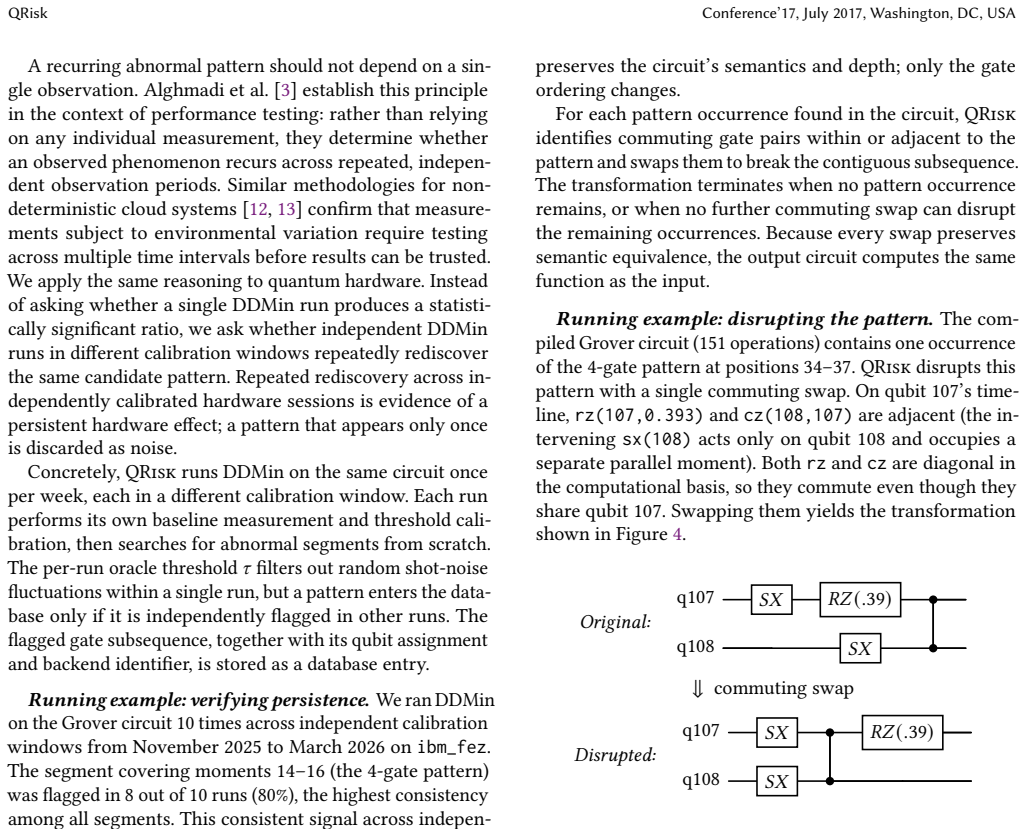
QRisk isolates recurring circuit fragments on NISQ hardware that cause excess errors beyond noise model predictions and mitigates them with commuting gate swaps.
A machine-rendered reading of the paper's core claim, the machinery that carries it, and where it could break.
Core claim
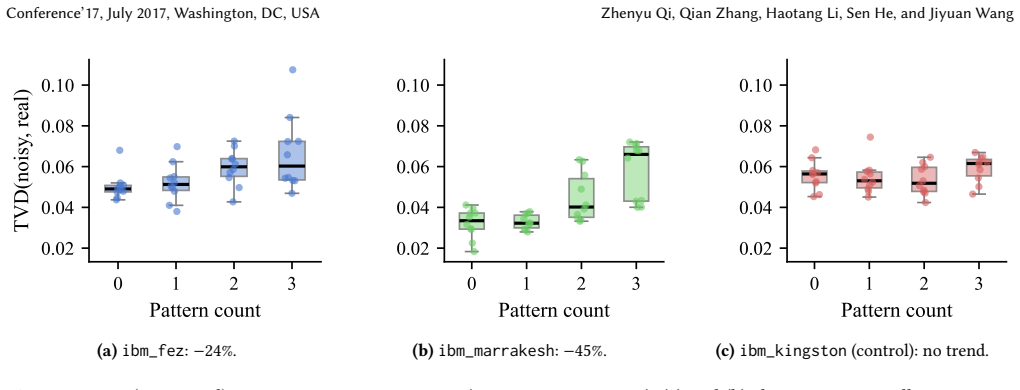
QRisk uses delta debugging to isolate compact circuit fragments that consistently produce excess error not predicted by the noise model, then validates their persistence across repeated runs and calibration windows. The verified patterns are stored in a backend-specific pattern database. At compilation time, QRisk scans a compiled circuit for occurrences of known patterns and applies targeted commuting gate swaps to disrupt them, producing a semantically equivalent circuit with fewer abnormal patterns. On Grover search circuits the method reduces excess hardware noise by 24 percent on ibm_fez and 45 percent on ibm_marrakesh while the noise model predicts identical error for all equivalent电路.
What carries the argument
Backend-specific pattern database populated by delta-debugging isolation of execution-dependent fragments, combined with targeted commuting-gate swaps that eliminate those fragments without altering circuit semantics.
If this is right
- Compilers can improve real-device performance by learning persistent mismatches between modeled and observed error rather than relying only on calibration data.
- The identified patterns remain stable across multiple calibration windows spanning months, enabling long-term mitigation without repeated discovery.
- The mitigation is device-specific, as patterns discovered on one backend do not appear on a third tested device.
- Two circuits that are indistinguishable under the noise model can be reliably distinguished by their actual error rates once abnormal patterns are removed.
Where Pith is reading between the lines
- Each new backend will require its own pattern-discovery campaign because the abnormal fragments are hardware-specific.
- The technique offers a practical way to incorporate runtime feedback into compilation without requiring changes to the underlying noise model.
- Similar isolation methods could be applied to other quantum algorithms to determine whether the patterns are algorithm-dependent or general hardware traits.
- The correlation between pattern count and excess noise suggests that pattern avoidance could become a standard post-mapping optimization step.
Load-bearing premise
The isolated fragments are causally responsible for the observed excess error rather than merely correlated with other unmodeled hardware effects.
What would settle it
Applying the commuting gate swaps to the discovered patterns and measuring no statistically significant drop in excess noise on the same hardware runs, or finding that the noise model assigns different costs to the swapped circuits.
Figures


read the original abstract
Quantum compilers rely on calibration-derived noise models to guide circuit mapping and optimization. These models characterize gate and qubit errors independently and miss context-dependent effects such as crosstalk and correlated scheduling errors. As a result, two compiled circuits that score equally under the noise model can behave very differently on real hardware, and the compiler has no mechanism to learn from such recurring mismatches. We present QRisk, a framework that discovers backend-specific abnormal patterns from real hardware executions. QRisk uses delta debugging to isolate compact circuit fragments that consistently produce excess error not predicted by the noise model, then validates their persistence across repeated runs and calibration windows. The verified patterns are stored in a backend-specific pattern database. At compilation time, QRisk scans a compiled circuit for occurrences of known patterns and applies targeted commuting gate swaps to disrupt them, producing a semantically equivalent circuit with fewer abnormal patterns. We evaluate QRisk on two IBM backends (ibm_fez and ibm_marrakesh) using Grover search circuits. On both backends, discovered patterns persist across multiple calibration windows over months. Disrupting these patterns via commuting gate swaps reduces excess hardware noise by 24% on ibm_fez (Spearman $\rho$ = 0.515, p = 0.0007) and 45% on ibm_marrakesh ($\rho$ = 0.711, p < 0.0001), while the noise model predicts identical error for all equivalent circuits. Testing on a third backend confirms that these patterns are backend-specific.
Editorial analysis
A structured set of objections, weighed in public.
Referee Report
Summary. The paper introduces QRisk, a framework that applies delta debugging to hardware executions on NISQ devices to isolate compact, recurring circuit fragments producing excess error beyond predictions from standard calibration-based noise models. These patterns are validated for persistence across multiple calibration windows spanning months on IBM backends; at compile time, QRisk detects them in Grover search circuits and applies targeted commuting gate swaps to produce semantically equivalent circuits with fewer such patterns. Empirical results show 24% and 45% reductions in excess hardware noise on ibm_fez and ibm_marrakesh respectively, with reported Spearman correlations and p-values, while the noise model assigns identical error to all equivalent circuits; patterns are shown to be backend-specific.
Significance. If the causal link between pattern disruption and noise reduction holds, the work provides a pragmatic, backend-specific method to mitigate context-dependent noise (crosstalk, scheduling effects) that standard models miss, improving compiled circuit fidelity without semantic changes. Strengths include direct hardware measurements rather than model fitting, explicit persistence validation over time, and statistical reporting; these could inform future quantum compilers if reproducibility and controls are strengthened.
major comments (2)
- [Evaluation of pattern disruption (ibm_fez and ibm_marrakesh results)] The central claim attributes the reported 24% (ibm_fez) and 45% (ibm_marrakesh) excess-noise reductions specifically to disruption of the delta-debugged patterns. However, the evaluation provides no ablation in which an equivalent number of commuting swaps that do not target the identified patterns are applied to the same circuits. Any reordering alters gate scheduling, qubit interactions, and timing, which can affect unmodeled hardware effects independently of the patterns; without this control, the reduction cannot be isolated from general reordering side-effects.
- [QRisk framework and pattern discovery] The description of the delta-debugging procedure used to isolate abnormal fragments lacks concrete implementation details required to assess reproducibility and soundness. No information is given on fragment granularity, the precise statistical threshold for declaring 'excess error' relative to the noise model, or how circuit depth and other structural factors were controlled when comparing pattern-containing vs. pattern-free executions.
minor comments (2)
- [Abstract and §1] The abstract and introduction refer to 'delta debugging' without a brief inline definition or reference tailored to the quantum-circuit setting, which may hinder readers outside software-engineering debugging literature.
- [Statistical reporting in evaluation] The reported Spearman ρ and p-values are useful, but the text does not state whether multiple-comparison corrections were applied across the two backends and multiple calibration windows.
Simulated Author's Rebuttal
We thank the referee for the constructive feedback. We address each major comment below, acknowledging where additional controls or details would strengthen the work, and describe the revisions we will incorporate.
read point-by-point responses
-
Referee: [Evaluation of pattern disruption (ibm_fez and ibm_marrakesh results)] The central claim attributes the reported 24% (ibm_fez) and 45% (ibm_marrakesh) excess-noise reductions specifically to disruption of the delta-debugged patterns. However, the evaluation provides no ablation in which an equivalent number of commuting swaps that do not target the identified patterns are applied to the same circuits. Any reordering alters gate scheduling, qubit interactions, and timing, which can affect unmodeled hardware effects independently of the patterns; without this control, the reduction cannot be isolated from general reordering side-effects.
Authors: We agree that the absence of a non-targeted swap control leaves open the possibility that general reordering effects contribute to the observed reductions. Our current evaluation selects only swaps that disrupt the delta-debugged patterns while preserving semantics and reports Spearman correlations between the count of disrupted patterns and excess-noise reduction (with the noise model assigning identical scores to all variants). We will add a dedicated limitations subsection discussing potential confounding from scheduling and timing changes, and we will attempt to include results from a small set of random commuting-swap controls on the same Grover instances if additional hardware time is granted. This addresses the concern without altering the core claims. revision: partial
-
Referee: [QRisk framework and pattern discovery] The description of the delta-debugging procedure used to isolate abnormal fragments lacks concrete implementation details required to assess reproducibility and soundness. No information is given on fragment granularity, the precise statistical threshold for declaring 'excess error' relative to the noise model, or how circuit depth and other structural factors were controlled when comparing pattern-containing vs. pattern-free executions.
Authors: We acknowledge that the methods section is currently high-level. The delta-debugging procedure operates on gate-level fragments of size 3–5 gates, declares a fragment abnormal when its measured error exceeds the noise-model prediction by more than two standard deviations (computed from 10,000 shots per circuit), and controls for depth by generating matched-depth variants that differ only in the presence/absence of the candidate pattern. We will expand the methods section with pseudocode, exact threshold formulas, and the depth-matching procedure in the revised manuscript. revision: yes
Circularity Check
No significant circularity; results rest on direct hardware measurements
full rationale
The paper's derivation chain relies on empirical isolation of patterns via delta debugging on real IBM hardware executions, followed by persistence validation across calibration windows and direct measurement of noise reduction after commuting swaps. The noise model is invoked only as a baseline that assigns identical scores to equivalent circuits; the reported 24-45% reductions and Spearman correlations are computed from hardware data, not from any fitted parameter or self-referential prediction. No self-citations, ansatzes, or uniqueness theorems are load-bearing, and no step renames a known result or equates a prediction to its input by construction. The central claims remain externally falsifiable through additional hardware runs.
Axiom & Free-Parameter Ledger
axioms (2)
- standard math Commuting gates can be swapped without changing circuit semantics
- domain assumption Excess error beyond the noise model is attributable to identifiable circuit fragments
Reference graph
Works this paper leans on
-
[1]
Fernandes, Luis Llana, and Guilherme Tavares
Rui Abreu, Jo ao P. Fernandes, Luis Llana, and Guilherme Tavares. 2022. Metamorphic Testing of Oracle Quantum Programs. InProceedings of the 3rd International Workshop on Quantum Software Engineering (Q-SE). ACM, New York, NY, USA, 16–23. doi:10.1145/3528230.3529189
-
[2]
Mazen AbuGhanem. 2025. IBM Quantum Computers: Evolution, Per- formance, and Future Directions.The Journal of Supercomputing81, 5 (2025), 687. doi:10.1007/s11227-025-07047-7
-
[3]
Alghmadi, Mark D
Hammam M. Alghmadi, Mark D. Syer, Weiyi Shang, and Ahmed E. Hassan. 2016. An Automated Approach for Recommending When to Stop Performance Tests. In2016 IEEE International Conference on Software Maintenance and Evolution (ICSME). IEEE, Piscataway, NJ, USA, 279–289
2016
-
[4]
Frank Arute, Kunal Arya, Ryan Babbush, Dave Bacon, Joseph C Bardin, Rami Barends, Rupak Biswas, Sergio Boixo, Fernando GSL Brandao, David A Buell, et al. 2019. Quantum supremacy using a programmable superconducting processor.Nature574, 7779 (2019), 505–510
2019
-
[5]
Jacob Biamonte, Peter Wittek, Nicola Pancotti, Patrick Rebentrost, Nathan Wiebe, and Seth Lloyd. 2017. Quantum machine learning. Nature549, 7671 (2017), 195–202
2017
- [6]
-
[7]
José Campos and André Souto. 2021. QBugs: A Collection of Re- producible Bugs in Quantum Algorithms and a Supporting Infras- tructure to Enable Controlled Quantum Software Testing and De- bugging Experiments. InIEEE/ACM International Workshop on Quan- tum Software Engineering (Q-SE). IEEE, Piscataway, NJ, USA, 28–32. doi:10.1109/Q-SE52541.2021.00013
-
[8]
Yudong Cao, Jonathan Romero, Jonathan P Olson, Matthias Degroote, Peter D Johnson, Mária Kieferová, Ian D Kivlichan, Tim Menke, Borja Peropadre, Nicolas PD Sawaya, et al. 2019. Quantum chemistry in the age of quantum computing.Chemical reviews119, 19 (2019), 10856– 10915
2019
-
[9]
Statistical Mechanics of Interacting Run-and-Tumble Bacteria
Marcus P. da Silva, Olivier Landon-Cardinal, and David Poulin. 2011. Practical Characterization of Quantum Devices without Tomography. Physical Review Letters107 (2011), 210404. doi:10.1103/PhysRevLett. 107.210404
-
[10]
Poulami Das, Suhas K. Vittal, and Moinuddin Qureshi. 2022. ForeSight: Reducing SWAPs in NISQ Programs via Adaptive Multi-Candidate Evaluations. arXiv:2204.13142
-
[11]
Lov K. Grover. 1996. A Fast Quantum Mechanical Algorithm for Database Search. InProceedings of the 28th Annual ACM Symposium on Theory of Computing (STOC). ACM, New York, NY, USA, 212–219. doi:10.1145/237814.237866
-
[12]
Sen He, Tianyi Liu, Palden Lama, Jaewoo Lee, In Kee Kim, and Wei Wang. 2021. Performance Testing for Cloud Computing with Depen- dent Data Bootstrapping. InThe 36th IEEE/ACM International Confer- ence on Automated Software Engineering (ASE). IEEE, Piscataway, NJ, USA, 666–678
2021
-
[13]
Sen He, Glenna Manns, John Saunders, Wei Wang, Lori Pollock, and Mary Lou Soffa. 2019. A Statistics-Based Performance Testing Method- ology for Cloud Applications. InProceedings of the 2019 27th ACM Joint Meeting on European Software Engineering Conference and Symposium on the Foundations of Software Engineering (ESEC/FSE). ACM, New York, NY, USA, 188–199...
-
[14]
Renáta Hodován and Ákos Kiss. 2016. Modernizing hierarchical delta debugging. InProceedings of the 7th International Workshop on Au- tomating Test Case Design, Selection, and Evaluation. ACM, New York, NY, USA, 31–37
2016
-
[15]
Renáta Hodován, Ákos Kiss, and Tibor Gyimóthy. 2017. Coarse hi- erarchical delta debugging. In2017 IEEE international conference on software maintenance and evolution (ICSME). IEEE, Piscataway, NJ, USA, 194–203
2017
-
[16]
Zhang, Travis Humble, and Ang Li
Fei Hua, Meng Wang, Gushu Li, Bo Peng, Chenxu Liu, Muqing Zheng, Samuel Stein, Yufei Ding, Eddy Z. Zhang, Travis Humble, and Ang Li. 2023. QASMTrans: A QASM Quantum Transpiler Framework for NISQ Devices. InProceedings of the International Conference for High Performance Computing, Networking, Storage and Analysis (SC). ACM, New York, NY, USA, 1468–1477. d...
-
[17]
Yuqian Huo, Jinbiao Wei, Christopher Kverne, Mayur Akewar, Janki Bhimani, and Tirthak Patel. 2025. Revisiting Noise-adaptive Transpi- lation in Quantum Computing: How Much Impact Does it Have?. In Proceedings of the International Conference on Computer-Aided Design (ICCAD). ACM, New York, NY, USA, 1–9. arXiv:2507.01195
-
[18]
Md Sakibul Islam and Protik Nag. 2022. Quantum Noise and Measuring Quantum Distance for NISQ Circuits. doi:10.36227/techrxiv.21791987 TechRxiv
-
[19]
Ákos Kiss, Renáta Hodován, and Tibor Gyimóthy. 2018. HDDr: a recursive variant of the hierarchical delta debugging algorithm. In Proceedings of the 9th ACM SIGSOFT International Workshop on Au- tomating TEST Case Design, Selection, and Evaluation. ACM, New York, NY, USA, 16–22
2018
-
[20]
Philip Krantz, Morten Kjaergaard, Fei Yan, Terry P Orlando, Simon Gustavsson, and William D Oliver. 2019. A quantum engineer’s guide to superconducting qubits.Applied physics reviews6, 2 (2019), 021318
2019
- [21]
-
[22]
Ghassan Misherghi and Zhendong Su. 2006. HDD: hierarchical delta debugging. InProceedings of the 28th international conference on Soft- ware engineering. ACM, New York, NY, USA, 142–151
2006
-
[23]
Baker, Ali Javadi-Abhari, Frederic T
Prakash Murali, Jonathan M. Baker, Ali Javadi-Abhari, Frederic T. Chong, and Margaret Martonosi. 2019. Noise-Adaptive Compiler Mappings for Noisy Intermediate-Scale Quantum Computers. InPro- ceedings of the 24th International Conference on Architectural Support for Programming Languages and Operating Systems (ASPLOS). ACM, New York, NY, USA, 1015–1029. do...
-
[24]
McKay, Margaret Martonosi, and Ali Javadi- Abhari
Prakash Murali, David C. McKay, Margaret Martonosi, and Ali Javadi- Abhari. 2020. Software Mitigation of Crosstalk on Noisy Intermediate- Scale Quantum Computers. InProceedings of the 25th International Conference on Architectural Support for Programming Languages and Operating Systems (ASPLOS). ACM, New York, NY, USA, 1001–1016. doi:10.1145/3373376.33784...
-
[25]
Siyuan Niu, Adrien Suau, Gabriel Staffelbach, and Aida Todri-Sanial
-
[26]
A Hardware-Aware Heuristic for the Qubit Mapping Problem in the NISQ Era.IEEE Transactions on Quantum Engineering1 (2020), 1–14. doi:10.1109/TQE.2020.3026544
-
[27]
Matteo Paltenghi and Michael Pradel. 2023. MorphQ: Metamorphic Testing of the Qiskit Quantum Computing Platform. InProceedings of the 45th International Conference on Software Engineering (ICSE). IEEE, Piscataway, NJ, USA, 2413–2424. doi:10.1109/ICSE48619.2023.00202
-
[28]
John Preskill. 2018. Quantum Computing in the NISQ Era and Beyond. Quantum2 (2018), 79. doi:10.22331/q-2018-08-06-79
-
[29]
Qiskit contributors. 2024. Qiskit: An Open-Source Framework for Quantum Computing. doi:10.5281/zenodo.2573505
-
[30]
Neilson Carlos Leite Ramalho, Higor Amario de Souza, and Mar- cos Lordello Chaim. 2025. Testing and Debugging Quantum Programs: The Road to 2030.ACM Transactions on Software Engineering and Methodology34, 5 (2025), 155:1–155:46. doi:10.1145/3715106
-
[31]
Kenneth Rudinger, Timothy Proctor, Dylan Langharst, Mohan Sarovar, Kevin Young, and Robin Blume-Kohout. 2019. Probing Context- Dependent Errors in Quantum Processors.Physical Review X9 (2019), 021045. doi:10.1103/PhysRevX.9.021045
-
[32]
Naoto Sato and Ryota Katsube. 2024. Locating Buggy Segments in Quantum Program Debugging. InProceedings of the ACM/IEEE In- ternational Conference on Software Engineering: Companion (ICSE- Companion). ACM, New York, NY, USA, 26–31. doi:10.1145/3639476. 3639761
-
[33]
Asim Sharma and Avah Banerjee. 2023. Noise-Aware Token Swap- ping for Qubit Routing. InIEEE International Conference on Quantum Computing and Engineering (QCE). IEEE, Piscataway, NJ, USA, 82–88. doi:10.1109/QCE57702.2023.10313692
-
[34]
Peter W Shor. 1999. Polynomial-time algorithms for prime factoriza- tion and discrete logarithms on a quantum computer.SIAM review41, 2 (1999), 303–332
1999
-
[35]
Chengnian Sun, Yuanbo Li, Qirun Zhang, Tianxiao Gu, and Zhendong Su. 2018. Perses: Syntax-guided program reduction. InProceedings of the 40th International Conference on Software Engineering. ACM, New York, NY, USA, 361–371
2018
-
[36]
Teruo Tanimoto, Shuhei Matsuo, Satoshi Kawakami, Yutaka Tabuchi, Masuo Hirokawa, and Koji Inoue. 2020. Practical Error Modeling toward Realistic NISQ Simulation. InIEEE Computer Society Annual Symposium on VLSI (ISVLSI). IEEE, Piscataway, NJ, USA, 291–293. doi:10.1109/ISVLSI49217.2020.00060
-
[37]
Yongqiang Tian, Xueyan Zhang, Yiwen Dong, Zhenyang Xu, Mengxiao Zhang, Yu Jiang, Shing-Chi Cheung, and Chengnian Sun. 2023. On the Caching Schemes to Speed Up Program Reduction.ACM Transactions on Software Engineering and Methodology33, 1 (2023), 1–30
2023
-
[38]
Friedrich Wagner, Daniel J. Egger, and Frauke Liers. 2025. Optimized Noise Suppression for Quantum Circuits.INFORMS Journal on Com- puting37, 1 (2025), 22–41. doi:10.1287/ijoc.2024.0551
-
[39]
Guancheng Wang, Ruobing Shen, Junjie Chen, Yingfei Xiong, and Lu Zhang. 2021. Probabilistic delta debugging. InProceedings of the 29th ACM Joint Meeting on European Software Engineering Conference and Symposium on the Foundations of Software Engineering. ACM, New York, NY, USA, 881–892
2021
-
[40]
Jiyuan Wang, Yuxin Qiu, Ben Limpanukorn, Hong Jin Kang, Qian Zhang, and Miryung Kim. 2025. DuoReduce: Bug Isolation for Multi- layer Extensible Compilation.Proceedings of the ACM on Software Engineering2, FSE (2025), 647–667
2025
-
[41]
Jiyuan Wang, Qian Zhang, Guoqing Harry Xu, and Miryung Kim. 2021. QDiff: Differential testing of quantum software stacks. In2021 36th IEEE/ACM international conference on automated software engineering (ASE). IEEE, Piscataway, NJ, USA, 692–704
2021
-
[42]
Andreas Zeller and Ralf Hildebrandt. 2002. Simplifying and Isolating Failure-Inducing Input.IEEE Transactions on Software Engineering28, 2 (2002), 183–200. doi:10.1109/32.988498
-
[43]
Mengxiao Zhang, Zhenyang Xu, Yongqiang Tian, Yu Jiang, and Cheng- nian Sun. 2023. PPR: Pairwise Program Reduction. InProceedings of the 31st ACM Joint European Software Engineering Conference and Symposium on the Foundations of Software Engineering. ACM, New York, NY, USA, 338–349
2023
- [44]
discussion (0)
Sign in with ORCID, Apple, or X to comment. Anyone can read and Pith papers without signing in.