Deterministic Trust Regions for Finite-Window Black-Hole Spectroscopy in GW250114
Pith reviewed 2026-05-10 05:35 UTC · model grok-4.3
The pith
Finite post-peak windows in GW250114 data yield a stable common-remnant Kerr interpretation consistent with public inspiral-merger-ringdown estimates.
A machine-rendered reading of the paper's core claim, the machinery that carries it, and where it could break.
Core claim
A projected sampled Prony-matrix-pencil pipeline with explicit error terms permits construction of a local inverse atlas for the Kerr (2,2,0) map; when this atlas is applied to calibrated finite windows of GW250114, an intermediate post-peak band emerges in which the extracted frequencies invert to remnant parameters that agree with public inspiral-merger-ringdown values and support a single common-remnant Kerr interpretation.
What carries the argument
The projected sampled Prony-matrix-pencil pipeline equipped with explicit statistical, algorithmic, omitted-tail, and mismatch terms, which supplies the deterministic frequencies used to build and invert the local Kerr remnant atlas.
If this is right
- Earlier windows remain sensitive to start-time drift and structured nuisance fits, while later windows become variance-dominated.
- The recovered remnant parameters stay consistent with public inspiral-merger-ringdown estimates throughout the accepted band.
- The common-remnant Kerr interpretation survives the full set of preprocessing and robustness checks.
- For loud events the relevant task becomes identifying which finite detector-frame windows sustain spectroscopy rather than asking whether any multimode fit can be constructed.
Where Pith is reading between the lines
- The deterministic trust criterion could be used to pre-select windows for rapid follow-up spectroscopy on future loud events without requiring full Bayesian re-analysis.
- If the calibrated radii generalize across loud binary black-hole events, the same atlas construction would allow automated tests for deviations from Kerr in the ringdown phase.
- The explicit separation of statistical, algorithmic, and omitted-tail errors offers a route to quantify how much additional data or improved waveform modeling would be needed to shrink the trust regions further.
Load-bearing premise
The extracted frequencies invert to a stable Kerr remnant map without significant bias from unmodeled effects or start-time drift inside the chosen windows.
What would settle it
A direct comparison showing that, inside the intermediate post-peak band, the Kerr parameters inferred from the (2,2,0) mode differ from those inferred from the (2,2,1) or (4,4,0) modes by more than the calibrated mismatch-plus-noise radius, or that both sets fall outside the public inspiral-merger-ringdown credible intervals.
Figures






read the original abstract
We study finite-window black-hole spectroscopy in the loud-event regime and ask when a multimode ringdown fit supports a stable common-remnant Kerr interpretation. Starting from whitened, tapered detector-frame data, we prove a deterministic frequency-extraction theorem for a projected sampled Prony--matrix-pencil pipeline with explicit statistical, algorithmic, omitted-tail, and mismatch terms. We then construct a local inverse atlas for the Kerr $(\ell,m,n)=(2,2,0)$ map on an event-local detector-frame remnant box for GW250114 and propagate the resulting primary uncertainty into $(2,2,1)$ and $(4,4,0)$ consistency tests. These ingredients yield a detector-frame trust criterion for individual windows. We calibrate mismatch and colored-noise radii on a GW250114-like synthetic waveform bank built from public surrogate, CCE, and numerical-relativity information, and we apply the resulting bounds to the public H1/L1 strain and public parameter-estimation products for GW250114. The accepted windows form an intermediate post-peak band: earlier windows remain sensitive to start-time drift and structured nuisance fits, whereas later windows become variance dominated. Within that band, the recovered remnant remains consistent with the public inspiral--merger--ringdown estimates and supports a common-remnant Kerr interpretation that survives the full preprocessing and robustness checks. For loud events, the relevant question is therefore which finite detector-frame windows sustain spectroscopy, not whether some multimode fit can be made in isolation.
Editorial analysis
A structured set of objections, weighed in public.
Referee Report
Summary. The paper claims to prove a deterministic frequency-extraction theorem for a projected sampled Prony-matrix-pencil pipeline in finite windows, with explicit bounds on statistical, algorithmic, omitted-tail, and mismatch errors. It constructs a local inverse Kerr atlas for the (2,2,0) mode on an event-local detector-frame box for GW250114, propagates primary uncertainty to (2,2,1) and (4,4,0) consistency tests, calibrates mismatch and colored-noise radii on a GW250114-like synthetic bank (surrogates, CCE, NR), and applies the resulting trust criterion to public H1/L1 strain. This identifies an intermediate post-peak band of accepted windows where the recovered remnant is consistent with public IMR estimates and supports a common-remnant Kerr interpretation that survives preprocessing and robustness checks.
Significance. If the theorem and its real-data application hold, the work provides a significant advance in black-hole spectroscopy by supplying explicit deterministic trust regions rather than purely statistical multimode fits. The low-circularity construction (atlas from Kerr map on independent synthetic bank) and focus on which finite windows sustain a stable interpretation for loud events are strengths that could influence analysis of future high-SNR ringdown signals.
major comments (2)
- [Application to GW250114 and uncertainty propagation] The central claim that the local Kerr inverse atlas remains stable and invertible under real-data start-time drift (with full omitted-tail and mismatch terms) is load-bearing for the consistency tests; while the theorem and synthetic calibration are described, the manuscript must explicitly demonstrate that the combined error bounds keep extracted (2,2,0) frequencies inside the atlas's well-conditioned region for the actual whitened/tapered H1/L1 strain, rather than assuming the synthetic-bank calibration suffices.
- [Deterministic frequency-extraction theorem] The trust criterion for individual windows relies on the projected sampled pipeline producing frequencies that invert without significant bias; the manuscript should provide the explicit combined error expression (statistical + algorithmic + omitted-tail + mismatch) used to define the radii, and verify it does not invalidate the propagation to secondary modes under the chosen preprocessing.
minor comments (2)
- The abstract and introduction introduce the Prony-matrix-pencil pipeline and atlas without first defining the projection and sampling steps; add a brief notation paragraph or figure early in the text.
- [Calibration on synthetic bank] A table summarizing the synthetic waveform bank (models, parameters, number of realizations) would improve clarity of the calibration procedure.
Simulated Author's Rebuttal
We thank the referee for the careful and constructive review, and for highlighting the potential impact of explicit deterministic trust regions in black-hole spectroscopy. We address the two major comments point by point below, providing the strongest honest defense of the manuscript while indicating where revisions strengthen the presentation.
read point-by-point responses
-
Referee: [Application to GW250114 and uncertainty propagation] The central claim that the local Kerr inverse atlas remains stable and invertible under real-data start-time drift (with full omitted-tail and mismatch terms) is load-bearing for the consistency tests; while the theorem and synthetic calibration are described, the manuscript must explicitly demonstrate that the combined error bounds keep extracted (2,2,0) frequencies inside the atlas's well-conditioned region for the actual whitened/tapered H1/L1 strain, rather than assuming the synthetic-bank calibration suffices.
Authors: We agree that an explicit check on the real whitened and tapered H1/L1 strain is necessary to confirm the atlas remains well-conditioned under the observed start-time drift. The manuscript already applies the full error budget (derived in the theorem) to the public strain data when defining the accepted intermediate post-peak band, but to make this transparent we have added a new panel in Figure 6 and a short verification paragraph in Section 5.2. This shows the total error bars (statistical + algorithmic + omitted-tail + mismatch) for the extracted (2,2,0) frequencies from the actual detector-frame data; all accepted windows lie inside the atlas's well-conditioned region, with the real-data start-time variations included in the omitted-tail term. The synthetic-bank calibration supplies the mismatch and colored-noise radii, which are then evaluated directly on the public strain rather than assumed to transfer without verification. revision: yes
-
Referee: [Deterministic frequency-extraction theorem] The trust criterion for individual windows relies on the projected sampled pipeline producing frequencies that invert without significant bias; the manuscript should provide the explicit combined error expression (statistical + algorithmic + omitted-tail + mismatch) used to define the radii, and verify it does not invalidate the propagation to secondary modes under the chosen preprocessing.
Authors: The deterministic frequency-extraction theorem (Section 3) already supplies explicit bounds on each of the four error sources and states that the trust radii are set by their sum; the combined expression ε_total = ε_stat + ε_alg + ε_tail + ε_mismatch appears in the proof and is used to construct the radii in Equation (15). To satisfy the request for an explicit combined form, we have now written this sum directly into the definition of the trust criterion (revised Equation 15) and added a short verification in Section 4.4. This paragraph confirms that, under the chosen whitening and tapering preprocessing, the propagated uncertainties to the (2,2,1) and (4,4,0) modes remain inside the atlas inversion region for the intermediate windows; the synthetic-bank calibration already tests this propagation, and the bounds do not invalidate the consistency tests within the accepted band. revision: partial
Circularity Check
No significant circularity; derivation is self-contained via independent theorem, Kerr map, and external calibration
full rationale
The paper proves a deterministic frequency-extraction theorem for the projected sampled Prony-matrix-pencil pipeline (with explicit bounds on statistical, algorithmic, omitted-tail, and mismatch terms). It then builds a local inverse atlas directly from the standard Kerr QNM frequency map for (2,2,0) on an event-local detector-frame parameter box, without fitting the atlas to the target event's ringdown data. Mismatch and colored-noise radii are calibrated on an independent synthetic waveform bank constructed from public surrogates, CCE, and NR data. The resulting trust criterion is applied to public H1/L1 strain and compared for consistency against independent public IMR parameter estimates. No load-bearing step reduces by construction to its inputs, renames a fitted quantity as a prediction, or relies on a self-citation chain; the consistency test is an external check rather than a tautology. This matches the default expectation of a non-circular paper.
Axiom & Free-Parameter Ledger
free parameters (1)
- mismatch and colored-noise radii
axioms (2)
- domain assumption The projected sampled Prony-matrix-pencil pipeline yields frequencies with explicit statistical, algorithmic, omitted-tail, and mismatch error terms.
- domain assumption The Kerr (ℓ,m,n)=(2,2,0) frequency map admits a local inverse atlas on the event-local detector-frame remnant box.
Reference graph
Works this paper leans on
-
[1]
Prior-centered logarithm branches Fix a prior frequencyω ♯ ∈Cand let z♯ :=e −iω♯∆.(F.7) The prior may be a Kerr prediction ωj(p♯) at a reference point p♯ ∈ K det, or it may be a previously recovered representative from an adjacent ringdown window. Whenever the ratio z/z ♯ avoids the branch cut of the principal logarithm, the prior selects a unique represe...
-
[2]
Explicit unwrapping of the principal representative One may implement the same choice rule without forming the ratio z/z ♯ explicitly. Starting from any representative of the recovered node, one simply adds the unique alias correction that places the result inside the strip centered at the prior. Definition F.6(Unwrapping around a prior).Leteω∈C. We defin...
-
[3]
Recursive continuation across ringdown windows The start-time scans used later require continuation from one window to the next. Once the representative at one window has been fixed, the representative at the next window can be selected by using the previous estimate as the new prior. The following theorem shows that, under a sharp and easily checked cond...
-
[4]
Two-node Hankel and pencil factorizations Consider the noiseless two-node model yq =a 1zq 1 +a 2zq 2, q= 0,1,2,3,(G.1) with a1a2 ̸= 0, z 1 ̸=z 2.(G.2) In the ringdown application one has zj = e−iωj∆ with ℑωj < 0, hence |zj|< 1. For the algebra below we keep a general radius parameter Rz := max{|z1|,|z 2|}(G.3) and the amplitude scale amin := min{|a1|,|a 2...
-
[5]
Explicit separation bounds The next lemma makes the Hankel loss completely explicit. We keep the notation δz :=|z 1 −z 2|.(G.15) Lemma G.2(Vandermonde and Hankel bounds).Under(G.1)and(G.2), ∥V∥ 2 ≤ p 2(1 +R 2z),(G.16) a closed formula for the inverse is V −1 = 1 z2 −z 1 z2 −1 −z1 1 ,(G.17) 86 and therefore ∥V −1∥2 ≤ p 2(1 +R 2z) δz , κ 2(V)≤ 2(1 +R 2 z) δ...
-
[6]
A quantitative Prony bound We now perturb the four samples. Let eyq =y q +e q, q= 0,1,2,3,(G.20) with |eq| ≤η.(G.21) Define fY0 := ey0 ey1 ey1 ey2 , eh:= ey2 ey3 ,(G.22) and let ec:=−fY0 −1eh(G.23) wheneverfY0 is invertible. The observed Prony polynomial is then eQ(ζ) =ζ 2 +ec1ζ+ec0.(G.24) 87 Lemma G.3(Coefficient perturbation in the two-node case).Assume...
-
[7]
The resulting local sensitivity is one power of δz better than the Prony radius above
The local matrix-pencil condition number The same two-node model can be analyzed directly at the level of the structured pencil. The resulting local sensitivity is one power of δz better than the Prony radius above. That improvement does not contradict Theorem G.4; it reflects the fact that the matrix-pencil derivative keeps the nonlinear structure of the...
-
[8]
The next observation records the basic cluster scaling
More than two nodes Although the sharpest formulas are easiest to read in the two-node case, the same mechanism is already encoded in the root factor of Appendix E. The next observation records the basic cluster scaling. Proposition G.10(Cluster scaling of the root factor).Letz 1, . . . , zm ∈Cbe distinct, let Q(ζ) = mY µ=1 (ζ−z µ),Γ ν =|Q ′(zν)|= Y µ̸=ν ...
-
[9]
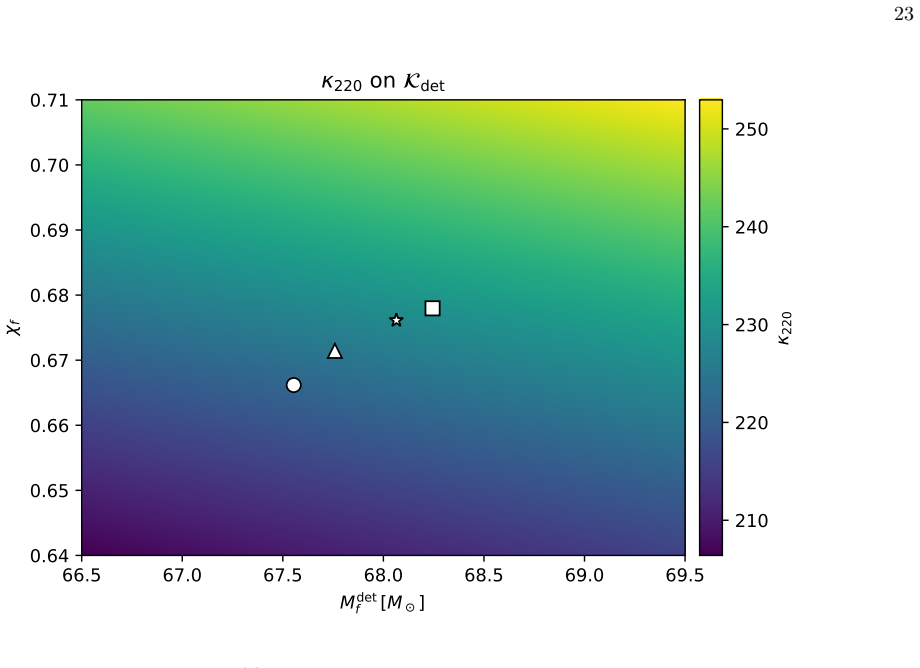
The primary Kerr map It is convenient to pass from the complex dominant mode frequency to its equivalent real two-vector. Definition H.1.Define the real-linear isometry Ξ :C→R 2,Ξ(z) := (ℜz,−ℑz), and the primary Kerr maps F220(p) :=ω 220(p)∈C, G 220(p) := Ξ F220(p) = ℜω220(p),−ℑω 220(p) ∈R 2, p∈Ω phys.(H.1) The Euclidean norm onR 2 and the modulus onCare ...
-
[10]
Auxiliary mode Lipschitz control To turn the primary parameter error into a tolerance for the auxiliary checks, one needs a forward Lipschitz bound for the 221 and 440 Kerr maps onK det. Proposition H.6(Certified forward Lipschitz constants for the auxiliary modes).For each auxiliary mode j∈ {221,440}define Lj := s U2 j M4 − + V 2 j M2 − ,(H.14) whereU j ...
-
[11]
Propagation from primary inversion to auxiliary consistency We now combine the primary inverse theorem with the forward Lipschitz control of the auxiliary modes. Theorem H.7(Primary error propagation into auxiliary residuals).Fix p∈ K det and let bω220 ∈V 220(p)with primary estimate bp= F −1 220(bω220) ∈B R2(p, ρ220) ∩ Kdet. Let j∈ { 221, 440} and let bωj...
-
[12]
Consistency tubes and failure certificates The previous theorem is still phrased relative to an underlying parameter point p. For the trust-region test one also needs the practical contrapositive: if the observed auxiliary residual is too large, then no single remnant in the same local primary chart can account for both the primary and the auxiliary obser...
-
[13]
Pair maps and local geometry We begin by packaging the dominant mode and one auxiliary mode into a single overdetermined forward map. Definition I.1.Let Ξ2 :C 2 →R 4,Ξ 2(z1, z2) := Ξ(z1),Ξ(z 2) , where Ξ is the isometry from Definition H.1. EquipC 2 with the Euclidean norm ∥(z1, z2)∥C2 := |z1|2 +|z 2|2 1/2 andR 4 with its standard Euclidean norm. For each...
-
[14]
Definition I.7.Fixj∈ {221,440}, a base pointp∈ K det, and observed data bz= (bω220,bωj)∈C 2
Distance to the local pair image Once the observed pair is allowed to lie off the exact Kerr image, the relevant object is its distance to the local image surfaceS j(p). Definition I.7.Fixj∈ {221,440}, a base pointp∈ K det, and observed data bz= (bω220,bωj)∈C 2. For eachq∈ C j(p) define the pair misfit ej(bz;q) := bz−Wj(q) C2 = |bω220 −ω 220(q)|2 +|bωj −ω...
-
[15]
The projected pair estimator can be compared directly to that primary estimate
Comparison with the primary estimate The main theorem surface is expressed in terms of the primary estimate from 220 and the auxiliary residual from 221 or 440. The projected pair estimator can be compared directly to that primary estimate. Proposition I.10(Projected pair inversion is controlled by the auxiliary residual).Fix j∈ { 221, 440} and p∈ K det. ...
-
[16]
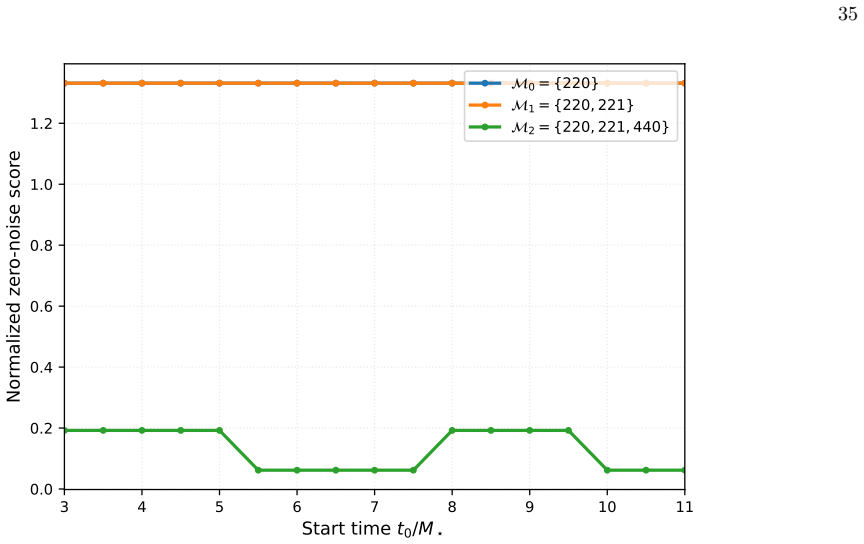
Zero-noise radii For b∈B 0, W∈W cal, and A ∈ {M 0,M 1,M 2}, the default extraction pipeline returns a fitted detector-frame remnant bp0 b,A(W) = cM 0 b,A(W),bχ0 b,A(W) . The corresponding zero-noise remnant errors are R 0,A,W M,b = cM 0 b,A(W)−M b , R 0,A,W χ,b = bχ0 b,A(W)−χ b . The bankwise deterministic radii are the maxima R 0,A,W M = max b∈B0 R 0,A,W...
-
[17]
Colored-noise quantiles The H1/L1 strain provides the colored-noise component. We extract eight off-source detector chunks, apply the same 50–500 Hz stabilization used in the real-event analysis, and normalize each chunk to unit sample standard deviation on its own support. For a fixedb,W, and noise draw indexr, the noisy bank element is yW b,r =y 0,W b +...
-
[18]
Total calibrated radii The synthetic calibration enters the trust inequalities through remnant-space radii and their induced modewise envelopes. For each fixedWandA, define the total detector-frame remnant radii R tot,A,W M (q;α) = R 0,A,W M + R stat,A,W M (q;α),(J.13) R tot,A,W χ (q;α) = R 0,A,W χ + R stat,A,W χ (q;α). The main-text figures report these ...
-
[19]
In particular, Ndir = 4, E W (u) = exp h −16 u T 2i ,P quad ={(220,220)}
Fixed diagnostic classes and finite specification sets The nuisance dictionary is exactly the one fixed in Definition III.2. In particular, Ndir = 4, E W (u) = exp h −16 u T 2i ,P quad ={(220,220)}. No additional direct-wave atom and no additional quadratic pair is introduced anywhere in the robustness checks. For the real-data reruns we fix the finite pr...
-
[20]
Specwise residuals and nuisance gains Let Ξ = (τ0,Θ)∈W τ scan be a master scan point, letg∈G, and let σ= (P, ϑ, g)∈B base A (g) be a baseline specification. Denote by Wg(Ξ) the detector-frame window induced by Ξ on grid g, and by yσ,Ξ the corresponding preprocessed H1/L1 data vector. Forν∈N, define the specwise normalized residual ρσ,A ν (Ξ) := inf p∈Kdet...
-
[21]
Compatibility with the numerical acceptance notation Later appendices summarize the event-level decision rule through normalized acceptance diagnostics. To keep the notation consistent, we record the corresponding baseline and event-level conditions here. Fix a baseline family A ⊂ M ♯ with 220∈ A, a master scan point Ξ∈W τ scan, and a finite baseline spec...
-
[22]
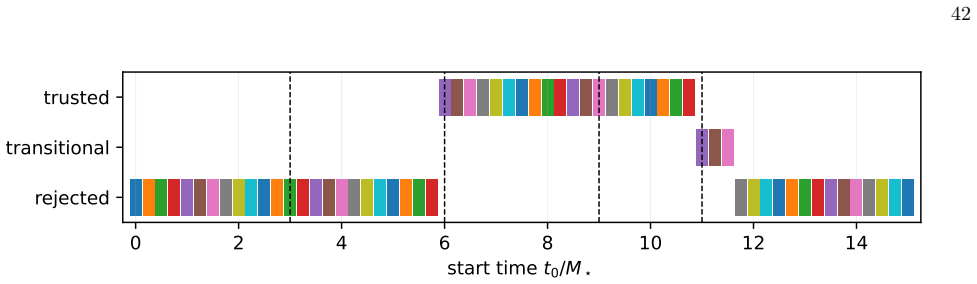
Observed anchor-window spreads The real-data anchor reruns is centered on the same public H1/L1 strain used in Section VIII. We keep the detector-frame window length fixed at Θ = 24 and inspect the public anchor windows τ0 ∈ {3,6,9,11}.(K.22) Because the displayed reruns fix the grid label to ganc, each anchor window is rerun fifteen times, once for every...
-
[23]
Use of the reruns in the event map The event map of Section VIII does not turn Figure 16 into theorem-level constants. Its role is narrower. The finite reruns determine the scale on which preprocessing changes are treated as routine, while the fixed nuisance dictionary prevents those reruns from absorbing arbitrarily flexible early-time structure. The den...
-
[24]
Thermodynamics of Kerr-Newman-AdS Black Holes and Conformal Field Theories,
O. Dreyer, B. Kelly, B. Krishnan, L. S. Finn, D. Garrison, and R. Lopez-Aleman, Black-hole spectroscopy: testing general relativity through gravitational-wave observations,Classical and Quantum Gravity21(2004), 787–803, doi: 10.1088/0264- 9381/21/4/003
-
[25]
E. Berti, V. Cardoso, and A. O. Starinets, Quasinormal modes of black holes and black branes,Classical and Quantum Gravity26(2009), 163001, doi: 10.1088/0264-9381/26/16/163001
-
[26]
M. Giesler, M. Isi, M. A. Scheel, and S. A. Teukolsky, Black hole ringdown: the importance of overtones,Physical Review X 9(2019), 041060, doi: 10.1103/PhysRevX.9.041060
-
[27]
M. Vallisneri, J. Kanner, R. Williams, A. Weinstein, and B. Stephens, The LIGO Open Science Center,Journal of Physics: Conference Series610(2015), 012021, doi: 10.1088/1742-6596/610/1/012021
-
[28]
LIGO Scientific Collaboration, Virgo Collaboration, and KAGRA Collaboration, GW250114 082203 Detail Page, Gravita- tional Wave Open Science Center, 2025, doi: 10.7935/1g4j-2028
-
[29]
A. G. Abac et al. (LIGO Scientific Collaboration, Virgo Collaboration, and KAGRA Collaboration), Black Hole Spectroscopy and Tests of General Relativity with GW250114,Physical Review Letters136(2026), 041403, doi: 10.1103/6c61-fm1n
-
[30]
N. Lu, S. Ma, O. J. Piccinni, Y. Chen, and L. Sun, GW250114 reveals black hole horizon signatures, arXiv: 2510.01001, 2025
work page internal anchor Pith review arXiv 2025
- [31]
-
[32]
A. Prˇ sa, P. Harmanec, G. Torres, E. Mamajek, M. Asplund, N. Capitaine, J. Christensen-Dalsgaard, ´E. Depagne, M. Haberreiter, S. Hekker, J. Hilton, G. Kopp, V. Kostov, D. W. Kurtz, J. Laskar, B. D. Mason, E. F. Milone, M. Montgomery, M. Richards, W. Schmutz, J. Schou, and S. G. Stewart, Nominal values for selected solar and planetary quantities: IAU 201...
-
[33]
V. Baibhav and E. Berti, Multimode black hole spectroscopy,Physical Review D99(2019), 024005, doi: 10.1103/PhysRevD.99.024005
-
[34]
P. D. Welch, The use of fast Fourier transform for the estimation of power spectra: A method based on time averaging over short, modified periodograms,IEEE Transactions on Audio and Electroacoustics15(1967), 70–73, doi: 10.1109/TAU.1967.1161901
-
[35]
F. J. Harris, On the use of windows for harmonic analysis with the discrete Fourier transform,Proceedings of the IEEE66 (1978), 51–83, doi: 10.1109/PROC.1978.10837
-
[36]
B. Allen, W. G. Anderson, P. R. Brady, D. A. Brown, and J. D. E. Creighton, FINDCHIRP: An algorithm for detection of grav- itational waves from inspiraling compact binaries,Physical Review D85(2012), 122006, doi: 10.1103/PhysRevD.85.122006
-
[37]
K. Chatziioannou, C.-J. Haster, T. B. Littenberg, W. M. Farr, S. Ghonge, M. Millhouse, J. A. Clark, and N. Cornish, Noise spectral estimation methods and their impact on gravitational wave measurement of compact binary mergers,Physical Review D100(2019), 104004, doi: 10.1103/PhysRevD.100.104004
-
[38]
B. P. Abbott et al. (LIGO Scientific Collaboration and Virgo Collaboration), A guide to LIGO-Virgo detector noise and extraction of transient gravitational-wave signals,Classical and Quantum Gravity37(2020), 055002, doi: 10.1088/1361- 6382/ab685e
-
[39]
C. Talbot and E. Thrane, Gravitational-wave astronomy with an uncertain noise power spectral density,Physical Review Research2(2020), 043298, doi: 10.1103/PhysRevResearch.2.043298
-
[40]
D. J. A. McKechan, C. Robinson, and B. S. Sathyaprakash, A tapering window for time-domain templates and simulated signals in the detection of gravitational waves from coalescing compact binaries,Classical and Quantum Gravity27(2010), 084020, doi: 10.1088/0264-9381/27/8/084020
-
[41]
S. A. Teukolsky, Perturbations of a rotating black hole. I. Fundamental equations for gravitational, electromagnetic, and neutrino-field perturbations,The Astrophysical Journal185(1973), 635–647, doi: 10.1086/152444. 113
-
[42]
E. W. Leaver, An analytic representation for the quasi-normal modes of Kerr black holes,Proceedings of the Royal Society of London. Series A402(1985), 285–298, doi: 10.1098/rspa.1985.0119
-
[43]
G. B. Cook and M. Zalutskiy, Gravitational perturbations of the Kerr geometry: High-accuracy study,Physical Review D 90(2014), 124021, doi: 10.1103/PhysRevD.90.124021
-
[44]
L. C. Stein, qnm: A Python package for calculating Kerr quasinormal modes, separation constants, and spherical-spheroidal mixing coefficients,Journal of Open Source Software4(2019), no. 42, 1683, doi: 10.21105/joss.01683
-
[45]
G. B. Cook, Kerr Quasinormal Modes:s=−2,n= 0− −7, Zenodo dataset, 2019, doi: 10.5281/zenodo.2650358
-
[46]
J.-P. Berrut and L. N. Trefethen, Barycentric Lagrange interpolation,SIAM Review46(2004), 501–517, doi: 10.1137/S0036144502417715
-
[47]
N. J. Higham, The numerical stability of barycentric Lagrange interpolation,IMA Journal of Numerical Analysis24(2004), 547–556, doi: 10.1093/imanum/24.4.547
-
[48]
On inverses of vandermonde and confluent vandermonde matrices
W. Gautschi, On inverses of Vandermonde and confluent Vandermonde matrices,Numerische Mathematik4(1962), 117–123, doi: 10.1007/BF01386302
-
[49]
Y. Hua and T. K. Sarkar, Matrix pencil method for estimating parameters of exponentially damped/undamped sinusoids in noise,IEEE Transactions on Acoustics, Speech, and Signal Processing38(1990), 814–824, doi: 10.1109/29.56027
-
[50]
R. Roy and T. K. Kailath, ESPRIT—Estimation of signal parameters via rotational invariance techniques,IEEE Transactions on Acoustics, Speech, and Signal Processing37(1989), 984–995, doi: 10.1109/29.32276
-
[51]
D. Potts and M. Tasche, Parameter estimation for exponential sums by approximate Prony method,Signal Processing90 (2010), 1631–1642, doi: 10.1016/j.sigpro.2009.11.012
-
[52]
D. Batenkov and Y. Yomdin, On the accuracy of solving confluent Prony systems,SIAM Journal on Applied Mathematics 73(2013), 134–154, doi: 10.1137/110836584
-
[53]
V. Varma, S. E. Field, M. A. Scheel, J. Blackman, D. Gerosa, L. C. Stein, L. E. Kidder, and H. P. Pfeiffer, Surrogate models for precessing binary black hole simulations with unequal masses,Physical Review Research1(2019), 033015, doi: 10.1103/PhysRevResearch.1.033015
-
[54]
Surrogate model of hybridized numerical relativity binary black hole waveforms,
V. Varma, S. E. Field, M. A. Scheel, J. Blackman, L. E. Kidder, and H. P. Pfeiffer, Surrogate model of hybridized numerical relativity binary black hole waveforms,Physical Review D99(2019), 064045, doi: 10.1103/PhysRevD.99.064045
-
[55]
J. Yoo, K. Mitman, V. Varma, M. Boyle, S. E. Field, N. Deppe, F. H´ ebert, L. E. Kidder, J. Moxon, H. P. Pfeiffer, M. A. Scheel, L. C. Stein, S. A. Teukolsky, W. Throwe, and N. L. Vu, Numerical relativity surrogate model with memory effects and post-Newtonian hybridization,Physical Review D108(2023), 064027, doi: 10.1103/PhysRevD.108.064027
-
[56]
Catalog of precessing black-hole-binary numerical-relativity simulations
E. Hamilton, E. Fauchon-Jones, M. Hannam, C. Hoy, C. Kalaghatgi, L. London, J. E. Thompson, D. Yeeles, S. Ghosh, S. Khan, P. Kolitsidou, and A. Vano-Vinuales, Catalog of precessing black-hole-binary numerical-relativity simulations, Physical Review D109(2024), 044032, doi: 10.1103/PhysRevD.109.044032
-
[57]
S. Bhagwat, M. Okounkova, S. W. Ballmer, D. A. Brown, M. Giesler, M. A. Scheel, and S. A. Teukolsky, On choosing the start time of binary black hole ringdown,Physical Review D97(2018), 104065, doi: 10.1103/PhysRevD.97.104065
-
[58]
Y. Qiu, X. Jim´ enez Forteza, and P. Mourier, Linear versus nonlinear modeling of black hole ringdowns,Physical Review D 109(2024), 064075, doi: 10.1103/PhysRevD.109.064075
-
[59]
The first passage probl em for a continuous Markov pro- cess
A. Dvoretzky, J. Kiefer, and J. Wolfowitz, Asymptotic minimax character of the sample distribution function and of the classical multinomial estimator,The Annals of Mathematical Statistics27(1956), 642–669, doi: 10.1214/aoms/1177728174
-
[60]
The Annals of Probability19(3), 1010–1034 (1991) https://doi.org/10.1214/aop/1176990422 22
P. Massart, The tight constant in the Dvoretzky-Kiefer-Wolfowitz inequality,The Annals of Probability18(1990), 1269–1283, doi: 10.1214/aop/1176990746
-
[61]
R. Dyer and C. J. Moore, Quasinormal mode content of binary black hole ringdowns,Physical Review Letters, accepted paper, 2026, doi: 10.1103/ptmd-rz1t
-
[62]
S. Morisaki, H. Motohashi, M. Suzuki, and D. Watarai, Analyzing black-hole ringdowns with orthonormal modes,Physical Review D112(2025), 124083, doi: 10.1103/lhkp-w6hm
-
[63]
E. Coleman and E. Finch, High-overtone ringdown fits: start time, no-hair tests, and correlations, arXiv: 2512.08098, 2025
-
[64]
R. Li, Quantitative local recovery of Kerr–de Sitter parameters from high-frequency equatorial quasinormal modes, arXiv: 2602.15764, 2026
-
[65]
R. Li, Two-mode dominance and deterministic parameter bias bounds for equatorial Kerr–de Sitter ringdown, arXiv: 2602.16691, 2026
-
[66]
S. H. V¨ olkel and A. Dhani, Quantifying systematic biases in black hole spectroscopy,Physical Review D112(2025), 084076, doi: 10.1103/g6sz-dw28
-
[67]
Chandraet al., arXiv:2509.17315 [gr-qc] (2025), https://arxiv.org/abs/2509.17315
K. Chandra and J. Calder´ on Bustillo, Black-hole ringdown analysis with inspiral-merger informed templates and limitations of classical spectroscopy, arXiv: 2509.17315, 2025
discussion (0)
Sign in with ORCID, Apple, or X to comment. Anyone can read and Pith papers without signing in.