Recognition: unknown
Achromatic optics using nonlinear plasma lenses for beam-quality preservation between plasma-accelerator stages
Pith reviewed 2026-05-10 04:50 UTC · model grok-4.3
The pith
Nonlinear plasma lenses create a compact achromatic lattice that preserves emittance for energy spreads of several percent in plasma-accelerator staging.
A machine-rendered reading of the paper's core claim, the machinery that carries it, and where it could break.
Core claim
A lattice of nonlinear plasma lenses cancels chromatic aberrations from high beam divergence and energy spread, allowing emittance-preserving transport between plasma stages. The lattice provides tunable R56 and outperforms a quadrupole-sextupole alternative by being half the length with twice the energy bandwidth. Performance is verified through analytic and numeric modeling, and the approach extends to TeV energies by scaling lengths with the square root of beam energy while mitigating coherent and incoherent synchrotron radiation.
What carries the argument
The nonlinear plasma lens, which supplies energy-dependent focusing to compensate chromatic effects in divergent beams from plasma accelerators.
Load-bearing premise
Nonlinear plasma lenses can be realized with exactly the required energy-dependent focusing without adding unmodeled aberrations, instabilities, or plasma complications.
What would settle it
An experiment that either shows emittance preservation through the plasma-lens lattice for a beam with several-percent energy spread or reveals degradation from effects outside the analytic and numeric models.
Figures
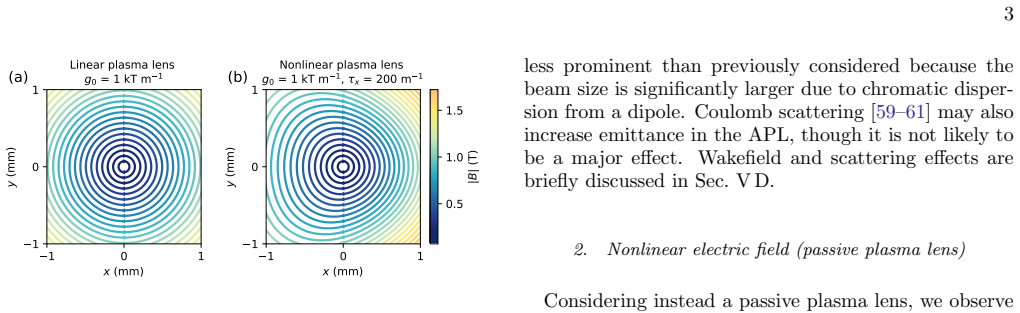


read the original abstract
Plasma acceleration promises to deliver high-energy particle beams by combining, or staging, several low- or medium-energy accelerator stages. However, chromatic aberrations from the combination of high divergence and energy spread make it nontrivial to transport beams between plasma-accelerator stages. This paper describes a compact and achromatic lattice optimized for staging, based on a new beam-optics element; a nonlinear plasma lens. The lattice preserves emittance for energy spreads up to several percent and has a tunable $R_{56}$ that enables bunch-length preservation or a longitudinal self-correction mechanism. The performance and limitations of the plasma-lens-based solution are modeled analytically and numerically, and compared to a more conventional yet novel solution based on quadrupole and sextupole magnets. While functional, the latter is double the length, has about twice the number of elements and a narrower energy bandwidth. Lastly, a solution for scaling to TeV energies is described, in which all lengths scale with the square root of the energy and the deleterious effects of coherent and incoherent synchrotron radiation are mitigated.
Editorial analysis
A structured set of objections, weighed in public.
Referee Report
Summary. The paper proposes a compact achromatic transport lattice for plasma-accelerator staging that uses a new nonlinear plasma lens element to cancel chromatic aberrations. It claims analytic and numerical modeling shows emittance preservation for energy spreads up to several percent, a tunable R56 for bunch-length control or self-correction, and superior performance (half the length, twice the energy bandwidth, fewer elements) compared with a quadrupole-sextupole magnet lattice; a sqrt(E) scaling solution for TeV energies is also outlined.
Significance. If the idealized nonlinear plasma lens can be realized without unmodeled aberrations or instabilities, the work would offer a shorter, more robust inter-stage optic that relaxes the energy-spread requirement on plasma stages and could accelerate progress toward multi-stage plasma accelerators. The analytic transport matrices, direct numerical tracking, and explicit comparison to a conventional alternative are positive features.
major comments (2)
- [analytic transport matrices and numerical tracking] The emittance-preservation result for several-percent energy spreads (abstract and modeling sections) is derived under the assumption that the nonlinear focusing coefficient exactly cancels chromatic terms with no residual aberrations; the analytic matrices and tracking therefore omit beam-induced plasma perturbations, density fluctuations, and wakefield effects that would break this cancellation at realistic currents.
- [comparison to quadrupole-sextupole lattice] The claim that the plasma-lens lattice has twice the energy bandwidth of the magnet alternative (comparison section) is load-bearing for the headline advantage, yet the bandwidth definition, the precise energy-spread values at which emittance growth begins, and the quantitative R56 tunability range are not cross-checked against the same figure of merit in both lattices.
minor comments (2)
- [TeV scaling section] The abstract states lengths scale with the square root of energy for TeV operation, but the scaling derivation and the mitigation of coherent/incoherent synchrotron radiation should be shown explicitly with the relevant equations.
- [throughout] Notation for the nonlinear focusing coefficient and the plasma density profile used to derive it should be defined once and used consistently; a short table of the free parameters would improve clarity.
Simulated Author's Rebuttal
We thank the referee for the thoughtful and constructive report. The comments highlight important aspects of our modeling assumptions and the need for consistent metrics in comparisons. We address both points below and will incorporate clarifications and revisions into the updated manuscript.
read point-by-point responses
-
Referee: [analytic transport matrices and numerical tracking] The emittance-preservation result for several-percent energy spreads (abstract and modeling sections) is derived under the assumption that the nonlinear focusing coefficient exactly cancels chromatic terms with no residual aberrations; the analytic matrices and tracking therefore omit beam-induced plasma perturbations, density fluctuations, and wakefield effects that would break this cancellation at realistic currents.
Authors: We agree that the analytic transport matrices and numerical tracking assume an idealized nonlinear plasma lens with exact cancellation of chromatic terms and no residual aberrations from beam-induced effects. The manuscript is scoped to demonstrate the optics principle and its potential under these assumptions, as full inclusion of plasma perturbations would require coupled PIC-beam tracking simulations outside the present focus. In the revised version, we will add a new subsection in the discussion explicitly stating these limitations, noting the applicability to low-current regimes where such effects remain small, and citing relevant work on plasma lens stability and wakefields. revision: partial
-
Referee: [comparison to quadrupole-sextupole lattice] The claim that the plasma-lens lattice has twice the energy bandwidth of the magnet alternative (comparison section) is load-bearing for the headline advantage, yet the bandwidth definition, the precise energy-spread values at which emittance growth begins, and the quantitative R56 tunability range are not cross-checked against the same figure of merit in both lattices.
Authors: We acknowledge the need for fully consistent metrics. The original comparison used emittance preservation as the primary criterion for both lattices, but the exact growth thresholds and R56 quantification were not aligned in presentation. We will revise the comparison section to adopt a single, explicitly defined figure of merit (normalized emittance growth below 5%), tabulate the precise energy-spread thresholds at which growth begins for each lattice, and report the R56 tunability range using identical analysis methods. This will make the performance claims directly comparable. revision: yes
Circularity Check
No circularity: forward analytic and numerical modeling of a proposed lattice element
full rationale
The paper constructs an achromatic lattice by proposing a nonlinear plasma lens element whose energy-dependent focusing is derived from an idealized plasma density profile. Analytic transport matrices and numerical tracking are then applied to demonstrate emittance preservation and tunable R56 for given energy spreads. These steps are self-contained forward calculations that do not reduce to fitted parameters extracted from the same dataset, self-definitional relations, or load-bearing self-citations. The comparison to a quadrupole-sextupole alternative and the TeV scaling discussion are likewise independent modeling exercises. No quoted equation or derivation collapses to its own input by construction.
Axiom & Free-Parameter Ledger
free parameters (1)
- nonlinear focusing coefficient
axioms (1)
- domain assumption Nonlinear plasma lenses can be engineered to provide the precise energy-dependent focusing needed for achromatic transport
invented entities (1)
-
nonlinear plasma lens
no independent evidence
Reference graph
Works this paper leans on
-
[1]
If we were using linear (i.e., chro- matic) plasma lenses in the lattice, this would imply a chromaticity of ∆W≈(L/β 0)(1 +L/l), or 1.45(L/β0) in the given example
Canceling first-order chromaticity Starting from zero chromaticity, the chromatic ampli- tude increases in a linear-optics element approximately as ∆W≈β lens/flens. If we were using linear (i.e., chro- matic) plasma lenses in the lattice, this would imply a chromaticity of ∆W≈(L/β 0)(1 +L/l), or 1.45(L/β0) in the given example. Since there is a 180 ◦ phas...
-
[2]
While the second-order dispersion does not need to be canceled if the energy spread is small, it may be required for energy spreads above 1% rms
Canceling second-order dispersion Finally, the second-order dispersion is affected by both dipoles and plasma lenses; here also the nonlinearityτ x matters. While the second-order dispersion does not need to be canceled if the energy spread is small, it may be required for energy spreads above 1% rms. To cancel the second-order dispersion, we wish to use ...
-
[3]
For pedagogical purposes, therefore, we have included Fig
Visualizing the evolution in 6D phase space The complex and interwoven operation of the achro- matic lattice is not straightforward to understand. For pedagogical purposes, therefore, we have included Fig. 4 to visualize the evolution of the beam throughout the lat- tice. The beam orbit and size is shown for three different energy slices, and the distribu...
-
[4]
inner route
Preservation of emittance and other beam qualities The ultimate goal of the staging optics is to trans- port beams from a plasma accelerator without degrad- ing beam qualities. Figure 5 shows the evolution of the transverse emittances, bunch length and energy spread. The horizontal emittance increases dramatically due to the introduction of a large horizo...
-
[5]
TunableR 56 While the standard solution presented in this paper has zeroR 56, it is a key feature that the lattice should have a tunableR 56, in particular to negative values as required for the longitudinal self-correction mechanism [32]. Fig- ure 6 highlights this capability, showing that for the staging lattice presented, longitudinal dispersions from ...
-
[6]
Transporting this particle through the drifts and applying the nonlinear kicks in the plasma lenses, and finally averaging over a Gaussian beam dis- tribution in phase space (see Appendix D for the full derivation), we estimate relative emittance growths ∆εnx εnx ≈ τ 2 x L3 β2 0 γ 1 + L l l L + 1 q 6ε2nx + 18ε2ny(29) ∆εny εny ≈ τ 2 x L3 β2 0 γ 1 + L l l L...
-
[7]
However, the plasma lenses are typi- cally too short for multiple Coulomb scattering events to occur
Coulomb scattering If there are multiple Coulomb scattering events, the expected emittance growth is given by [59–61] ∆εn ≈0.83r 2 e βlensLlens γ nlensZ(Z+ 1) ln 287√ Z , (36) wherer e is the classical electron radius,Zis the atomic number of the gas species,β lens is the beta function inside the plasma lens, andL lens andn lens are its length and atomic ...
-
[8]
locked in
Distortion from wakefield focusing In an active plasma lens, if the beam density is suffi- ciently high, it can drive a plasma wake whose transverse focusing forces compete with the lens field, causing dis- tortion and possibly emittance growth [49, 58]. However, this does not apply to passive plasma lenses, as these al- ready rely on a plasma wakefield (...
-
[9]
In the plasma lenses, a kick is applied based on the particle position, but at this loca- tion the position is dominated by the angles and not the initial position; e.g., in the first lensx 0 +x ′ 0L→x ′ 0L. The angle term dominates because for a matched beam ⟨x0⟩/⟨x′ 0⟩=β 0 and in our setup we assumeβ 0 ≪L(and hencex 0 ≪x ′ 0L), which is the reason why c...
-
[10]
+O(τ 3 x) y3 =−τ 2 x L3 1 + L l l L + 1 y′ 0(3x′ 0 2 +y ′ 0
-
[11]
The final angles are the same as after the second lens, i.e.x ′ 3 =x ′ 2 andy ′ 3 =y ′
+O(τ 3 x). The final angles are the same as after the second lens, i.e.x ′ 3 =x ′ 2 andy ′ 3 =y ′
-
[12]
Starting with the assumption that the initial distri- butions in all phase-space variables (x 0,y 0,x ′ 0,y ′
This shows that the−Itrans- form does indeed cancel the geometric effects to first or- der in the final offset [i.e., there is noO(τ x) term], but not on the final angle (which indeed has aO(τ x) term). Starting with the assumption that the initial distri- butions in all phase-space variables (x 0,y 0,x ′ 0,y ′
-
[13]
are Gaussian, we can estimate the rms geometric emittance (first in the horizontal plane only) to be εx = q ⟨x2 3⟩⟨x′ 3 2⟩ − ⟨x3x′ 3⟩2 ≈ q ⟨(x0 + ∆x)2⟩⟨x′ 0 2⟩ − ⟨(x0 + ∆x)x′ 0⟩2 ≈ r ⟨x2 0⟩⟨x′ 0 2⟩ − ⟨x0x′ 0⟩2 + ⟨∆x2⟩⟨x′ 0 2⟩ − ⟨∆xx′ 0⟩2 ≈ r ε2 x0 + ⟨∆x2⟩⟨x′ 0 2⟩ − ⟨∆xx′ 0⟩2 ≡ q ε2 x0 + ∆ε2x, where in the second step, we make use of the finding that the i...
-
[14]
+ ∆2 2 −2∆ 1∆2 2l L −1 + ∆2 1 2l L −1 2! 1 L + 1 l 2 (E8) ≈ γ 2β0 (∆2 1 + 2∆1∆2 + ∆2 2) 1 + L l 2 ,(E9) where the final approximation assumes thatβ 0 ≪L. Further, we can assume that the offset of the first and second lens are random, normally distributed with the same rmsσ ∆x = p ⟨∆1⟩= p ⟨∆2⟩, and not correlated with each other (i.e., cross terms ∆ 1∆2 va...
-
[15]
Esarey, C
E. Esarey, C. B. Schroeder, and W. P. Leemans, Physics of laser-driven plasma-based electron accelerators, Rev. Mod. Phys.81, 1229 (2009)
2009
- [16]
-
[17]
M. J. Hogan, C. D. Barnes, C. E. Clayton, F. J. Decker, S. Deng, P. Emmaet al., Multi-GeV energy gain in a plasma-wakefield accelerator, Phys. Rev. Lett.95, 054802 (2005)
2005
-
[18]
W. P. Leemans, B. Nagler, A. J. Gonsalves, Cs. T´ oth, K. Nakamura, C. G. R. Geddes, E. Esarey, C. B. Schroeder and S. M. Hooker, GeV electron beams from a centimetre-scale accelerator, Nat. Phys.2, 696 (2006)
2006
-
[19]
Grudiev, S
A. Grudiev, S. Calatroni and W. Wuensch, New local field quantity describing the high gradient limit of ac- celerating structures, Phys. Rev. ST Accel. Beams12, 102001 (2009)
2009
-
[20]
Joshi and T
C. Joshi and T. Katsouleas, Plasma accelerators at the energy frontier and on tabletops, Phys. Today56, 6, 47 (2003)
2003
-
[21]
Tajima and J
T. Tajima and J. M. Dawson, Laser electron accelerator, Phys. Rev. Lett.43, 267 (1979)
1979
-
[22]
V. I. Veksler, Coherent principle of acceleration of charged particles, Proceedings of the CERN Symposium on High Energy Accelerators and Pion Physics, pp. 80–83 (1956)
1956
-
[23]
Ya. B. Fainberg, The use of plasma waveguides as accel- erating structures in linear accelerators, Proceedings of the CERN Symposium on High Energy Accelerators and Pion Physics, pp. 84–90 (1956)
1956
-
[25]
P. Chen, J. M. Dawson, R. W. Huff and T. Katsouleas, Acceleration of Electrons by the Interaction of a Bunched Electron Beam with a Plasma, Phys. Rev. Lett.54, 693 (1985)
1985
-
[26]
M. J. Hogan, C. E. Clayton, C. Huang, P. Muggli, S. Wang, B. E. Blueet al., Ultrarelativistic-positron-beam transport through meter-scale plasmas, Phys. Rev. Lett. 90, 205002 (2003)
2003
-
[27]
Muggli, B
P. Muggli, B. E. Blue, C. E. Clayton, S. Deng, F.-J. Decker, M. J. Hoganet al., Meter-scale plasma-wakefield accelerator driven by a matched electron beam, Phys. Rev. Lett.93, 014802 (2004)
2004
-
[28]
Steinkeet al., Multistage coupling of independent laser-plasma accelerators, Nature (London)530, 190 (2016)
S. Steinkeet al., Multistage coupling of independent laser-plasma accelerators, Nature (London)530, 190 (2016)
2016
-
[29]
C. A. Lindstrøm, Staging of plasma-wakefield accelera- 25 tors, Phys. Rev. Accel. Beams24, 014801 (2021)
2021
-
[30]
Litoset al., 9 GeV energy gain in a beam-driven plasma wakefield accelerator, Plasma Phys
M. Litoset al., 9 GeV energy gain in a beam-driven plasma wakefield accelerator, Plasma Phys. Control. Fu- sion58, 034017 (2016)
2016
-
[31]
Gonsalveset al., Petawatt laser guiding and elec- tron beam acceleration to 8 GeV in a laser-heated capil- lary discharge waveguide, Phys
A. Gonsalveset al., Petawatt laser guiding and elec- tron beam acceleration to 8 GeV in a laser-heated capil- lary discharge waveguide, Phys. Rev. Lett.122, 084801 (2019)
2019
-
[32]
Picksleyet al., Matched guiding and controlled injec- tion in dark-current-free, 10-GeV-class, channel-guided laser-plasma accelerators, Phys
A. Picksleyet al., Matched guiding and controlled injec- tion in dark-current-free, 10-GeV-class, channel-guided laser-plasma accelerators, Phys. Rev. Lett.133, 255001 (2024)
2024
-
[33]
Adli and P
E. Adli and P. Muggli, Proton-Beam-Driven Plasma Ac- celeration, Rev. Accel. Sci. Tech.9, 85–104 (2016)
2016
-
[34]
Adliet al.(AWAKE Collaboration), Acceleration of electrons in the plasma wakefield of a proton bunch, Na- ture (London)561, 363–367 (2018)
E. Adliet al.(AWAKE Collaboration), Acceleration of electrons in the plasma wakefield of a proton bunch, Na- ture (London)561, 363–367 (2018)
2018
-
[35]
Farmer, A
J. Farmer, A. Caldwell and A. Pukhov, Preliminary in- vestigation of a higgs factory based on proton-driven plasma wakefield acceleration, New J. Phys.26, 113011 (2024)
2024
-
[36]
D’Arcyet al., Recovery time of a plasma-wakefield accelerator, Nature (London)603, 58–62 (2022)
R. D’Arcyet al., Recovery time of a plasma-wakefield accelerator, Nature (London)603, 58–62 (2022)
2022
-
[37]
Litoset al., High-efficiency acceleration of an electron beam in a plasma wakefield accelerator, Nature (London) 515, 92–95 (2014)
M. Litoset al., High-efficiency acceleration of an electron beam in a plasma wakefield accelerator, Nature (London) 515, 92–95 (2014)
2014
-
[38]
C. A. Lindstrømet al., Energy-spread preservation and high efficiency in a plasma-wakefield accelerator, Phys. Rev. Lett.126, 014801 (2021)
2021
-
[39]
Rosenzweig, N
J. Rosenzweig, N. Barov, A. Murokh, E. Colby and P. Colestock, Towards a plasma wake-field acceleration- based linear collider, Nucl. Instrum. Methods Phys. Res. A410, 532–543 (1998)
1998
-
[40]
Seryi, M
A. Seryi, M. J. Hogan, S. Pei, T. Raubenheimer, P. Tenenbaum, T. Katsouleas, C. Huang, C. Joshi, W. Mori, and P. Muggli, A concept of plasma wake field accelera- tion linear collider (PWFA-LC),Proceedings of PAC09, Vancouver, BC, Canada(JACoW, Geneva, 2009), pp. 2688–2690
2009
-
[41]
Adli, J.-P
E. Adli, J.-P. Delahaye, S. J. Gessner, M. J. Hogan, T. O. Raubenheimer, W. An, C. Joshi, and W. B. Mori, A beam driven plasma-wakefield linear collider: from Higgs factory to multi-TeV, SLAC Report No. SLAC- PUB-15426, 2013
2013
-
[42]
Foster, R
B. Foster, R. D’Arcy and C. A. Lindstrøm, A hy- brid, asymmetric, linear Higgs factory based on plasma- wakefield and radio-frequency acceleration, New J. Phys. 25, 093037 (2023)
2023
-
[43]
Fosteret al., Proceedings of the Erice workshop: A new baseline for the hybrid, asymmetric, linear Higgs factory HALHF, Phys
B. Fosteret al., Proceedings of the Erice workshop: A new baseline for the hybrid, asymmetric, linear Higgs factory HALHF, Phys. Open23, 100261 (2025)
2025
-
[44]
Gonoskov, T
A. Gonoskov, T. G. Blackburn, M. Marklund, and S. S. Bulanov, Charged particle motion and radiation in strong electromagnetic fields, Rev. Mod. Phys.94, 045001 (2022)
2022
-
[45]
C. A. Lindstrømet al., The SPARTA project: toward a demonstrator facility for multistage plasma accelera- tion, Proceedings of IPAC’25 (Taipei, Taiwan, 2025), pp. 1615–1618
2025
- [46]
-
[47]
Antici, A
P. Antici, A. Bacci, C. Benedetti, E. Chiadroni, M. Fer- rario, A. R. Rossiet al., Laser-driven electron beamlines generated by coupling laser-plasma sources with conven- tional transport systems, J. Appl. Phys.112, 044902 (2012)
2012
-
[48]
Migliorati, A
M. Migliorati, A. Bacci, C. Benedetti, E. Chiadroni, M. Ferrario, A. Mostacci, L. Palumbo, A. R. Rossi, L. Ser- afini and P. Antici, Intrinsic normalized emittance growth in laser-driven electron accelerators, Phys. Rev. ST Ac- cel. Beams16, 011302 (2013)
2013
-
[49]
B. W. Montague, Linear optics for improved chromaticity correction, LEP Note 165 (CERN, Geneva, 1979)
1979
-
[50]
C. A. Lindstrøm and E. Adli, Design of general apoc- hromatic drift-quadrupole beam lines, Phys. Rev. Accel. Beams19, 071002 (2016)
2016
-
[51]
Pe˜ naet al., Energy depletion and re-acceleration of driver electrons in a plasma-wakefield accelerator, Phys
F. Pe˜ naet al., Energy depletion and re-acceleration of driver electrons in a plasma-wakefield accelerator, Phys. Rev. Research6, 043090 (2024)
2024
-
[52]
Thauryet al., Plasma mirrors for ultrahigh-intensity optics, Nat
C. Thauryet al., Plasma mirrors for ultrahigh-intensity optics, Nat. Phys.3, 424–429 (2007)
2007
-
[53]
Zingaleet al., Emittance preserving thin film plasma mirrors for GeV scale laser plasma accelerators, Phys
A. Zingaleet al., Emittance preserving thin film plasma mirrors for GeV scale laser plasma accelerators, Phys. Rev. Accel. Beams24, 121301 (2021)
2021
-
[54]
B. W. Montague and F. Ruggiero, Apochromatic focus- ing for linear colliders,CLIC Note 37(CERN, Geneva, 1987)
1987
-
[55]
Raimondi and A
P. Raimondi and A. Seryi, Novel final focus design for future linear colliders, Phys. Rev. Lett.86, 3779 (2001)
2001
-
[56]
G. R. Whiteet al.(ATF2 Collaboration), Experimental validation of a novel compact focusing scheme for future energy-frontier linear lepton colliders, Phys. Rev. Lett. 112, 034802 (2014)
2014
-
[57]
Nakanishiet al., Direct observation of plasma-lens ef- fect, Phys
H. Nakanishiet al., Direct observation of plasma-lens ef- fect, Phys. Rev. Lett.66, 1870–1873 (1991)
1991
-
[58]
J. S. T. Nget al., Observation of plasma focusing of a 28.5 GeV positron beam, Phys. Rev. Lett.87, 244801 (2001)
2001
-
[59]
Marocchinoet al., Experimental characterization of the effects induced by passive plasma lens on high bright- ness electron bunches, Appl
A. Marocchinoet al., Experimental characterization of the effects induced by passive plasma lens on high bright- ness electron bunches, Appl. Phys. Lett.111, 184101 (2017)
2017
-
[60]
C. E. Dosset al., Laser-ionized, beam-driven, under- dense, passive thin plasma lens, Phys. Rev. Accel. Beams 22, 111001 (2019)
2019
-
[61]
W. K. H. Panofsky and W. R. Baker, A focusing device for the external 350-MeV proton beam of the 184-inch cyclotron at Berkeley, Rev. Sci. Instrum.21, 445–447 (1950)
1950
-
[62]
van Tilborget al., Active plasma lensing for relativis- tic laser-plasma-accelerated electron beams, Phys
J. van Tilborget al., Active plasma lensing for relativis- tic laser-plasma-accelerated electron beams, Phys. Rev. Lett.115, 184802 (2015)
2015
-
[63]
Pompiliet al., Focusing of high-brightness electron beams with active-plasma lenses, Phys
R. Pompiliet al., Focusing of high-brightness electron beams with active-plasma lenses, Phys. Rev. Lett.121, 174801 (2018)
2018
-
[64]
C. A. Lindstrømet al., Emittance preservation in an aberration-free active plasma lens, Phys. Rev. Lett.121, 194801 (2018)
2018
-
[65]
K. N. Sjobaket al., Strong focusing gradient in a linear active plasma lens, Phys. Rev. Accel. Beams24, 121306 (2021)
2021
-
[66]
van Tilborg, S
J. van Tilborg, S. K. Barber, C. Benedetti, C. B. Schroeder, F. Isono, H.-E. Tsai, C. G. R. Geddes and W. P. Leemans, Comparative study of active plasma lenses in high-quality electron accelerator transport lines, Phys. Plasmas25, 056702 (2018)
2018
-
[67]
C. E. Dosset al., Underdense plasma lens with a trans- 26 verse density gradient, Phys. Rev. Accel. Beams26, 031302 (2023)
2023
-
[68]
Drobniak, E
P. Drobniak, E. Adli, H. Bergravf Anderson, A. Dyson, S. M. Mewes, K. N. Sjobak, M. Th´ evenet, C. A. Lindstrøm, Development of a nonlinear plasma lens for achromatic beam transport, Nucl. Instrum. Methods Phys. Res. A 1072, 170223 (2025)
2025
-
[69]
Drobniak, E
P. Drobniak, E. Adli, H. Bergravf Anderson, K. N. Sjobak, C. A. Lindstrøm, A. Dyson, S. M. Mewes, M. Th´ evenet, Preliminary results from the CLEAR non- linear plasma lens experiment, Proceedings of IPAC’25 (Taipei, Taiwan, 2025), pp. 655–658
2025
-
[70]
W. B. Kunkel, Hall effect in a plasma, Am. J. Phys.49, 733–738 (1981)
1981
-
[71]
J. R. Davieset al., Transport coefficients for magnetic- field evolution in inviscid magnetohydrodynamics, Phys. Plasmas28, 012305 (2021)
2021
- [72]
-
[73]
B. W. Montague, Emittance growth from multiple scat- tering in the plasma beat-wave accelerator, inThe Gen- eration of High Fields for Particle Acceleration to Very- high Energies: Proceedings of the CAS-ECFA-INFN Workshop, pp. 208–218 (CERN, Geneva, 1985)
1985
-
[74]
Y. Zhao, R. Lehe, A. Myers, M. Th´ evenet, A. Huebl, C. B. Schroeder, J.-L. Vay, Modeling of emittance growth due to Coulomb collisions in plasma-based accelerators, Phys. Plasmas 27, 113105 (2020)
2020
-
[75]
Y. Zhao, R. Lehe, A. Myers, M. Th´ evenet, A. Huebl, C. B. Schroeder, J.-L. Vay, Plasma electron contribu- tion to beam emittance growth from Coulomb collisions in plasma-based accelerators, Phys. Plasmas 29, 103109 (2022)
2022
-
[76]
K. A. Marshet al., Beam matching to a plasma wake field accelerator using a ramped density profile at the plasma boundary,Proceedings of PAC2005, Knoxville, TN, USA (JACoW, Geneva, 2005), p. 2702
2005
-
[77]
Dornmair, K
I. Dornmair, K. Floettmann and A. R. Maier, Emittance conservation by tailored focusing profiles in a plasma ac- celerator, Phys. Rev. ST Accel. Beams18, 041302 (2015)
2015
-
[78]
Ariniello, C
R. Ariniello, C. E. Doss, K. Hunt-Stone, J. R. Cary and M. D. Litos, Transverse beam dynamics in a plasma den- sity ramp, Phys. Rev. Accel. Beams22, 041304 (2019)
2019
-
[79]
J. B. B. Chenet al., ABEL: The Adaptable Beginning- to-End Linac simulation framework, Proceedings of IPAC’25 (Taipei, Taiwan, 2025), pp. 1438–1441
2025
-
[80]
Hueblet al., Next Generation Computational Tools for the Modeling and Design of Particle Accelerators at Exascale, Proceedings of NAPAC’22 (Albuquerque, NM, USA, 2022), pp
A. Hueblet al., Next Generation Computational Tools for the Modeling and Design of Particle Accelerators at Exascale, Proceedings of NAPAC’22 (Albuquerque, NM, USA, 2022), pp. 302–306
2022
-
[81]
All analysis and simulation scripts have been deposited athttps://doi.org/10.5281/zenodo.19592228
discussion (0)
Sign in with ORCID, Apple, or X to comment. Anyone can read and Pith papers without signing in.