Microscopic Theory of Acoustic Phonon Scattering by Charge-Density-Wave Fluctuations
Pith reviewed 2026-05-10 05:02 UTC · model grok-4.3
The pith
A Green's-function theory shows that charge-density-wave fluctuations scatter acoustic phonons via a hybrid soft-mode propagator and an electron-loop vertex.
A machine-rendered reading of the paper's core claim, the machinery that carries it, and where it could break.
Core claim
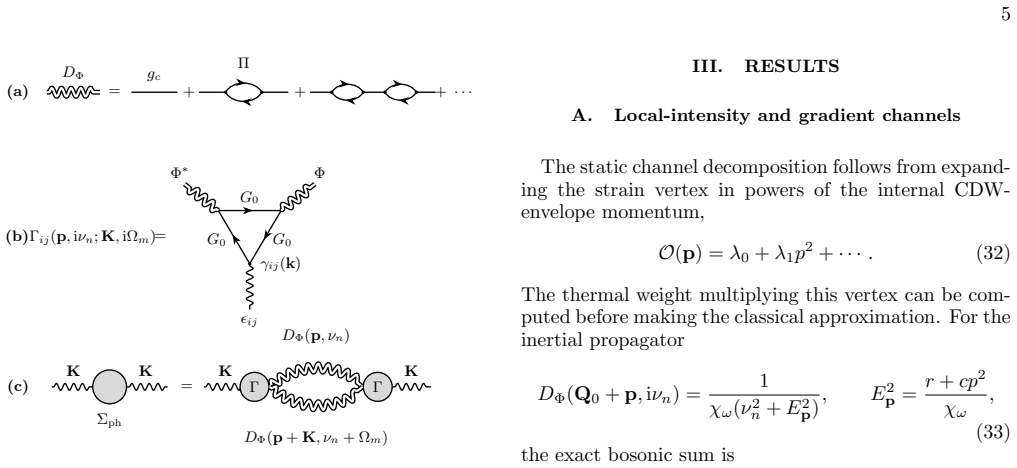
We develop a Green's-function theory in which a damped-harmonic-oscillator propagator for a hybrid CDW-lattice soft mode at the ordering wavevector Q0 and a strain-intensity vertex obtained from an electron loop combine to give the acoustic phonon self-energy. The theory identifies two scattering channels: a local-intensity channel, controlled by a retarded composite CDW response and giving a narrow critical contribution when the CDW correlation length is large, and a texture (gradient) channel, which couples acoustic strain to spatial variations of the CDW envelope and, in a frozen-texture limit, reduces to a phenomenological form set by the measured diffraction peak weight and width. The s
What carries the argument
Damped-harmonic-oscillator propagator for the hybrid CDW-lattice soft mode at Q0 combined with the strain-intensity vertex from an electron loop calculation.
If this is right
- The local-intensity channel produces a narrow critical peak in phonon scattering once the CDW correlation length becomes large.
- The texture channel reduces exactly to a form fixed by measured diffraction peak weight and width when the CDW texture is frozen.
- The same propagator determines the underdamped-to-overdamped crossover and the mass-tracking identity for the slow relaxation rate seen in inelastic X-ray scattering.
- The framework unifies the description of diffraction intensities, soft-mode spectra, and anomalous thermal transport in one set of expressions.
- The expressions apply without material-specific adjustments to transition-metal dichalcogenides, rare-earth tritellurides, kagome CDW compounds, and the cuprate fluctuating-charge-order regime.
Where Pith is reading between the lines
- The two-channel decomposition could be used to separate the temperature dependence of thermal conductivity into critical and non-critical parts in any CDW system where both diffraction and IXS data exist.
- Because the vertex is computed from an electron loop, doping or pressure that changes the electronic susceptibility should produce predictable changes in the phonon damping that can be checked against transport data.
- The mass-tracking identity for the overdamped rate offers a direct way to extract the distance to the CDW instability from measured relaxation times without fitting extra parameters.
- The theory implies that suppressing CDW fluctuations by external means would produce a corresponding recovery of acoustic-phonon lifetimes, testable by comparing transport before and after such suppression.
Load-bearing premise
Charge-density-wave precursor fluctuations are accurately captured by a damped-harmonic-oscillator propagator for the hybrid soft mode at Q0, and the strain-intensity vertex is correctly given by the electron-loop calculation.
What would settle it
Direct measurement of acoustic-phonon linewidths or thermal conductivity in 2H-TaSe2 at elevated temperatures that deviates systematically from the damping rates predicted by the two-channel self-energy would falsify the central claim.
Figures
read the original abstract
Charge-density-wave (CDW) order in correlated metals originates in a peaked electronic susceptibility at a finite wavevector $\mathbf Q_0$, set either by Fermi-surface features (nesting or saddle-point singularities) or by momentum-resolved electron-phonon coupling, or by a combination of the two. CDW precursor fluctuations can attenuate heat-carrying acoustic phonons even when long-range order is absent. We develop a Green's-function theory in which a damped-harmonic-oscillator propagator for a hybrid CDW--lattice soft mode at the ordering wavevector $\mathbf Q_0$ and a strain--intensity vertex obtained from an electron loop combine to give the acoustic phonon self-energy. The theory identifies two scattering channels: a local-intensity channel, controlled by a retarded composite CDW response and giving a narrow critical contribution when the CDW correlation length is large, and a texture (gradient) channel, which couples acoustic strain to spatial variations of the CDW envelope and, in a frozen-texture limit, reduces to a phenomenological form set by the measured diffraction peak weight and width. The same propagator fixes the lattice projection of a hybrid CDW--phonon soft pole measured by inelastic X-ray scattering, with an underdamped-to-overdamped crossover controlled by the distance to the CDW instability and a mass-tracking identity for the slow overdamped relaxation rate. The framework unifies diffraction, soft-mode spectroscopy, and thermal transport and applies broadly across CDW materials, including the transition-metal dichalcogenides, rare-earth tritellurides, kagome CDW compounds, and the cuprate fluctuating charge-order regime; we illustrate it by direct comparison with experimental IXS phonon softening and anomalous thermal transport in 2H-TaSe$_2$ at elevated temperatures.
Editorial analysis
A structured set of objections, weighed in public.
Referee Report
Summary. The manuscript develops a Green's-function theory for acoustic phonon scattering by CDW precursor fluctuations in correlated metals. It combines a damped-harmonic-oscillator propagator for a hybrid CDW-lattice soft mode at the ordering wavevector Q0 with a strain-intensity vertex computed from an electron loop to obtain the acoustic phonon self-energy. The theory identifies a local-intensity channel (retarded composite CDW response yielding narrow critical scattering for large correlation lengths) and a texture channel (coupling to CDW envelope gradients, reducing in the frozen limit to a form fixed by measured diffraction peak weight and width). The same propagator is used to describe the lattice projection of the hybrid soft pole seen in IXS, including underdamped-to-overdamped crossover and mass-tracking for the overdamped rate. The framework is illustrated by comparison to IXS phonon softening and anomalous thermal transport in 2H-TaSe2 and is claimed to apply broadly to TMDs, tritellurides, kagome CDW compounds, and cuprates.
Significance. If the central ansatz for the propagator and vertex holds across the relevant temperature and correlation-length regimes, the work supplies a compact, unifying description that links diffraction intensities, soft-mode spectroscopy, and phonon damping without introducing new free parameters beyond the CDW correlation length. This could provide a practical route to quantitative predictions for thermal transport anomalies in a wide class of CDW materials.
major comments (2)
- [Abstract] Abstract and the description of the texture channel: the reduction of the texture (gradient) channel to a phenomenological form determined solely by measured diffraction peak weight and width means that this contribution is anchored to experimental inputs rather than derived from the microscopic electron-loop vertex or the propagator. This undercuts the claim of a fully microscopic theory for both channels and introduces a degree of circularity when the same framework is used to interpret thermal transport data.
- [Theory development (propagator and self-energy sections)] The central construction (damped-oscillator propagator localized at Q0 times electron-loop vertex): when the CDW correlation length diverges, additional soft-mode dispersion, vertex corrections, or non-Markovian memory effects in the underlying electronic susceptibility could redistribute spectral weight away from the assumed pole. No explicit test or bound is given showing that the single-pole ansatz remains quantitatively accurate through the underdamped-to-overdamped crossover or in the critical regime.
minor comments (1)
- Notation for the strain-intensity vertex and the hybrid soft-mode propagator should be defined with explicit momentum and frequency arguments in the first appearance to avoid ambiguity when the local-intensity and texture channels are later combined.
Simulated Author's Rebuttal
We thank the referee for the careful and constructive review. We address the two major comments point by point below, clarifying the microscopic status of each channel and the regime of validity of the propagator ansatz. Revisions have been made to the abstract, theory sections, and discussion to improve precision without altering the central results.
read point-by-point responses
-
Referee: [Abstract] Abstract and the description of the texture channel: the reduction of the texture (gradient) channel to a phenomenological form determined solely by measured diffraction peak weight and width means that this contribution is anchored to experimental inputs rather than derived from the microscopic electron-loop vertex or the propagator. This undercuts the claim of a fully microscopic theory for both channels and introduces a degree of circularity when the same framework is used to interpret thermal transport data.
Authors: The texture channel originates from the same microscopic strain-intensity vertex computed via the electron loop, now contracted with the gradient of the CDW envelope. The general expression remains fully microscopic. Only in the frozen-texture limit does it reduce to a form proportional to the CDW structure factor S(Q), which is then matched to the measured diffraction peak weight and width. This matching uses independent experimental input and does not replace the vertex derivation; it simply eliminates free parameters when comparing to transport. No circularity arises for thermal transport predictions because diffraction data are obtained separately from the phonon lifetime or thermal conductivity measurements. We have revised the abstract and the opening of the theory section to state explicitly that both channels begin from the microscopic vertex, with the phenomenological reduction applying solely to the frozen limit. revision: partial
-
Referee: [Theory development (propagator and self-energy sections)] The central construction (damped-oscillator propagator localized at Q0 times electron-loop vertex): when the CDW correlation length diverges, additional soft-mode dispersion, vertex corrections, or non-Markovian memory effects in the underlying electronic susceptibility could redistribute spectral weight away from the assumed pole. No explicit test or bound is given showing that the single-pole ansatz remains quantitatively accurate through the underdamped-to-overdamped crossover or in the critical regime.
Authors: The damped-oscillator propagator is adopted because it reproduces the hybrid CDW-lattice soft pole and the underdamped-to-overdamped crossover observed in IXS on 2H-TaSe2, with the overdamped rate tracking the soft-mode mass as required by the fluctuation-dissipation theorem. The ansatz is standard for soft modes near a finite-Q instability and is controlled by the finite correlation length in the precursor regime. We acknowledge that, strictly as the correlation length diverges, additional dispersion, vertex corrections, or memory effects could redistribute weight. We have added a dedicated paragraph in the propagator section that (i) states the regime of validity (finite but large correlation length, separation of electronic and lattice timescales), (ii) provides a qualitative bound based on the observed IXS linewidths, and (iii) notes that a full treatment of critical fluctuations lies beyond the present scope. No quantitative numerical test against a multi-pole susceptibility is supplied, as that would require a separate, more computationally intensive calculation. revision: partial
Circularity Check
Texture channel reduces to phenomenological form fixed by measured diffraction peak weight and width
specific steps
-
fitted input called prediction
[Abstract]
"and a texture (gradient) channel, which couples acoustic strain to spatial variations of the CDW envelope and, in a frozen-texture limit, reduces to a phenomenological form set by the measured diffraction peak weight and width."
The acoustic-phonon self-energy contribution from the texture channel is explicitly reduced to an expression whose numerical content is taken from experimental diffraction measurements (peak weight and width). The claimed microscopic prediction for phonon scattering in this channel is therefore identical to the phenomenological input by construction rather than obtained from the electron-loop vertex or the CDW propagator.
full rationale
The paper constructs the acoustic-phonon self-energy from a damped-harmonic-oscillator propagator for the hybrid CDW-lattice mode at Q0 together with an electron-loop vertex. This ansatz is used uniformly for the local-intensity channel, the texture channel, and the IXS soft-mode pole. In the frozen-texture limit the texture contribution is stated to reduce directly to a form whose parameters are the measured diffraction peak weight and width; thus that portion of the predicted phonon scattering rate is fixed by experimental inputs rather than derived independently from the microscopic vertex or propagator. The unification of transport, IXS, and diffraction therefore rests in part on this explicit reduction to data, producing moderate circularity confined to one channel.
Axiom & Free-Parameter Ledger
free parameters (1)
- CDW correlation length
axioms (1)
- domain assumption CDW order originates in a peaked electronic susceptibility at finite wavevector Q0 set by Fermi-surface features, momentum-resolved electron-phonon coupling, or both.
invented entities (1)
-
hybrid CDW-lattice soft mode
no independent evidence
Reference graph
Works this paper leans on
-
[1]
N. F. Berk and J. R. Schrieffer, Phys. Rev. Lett.17, 433 (1966)
work page 1966
- [2]
-
[3]
T. Moriya,Spin Fluctuations in Itinerant Electron Mag- netism, Springer Series in Solid-State Sciences, Vol. 56 (Springer-Verlag, Berlin, Heidelberg, 1985)
work page 1985
- [4]
- [5]
-
[6]
M. T. B´ eal-Monod, S.-K. Ma, and D. R. Fredkin, Phys. Rev. Lett.20, 929 (1968)
work page 1968
- [7]
-
[8]
P. W. Anderson and W. F. Brinkman, Phys. Rev. Lett. 30, 1108 (1973)
work page 1973
- [9]
- [10]
-
[11]
D. J. Scalapino, Rev. Mod. Phys.84, 1383 (2012)
work page 2012
-
[12]
D. E. Moncton, J. D. Axe, and F. J. DiSalvo, Phys. Rev. B16, 801 (1977)
work page 1977
-
[13]
M. D. Johannes and I. I. Mazin, Phys. Rev. B77, 165135 (2008)
work page 2008
- [14]
-
[15]
L. P. Gor’kov, Phys. Rev. B85, 165142 (2012)
work page 2012
- [16]
-
[17]
G. Ghiringhelli, M. Le Tacon, M. Minola, S. Blanco- Canosa, C. Mazzoli, N. B. Brookes, G. M. De Luca, A. Frano, D. G. Hawthorn, F. He, T. Loew, M. Moretti Sala, D. C. Peets, M. Salluzzo, E. Schierle, R. Sutarto, G. A. Sawatzky, E. Weschke, B. Keimer, and L. Braicovich, Science337, 821 (2012)
work page 2012
- [18]
-
[19]
B. R. Ortiz, S. M. L. Teicher, Y. Hu, J. L. Zuo, P. M. Sarte, E. C. Schueller, A. M. M. Abeykoon, M. J. Krogstad, S. Rosenkranz, R. Osborn, R. Seshadri, L. Ba- lents, J. He, and S. D. Wilson, Phys. Rev. Lett.125, 247002 (2020)
work page 2020
-
[20]
X. Shen, R. Heid, R. Hott,et al., Nat. Commun.14, 7282 (2023)
work page 2023
-
[21]
Anomalous Thermal Transport Reveals Weak First-Order Melting of Charge Density Waves in 2H-TaSe2
H. Huang, J. Dai, J. Christiansen-Salameh, J. Kim, S. Kielar, D. Ma, N. Schinitzer, D. Ni, G. Alvarez, C. Li, C. Slebodnick, M. Medina, B. Azhar, A. Alatas, R. Cava, D. Muller, and Z. Tian, arXiv preprint 10.48550/arXiv.2603.15915 (2026), arXiv:2603.15915
work page internal anchor Pith review Pith/arXiv arXiv doi:10.48550/arxiv.2603.15915 2026
-
[22]
A. A. Maznev, J. A. Johnson, and K. A. Nelson, Phys. Rev. B84, 195206 (2011)
work page 2011
- [23]
-
[24]
F. Giustino, Rev. Mod. Phys.89, 015003 (2017), erra- tum: Rev. Mod. Phys.91, 019901 (2019)
work page 2017
- [25]
-
[26]
M. Fedele, G. Merzoni, M. Moretti Sala, F. Rosa, N. B. Brookes, F. Lombardi, S. Caprara, G. Ghiringhelli, and R. Arpaia, arXiv preprint 10.48550/arXiv.2602.18112 (2026), arXiv:2602.18112
discussion (0)
Sign in with ORCID, Apple, or X to comment. Anyone can read and Pith papers without signing in.