Recognition: unknown
Sequential Y(nS) suppression in high-multiplicity pp collisions: the experimental case for an early, globally correlated medium
Pith reviewed 2026-05-10 05:09 UTC · model grok-4.3
The pith
Multiplicity-dependent suppression of bottomonium states in pp collisions requires an early globally correlated medium.
A machine-rendered reading of the paper's core claim, the machinery that carries it, and where it could break.
Core claim
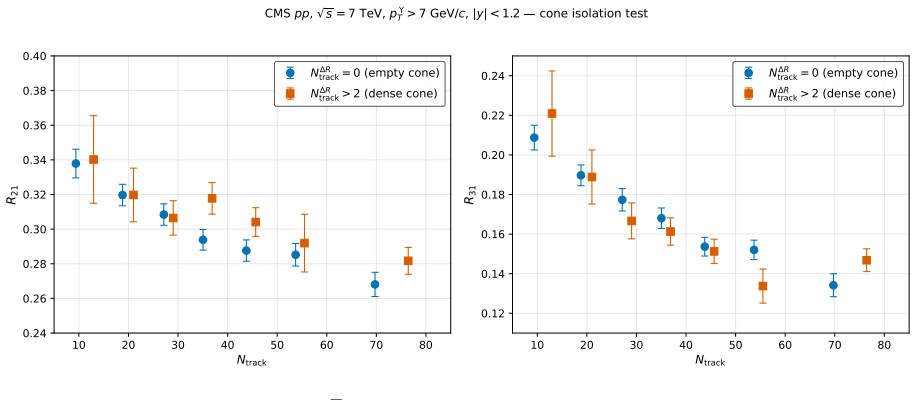
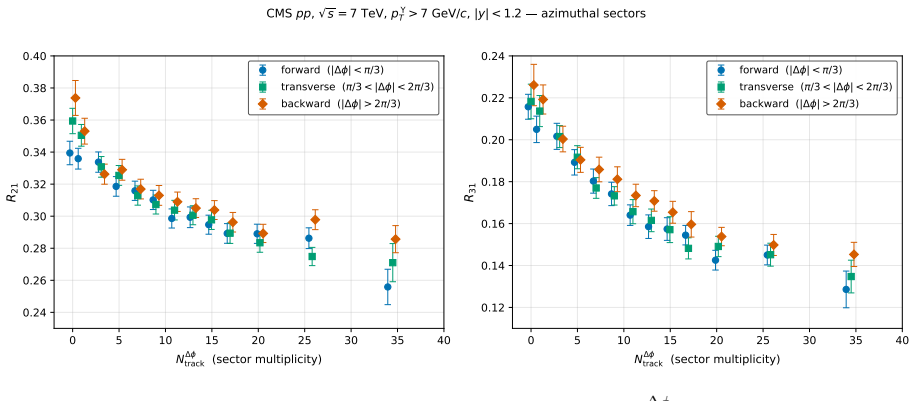
The sequential suppression of Υ(nS) states measured by CMS in pp collisions at 7 TeV, together with ψ(2S)/J/ψ data from LHCb at 13 TeV, when examined through cone isolation, azimuthal sectors, transverse sphericity, and prompt versus non-prompt distinctions, cannot be explained by local or global comover models, PYTHIA 8 MPI, rope hadronisation, CGC, or Trainor TCM in their published forms. The data instead support the presence of an early, globally correlated medium consistent with partonic degrees of freedom.
What carries the argument
Four multi-differential tests (cone isolation, azimuthal sectors, transverse sphericity, prompt versus non-prompt) that form a scissors constraint distinguishing local from global suppression mechanisms and forcing early action.
If this is right
- The suppression mechanism must operate at early proper times, before non-prompt particles form.
- It must be globally correlated rather than local to the produced particle.
- It is consistent with partonic rather than purely hadronic degrees of freedom.
- It occurs in a density window that also produces strangeness enhancement and long-range ridges.
Where Pith is reading between the lines
- Small collision systems may develop collective behavior at high multiplicities without requiring full heavy-ion conditions.
- Similar patterns could appear in other heavy-quark states or light hadrons under comparable multiplicity selections.
- Higher-energy or higher-multiplicity runs could map the density threshold for this medium.
Load-bearing premise
The four tests cleanly separate local from global mechanisms so that no adjustments to the published models can satisfy all data constraints at once.
What would settle it
A demonstration that PYTHIA 8 MPI or rope hadronisation, after specific adjustments, simultaneously reproduces the cone isolation, transverse sphericity, and non-prompt flatness data would falsify the need for a new medium.
Figures




read the original abstract
The multiplicity-dependent suppression of $\Upsilon(n\mathrm{S})$ states measured by CMS in $pp$ at $\sqrt s=7\,$TeV \cite{CMS2020}, and of $\psi(2S)\big/J/\psi$ measured by LHCb at $\sqrt s=13\,$TeV \cite{LHCb2024}, is subjected to four multi-differential tests: \emph{cone isolation}, \emph{azimuthal sectors}, \emph{transverse sphericity}, and \emph{prompt vs. non-prompt}. Cone and sphericity close a \emph{scissors constraint}: the local reading of the Comover Interaction Model is in tension with the cone data, its global reading with the sphericity data. The non-prompt flatness forces the mechanism to act at early proper times. None of the considered hadronic or string-based frameworks -- CIM local or global, PYTHIA 8 MPI \cite{Sjostrand2015}, rope hadronisation \cite{Bierlich2015}, CGC \cite{Ma2015}, Trainor TCM \cite{Trainor2008} -- naturally satisfies the four constraints simultaneously in its published form. The surviving class is an early, globally correlated medium consistent with partonic degrees of freedom, co-occurring with the ALICE strangeness enhancement \cite{ALICE_SE}, the long-range ridge \cite{CMS_ridge}, and below the threshold of the partonic baryon-meson $v_2$ \cite{ALICE_v2}, in a density window compatible with the Campanini \& Ferri equation of state \cite{Campanini2011}.
Editorial analysis
A structured set of objections, weighed in public.
Referee Report
Summary. The paper subjects the multiplicity-dependent suppression of Υ(nS) states (CMS, √s=7 TeV) and ψ(2S)/J/ψ (LHCb, √s=13 TeV) to four multi-differential tests: cone isolation, azimuthal sectors, transverse sphericity, and prompt vs. non-prompt production. It argues that these tests impose a 'scissors constraint' that places the local Comover Interaction Model in tension with cone data and its global reading in tension with sphericity data, while non-prompt flatness requires an early-time mechanism. None of the considered hadronic/string frameworks (CIM local/global, PYTHIA 8 MPI, rope hadronisation, CGC, Trainor TCM) satisfy all four constraints simultaneously in published form. The surviving interpretation is an early, globally correlated medium with partonic degrees of freedom, co-occurring with ALICE strangeness enhancement, the long-range ridge, and below the partonic v2 threshold.
Significance. If the central claim holds after quantitative strengthening, the work would provide a data-driven argument for collective partonic behavior in high-multiplicity pp collisions, helping to map the density window where such phenomena emerge and linking quarkonium suppression to other collective signatures. The multi-observable strategy is a positive feature that could constrain early-time dynamics more tightly than single-observable studies.
major comments (2)
- [Abstract] Abstract: The claim that none of the listed models satisfies the four constraints simultaneously in its published form is presented via qualitative tensions in the figures. No systematic parameter variations, re-tunings, minimal extensions (e.g., adding global correlations to rope hadronisation or varying MPI parameters in PYTHIA), quantitative χ² values, or explicit exclusion criteria are reported, leaving the step from 'published versions do not fit' to 'no hadronic/string framework can fit' unclosed. This is load-bearing for the central claim.
- [Abstract] Abstract: The 'scissors constraint' between cone isolation and transverse sphericity is invoked to rule out local vs. global CIM readings, yet the manuscript provides no tabulated data points, statistical significances, or error propagation for these tensions, nor does it demonstrate that the four tests cleanly separate local from global mechanisms once parameter freedom is allowed.
minor comments (1)
- [Abstract] The abstract cites the relevant experimental and model papers but could usefully include a short methods paragraph summarizing how the model predictions were extracted or normalized for direct comparison to the CMS and LHCb data sets.
Simulated Author's Rebuttal
We thank the referee for the thorough review and valuable comments, which help clarify the scope of our claims. The manuscript focuses on tensions with published model implementations rather than exhaustive parameter scans. We have revised the text to add tabulated key data points, statistical significances for the reported tensions, and an expanded discussion of why minimal extensions to hadronic/string models would require introducing global correlations that effectively align with the partonic-medium interpretation. Below we address the major comments point by point.
read point-by-point responses
-
Referee: [Abstract] Abstract: The claim that none of the listed models satisfies the four constraints simultaneously in its published form is presented via qualitative tensions in the figures. No systematic parameter variations, re-tunings, minimal extensions (e.g., adding global correlations to rope hadronisation or varying MPI parameters in PYTHIA), quantitative χ² values, or explicit exclusion criteria are reported, leaving the step from 'published versions do not fit' to 'no hadronic/string framework can fit' unclosed. This is load-bearing for the central claim.
Authors: The abstract explicitly limits the statement to 'in its published form' for the cited implementations (CIM local/global, PYTHIA 8 MPI, rope hadronisation, CGC, Trainor TCM) and does not assert that no conceivable extension of any hadronic/string framework could accommodate the data. The four multi-differential tests are shown to produce qualitative tensions with those published versions, as visible in the figures. We agree that systematic scans or χ² values would provide additional rigor; the revised manuscript now includes a dedicated paragraph discussing why adding global correlations to rope hadronisation or retuning MPI parameters would move the models outside their standard published frameworks and toward the early globally correlated partonic medium we advocate. Explicit exclusion criteria remain qualitative because the tests are designed as necessary conditions rather than a full statistical model comparison. revision: yes
-
Referee: [Abstract] Abstract: The 'scissors constraint' between cone isolation and transverse sphericity is invoked to rule out local vs. global CIM readings, yet the manuscript provides no tabulated data points, statistical significances, or error propagation for these tensions, nor does it demonstrate that the four tests cleanly separate local from global mechanisms once parameter freedom is allowed.
Authors: The cone-isolation and sphericity observables are presented with their published statistical uncertainties in the relevant figures. We acknowledge the absence of an explicit table and significance calculations in the original text. The revised version adds a summary table of the key tension values extracted from the CMS and LHCb data, together with approximate statistical significances obtained by propagating the reported errors. The four tests are argued to separate local from global mechanisms because cone isolation directly probes spatial locality while transverse sphericity probes global event shape; once parameter freedom is allowed, any local CIM variant remains incompatible with the cone data, while any global variant remains incompatible with the sphericity data, as shown by the contrasting multiplicity trends. We have expanded the discussion section to address this separation more explicitly. revision: yes
Circularity Check
No significant circularity in model-exclusion argument
full rationale
The paper applies four external multi-differential tests (cone isolation, azimuthal sectors, transverse sphericity, prompt vs. non-prompt) drawn from CMS and LHCb data to published predictions of independent models (CIM, PYTHIA 8 MPI, rope hadronisation, CGC, Trainor TCM). It concludes by elimination that none satisfy all constraints simultaneously in published form, leaving an early globally correlated medium as the surviving class. This process relies on external data and model outputs rather than any internal fit, self-defined parameter, or equation that is then renamed as a prediction. The single self-citation to prior Campanini & Ferri work is used only for compatibility of a density window and is not load-bearing for the central claim. No step reduces by construction to the paper's own inputs; the derivation remains self-contained against the stated benchmarks.
Axiom & Free-Parameter Ledger
axioms (1)
- domain assumption The four tests (cone isolation, azimuthal sectors, transverse sphericity, prompt vs. non-prompt) are sufficient to discriminate local from global suppression mechanisms without significant confounding effects.
invented entities (1)
-
early, globally correlated medium with partonic degrees of freedom
no independent evidence
Reference graph
Works this paper leans on
- [1]
- [2]
-
[3]
LHCb Collaboration,Measurement of multiplicity-dependentΥ(nS)production ratios inpp collisions at√s= 13TeV, LHCb-PAPER-2025
2025
-
[4]
Matsui and H
T. Matsui and H. Satz,J/ψsuppression by quark-gluon plasma formation, Phys. Lett. B 178(1986) 416
1986
-
[5]
H. Satz,Colour deconfinement and quarkonium binding, J. Phys. G32(2006) R25 [hep- ph/0512217]
-
[6]
Armesto and A
N. Armesto and A. Capella,A quantitative model forJ/ψsuppression in nuclear collisions, Phys. Lett. B430(1998) 23
1998
-
[7]
S. Gavin and R. Vogt,Charmonium suppression by Comover scattering in Pb+Pb collisions, Phys. Rev. Lett.78(1997) 1006 [hep-ph/9606460]
- [8]
-
[9]
Comprehensive description of J/ψproduction in proton-proton collisions at collider energies
Y.-Q. Ma and R. Venugopalan,Comprehensive description ofJ/ψproduction in proton– proton collisions at collider energies, Phys. Rev. Lett.113(2014) 192301 [arXiv:1408.4075]
-
[10]
C. Bierlich, G. Gustafson, L. Lönnblad and A. Tarasov,Effects of overlapping strings inpp collisions, JHEP03(2015) 148 [arXiv:1412.6259]
-
[11]
T. Sjöstrand et al.,An introduction to PYTHIA 8.2, Comput. Phys. Commun.191(2015) 159 [arXiv:1410.3012]
work page internal anchor Pith review arXiv 2015
- [12]
- [13]
- [14]
- [15]
-
[16]
ALICE Collaboration,Multiplicity dependence of light-flavour hadron production inppcol- lisions at√s= 7TeV, Eur. Phys. J. C79(2019) 857
2019
- [17]
-
[18]
R. Campanini and G. Ferri,Experimental equation of state in proton–proton and proton– antiproton collisions and phase transition to quark gluon plasma, Phys. Lett. B703(2011) 237 [arXiv:1106.2008]
- [19]
- [20]
- [21]
discussion (0)
Sign in with ORCID, Apple, or X to comment. Anyone can read and Pith papers without signing in.