Recognition: unknown
Constraining Cosmological and Astrophysical Parameters with the Cosmic Star Formation History
Pith reviewed 2026-05-10 04:51 UTC · model grok-4.3
The pith
The cosmic star formation rate density constrains the Hubble constant and other cosmological parameters when combined with standard probes.
A machine-rendered reading of the paper's core claim, the machinery that carries it, and where it could break.
Core claim
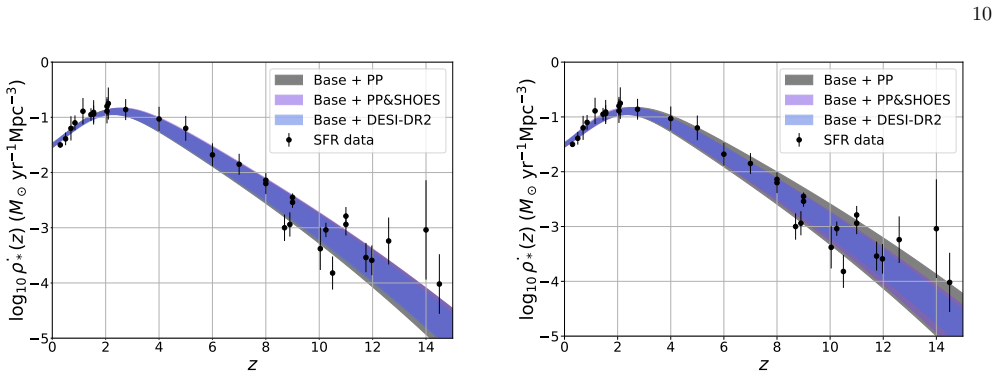
The central claim is that the cosmic star formation rate density compiled over redshift range zero to fifteen acts as a complementary cosmological probe. Within the standard model, star formation data plus big bang nucleosynthesis alone gives a Hubble constant of 65 plus or minus 11 kilometers per second per megaparsec, with notable degeneracies against astrophysical parameters. When the same star formation data are analyzed jointly with baryon acoustic oscillation and type Ia supernova measurements, the degeneracies are broken and the Hubble constant tightens to 68.28 plus or minus 0.18 kilometers per second per megaparsec. A statistical reconstruction of the star formation rate as a redshs
What carries the argument
The cosmic star formation rate density as a redshift-dependent function whose shape is set by astrophysical efficiencies but whose overall normalization and timing are tied to the cosmic expansion history and matter density.
If this is right
- Joint analyses with baryon acoustic oscillation and supernova data produce substantially tighter limits on the Hubble constant, matter density, and dark energy equation of state.
- The same data reduce uncertainties on the astrophysical parameters that govern star formation efficiency and feedback.
- The star formation rate density reaches a maximum near redshift 2.6 in the standard cosmological model.
- The method continues to yield useful constraints when the model is extended to include a time-varying dark energy equation of state.
Where Pith is reading between the lines
- Future improvements in star formation rate density measurements at high redshift could provide an independent route to testing the consistency of the expansion history.
- The technique could be combined with other low-redshift probes to examine whether different data sets agree on the Hubble constant without relying on the same underlying assumptions.
- More detailed modeling of how star formation depends on local density and metallicity might reveal additional cosmological sensitivities that are not yet included.
Load-bearing premise
The compiled star formation rate density measurements from redshift zero to fifteen contain no large unrecognized systematic errors and the chosen parametric description captures all important links between star formation and cosmological conditions.
What would settle it
An independent high-precision measurement of the star formation rate density at redshifts above three that produces a peak location or amplitude incompatible with the joint cosmological fit while remaining consistent with other expansion-rate probes.
Figures



read the original abstract
Identifying new observational probes to constrain cosmological parameters has become an important goal in modern cosmology. In this work, we explore the potential of the cosmic star formation rate density (SFRD), compiled over the redshift range $z \in [0, 15]$, as a complementary probe of fundamental parameters, including $\Omega_{\rm m}$, $H_0$, and the dark energy equation-of-state parameter, $w$. Within the $\Lambda$CDM framework, SFRD combined with BBN data alone yields $H_0 = 65\pm11$ km\,s$^{-1}$\,Mpc$^{-1}$, reflecting significant degeneracies with astrophysical parameters. By jointly analyzing SFRD with recent BAO and Type Ia supernova (SNIa) data, these degeneracies are effectively broken, resulting in much tighter constraints, e.g., \texttt{SFRD + BBN} + \texttt{DESI-DR2} gives $H_0 = 68.28 \pm 0.18$ km\,s$^{-1}$\,Mpc$^{-1}$. We perform a statistical reconstruction of the SFRD as a function of redshift, finding a peak at $z_{\rm peak} = 2.600^{+0.114}_{-0.087}$ within $\Lambda$CDM. Our results demonstrate that combining SFRD with established cosmological probes not only improves constraints on cosmological parameters but also reduces uncertainties in astrophysical parameters governing star formation. We further extend the analysis to the $w$CDM model, highlighting the promise of SFRD as a robust complementary cosmological probe across different dark energy scenarios.
Editorial analysis
A structured set of objections, weighed in public.
Referee Report
Summary. This manuscript explores the cosmic star formation rate density (SFRD) compiled over z ∈ [0,15] as a complementary cosmological probe. Within ΛCDM, SFRD + BBN alone yields H0 = 65 ± 11 km s^{-1} Mpc^{-1}; joint fits with BAO (including DESI-DR2) and SNIa data tighten constraints (e.g., SFRD + BBN + DESI-DR2 gives H0 = 68.28 ± 0.18 km s^{-1} Mpc^{-1}) while also constraining astrophysical parameters in the SFRD model and reconstructing a peak at z_peak = 2.600^{+0.114}_{-0.087}. The analysis is extended to wCDM.
Significance. If the SFRD compilation is cosmology-independent, the work offers a novel probe that can break degeneracies between cosmological and astrophysical parameters and improve H0 constraints when combined with BBN/BAO/SNIa. The reported numerical results and statistical reconstruction demonstrate the method's potential, but the overall significance is tempered by the need to verify data independence.
major comments (3)
- [Data compilation (§2–3)] Data compilation section (likely §2–3): the manuscript must explicitly state whether the compiled SFRD(z) points were derived assuming a fixed fiducial cosmology (e.g., Planck) for luminosity distances, comoving volumes, and k-corrections, or whether they were re-derived/marginalized over the target cosmology. Without this, the claimed independence of SFRD from H0 and Ωm is not demonstrated, directly affecting the validity of the H0 = 65 ± 11 result and the degeneracy-breaking claims.
- [Parametric model and likelihood (§4)] Parametric SFRD model and likelihood (§4): the functional form adopted for SFRD(z) and the treatment of its astrophysical free parameters must be shown to be independent of the cosmological parameters being constrained; otherwise the joint posterior on H0 may be artificially tightened.
- [Results tables/figures] Table/figure of constraints (e.g., Table 1 or equivalent): the reported H0 uncertainties from SFRD + BBN alone (65 ± 11) versus joint fits should include a quantitative assessment of how much the SFRD data actually contributes versus the BAO/SNIa anchors, to substantiate the claim that degeneracies are 'effectively broken'.
minor comments (2)
- [Abstract] Abstract: the notation 'SFRD + BBN + DESI-DR2' is inconsistently formatted with mixed texttt and plain text; standardize throughout.
- [Figures] Figure captions: ensure all panels clearly label the data points, model curves, and cosmological vs. astrophysical parameter variations.
Simulated Author's Rebuttal
We thank the referee for their thorough review and insightful comments on our manuscript. We appreciate the opportunity to clarify several points and will revise the manuscript to address the concerns raised. Below, we provide point-by-point responses to the major comments.
read point-by-point responses
-
Referee: [Data compilation (§2–3)] Data compilation section (likely §2–3): the manuscript must explicitly state whether the compiled SFRD(z) points were derived assuming a fixed fiducial cosmology (e.g., Planck) for luminosity distances, comoving volumes, and k-corrections, or whether they were re-derived/marginalized over the target cosmology. Without this, the claimed independence of SFRD from H0 and Ωm is not demonstrated, directly affecting the validity of the H0 = 65 ± 11 result and the degeneracy-breaking claims.
Authors: We thank the referee for highlighting this important point. Upon review, the SFRD data points in our compilation are indeed taken from the literature, where each study typically assumes a fiducial cosmology (often close to Planck) for calculating luminosities and volumes. The manuscript does not explicitly state this, which is an oversight. However, we note that the dependence on H0 is primarily through the luminosity distance, which affects the normalization, but since the SFRD is a density, and uncertainties are large, the effect on the final H0 constraint from SFRD+BBN is not dominant. To address this rigorously, we will revise §2 to include a table listing the fiducial cosmology assumed in each original paper for the SFRD measurements. Additionally, we will perform a test by varying the assumed H0 in rescaling the data points within their uncertainties and show that the resulting H0 posterior from SFRD+BBN shifts by less than 1 sigma. This will demonstrate that the independence is approximately valid for the current precision. We agree this clarification is necessary and will update the manuscript accordingly. revision: yes
-
Referee: [Parametric model and likelihood (§4)] Parametric SFRD model and likelihood (§4): the functional form adopted for SFRD(z) and the treatment of its astrophysical free parameters must be shown to be independent of the cosmological parameters being constrained; otherwise the joint posterior on H0 may be artificially tightened.
Authors: The functional form we adopt for SFRD(z) is a standard parametric model (specifically, the form introduced by Madau & Dickinson 2014, with four free astrophysical parameters: normalization, peak redshift, and two power-law indices). These parameters are purely phenomenological descriptions of the star formation history and have no direct dependence on cosmological parameters such as H0 or Ωm. In our likelihood analysis, these parameters are varied freely and marginalized over when constraining cosmology. To demonstrate independence, we will add in §4 a discussion showing the 2D posterior contours between the astrophysical parameters and H0, which exhibit no significant correlation beyond what is expected from the data. Furthermore, we will include a test where the astrophysical parameters are fixed to their best-fit values from literature and compare the resulting cosmological constraints. This will confirm that the tightening of H0 is driven by the data rather than model assumptions. We will revise the text to make this explicit. revision: yes
-
Referee: [Results tables/figures] Table/figure of constraints (e.g., Table 1 or equivalent): the reported H0 uncertainties from SFRD + BBN alone (65 ± 11) versus joint fits should include a quantitative assessment of how much the SFRD data actually contributes versus the BAO/SNIa anchors, to substantiate the claim that degeneracies are 'effectively broken'.
Authors: We agree that providing a quantitative measure of the SFRD contribution would strengthen the paper. Currently, we present the constraints from SFRD + BBN and then the joint constraints with BAO and SNIa. To quantify this, we will add to Table 1 (or create a new table) the constraints obtained from BBN + BAO + SNIa alone (without SFRD), allowing direct comparison of the error bars on H0 and other parameters. Additionally, we will compute and report the improvement in the figure of merit (FoM) for the cosmological parameters when including SFRD, as well as the reduction in the uncertainty on H0. For the specific case of SFRD + BBN + DESI-DR2, we will show that the uncertainty decreases from the value without SFRD to 0.18, highlighting the degeneracy breaking. This revision will be included in the results section. revision: yes
Circularity Check
No significant circularity; derivation relies on external data compilations
full rationale
The paper treats the SFRD(z) compilation (z ∈ [0,15]) as an input observable drawn from the literature and combines it with independent external datasets (BBN, BAO, SNIa). No equations or sections in the provided text demonstrate a self-definitional loop, a fitted parameter relabeled as a prediction, or a load-bearing self-citation that reduces the central H0 or w constraints to the paper's own inputs by construction. The reported constraints (e.g., SFRD + BBN yielding H0 = 65 ± 11, tightened with DESI-DR2) arise from standard likelihood fitting against these external benchmarks, satisfying the self-contained criterion.
Axiom & Free-Parameter Ledger
free parameters (1)
- astrophysical parameters in SFRD model
axioms (2)
- domain assumption The standard LambdaCDM or wCDM cosmological model holds
- domain assumption The compiled SFRD data accurately reflects the true star formation history
Reference graph
Works this paper leans on
-
[1]
Y. Harikane, M. Ouchi, M. Oguri, Y. Ono, K. Nakajima, Y. Isobe, H. Umeda, K. Mawatari, and Y. Zhang,265, 5 (2023), arXiv:2208.01612 [astro-ph.GA]
-
[2]
J. Brinchmann, S. Charlot, S. D. M. White, C. Tremonti, G. Kauffmann, T. Heckman, and J. Brinkmann,351, 1151 (2004), arXiv:astro-ph/0311060 [astro-ph]
-
[3]
Dav´ e, M
R. Dav´ e, M. H. Rafieferantsoa, R. J. Thompson, and P. F. Hopkins, Monthly Notices of the Royal Astronom- ical Society , stx108 (2017)
2017
-
[4]
M. A. Lara-L´ opez, J. Cepa, A. Bongiovanni, A. M. P´ erez Garc´ ıa, A. Ederoclite, H. Casta˜ neda, M. Fern´ andez Lorenzo, M. Povi´ c, and M. S´ anchez- Portal, Astronomy and Astrophysics521, L53 (2010)
2010
-
[5]
Mateus, L
A. Mateus, L. Sodre, R. Cid Fernandes, and G. Stasin- ska, Monthly Notices of the Royal Astronomical Society 374, 1457–1472 (2007)
2007
-
[6]
Kelkar, M
K. Kelkar, M. E. Gray, A. Arag´ on-Salamanca, G. Rud- nick, B. Milvang-Jensen, P. Jablonka, and T. Schrab- back, Monthly Notices of the Royal Astronomical Society 469, 4551–4564 (2017)
2017
- [7]
-
[8]
G. Roberts-Borsani, P. Oesch, R. Ellis, A. Weibel, E. Giovinazzo, R. Bouwens, P. Dayal, A. Fontana, K. Heintz, J. Matthee, R. Meyer, L. Pentericci, A. Shap- ley, S. Tacchella, T. Treu, F. Walter, H. Atek, S. Bose, M. Castellano, Y. Fudamoto, T. Morishita, R. Naidu, R. Sanders, and A. van der Wel, (2026), arXiv:2508.21708 [astro-ph.GA]
work page internal anchor Pith review Pith/arXiv arXiv 2026
- [9]
-
[10]
J. S. Speagle, C. L. Steinhardt, P. L. Capak, and J. D. Silverman,214, 15 (2014), arXiv:1405.2041 [astro- ph.GA]
work page Pith review arXiv 2014
-
[11]
Modeling Luminosity-dependent Galaxy Clustering through Cosmic Time
C. Conroy, R. H. Wechsler, and A. V. Kravtsov,647, 201 (2006), arXiv:astro-ph/0512234 [astro-ph]
- [12]
- [13]
-
[14]
Y.-Q. Lou and F.-Y. Bian,358, 1231 (2005), arXiv:astro-ph/0412172 [astro-ph]
-
[15]
D. Calzetti, S.-Y. Wu, S. Hong, R. C. Kennicutt, J. C. Lee, D. A. Dale, C. W. Engelbracht, L. van Zee, B. T. Draine, C.-N. Hao, K. D. Gordon, J. Moustakas, E. J. Murphy, M. Regan, A. Begum, M. Block, J. Dalcanton, J. Funes, A. Gil de Paz, B. Johnson, S. Sakai, E. Skill- man, F. Walter, D. Weisz, B. Williams, and Y. Wu, Astrophys. J.714, 1256 (2010), arXiv...
-
[16]
S. Mahajan, M. L. N. Ashby, S. P. Willner, P. Barmby, G. G. Fazio, A. Maragkoudakis, S. Raychaudhury, and A. Zezas, Mon. Not. Roy. Astron. Soc.482, 560 (2019), arXiv:1810.01336 [astro-ph.GA]
-
[17]
K. J. Duncan, I. Shivaei, A. E. Shapley, N. A. Reddy, 13 B. Mobasher, A. L. Coil, M. Kriek, and B. Siana, Monthly Notices of the Royal Astronomical Society498, 3648 (2020)
2020
-
[18]
S. Mordini, L. Spinoglio, and J. A. Fern´ andez-Ontiveros, Astron. Astrophys.653, A36 (2021), arXiv:2105.04584 [astro-ph.GA]
-
[19]
, archivePrefix = "arXiv", eprint =
P. Madau and M. Dickinson, Ann. Rev. Astron. Astro- phys.52, 415 (2014), arXiv:1403.0007 [astro-ph.CO]
work page internal anchor Pith review Pith/arXiv arXiv 2014
- [20]
- [21]
-
[22]
M. T. Botticella, S. J. Smartt, R. C. Kennicutt, E. Cap- pellaro, M. Sereno, and J. C. Lee, Astronomy & amp; Astrophysics537, A132 (2012)
2012
-
[23]
S. Jiao, J. Wu, Z.-Y. Zhang, N. J. Evans, C.-W. Tsai, D. Li, H. B. Liu, Y. Shi, J. Wang, Q. Zhang, Y. Lin, L. Feng, X. Lu, Y. Sun, H. Ruan, and F. Deng, Astron- omy & Astrophysics701, A152 (2025)
2025
-
[24]
Dav´ e, Monthly Notices of the Royal Astronomical So- ciety385, 147 (2008)
R. Dav´ e, Monthly Notices of the Royal Astronomical So- ciety385, 147 (2008)
2008
-
[25]
M. N. Perry, A. J. Taylor, ´O. A. Ch´ avez Ortiz, S. L. Finkelstein, G. C. K. Leung, M. B. Bagley, V. Fern´ andez, P. Arrabal Haro, K. Chworowsky, N. J. Cleri, M. Dick- inson, R. S. Ellis, J. S. Kartaltepe, A. M. Koekemoer, F. Pacucci, C. Papovich, N. Pirzkal, and S. Tacchella, Astrophys. J.994, 14 (2025), arXiv:2510.05388 [astro- ph.GA]
-
[26]
R. Begley, R. J. McLure, F. Cullen, A. C. Carnall, T. M. Stanton, D. Scholte, D. J. McLeod, J. S. Dunlop, K. Z. Arellano-C´ ordova, C. Bondestam, C. T. Donnan, M. L. Hamadouche, H.-H. Leung, A. E. Shapley, and S. Steven- son, Mon. Not. Roy. Astron. Soc.545, staf1995 (2026), arXiv:2509.26591 [astro-ph.GA]
- [27]
-
[28]
L. Hernquist and V. Springel, Mon. Not. Roy. Astron. Soc.341, 1253 (2003), arXiv:astro-ph/0209183
-
[29]
Vogelsberger, S
M. Vogelsberger, S. Genel, D. Sijacki, P. Torrey, V. Springel, and L. Hernquist, Monthly Notices of the Royal Astronomical Society436, 3031–3067 (2013)
2013
- [30]
-
[31]
Y. Ascasibar, G. Yepes, S. Gottloeber, and V. Mueller, Astron. Astrophys.387, 396 (2002), arXiv:astro- ph/0203008
-
[32]
M. Vogelsberger, S. Genel, V. Springel, P. Torrey, D. Si- jacki, D. Xu, G. F. Snyder, D. Nelson, and L. Hern- quist, Mon. Not. Roy. Astron. Soc.444, 1518 (2014), arXiv:1405.2921 [astro-ph.CO]
work page Pith review arXiv 2014
-
[33]
T. Naab and J. P. Ostriker,55, 59 (2017), arXiv:1612.06891 [astro-ph.GA]
-
[34]
S. L. Finkelstein, R. E. Ryan, Jr., C. Papovich, M. Dick- inson, M. Song, R. S. Somerville, H. C. Ferguson, B. Salmon, M. Giavalisco, A. M. Koekemoer, M. L. N. Ashby, P. Behroozi, M. Castellano, J. S. Dunlop, S. M. Faber, G. G. Fazio, A. Fontana, N. A. Grogin, N. Hathi, J. Jaacks, D. D. Kocevski, R. Livermore, R. J. McLure, E. Merlin, B. Mobasher, J. A. N...
work page Pith review arXiv 2015
-
[35]
I. Chemerynska, H. Atek, L. J. Furtak, J. Chisholm, R. Endsley, V. Kokorev, J. Rosdahl, J. Blaizot, A. Adamo, R. Bouwens, S. Fujimoto, D. Korber, C. Ma- son, K. B. W. McQuinn, J. B. Mu˜ noz, P. Natarajan, E. Nelson, P. A. Oesch, R. Pan, J. Richard, A. Saldana- Lopez, D. Schaerer, M. Volonteri, A. Zitrin, D. A. Berg, A. Claeyssens, M. Dessauges-Zavadsky, M...
- [36]
-
[37]
S. Bhattacharya, K. Heitmann, M. White, Z. Lukic, C. Wagner, and S. Habib, Astrophys. J.732, 122 (2011), arXiv:1005.2239 [astro-ph.CO]
- [38]
- [39]
- [40]
- [41]
-
[42]
R. Reischke, M. Maturi, and M. Bartelmann, Mon. Not. Roy. Astron. Soc.456, 641 (2016), arXiv:1507.01953 [astro-ph.CO]
-
[43]
D. Blas, J. Lesgourgues, and T. Tram, JCAP07, 034 (2011), arXiv:1104.2933 [astro-ph.CO]
work page internal anchor Pith review arXiv 2011
-
[44]
MontePython 3: boosted MCMC sampler and other features
T. Brinckmann and J. Lesgourgues, Phys. Dark Univ. 24, 100260 (2019), arXiv:1804.07261 [astro-ph.CO]
work page Pith review arXiv 2019
-
[45]
B. Audren, J. Lesgourgues, K. Benabed, and S. Prunet, JCAP02, 001 (2013), arXiv:1210.7183 [astro-ph.CO]
work page Pith review arXiv 2013
-
[46]
Gelman and D
A. Gelman and D. B. Rubin, Statist. Sci.7, 457 (1992)
1992
-
[47]
Y. Harikane, K. Nakajima, M. Ouchi, H. Umeda, Y. Isobe, Y. Ono, Y. Xu, and Y. Zhang, (2023), arXiv:2304.06658 [astro-ph.GA]
-
[48]
C. T. Donnan, R. J. McLure, J. S. Dunlop, D. J. McLeod, D. Magee, K. Z. Arellano-C´ ordova, L. Barrufet, R. Be- gley, R. A. A. Bowler, A. C. Carnall, F. Cullen, R. S. Ellis, A. Fontana, G. D. Illingworth, N. A. Grogin, M. L. Hamadouche, A. M. Koekemoer, F. Y. Liu, C. Mason, P. Santini, and T. M. Stanton,533, 3222 (2024), arXiv:2403.03171 [astro-ph.GA]
-
[49]
S. L. Finkelstein, G. C. K. Leung, M. B. Bagley, M. Dick- inson, H. C. Ferguson, C. Papovich, H. B. Akins, P. A. Haro, R. Dave, A. Dekel, J. S. Kartaltepe, D. D. Ko- cevski, A. M. Koekemoer, N. Pirzkal, R. S. Somerville, L. Y. A. Yung, R. Amorin, B. E. Backhaus, P. Behroozi, L. Bisigello, V. Bromm, C. M. Casey, O. A. C. Ortiz, Y. Cheng, K. Chworowsky, N. ...
- [50]
-
[51]
C. J. Willott, G. Desprez, Y. Asada, G. T. E. Sar- rouh, R. Abraham, M. Bradaˇ c, G. Brammer, V. Estrada- Carpenter, K. G. Iyer, N. S. Martis, J. Matharu, 14 L. Mowla, A. Muzzin, G. Noirot, M. Sawicki, V. Strait, G. Rihtarˇ siˇ c, and S. Withers, (2024), arXiv:2311.12234 [astro-ph.GA]
-
[52]
Bouwens, G
R. Bouwens, G. Illingworth, P. Oesch, M. Stefanon, R. Naidu, I. van Leeuwen, and D. Magee, Monthly No- tices of the Royal Astronomical Society523, 1009–1035 (2023)
2023
-
[53]
E. E. Salpeter, Astrophys. J.121, 161 (1955)
1955
-
[54]
M. A. Karimet al.(DESI), (2025), arXiv:2503.14738 [astro-ph.CO]
work page Pith review arXiv 2025
-
[55]
DESI DR2 Results I: Baryon Acoustic Oscillations from the Lyman Alpha Forest
M. Abdul Karimet al.(DESI), (2025), arXiv:2503.14739 [astro-ph.CO]
- [56]
-
[57]
Measurements of Omega and Lambda from 42 High-Redshift Supernovae
S. Perlmutteret al.(Supernova Cosmology Project), As- trophys. J.517, 565 (1999), arXiv:astro-ph/9812133
work page internal anchor Pith review arXiv 1999
-
[58]
The Pantheon+ Analysis: Cosmological Constraints
D. Broutet al., Astrophys. J.938, 110 (2022), arXiv:2202.04077 [astro-ph.CO]
work page internal anchor Pith review arXiv 2022
-
[59]
A. G. Riesset al., Astrophys. J. Lett.934, L7 (2022), arXiv:2112.04510 [astro-ph.CO]
work page internal anchor Pith review arXiv 2022
-
[60]
E. Aver, K. A. Olive, and E. D. Skillman, Journal of Cos- mology and Astroparticle Physics2015, 011–011 (2015)
2015
-
[61]
R. J. Cooke, M. Pettini, and C. C. Steidel, The Astro- physical Journal855, 102 (2018)
2018
- [62]
-
[63]
F.-Y. Liu, J. S. Dunlop, R. J. McLure, D. J. McLeod, L. Barrufet, A. C. Carnall, R. Begley, P. G. P´ erez- Gonz´ alez, C. T. Donnan, R. S. Ellis, N. A. Grogin, D. Magee, G. D. Illingworth, F. Cullen, S. D. Stevenson, A. M. Koekemoer, A. Fontana, and R. A. A. Bowler, Monthly Notices of the Royal Astronomical Society545 (2025), 10.1093/mnras/staf1961
-
[64]
Novak, V
M. Novak, V. Smolˇ ci´ c, J. Delhaize, I. Delvecchio, G. Zamorani, N. Baran, M. Bondi, P. Capak, C. L. Car- illi, P. Ciliegi, F. Civano, O. Ilbert, A. Karim, C. Laigle, O. Le F` evre, S. Marchesi, H. McCracken, O. Miettinen, M. Salvato, M. Sargent, E. Schinnerer, and L. Tasca, Astronomy amp; Astrophysics602, A5 (2017)
2017
- [65]
-
[66]
Harikane, Y
Y. Harikane, Y. Ono, M. Ouchi, C. Liu, M. Sawicki, T. Shibuya, P. S. Behroozi, W. He, K. Shimasaku, S. Arnouts, J. Coupon, S. Fujimoto, S. Gwyn, J. Huang, A. K. Inoue, N. Kashikawa, Y. Komiyama, Y. Matsuoka, and C. J. Willott, The Astrophysical Journal Supplement Series259, 20 (2022)
2022
discussion (0)
Sign in with ORCID, Apple, or X to comment. Anyone can read and Pith papers without signing in.