Recognition: unknown
FlashFPS: Efficient Farthest Point Sampling for Large-Scale Point Clouds via Pruning and Caching
Pith reviewed 2026-05-10 04:53 UTC · model grok-4.3
The pith
FlashFPS accelerates farthest point sampling in point-based neural networks by pruning redundant computations and caching inter-layer results.
A machine-rendered reading of the paper's core claim, the machinery that carries it, and where it could break.
Core claim
The authors show that farthest point sampling across multiple layers of a point-based network repeats three kinds of unnecessary work: computing distances over the entire cloud when only a subset matters, continuing iterations after most useful points have been chosen, and recalculating outputs that are already known from earlier layers. FPS-Prune removes the first two by candidate pruning and iteration pruning. FPS-Cache stores and reuses the third. When these are added to current CUDA implementations and hardware accelerators, the same sampling quality is retained at far lower cost.
What carries the argument
FPS-Prune and FPS-Cache, a pair of techniques that prune candidate points and late iterations while storing and reusing predictable outputs between network layers.
If this is right
- Candidate pruning can safely shrink the set of points considered in each FPS round.
- Iteration pruning can stop the sampling loop early once additional points add little new information.
- Caching inter-layer outputs can eliminate repeated distance calculations across stacked network layers.
- The combined changes integrate directly into existing CUDA kernels and accelerator designs to deliver the reported speedups.
Where Pith is reading between the lines
- The same redundancy patterns may exist in other iterative sampling or clustering routines used in 3D vision.
- Hardware designers could expose simple cache hints for layer outputs to make the reuse step even cheaper.
- Varying the aggressiveness of candidate and iteration pruning could produce tunable speed-accuracy curves for different applications.
Load-bearing premise
The three redundancies appear in the workloads of interest and can be removed by pruning or caching without more than negligible harm to the quality of the final sampled points.
What would settle it
Apply the pruning and caching steps to a point-based network on a standard large-scale point cloud benchmark and measure either no wall-clock speedup or a clear drop in downstream task accuracy.
Figures



read the original abstract
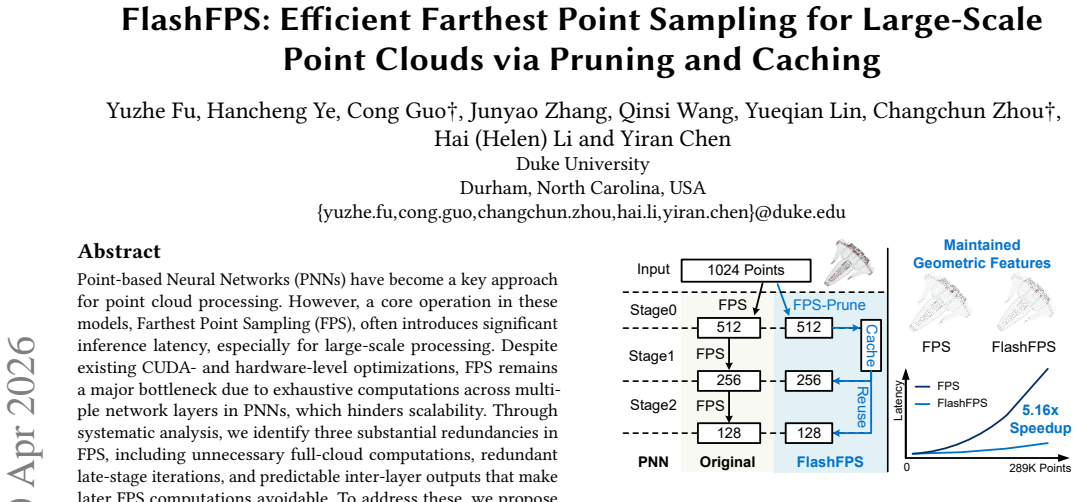
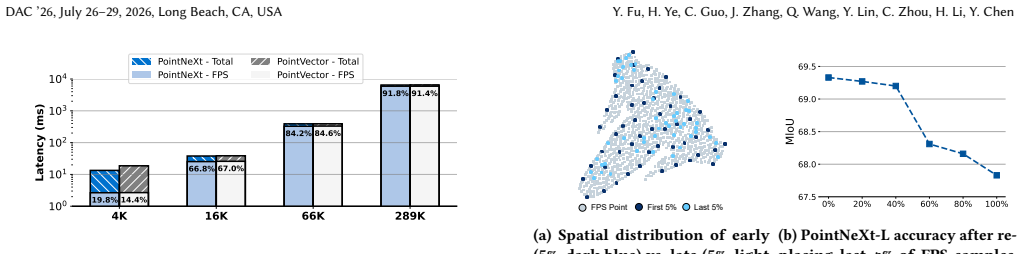
Point-based Neural Networks (PNNs) have become a key approach for point cloud processing. However, a core operation in these models, Farthest Point Sampling (FPS), often introduces significant inference latency, especially for large-scale processing. Despite existing CUDA- and hardware-level optimizations, FPS remains a major bottleneck due to exhaustive computations across multiple network layers in PNNs, which hinders scalability. Through systematic analysis, we identify three substantial redundancies in FPS, including unnecessary full-cloud computations, redundant late-stage iterations, and predictable inter-layer outputs that make later FPS computations avoidable. To address these, we propose \textbf{\textit{FlashFPS}}, a hardware-agnostic, plug-and-play framework for FPS acceleration, composed of \textit{FPS-Prune} and \textit{FPS-Cache}. \textit{FPS-Prune} introduces candidate pruning and iteration pruning to reduce redundant computations in FPS while preserving sampling quality, and \textit{FPS-Cache} eliminates layer-wise redundancy via cache-and-reuse. Integrated into existing CUDA libraries and state-of-the-art PNN accelerators, \textit{FlashFPS} achieves 5.16$\times$ speedup over the standard CUDA baseline on GPU and 2.69$\times$ on PNN accelerators, with negligible accuracy loss, enabling efficient and scalable PNN inference. Codes are released at https://github.com/Yuzhe-Fu/FlashFPS.
Editorial analysis
A structured set of objections, weighed in public.
Referee Report
Summary. The paper claims that Farthest Point Sampling (FPS) in Point-based Neural Networks (PNNs) contains three exploitable redundancies (full-cloud computations, late-stage iterations, and predictable inter-layer outputs). It introduces the hardware-agnostic FlashFPS framework consisting of FPS-Prune (candidate pruning plus iteration pruning) and FPS-Cache (inter-layer reuse) that can be plugged into existing CUDA libraries and PNN accelerators. End-to-end experiments report 5.16× GPU speedup and 2.69× accelerator speedup versus standard baselines while preserving downstream PNN accuracy, with code released at https://github.com/Yuzhe-Fu/FlashFPS.
Significance. If the reported speedups and accuracy preservation hold under the stated pruning rules, the work would meaningfully reduce a well-known inference bottleneck for large-scale point-cloud models, improving practicality of PNNs in real-time or resource-constrained settings. The explicit pruning logic, cache mechanism, and public code release constitute verifiable strengths that support adoption and further optimization.
minor comments (3)
- [§4 / §5] The manuscript would benefit from a short table or paragraph in §4 or §5 that lists the exact pruning thresholds (e.g., candidate ratio, iteration cutoff) used for each benchmark, as these values are central to reproducing the claimed speedups.
- [§3.2] Figure 3 (or equivalent) showing cache hit rates across layers would clarify the contribution of FPS-Cache; currently the text describes the mechanism but does not quantify its isolated impact.
- [§5.2] A brief comparison of sampled-point distributions (e.g., Chamfer distance or coverage metrics between original FPS and FlashFPS) in addition to downstream accuracy would strengthen the claim that sampling quality is preserved.
Simulated Author's Rebuttal
We thank the referee for their positive review, recognition of the practical impact of FlashFPS on reducing FPS bottlenecks in point-based networks, and recommendation to accept the manuscript.
Circularity Check
No significant circularity; empirical optimization validated by external measurements
full rationale
The paper is an engineering contribution that identifies three redundancies in FPS via systematic analysis and introduces FPS-Prune and FPS-Cache as plug-and-play optimizations. All load-bearing claims (5.16× GPU speedup, 2.69× accelerator speedup, negligible accuracy loss) are supported by direct end-to-end timing and accuracy measurements on real PNN workloads against independent CUDA and accelerator baselines, plus released code. No equations, fitted parameters, or predictions appear; no self-citations are invoked as uniqueness theorems or to justify core premises. The derivation chain is therefore self-contained against external benchmarks rather than reducing to its own inputs by construction.
Axiom & Free-Parameter Ledger
axioms (1)
- standard math FPS definition as iterative selection of the point farthest from already selected points
Reference graph
Works this paper leans on
-
[1]
Iro Armeni, Ozan Sener, Amir R Zamir, Helen Jiang, Ioannis Brilakis, Martin Fischer, and Silvio Savarese. 2016. 3d semantic parsing of large-scale indoor spaces. InProceedings of the IEEE conference on computer vision and pattern recognition. 1534–1543
2016
-
[2]
Angela Dai, Angel X Chang, Manolis Savva, Maciej Halber, Thomas Funkhouser, and Matthias Nießner. 2017. Scannet: Richly-annotated 3d reconstructions of indoor scenes. InProceedings of the IEEE conference on computer vision and pattern recognition. 5828–5839
2017
-
[3]
Matt Deitke, Dustin Schwenk, Jordi Salvador, Luca Weihs, Oscar Michel, Eli VanderBilt, Ludwig Schmidt, Kiana Ehsani, Aniruddha Kembhavi, and Ali Farhadi
-
[4]
InProceedings of the IEEE/CVF conference on computer vision and pattern recognition
Objaverse: A universe of annotated 3d objects. InProceedings of the IEEE/CVF conference on computer vision and pattern recognition. 13142–13153
-
[5]
Xin Deng, WenYu Zhang, Qing Ding, and XinMing Zhang. 2023. Pointvector: A vector representation in point cloud analysis. InProceedings of the IEEE/CVF conference on computer vision and pattern recognition. 9455–9465
2023
-
[6]
Yu Feng, Gunnar Hammonds, Yiming Gan, and Yuhao Zhu. 2022. Crescent: taming memory irregularities for accelerating deep point cloud analytics. In Proceedings of the 49th Annual International Symposium on Computer Architecture. 962–977
2022
-
[7]
Yu Feng, Boyuan Tian, Tiancheng Xu, Paul Whatmough, and Yuhao Zhu. 2020. Mesorasi: Architecture support for point cloud analytics via delayed-aggregation. In2020 53rd Annual IEEE/ACM International Symposium on Microarchitecture (MICRO). IEEE, 1037–1050
2020
-
[8]
Yuzhe Fu, Changchun Zhou, Hancheng Ye, Bowen Duan, Qiyu Huang, Chiyue Wei, Cong Guo, Hai Helen Li, and Yiran Chen. 2026. FractalCloud: A Fractal- Inspired Architecture for Efficient Large-Scale Point Cloud Processing. In2026 IEEE International Symposium on High Performance Computer Architecture (HPCA). IEEE, 1–15
2026
-
[9]
Yiming Gao, Chao Jiang, Wesley Piard, Xiangru Chen, Bhavesh Patel, and Herman Lam. 2024. Hgpcn: A heterogeneous architecture for e2e embedded point cloud inference. In2024 57th IEEE/ACM International Symposium on Microarchitecture (MICRO). IEEE, 1588–1600
2024
-
[10]
Yiming Gao, Jieming Yin, Yuxiang Wang, Xiangru Chen, Zhilei Chai, Bowen Jiang, Jiliang Zhang, and Herman Lam. 2026. L-PCN: A Point Cloud Accelerator Exploiting Spatial Locality through Octree-based Islandization.arXiv preprint arXiv:2604.10716(2026)
work page internal anchor Pith review Pith/arXiv arXiv 2026
- [11]
-
[12]
Cong Guo, Jiaming Tang, Weiming Hu, Jingwen Leng, Chen Zhang, Fan Yang, Yunxin Liu, Minyi Guo, and Yuhao Zhu. 2023. Olive: Accelerating large language models via hardware-friendly outlier-victim pair quantization. InProceedings of the 50th Annual International Symposium on Computer Architecture. 1–15
2023
-
[13]
Meng Han, Liang Wang, Limin Xiao, Hao Zhang, Chenhao Zhang, Xiangrong Xu, and Jianfeng Zhu. 2023. Quickfps: Architecture and algorithm co-design for farthest point sampling in large-scale point clouds.IEEE Transactions on Computer-Aided Design of Integrated Circuits and Systems42, 11 (2023), 4011– 4024
2023
-
[14]
Qingdong He, Jiangning Zhang, Jinlong Peng, Haoyang He, Xiangtai Li, Yabiao Wang, and Chengjie Wang. 2025. Pointrwkv: Efficient rwkv-like model for hier- archical point cloud learning. InProceedings of the AAAI Conference on Artificial Intelligence, Vol. 39. 3410–3418
2025
-
[15]
Sangjin Kim, Juhyoung Lee, Dongseok Im, and Hoi-Jun Yoo. 2021. PNNPU: A 11.9 TOPS/W high-speed 3D point cloud-based neural network processor with block-based point processing for regular DRAM access. In2021 Symposium on VLSI Circuits. IEEE, 1–2
2021
-
[16]
Woosuk Kwon, Zhuohan Li, Siyuan Zhuang, Ying Sheng, Lianmin Zheng, Cody Hao Yu, Joseph Gonzalez, Hao Zhang, and Ion Stoica. 2023. Efficient memory management for large language model serving with pagedattention. In Proceedings of the 29th symposium on operating systems principles. 611–626
2023
-
[17]
Sixu Li, Yang Zhao, Chaojian Li, Bowei Guo, Jingqun Zhang, Wenbo Zhu, Zhifan Ye, Cheng Wan, and Yingyan Celine Lin. 2024. Fusion-3D: Integrated Acceleration for Instant 3D Reconstruction and Real-Time Rendering. In2024 57th IEEE/ACM International Symposium on Microarchitecture (MICRO). IEEE, 78–91
2024
-
[18]
Yujun Lin, Zhekai Zhang, Haotian Tang, Hanrui Wang, and Song Han. 2021. Pointacc: Efficient point cloud accelerator. InMICRO-54: 54th Annual IEEE/ACM International Symposium on Microarchitecture. 449–461
2021
-
[19]
Charles R Qi, Hao Su, Kaichun Mo, and Leonidas J Guibas. 2017. Pointnet: Deep learning on point sets for 3d classification and segmentation. InProceedings of the IEEE conference on computer vision and pattern recognition. 652–660
2017
-
[20]
Charles Ruizhongtai Qi, Li Yi, Hao Su, and Leonidas J Guibas. 2017. Pointnet++: Deep hierarchical feature learning on point sets in a metric space.Advances in neural information processing systems30 (2017)
2017
-
[21]
Guocheng Qian. 2023. OpenPoints: An Open-Source Library for Point Cloud Analysis. https://github.com/guochengqian/openpoints. Accessed: July 10, 2025
2023
-
[22]
Guocheng Qian, Yuchen Li, Houwen Peng, Jinjie Mai, Hasan Hammoud, Mo- hamed Elhoseiny, and Bernard Ghanem. 2022. Pointnext: Revisiting pointnet++ with improved training and scaling strategies.Advances in neural information processing systems35 (2022), 23192–23204
2022
-
[23]
Ricardo Roriz, Heitor Silva, Francisco Dias, and Tiago Gomes. 2024. A survey on data compression techniques for automotive lidar point clouds.Sensors24, 10 (2024), 3185
2024
-
[24]
Jiachen Sun, Qingzhao Zhang, Bhavya Kailkhura, Zhiding Yu, Chaowei Xiao, and Z Morley Mao. 2022. Modelnet40-c: A robustness benchmark for 3d point cloud recognition under corruption. InICLR 2022 Workshop on Socially Responsible Machine Learning, Vol. 7
2022
-
[25]
Runsen Xu, Xiaolong Wang, Tai Wang, Yilun Chen, Jiangmiao Pang, and Dahua Lin. 2024. Pointllm: Empowering large language models to understand point clouds. InEuropean Conference on Computer Vision. Springer, 131–147
2024
-
[26]
Hyunsung Yoon and Jae-Joon Kim. 2023. Efficient sampling and grouping accel- eration for point cloud deep learning via single coordinate comparison. In2023 IEEE/ACM International Conference on Computer Aided Design (ICCAD). IEEE, 1–9
2023
-
[27]
Lianmin Zheng, Liangsheng Yin, Zhiqiang Xie, Chuyue Livia Sun, Jeff Huang, Cody Hao Yu, Shiyi Cao, Christos Kozyrakis, Ion Stoica, Joseph E Gonzalez, et al. 2024. Sglang: Efficient execution of structured language model programs. Advances in neural information processing systems37 (2024), 62557–62583
2024
-
[28]
Changchun Zhou, Yuzhe Fu, Min Liu, Siyuan Qiu, Ge Li, Yifan He, and Hailong Jiao. 2023. An energy-efficient 3D point cloud neural network accelerator with efficient filter pruning, MLP fusion, and dual-stream sampling. In2023 IEEE/ACM International Conference on Computer Aided Design (ICCAD). IEEE, 1–9
2023
-
[29]
Changchun Zhou, Yuzhe Fu, Yanzhe Ma, Eryi Han, Yifan He, and Hailong Jiao
-
[30]
Adjustable Multi-Stream Block-Wise Farthest Point Sampling Acceleration in Point Cloud Analysis.IEEE Transactions on Circuits and Systems II: Express Briefs71, 7 (2024), 3523–3527
2024
-
[31]
Changchun Zhou, Tianling Huang, Yanzhe Ma, Yuzhe Fu, Xiangjie Song, Siyuan Qiu, Jiacong Sun, Min Liu, Ge Li, Yifan He, et al. 2025. 23.4 Nebula: A 28nm 109.8 TOPS/W 3D PNN Accelerator Featuring Adaptive Partition, Multi-Skipping, and Block-Wise Aggregation. In2025 IEEE International Solid-State Circuits Conference (ISSCC), Vol. 68. IEEE, 412–414
2025
-
[32]
Haoyi Zhu, Yating Wang, Di Huang, Weicai Ye, Wanli Ouyang, and Tong He
-
[33]
Point cloud matters: Rethinking the impact of different observation spaces on robot learning.Advances in Neural Information Processing Systems37 (2024), 77799–77830
2024
discussion (0)
Sign in with ORCID, Apple, or X to comment. Anyone can read and Pith papers without signing in.