Recognition: unknown
Polarization, Maximal Concurrence, and Pure States in High-Energy Collisions
Pith reviewed 2026-05-10 05:11 UTC · model grok-4.3
The pith
Increasing local spin polarization imposes an upper bound on concurrence in two-qubit systems.
A machine-rendered reading of the paper's core claim, the machinery that carries it, and where it could break.
Core claim
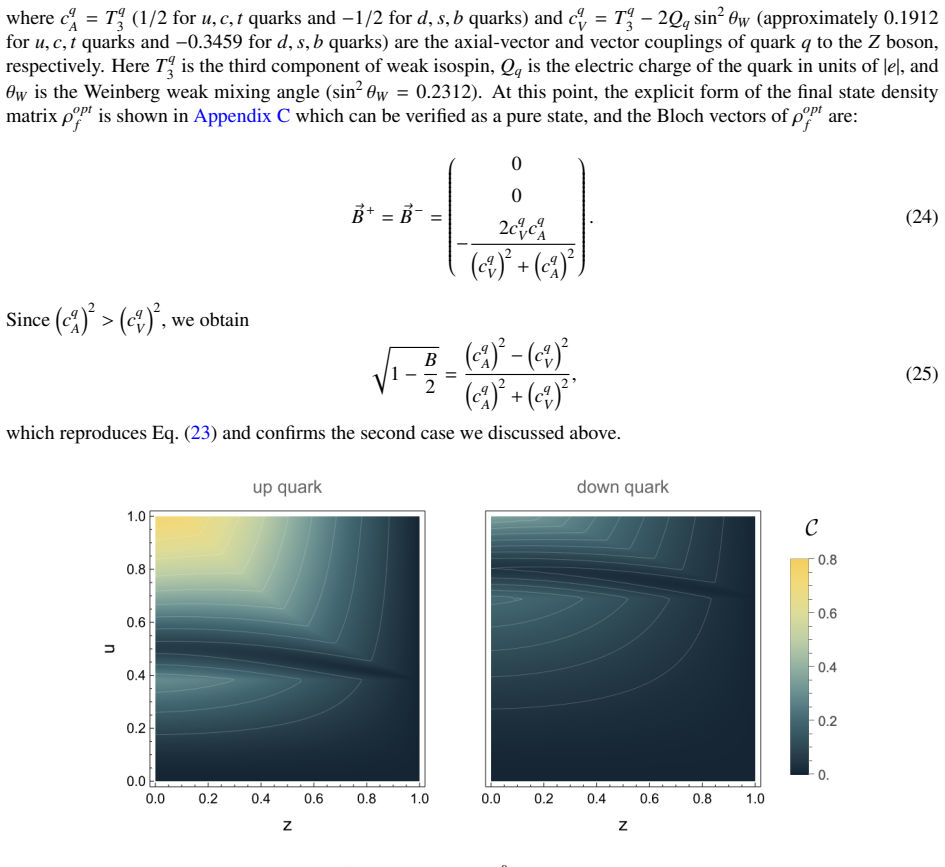
We establish a quantitative relation between local spin polarization and quantum entanglement in two-qubit systems by deriving an upper bound on the concurrence at fixed local polarization, showing that increasing polarization constrains the maximum achievable entanglement. We further demonstrate that this bound is saturated by pure states in certain cases. As a concrete physical application, we consider the parity-violating process e⁺e⁻ → Z⁰ → q q-bar, which generates final-state spin polarization. We show that the maximal concurrence is attained in specific kinematic regions and is significantly reduced relative to the unpolarized case. These results establish a general, processindependent
What carries the argument
The upper bound on concurrence expressed as a function of the local polarization vector magnitude in a two-qubit system.
If this is right
- In the e⁺e⁻ to Z to q q-bar process the maximal concurrence occurs only in particular kinematic regions.
- The maximal concurrence drops substantially compared with the unpolarized case once polarization is present.
- Pure states saturate the derived bound in specific cases.
- The polarization-concurrence relation holds for any two-qubit system and is independent of the underlying production mechanism.
Where Pith is reading between the lines
- The same bound may constrain entanglement in other polarized particle-production channels such as heavy-ion collisions.
- Collider experiments that measure both polarization and a suitable entanglement witness could directly test the bound.
- The approach could be extended to mixed states or to systems with more than two qubits if the local-polarization description remains valid.
Load-bearing premise
The final-state quark and antiquark spins can be modeled as a two-qubit system in which the local polarization vector directly determines the upper limit on concurrence.
What would settle it
A measured concurrence in e⁺e⁻ → Z → q q-bar events that exceeds the bound calculated from the simultaneously measured local polarization vector would contradict the claimed relation.
Figures


read the original abstract
We establish a quantitative relation between local spin polarization and quantum entanglement in two-qubit systems by deriving an upper bound on the concurrence at fixed local polarization, showing that increasing polarization constrains the maximum achievable entanglement. We further demonstrate that this bound is saturated by pure states in certain cases. As a concrete physical application, we consider the parity-violating process $e^+e^- \to Z^0 \to q\bar{q}$, which generates final-state spin polarization. We show that the maximal concurrence is attained in specific kinematic regions and is significantly reduced relative to the unpolarized case. These results establish a general, process-independent framework connecting local polarization, maximal entanglement, and the role of pure states.
Editorial analysis
A structured set of objections, weighed in public.
Referee Report
Summary. The manuscript derives an upper bound on the concurrence of two-qubit systems in terms of their local polarization vectors, showing that increasing polarization reduces the maximum achievable entanglement, and demonstrates that this bound is saturated by certain pure states. It applies the framework to the parity-violating process e⁺e⁻ → Z⁰ → q q̄, arguing that the final-state quark spins form an effective two-qubit system whose local polarizations constrain the concurrence, with the maximum value attained only in specific kinematic regions and significantly lower than in the unpolarized case.
Significance. If the bound derivation is non-tautological and the two-qubit modeling holds after all traces, the result supplies a general, process-independent relation between measurable local polarization and entanglement in high-energy collisions. This could provide a quantitative tool for assessing quantum correlations in polarized production processes and highlights the role of pure states in saturating the bound.
major comments (1)
- In the section applying the bound to e⁺e⁻ → Z⁰ → q q̄: the assumption that the spin degrees of freedom of the produced quarks form a closed two-qubit system whose reduced Bloch vectors enter the concurrence bound directly is not justified. Tracing over color, integrating over unobserved kinematics, and summing over other final-state particles can introduce mixing; without an explicit demonstration that the effective spin density matrix remains consistent with the abstract two-qubit derivation, the physical claim that polarization constrains concurrence in this process does not follow.
minor comments (1)
- The explicit functional form of the derived upper bound on concurrence should be stated clearly in the general two-qubit section, together with the definitions of the local polarization vectors, to allow readers to verify the saturation claim for pure states.
Simulated Author's Rebuttal
We thank the referee for the careful reading and constructive feedback. We address the single major comment below and will revise the manuscript to provide the requested explicit demonstration.
read point-by-point responses
-
Referee: In the section applying the bound to e⁺e⁻ → Z⁰ → q q̄: the assumption that the spin degrees of freedom of the produced quarks form a closed two-qubit system whose reduced Bloch vectors enter the concurrence bound directly is not justified. Tracing over color, integrating over unobserved kinematics, and summing over other final-state particles can introduce mixing; without an explicit demonstration that the effective spin density matrix remains consistent with the abstract two-qubit derivation, the physical claim that polarization constrains concurrence in this process does not follow.
Authors: We agree that the current manuscript would benefit from a more explicit derivation to confirm that the reduced spin density matrix for the q q̄ pair remains a valid two-qubit state after all traces. In e⁺e⁻ → Z⁰ → q q̄ the Z decay produces a color-singlet quark pair whose spin correlations are fully determined by the electroweak matrix elements; color and kinematic degrees of freedom factorize and do not introduce additional spin mixing once the reduced density matrix is formed. The local polarization vectors are obtained precisely by tracing over the partner spin and integrating over the unobserved production angle. In the revision we will add a dedicated appendix that (i) writes the full 4×4 spin density matrix from the Z decay amplitude, (ii) performs the explicit partial traces over color and kinematics, and (iii) shows that the resulting operator is of the standard two-qubit Bloch form (I⊗I + r·σ⊗I + I⊗s·σ + c_{ij} σ_i⊗σ_j)/4 with the concurrence bound applying directly to the extracted r and s. This will rigorously justify the physical claim without altering the reported results. revision: yes
Circularity Check
No significant circularity; mathematical bound derived from standard two-qubit definitions
full rationale
The paper's central derivation establishes an upper bound on concurrence for fixed local polarization in two-qubit systems and shows saturation by pure states. This is presented as a direct mathematical result from the definitions of concurrence (via the standard Wootters formula) and Bloch-vector polarization, without any fitting to data or reduction to self-citation. The e+e- to Z to qqbar application applies the bound to a modeled two-qubit spin subspace but does not alter the independence of the QI derivation itself. No load-bearing self-citations, ansatze smuggled via prior work, or predictions that collapse to fitted inputs are evident from the abstract and claimed structure. The modeling assumption is an applicability question rather than a circularity in the derivation chain.
Axiom & Free-Parameter Ledger
axioms (1)
- domain assumption Spin states of quark-antiquark pairs produced in the process can be treated as two-qubit systems with a local polarization vector.
Reference graph
Works this paper leans on
-
[1]
J. Ashmanet al.[European Muon], Phys. Lett. B206(1988), 364 doi:10.1016/0370-2693(88)91523-7
-
[2]
Airapetianet al.[HERMES], Phys
A. Airapetianet al.[HERMES], Phys. Rev. D75(2007), 012007 doi:10.1103/PhysRevD.75.012007 [arXiv:hep- ex/0609039 [hep-ex]]
-
[3]
S. Schaelet al.[ALEPH, DELPHI, L3, OPAL, SLD, LEP Electroweak Working Group, SLD Electroweak Group and SLD Heavy Flavour Group], Phys. Rept.427(2006), 257-454 doi:10.1016/j.physrep.2005.12.006 [arXiv:hep-ex/0509008 [hep-ex]]
-
[4]
G. Bunce, R. Handler, R. March, P. Martin, L. Pondrom, M. Sheaff, K. J. Heller, O. Overseth, P. Skubic and T. Devlin,et al.Phys. Rev. Lett.36(1976), 1113-1116 doi:10.1103/PhysRevLett.36.1113
-
[5]
Z. T. Liang and X. N. Wang, Phys. Rev. Lett.94(2005), 102301 [erratum: Phys. Rev. Lett.96(2006), 039901] doi:10.1103/PhysRevLett.94.102301 [arXiv:nucl-th/0410079 [nucl-th]]. 10
-
[6]
Global Λ hyperon polarization in nuclear col- lisions: evidence for the most vortical fluid
L. Adamczyket al.[STAR], Nature548(2017), 62-65 doi:10.1038/nature23004 [arXiv:1701.06657 [nucl-ex]]
-
[7]
J. Adamet al.[STAR], Phys. Rev. C98(2018), 014910 doi:10.1103/PhysRevC.98.014910 [arXiv:1805.04400 [nucl-ex]]
-
[8]
P. Uwer, Phys. Lett. B609(2005), 271-276 doi:10.1016/j.physletb.2005.01.005 [arXiv:hep-ph/0412097 [hep- ph]]
-
[9]
M. Hentschinski, D. E. Kharzeev, K. Kutak and Z. Tu, Phys. Rev. Lett.131(2023) no.24, 241901 doi:10.1103/PhysRevLett.131.241901 [arXiv:2305.03069 [hep-ph]]
-
[10]
Y . Afik and J. R. M. de Nova, Eur. Phys. J. Plus136(2021) no.9, 907 doi:10.1140/epjp/s13360-021-01902-1 [arXiv:2003.02280 [quant-ph]]
-
[11]
Y . Afik and J. R. M. de Nova, Phys. Rev. Lett.130(2023) no.22, 221801 doi:10.1103/PhysRevLett.130.221801 [arXiv:2209.03969 [quant-ph]]
-
[12]
Y . Afik and J. R. M. de Nova, Quantum6(2022), 820 doi:10.22331/q-2022-09-29-820 [arXiv:2203.05582 [quant-ph]]
-
[13]
K. Cheng, T. Han and M. Low, Phys. Rev. D111(2025) no.3, 033004 doi:10.1103/PhysRevD.111.033004 [arXiv:2407.01672 [hep-ph]]
-
[14]
S. Wu, C. Qian, Y . G. Yang and Q. Wang, Chin. Phys. Lett.41(2024) no.11, 110301 doi:10.1088/0256- 307X/41/11/110301 [arXiv:2402.16574 [hep-ph]]
-
[15]
A. J. Barr, M. Fabbrichesi, R. Floreanini, E. Gabrielli and L. Marzola, Prog. Part. Nucl. Phys.139(2024), 104134 doi:10.1016/j.ppnp.2024.104134 [arXiv:2402.07972 [hep-ph]]
-
[16]
K. Ehatäht, M. Fabbrichesi, L. Marzola and C. Veelken, Phys. Rev. D109(2024) no.3, 032005 doi:10.1103/PhysRevD.109.032005 [arXiv:2311.17555 [hep-ph]]
-
[17]
Y . Guo, X. Liu, F. Yuan and H. X. Zhu, Research2025(2025), 0552 doi:10.34133/research.0552 [arXiv:2406.05880 [hep-ph]]
-
[18]
R. A. Morales, Eur. Phys. J. Plus138(2023) no.12, 1157 doi:10.1140/epjp/s13360-023-04784-7 [arXiv:2306.17247 [hep-ph]]
-
[19]
S. J. Parke and Y . Shadmi, Phys. Lett. B387(1996), 199-206 doi:10.1016/0370-2693(96)00998-7 [arXiv:hep- ph/9606419 [hep-ph]]
-
[20]
M. M. Altakach, P. Lamba, F. Maltoni, K. Mawatari and K. Sakurai, Phys. Rev. D107(2023) no.9, 093002 doi:10.1103/PhysRevD.107.093002 [arXiv:2211.10513 [hep-ph]]
- [21]
-
[22]
A. Bernal, Phys. Rev. D109(2024) no.11, 116007 doi:10.1103/PhysRevD.109.116007 [arXiv:2310.10838 [hep- ph]]
-
[23]
A. Brandenburg, Z. G. Si and P. Uwer, Phys. Lett. B539(2002), 235-241 doi:10.1016/S0370-2693(02)02098-1 [arXiv:hep-ph/0205023 [hep-ph]]
-
[24]
M. Hentschinski, D. E. Kharzeev, K. Kutak and Z. Tu, Rept. Prog. Phys.87(2024) no.12, 120501 doi:10.1088/1361-6633/ad910b [arXiv:2408.01259 [hep-ph]]
-
[25]
D. F. V . James, P. G. Kwiat, W. J. Munro and A. G. White, Phys. Rev. A64(2001) no.5, 052312 doi:10.1103/PhysRevA.64.052312 [arXiv:quant-ph/0103121 [quant-ph]]. 11
-
[26]
K. Kowalska and E. M. Sessolo, JHEP07(2024), 156 doi:10.1007/JHEP07(2024)156 [arXiv:2404.13743 [hep- ph]]
-
[27]
X. L. Li, X. Liu, F. Yuan and H. X. Zhu, Phys. Rev. D108(2023) no.9, L091502 doi:10.1103/PhysRevD.108.L091502 [arXiv:2308.10942 [hep-ph]]
-
[28]
F. Maltoni, C. Severi, S. Tentori and E. Vryonidou, JHEP09(2024), 001 doi:10.1007/JHEP09(2024)001 [arXiv:2404.08049 [hep-ph]]
-
[29]
C. Severi and E. Vryonidou, JHEP01(2023), 148 doi:10.1007/JHEP01(2023)148 [arXiv:2210.09330 [hep-ph]]
- [30]
-
[31]
C. Severi, C. D. Boschi, F. Maltoni and M. Sioli, Eur. Phys. J. C82(2022) no.4, 285 doi:10.1140/epjc/s10052- 022-10245-9 [arXiv:2110.10112 [hep-ph]]
-
[32]
S. Wu, C. Qian, Q. Wang and X. R. Zhou, Phys. Rev. D110(2024) no.5, 054012 doi:10.1103/PhysRevD.110.054012 [arXiv:2406.16298 [hep-ph]]
-
[33]
S. Li, W. Shen and J. M. Yang, Eur. Phys. J. C84(2024) no.11, 1195 doi:10.1140/epjc/s10052-024-13584-x [arXiv:2401.01162 [hep-th]]
-
[34]
G. Mahlon and S. J. Parke, Phys. Rev. D53(1996), 4886-4896 doi:10.1103/PhysRevD.53.4886 [arXiv:hep- ph/9512264 [hep-ph]]
-
[35]
Z. Dong, D. Gonçalves, K. Kong and A. Navarro, Phys. Rev. D109(2024) no.11, 115023 doi:10.1103/PhysRevD.109.115023 [arXiv:2305.07075 [hep-ph]]
-
[36]
J. A. Aguilar-Saavedra and J. A. Casas, Eur. Phys. J. C82(2022) no.8, 666 doi:10.1140/epjc/s10052-022-10630- 4 [arXiv:2205.00542 [hep-ph]]
-
[37]
M. Fabbrichesi, R. Floreanini, E. Gabrielli and L. Marzola, Eur. Phys. J. C83(2023) no.9, 823 doi:10.1140/epjc/s10052-023-11935-8 [arXiv:2302.00683 [hep-ph]]
-
[38]
D. Ghosh and R. Sharma, JHEP08(2023), 146 doi:10.1007/JHEP08(2023)146 [arXiv:2303.03375 [hep-th]]
-
[39]
C. D. White and M. J. White, Phys. Rev. D110(2024) no.11, 116016 doi:10.1103/PhysRevD.110.116016 [arXiv:2406.07321 [hep-ph]]
-
[40]
T. Han, M. Low and T. A. Wu, JHEP07(2024), 192 doi:10.1007/JHEP07(2024)192 [arXiv:2310.17696 [hep- ph]]
-
[41]
Y . Du, X. G. He, C. W. Liu and J. P. Ma, Eur. Phys. J. C85(2025) no.11, 1255 doi:10.1140/epjc/s10052-025- 15003-1 [arXiv:2409.15418 [hep-ph]]
-
[42]
R. A. Morales, Eur. Phys. J. C84(2024) no.6, 581 doi:10.1140/epjc/s10052-024-12921-4 [arXiv:2403.18023 [hep-ph]]
-
[43]
L. Yang, Y . K. Song and S. Y . Wei, Phys. Rev. D111(2025) no.5, 054035 doi:10.1103/PhysRevD.111.054035 [arXiv:2410.20917 [hep-ph]]
-
[44]
M. Fabbrichesi, R. Floreanini and G. Panizzo, Phys. Rev. Lett.127(2021) no.16, 16 doi:10.1103/PhysRevLett.127.161801 [arXiv:2102.11883 [hep-ph]]
-
[45]
R. Aoude, E. Madge, F. Maltoni and L. Mantani, Phys. Rev. D106(2022) no.5, 055007 doi:10.1103/PhysRevD.106.055007 [arXiv:2203.05619 [hep-ph]]. 12
-
[46]
Y . Afik, F. Fabbri, M. Low, L. Marzola, J. A. Aguilar-Saavedra, M. M. Altakach, N. A. Asbah, Y . Bai, H. Banks and A. J. Barr,et al.Eur. Phys. J. Plus140(2025) no.9, 855 doi:10.1140/epjp/s13360-025-06752- 9 [arXiv:2504.00086 [hep-ph]]
-
[47]
M. Fabbrichesi, R. Floreanini and L. Marzola, JHEP11(2025), 005 doi:10.1007/JHEP11(2025)005 [arXiv:2505.02902 [hep-ph]]
-
[48]
K. Cheng and B. Yan, Phys. Rev. Lett.135(2025) no.1, 1 doi:10.1103/gmqz-v4cl [arXiv:2501.03321 [hep-ph]]
-
[49]
W. Qi, Z. Guo and B. W. Xiao, Phys. Rev. D113(2026) no.5, 054048 doi:10.1103/6ycn-x3yj [arXiv:2506.12889 [hep-ph]]
- [50]
-
[51]
S. J. Lin, M. J. Liu, D. Y . Shao and S. Y . Wei, JHEP11(2025), 082 doi:10.1007/JHEP11(2025)082 [arXiv:2507.15387 [hep-ph]]
-
[52]
M. Low, Phys. Rev. D112(2025) no.9, 096008 doi:10.1103/15c3-mg5l [arXiv:2508.10979 [hep-ph]]
-
[53]
Probing quantum en- tanglement with Generalized Parton Distributions at the Electron-Ion Collider,
Y . Hatta and J. Schoenleber, [arXiv:2511.04537 [hep-ph]]
-
[54]
X. Q. Xi, K. B. Chen, X. B. Tong, S. Y . Wei and J. Wu, Eur. Phys. J. C85(2025) no.12, 1458 doi:10.1140/epjc/s10052-025-15193-8 [arXiv:2510.06103 [hep-ph]]
- [55]
- [56]
-
[57]
M. Fucilla and Y . Hatta, Phys. Rev. D113(2026) no.3, L031504 doi:10.1103/gbk8-z3dd [arXiv:2509.05267 [hep-ph]]
- [58]
- [59]
-
[60]
M. Fucilla, Y . Hatta and B. W. Xiao, [arXiv:2604.11697 [hep-ph]]
work page internal anchor Pith review Pith/arXiv arXiv
-
[61]
Observation of quantum entanglement with top quarks at the ATLAS detector
G. Aadet al.[ATLAS], Nature633(2024) no.8030, 542-547 doi:10.1038/s41586-024-07824-z [arXiv:2311.07288 [hep-ex]]
-
[62]
A. Hayrapetyanet al.[CMS], Rept. Prog. Phys.87(2024) no.11, 117801 doi:10.1088/1361-6633/ad7e4d [arXiv:2406.03976 [hep-ex]]
-
[63]
B. E. Aboonaet al.[STAR], Nature650(2026) no.8100, 65-71 doi:10.1038/s41586-025-09920-0 [arXiv:2506.05499 [hep-ex]]
-
[64]
W. K. Wootters, Phys. Rev. Lett.80(1998), 2245-2248 doi:10.1103/PhysRevLett.80.2245 [arXiv:quant- ph/9709029 [quant-ph]]
-
[65]
S. Hill and W. K. Wootters, Phys. Rev. Lett.78(1997), 5022-5025 doi:10.1103/PhysRevLett.78.5022 [arXiv:quant-ph/9703041 [quant-ph]]
-
[66]
P. Rungta, V . Bužek, C. M. Caves, M. Hillery and G. J. Milburn, Phys. Rev. A64(2001) no.4, 042315 doi:10.1103/PhysRevA.64.042315 [arXiv:quant-ph/0102040 [quant-ph]]
-
[67]
M. Ali, A. R. P. Rau and G. Alber, Phys. Rev. A81(2010) no.4, 042105 doi:10.1103/PhysRevA.81.042105 [arXiv:1002.3429 [quant-ph]]
-
[68]
J. Wang, H. Batelaan, J. Podany and A. F. Starace, J. Phys. B39(2006), 4343-4353 doi:10.1088/0953- 4075/39/21/001 [arXiv:quant-ph/0503116 [quant-ph]]. 13
-
[69]
W. J. Munro, D. F. V . James, A. G. White and P. G. Kwiat, Phys. Rev. A64(2001) no.3, 030302 doi:10.1103/PhysRevA.64.030302 [arXiv:quant-ph/0103113 [quant-ph]]
-
[70]
G. Baio, D. Chruscinski, P. Horodecki, A. Messina and G. Sarbicki, Phys. Rev. A99(2019), 062312 doi:10.1103/PhysRevA.99.062312 [arXiv:1904.07650 [quant-ph]]
-
[71]
C. J. Zhang, Y . X. Gong, Y . S. Zhang and G. C. Guo, Phys. Rev. A78(2008), 042308 doi:10.1103/PhysRevA.78.042308 [arXiv:0806.2598 [quant-ph]]
-
[72]
W. Bernreuther and A. Brandenburg, Phys. Rev. D49(1994), 4481-4492 doi:10.1103/PhysRevD.49.4481 [arXiv:hep-ph/9312210 [hep-ph]]
-
[73]
W. Bernreuther, M. Flesch and P. Haberl, Phys. Rev. D58(1998), 114031 doi:10.1103/PhysRevD.58.114031 [arXiv:hep-ph/9709284 [hep-ph]]
-
[74]
A. Brandenburg, M. Flesch and P. Uwer, Phys. Rev. D59(1999), 014001 doi:10.1103/PhysRevD.59.014001 [arXiv:hep-ph/9806306 [hep-ph]]
-
[75]
M. Baumgart and B. Tweedie, JHEP03(2013), 117 doi:10.1007/JHEP03(2013)117 [arXiv:1212.4888 [hep-ph]]
-
[76]
W. Bernreuther, D. Heisler and Z. G. Si, JHEP12(2015), 026 doi:10.1007/JHEP12(2015)026 [arXiv:1508.05271 [hep-ph]]. 14
discussion (0)
Sign in with ORCID, Apple, or X to comment. Anyone can read and Pith papers without signing in.