Recognition: unknown
Quantum entanglement in electron-nucleus collisions: Role of the linearly polarized gluon distribution
Pith reviewed 2026-05-10 14:54 UTC · model grok-4.3
The pith
The linearly polarized gluon distribution enhances the entanglement of heavy quark pairs in electron-nucleus collisions when total and relative transverse momenta are orthogonal.
A machine-rendered reading of the paper's core claim, the machinery that carries it, and where it could break.
Core claim
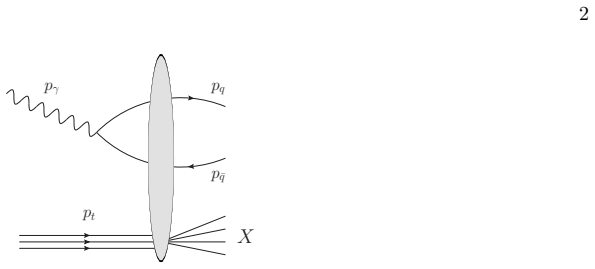
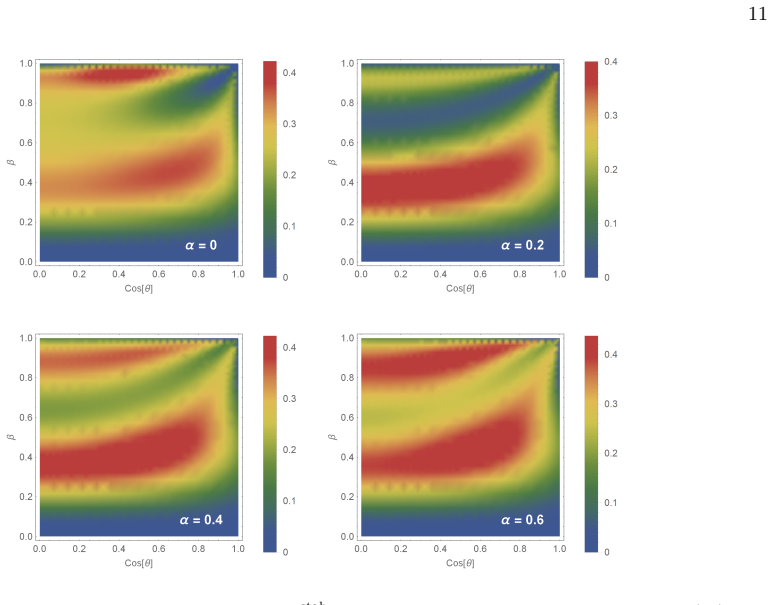
We calculate the spin density matrix of a back-to-back quark-antiquark pair inclusively produced in electron-nucleus scattering, taking into account the gluon saturation effect and the linearly polarized gluon distribution. We then investigate concurrence and stabilizer Rényi entropy, quantifying entanglement, Bell-nonlocality, and magic. We find that the linearly polarized gluon distribution tends to enhance the entanglement of a heavy quark pair when the total and relative transverse momenta of the pair are orthogonal.
What carries the argument
The spin density matrix of the quark-antiquark pair constructed from gluon saturation and the linearly polarized gluon distribution, from which concurrence and stabilizer Rényi entropy are computed.
If this is right
- Entanglement of the heavy quark pair increases when the linearly polarized gluon distribution is included under orthogonal-momentum kinematics.
- The same spin density matrix supplies values for Bell nonlocality and magic alongside concurrence.
- The enhancement is obtained after gluon saturation is accounted for in the nuclear target.
- The effect is specific to inclusive back-to-back quark-antiquark production in electron-nucleus scattering.
Where Pith is reading between the lines
- Measurements at a future electron-ion collider could extract information on the linearly polarized gluon distribution by recording entanglement observables in the appropriate kinematics.
- The framework may extend to other high-energy processes where saturated gluons generate quark pairs, allowing entanglement to serve as an additional observable.
- Varying nuclear size or beam energy would test how saturation strength modulates the polarization-driven entanglement boost.
Load-bearing premise
The gluon saturation effect and the specific functional form of the linearly polarized gluon distribution are correctly incorporated into the spin density matrix for the quark-antiquark pair.
What would settle it
A measurement of spin correlations or concurrence proxies for heavy quark pairs produced with orthogonal total and relative transverse momenta in electron-nucleus collisions that shows no increase in entanglement relative to calculations using only the unpolarized gluon distribution would falsify the claimed enhancement.
Figures




read the original abstract
We calculate the spin density matrix of a back-to-back quark-antiquark pair inclusively produced in electron-nucleus scattering, taking into account the gluon saturation effect and the linearly polarized gluon distribution. We then investigate concurrence and stabilizer R\'enyi entropy, quantifying entanglement, Bell-nonlocality, and magic. We find that the linearly polarized gluon distribution tends to enhance the entanglement of a heavy quark pair when the total and relative transverse momenta of the pair are orthogonal.
Editorial analysis
A structured set of objections, weighed in public.
Referee Report
Summary. The paper calculates the spin density matrix of back-to-back heavy quark-antiquark pairs produced inclusively in electron-nucleus scattering within the color-glass-condensate framework. It incorporates both gluon saturation (via dipole amplitudes) and the linearly polarized gluon TMD, then evaluates concurrence, stabilizer Rényi entropy, Bell nonlocality, and magic. The central result is that the linearly polarized gluon distribution enhances entanglement when the total transverse momentum P and relative momentum q are orthogonal.
Significance. If the derivation holds, the work provides a novel quantum-information observable for the linearly polarized gluon TMD in the saturation regime, potentially accessible at the EIC. The explicit use of concurrence and Rényi entropy on the spin density matrix, together with the reported orthogonal-momentum dependence, constitutes a falsifiable prediction that goes beyond conventional cross-section studies. The paper correctly grounds the calculation in established CGC/TMD machinery without introducing ad-hoc parameters.
minor comments (3)
- [§2.2, Eq. (9)] §2.2, Eq. (9): the definition of the spin density matrix elements should explicitly state the trace-normalization condition after including the h_1^⊥g term to confirm that Tr(ρ)=1 is preserved under saturation.
- [Figure 2] Figure 2: the curves for polarized versus unpolarized cases lack error bands or variation with the saturation scale; adding a brief sensitivity check would strengthen the enhancement claim.
- [§4.1] §4.1: the discussion of Bell nonlocality would benefit from a short comparison to the unpolarized baseline value to quantify the size of the linear-polarization effect.
Simulated Author's Rebuttal
We thank the referee for the positive evaluation of our work and the recommendation for minor revision. No specific major comments were raised in the report.
Circularity Check
No significant circularity; derivation is self-contained
full rationale
The central result follows from an explicit computation of the spin density matrix for the back-to-back heavy quark pair in the CGC/dipole framework, incorporating the standard linearly polarized gluon TMD as an input distribution. Entanglement quantifiers (concurrence, Rényi entropy) are then evaluated directly from the eigenvalues of that matrix. No equation reduces by construction to a fitted parameter or prior self-citation; the reported orthogonal-momentum enhancement is a derived numerical/analytic outcome under the model's stated assumptions rather than a renaming or self-definition. The calculation remains independent of the target observable and does not rely on load-bearing self-citations for its uniqueness or validity.
Axiom & Free-Parameter Ledger
axioms (2)
- domain assumption Gluon saturation effects are present and can be modeled in electron-nucleus scattering
- domain assumption The linearly polarized gluon distribution exists and has a defined impact on quark pair production
Forward citations
Cited by 2 Pith papers
-
Polarization, Maximal Concurrence, and Pure States in High-Energy Collisions
Local spin polarization imposes an upper bound on concurrence in two-qubit systems that is saturated by pure states, and this bound lowers maximal entanglement in the polarized e+e- to Z to qqbar process relative to t...
-
Higher-order local constraints from reciprocal symmetry and entanglement entropy of charged-particle multiplicity distributions in $pp$ collisions
Reciprocal symmetry f_s(z)=f_s(1/z) implies local constraints on multiplicity distributions at n=<n> that hold to leading order in ATLAS data, plus a model-independent entanglement entropy expression S=ln<n>+1-½∫e^{-z...
Reference graph
Works this paper leans on
-
[1]
Impact factors TheS-matrix element for the inclusive dijet production in DIS reads Sγ∗→q1q2 =−iee f ελ µ(pγ) Z d4z θ(−z +)eipγ ·z ¯ushock α (pq, z)γµvshock α′ (p¯q, z) (A1) 15 where the effective quark/anti-quark spinors through the shockwave reads ¯ushock α (pq, z) =θ(p + q ) Z d2k⊥ (2π)2 Z d2x1⊥e−ix1⊥·(k1−k)⊥ UF (x1⊥) ×e iz+ k2 ⊥+m2 2p+q +iz−p+ q −iz⊥·k...
-
[2]
∂ ∂P j ⊥ ψT(λ) αα′ (P⊥) # =c T ∂ ∂P i ⊥ 1 P 2 ⊥ + ¯Q2 ¯vβ′(p¯q) (1−2z)P k ⊥ −iϵ klP l ⊥γ5 +mγ k γ+uβ(pq) ×
Cross section of the inclusive dijet production The CGC event-by-event amplitude can be written ML/T(λ) γ∗→q1q2 = (−i)eef Z d2x1⊥ Z d2x2⊥e−ix1⊥·pq⊥ e−ix2⊥·p¯q⊥ΦL/T(λ) αα′ (x12⊥)[UF (x1⊥)U † F (x2⊥)−1], (A12) The longitudinal and transverse cross sections are respectively obtained as dσL dP.S. = 2p+ γ (2π)δ(p+ γ −p + q −p + ¯q) X hel.col. ⟨|ML γ∗→q1q2 |2⟩A...
-
[3]
+n a 3Cab(nb 2 −n b 4) ≤2,(C4) for unit vectors|⃗ ni|= 1 (i= 1,2,3,4). Given a correlation matrixC ab, this inequality is violated for certain choices of⃗ ni if the largest two of the three eigenvaluesµ 3 ≤µ 2 ≤µ 1 of the matrixC T C(the symbolTdenotes ‘transpose’) satisfy [69] 1< µ 1 +µ 2 ≤2.(C5) When this is the case, we say that the pair exhibit ‘Bell-...
-
[4]
Aadet al.(ATLAS Collaboration), Nature633, 542 (2024), arXiv:2311.07288
G. Aad et al. (ATLAS), Nature633, 542 (2024), 2311.07288
-
[5]
Hayrapetyanet al.(CMS Collaboration), Rept
A. Hayrapetyan et al. (CMS), Rept. Prog. Phys.87, 117801 (2024), 2406.03976
- [6]
- [7]
-
[8]
Y. Afik et al. (2025), 2504.00086
- [9]
-
[10]
Spin-spin entanglement in diffractive heavy-quark production,
M. Fucilla and Y. Hatta, Phys. Rev. D113, L031504 (2026), 2509.05267. 20
- [11]
- [12]
-
[13]
Probing quantum en- tanglement with Generalized Parton Distributions at the Electron-Ion Collider,
Y. Hatta and J. Schoenleber (2025), 2511.04537
- [14]
-
[15]
F. Gelis, E. Iancu, J. Jalilian-Marian, and R. Venugopalan, Ann. Rev. Nucl. Part. Sci.60, 463 (2010), 1002.0333
work page Pith review arXiv 2010
-
[16]
A. Kovner and M. Lublinsky, Phys. Rev. D92, 034016 (2015), 1506.05394
-
[17]
R. Peschanski and S. Seki, Phys. Lett. B758, 89 (2016), 1602.00720
-
[18]
D. E. Kharzeev and E. M. Levin, Phys. Rev. D95, 114008 (2017), 1702.03489
work page Pith review arXiv 2017
- [19]
- [20]
-
[21]
S. Bhattacharya, R. Boussarie, and Y. Hatta, Phys. Lett. B859, 139134 (2024), 2404.04208
- [22]
- [23]
-
[24]
Y. Hatta and J. Montgomery, Phys. Rev. D111, 014024 (2025), 2410.16082
-
[25]
A. Dumitru and E. Kolbusz, Phys. Rev. D111, 114033 (2025), 2501.12312
- [26]
-
[27]
S. Agrawal and R. Abir, Phys. Lett. B868, 139802 (2025), 2505.21048
-
[28]
Pomeron evolution, entan- glement entropy and Abramovskii-Gribov-Kancheli cut- ting rules,
M. Ouchen and A. Prygarin (2025), 2508.12102
-
[29]
Entanglement entropy, Monte Carlo event generators, and soft gluons DIScovery
M. Hentschinski, H. Jung, and K. Kutak, Phys. Rev. D113, 054024 (2026), 2509.03400
work page internal anchor Pith review Pith/arXiv arXiv 2026
- [30]
- [31]
-
[32]
E. A. Kuraev, L. N. Lipatov, and V. S. Fadin, Sov. Phys. JETP44, 443 (1976)
1976
-
[33]
E. A. Kuraev, L. N. Lipatov, and V. S. Fadin, Sov. Phys. JETP45, 199 (1977)
1977
-
[34]
Y. Y. Balitsky and L. N. Lipatov, Sov. J. Nucl. Phys.28, 822 (1978)
1978
-
[35]
K. Cheng and B. Yan, Phys. Rev. Lett.135, 011902 (2025), 2501.03321
- [36]
- [37]
-
[38]
Universality of Unintegrated Gluon Distributions at small x
F. Dominguez, C. Marquet, B.-W. Xiao, and F. Yuan, Phys. Rev. D83, 105005 (2011), 1101.0715
work page Pith review arXiv 2011
- [39]
- [40]
- [41]
-
[42]
F. Bergabo and J. Jalilian-Marian, Phys. Rev. D107, 054036 (2023), 2301.03117
- [43]
- [44]
-
[45]
T. Altinoluk, G. Beuf, A. Czajka, and A. Tymowska, Phys. Rev. D107, 074016 (2023), 2212.10484
-
[46]
T. Altinoluk, G. Beuf, A. Czajka, and C. Marquet, Phys. Rev. D111, 014010 (2025), 2410.00612
- [47]
-
[48]
S. Mukherjee, V. V. Skokov, A. Tarasov, S. Tiwari, and F. Yao (2026), 2602.15137
-
[49]
G. A. Chirilli (2026), 2603.23428
work page internal anchor Pith review Pith/arXiv arXiv 2026
-
[50]
N. N. Nikolaev and B. G. Zakharov, Z. Phys. C49, 607 (1991)
1991
- [51]
-
[52]
G. Beuf, Phys. Rev. D94, 054016 (2016), 1606.00777
- [53]
- [54]
- [55]
- [56]
-
[57]
J. Gargalionis, N. Moynihan, M. L. Reichenberg Ashby, E. N. V. Wallace, C. D. White, and M. J. White (2026), 2603.04148
- [58]
-
[59]
L. D. McLerran and R. Venugopalan, Phys. Rev. D49, 2233 (1994), hep-ph/9309289
work page Pith review arXiv 1994
- [60]
-
[61]
F. Dominguez, J.-W. Qiu, B.-W. Xiao, and F. Yuan, Phys. Rev. D85, 045003 (2012), 1109.6293
-
[62]
A. Dumitru and V. Skokov, Phys. Rev. D94, 014030 (2016), 1605.02739
-
[63]
M. Galanti, A. Giammanco, Y. Grossman, Y. Kats, E. Stamou, and J. Zupan, JHEP11, 067 (2015), 1505.02771
-
[64]
Y. Hatta, B.-W. Xiao, F. Yuan, and J. Zhou, Phys. Rev. Lett.126, 142001 (2021), 2010.10774
-
[65]
Y. Hatta, B.-W. Xiao, F. Yuan, and J. Zhou, Phys. Rev. D104, 054037 (2021), 2106.05307
- [66]
- [67]
-
[68]
Separability Criterion for Density Matrices
A. Peres, Phys. Rev. Lett.77, 1413 (1996), quant-ph/9604005
work page Pith review arXiv 1996
-
[69]
Separability criterion and inseparable mixed states with positive partial transposition
P. Horodecki, Phys. Lett. A232, 333 (1997), quant-ph/9703004
work page Pith review arXiv 1997
-
[70]
Y. Afik and J. R. M. de Nova, Eur. Phys. J. Plus136, 907 (2021), 2003.02280
-
[71]
J. F. Clauser, M. A. Horne, A. Shimony, and R. A. Holt, Phys. Rev. Lett.23, 880 (1969)
1969
-
[72]
Horodecki, P
R. Horodecki, P. Horodecki, and M. Horodecki, Phys. Lett. A200, 340 (1995)
1995
-
[73]
The Heisenberg Representation of Quantum Computers
D. Gottesman, in22nd International Colloquium on Group Theoretical Methods in Physics(1998), pp. 32–43, quant-ph/9807006
work page internal anchor Pith review arXiv 1998
discussion (0)
Sign in with ORCID, Apple, or X to comment. Anyone can read and Pith papers without signing in.