Recognition: unknown
Exploring Polarized Millimeter Emission from Protoplanetary Disks with Irregular Dust Grains
Pith reviewed 2026-05-10 04:33 UTC · model grok-4.3
The pith
Switching to irregular dust grains leaves polarization nearly the same but raises scattering opacity by a factor of 2.5
A machine-rendered reading of the paper's core claim, the machinery that carries it, and where it could break.
Core claim
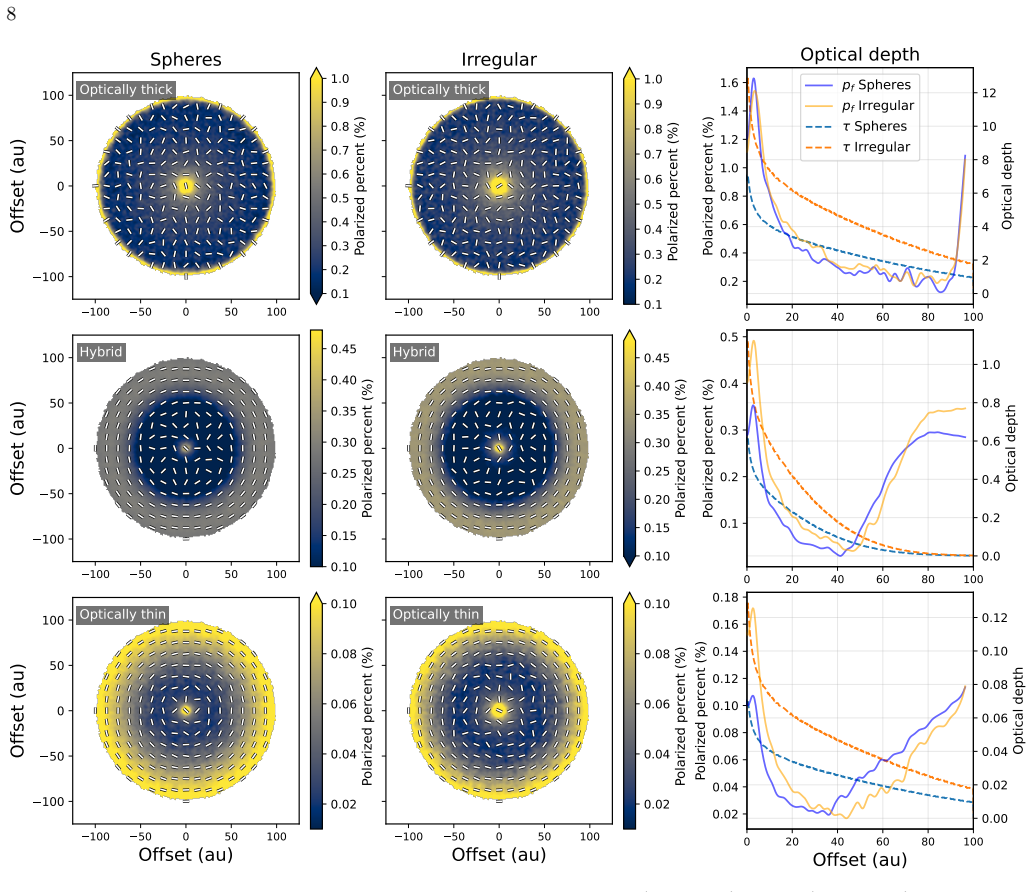
Models using solid irregular hexahedral particles drawn from the TAMUdust2020 database produce polarization patterns and fractions that are nearly indistinguishable from those using solid spherical grains when the maximum grain size is approximately the observing wavelength divided by 2 pi. These irregular grains enhance the scattering opacity by up to a factor of about 2.5 and suppress the polarization reversal expected from Mie theory at size parameters greater than 1. However, the modifications from grain geometry are not sufficient to reproduce the observed polarization fractions in a pure self-scattering framework across optically thick, thin, and hybrid regimes.
What carries the argument
Comparison of self-scattering induced polarization using populations of solid spherical grains versus solid irregular hexahedral grains sharing the same size distribution and material density
Load-bearing premise
The two grain types are modeled with identical size distributions and the same internal material structure so that only the external shape differs.
What would settle it
If self-scattering models using irregular grains successfully match the observed high polarization fractions in protoplanetary disks, this would falsify the conclusion that grain geometry alone is insufficient.
Figures




read the original abstract
Polarization at millimeter wavelengths provides a powerful diagnostic of dust grain properties in protoplanetary disks. Standard models based on solid spherical grains often struggle to reproduce the observed polarization fractions and morphologies in systems where self-scattering is expected to dominate. We investigate the impact of grain morphology on polarized millimeter emission by comparing models that adopt solid spherical grains with models that employ solid irregular hexahedral particles drawn from the TAMUdust2020 database. Both grain populations share identical size distributions, enabling us to isolate the effects of geometry while preserving the same internal structure and material density. We explore three optical-depth regimes-optically thick, optically thin, and an intermediate hybrid case-to assess how grain morphology modifies the polarization structure under different conditions. For size distributions with $a_{\mathrm{max}} \sim \lambda / 2\pi$, where scattering-induced polarization is expected to peak, we find that the polarization morphology and fraction are nearly indistinguishable between spherical and irregular grains. The primary quantitative difference is an enhancement of the scattering opacity by up to a factor of $\sim 2.5$ for irregular particles, implying that disk dust masses inferred under the assumption of spherical grains may be systematically overestimated. Irregular grains also suppress the polarization reversal predicted by Mie theory at large size parameters ($x>1$). Nevertheless, modifying grain geometry alone is insufficient to reproduce the observed polarization fractions within a pure self-scattering framework. These results suggest that additional physical effects, such as dust porosity, warrant dedicated investigation.
Editorial analysis
A structured set of objections, weighed in public.
Referee Report
Summary. The manuscript compares polarized millimeter emission from protoplanetary disks using solid spherical grains versus solid irregular hexahedral grains from the TAMUdust2020 database. Both populations share identical size distributions, internal structure, and material density to isolate geometry effects. The study examines three optical depth regimes and reports that for a_max ∼ λ/2π (where scattering polarization peaks), the polarization morphology and fraction are nearly indistinguishable between grain types. Irregular grains enhance scattering opacity by up to a factor of ∼2.5, suppress polarization reversal at x>1, and the authors conclude that grain geometry modification alone cannot reproduce observed polarization fractions in a pure self-scattering framework, suggesting additional effects such as porosity are required.
Significance. If the results hold, this work isolates grain shape effects on self-scattering polarization while controlling for size distribution, showing limited impact on morphology/fraction at relevant sizes but a systematic bias in dust mass estimates from spherical-grain assumptions. The use of independent grain databases (TAMUdust2020), exploration of multiple optical depth regimes, and identification of a clear limitation of pure self-scattering models provide a useful benchmark for disk modeling. It motivates targeted follow-up on porosity and other complexities, with direct implications for interpreting ALMA polarization observations.
major comments (1)
- Abstract: The claim that polarization morphology and fraction are 'nearly indistinguishable' for a_max ∼ λ/2π is load-bearing for the central result. The abstract does not state whether disk models fix surface density Σ or optical depth τ across grain types. Given the reported ∼2.5× scattering opacity enhancement for irregular grains, fixing Σ would yield τ_irregular ≈ 2.5 τ_spherical. Since self-scattering polarization fraction is non-monotonic in τ (peaking near τ∼1), this could place the cases in different regimes, making the similarity specific to the chosen normalization rather than a general geometry-independent finding. The methods or results section must clarify the normalization choice and report the actual τ values realized in each regime for both grain types.
minor comments (2)
- Abstract: The three optical-depth regimes are described only qualitatively ('optically thick, optically thin, and an intermediate hybrid case'); providing the specific τ ranges or example values used would improve reproducibility and allow readers to assess regime placement.
- Abstract: The statement that grain geometry modification 'is insufficient to reproduce the observed polarization fractions' would be strengthened by citing specific observed fractions or representative literature values for comparison.
Simulated Author's Rebuttal
We thank the referee for their constructive and detailed review. The major comment raises a valid point about clarifying the normalization in our models, and we will revise the manuscript to address it explicitly.
read point-by-point responses
-
Referee: Abstract: The claim that polarization morphology and fraction are 'nearly indistinguishable' for a_max ∼ λ/2π is load-bearing for the central result. The abstract does not state whether disk models fix surface density Σ or optical depth τ across grain types. Given the reported ∼2.5× scattering opacity enhancement for irregular grains, fixing Σ would yield τ_irregular ≈ 2.5 τ_spherical. Since self-scattering polarization fraction is non-monotonic in τ (peaking near τ∼1), this could place the cases in different regimes, making the similarity specific to the chosen normalization rather than a general geometry-independent finding. The methods or results section must clarify the normalization choice and report the actual τ values realized in each regime for both grain types.
Authors: We appreciate the referee pointing out this potential ambiguity. Our models are constructed by fixing the optical depth τ to the same target values for both spherical and irregular grain populations in each of the three regimes (optically thin, intermediate, and optically thick). This normalization isolates the geometric effects of grain shape at equivalent optical depths, which is the appropriate basis for comparing polarization morphology and fraction. The surface density Σ is then scaled downward for the irregular grains to achieve the same τ given their higher scattering opacity. We will revise the abstract to state that the disk models are normalized to fixed optical depth τ across grain types. We will also add explicit reporting of the realized τ values (identical for both grain types) in the methods and results sections, along with a brief note on the corresponding Σ adjustment. revision: yes
Circularity Check
No significant circularity; results are independent modeling outputs
full rationale
The paper conducts radiative transfer simulations comparing spherical and irregular grains drawn from the external TAMUdust2020 database, using identical size distributions and material densities to isolate geometry effects. The reported near-indistinguishability of polarization morphology for a_max ~ λ/2π, the factor of ~2.5 scattering opacity enhancement, and suppression of reversal at x>1 are direct numerical outputs across the three explicitly explored optical-depth regimes, not reductions of fitted parameters or self-referential definitions. No load-bearing self-citations, imported uniqueness theorems, or ansatzes are invoked to justify the central claims; the conclusion that geometry modification alone is insufficient is likewise an empirical modeling result rather than a tautology. The comparison is self-contained against external grain-property benchmarks.
Axiom & Free-Parameter Ledger
free parameters (2)
- maximum grain size a_max
- optical depth regimes
axioms (2)
- domain assumption Dust grains in protoplanetary disks can be modeled as solid particles with given size distributions and optical properties for radiative transfer calculations
- domain assumption The TAMUdust2020 database provides accurate scattering properties for irregular hexahedral particles
Reference graph
Works this paper leans on
-
[1]
ALMA Partnership, Brogan, C. L., Pérez, L. M., et al. 2015, ApJL, 808, L3, doi: 10.1088/2041-8205/808/1/L3
-
[2]
The Astrophysical Journal , author =
Andrews, S. M., Huang, J., Pérez, L. M., et al. 2018, ApJL, 869, L41, doi: 10.3847/2041-8213/aaf741 Astropy Collaboration, Robitaille, T. P., Tollerud, E. J., et al. 2013, A&A, 558, A33, doi: 10.1051/0004-6361/201322068 Astropy Collaboration, Price-Whelan, A. M., Sipőcz, B. M., et al. 2018, AJ, 156, 123, doi: 10.3847/1538-3881/aabc4f Astropy Collaboration...
-
[3]
Birnstiel, T., Dullemond, C. P., Zhu, Z., et al. 2018, ApJL, 869, L45, doi: 10.3847/2041-8213/aaf743 Carrasco-González, C., Henning, T., Chandler, C. J., et al. 2016, ApJL, 821, L16, doi: 10.3847/2041-8205/821/1/L16 Carrasco-González, C., Sierra, A., Flock, M., et al. 2019, ApJ, 883, 71, doi: 10.3847/1538-4357/ab3d33
-
[4]
Chiang, E. I., & Goldreich, P. 1997, ApJ, 490, 368, doi: 10.1086/304869
-
[5]
2007, ApJ, 669, 1085, doi: 10.1086/521805 Cortés, P
Cho, J., & Lazarian, A. 2007, ApJ, 669, 1085, doi: 10.1086/521805
-
[6]
1980, A&A, 87, 204
Daniel, J.-Y. 1980, A&A, 87, 204
1980
-
[7]
Protostars and Planets VII , year = 2023, editor =
Dominik, C., Min, M., & Tazaki, R. 2021, OpTool: Command-line driven tool for creating complex dust opacities„ Astrophysics Source Code Library, record ascl:2104.010 Drążkowska, J., Bitsch, B., Lambrechts, M., et al. 2023, in Astronomical Society of the Pacific Conference Series, Vol. 534, Protostars and Planets VII, ed. S. Inutsuka, Y. Aikawa, T. Muto, K...
-
[8]
P., Juhasz, A., Pohl, A., et al
Dullemond, C. P., Juhasz, A., Pohl, A., et al. 2012, RADMC-3D: A multi-purpose radiative transfer tool„ Astrophysics Source Code Library, record ascl:1202.015
2012
-
[9]
2017, ApJ, 838, 74, doi: 10.3847/1538-4357/aa6303
Escobar-Cerezo, J., Palmer, C., Muñoz, O., et al. 2017, ApJ, 838, 74, doi: 10.3847/1538-4357/aa6303
-
[10]
Nature Astronomy 3, 749–754 (2019)
Haffert, S. Y., Bohn, A. J., de Boer, J., et al. 2019, Nature Astronomy, 3, 749, doi: 10.1038/s41550-019-0780-5
-
[11]
Harrison, R. E., Lin, Z.-Y. D., Looney, L. W., et al. 2024, ApJ, 967, 40, doi: 10.3847/1538-4357/ad39ec
-
[12]
Harrison, R. E., Looney, L. W., Stephens, I. W., et al. 2019, ApJL, 877, L2, doi: 10.3847/2041-8213/ab1e46
-
[13]
W., Van Der Mee, C., & Domke, H
Hovenier, J. W., Van Der Mee, C., & Domke, H. 2004, Transfer of polarized light in planetary atmospheres : basic concepts and practical methods, Vol. 318 (Springer Dordrecht), doi: 10.1007/978-1-4020-2856-4 15
-
[14]
Hughes, A. M., Wilner, D. J., Cho, J., et al. 2009, ApJ, 704, 1204, doi: 10.1088/0004-637X/704/2/1204
-
[15]
Hull, C. L. H., Yang, H., Li, Z.-Y., et al. 2018, ApJ, 860, 82, doi: 10.3847/1538-4357/aabfeb
-
[16]
Dullemond, C. P. 2016a, ApJ, 820, 54, doi: 10.3847/0004-637X/820/1/54
-
[17]
2019, ApJL, 874, L6, doi: 10.3847/2041-8213/ab0c9a
Kataoka, A., Okuzumi, S., & Tazaki, R. 2019, ApJL, 874, L6, doi: 10.3847/2041-8213/ab0c9a
-
[18]
2017, ApJL, 844, L5, doi: 10.3847/2041-8213/aa7e33
Kataoka, A., Tsukagoshi, T., Pohl, A., et al. 2017, ApJL, 844, L5, doi: 10.3847/2041-8213/aa7e33
-
[19]
2015, ApJ, 809, 78, doi: 10.1088/0004-637X/809/1/78
Kataoka, A., Muto, T., Momose, M., et al. 2015, ApJ, 809, 78, doi: 10.1088/0004-637X/809/1/78
-
[20]
2016b, ApJL, 831, L12, doi: 10.3847/2041-8205/831/2/L12
Kataoka, A., Tsukagoshi, T., Momose, M., et al. 2016b, ApJL, 831, L12, doi: 10.3847/2041-8205/831/2/L12
-
[21]
DOI 10.1051/0004-6361/201832957
Keppler, M., Benisty, M., Müller, A., et al. 2018, A&A, 617, A44, doi: 10.1051/0004-6361/201832957
-
[22]
Kirchschlager, F., & Bertrang, G. H. M. 2020, A&A, 638, A116, doi: 10.1051/0004-6361/202037943
-
[23]
Kirchschlager, F., Bertrang, G. H. M., & Flock, M. 2019, MNRAS, 488, 1211, doi: 10.1093/mnras/stz1763
-
[24]
Lin, Z.-Y. D., Li, Z.-Y., Yang, H., et al. 2024a, MNRAS, 534, 3713, doi: 10.1093/mnras/stae2248
-
[25]
D., Li, Z.-Y., Yang, H., et al
Lin, Z.-Y. D., Li, Z.-Y., Yang, H., et al. 2023, MNRAS, 520, 1210, doi: 10.1093/mnras/stad173
-
[26]
Lin, Z.-Y. D., Li, Z.-Y., Stephens, I. W., et al. 2024b, MNRAS, 528, 843, doi: 10.1093/mnras/stae040
-
[27]
Liu, Y., Roussel, H., Linz, H., et al. 2024, A&A, 692, A148, doi: 10.1051/0004-6361/202451981
-
[28]
Long, F., Pinilla, P., Herczeg, G. J., et al. 2018, ApJ, 869, 17, doi: 10.3847/1538-4357/aae8e1
-
[29]
Lynden-Bell, D., & Pringle, J. E. 1974, MNRAS, 168, 603, doi: 10.1093/mnras/168.3.603 Macías, E., Guerra-Alvarado, O., Carrasco-González, C., et al. 2021, A&A, 648, A33, doi: 10.1051/0004-6361/202039812
-
[30]
Martikainen, J., Muñoz, O., Gómez Martín, J. C., et al. 2025, MNRAS, 537, 1489, doi: 10.1093/mnras/staf108
-
[31]
Mishchenko, M. I., Hovenier, J. W., & Travis, L. D., eds. 2000, Light Scattering by Nonspherical Particles: Theory, Measurements, and Applications (San Diego: Academic Press) Muñoz, O., Frattin, E., Jardiel, T., et al. 2021, ApJS, 256, 17, doi: 10.3847/1538-4365/ac0efa
-
[32]
Videen, G. 2009, Journal of Quantitative Spectroscopy and Radiative Transfer, 110, 1628, doi: https://doi.org/10.1016/j.jqsrt.2009.03.012 Müller, A., Keppler, M., Henning, T., et al. 2018, A&A, 617, L2, doi: 10.1051/0004-6361/201833584
-
[33]
2018, ApJ, 864, 81, doi: 10.3847/1538-4357/aad632
Ohashi, S., Kataoka, A., Nagai, H., et al. 2018, ApJ, 864, 81, doi: 10.3847/1538-4357/aad632 Pérez, L. M., Carpenter, J. M., Chandler, C. J., et al. 2012, ApJL, 760, L17, doi: 10.1088/2041-8205/760/1/L17
-
[34]
Potapov, A., McCoustra, M. R. S., Tazaki, R., et al. 2025, A&A Rv, 33, 6, doi: 10.1007/s00159-025-00164-5
-
[35]
U., Fritz, J., González-Martín, O., et al
Reyes-Amador, O. U., Fritz, J., González-Martín, O., et al. 2024, MNRAS, 531, 1841, doi: 10.1093/mnras/stae1281
-
[36]
2021, TAMUdust2020 Database, 1.0.0 Zenodo, doi: 10.5281/zenodo.4711247
Saito, M. 2021, TAMUdust2020 Database, 1.0.0 Zenodo, doi: 10.5281/zenodo.4711247
-
[37]
2021, Journal of the Atmospheric Sciences, 78, 2089, doi: 10.1175/JAS-D-20-0338.1
Saito, M., Yang, P., Ding, J., & Liu, X. 2021, Journal of the Atmospheric Sciences, 78, 2089, doi: 10.1175/JAS-D-20-0338.1
-
[38]
2020, ApJ, 892, 136, doi: 10.3847/1538-4357/ab7d32
Sierra, A., & Lizano, S. 2020, ApJ, 892, 136, doi: 10.3847/1538-4357/ab7d32
-
[39]
W., Yang, H., Li, Z.-Y., et al
Stephens, I. W., Yang, H., Li, Z.-Y., et al. 2017, ApJ, 851, 55, doi: 10.3847/1538-4357/aa998b
-
[40]
Stephens, I. W., Lin, Z.-Y. D., Fernández-López, M., et al. 2023, Nature, 623, 705, doi: 10.1038/s41586-023-06648-7
-
[41]
2017, ApJ, 839, 56, doi: 10.3847/1538-4357/839/1/56
Tazaki, R., Lazarian, A., & Nomura, H. 2017, ApJ, 839, 56, doi: 10.3847/1538-4357/839/1/56
-
[42]
Tazaki, R., Tanaka, H., Kataoka, A., Okuzumi, S., & Muto, T. 2019, ApJ, 885, 52, doi: 10.3847/1538-4357/ab45f0
-
[43]
2016, ApJ, 823, 70, doi: 10.3847/0004-637X/823/2/70
Nomura, H. 2016, ApJ, 823, 70, doi: 10.3847/0004-637X/823/2/70
-
[44]
2016a, MNRAS, 456, 2794, doi: 10.1093/mnras/stv2633
Yang, H., Li, Z.-Y., Looney, L., & Stephens, I. 2016a, MNRAS, 456, 2794, doi: 10.1093/mnras/stv2633
-
[45]
Yang, H., Li, Z.-Y., Looney, L. W., et al. 2016b, MNRAS, 460, 4109, doi: 10.1093/mnras/stw1253
-
[46]
2019, MNRAS, 483, 2371, doi: 10.1093/mnras/sty3263
Looney, L. 2019, MNRAS, 483, 2371, doi: 10.1093/mnras/sty3263
-
[47]
Zhang, S., Zhu, Z., Ueda, T., et al. 2023, ApJ, 953, 96, doi: 10.3847/1538-4357/acdb4e
discussion (0)
Sign in with ORCID, Apple, or X to comment. Anyone can read and Pith papers without signing in.