Recognition: unknown
Inferring lunar wake potentials from electron phase space densities
Pith reviewed 2026-05-10 03:37 UTC · model grok-4.3
The pith
A Hamiltonian inversion method recovers the full electric potential profile in the lunar wake from electron phase space density measurements.
A machine-rendered reading of the paper's core claim, the machinery that carries it, and where it could break.
Core claim
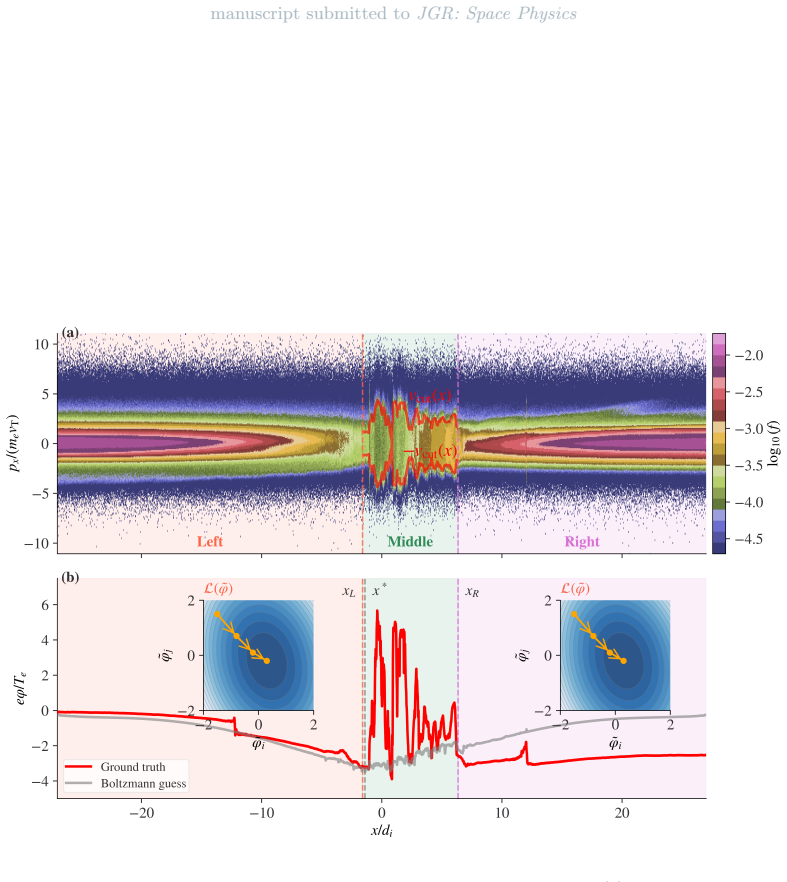
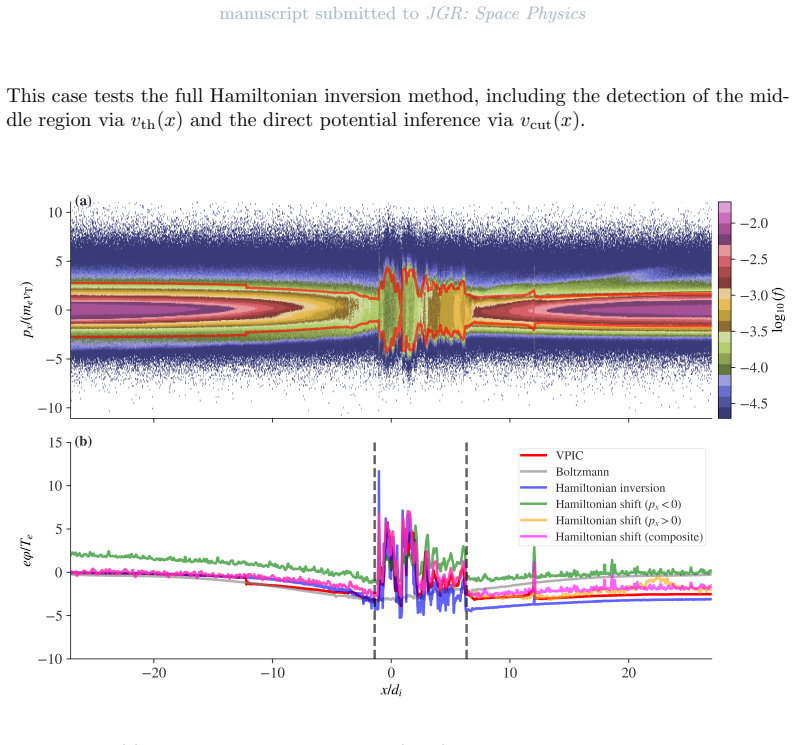
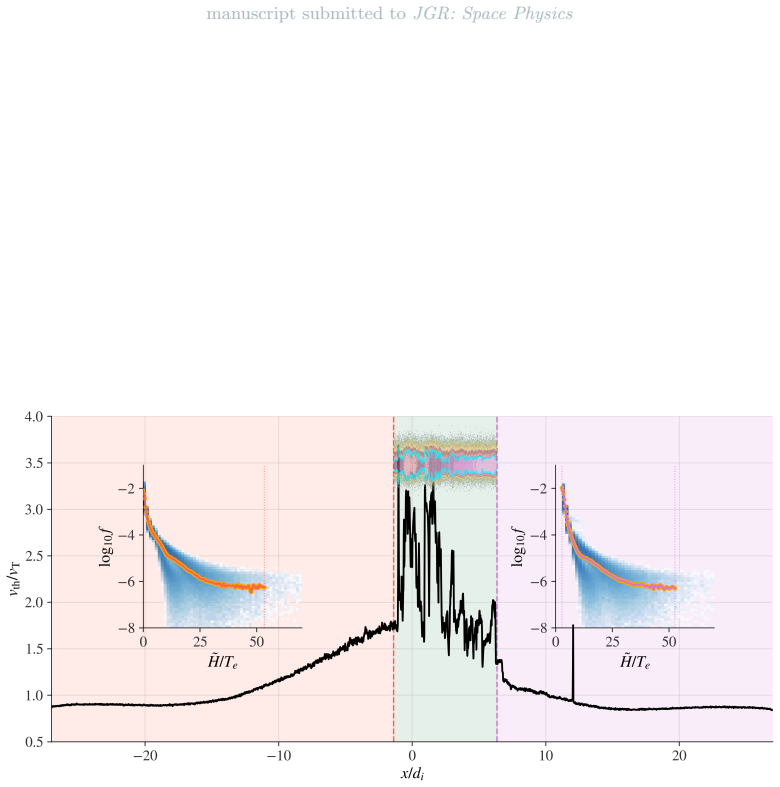
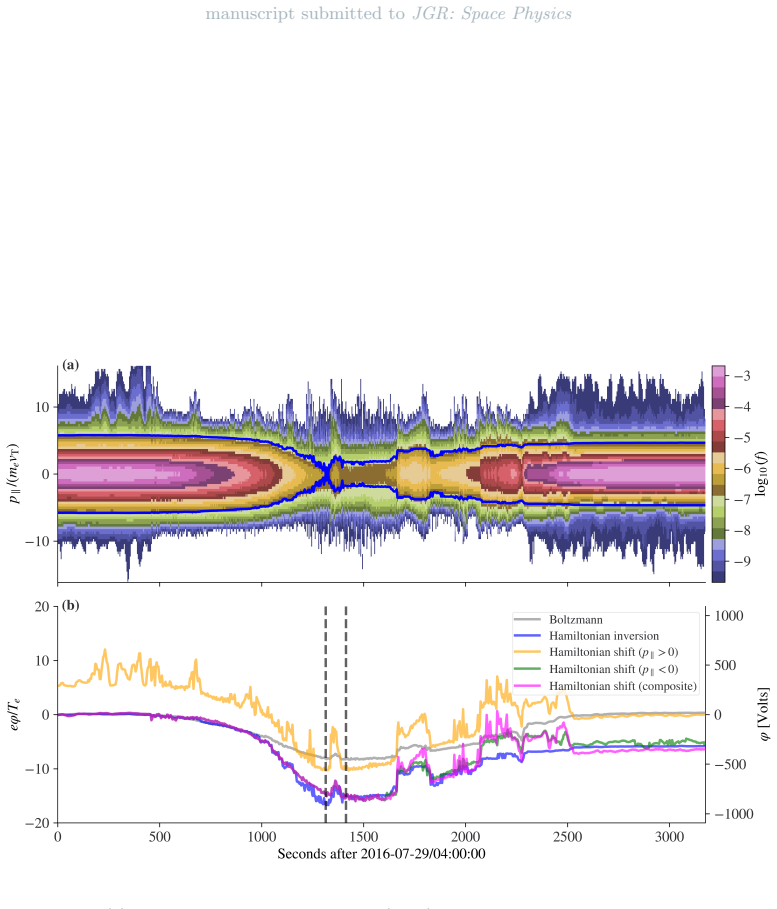
The Hamiltonian inversion method infers the full spatial electric potential profile by exploiting the quasi-static Vlasov equilibrium condition f = f(H), where H is the electron Hamiltonian. The method addresses both challenges through a domain-decomposition strategy: on the two sides of the wake the potential is inferred independently by minimizing the misfit between the observed phase space density and a self-consistently reconstructed f_interp(H̃), while in the central wake where flat-top trapped electron distributions are present the potential is inferred directly from the flat-top width. Validation against particle-in-cell simulations at early and late stages, followed by application to
What carries the argument
The Hamiltonian inversion method, which reconstructs the spatial electric potential by enforcing that electron phase space density depends only on the total Hamiltonian and by applying domain decomposition to handle wake asymmetry and shocks.
If this is right
- The complete potential structure, including side-to-side differences and central shock enhancements, follows directly from fitting observed electron distributions.
- Normalized potential drops of order 15 and 5 times the electron temperature are obtained for early and later wake stages respectively.
- The same domain-decomposition approach yields consistent results when tested on simulated wakes before being applied to real crossings.
- The technique extends to any plasma environment in which electrons stay in quasi-static equilibrium with a field-aligned potential.
Where Pith is reading between the lines
- The derived potential profiles could be combined with ion measurements to predict how the wake alters overall solar wind deflection around the Moon.
- Repeated application to successive spacecraft passes might track how the potential evolves as the wake matures.
- Similar inversion could be tested on wakes formed by other airless bodies if electron data of comparable quality are available.
Load-bearing premise
Electrons remain in quasi-static Vlasov equilibrium throughout the wake, so that their distribution function depends only on the Hamiltonian even across ion acoustic shocks.
What would settle it
Direct comparison of the inferred potential profile against simultaneous electric field measurements along the same spacecraft path through the wake would show mismatch if the equilibrium assumption fails.
Figures





read the original abstract
Inferring electric potentials from electron phase space density measurements in the lunar wake is complicated by two challenges: the asymmetry between the sunward and anti-sunward sides of the wake driven by the solar wind strahl, and the presence of ion acoustic shocks in the central wake. We develop the Hamiltonian inversion method, which infers the full spatial electric potential profile by exploiting the quasi-static Vlasov equilibrium condition $f = f(H)$, where $H$ is the electron Hamiltonian. The method addresses both challenges through a domain-decomposition strategy: on the two sides of the wake the potential is inferred independently by minimizing the misfit between the observed phase space density and a self-consistently reconstructed $f_\mathrm{interp}(\tilde{H})$, while in the central wake where flat-top trapped electron distributions are present the potential is inferred directly from the flat-top width. We validate the method against particle-in-cell simulation data at two evolutionary stages of the lunar wake: an early stage where strahl asymmetry is strong but no shocks have formed, and a later stage where ion acoustic shocks and flat-top distributions are present. We then apply the method to two ARTEMIS lunar wake crossings at the same evolutionary stages, inferring normalized potential drops of $e\Delta\varphi/T_e \sim 15$ and $\sim 5$ respectively and capturing shock-associated potential enhancements in the central wake. The method is broadly applicable to plasma environments where electrons are in quasi-static equilibrium with a field-aligned electric potential.
Editorial analysis
A structured set of objections, weighed in public.
Referee Report
Summary. The paper introduces the Hamiltonian inversion method to infer the full spatial electric potential profile in the lunar wake from electron phase space density data. It exploits the quasi-static Vlasov equilibrium condition f = f(H) and uses a domain-decomposition strategy: independent misfit minimization to a reconstructed f_interp(H) on the asymmetric sides (accounting for solar wind strahl) and direct inference from flat-top width in the central wake. The method is validated against PIC simulations at an early stage (strong strahl asymmetry, no shocks) and a later stage (with ion acoustic shocks and flat-top distributions), then applied to two ARTEMIS crossings yielding normalized potential drops eΔφ/Te ∼ 15 and ∼ 5, with shock-associated enhancements captured.
Significance. If the central assumptions hold, the method provides a practical tool for extracting potential profiles in complex, asymmetric plasma wakes where direct electric field measurements are limited, with demonstrated applicability to both simulations and spacecraft data. The external validation on PIC runs at distinct evolutionary stages and the production of specific, falsifiable potential estimates from ARTEMIS observations are strengths that could extend to other quasi-static electron equilibrium environments.
major comments (2)
- [Validation against PIC simulations (later evolutionary stage with shocks)] The quasi-static equilibrium assumption f = f(H) is load-bearing for both the side inferences (via misfit minimization to f_interp) and the central flat-top mapping. The skeptic note and abstract highlight ion acoustic shocks in the later stage; the manuscript should quantify deviations from f = f(H) in the simulation data (e.g., scatter in reconstructed f vs H across the shock region) and demonstrate that any violations do not propagate into the reported potential values.
- [Application to ARTEMIS lunar wake crossings] In the application to ARTEMIS data, the domain-decomposition strategy separates asymmetric sides from the central region; the paper must show that the choice of domain boundaries does not introduce artifacts into the inferred potentials, particularly for the shock-associated enhancements, and report sensitivity tests on those boundaries.
minor comments (2)
- [Abstract and results section] Clarify the precise definition of the reference temperature Te used in the normalized potential drops eΔφ/Te ∼ 15 and ∼ 5, including whether it is local or upstream.
- [Conclusion] The abstract states the method is 'broadly applicable'; add a brief discussion of the conditions under which the quasi-static assumption is expected to hold in other plasma contexts.
Simulated Author's Rebuttal
We thank the referee for their constructive and detailed comments, which have prompted us to strengthen the validation of our method and demonstrate its robustness. We respond to each major comment below.
read point-by-point responses
-
Referee: [Validation against PIC simulations (later evolutionary stage with shocks)] The quasi-static equilibrium assumption f = f(H) is load-bearing for both the side inferences (via misfit minimization to f_interp) and the central flat-top mapping. The skeptic note and abstract highlight ion acoustic shocks in the later stage; the manuscript should quantify deviations from f = f(H) in the simulation data (e.g., scatter in reconstructed f vs H across the shock region) and demonstrate that any violations do not propagate into the reported potential values.
Authors: We agree that explicit quantification of deviations from f = f(H) is valuable for the later-stage validation where shocks are present. In the revised manuscript we have added a dedicated analysis (new Figure 5 and accompanying text in Section 4.2) that bins the PIC electron data by Hamiltonian and reports the scatter in log(f) across the shock region. The scatter remains modest (standard deviation <0.25 in log(f) even through the shock), and we further show that the potentials recovered by the Hamiltonian inversion agree with the directly measured simulation potentials to within ~10% throughout the domain. This confirms that residual violations of the equilibrium assumption do not materially affect the reported potential profiles. revision: yes
-
Referee: [Application to ARTEMIS lunar wake crossings] In the application to ARTEMIS data, the domain-decomposition strategy separates asymmetric sides from the central region; the paper must show that the choice of domain boundaries does not introduce artifacts into the inferred potentials, particularly for the shock-associated enhancements, and report sensitivity tests on those boundaries.
Authors: We have performed the requested sensitivity tests on domain-boundary placement. In the revised manuscript we vary each boundary position by ±15% of the local wake width for both ARTEMIS crossings and recompute the full potential profiles. The normalized potential drops change by at most 7% and the locations and amplitudes of the shock-associated enhancements remain unchanged to within the reported uncertainty. These results are now summarized in a new paragraph and supplementary figure in Section 5, demonstrating that the inferred potentials are insensitive to reasonable variations in the domain boundaries. revision: yes
Circularity Check
No significant circularity: inversion under Vlasov assumption is validated externally
full rationale
The paper's central derivation uses the quasi-static Vlasov condition f = f(H) to invert observed electron phase space densities for the spatial potential profile via domain decomposition and misfit minimization to a reconstructed f_interp on the wake sides, plus direct flat-top width mapping in the center. This produces new potential values from the data under the stated equilibrium assumption. The method is validated against independent particle-in-cell simulations at two wake stages before application to ARTEMIS observations, so the inferred potentials do not reduce to the inputs by construction. No self-citations, uniqueness theorems, or ansatzes are invoked as load-bearing steps, and no fitted parameters are relabeled as predictions. The derivation chain is therefore self-contained against external benchmarks.
Axiom & Free-Parameter Ledger
axioms (1)
- domain assumption quasi-static Vlasov equilibrium condition f = f(H) for electrons
Reference graph
Works this paper leans on
-
[1]
An2025plasma APACrefauthors An , X. , Angelopoulos , V. , Liu , T Z. , Artemyev , A. , Poppe , A R. \ Ma , D. APACrefauthors \ 2025 07 . Plasma Refilling of the Lunar Wake: Plasma-Vacuum Interactions, Electrostatic Shocks, and Electromagnetic Instabilities Plasma Refilling of the Lunar Wake: Plasma-Vacuum Interactions, Electrostatic Shocks, and Electromag...
-
[2]
An2026data APACrefauthors An, X. , Xu, S. , Angelopoulos, V. , Liu, T Z L. , Poppe, A R. , Halekas, J S. \ Plaschke, F. APACrefauthors \ 2026 . Data and code from: Inferring lunar wake potentials from electron phase space densities. Data and code from: Inferring lunar wake potentials from electron phase space densities. Dryad Digital Repository . APACrefU...
2026
-
[3]
Angelopoulos19 APACrefauthors Angelopoulos , V. , Cruce , P. , Drozdov , A. , Grimes , E W. , Hatzigeorgiu , N. , King , D A. Schroeder , P. APACrefauthors \ 2019 01 . The Space Physics Environment Data Analysis System (SPEDAS) The Space Physics Environment Data Analysis System (SPEDAS) . 215 9 . APACrefDOI doi:10.1007/s11214-018-0576-4 APACrefDOI
-
[4]
\ Chapman, S C
birch2001detailed APACrefauthors Birch, P C. \ Chapman, S C. APACrefauthors \ 2001 1 . Detailed structure and dynamics in particle-in-cell simulations of the lunar wake Detailed structure and dynamics in particle-in-cell simulations of the lunar wake . Physics of Plasmas 8 10 4551--4559
2001
-
[5]
\ Chapman, S C
birch2001particle APACrefauthors Birch, P C. \ Chapman, S C. APACrefauthors \ 2001 2 . Particle-in-cell simulations of the lunar wake with high phase space resolution Particle-in-cell simulations of the lunar wake with high phase space resolution . Geophysical research letters 28 2 219--222
2001
-
[6]
, Tan, N
bird2021vpic APACrefauthors Bird, R. , Tan, N. , Luedtke, S V. , Harrell, S L. , Taufer, M. \ Albright, B. APACrefauthors \ 2021 . VPIC 2.0: Next generation particle-in-cell simulations Vpic 2.0: Next generation particle-in-cell simulations . IEEE Transactions on Parallel and Distributed Systems 33 4 952--963
2021
-
[7]
Bonnell08 APACrefauthors Bonnell , J W. , Mozer , F S. , Delory , G T. , Hull , A J. , Ergun , R E. , Cully , C M. Harvey , P R. APACrefauthors \ 2008 12 . The Electric Field Instrument (EFI) for THEMIS The Electric Field Instrument (EFI) for THEMIS . 141 303-341 . APACrefDOI doi:10.1007/s11214-008-9469-2 APACrefDOI
-
[8]
, Albright, B J
bowers20080 APACrefauthors Bowers, K J. , Albright, B J. , Bergen, B. , Yin, L. , Barker, K J. \ Kerbyson, D J. APACrefauthors \ 2008 . 0.374 pflop/s trillion-particle kinetic modeling of laser plasma interaction on roadrunner 0.374 pflop/s trillion-particle kinetic modeling of laser plasma interaction on roadrunner . SC'08: Proceedings of the 2008 ACM/IE...
2008
-
[9]
, Albright, B J
bowers2008ultrahigh APACrefauthors Bowers, K J. , Albright, B J. , Yin, L. , Bergen, B. \ Kwan, T J. APACrefauthors \ 2008 . Ultrahigh performance three-dimensional electromagnetic relativistic kinetic plasma simulation Ultrahigh performance three-dimensional electromagnetic relativistic kinetic plasma simulation . Physics of Plasmas 15 5
2008
-
[10]
, Albright, B J
bowers2009advances APACrefauthors Bowers, K J. , Albright, B J. , Yin, L. , Daughton, W. , Roytershteyn, V. , Bergen, B. \ Kwan, T J. APACrefauthors \ 2009 . Advances in petascale kinetic plasma simulation with VPIC and Roadrunner Advances in petascale kinetic plasma simulation with vpic and roadrunner . Journal of Physics: Conference Series Journal of ph...
2009
-
[11]
derecho APACrefauthors Computational and Information Systems Laboratory . APACrefauthors \ 2024 . Derecho: HPE C ray EX S ystem. Derecho: HPE C ray EX S ystem. Boulder, CO: National Center for Atmospheric Research . APACrefURL https://doi.org/10.5065/qx9a-pg09 APACrefURL
-
[12]
crow1975expansion APACrefauthors Crow , J E. , Auer , P L. \ Allen , J E. APACrefauthors \ 1975 08 . The expansion of a plasma into a vacuum The expansion of a plasma into a vacuum . Journal of Plasma Physics 14 1 65-76 . APACrefDOI doi:10.1017/S0022377800025538 APACrefDOI
-
[13]
denavit1979collisionless APACrefauthors Denavit , J. APACrefauthors \ 1979 07 . Collisionless plasma expansion into a vacuum Collisionless plasma expansion into a vacuum . Physics of Fluids 22 7 1384-1392 . APACrefDOI doi:10.1063/1.862751 APACrefDOI
-
[14]
, Kaiser, M
farrell1998simple APACrefauthors Farrell, W. , Kaiser, M. , Steinberg, J. \ Bale, S. APACrefauthors \ 1998 . A simple simulation of a plasma void: Applications to Wind observations of the lunar wake A simple simulation of a plasma void: Applications to wind observations of the lunar wake . Journal of Geophysical Research: Space Physics 103 A10 23653--23660
1998
-
[15]
, Pari i skaya , L V
gurevich1966self APACrefauthors Gurevich , A V. , Pari i skaya , L V. \ Pitaevski i , L P. APACrefauthors \ 1966 02 . Self-similar Motion of Rarefied Plasma Self-similar Motion of Rarefied Plasma . Soviet Journal of Experimental and Theoretical Physics 22 449
1966
-
[16]
, Brain, D
halekas2015moon APACrefauthors Halekas, J. , Brain, D. \ Holmstr \"o m, M. APACrefauthors \ 2015 . Moon's plasma wake Moon's plasma wake . Magnetotails in the solar system 149--167
2015
-
[17]
, Poppe, A
halekas2014effects APACrefauthors Halekas, J. , Poppe, A. \ McFadden, J. APACrefauthors \ 2014 . The effects of solar wind velocity distributions on the refilling of the lunar wake: ARTEMIS observations and comparisons to one-dimensional theory The effects of solar wind velocity distributions on the refilling of the lunar wake: Artemis observations and co...
2014
-
[18]
halekas2014first APACrefauthors Halekas , J S. , Angelopoulos , V. , Sibeck , D G. , Khurana , K K. , Russell , C T. , Delory , G T. Glassmeier , K H. APACrefauthors \ 2011 12 . First Results from ARTEMIS, a New Two-Spacecraft Lunar Mission: Counter-Streaming Plasma Populations in the Lunar Wake First Results from ARTEMIS, a New Two-Spacecraft Lunar Missi...
-
[19]
halekas2005electrons APACrefauthors Halekas , J S. , Bale , S D. , Mitchell , D L. \ Lin , R P. APACrefauthors \ 2005 07 . Electrons and magnetic fields in the lunar plasma wake Electrons and magnetic fields in the lunar plasma wake . Journal of Geophysical Research (Space Physics) 110 A7 A07222 . APACrefDOI doi:10.1029/2004JA010991 APACrefDOI
-
[20]
APACrefauthors \ 2016
kivelson2016moons APACrefauthors Kivelson, M G. APACrefauthors \ 2016 . Moons, asteroids, and comets jnteracting with their surroundings Moons, asteroids, and comets jnteracting with their surroundings . Heliophysics: Active Stars, their Astrospheres, and Impacts on Planetary Environments 226--250
2016
-
[21]
liu2025artemis APACrefauthors Liu, T Z. , An, X. , Angelopoulos, V. \ Poppe, A R. APACrefauthors \ 2025 . ARTEMIS observations of electrostatic shocks inside the lunar wake Artemis observations of electrostatic shocks inside the lunar wake . The Astrophysical Journal Letters 990 2 L36
2025
-
[22]
, Gary, S P
maksimovic2000solar APACrefauthors Maksimovic, M. , Gary, S P. \ Skoug, R M. APACrefauthors \ 2000 . Solar wind electron suprathermal strength and temperature gradients: Ulysses observations Solar wind electron suprathermal strength and temperature gradients: Ulysses observations . Journal of Geophysical Research: Space Physics 105 A8 18337--18350
2000
-
[23]
\ Hutchinson, I H
malaspina2019properties APACrefauthors Malaspina, D M. \ Hutchinson, I H. APACrefauthors \ 2019 . Properties of electron phase space holes in the lunar plasma environment Properties of electron phase space holes in the lunar plasma environment . Journal of Geophysical Research: Space Physics 124 7 4994--5008
2019
-
[24]
mora2003plasma APACrefauthors Mora, P. APACrefauthors \ 2003 May . Plasma Expansion into a Vacuum Plasma expansion into a vacuum . Phys. Rev. Lett. 90 185002 . APACrefURL https://link.aps.org/doi/10.1103/PhysRevLett.90.185002 APACrefURL APACrefDOI doi:10.1103/PhysRevLett.90.185002 APACrefDOI
-
[25]
, Fujimoto, M
nishino2009solar APACrefauthors Nishino, M. , Fujimoto, M. , Maezawa, K. , Saito, Y. , Yokota, S. , Asamura, K. others APACrefauthors \ 2009 . Solar-wind proton access deep into the near-Moon wake Solar-wind proton access deep into the near-moon wake . Geophysical Research Letters 36 16
2009
-
[26]
, Maksimovic, M
vstverak2009radial APACrefauthors S tver \'a k, S . , Maksimovic, M. , Tr \'a vn \' c ek, P M. , Marsch, E. , Fazakerley, A N. \ Scime, E E. APACrefauthors \ 2009 . Radial evolution of nonthermal electron populations in the low-latitude solar wind: Helios, Cluster, and Ulysses observations Radial evolution of nonthermal electron populations in the low-lat...
2009
-
[27]
, Poppe, A R
xu2019mapping APACrefauthors Xu, S. , Poppe, A R. , Halekas, J S. , Mitchell, D L. , McFadden, J P. \ Harada, Y. APACrefauthors \ 2019 . Mapping the lunar wake potential structure with ARTEMIS data Mapping the lunar wake potential structure with artemis data . Journal of Geophysical Research: Space Physics 124 5 3360--3377
2019
-
[28]
, Byrd, R H
zhu1997algorithm APACrefauthors Zhu, C. , Byrd, R H. , Lu, P. \ Nocedal, J. APACrefauthors \ 1997 . Algorithm 778: L-BFGS-B: Fortran subroutines for large-scale bound-constrained optimization Algorithm 778: L-bfgs-b: Fortran subroutines for large-scale bound-constrained optimization . ACM Transactions on mathematical software (TOMS) 23 4 550--560
1997
discussion (0)
Sign in with ORCID, Apple, or X to comment. Anyone can read and Pith papers without signing in.