Recognition: unknown
Three Subclasses of the Intensity-tracking Pattern in Gamma-Ray Burst Spectral Evolution
Pith reviewed 2026-05-10 04:38 UTC · model grok-4.3
The pith
The intensity-tracking pattern in GRB prompt emission divides into three subclasses by the lag between Ep and flux peaks.
A machine-rendered reading of the paper's core claim, the machinery that carries it, and where it could break.
Core claim
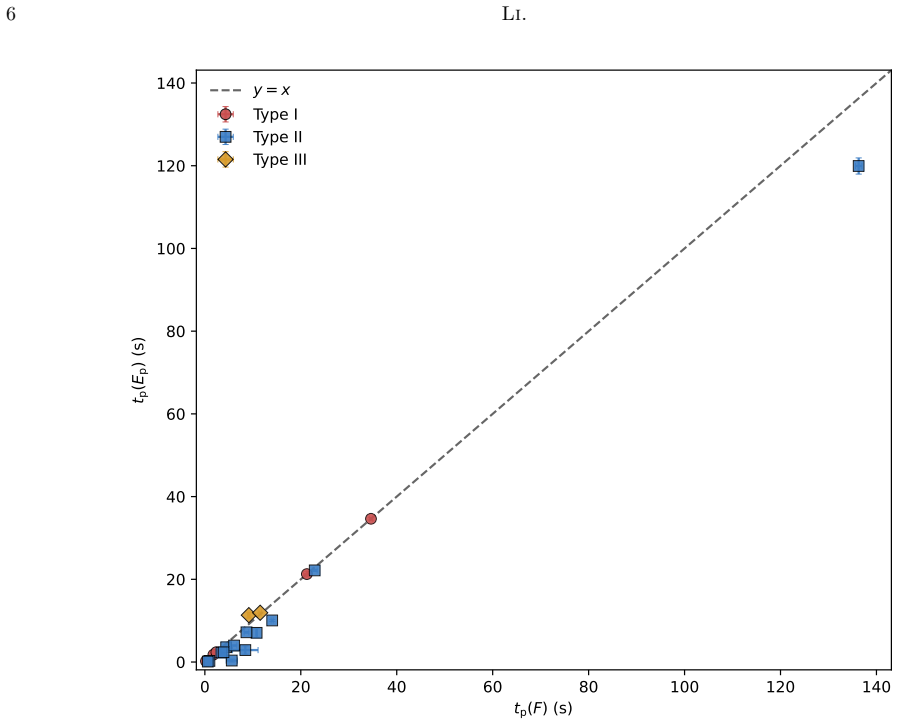
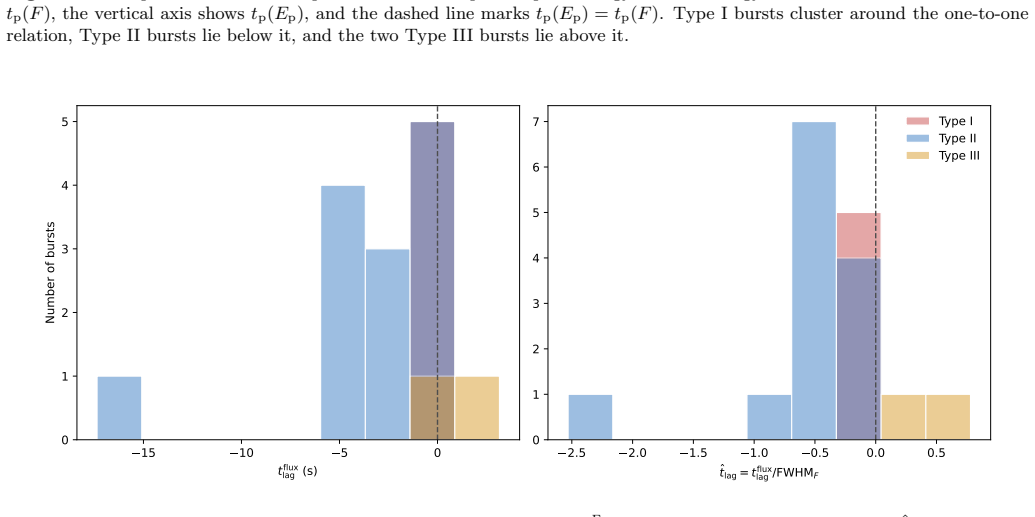
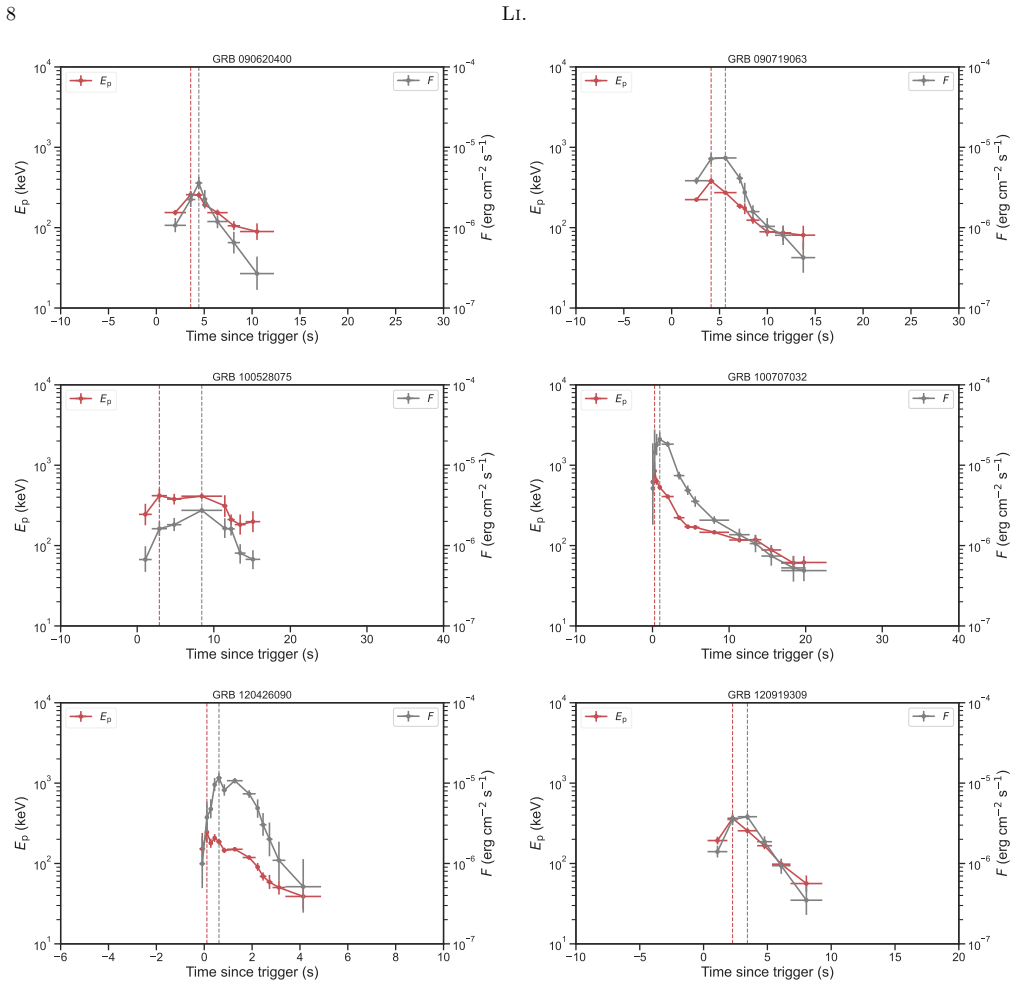
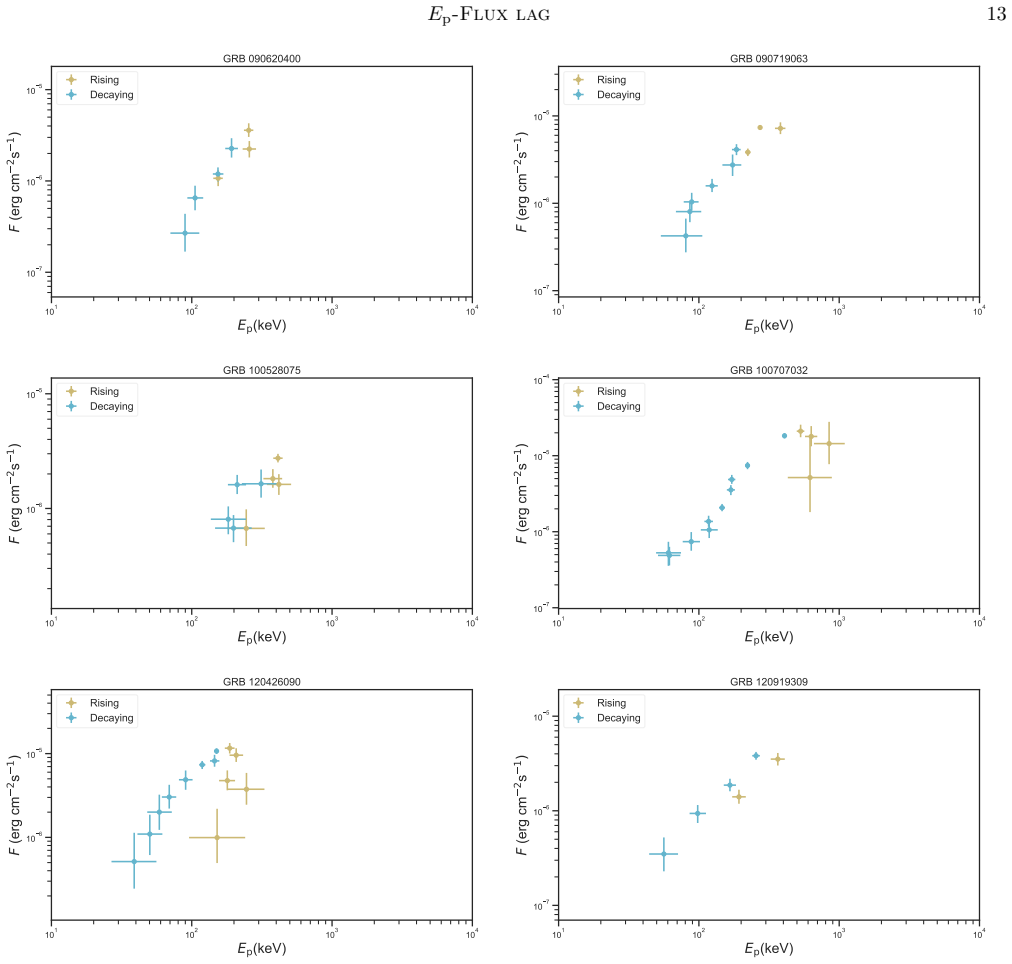
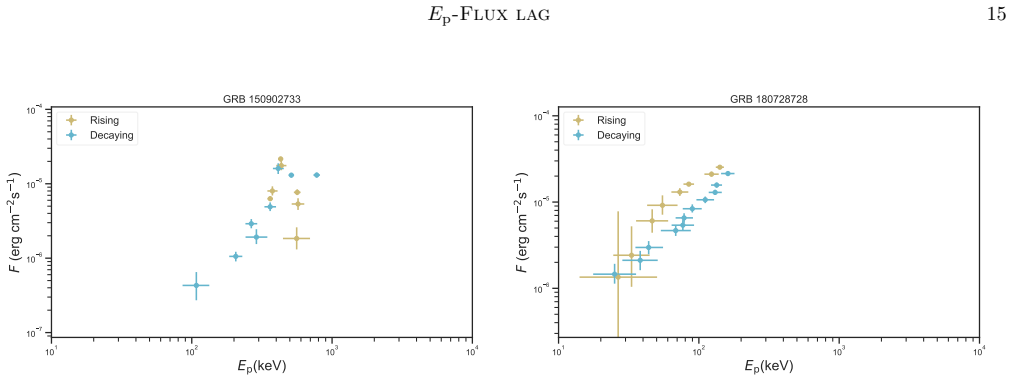
Through time-resolved spectral analysis of 20 single-pulse GRBs showing intensity-tracking, the intensity-tracking pattern is found to subdivide into three distinct subclasses. Type I (5/20) has aligned Ep and flux peaks. Type II (13/20) has Ep peaking before the flux. Type III (2/20) has Ep peaking after the flux. The subclasses differ systematically in spectral hardness, pulse width, and Ep-F branch asymmetry, with Type II being harder and more asymmetric.
What carries the argument
The matched-bin lag t_lag^F, calculated as the difference in peak times of Ep and F using identical time bins from spectral fits, which classifies the subclasses.
If this is right
- Type II dominates the sample and is systematically harder than Type I, with broader flux pulses and more asymmetric rising and decaying Ep-F branches.
- Type I is consistent with tightly coupled spectral and power evolution.
- Type II aligns with nonthermal or hybrid prompt-emission scenarios where spectral hardening precedes peak radiative output.
- Type III forms a rare positive-lag tail whose physical origin is uncertain.
- These differences indicate that the intensity-tracking pattern is not monolithic but reflects varied physical processes.
Where Pith is reading between the lines
- Confirming these subclasses in larger or multi-pulse samples could refine models distinguishing synchrotron from photospheric emission.
- Observing whether the lag distribution remains trimodal in different energy bands or detectors would test the robustness of the classification.
- Extending the analysis to include polarization or afterglow data might reveal if the subclasses correlate with other GRB properties.
Load-bearing premise
The 20 single-pulse GRBs form a representative sample and the time-resolved spectral analysis with matched bins reliably identifies distinct subclasses free from significant biases or artifacts.
What would settle it
A study of additional single-pulse GRBs showing that the lag values between Ep and F do not separate into three groups around zero lag, or that the reported differences in properties between types disappear with alternative analysis methods.
Figures





read the original abstract
The properties of the spectral evolution during the prompt emission phase of gamma-ray bursts (GRBs), which are closely related to the radiation mechanism (synchrotron or photosphere), are still a subject of debate. Two spectral evolution patterns (``hard-to-soft'' and ``intensity-tracking'') have been commonly observed in GRB prompt emission spectra. Here we present a well-defined sample of 20 single-pulse GRBs detected by \emph{Fermi} whose prompt emission spectra exhibit the intensity-tracking pattern. By performing a time-resolved spectral analysis, we derive $E_{\rm p}$ and the energy flux $F$ from the same time bins and introduce a matched-bin lag, $t_{\rm lag}^{\rm F} \equiv t_{\rm p}(E_{\rm p})-t_{\rm p}(F)$, where $t_{\rm p}$ denotes the time at which each quantity reaches its maximum. We find that the intensity-tracking pattern subdivides into three distinct subclasses: Type I (5/20), with aligned $E_{\rm p}$ and flux peaks; Type II (13/20), with $E_{\rm p}$ peaking before the flux; and Type III (2/20), with $E_{\rm p}$ peaking after the flux. The early-peaking Type~II subclass dominates the sample. The subclasses also exhibit systematic differences in their spectral and temporal properties. Type II bursts are systematically harder than Type I, show broader flux pulses, and more often display asymmetric rising and decaying $E_{\rm p}$-$F$ branches. Type I is consistent with tightly coupled spectral and power evolution, whereas Type II is more naturally explained by nonthermal or hybrid prompt-emission scenarios in which spectral hardening precedes the peak radiative output. Type III appears to form a rare positive-lag tail whose physical origin remains uncertain.
Editorial analysis
A structured set of objections, weighed in public.
Referee Report
Summary. The manuscript analyzes a sample of 20 single-pulse Fermi GRBs exhibiting the intensity-tracking spectral evolution pattern. Using time-resolved spectroscopy to derive Ep and energy flux F from identical time bins, the authors define a matched-bin lag t_lag^F ≡ t_p(Ep) − t_p(F) and classify the bursts into three subclasses: Type I (5/20, aligned peaks), Type II (13/20, Ep peaks before flux), and Type III (2/20, Ep peaks after flux). They report systematic differences in hardness, pulse width, and Ep-F branch asymmetry, interpreting Type I as tightly coupled evolution and Type II as consistent with nonthermal or hybrid emission scenarios.
Significance. If the peak-timing classification proves robust, the work supplies a concrete observational subdivision of the intensity-tracking pattern that could help discriminate among prompt-emission models. The explicit sample size, direct use of matched bins for Ep and F, and reported counts (5/20, 13/20, 2/20) together with noted differences in spectral and temporal properties constitute clear strengths. The dominance of the early-Ep Type II subclass and its association with harder spectra and broader pulses would, if confirmed, provide a useful empirical anchor for theoretical studies of spectral hardening preceding peak radiative output.
major comments (2)
- [time-resolved spectral analysis and classification scheme] The subdivision into three subclasses and the reported counts (Type I 5/20, Type II 13/20, Type III 2/20) rest on identification of maxima in the Ep and F light curves. No uncertainties on the peak times t_p(Ep) and t_p(F) are propagated from the time-resolved spectral fits, nor are robustness tests against binning choices, background subtraction, or model variations (Band vs. cutoff power-law) presented. This directly affects the reliability of the lag sign assignments and the claimed systematic differences in hardness, width, and asymmetry.
- [sample and subclass statistics] With only 20 events and a strongly dominant Type II bin (13/20), even modest reassignments of a few bursts due to fit or binning variations would alter the reported subclass fractions and the statistical significance of the inter-subclass differences. The manuscript does not quantify how sensitive the classification is to these analysis choices.
minor comments (2)
- [sample selection] The abstract states that the sample is 'well-defined' but does not summarize the explicit selection criteria for single-pulse GRBs or for confirming the intensity-tracking pattern; these details should be stated concisely in the main text or a table.
- [definition of t_lag^F] Notation for the lag (t_lag^F) and peak times (t_p) is introduced clearly, but the manuscript should specify whether the maxima are determined by simple bin maxima or by any smoothing/interpolation procedure.
Simulated Author's Rebuttal
We thank the referee for the positive evaluation of our work and the constructive comments on the robustness of the subclassification. We respond point by point to the major comments below.
read point-by-point responses
-
Referee: [time-resolved spectral analysis and classification scheme] The subdivision into three subclasses and the reported counts (Type I 5/20, Type II 13/20, Type III 2/20) rest on identification of maxima in the Ep and F light curves. No uncertainties on the peak times t_p(Ep) and t_p(F) are propagated from the time-resolved spectral fits, nor are robustness tests against binning choices, background subtraction, or model variations (Band vs. cutoff power-law) presented. This directly affects the reliability of the lag sign assignments and the claimed systematic differences in hardness, width, and asymmetry.
Authors: We agree that propagating uncertainties on the peak times and performing explicit robustness tests would strengthen the analysis. In the revised manuscript we will derive error estimates on t_p(Ep) and t_p(F) from the spectral-fit covariance matrices and conduct additional checks by varying time-binning schemes, background-subtraction methods, and spectral models (Band function versus cutoff power-law). These additions will quantify the stability of the lag assignments and the reported inter-subclass differences. revision: yes
-
Referee: [sample and subclass statistics] With only 20 events and a strongly dominant Type II bin (13/20), even modest reassignments of a few bursts due to fit or binning variations would alter the reported subclass fractions and the statistical significance of the inter-subclass differences. The manuscript does not quantify how sensitive the classification is to these analysis choices.
Authors: The sample of 20 single-pulse intensity-tracking GRBs is the largest that satisfies our strict selection criteria from the Fermi catalog. In the revision we will add a quantitative sensitivity analysis, for example by perturbing Ep and F values within their fit uncertainties and re-deriving the lag signs, to evaluate the stability of the subclass fractions and the significance of the observed differences in hardness and pulse width. revision: yes
Circularity Check
No circularity: classification rests on direct observational peak timing from independent spectral fits
full rationale
The paper selects 20 single-pulse GRBs already identified as showing the intensity-tracking pattern, performs time-resolved spectral fitting to obtain Ep and F in matched bins, defines t_lag^F ≡ t_p(Ep) − t_p(F) as the difference in their observed peak times, and simply counts how many events fall into each sign category (aligned, Ep early, Ep late). This produces an empirical subdivision into three subclasses with reported differences in other properties. No step claims a derivation of one quantity from another that reduces by construction to the input; the lag definition is a measurement convention, not a self-referential equation; no self-citations are invoked as load-bearing uniqueness theorems; and the central result is a count of observed peak alignments rather than a fitted parameter renamed as a prediction. The analysis is therefore self-contained against external benchmarks.
Axiom & Free-Parameter Ledger
axioms (2)
- domain assumption Single-pulse GRBs can be cleanly isolated from multi-pulse events in the Fermi sample.
- domain assumption Time-resolved spectral fitting yields reliable Ep and flux values whose peak times can be compared directly.
Reference graph
Works this paper leans on
-
[1]
2018, MNRAS, 475, 1708, doi: 10.1093/mnras/stx3106
Acuner, Z., & Ryde, F. 2018, MNRAS, 475, 1708, doi: 10.1093/mnras/stx3106
-
[2]
1993, ApJ, 413, 281, doi: 10.1086/172995
Band, D., Matteson, J., Ford, L., et al. 1993, ApJ, 413, 281, doi: 10.1086/172995
-
[3]
Band, D. L. 1997, ApJ, 486, 928, doi: 10.1086/304566
-
[4]
Bhat, P. N., Fishman, G. J., Meegan, C. A., et al. 1994, ApJ, 426, 604, doi: 10.1086/174097
-
[5]
M., Greiner, J., B´ egu´ e, D., & Berlato, F
Burgess, J. M., Greiner, J., B´ egu´ e, D., & Berlato, F. 2019, MNRAS, 490, 927, doi: 10.1093/mnras/stz2589
-
[6]
Burgess, J. M., Preece, R. D., Connaughton, V., et al. 2014, ApJ, 784, 17, doi: 10.1088/0004-637X/784/1/17 Caballero-Garc´ ıa, M. D., Gupta, R., Pandey, S. B., et al. 2023, MNRAS, 519, 3201, doi: 10.1093/mnras/stac3629
-
[7]
2022, ApJ, 932, 25, doi: 10.3847/1538-4357/ac6c2a
Chen, J.-M., Peng, Z.-Y., Du, T.-T., & Yin, Y. 2022, ApJ, 932, 25, doi: 10.3847/1538-4357/ac6c2a
-
[8]
2021, ApJ, 920, 53, doi: 10.3847/1538-4357/ac14b8
Chen, J.-M., Peng, Z.-Y., Du, T.-T., Yin, Y., & Wu, H. 2021, ApJ, 920, 53, doi: 10.3847/1538-4357/ac14b8
-
[9]
Crider, A., Liang, E. P., Smith, I. A., et al. 1997, ApJL, 479, L39, doi: 10.1086/310574
-
[10]
2019, ApJ, 884, 61, doi: 10.3847/1538-4357/ab3c6e
Duan, M.-Y., & Wang, X.-G. 2019, ApJ, 884, 61, doi: 10.3847/1538-4357/ab3c6e
-
[11]
Ford, L. A., Band, D. L., Matteson, J. L., et al. 1995, ApJ, 439, 307, doi: 10.1086/175174
-
[12]
2015, ApJ, 801, 103, doi: 10.1088/0004-637X/801/2/103
Gao, H., & Zhang, B. 2015, ApJ, 801, 103, doi: 10.1088/0004-637X/801/2/103
-
[13]
Goldstein, A., Burgess, J. M., Preece, R. D., et al. 2012, ApJS, 199, 19, doi: 10.1088/0067-0049/199/1/19
-
[14]
Golenetskii, S. V., Mazets, E. P., Aptekar, R. L., & Ilinskii, V. N. 1983, Nature, 306, 451, doi: 10.1038/306451a0
-
[15]
2014, ApJS, 211, 12, doi: 10.1088/0067-0049/211/1/12
Gruber, D., Goldstein, A., Weller von Ahlefeld, V., et al. 2014, ApJS, 211, 12, doi: 10.1088/0067-0049/211/1/12
-
[16]
Gupta, R., Oates, S. R., Pandey, S. B., et al. 2021, MNRAS, 505, 4086, doi: 10.1093/mnras/stab1573
-
[17]
2022, MNRAS, doi: 10.1093/mnras/stac015
Gupta, R., Gupta, S., Chattopadhyay, T., et al. 2022, MNRAS, doi: 10.1093/mnras/stac015
-
[18]
Kaneko, Y., Preece, R. D., Briggs, M. S., et al. 2006, ApJS, 166, 298, doi: 10.1086/505911
-
[19]
Kargatis, V. E., Liang, E. P., Hurley, K. C., et al. 1994, ApJ, 422, 260, doi: 10.1086/173724
-
[20]
2019a, ApJS, 242, 16, doi: 10.3847/1538-4365/ab1b78 —
Li, L. 2019a, ApJS, 242, 16, doi: 10.3847/1538-4365/ab1b78 —. 2019b, ApJS, 245, 7, doi: 10.3847/1538-4365/ab42de —. 2020, ApJ, 894, 100, doi: 10.3847/1538-4357/ab8014
-
[21]
2021, ApJS, 254, 35, doi: 10.3847/1538-4365/abee2a
Li, L., Ryde, F., Pe’er, A., Yu, H.-F., & Acuner, Z. 2021, ApJS, 254, 35, doi: 10.3847/1538-4365/abee2a
-
[22]
2021, ApJS, 253, 43, doi: 10.3847/1538-4365/abded1
Li, L., & Zhang, B. 2021, ApJS, 253, 43, doi: 10.3847/1538-4365/abded1
-
[23]
2019, ApJ, 884, 109, doi: 10.3847/1538-4357/ab40b9
Li, L., Geng, J.-J., Meng, Y.-Z., et al. 2019, ApJ, 884, 109, doi: 10.3847/1538-4357/ab40b9
-
[24]
1983, ApJ, 272, 317, doi: 10.1086/161295
Li, T.-P., & Ma, Y.-Q. 1983, ApJ, 272, 317, doi: 10.1086/161295
-
[25]
1996, Nature, 381, 49, doi: 10.1038/381049a0
Liang, E., & Kargatis, V. 1996, Nature, 381, 49, doi: 10.1038/381049a0
-
[26]
2012, ApJ, 756, 112, doi: 10.1088/0004-637X/756/2/112
Lu, R.-J., Wei, J.-J., Liang, E.-W., et al. 2012, ApJ, 756, 112, doi: 10.1088/0004-637X/756/2/112
-
[27]
Meegan, C., Lichti, G., Bhat, P. N., et al. 2009, ApJ, 702, 791, doi: 10.1088/0004-637X/702/1/791
-
[28]
Norris, J. P., Share, G. H., Messina, D. C., et al. 1986, ApJ, 301, 213, doi: 10.1086/163889
-
[29]
2018, A&A, 616, A138, doi: 10.1051/0004-6361/201732172 Pe’er, A., M´ esz´ aros, P., & Rees, M
Oganesyan, G., Nava, L., Ghirlanda, G., & Celotti, A. 2018, A&A, 616, A138, doi: 10.1051/0004-6361/201732172 Pe’er, A., M´ esz´ aros, P., & Rees, M. J. 2006, ApJ, 642, 995, doi: 10.1086/501424 Pe’Er, A., & Ryde, F. 2017, International Journal of Modern Physics D, 26, 1730018, doi: 10.1142/S021827181730018X
-
[30]
Peng, Z. Y., Ma, L., Zhao, X. H., et al. 2009, ApJ, 698, 417, doi: 10.1088/0004-637X/698/1/417 22Li
-
[31]
Rees, M. J., & M´ esz´ aros, P. 2005, ApJ, 628, 847, doi: 10.1086/430818
-
[32]
K., Gupta, R., Jel´ ınek, M., et al
Ror, A. K., Gupta, R., Jel´ ınek, M., et al. 2023, ApJ, 942, 34, doi: 10.3847/1538-4357/aca414
-
[33]
1999, ApJ, 512, 693, doi: 10.1086/306818
Ryde, F., & Svensson, R. 1999, ApJ, 512, 693, doi: 10.1086/306818
-
[34]
2019, MNRAS, 484, 1912, doi: 10.1093/mnras/stz083
Ryde, F., Yu, H.-F., Dereli-B´ egu´ e, H., et al. 2019, MNRAS, 484, 1912, doi: 10.1093/mnras/stz083
-
[35]
Scargle, J. D., Norris, J. P., Jackson, B., & Chiang, J. 2013, ApJ, 764, 167, doi: 10.1088/0004-637X/764/2/167
-
[36]
2022, ApJ, 927, 173, doi: 10.3847/1538-4357/ac46a8
Shao, X., & Gao, H. 2022, ApJ, 927, 173, doi: 10.3847/1538-4357/ac46a8
-
[37]
Uhm, Z. L., & Zhang, B. 2014, Nature Physics, 10, 351, doi: 10.1038/nphys2932
-
[38]
Uhm, Z. L., Zhang, B., & Racusin, J. 2018, ApJ, 869, 100, doi: 10.3847/1538-4357/aaeb30
-
[39]
2018, ApJS, 236, 17, doi: 10.3847/1538-4365/aab780
Vianello, G. 2018, ApJS, 236, 17, doi: 10.3847/1538-4365/aab780
-
[40]
Vianello, G., Lauer, R. J., Younk, P., et al. 2015, arXiv e-prints. https://arxiv.org/abs/1507.08343
-
[41]
2019, ApJ, 886, 20, doi: 10.3847/1538-4357/ab488a
Yu, H.-F., Dereli-B´ egu´ e, H., & Ryde, F. 2019, ApJ, 886, 20, doi: 10.3847/1538-4357/ab488a
-
[42]
Yu, H.-F., Preece, R. D., Greiner, J., et al. 2016, A&A, 588, A135, doi: 10.1051/0004-6361/201527509
-
[43]
2011, ApJ, 726, 90, doi: 10.1088/0004-637X/726/2/90
Zhang, B., & Yan, H. 2011, ApJ, 726, 90, doi: 10.1088/0004-637X/726/2/90 Ep-Flux lag23 APPENDIX In this appendix, we present below the counts-based comparison figures. A1.COUNTS-BASED COMPARISON FIGURES For comparison with the conventional observational light curve, we define an auxiliary counts-based lag, tcnt lag ≡t p(Ep)−t p(C),(A1) wheret p(C) is the ...
discussion (0)
Sign in with ORCID, Apple, or X to comment. Anyone can read and Pith papers without signing in.