Recognition: unknown
On Scalability of Multi-Objective Evolutionary Algorithms on Combinatorial Optimisation Problems
Pith reviewed 2026-05-10 04:01 UTC · model grok-4.3
The pith
SEMO slows in convergence on large combinatorial problems due to missing crossover, which when added improves speed but reduces solution spread.
A machine-rendered reading of the paper's core claim, the machinery that carries it, and where it could break.
Core claim
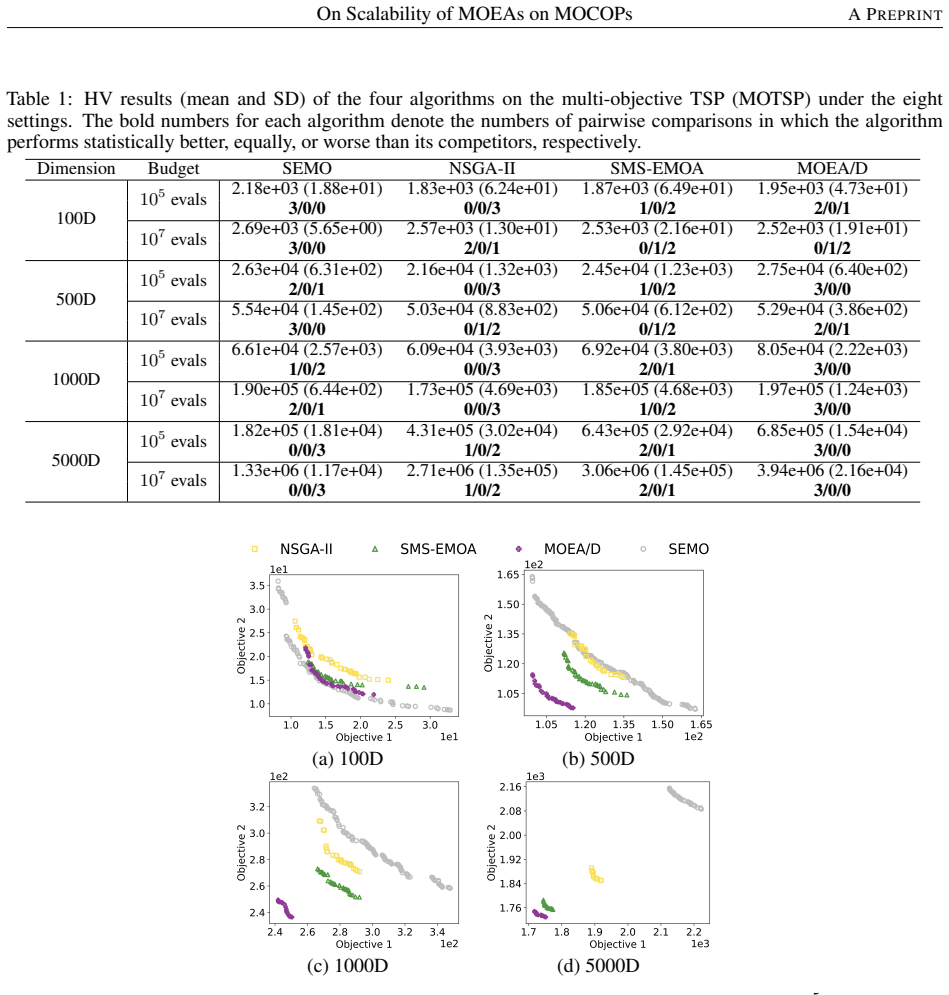
Our results show that SEMO experiences a decline in convergence speed as dimensionality increases, compared to other MOEAs such as NSGA-II, SMS-EMOA and MOEA/D. We further demonstrate that the absence of crossover is a major contributor to SEMO's underperformance in large-scale problems, and that incorporating crossover into SEMO can substantially accelerate convergence in general, despite being detrimental in spreading solutions over the Pareto front.
What carries the argument
The crossover operator that recombines parent solutions to create offspring, whose presence or absence controls convergence speed versus solution spread in MOEAs on high-dimensional combinatorial problems.
If this is right
- SEMO performs well on small MOCOPs but loses relative advantage as problem size increases.
- Adding crossover to SEMO raises its convergence rate on large problems.
- Crossover in SEMO narrows the spread of solutions across the Pareto front.
- MOEAs that already use crossover maintain steadier performance as dimensionality grows.
Where Pith is reading between the lines
- Future MOEA designs for large combinatorial tasks could combine crossover for speed with separate diversity mechanisms to preserve spread.
- The pattern may guide algorithm choice for real-world problems where both quick convergence and broad trade-off coverage are needed.
- Repeating the tests on even larger instances or additional combinatorial problem families would test how far the crossover effect generalizes.
Load-bearing premise
The chosen benchmark problems, performance metrics and algorithm implementations are representative of how MOEAs generally behave on large combinatorial optimization problems.
What would settle it
Running the same scalability tests on a new set of combinatorial problems with 5,000 variables and finding that SEMO without crossover converges at least as fast as the version with crossover.
Figures


read the original abstract
Scalability of evolutionary algorithms refers to assessing how their performance changes as problem size increases. In the area of multi-objective optimisation, research on the scalability of multi-objective evolutionary algorithms (MOEAs) has predominantly focussed on continuous problems. However, multi-objective combinatorial optimisation problems (MOCOPs) differ from continuous ones. Their discrete and rigid structure often brings rugged landscape, numerous local optimal solutions and disjoint global optimal regions. This leads to different behaviour of MOEAs. For example, SEMO, a simple MOEA without mating selection and diversity maintenance mechanisms, has been shown to be highly competitive, and in many cases to outperform more sophisticated MOEAs on MOCOPs. Yet, it remains unclear whether such findings hold for large-scale cases. In this paper, we conduct an empirical investigation into the scalability of MOEAs on combinatorial problems, with problem size from 50 to 5,000. Our results show that SEMO experiences a decline in convergence speed as dimensionality increases, compared to other MOEAs such as NSGA-II, SMS-EMOA and MOEA/D. We further demonstrate that the absence of crossover is a major contributor to SEMO's underperformance in large-scale problems, and that incorporating crossover into SEMO can substantially accelerate convergence in general, despite being detrimental in spreading solutions over the Pareto front.
Editorial analysis
A structured set of objections, weighed in public.
Referee Report
Summary. The manuscript presents an empirical study on the scalability of multi-objective evolutionary algorithms (MOEAs) for combinatorial optimization problems (MOCOPs). It compares SEMO with NSGA-II, SMS-EMOA, and MOEA/D on problems with dimensions ranging from 50 to 5000, finding that SEMO's convergence speed decreases with increasing size. The study further shows that incorporating crossover into SEMO improves convergence speed but reduces the spread of solutions on the Pareto front.
Significance. If the results hold under representative conditions, this work is significant for extending MOEA scalability research from continuous to combinatorial domains, where rugged landscapes and local optima are prevalent. It provides direct empirical evidence (via algorithm runs without fitted parameters) on the role of crossover in large-scale MOCOPs and challenges the competitiveness of simple MOEAs like SEMO at scale. This could inform operator design in evolutionary computation.
major comments (2)
- [Experimental Methodology] Experimental Methodology section: The stopping criteria and evaluation budgets are not described as scaling with problem dimensionality n (from 50 to 5000). If budgets are fixed rather than increased proportionally, the reported decline in SEMO convergence speed relative to NSGA-II/SMS-EMOA/MOEA/D could be an artifact of insufficient search effort at large n, rather than a general property of MOCOP scalability.
- [Results and Discussion] Results and Discussion: The specific MOCOP benchmark instances (e.g., multi-objective knapsack variants or other discrete problems) and performance metrics are not justified as representative of general combinatorial optimization behavior. Without this, the claim that absence of crossover is the major contributor to SEMO underperformance, and that adding it accelerates convergence, risks being tied to the chosen test suite rather than broadly applicable.
minor comments (2)
- [Abstract] The abstract and introduction could more explicitly state the exact problem classes and metrics to aid readers in assessing generalizability.
- [Throughout] Notation for algorithms and operators (e.g., SEMO variants with/without crossover) should be standardized across sections for clarity.
Simulated Author's Rebuttal
We thank the referee for their constructive comments, which help clarify key aspects of our empirical study on MOEA scalability for large-scale MOCOPs. We address each major comment point by point below, with planned revisions where appropriate.
read point-by-point responses
-
Referee: [Experimental Methodology] Experimental Methodology section: The stopping criteria and evaluation budgets are not described as scaling with problem dimensionality n (from 50 to 5000). If budgets are fixed rather than increased proportionally, the reported decline in SEMO convergence speed relative to NSGA-II/SMS-EMOA/MOEA/D could be an artifact of insufficient search effort at large n, rather than a general property of MOCOP scalability.
Authors: We thank the referee for highlighting the need for explicit detail on this aspect of the design. We will revise the Experimental Methodology section to fully describe the stopping criteria (maximum function evaluations until no further improvement or a hard cap) and the evaluation budgets employed. The budgets were held constant across problem sizes to enable a direct, fair comparison of relative scalability under equivalent computational effort for all algorithms. Because every algorithm received identical resources, the observed decline in SEMO's convergence speed relative to NSGA-II, SMS-EMOA and MOEA/D cannot be dismissed as an artifact of under-budgeting; rather, it indicates that SEMO requires disproportionately more evaluations to maintain performance as n grows. We will add a short discussion of this design rationale and its implications for interpreting scalability results. revision: yes
-
Referee: [Results and Discussion] Results and Discussion: The specific MOCOP benchmark instances (e.g., multi-objective knapsack variants or other discrete problems) and performance metrics are not justified as representative of general combinatorial optimization behavior. Without this, the claim that absence of crossover is the major contributor to SEMO underperformance, and that adding it accelerates convergence, risks being tied to the chosen test suite rather than broadly applicable.
Authors: We appreciate the referee's point on generalizability. In the revised manuscript we will expand the Results and Discussion section with a dedicated paragraph justifying the chosen MOCOP instances. These problems (multi-objective knapsack and similar discrete benchmarks) are standard in the MOEA literature precisely because they exhibit the rugged landscapes, numerous local optima and disjoint Pareto regions characteristic of combinatorial optimisation. We will cite representative prior studies that have used the same suites for scalability and operator analysis. The performance metrics (hypervolume and spread indicators) are likewise standard for jointly assessing convergence and diversity. While we stand by the experimental finding that crossover is a major factor in the observed scalability gap, we will qualify the claims to note that they are demonstrated on these representative problem classes and suggest that future work should examine additional MOCOP families. revision: partial
Circularity Check
No circularity: purely empirical comparison with no derivations or fitted predictions
full rationale
The paper conducts an empirical study of MOEA scalability on MOCOP benchmarks with problem sizes from 50 to 5000. Claims about SEMO's declining convergence speed and the effect of adding crossover are supported solely by direct algorithm runs, performance metrics, and statistical comparisons on chosen test problems. No equations, parameter fitting, uniqueness theorems, or self-citations are used to derive results; the central findings reduce only to the experimental data itself rather than any self-referential construction. This is a standard non-circular empirical analysis.
Axiom & Free-Parameter Ledger
axioms (1)
- domain assumption Performance differences observed on the chosen test problems generalize to other MOCOPs.
Reference graph
Works this paper leans on
-
[1]
W. Stadler. A survey of multicriteria optimization or the vector maximum problem, part I: 1776-1960. Journal of Optimization Theory and Applications , 29(1):1–52, September 1979
1960
-
[2]
P . A. Castillo, M. G. Arenas, J. J. Castillo-V aldivieso, J. J. Merelo, A. Prieto, and G. Romero. Artificial Neural Networks Design using Evolutionary Algorithms , pages 43–52. Springer London, 2003. 11 On Scalability of MOEAs on MOCOPs A P REPRINT
2003
-
[3]
Sendhoff
Y aochu Jin and B. Sendhoff. Pareto-based multiobjective machine learning: An overview and case studies. IEEE Transactions on Systems, Man, and Cybernetics, Part C (Applications and Reviews) , 38(3):397–415, May 2008
2008
-
[4]
Configuring software product lines by combining many- objective optimization and SA T solvers.ACM Transactions on Software Engineering and Methodology, 26(4):1– 46, October 2017
Yi Xiang, Y uren Zhou, Zibin Zheng, and Miqing Li. Configuring software product lines by combining many- objective optimization and SA T solvers.ACM Transactions on Software Engineering and Methodology, 26(4):1– 46, October 2017
2017
-
[5]
Gonzalez-Alvarez, Francisco Chicano, and Miguel A
Francisco Luna, David L. Gonzalez-Alvarez, Francisco Chicano, and Miguel A. V ega-Rodriguez. On the scalabil- ity of multi-objective metaheuristics for the software scheduling problem. In 2011 11th International Conference on Intelligent Systems Design and Applications , pages 1110–1115. IEEE, November 2011
2011
-
[6]
Hierons, Miqing Li, Xiaohui Liu, Sergio Segura, and Wei Zheng
Robert M. Hierons, Miqing Li, Xiaohui Liu, Sergio Segura, and Wei Zheng. SIP: Optimal product selection from feature models using many-objective evolutionary optimization. ACM Transactions on Software Engineering and Methodology, 25(2):1–39, 2016
2016
-
[7]
Multi-objective vehicle routing problems
Nicolas Jozefowiez, Frédéric Semet, and El-Ghazali Talbi. Multi-objective vehicle routing problems. European Journal of Operational Research, 189(2):293–309, September 2008
2008
-
[8]
Tem- poral information services in large-scale vehicular networks through evolutionary multi-objective optimization
Penglin Dai, Kai Liu, Liang Feng, Haijun Zhang, Victor Chung Sing Lee, Sang Hyuk Son, and Xiao Wu. Tem- poral information services in large-scale vehicular networks through evolutionary multi-objective optimization. IEEE Transactions on Intelligent Transportation Systems, 20(1):218–231, January 2019
2019
-
[9]
EMODMI: A multi-objective optimization based method to identify disease modules
Y e Tian, Xiaochun Su, Y ansen Su, and Xingyi Zhang. EMODMI: A multi-objective optimization based method to identify disease modules. IEEE Transactions on Emerging Topics in Computational Intelligence , 5(4):570– 582, August 2021
2021
-
[10]
Sastry, D.E
K. Sastry, D.E. Goldberg, and M. Pelikan. Limits of scalability of multiobjective estimation of distribution algorithms. In 2005 IEEE Congress on Evolutionary Computation , volume 3, pages 2217–2224. IEEE
2005
-
[11]
Coello Coello
Luis Miguel Antonio and Carlos A. Coello Coello. Decomposition-Based Approach for Solving Large Scale Multi-objective Problems, pages 525–534. Springer International Publishing, 2016
2016
-
[12]
A scalable indicator-based evolution- ary algorithm for large-scale multiobjective optimization
Wenjing Hong, Ke Tang, Aimin Zhou, Hisao Ishibuchi, and Xin Y ao. A scalable indicator-based evolution- ary algorithm for large-scale multiobjective optimization. IEEE Transactions on Evolutionary Computation , 23(3):525–537, June 2019
2019
-
[13]
Durillo, Antonio J
Juan J. Durillo, Antonio J. Nebro, Carlos A. Coello Coello, Francisco Luna, and Enrique Alba. A comparative study of the effect of parameter scalability in multi-objective metaheuristics. In 2008 IEEE Congress on Evo- lutionary Computation (IEEE World Congress on Computational Intelligence) , pages 1893–1900. IEEE, June 2008
2008
-
[14]
A study of multiobjective metaheuristics when solving parameter scalable problems
J J Durillo, A J Nebro, C A C Coello, Jose Garcia-Nieto, F Luna, and E Alba. A study of multiobjective metaheuristics when solving parameter scalable problems. IEEE Transactions on Evolutionary Computation , 14(4):618–635, August 2010
2010
-
[15]
MOEAs are stuck in a different area at a time
Miqing Li, Xiaofeng Han, and Xiaochen Chu. MOEAs are stuck in a different area at a time. In Proceedings of the Genetic and Evolutionary Computation Conference , GECCO 23, pages 303–311. ACM, July 2023
2023
-
[16]
Empirical comparison between MOEAs and local search on multi-objective combinatorial optimisation problems
Miqing Li, Xiaofeng Han, Xiaochen Chu, and Zimin Liang. Empirical comparison between MOEAs and local search on multi-objective combinatorial optimisation problems. In Proceedings of the Genetic and Evolutionary Computation Conference, GECCO 24, pages 547–556. ACM, July 2024
2024
-
[17]
Laumanns, L
M. Laumanns, L. Thiele, and E. Zitzler. Running time analysis of multiobjective evolutionary algorithms on pseudo-boolean functions. IEEE Transactions on Evolutionary Computation , 8(2):170–182, April 2004
2004
-
[18]
K. Deb, A. Pratap, S. Agarwal, and T. Meyarivan. A fast and elitist multiobjective genetic algorithm: NSGA-II. IEEE Transactions on Evolutionary Computation , 6(2):182–197, April 2002
2002
-
[19]
MOEA/D: A multiobjective evolutionary algorithm based on decomposition
Qingfu Zhang and Hui Li. MOEA/D: A multiobjective evolutionary algorithm based on decomposition. IEEE Transactions on Evolutionary Computation, 11(6):712–731, December 2007
2007
-
[20]
SMS-EMOA: Multiobjective selection based on domi- nated hypervolume
Nicola Beume, Boris Naujoks, and Michael Emmerich. SMS-EMOA: Multiobjective selection based on domi- nated hypervolume. European Journal of Operational Research, 181(3):1653–1669, September 2007
2007
-
[21]
Behavior of multiobjective evolutionary algorithms on many-objective knapsack problems
Hisao Ishibuchi, Naoya Akedo, and Y usuke Nojima. Behavior of multiobjective evolutionary algorithms on many-objective knapsack problems. IEEE Transactions on Evolutionary Computation , 19(2):264–283, April 2015
2015
-
[22]
Jaszkiewicz
A. Jaszkiewicz. On the performance of multiple-objective genetic local search on the 0/1 knapsack problem - a comparative experiment. IEEE Transactions on Evolutionary Computation , 6(4):402–412, August 2002
2002
-
[23]
Zitzler and L
E. Zitzler and L. Thiele. Multiobjective evolutionary algorithms: a comparative case study and the strength pareto approach. IEEE Transactions on Evolutionary Computation , 3(4):257–271, 1999. 12 On Scalability of MOEAs on MOCOPs A P REPRINT
1999
-
[24]
Evolutionary algorithms for solving multi- objective travelling salesman problem
Vui Ann Shim, Kay Chen Tan, Jun Y ong Chia, and Jin Kiat Chong. Evolutionary algorithms for solving multi- objective travelling salesman problem. Flexible Services and Manufacturing Journal, 23(2):207–241, June 2011
2011
-
[25]
Hybrid evolutionary algorithms for the mul- tiobjective traveling salesman problem
Iraklis-Dimitrios Psychas, Eleni Delimpasi, and Y annis Marinakis. Hybrid evolutionary algorithms for the mul- tiobjective traveling salesman problem. Expert Systems with Applications , 42(22):8956–8970, December 2015
2015
-
[26]
Merz and B
P . Merz and B. Freisleben. On the effectiveness of evolutionary search in high-dimensional NK-landscapes. In 1998 IEEE International Conference on Evolutionary Computation Proceedings. IEEE World Congress on Computational Intelligence (Cat. No.98TH8360) , ICEC-98, pages 741–745. IEEE
1998
-
[27]
Aguirre and Kiyoshi Tanaka
Hernán E. Aguirre and Kiyoshi Tanaka. Working principles, behavior, and performance of MOEAs on MNK- landscapes. European Journal of Operational Research, 181(3):1670–1690, September 2007
2007
-
[28]
On the problem characteristics of multi-objective pseudo-Boolean functions in runtime analysis
Zimin Liang and Miqing Li. On the problem characteristics of multi-objective pseudo-Boolean functions in runtime analysis. In FOGA, page 166177, 2025
2025
-
[29]
Local optima networks for con- strained search spaces
Jonathan Fieldsend, Arnaud Liefooghe, Katherine Malan, and Sébastien V erel. Local optima networks for con- strained search spaces. In Proceedings of the Genetic and Evolutionary Computation Conference , GECCO 25, pages 204–212. ACM, July 2025
2025
-
[30]
Random is faster than systematic in multi-objective local search
Zimin Liang and Miqing Li. Random is faster than systematic in multi-objective local search. In Proceedings of the AAAI Conference on Artificial Intelligence , 2026
2026
-
[31]
Reza Behmanesh, Iman Rahimi, and Amir H. Gandomi. Evolutionary many-objective algorithms for combinato- rial optimization problems: A comparative study. Archives of Computational Methods in Engineering, 28(2):673– 688, March 2020
2020
-
[32]
Easy to say they are hard, but hard to see they are easytowards a categorization of tractable multiobjective combinatorial optimization problems
José Rui Figueira, Carlos M Fonseca, Pascal Halffmann, Kathrin Klamroth, Luís Paquete, Stefan Ruzika, Britta Schulze, Michael Stiglmayr, and David Willems. Easy to say they are hard, but hard to see they are easytowards a categorization of tractable multiobjective combinatorial optimization problems. Journal of Multi-Criteria De- cision Analysis, 24(1-2):...
2017
-
[33]
A general approach to running time analysis of multi-objective evolu- tionary algorithms
Chao Bian, Chao Qian, and Ke Tang. A general approach to running time analysis of multi-objective evolu- tionary algorithms. In Proceedings of the Twenty-Seventh International Joint Conference on Artificial Intelli- gence, IJCAI-2018, pages 1405–1411. International Joint Conferences on Artificial Intelligence Organization, July 2018
2018
-
[34]
Theoretical analyses of multi-objective evolutionary algorithms on multi- modal objectives: (hot-off-the-press track at gecco 2021)
Benjamin Doerr and Weijie Zheng. Theoretical analyses of multi-objective evolutionary algorithms on multi- modal objectives: (hot-off-the-press track at gecco 2021). In Proceedings of the Genetic and Evolutionary Computation Conference Companion, GECCO 21, pages 25–26. ACM, July 2021
2021
-
[35]
On the effect of populations in evolutionary multi-objective optimization
Oliver Giel and Per Kristian Lehre. On the effect of populations in evolutionary multi-objective optimization. In Proceedings of the 8th annual conference on Genetic and evolutionary computation , GECCO06, pages 651–658. ACM, July 2006
2006
-
[36]
Design and analysis of diversity-based parent selection schemes for speeding up evolutionary multi-objective optimisation
Edgar Covantes Osuna, Wanru Gao, Frank Neumann, and Dirk Sudholt. Design and analysis of diversity-based parent selection schemes for speeding up evolutionary multi-objective optimisation. 2018
2018
-
[37]
An analysis on recombination in multi-objective evolutionary optimiza- tion
Chao Qian, Y ang Y u, and Zhi-Hua Zhou. An analysis on recombination in multi-objective evolutionary optimiza- tion. Artificial Intelligence, 204:99–119, November 2013
2013
-
[38]
A survey on the hypervolume indicator in evo- lutionary multiobjective optimization
Ke Shang, Hisao Ishibuchi, Linjun He, and Lie Meng Pang. A survey on the hypervolume indicator in evo- lutionary multiobjective optimization. IEEE Transactions on Evolutionary Computation , 25(1):1–20, February 2021
2021
-
[39]
Dominance, Indica- tor and Decomposition Based Search for Multi-objective QAP: Landscape Analysis and Automated Algorithm Selection, pages 33–47
Arnaud Liefooghe, Sébastien V erel, Bilel Derbel, Hernan Aguirre, and Kiyoshi Tanaka. Dominance, Indica- tor and Decomposition Based Search for Multi-objective QAP: Landscape Analysis and Automated Algorithm Selection, pages 33–47. Springer International Publishing, 2020
2020
-
[40]
Decision/Objective Space Trajectory Networks for˘ aMulti-objective Combinatorial Optimisation, pages 211–226
Gabriela Ochoa, Arnaud Liefooghe, Y uri Lavinas, and Claus Aranha. Decision/Objective Space Trajectory Networks for˘ aMulti-objective Combinatorial Optimisation, pages 211–226. Springer Nature Switzerland, 2023
2023
-
[41]
Multi-objective archiving
Miqing Li, Manuel López-Ibáñez, and Xin Y ao. Multi-objective archiving. IEEE Transactions on Evolutionary Computation, 28(3):696–717, June 2024
2024
-
[42]
Benchmarking MOEAs for multi- and many-objective optimization using an unbounded external archive
Ryoji Tanabe and Akira Oyama. Benchmarking MOEAs for multi- and many-objective optimization using an unbounded external archive. In Proceedings of the Genetic and Evolutionary Computation Conference , GECCO 17, pages 633–640. ACM, July 2017
2017
-
[43]
An Empirical Investigation of the Optimality and Monotonicity Properties of Multiob- jective Archiving Methods, pages 15–26
Miqing Li and Xin Y ao. An Empirical Investigation of the Optimality and Monotonicity Properties of Multiob- jective Archiving Methods, pages 15–26. Springer International Publishing, 2019. 13 On Scalability of MOEAs on MOCOPs A P REPRINT
2019
-
[44]
A Study of Global Convexity for a Multiple Objective Travelling Salesman Problem, pages 129–150
Pedro Castro Borges and Michael Pilegaard Hansen. A Study of Global Convexity for a Multiple Objective Travelling Salesman Problem, pages 129–150. Springer US, 2002
2002
-
[45]
Corne and Joshua D
David W. Corne and Joshua D. Knowles. Techniques for highly multiobjective optimisation: some nondomi- nated points are better than others. In Proceedings of the 9th annual conference on Genetic and evolutionary computation, GECCO07, pages 773–780. ACM, July 2007
2007
-
[46]
Aguirre and K
H.E. Aguirre and K. Tanaka. Effects of elitism and population climbing on multiobjective MNK-landscapes. In Proceedings of the 2004 Congress on Evolutionary Computation (IEEE Cat. No.04TH8753) , CEC-04, pages 449–456. IEEE, 2004
2004
-
[47]
Global vs local search on multi-objective nk-landscapes: Contrasting the impact of problem features
Fabio Daolio, Arnaud Liefooghe, Sébastien V erel, Hernán Aguirre, and Kiyoshi Tanaka. Global vs local search on multi-objective nk-landscapes: Contrasting the impact of problem features. In Proceedings of the 2015 Annual Conference on Genetic and Evolutionary Computation , GECCO 15, pages 369–376. ACM, July 2015
2015
-
[48]
Instance Generators and Test Suites for the Multiobjective Quadratic Assign- ment Problem, pages 295–310
Joshua Knowles and David Corne. Instance Generators and Test Suites for the Multiobjective Quadratic Assign- ment Problem, pages 295–310. Springer Berlin Heidelberg, 2003
2003
-
[49]
Taillard
Éric D. Taillard. Comparison of iterative searches for the quadratic assignment problem. Location Science , 3(2):87–105, August 1995
1995
-
[50]
Quality evaluation of solution sets in multiobjective optimisation: A survey
Miqing Li and Xin Y ao. Quality evaluation of solution sets in multiobjective optimisation: A survey. ACM Computing Surveys, (2), 2019
2019
-
[51]
How to evaluate solutions in pareto-based search-based software engineering: A critical review and methodological guidance
Miqing Li, Tao Chen, and Xin Y ao. How to evaluate solutions in pareto-based search-based software engineering: A critical review and methodological guidance. IEEE Transactions on Software Engineering , 48(5):1771–1799, May 2022
2022
-
[52]
Eiben and J.E
A.E. Eiben and J.E. Smith. Introduction to Evolutionary Computing . Springer Berlin Heidelberg, 2015
2015
-
[53]
A comparison of alternative tests of significance for the problem of m rankings
Milton Friedman. A comparison of alternative tests of significance for the problem of m rankings. The Annals of Mathematical Statistics, 11(1):86–92, March 1940
1940
-
[54]
Wilcoxon Rank Sum Test, pages 2354–2355
Winston Haynes. Wilcoxon Rank Sum Test, pages 2354–2355. Springer New Y ork, 2013
2013
-
[55]
A simple sequentially rejective multiple test procedure
Sture Holm. A simple sequentially rejective multiple test procedure. Scandinavian Journal of Statistics, 6(2):65– 70, 1979
1979
-
[56]
Crossover can guarantee exponential speed-ups in evolution- ary multi-objective optimisation
Duc-Cuong Dang, Andre Opris, and Dirk Sudholt. Crossover can guarantee exponential speed-ups in evolution- ary multi-objective optimisation. Artificial Intelligence, 330:104098, May 2024
2024
-
[57]
A proof that using crossover can guarantee ex- ponential speed-ups in evolutionary multi-objective optimisation
Duc-Cuong Dang, Andre Opris, Bahare Salehi, and Dirk Sudholt. A proof that using crossover can guarantee ex- ponential speed-ups in evolutionary multi-objective optimisation. In AAAI Conference on Artificial Intelligence , volume 37, pages 12390–12398, 2023
2023
-
[58]
A many objective problem where crossover is provably indispensable
Andre Opris. A many objective problem where crossover is provably indispensable. arXiv preprint arXiv:2412.18375, 2024
-
[59]
An Empirical Study on the Effect of Mating Restriction on the Search Ability of EMO Algorithms , pages 433–447
Hisao Ishibuchi and Y ouhei Shibata. An Empirical Study on the Effect of Mating Restriction on the Search Ability of EMO Algorithms , pages 433–447. Springer Berlin Heidelberg, 2003
2003
-
[60]
Recombination of Similar Parents in SMS-EMOA on Many- Objective 0/1 Knapsack Problems, pages 132–142
Hisao Ishibuchi, Naoya Akedo, and Y usuke Nojima. Recombination of Similar Parents in SMS-EMOA on Many- Objective 0/1 Knapsack Problems, pages 132–142. Springer Berlin Heidelberg, 2012
2012
-
[61]
What if we increase the number of objectives? theoretical and empirical implications for many-objective combinatorial optimization
Richard Allmendinger, Andrzej Jaszkiewicz, Arnaud Liefooghe, and Christiane Tammer. What if we increase the number of objectives? theoretical and empirical implications for many-objective combinatorial optimization. Computers & Operations Research, 145:105857, September 2022
2022
-
[62]
Many-objective (combinatorial) optimization is easy
Arnaud Liefooghe and Manuel López-Ibáñez. Many-objective (combinatorial) optimization is easy. In Proceed- ings of the Genetic and Evolutionary Computation Conference , pages 704–712, 2023
2023
-
[63]
On dominance- based multiobjective local search: design, implementation and experimental analysis on scheduling and traveling salesman problems
Arnaud Liefooghe, Jérémie Humeau, Salma Mesmoudi, Laetitia Jourdan, and El-Ghazali Talbi. On dominance- based multiobjective local search: design, implementation and experimental analysis on scheduling and traveling salesman problems. Journal of Heuristics, 18(2):317–352, 2012
2012
-
[64]
Learning variable importance to guide recombination on many-objective optimization
Miyako Sagawa, Hernan Aguirre, Fabio Daolio, Arnaud Liefooghe, Bilel Derbel, Sebastien V erel, and Kiyoshi Tanaka. Learning variable importance to guide recombination on many-objective optimization. In 2017 6th IIAI International Congress on Advanced Applied Informatics (IIAI-AAI) , pages 874–879. IEEE, July 2017
2017
-
[65]
A large-scale experimental evaluation of high-performing multi-and many-objective evolutionary algorithms
Leonardo CT Bezerra, Manuel López-Ibáñez, and Thomas Stützle. A large-scale experimental evaluation of high-performing multi-and many-objective evolutionary algorithms. Evolutionary computation, 26(4):621–656, 2018. 14
2018
discussion (0)
Sign in with ORCID, Apple, or X to comment. Anyone can read and Pith papers without signing in.