Recognition: unknown
Modeling Utah FORGE 2022 EGS Hydraulic Stimulations: Tensile Hydraulic Fractures versus Fluid-Induced Dilatant Shear Ruptures
Pith reviewed 2026-05-10 03:37 UTC · model grok-4.3
The pith
Microseismic data at Utah FORGE show cross-linked gel creates a radial tensile hydraulic fracture while slickwater aligns with dilatant shear rupture.
A machine-rendered reading of the paper's core claim, the machinery that carries it, and where it could break.
Core claim
We demonstrate that the cross-linked gel stage developed a planar radial tensile hydraulic fracture whose extent evolution follows the scalings predicted for viscosity-storage-dominated radial hydraulic fracture, providing strong evidence for tensile failure, while the slickwater stage is consistent with a fluid-induced dilatant shear fracture provided sufficient dilatancy. We confirm these insights using a 3D axisymmetric fully-coupled hydro-mechanical numerical model capable of resolving both tensile and shear failure modes, and including leak-off. Finally, we propagate uncertainties in the in-situ stress state and natural fracture orientations through this numerical model to assess their
What carries the argument
Analytical scalings for viscosity-storage-dominated radial hydraulic fracture extent combined with a 3D axisymmetric hydro-mechanical numerical model that resolves both tensile and shear failure including leak-off.
Load-bearing premise
That the located microseismic events reliably track the fracture front and that post-shut-in behavior differences arise primarily from fracture mode rather than unmodeled fluid rheology or leak-off variations.
What would settle it
Direct observation or independent measurement showing that the fracture front advanced at a rate inconsistent with the analytical viscosity-storage-dominated radial hydraulic fracture scaling would falsify the tensile interpretation for the gel stage.
Figures







read the original abstract
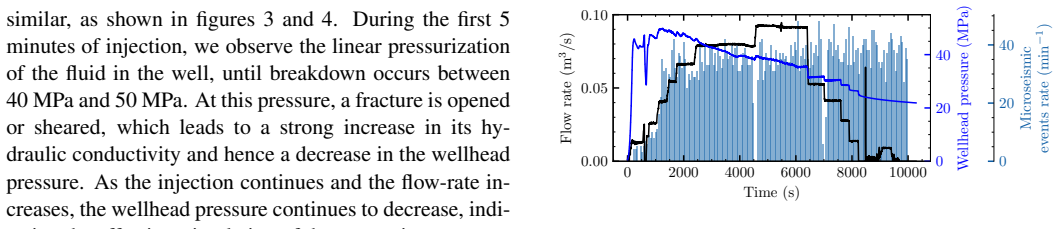
We investigate two hydraulic stimulation stages performed in April 2022 at the Utah FORGE enhanced geothermal system test site using analytical and numerical models for tensile hydraulic fractures and fluid-induced dilatant shear fractures. The two injection stages differ primarily by the viscosity of the fracturing fluid. Despite similar injection rate schedules and well-head pressure responses, the two stages exhibit markedly different post-shut-in microseismic behavior. The cross-linked gel stage shows sustained microseismic activity for several hours after shut-in, whereas the slickwater stage exhibits an immediate decrease. For the cross-linked gel stage, the located microseismic events reveal the development of a planar radial fracture and allow confident retrieval of the fracture extent evolution with time. We demonstrate that this evolution follows the scalings predicted for viscosity-storage-dominated radial hydraulic fracture by analytical models, providing strong evidence for the development of a planar tensile hydraulic fracture. We further show that leak-off is required to reproduce the fracture extent. In contrast, the immediate arrest observed during the slick-water stage suggests either a transition to a toughness- or leak-off-dominated hydraulic fracture regime, or the development of a fluid-induced shear fracture. We show that the slickwater stage could plausibly correspond to a dilatant shear fracture, provided sufficient dilatancy, whereas this hypothesis is invalidated for the cross-linked gel stage. We confirm these insights using a 3D axisymmetric fully-coupled hydro-mechanical numerical model capable of resolving both tensile and shear failure modes, and including leak-off. Finally, we propagate uncertainties in the in-situ stress state and natural fracture orientations through this numerical model to assess their impact on injection pressures.
Editorial analysis
A structured set of objections, weighed in public.
Referee Report
Summary. The paper models two 2022 Utah FORGE EGS stimulation stages that differ mainly in fluid viscosity. It claims the cross-linked gel stage produced a planar radial tensile hydraulic fracture whose microseismic-derived extent evolution matches the analytical scalings for viscosity-storage-dominated radial growth once leak-off is included, while the slickwater stage is consistent with a fluid-induced dilatant shear fracture (provided sufficient dilatancy) because of its immediate post-shut-in microseismic arrest. These interpretations are supported by a 3D axisymmetric fully-coupled hydro-mechanical numerical model that resolves both tensile and shear modes and by propagation of uncertainties in in-situ stress and natural-fracture orientations.
Significance. If the microseismic front-tracking assumption holds, the work supplies concrete evidence that fluid viscosity can control the dominant failure mode during EGS stimulation and demonstrates how analytical scalings plus numerical confirmation can be combined to interpret field observations. The inclusion of leak-off, dilatancy, and stress-orientation uncertainty propagation are positive features that move the field toward more mechanistic rather than purely empirical modeling.
major comments (4)
- [Abstract / gel-stage section] Abstract and gel-stage microseismic analysis: the assertion that located events 'allow confident retrieval' of fracture extent evolution is load-bearing for the tensile interpretation, yet the manuscript provides no explicit definition of front location (maximum radius, percentile contour, fitted ellipse) nor any robustness test against location uncertainty, detection threshold, or events triggered behind the tip rather than at the propagating front.
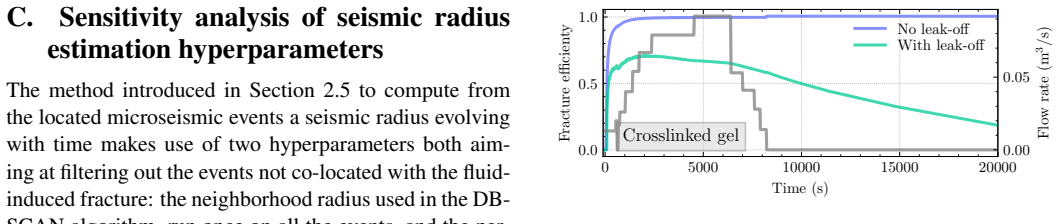
- [Analytical scaling section] Gel-stage scaling comparison: the reported match to viscosity-storage-dominated R(t) scalings is obtained only after introducing a leak-off coefficient that is adjusted to fit the observed extent; this reduces the claimed parameter-free character of the scaling test and introduces the circularity noted in the stress-test evaluation.
- [Slickwater / numerical model section] Slickwater-stage interpretation: the dilatancy parameter required to reproduce the immediate post-shut-in arrest is chosen to match the data; without a sensitivity table or quantitative error bars on how much dilatancy is needed versus other unmodeled effects (rheology, variable leak-off), the uniqueness of the shear-fracture hypothesis remains unquantified.
- [Numerical modeling section] Numerical model validation: while the 3D axisymmetric model reproduces both stages when leak-off and dilatancy are included, the manuscript does not report a systematic sensitivity study or misfit metrics (e.g., RMS error on pressure or extent) that would show how well the model distinguishes the two modes when parameters are varied within plausible ranges.
minor comments (1)
- [Figures] Figures showing microseismic clouds would be clearer if they overlaid the derived extent contours used for the scaling comparison and included the analytical R(t) curves for direct visual assessment.
Simulated Author's Rebuttal
We thank the referee for the thoughtful and constructive review. The comments highlight important areas where the manuscript can be strengthened through clearer definitions, additional robustness checks, and quantitative sensitivity analyses. We address each major comment below and will revise the manuscript accordingly.
read point-by-point responses
-
Referee: [Abstract / gel-stage section] Abstract and gel-stage microseismic analysis: the assertion that located events 'allow confident retrieval' of fracture extent evolution is load-bearing for the tensile interpretation, yet the manuscript provides no explicit definition of front location (maximum radius, percentile contour, fitted ellipse) nor any robustness test against location uncertainty, detection threshold, or events triggered behind the tip rather than at the propagating front.
Authors: We agree that an explicit definition of the fracture front and robustness tests are needed to support the claim of confident retrieval. In the revised manuscript we will define the front as the 95th-percentile radial distance of located events within successive time windows and will add an appendix containing robustness tests that vary the percentile threshold, incorporate location uncertainty ellipsoids, and assess the effect of detection thresholds and possible behind-the-tip events. These additions will make the microseismic extent analysis more transparent and reproducible. revision: yes
-
Referee: [Analytical scaling section] Gel-stage scaling comparison: the reported match to viscosity-storage-dominated R(t) scalings is obtained only after introducing a leak-off coefficient that is adjusted to fit the observed extent; this reduces the claimed parameter-free character of the scaling test and introduces the circularity noted in the stress-test evaluation.
Authors: The leak-off coefficient was chosen from the range of values reported in prior Utah FORGE site characterization rather than being freely fitted; however, we acknowledge that the presentation can give the impression of circularity. We will revise the scaling section to show the R(t) comparison both with and without leak-off, demonstrate that the no-leak-off case deviates systematically from the data, and clarify the independent basis for the selected leak-off value. We will also separate the stress-test evaluation from the scaling comparison to eliminate any perceived circularity. revision: partial
-
Referee: [Slickwater / numerical model section] Slickwater-stage interpretation: the dilatancy parameter required to reproduce the immediate post-shut-in arrest is chosen to match the data; without a sensitivity table or quantitative error bars on how much dilatancy is needed versus other unmodeled effects (rheology, variable leak-off), the uniqueness of the shear-fracture hypothesis remains unquantified.
Authors: We accept that a quantitative sensitivity analysis is required to assess the uniqueness of the dilatancy explanation. In revision we will add a table and accompanying text that vary the dilatancy coefficient over a plausible range, report the minimum dilatancy needed to produce immediate post-shut-in arrest, and compare this requirement against plausible variations in fluid rheology and leak-off. This will allow readers to judge how distinctive the dilatant-shear interpretation is relative to alternative mechanisms. revision: yes
-
Referee: [Numerical modeling section] Numerical model validation: while the 3D axisymmetric model reproduces both stages when leak-off and dilatancy are included, the manuscript does not report a systematic sensitivity study or misfit metrics (e.g., RMS error on pressure or extent) that would show how well the model distinguishes the two modes when parameters are varied within plausible ranges.
Authors: We agree that systematic sensitivity results and quantitative misfit metrics would strengthen the numerical validation. We will add RMS error values for both well-head pressure and fracture-extent time series, together with a sensitivity study that perturbs leak-off, dilatancy, in-situ stress, and natural-fracture orientation within their documented uncertainty ranges. The results will be presented to demonstrate the model’s ability to discriminate between tensile and dilatant-shear modes under realistic parameter variations. revision: yes
Circularity Check
No significant circularity in derivation chain.
full rationale
The paper retrieves fracture extent from microseismic locations as an independent observational input, then compares its time evolution against standard analytical scalings for viscosity-storage-dominated radial hydraulic fractures drawn from the external literature. Leak-off is introduced as an adjustable parameter required to reproduce the observed extent, but this does not redefine the scalings themselves or convert a fit into a claimed first-principles prediction. The slickwater interpretation is presented as one plausible hypothesis among alternatives, tested via a separate 3D hydro-mechanical numerical model that resolves tensile versus shear modes without reducing to self-definition or self-citation load-bearing. No quoted steps exhibit the enumerated circular patterns; the central claim rests on external model comparison rather than tautological construction.
Axiom & Free-Parameter Ledger
free parameters (2)
- leak-off coefficient
- dilatancy parameter
axioms (2)
- standard math Linear elastic fracture mechanics governs tensile crack growth
- domain assumption Microseismic event locations accurately delineate the fracture front
Reference graph
Works this paper leans on
-
[1]
Arrest of a radial hydraulic fracture upon shut-in of the injection , volume =
M. Arrest of a radial hydraulic fracture upon shut-in of the injection , volume =. International Journal of Solids and Structures , pages =
-
[2]
Development of a Discrete Fracture Network Model for Utah FORGE using Microseismic Data Collected During Stimulation of Well 16A(78)-32 , year =
Aleta, Finnila and Bryan, Forbes and Podgorney, Robert , journal =. Development of a Discrete Fracture Network Model for Utah FORGE using Microseismic Data Collected During Stimulation of Well 16A(78)-32 , year =
-
[3]
Updated Reference Discrete Fracture Network Model at Utah FORGE , year =
Aleta, Finnila and Bryan, Forbes , journal =. Updated Reference Discrete Fracture Network Model at Utah FORGE , year =
-
[4]
Utah FORGE: Updated Seismic Event Catalogue from the April, 2022 Stimulation of Well 16A(78)-32 , url =
Dyer, Ben and Karvounis, Dimitrios and Bethmann, Falko , doi =. Utah FORGE: Updated Seismic Event Catalogue from the April, 2022 Stimulation of Well 16A(78)-32 , url =
2022
-
[5]
Xing, Pengju and Damjanac, Branko and Moore, Joseph and McLennan, John , journal =. Flowback. 2022 , issn =. doi:10.1007/s00603-021-02604-x , file =
-
[6]
The Utah Frontier Observatory for Research in Geothermal Energy (FORGE): an international laboratory for enhanced geothermal system technology development , year =
Moore, Joseph and McLennan, John and Allis, Rick and Pankow, Kristine and Simmons, Stuart and Podgorney, Robert and Wannamaker, Phil and Bartley, John and Jones, Clay and Rickard, William , booktitle =. The Utah Frontier Observatory for Research in Geothermal Energy (FORGE): an international laboratory for enhanced geothermal system technology development...
-
[7]
Deichmann, Nicholas and Giardini, Domenico , journal =. 2009 , issn =. doi:10.1785/gssrl.80.5.784 , eprint =
-
[8]
Post-injection aseismic slip as a mechanism for the delayed triggering of seismicity , year =
Sáez, Alexis and Lecampion, Brice , journal =. Post-injection aseismic slip as a mechanism for the delayed triggering of seismicity , year =. doi:10.1098/rspa.2022.0810 , file =
-
[9]
Utah FORGE: 2023 Phase 3B Year 1 Annual Report , url =
Moore, Joe and Wannamaker, Phillip and McLennen, John and Pankow, Kris and Skowron, Gosia and Nash, Greg and Jones, Clay and Barker, Ben and Podgorney, Rob and Simmons, Stuart , month =. Utah FORGE: 2023 Phase 3B Year 1 Annual Report , url =
2023
-
[10]
Evans, K. F. and Moriya, H. and Niitsuma, H. and Jones, R. H. and Phillips, W. S. and Genter, A. and Sausse, J. and Jung, R. and Baria, R. , journal =. Microseismicity and permeability enhancement of hydrogeologic structures during massive fluid injections into granite at 3 km depth at the. 2005 , issn =. doi:10.1111/j.1365-246X.2004.02474.x , file =
-
[11]
The value of in-reservoir energy storage for flexible dispatch of geothermal power , year =
Ricks, Wilson and Norbeck, Jack and Jenkins, Jesse , journal =. The value of in-reservoir energy storage for flexible dispatch of geothermal power , year =. doi:10.1016/j.apenergy.2022.118807 , file =
-
[12]
2023 , month = jul, abstract =
Norbeck, Jack Hunter and Latimer, Timothy , title =. 2023 , month = jul, abstract =
2023
-
[13]
Adachi, J. I. and Detournay, E. , journal =. Self-similar solution of a plane-strain fracture driven by a power-law fluid , year =. doi:10.1002/nag.213 , file =
-
[14]
and Detournay, Emmanuel , journal =
Garagash, Dmitry I. and Detournay, Emmanuel , journal =. Plane-. 2005 , issn =. doi:10.1115/1.2047596 , file =
-
[15]
Utah FORGE: Phase 2C Topical Report , url =
Moore, Joseph and Simmons, Stuart and McLennan, John and Jones, Clay and Skowron, Gosia and Wannamaker, Phil and Nash, Greg and Hardwick, Christian and Hurlbut, Will and Allis, Rick and Kirby, Stephan and Erickson, Ben and Feigl, Kurt and Batzli, Sam and Miller, John and Witter, Jeff and Podgorney, Rob and Pankow, Kristine and Reinisch, Elena and Patel, V...
-
[16]
Journal of the Mechanics and Physics of Solids , author =
Sáez, Alexis and Lecampion, Brice and Bhattacharya, Pathikrit and Viesca, Robert C. , journal =. Three-dimensional fluid-driven stable frictional ruptures , year =. doi:10.1016/j.jmps.2021.104754 , file =
-
[17]
Olasolo, P. and Juárez, M. C. and Morales, M. P. and D´Amico, Sebastiano and Liarte, I. A. , journal =. Enhanced geothermal systems (. 2016 , issn =. doi:10.1016/j.rser.2015.11.031 , file =
-
[18]
Villiger, Linus and Gischig, Valentin and Kwiatek, Grzegorz and Krietsch, Hannes and Doetsch, Joseph and Jalali, Mohammadreza and Amann, Florian and Giardini, Domenico and Wiemer, Stefan , journal =. Meter-scale stress heterogeneities and stress redistribution drive complex fracture slip and fracture growth during a hydraulic stimulation experiment , year...
-
[19]
2023 , month =
Mustafa, Ayyaz and Bunger, Andrew and Kelley, Mark , title =. 2023 , month =
2023
-
[20]
Lecampion, Brice and Desroches, Jean , journal =. Simultaneous initiation and growth of multiple radial hydraulic fractures from a horizontal wellbore , year =. doi:10.1016/j.jmps.2015.05.010 , file =
-
[21]
Ciardo, Federico and Lecampion, Brice , title =. 2022 , month = dec, note =. doi:10.48550/arXiv.2212.01050 , file =
-
[22]
Garagash, Dmitry and Germanovich, Leonid , journal =. Nucleation and. 2012 , month = oct, pages =. doi:10.1029/2012JB009209 , file =
-
[23]
Fluid-driven slow slip and earthquake nucleation on a slip-weakening circular fault , year =
Sáez, Alexis and Lecampion, Brice , journal =. Fluid-driven slow slip and earthquake nucleation on a slip-weakening circular fault , year =. doi:10.1016/j.jmps.2023.105506 , file =
-
[24]
McClure, Mark W. and Horne, Roland N. , journal =. An investigation of stimulation mechanisms in. 2014 , issn =. doi:10.1016/j.ijrmms.2014.07.011 , file =
-
[25]
Three-dimensional fluid-driven frictional ruptures: theory and applications , year =
Sáez Uribe, Alexis Alejandro , school =. Three-dimensional fluid-driven frictional ruptures: theory and applications , year =. doi:10.5075/epfl-thesis-10303 , file =
-
[26]
and Renner, J
Ortiz R, A.E. and Renner, J. and Jung, R. , journal =. Hydromechanical analyses of the hydraulic stimulation of borehole Basel 1 , year =
-
[27]
Xing, Pengju and McLennan, John and Moore, Joseph , journal =. In-. 2020 , issn =. doi:10.3390/en13215842 , file =
-
[28]
and Detournay, Emmanuel , journal =
Bunger, Andrew P. and Detournay, Emmanuel , journal =. Early-. 2007 , issn =. doi:10.1061/(ASCE)0733-9399(2007)133:5(534) , file =
-
[29]
Saez, Alexis and Passelègue, François and Lecampion, Brice , title =. 2024 , month = sep, note =. doi:10.48550/arXiv.2409.03330 , file =
-
[30]
Theis, Charles V. , journal =. The relation between the lowering of the. 1935 , month = jan, note =. doi:10.1029/TR016i002p00519 , file =
-
[31]
Sayers, C. M. and Kachanov, M. , journal =. A simple technique for finding effective elastic constants of cracked solids for arbitrary crack orientation statistics , year =. doi:10.1016/0020-7683(91)90027-D , file =
-
[32]
Detournay, Emmanuel , journal =. Mechanics of. 2016 , month = jan, pages =. doi:10.1146/annurev-fluid-010814-014736 , file =
-
[33]
Savitski, A. A. and Detournay, E. , journal =. Propagation of a penny-shaped fluid-driven fracture in an impermeable rock: asymptotic solutions , year =. doi:10.1016/S0020-7683(02)00492-4 , file =
-
[34]
Reservoir stimulation , year =
Economides, Michael J and Nolte, Kenneth G and others , publisher =. Reservoir stimulation , year =
-
[35]
Utah FORGE: Well 58-32 Core Analyses , year =
McLennan, John , howpublished =. Utah FORGE: Well 58-32 Core Analyses , year =. doi:10.15121/1557418 , url =
-
[36]
Utah FORGE: 2023 Large Upscaled Discrete Fracture Network Models , year =
Finnila, Aleta , howpublished =. Utah FORGE: 2023 Large Upscaled Discrete Fracture Network Models , year =. doi:10.15121/2007506 , url =
-
[37]
Hoek, E. and Diederichs, M. S. , journal =. Empirical estimation of rock mass modulus , year =. doi:10.1016/j.ijrmms.2005.06.005 , file =
-
[38]
Calibration Parameters Required to Match the Utah FORGE 16A(78)-32 Stage 3 Stimulationwith a Planar Fracturing Model , year =
McClure, Mark , journal =. Calibration Parameters Required to Match the Utah FORGE 16A(78)-32 Stage 3 Stimulationwith a Planar Fracturing Model , year =
-
[39]
The Utah Frontier Observatory for Research in Geothermal Energy (FORGE): AnInternational Laboratory for Enhanced Geothermal System Technology Development , year =
Moore, Joseph and McLennan,John and Allis,Rick and Pankow,Kristine and Simmons,Stuart and Podgorney,Robert and Wannamaker,Philip and Bartley,John and Jones,Clay and Rickard,William , booktitle =. The Utah Frontier Observatory for Research in Geothermal Energy (FORGE): AnInternational Laboratory for Enhanced Geothermal System Technology Development , year =
-
[40]
, file =
Kelley, Mark and Raziperchikolaee, Samin and Likrama, Fatmir and Skopec, Stuart and Barrios, Jorge. , file =. Utah FORGE 2439: Report on Minifrac Tests for Stress Characterization , url =
-
[41]
2024 , month =
Ye, Zhi and Ghassemi, Ahmad , title =. 2024 , month =
2024
-
[42]
Iyare, U. C. and Frash, L. P. and K c, B. and Meng, M. and Li, W. and Madenova, Y. and Peterson, S. K. and Gross, M. R. and Smith, M. M. and Kroll, K. A. , journal =. Experimental investigation of shear in granite fractures at. 2025 , issn =. doi:10.1016/j.geothermics.2025.103344 , file =
-
[43]
Goebel, Thomas H. W. and Brodsky, Emily E. , journal =. The spatial footprint of injection wells in a global compilation of induced earthquake sequences , year =. doi:10.1126/science.aat5449 , file =
-
[44]
Kanin, Evgenii A. and Dontsov, Egor V. and Garagash, Dmitry I. and Osiptsov, Andrei A. , journal =. A radial hydraulic fracture with pressure-dependent leak-off , year =. doi:10.1016/j.jmps.2020.104062 , file =
-
[45]
2021 , month = jun, file =
Xing, Pengju and Damjanac, Branko and Radakovic-Guzina, Zorica and Finnila, Aleta and Podgorney, Robert and Moore, Joseph and Mclennan, John , title =. 2021 , month = jun, file =
2021
-
[46]
Wagner, W. and Pruß, A. , journal =. The. 2002 , issn =. doi:10.1063/1.1461829 , file =
-
[47]
and Gupta, A
Lecampion, B. and Gupta, A. and S. A robust numerical solver for the simulation of fluid-driven ruptures on pre-existing discontinuities in fractured rocks , year =. Proceedings of the International Conference on Energy Geotechnics , month =
-
[48]
Lessons learned from the
Hogarth, Robert and Holl, Heinz-Gerd , journal =. Lessons learned from the. 2017 , month = oct, volume =
2017
-
[49]
Papanastasiou, Panos , journal =. The. 1999 , issn =. doi:10.1023/A:1018676212444 , file =
discussion (0)
Sign in with ORCID, Apple, or X to comment. Anyone can read and Pith papers without signing in.