Recognition: unknown
The strange mechanics of an elastic rod under null-resultant transverse loads
Pith reviewed 2026-05-10 03:28 UTC · model grok-4.3
The pith
Null-resultant transverse loads on an elastic rod produce the same buckling effect as axial compression.
A machine-rendered reading of the paper's core claim, the machinery that carries it, and where it could break.
Core claim
Two equal and opposite distributed dead loads applied orthogonally to the axis of an elastic rod in its rectilinear reference configuration produce a transverse stress that adds to any axial load in a generalized version of the Euler elastica. This leads to buckling and nontrivial postcritical deformations when the transverse load is compressive. The critical transverse stress for buckling has the same form as the Euler critical stress under axial force and tends to zero in the limit of vanishing rod inertia, so that instability persists even when the rod thickness tends to zero.
What carries the argument
Generalized Euler elastica equation that incorporates the transverse stress arising from null-resultant loads, derived from asymptotic analysis of the elastic layer and homogenization of a discrete model.
If this is right
- Buckling occurs at a critical transverse stress that has exactly the same form as the classical Euler critical load.
- Postcritical deformation paths follow the generalized elastica, including configurations beyond self-intersection.
- Instability induced by transverse loading does not disappear as rod thickness tends to zero.
- Numerical simulations of a slender elastic layer reproduce the predicted deformation path throughout the entire postcritical regime.
- Dedicated experiments confirm both the onset of buckling and the subsequent deformation under transverse loading.
Where Pith is reading between the lines
- The same transverse-stress mechanism may govern stability in thin plates or shells subjected to balanced lateral pressures.
- Designers of microscale elastic devices could exploit side loads to trigger controlled buckling without end forces.
- Biological filaments or polymer chains under distributed lateral contact may exhibit analogous instability modes.
- Dynamic or viscoelastic extensions of the model could uncover time-dependent buckling thresholds not captured by the static analysis.
Load-bearing premise
The three rod models and the numerical layer simulations correctly capture the incremental deformation produced by the null-resultant transverse loads.
What would settle it
A measurement in which the buckling threshold under increasing transverse stress deviates from the Euler-like formula or in which buckling fails to appear as rod inertia approaches zero.
Figures




read the original abstract
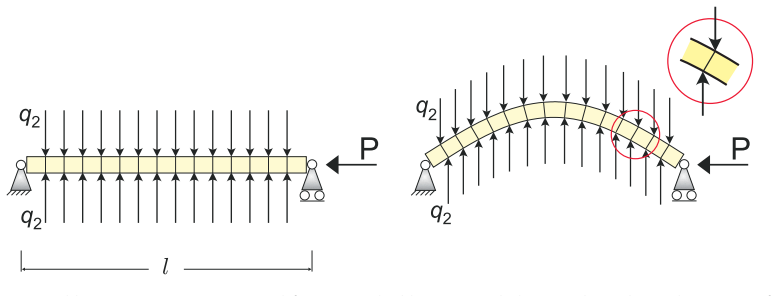
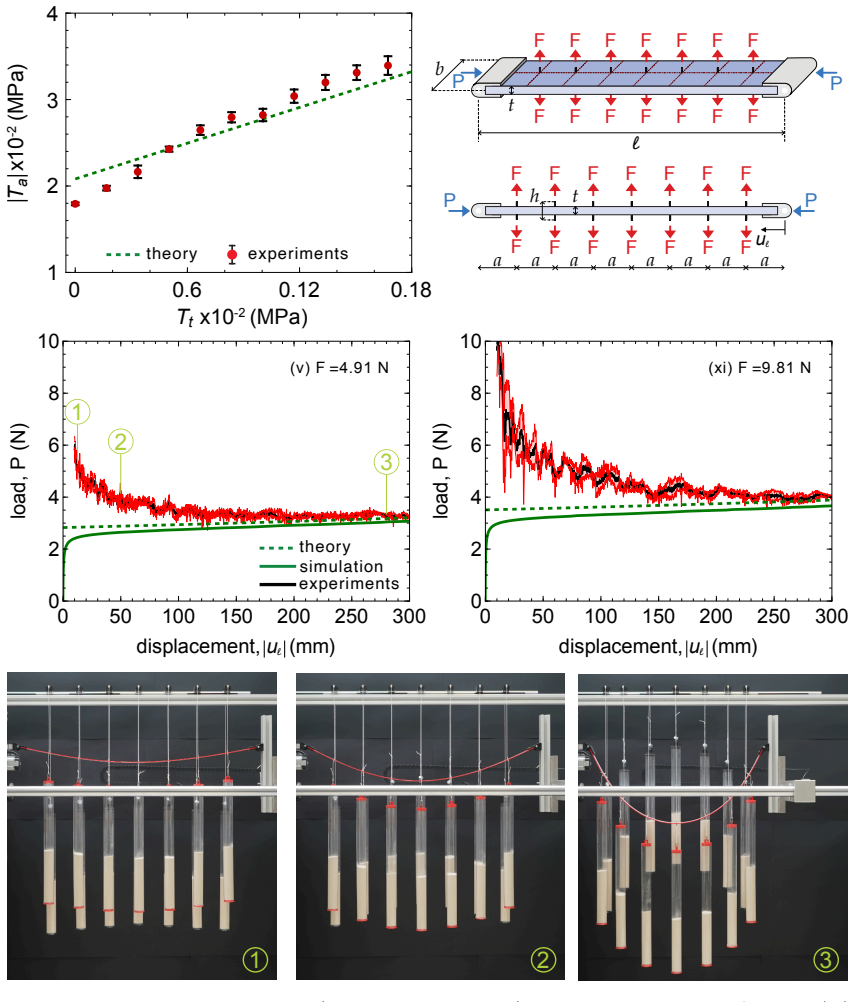
Two equal and opposite distributed dead loads are applied orthogonally to the axis of an elastic rod in its rectilinear reference configuration, one at the extrados and the other at the intrados, such that the resultant applied force per unit length is uniformly zero. In this configuration, the rod is subjected to a transverse (tensile or compressive) stress, which is usually believed to have no significant effect on the structural response and has therefore not been considered so far. Contrary to this common belief, the asymptotic behavior of an incrementally deformed elastic layer and three different rod models (the first derived as an asymptotic approximation of the elastic layer; the second based on Euler elastica; and the third obtained by homogenization of a discrete model) reveal that this loading condition produces the same deformation in the rod as an axial load. In particular, the transverse load adds to the axial load in a generalized version of the Euler elastica, leading to buckling and nontrivial postcritical deformations when compressive. The critical transverse stress for buckling is found to have the same form as the Euler critical stress under axial force and tends to zero in the limit of vanishing rod inertia. For this reason, instability induced by transverse loading persists even when the rod thickness tends to zero. These theoretical predictions are confirmed by numerical simulations of a slender elastic layer, which show that increasing transverse load can induce buckling and drive the layer along a deformation path that closely follows that predicted by the generalized Euler elastica throughout the entire postcritical regime, even beyond self-intersection. To show that this behavior can be realized in practice, a dedicated experimental setup is developed, and the experimental results fully confirm the theoretical and numerical predictions.
Editorial analysis
A structured set of objections, weighed in public.
Referee Report
Summary. The paper claims that null-resultant transverse loads (equal and opposite distributed dead loads applied orthogonally to the rod axis on extrados and intrados) induce the same incremental and post-critical deformations as an axial compressive load in a generalized Euler elastica. The critical transverse stress for buckling takes the same form as the classical Euler stress and remains nonzero even as rod thickness (inertia) tends to zero. This equivalence is derived via three routes—asymptotic reduction of a 2D elastic layer, direct modification of the elastica equations, and homogenization of a discrete chain—then confirmed by 2D layer finite-element simulations and a dedicated experiment.
Significance. If the equivalence is rigorously established, the result identifies a previously overlooked instability mechanism in slender elastic bodies: transverse surface tractions that cancel in net force can still drive buckling and large post-critical deformations. The multi-model strategy (asymptotic, elastica, homogenization) plus numerical and experimental corroboration constitutes a strength; the finding that the critical stress survives the thin-rod limit is particularly noteworthy and could affect modeling of thin films, filaments, and layered structures under contact or pressure loads.
major comments (3)
- [Sections deriving the three rod models (asymptotic, elastica, homogenization)] The central equivalence rests on showing that the null-resultant transverse tractions enter the moment balance exactly as an effective axial force without generating residual distributed shear, extension, or moment contributions in the deformed configuration. The manuscript must therefore display the explicit moment-balance equation obtained from each of the three modeling routes (asymptotic layer reduction, modified elastica, and discrete homogenization) and demonstrate that the transverse-stress term appears identically in all three without extra kinematic or constitutive assumptions that would break the mapping.
- [Numerical simulations section] The 2D layer simulations are presented as independent confirmation, yet any shared kinematic idealization (e.g., plane-sections assumption or neglect of transverse shear in the constitutive law) could make the agreement with the elastica an artifact rather than a falsification of the skeptic's concern. Quantitative error measures—such as L2-norm difference in centerline deflection or relative error in critical load versus the generalized elastica prediction—must be reported for several thickness-to-length ratios and load levels.
- [Experimental section] The experimental setup must demonstrate that the applied surface tractions remain null-resultant throughout the deformation (i.e., that contact or fixture compliance does not introduce net force or unintended moments). Without such verification, the observed buckling path cannot be unambiguously attributed to the transverse-stress mechanism.
minor comments (2)
- [Abstract] The abstract states that the critical transverse stress 'has the same form as the Euler critical stress' but does not display the explicit formula; including it would improve readability.
- [Figures] Figure captions should state the nondimensionalization used for the transverse stress (e.g., normalized by EI/L^2) so that readers can directly compare numerical and experimental data to the analytic prediction.
Simulated Author's Rebuttal
We thank the referee for the careful reading and constructive comments on our manuscript. We address each major comment below and will revise the manuscript to incorporate the requested clarifications and additions.
read point-by-point responses
-
Referee: [Sections deriving the three rod models (asymptotic, elastica, homogenization)] The central equivalence rests on showing that the null-resultant transverse tractions enter the moment balance exactly as an effective axial force without generating residual distributed shear, extension, or moment contributions in the deformed configuration. The manuscript must therefore display the explicit moment-balance equation obtained from each of the three modeling routes (asymptotic layer reduction, modified elastica, and discrete homogenization) and demonstrate that the transverse-stress term appears identically in all three without extra kinematic or constitutive assumptions that would break the mapping.
Authors: We agree that explicit comparison of the moment-balance equations is necessary to substantiate the claimed equivalence. In the revised manuscript we will add a dedicated subsection (or appendix) that presents the moment-balance equation derived from each of the three routes—asymptotic reduction of the 2D layer, direct modification of the elastica, and discrete homogenization—and shows that the transverse-stress term enters identically as an effective axial force, without introducing extraneous shear, extension or moment residuals that would invalidate the mapping. revision: yes
-
Referee: [Numerical simulations section] The 2D layer simulations are presented as independent confirmation, yet any shared kinematic idealization (e.g., plane-sections assumption or neglect of transverse shear in the constitutive law) could make the agreement with the elastica an artifact rather than a falsification of the skeptic's concern. Quantitative error measures—such as L2-norm difference in centerline deflection or relative error in critical load versus the generalized elastica prediction—must be reported for several thickness-to-length ratios and load levels.
Authors: The referee correctly identifies the value of quantitative error metrics to strengthen the numerical validation. We will augment the simulations section with L2-norm differences in centerline deflection and relative errors in critical load, evaluated against the generalized elastica solution for several thickness-to-length ratios and multiple load levels. revision: yes
-
Referee: [Experimental section] The experimental setup must demonstrate that the applied surface tractions remain null-resultant throughout the deformation (i.e., that contact or fixture compliance does not introduce net force or unintended moments). Without such verification, the observed buckling path cannot be unambiguously attributed to the transverse-stress mechanism.
Authors: We acknowledge the importance of verifying that the applied tractions remain null-resultant during deformation. In the revised manuscript we will supply additional documentation of the experimental apparatus, including force-balance measurements and fixture-compliance estimates, to confirm that net force and unintended moments remain negligible throughout the observed buckling path. revision: yes
Circularity Check
No circularity: equivalence derived independently across three rod models and validated externally
full rationale
The paper establishes the equivalence of null-resultant transverse loads to axial loads via three separate derivations (asymptotic reduction of the 2D elastic layer, modification of the Euler elastica, and homogenization of a discrete chain) plus direct numerical simulation of the layer and physical experiments. None of these steps reduces a claimed prediction to a fitted input, self-citation, or definitional renaming; each model starts from its own equilibrium and constitutive assumptions and arrives at the same generalized elastica equation. The critical transverse stress formula is obtained from the moment balance in each framework rather than imposed by construction. This multi-route structure supplies independent content, so the overall derivation chain is self-contained.
Axiom & Free-Parameter Ledger
axioms (3)
- domain assumption Standard assumptions of linear elasticity for small incremental deformations of the layer
- domain assumption Euler-Bernoulli kinematics remain valid for the elastica model under the added transverse stress
- domain assumption Homogenization of the discrete model yields an equivalent continuum rod
Reference graph
Works this paper leans on
-
[1]
Discrete and nonlocal models of Engesser and Haringx elastica , volume =
Kocsis, Attila and Challamel, Noël and Károlyi, György , urldate =. Discrete and nonlocal models of Engesser and Haringx elastica , volume =. doi:10.1016/j.ijmecsci.2017.05.037 , pages =
-
[2]
Paradiso, M. and Dal Corso, F. and Bigoni, D. , urldate =. A nonlinear model of shearable elastic rod from an origami-like microstructure displaying folding and faulting , volume =. doi:10.1016/j.jmps.2025.106100 , pages =
-
[3]
Hill, R. and Hutchinson, J.W. , urldate =. Bifurcation phenomena in the plane tension test , volume =. doi:10.1016/0022-5096(75)90027-7 , pages =
-
[4]
, date =
Biot, M.A. , date =. Mechanics of incremental deformations , url =
-
[5]
Domokos, G. and Holmes, P. , urldate =. Euler's problem, Euler's method, and the standard map; or, the discrete charm of buckling , volume =. doi:10.1007/BF02429861 , pages =
-
[6]
The Odd Stability of the Euler Beam , volume =
Domokos, Gábor , editor =. The Odd Stability of the Euler Beam , volume =. Modern Problems of Structural Stability , publisher =
-
[7]
Qualitative Convergence in the Discrete Approximation of the Euler Problem , volume =
Domokos, Gabor , urldate =. Qualitative Convergence in the Discrete Approximation of the Euler Problem , volume =. doi:10.1080/08905459308905200 , pages =
-
[8]
Bigoni, D. and Ortiz, M. and Needleman, A. , urldate =. Effect of interfacial compliance on bifurcation of a layer bonded to a substrate , volume =. doi:10.1016/S0020-7683(97)00025-5 , pages =
-
[9]
Nonlinear solid mechanics: bifurcation theory and material instability , isbn =
Bigoni, Davide , date =. Nonlinear solid mechanics: bifurcation theory and material instability , isbn =
discussion (0)
Sign in with ORCID, Apple, or X to comment. Anyone can read and Pith papers without signing in.