Recognition: unknown
X-Ray Polarization from the Atoll 4U 1735-44 Suggests a Low Inclination
Pith reviewed 2026-05-10 04:23 UTC · model grok-4.3
The pith
X-ray polarimetry of 4U 1735-44 shows marginal polarization consistent with a low disk inclination of about 40 degrees.
A machine-rendered reading of the paper's core claim, the machinery that carries it, and where it could break.
Core claim
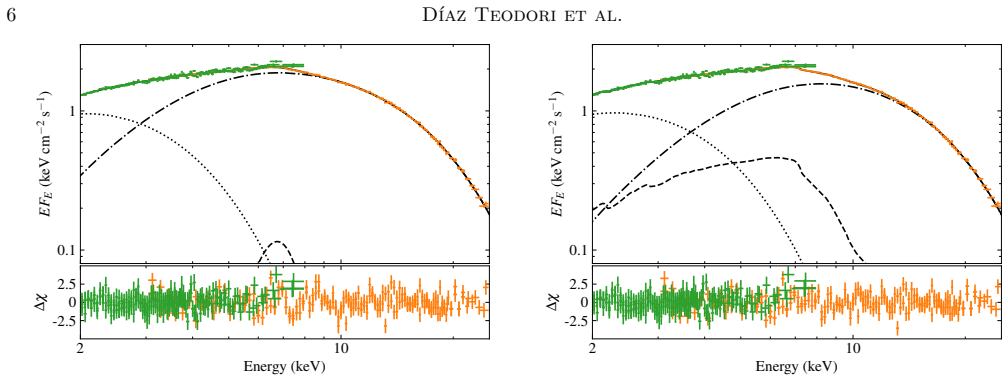
The spectroscopic and polarimetric properties of 4U 1735-44 are consistent with those observed in other atoll sources studied by IXPE, with its low polarization likely due to its low inclination. The best-fit model comprises a thermal component associated with the accretion disk, a Comptonized blackbody component, and a relativistic reflection component, from which a disk inclination of about 40 degrees is derived.
What carries the argument
Relativistic reflection modeling of the X-ray spectrum combined with direct polarization measurements, which together constrain the accretion disk inclination angle.
If this is right
- The marginal polarization signal supports the low-inclination interpretation derived from the reflection component.
- Atoll sources with similarly low inclinations are expected to exhibit comparably low polarization degrees.
- Polarimetry can serve as a complementary tool to spectral reflection modeling for determining viewing angles in neutron star accretion systems.
- The consistency with other IXPE-studied atoll sources suggests shared accretion geometries across this class.
Where Pith is reading between the lines
- If low inclination is the main suppressor of polarization, then higher-inclination atoll sources should display measurably stronger polarization signals in future IXPE data.
- Correcting for inclination effects may enable polarimetry to isolate contributions from the Comptonizing region or disk atmosphere in these systems.
- This approach could be extended to statistical samples of atoll sources to map their inclination distribution and accretion flow properties.
Load-bearing premise
The low observed polarization is caused primarily by the low disk inclination rather than by details of the Comptonization geometry, magnetic field structure, or other unmodeled effects in the accretion flow.
What would settle it
A future observation that measures a polarization degree well above the current 3.5 percent upper limit, or an independent determination of a disk inclination much larger than 40 degrees from orbital dynamics or burst oscillation analysis, would challenge the claim.
Figures


read the original abstract
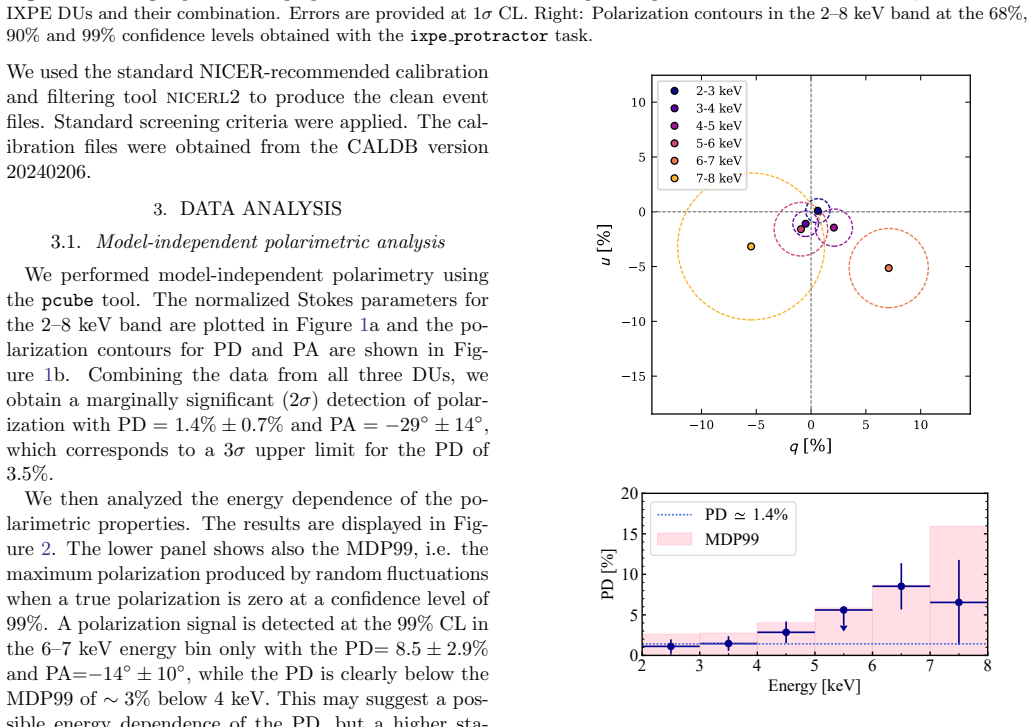
X-ray polarimetry is a new tool capable of probing the geometry of accretion onto weakly magnetized neutron stars. Here we present the first X-ray spectropolarimetric results from coordinated observations of the atoll source 4U 1735-44, conducted with the Imaging X-ray Polarimetry Explorer (IXPE), NICER, and NuSTAR. Over the 2-8 keV energy range, we obtained a marginal detection of polarization with the polarization degree of $1.4\%\pm0.7\%$ and polarization angle of $-29^\circ\pm14^\circ$, corresponding to a $3\sigma$ upper limit on the polarization degree of 3.5\%. The best-fit model to describe the spectrum comprises a thermal component associated with the accretion disk, a Comptonized blackbody component, and a relativistic reflection component. From the reflection model, we infer a disk inclination of $\sim 40^\circ$. The spectroscopic and polarimetric properties of 4U 1735-44 are consistent with those observed in other atoll sources studied by IXPE, with its low polarization likely due to its low inclination.
Editorial analysis
A structured set of objections, weighed in public.
Referee Report
Summary. The paper reports the first spectropolarimetric observations of the atoll source 4U 1735-44 using coordinated IXPE, NICER, and NuSTAR data. It finds a marginal polarization detection in the 2-8 keV band with PD = 1.4% ± 0.7% and PA = -29° ± 14°, yielding a 3σ upper limit of 3.5%. Spectral modeling with a disk blackbody, Comptonized blackbody, and relativistic reflection component infers a disk inclination of ~40°. The authors conclude that the low polarization is likely due to this low inclination and that the source's properties are consistent with other IXPE-observed atoll sources.
Significance. If the interpretation holds, this work adds a new source to the limited IXPE sample of polarized atoll sources, supporting a possible correlation between low polarization degree and low system inclination in weakly magnetized neutron star accretors. The multi-instrument spectral decomposition provides an independent inclination constraint via reflection modeling, which is a methodological strength. The result is incremental but useful for building statistical understanding of accretion geometries; the marginal detection, however, restricts its impact to suggestive rather than definitive.
major comments (1)
- [Abstract] Abstract: The central claim that the observed low polarization 'is likely due to its low inclination' lacks quantitative support. The manuscript does not compute the polarization degree and angle predicted by the best-fit multi-component model (disk blackbody + Comptonized blackbody + relativistic reflection) at i ≈ 40°. Comptonization and reflection each contribute energy-dependent polarization whose net value depends on optical depth, geometry, and 2-8 keV flux weighting; without this forward modeling, it is unclear whether the low inclination alone accounts for the marginal PD = 1.4% ± 0.7% or whether other unmodeled effects dominate.
minor comments (2)
- The polarization angle reference frame and any assumptions about energy dependence or constant polarization across the band should be stated explicitly in the polarization analysis section.
- Provide the full best-fit spectral parameters (including uncertainties on inclination and component normalizations) in a table to allow readers to evaluate the robustness of the ~40° inclination.
Simulated Author's Rebuttal
We thank the referee for their constructive and detailed review of our manuscript. We address the major comment below and are prepared to revise the paper to strengthen the interpretation of our results.
read point-by-point responses
-
Referee: [Abstract] Abstract: The central claim that the observed low polarization 'is likely due to its low inclination' lacks quantitative support. The manuscript does not compute the polarization degree and angle predicted by the best-fit multi-component model (disk blackbody + Comptonized blackbody + relativistic reflection) at i ≈ 40°. Comptonization and reflection each contribute energy-dependent polarization whose net value depends on optical depth, geometry, and 2-8 keV flux weighting; without this forward modeling, it is unclear whether the low inclination alone accounts for the marginal PD = 1.4% ± 0.7% or whether other unmodeled effects dominate.
Authors: We agree that the central claim would be strengthened by explicit forward modeling of the expected polarization from the best-fit spectral model. Our interpretation relies on the general theoretical expectation that both disk blackbody and relativistic reflection produce low polarization degrees at inclinations around 40°, with the Comptonized component likely diluting the net signal further, and on the consistency with other IXPE-observed atoll sources. However, we acknowledge that without a quantitative calculation incorporating the specific flux contributions, optical depths, and geometries from our multi-component fit, the link remains qualitative. In the revised manuscript we will add a dedicated subsection (or appendix) that estimates the predicted polarization degree and angle in the 2-8 keV band. This will be done by weighting the polarization properties of each component according to their best-fit fluxes: using known analytic or numerical expectations for Comptonized emission (depending on scattering geometry) and the inclination-dependent polarization from the relxill reflection model. The resulting net PD and PA will be compared directly to the observed marginal detection to assess consistency or identify possible additional effects. revision: yes
Circularity Check
No circularity: inclination from independent reflection fit, polarization direct measurement, comparison to other sources is external
full rationale
The paper measures polarization degree and angle directly from IXPE data (PD = 1.4% ± 0.7%, 3σ upper limit 3.5%). Disk inclination (~40°) is obtained separately from relativistic reflection modeling of the NICER+NuSTAR spectrum. The statement that low polarization is 'likely due to its low inclination' is a qualitative inference based on consistency with other IXPE atoll sources; no equation redefines one quantity in terms of the other, no parameter is fitted to polarization data and then called a prediction, and no self-citation chain supplies a load-bearing uniqueness theorem. The derivation chain remains self-contained against external benchmarks.
Axiom & Free-Parameter Ledger
free parameters (2)
- disk inclination
- polarization degree
axioms (2)
- domain assumption Standard assumptions of relativistic reflection modeling (disk geometry, emissivity profile, ionization state) accurately recover the true inclination.
- domain assumption Polarization in atoll sources is dominated by scattering in the accretion disk and corona geometry rather than other effects.
Reference graph
Works this paper leans on
-
[1]
Arnaud, K. A. 1996, in ASP Conf. Ser., Vol. 101, Astronomical Data Analysis Software and Systems V, ed. G. H. Jacoby & J. Barnes (San Francisco: ASP), 17–20
1996
-
[2]
Bahramian, A., & Degenaar, N. 2024, in Handbook of X-ray and Gamma-ray Astrophysics, ed. C. Bambi & A. Santangelo (Singapore: Springer), 3657–3718, doi: 10.1007/978-981-19-6960-7 94
-
[3]
2018, AJ, 156, 58, doi: 10.3847/1538-3881/aacb21
Mantelet, G., & Andrae, R. 2018, AJ, 156, 58, doi: 10.3847/1538-3881/aacb21
-
[4]
Baldini, L., Bucciantini, N., Di Lalla, N., et al. 2022, SoftwareX, 19, 101194, doi: 10.1016/j.softx.2022.101194
-
[5]
Astroparticle Physics , keywords =
Baldini, L., Barbanera, M., Bellazzini, R., et al. 2021, Astroparticle Physics, 133, 102628, doi: 10.1016/j.astropartphys.2021.102628
-
[6]
2024a, A&A, 688, A217, doi: 10.1051/0004-6361/202450207
Bobrikova, A., Di Marco, A., La Monaca, F., et al. 2024a, A&A, 688, A217, doi: 10.1051/0004-6361/202450207
-
[7]
2025, A&A, 696, A181, doi: 10.1051/0004-6361/202452358
Bobrikova, A., Poutanen, J., & Loktev, V. 2025, A&A, 696, A181, doi: 10.1051/0004-6361/202452358
-
[8]
Bobrikova, A., Forsblom, S. V., Di Marco, A., et al. 2024b, A&A, 688, A170, doi: 10.1051/0004-6361/202449318
-
[9]
2023, ApJ, 943, 129, doi: 10.3847/1538-4357/acae88
Capitanio, F., Fabiani, S., Gnarini, A., et al. 2023, ApJ, 943, 129, doi: 10.3847/1538-4357/acae88
-
[10]
Casares, J., Cornelisse, R., Steeghs, D., et al. 2006, MNRAS, 373, 1235, doi: 10.1111/j.1365-2966.2006.11106.x
-
[11]
2023, A&A, 674, L10, doi: 10.1051/0004-6361/202346275
Cocchi, M., Gnarini, A., Fabiani, S., et al. 2023, A&A, 674, L10, doi: 10.1051/0004-6361/202346275
-
[12]
Corbet, R. H. D., Smale, A. P., Charles, P. A., et al. 1989, MNRAS, 239, 533, doi: 10.1093/mnras/239.2.533 Di Marco, A., Costa, E., Muleri, F., et al. 2022, AJ, 163, 170, doi: 10.3847/1538-3881/ac51c9 Di Marco, A., La Monaca, F., Poutanen, J., et al. 2023a, ApJL, 953, L22, doi: 10.3847/2041-8213/acec6e Di Marco, A., Soffitta, P., Costa, E., et al. 2023b, ...
-
[13]
J., Schawinski, K., Slosar, A., et al
Matt, G. 2008, MNRAS, 391, 32, doi: 10.1111/j.1365-2966.2008.13872.x
-
[14]
2024, A&A, 684, A137, doi: 10.1051/0004-6361/202347374
Fabiani, S., Capitanio, F., Iaria, R., et al. 2024, A&A, 684, A137, doi: 10.1051/0004-6361/202347374
-
[15]
2024, A&A, 684, A62, doi: 10.1051/0004-6361/202348915
Farinelli, R., Waghmare, A., Ducci, L., & Santangelo, A. 2024, A&A, 684, A62, doi: 10.1051/0004-6361/202348915
-
[16]
2023, MNRAS, 519, 3681, doi: 10.1093/mnras/stac3726
Farinelli, R., Fabiani, S., Poutanen, J., et al. 2023, MNRAS, 519, 3681, doi: 10.1093/mnras/stac3726
-
[17]
Fridriksson, J. K., Homan, J., & Remillard, R. A. 2015, ApJ, 809, 52, doi: 10.1088/0004-637X/809/1/52
-
[18]
Galloway, D. K., Muno, M. P., Hartman, J. M., Psaltis, D., & Chakrabarty, D. 2008, ApJS, 179, 360, doi: 10.1086/592044 Garc´ ıa, J. A., Dauser, T., Ludlam, R., et al. 2022, ApJ, 926, 13, doi: 10.3847/1538-4357/ac3cb7
-
[19]
Space Telescopes and Instrumentation 2016: Ultraviolet to Gamma Ray , year = 2016, editor =
Gendreau, K. C., Arzoumanian, Z., Adkins, P. W., et al. 2016, in Proc. SPIE, Vol. 9905, Space Telescopes and Instrumentation 2016: Ultraviolet to Gamma Ray, ed. J.-W. A. den Herder, T. Takahashi, & M. Bautz, 99051H, doi: 10.1117/12.2231304
-
[20]
2022, MNRAS, 514, 2561, doi: 10.1093/mnras/stac1523 Polarized Emission from 4U 1735−449
Gnarini, A., Ursini, F., Matt, G., et al. 2022, MNRAS, 514, 2561, doi: 10.1093/mnras/stac1523 Polarized Emission from 4U 1735−449
-
[21]
2024, A&A, 692, A123, doi: 10.1051/0004-6361/202452642
Gnarini, A., Farinelli, R., Ursini, F., et al. 2024, A&A, 692, A123, doi: 10.1051/0004-6361/202452642
-
[22]
Harrison, F. A., Craig, W. W., Christensen, F. E., et al. 2013, ApJ, 770, 103, doi: 10.1088/0004-637X/770/2/103
-
[23]
Hasinger, G., & van der Klis, M. 1989, A&A, 225, 79 HI4PI Collaboration, Ben Bekhti, N., Fl¨ oer, L., et al. 2016, A&A, 594, A116, doi: 10.1051/0004-6361/201629178
-
[24]
Astronomy Letters , keywords =
Inogamov, N. A., & Sunyaev, R. A. 1999, Astronomy Letters, 25, 269, doi: 10.48550/arXiv.astro-ph/9904333
work page internal anchor Pith review doi:10.48550/arxiv.astro-ph/9904333 1999
-
[25]
doi:10.1016/j.astropartphys.2015.02.007 , eprint =
Kislat, F., Clark, B., Beilicke, M., & Krawczynski, H. 2015, Astroparticle Physics, 68, 45, doi: 10.1016/j.astropartphys.2015.02.007
-
[26]
1998, PASJ, 50, 667, doi: 10.1093/pasj/50.6.667 La Monaca, F., Di Marco, A., Poutanen, J., et al
Kubota, A., Tanaka, Y., Makishima, K., et al. 1998, PASJ, 50, 667, doi: 10.1093/pasj/50.6.667 La Monaca, F., Di Marco, A., Poutanen, J., et al. 2024, ApJL, 960, L11, doi: 10.3847/2041-8213/ad132d
-
[27]
Lapidus, I. I., & Sunyaev, R. A. 1985, MNRAS, 217, 291, doi: 10.1093/mnras/217.2.291
-
[28]
Lavanya, S., Thomas, N. T., Gudennavar, S. B., & Bubbly, S. G. 2024, MNRAS, 534, 2783, doi: 10.1093/mnras/stae2269
-
[29]
2013, AJ, 146, 60, doi: 10.1088/0004-6256/146/3/60
Lei, Y.-J., Zhang, H.-T., Zhang, C.-M., et al. 2013, AJ, 146, 60, doi: 10.1088/0004-6256/146/3/60
-
[30]
Lewin, W. H. G., van Paradijs, J., & Taam, R. E. 1993, SSRv, 62, 223, doi: 10.1007/BF00196124
-
[31]
2022, A&A, 660, A25, doi: 10.1051/0004-6361/202142360
Loktev, V., Veledina, A., & Poutanen, J. 2022, A&A, 660, A25, doi: 10.1051/0004-6361/202142360
-
[32]
Ludlam, R. M., Cackett, E. M., Garc´ ıa, J. A., et al. 2020, ApJ, 895, 45, doi: 10.3847/1538-4357/ab89a6
-
[33]
Marshall, H. L. 2021a, ApJ, 907, 82, doi: 10.3847/1538-4357/abcfc3
-
[34]
Marshall, H. L. 2021b, AJ, 162, 134, doi: 10.3847/1538-3881/ac173d
-
[35]
Marshall, H. L. 2024, ApJ, 964, 88, doi: 10.3847/1538-4357/ad0897
-
[36]
1993, MNRAS, 260, 663, doi: 10.1093/mnras/260.3.663
Matt, G. 1993, MNRAS, 260, 663, doi: 10.1093/mnras/260.3.663
-
[37]
Miller, J. M., Maitra, D., Cackett, E. M., Bhattacharyya, S., & Strohmayer, T. E. 2011, ApJL, 731, L7, doi: 10.1088/2041-8205/731/1/L7 M¨ uck, B., Piraino, S., & Santangelo, A. 2013, A&A, 555, A17, doi: 10.1051/0004-6361/201321645 Nasa Heasarc. 2014, HEAsoft: Unified Release of FTOOLS and XANADU,, Astrophysics Source Code Library, record ascl:1408.004 htt...
-
[38]
Ng, M., Hughes, A. K., Homan, J., et al. 2024, ApJ, 966, 232, doi: 10.3847/1538-4357/ad35bd
-
[39]
Paradijs, J., & Lewin, W. H. G. 1995, A&A, 297, 141
1995
-
[40]
Monthly Notices of the Royal Astronomical Society , author =
Piconcelli, E., Jimenez-Bail´ on, E., Guainazzi, M., et al. 2004, MNRAS, 351, 161, doi: 10.1111/j.1365-2966.2004.07764.x
-
[41]
2001, The Astrophysical Journal, 547, 355, doi: 10.1086/318336
Popham, R., & Sunyaev, R. 2001, ApJ, 547, 355, doi: 10.1086/318336
-
[42]
Poutanen, J., Nagendra, K. N., & Svensson, R. 1996, MNRAS, 283, 892, doi: 10.1093/mnras/283.3.892
-
[43]
Rankin, J., La Monaca, F., Di Marco, A., et al. 2024, ApJL, 961, L8, doi: 10.3847/2041-8213/ad1832
-
[44]
Ravi, S., Ng, M., Marshall, H. L., & Gnarini, A. 2026, ApJ, 997, 60, doi: 10.3847/1538-4357/ae21bd
-
[45]
L., Kaaret, P., Gnarini, A., et al
Saade, M. L., Kaaret, P., Gnarini, A., et al. 2024, ApJ, 963, 133, doi: 10.3847/1538-4357/ad235a
-
[46]
S., Reerink, T., van der Klis, M., et al
Schnerr, R. S., Reerink, T., van der Klis, M., et al. 2003, A&A, 406, 221, doi: 10.1051/0004-6361:20030682
-
[47]
I., & Sunyaev, R
Shakura, N. I., & Sunyaev, R. A. 1973, A&A, 24, 337
1973
-
[48]
Shakura, N. I., & Sunyaev, R. A. 1988, Advances in Space Research, 8, 135, doi: 10.1016/0273-1177(88)90396-1
-
[49]
Shirey, R. E., Bradt, H. V., Levine, A. M., & Morgan, E. H. 1998, ApJ, 506, 374, doi: 10.1086/306247
-
[50]
2021, AJ, 162, 208, doi: 10.3847/1538-3881/ac19b0
Soffitta, P., Baldini, L., Bellazzini, R., et al. 2021, AJ, 162, 208, doi: 10.3847/1538-3881/ac19b0
-
[51]
Suleimanov, V., & Poutanen, J. 2006, MNRAS, 369, 2036, doi: 10.1111/j.1365-2966.2006.10454.x
-
[52]
2025, A&A, 698, A245, doi: 10.1051/0004-6361/202554083
Tarana, A., Capitanio, F., Gnarini, A., et al. 2025, A&A, 698, A245, doi: 10.1051/0004-6361/202554083
-
[53]
2023, A&A, 676, A20, doi: 10.1051/0004-6361/202346541
Ursini, F., Farinelli, R., Gnarini, A., et al. 2023, A&A, 676, A20, doi: 10.1051/0004-6361/202346541
-
[54]
2024, A&A, 690, A200, doi: 10.1051/0004-6361/202451584 van Paradijs, J., Penninx, W., Lewin, W
Ursini, F., Gnarini, A., Bianchi, S., et al. 2024, A&A, 690, A200, doi: 10.1051/0004-6361/202451584 van Paradijs, J., Penninx, W., Lewin, W. H. G., Sztajno, M., & Truemper, J. 1988, A&A, 192, 147
-
[55]
Journal of Astronomical Telescopes, Instruments, and Systems , keywords =
Weisskopf, M. C., Soffitta, P., Baldini, L., et al. 2022, JATIS, 8, 026002, doi: 10.1117/1.JATIS.8.2.026002
-
[56]
2000, The Astrophysical Journal, 542, 914, doi: 10.1086/317016
Wilms, J., Allen, A., & McCray, R. 2000, ApJ, 542, 914, doi: 10.1086/317016
work page internal anchor Pith review doi:10.1086/317016 2000
discussion (0)
Sign in with ORCID, Apple, or X to comment. Anyone can read and Pith papers without signing in.