Recognition: unknown
The Topological Dual of a Dataset: A Logic-to-Topology Encoding for AlphaGeometry-Style Data
Pith reviewed 2026-05-10 04:55 UTC · model grok-4.3
The pith
A logic-to-topology encoder transforms datasets into topological duals to reveal structural invariants preserved in neural latent spaces under input changes.
A machine-rendered reading of the paper's core claim, the machinery that carries it, and where it could break.
Core claim
The topological dual of a dataset is a transformation obtained by applying a logic-to-topology encoder grounded in the Logic of Observation; this dual converts formal logical input into a topological space whose features remain stable under transformations of the original input, thereby exposing the structural invariants that a neural model actually uses when navigating deduction paths.
What carries the argument
The topological dual of a dataset: a logic-to-topology transformation that encodes provability relations as topological properties to make latent-space invariants visible to neural processing.
If this is right
- The encoder directly targets the log-linear scaling bottleneck in symbolic deduction engines by replacing superficial representations with structurally invariant ones.
- Latent-space analysis becomes possible in terms of preserved topological features rather than token-level statistics.
- The same dual construction supplies a uniform interface between logical theories and neural architectures, enabling systematic comparison across different domain languages.
- Mechanistic interpretability gains a concrete handle: any invariant detected in the dual corresponds to a stable logical property independent of surface encoding.
Where Pith is reading between the lines
- If the dual proves effective, the same construction could be applied to other formal reasoning domains such as theorem proving in algebra or program verification to test whether topological features predict proof complexity.
- Models trained on topological duals might exhibit greater robustness to rephrasing of premises, since the encoding discards superficial syntax by design.
- The framework opens a route to hybrid architectures in which topological operations are performed explicitly before neural layers rather than discovered implicitly inside them.
Load-bearing premise
The duality between provability in observable theories and topologies can be turned into a concrete encoder that actually extracts usable structural invariants from real datasets rather than remaining a formal analogy.
What would settle it
Training an AlphaGeometry-style model on the same problems once with standard domain-specific language inputs and once with their topological duals, then measuring whether the dual version shows measurably higher success rates on harder instances or clearer invariant patterns in its latent activations.
Figures

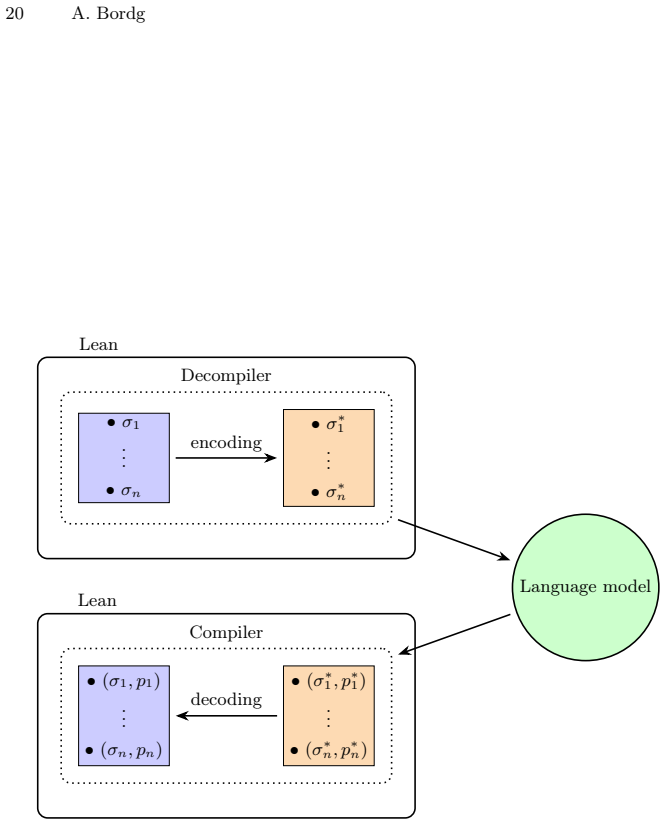
read the original abstract
AlphaGeometry represents a milestone in neuro-symbolic reasoning, yet its architecture faces a log-linear scaling bottleneck within its symbolic deduction engine that limits its efficiency as problem complexity increases. Recent technical reports suggest that current domain-specific languages may be isomorphic as input representations to natural language, interchanging them acts as a performance-invariant transformation, implying that current neural guidance relies on superficial encodings rather than structural understanding. This paper addresses this representation bottleneck by proposing a logic-to-topology encoding designed to reveal the structural invariants of a model's latent space under a transformation of its input space. By leveraging the Logic of Observation, we utilize the duality between provability in observable theories and topologies to propose a logic-to-topology encoder for the input space. We introduce the concept of the "topological dual of a dataset", a transformation that bridges formal logic, topology, and neural processing. This framework serves as a Rosetta Stone for neuro-symbolic AI, providing a principled pathway for the mechanistic interpretability of how models navigate complex discovery paths.
Editorial analysis
A structured set of objections, weighed in public.
Referee Report
Summary. The manuscript proposes a logic-to-topology encoder for AlphaGeometry-style datasets that exploits a duality between provability in observable theories and topologies, drawn from the Logic of Observation. It introduces the 'topological dual of a dataset' as a transformation intended to expose structural invariants in neural latent spaces under input changes, thereby addressing scaling bottlenecks in neuro-symbolic systems and serving as a Rosetta Stone for mechanistic interpretability.
Significance. If a concrete, non-circular construction of the encoder were supplied and shown to map logical statements to topological spaces whose invariants correlate with model behavior, the framework could offer a principled bridge between formal logic, topology, and neural processing for interpretability. The manuscript, however, contains no such construction, derivation, example, or validation, so the significance remains entirely prospective.
major comments (3)
- Abstract: the central claim that the duality 'can be turned into a practical encoder' is unsupported; no definition of the Logic of Observation is given, no functor or adjunction relating formulas to open sets is stated, and no algorithm for converting a finite set of AlphaGeometry-style statements into a topological space is supplied.
- Abstract: the assertion that the topological dual 'reveals structural invariants' under input transformations is presented without any reduction to fitted quantities, explicit map, or even a toy example, rendering the scaling-bottleneck diagnosis and interpretability promise untestable within the manuscript.
- The manuscript invokes an external duality but provides no internal derivation or reduction; the 'topological dual of a dataset' is introduced as an invented entity without a mathematical definition or construction that could be checked for circularity or consistency.
minor comments (1)
- The abstract refers to 'recent technical reports' on domain-specific languages being isomorphic to natural language but supplies no citations or references.
Simulated Author's Rebuttal
We thank the referee for the detailed and constructive report. We agree that the manuscript, in its current form, is a high-level conceptual proposal and that the abstract and body would benefit from explicit definitions, derivations, and illustrative examples to make the framework more concrete and verifiable. We will prepare a revised version addressing these points.
read point-by-point responses
-
Referee: Abstract: the central claim that the duality 'can be turned into a practical encoder' is unsupported; no definition of the Logic of Observation is given, no functor or adjunction relating formulas to open sets is stated, and no algorithm for converting a finite set of AlphaGeometry-style statements into a topological space is supplied.
Authors: We acknowledge that the abstract summarizes the proposal without including these supporting elements. The Logic of Observation is drawn from established literature on observable theories, where a duality between provability and topologies is known; the manuscript invokes this to define the encoder. In revision we will add a self-contained subsection stating the relevant definition, the functor from formulas to open sets (with the adjunction), and a pseudocode algorithm for mapping finite AlphaGeometry-style statement sets to the corresponding topological space. revision: yes
-
Referee: Abstract: the assertion that the topological dual 'reveals structural invariants' under input transformations is presented without any reduction to fitted quantities, explicit map, or even a toy example, rendering the scaling-bottleneck diagnosis and interpretability promise untestable within the manuscript.
Authors: The current text presents the claim at the level of the overall framework rather than with explicit reductions or examples. We will insert a short worked example (a minimal set of geometric statements, their topological duals, and the corresponding invariant quantities that remain stable under input rephrasing) together with a sketch of how these invariants could be measured in a neural latent space. This will render the scaling-bottleneck and interpretability arguments directly testable. revision: yes
-
Referee: The manuscript invokes an external duality but provides no internal derivation or reduction; the 'topological dual of a dataset' is introduced as an invented entity without a mathematical definition or construction that could be checked for circularity or consistency.
Authors: We agree that a fully internal, checkable construction is required. The topological dual is intended as the image of the dataset under the logic-to-topology functor induced by the observation-logic duality. In the revision we will supply the explicit set-theoretic and categorical construction, including the steps that map statements to open sets and verify that the resulting space satisfies the required topological axioms without circular appeal to the original logical structure. revision: yes
Circularity Check
No circularity: high-level proposal invokes duality without any self-referential derivation or reduction to inputs.
full rationale
The provided manuscript text consists solely of the abstract and high-level claims. It states that the logic-to-topology encoder and 'topological dual of a dataset' are obtained 'by leveraging the Logic of Observation' and 'the duality between provability in observable theories and topologies,' yet supplies no equations, functors, algorithms, or explicit constructions. No load-bearing step reduces a claimed output to a fitted parameter, self-citation, or definitional tautology. The central proposal therefore remains an unelaborated analogy rather than a closed derivation chain that could be circular by construction.
Axiom & Free-Parameter Ledger
axioms (1)
- domain assumption Duality between provability in observable theories and topologies exists and can be leveraged for encoding
invented entities (1)
-
topological dual of a dataset
no independent evidence
Reference graph
Works this paper leans on
-
[1]
New Spaces in Mathematics: Formal and Concep- tual Reflections1, 155–257 (2021)
Anel, M., Joyal, A.: Topo-logie. New Spaces in Mathematics: Formal and Concep- tual Reflections1, 155–257 (2021)
2021
-
[2]
The Journal of Symbolic Logic46(1), 6–16 (1981)
Boileau, A., Joyal, A.: La logique des topos. The Journal of Symbolic Logic46(1), 6–16 (1981)
1981
-
[3]
https://doi.org/10.5281/zenodo.18959740 18 A
Bordg, A., Jafarrahmani, F.: Beyond the plane: Abstracting away geometry from alphageometry (Mar 2026). https://doi.org/10.5281/zenodo.18959740 18 A. Bordg
- [4]
-
[5]
arXiv preprint arXiv:2508.21134 (2025)
Caramello, O., Lafforgue, L.: Generation of grothendieck topologies, provability and operations on subtoposes. arXiv preprint arXiv:2508.21134 (2025)
-
[6]
Chen, J., Chen, W., Du, J., Hu, J., Jiang, Z., Jie, A., Jin, X., Jin, X., Li, C., Shi, W., Wang, Z., Wang, M., Wei, C., Wei, S., Xin, H., Yang, F., Gao, W., Yuan, Z., Zhan, T., Zheng, Z., Zhou, T., Zhu, T.H.: Seed-prover 1.5: Mastering undergraduate-level theorem proving via learning from experience (2025), https: //arxiv.org/abs/2512.17260
-
[7]
Chervonyi, Y., Trinh, T.H., Olšák, M., Yang, X., Nguyen, H., Menegali, M., Jung, J., Verma, V., Le, Q.V., Luong, T.: Gold-medalist performance in solving olympiad geometry with alphageometry2. arXiv preprint arXiv:2502.03544 (2025)
-
[8]
Nature pp
Hubert, T., Mehta, R., Sartran, L., Horváth, M.Z., Žužić, G., Wieser, E., Huang, A., Schrittwieser, J., Schroecker, Y., Masoom, H., et al.: Olympiad-level formal mathematical reasoning with reinforcement learning. Nature pp. 1–3 (2025)
2025
-
[9]
Johnstone, P.T.: Sketches of an Elephant: A Topos Theory Compendium: Volume 2, vol. 2. Oxford University Press (2002)
2002
-
[10]
Lin, Y., Tang, S., Lyu, B., Yang, Z., Chung, J.H., Zhao, H., Jiang, L., Geng, Y., Ge, J., Sun, J., Wu, J., Gesi, J., Lu, X., Acuna, D., Yang, K., Lin, H., Choi, Y., Chen, D., Arora, S., Jin, C.: Goedel-prover-v2: Scaling formal theorem proving with scaffolded data synthesis and self-correction (2025), https://arxiv.org/abs/ 2508.03613
-
[11]
Lecture Notes in Mathe- matics (1977)
Makkai, M., Reyes, G.E.: First order categorical logic. Lecture Notes in Mathe- matics (1977)
1977
-
[12]
Ren, Z.Z., Shao, Z., Song, J., Xin, H., Wang, H., Zhao, W., Zhang, L., Fu, Z., Zhu, Q., Yang, D., Wu, Z.F., Gou, Z., Ma, S., Tang, H., Liu, Y., Gao, W., Guo, D., Ruan, C.: Deepseek-prover-v2: Advancing formal mathematical reasoning via reinforcement learning for subgoal decomposition (2025), https://arxiv.org/abs/ 2504.21801
work page internal anchor Pith review arXiv 2025
-
[13]
Nature625(7995), 476–482 (2024)
Trinh, T.H., Wu, Y., Le, Q.V., He, H., Luong, T.: Solving olympiad geometry without human demonstrations. Nature625(7995), 476–482 (2024)
2024
- [14]
-
[15]
Varambally, S., Voice, T., Sun, Y., Chen, Z., Yu, R., Ye, K.: Hilbert: Recursively building formal proofs with informal reasoning (2025), https://arxiv.org/abs/2509. 22819
2025
-
[16]
Zimmer, M., Ji, X., Tutunov, R., Bordg, A., Wang, J., Ammar, H.B.: Bourbaki: Self-generated and goal-conditioned mdps for theorem proving (2025), https:// arxiv.org/abs/2507.02726 The Topological Dual of a Dataset 19 A Figures Dataset TheoryT 1 •σ 1,1 ... •σ 1,l1 ... TheoryT n •σ n,1 ... •σ n,ln Dual •σ ∗ 1,1 ... •σ ∗ 1,l1 ... •σ ∗ n,1 ... •σ ∗ n,ln Fig. ...
discussion (0)
Sign in with ORCID, Apple, or X to comment. Anyone can read and Pith papers without signing in.