Recognition: unknown
A barotropic alternative to Early Dark Energy for alleviating the H₀ tension
Pith reviewed 2026-05-10 04:03 UTC · model grok-4.3
The pith
An extra barotropic fluid with positive equation of state raises the inferred Hubble constant to match local measurements while staying subdominant today.
A machine-rendered reading of the paper's core claim, the machinery that carries it, and where it could break.
Core claim
The central discovery is that a barotropic fluid obeying P = ω_s ρ with ω_s > 0 modifies the pre-recombination expansion history in a way that reconciles the CMB-inferred Hubble constant with direct local measurements, without violating late-time constraints on structure formation or the expansion rate.
What carries the argument
The barotropic fluid with constant positive equation of state ω_s, implemented as an additional component in the background and perturbation equations of a modified CLASS Boltzmann code.
If this is right
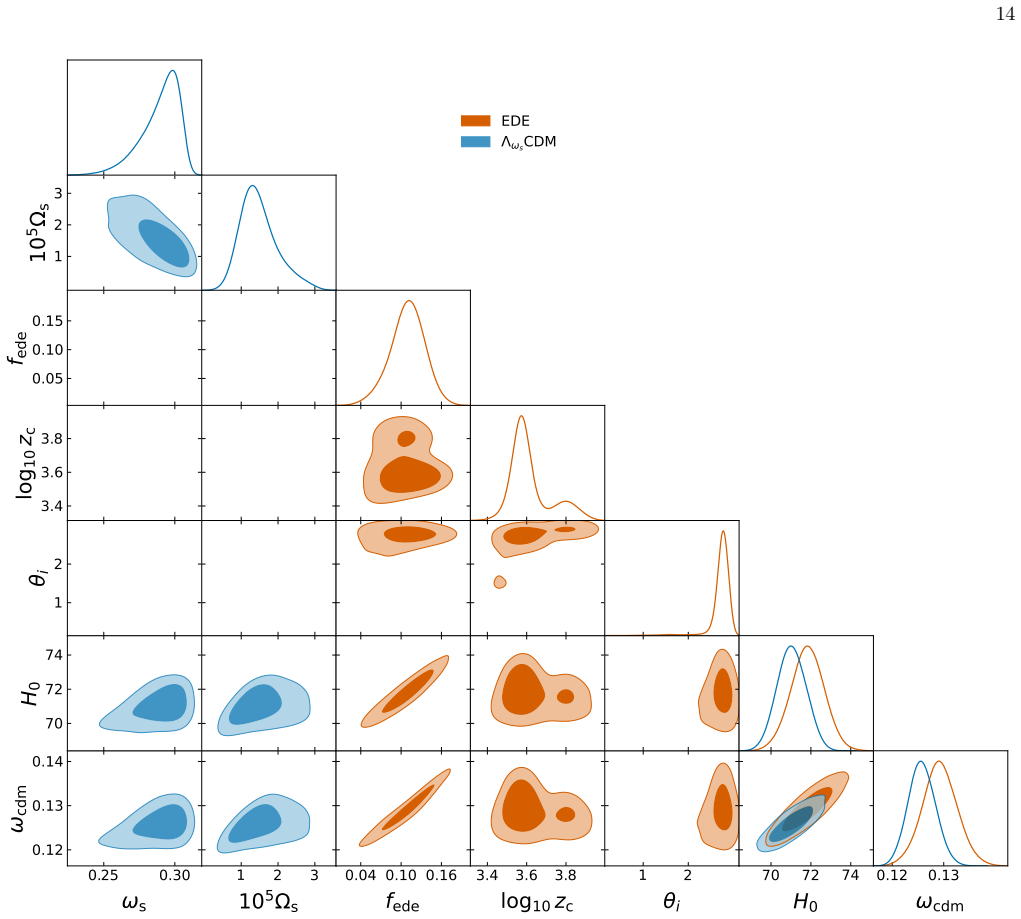
- Inclusion of the SH0ES prior drives the posterior toward ω_s ≈ 0.29 and 10^5 Ω_s ≈ 1.5, raising the inferred H0 without late-time conflicts.
- The model fits current CMB+BAO+Pantheon+SH0ES data at least as well as Early Dark Energy, with no strong Bayesian evidence favoring one over the other.
- The fluid can be reinterpreted as pressure-carrying matter, implying the standard model needs an additional early-time component.
- Excluding BAO data shifts the best-fit values only mildly, indicating robustness to that dataset.
Where Pith is reading between the lines
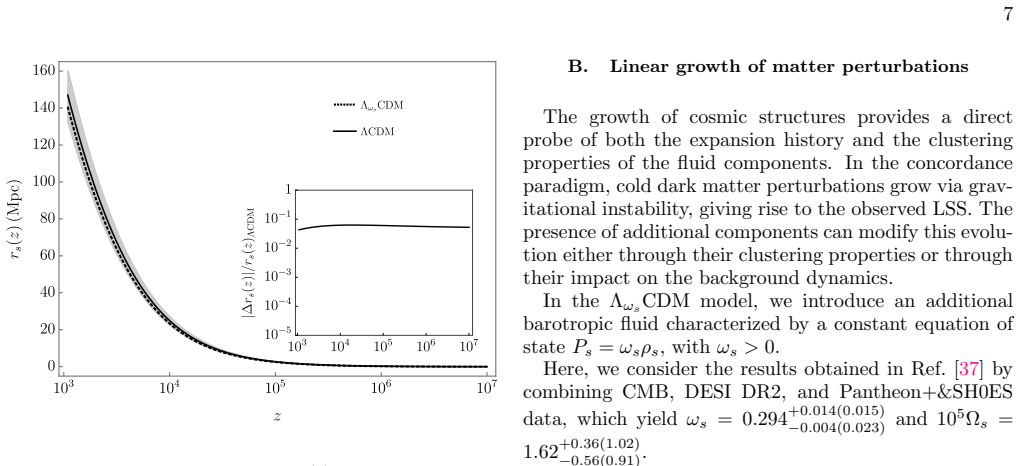
- If confirmed, this fluid would point to a new early-universe degree of freedom distinct from scalar-field EDE, potentially testable through its different impact on the sound horizon.
- The physical picture of matter with pressure invites exploration of microphysical origins such as a dark-sector interaction or modified equation of state for baryons at high redshift.
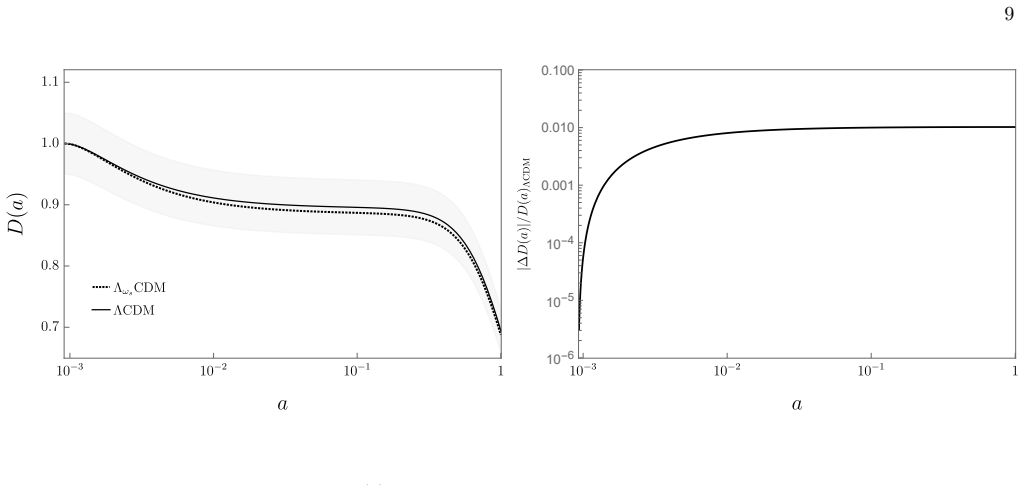
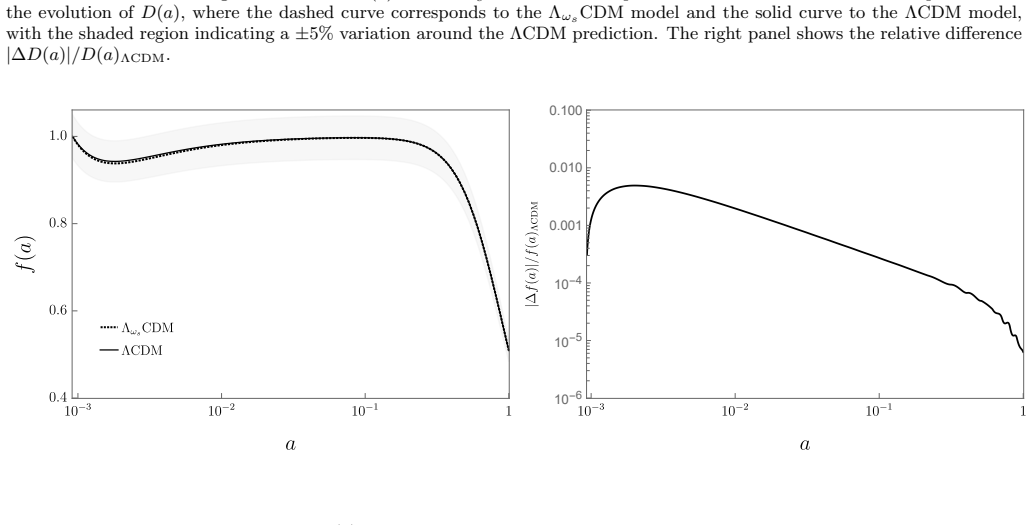
- Larger future datasets could distinguish this scenario from EDE by measuring whether the required extra density correlates with changes in the growth rate at z ≈ 1–2.
Load-bearing premise
The fluid remains subdominant after recombination, produces no observable deviations from standard structure growth, and the perturbative treatment in the modified code captures all relevant effects.
What would settle it
Future high-precision measurements of the matter power spectrum or CMB lensing that show no excess small-scale power or clustering amplitude beyond ΛCDM predictions while still requiring a non-zero ω_s to fit H0.
Figures





read the original abstract
We propose a cosmological scenario in which, beyond matter and radiation, an additional barotropic fluid with positive equation of state $\omega_s$ contributes to the cosmic energy budget, in contrast to Early Dark Energy (EDE). We investigate the theoretical implications of this framework, here dubbed the $\Lambda_{\omega_s}$CDM model, at both the background and perturbative levels, exploring its impact on the expansion history and structure formation. We show that, while remaining subdominant at late times and therefore consistent with current observational bounds, the additional fluid modifies the early-time expansion rate, leading to a higher inferred value of the Hubble constant. Thus, we perform a full Bayesian analysis using a modified version of the \texttt{CLASS} Boltzmann code interfaced with \texttt{MontePython}, considering combinations of \textit{Planck} 2018 Cosmic Microwave Background (CMB) data, DESI DR2 Baryon Acoustic Oscillations (BAO) measurements, Pantheon Type Ia supernovae (SNe Ia), and SH0ES determinations of $H_0$. We find that the inclusion of the SH0ES prior, $H_0 = 73.04 \pm 1.04\,\mathrm{km/s/Mpc}$, leads to a preference for a nonvanishing barotropic fluid. In particular, we obtain $\omega_s = 0.290^{+0.017(0.021)}_{-0.007(0.028)}$ and density $10^5\Omega_s = 1.47^{+0.35(1.14)}_{-0.62(0.94)}$ for the dataset combination CMB + BAO + Pantheon + SH0ES, and $\omega_s = 0.302^{+0.024(0.034)}_{-0.013(0.038)}$ and $10^5\Omega_s = 1.21^{+0.31(1.10)}_{-0.65(0.86)}$ when BAO data are excluded. We further compare our scenario with the EDE framework and show that, statistically, no strong evidence is found against the $\Lambda_{\omega_s}$CDM model. Finally, we provide a physical interpretation of our fluid in terms of matter with pressure, indicating that the standard cosmological model may be incomplete in its current minimal formulation.
Editorial analysis
A structured set of objections, weighed in public.
Referee Report
Summary. The paper proposes the Λ_ωs CDM model, an extension of ΛCDM that adds a barotropic fluid with constant positive equation-of-state parameter ω_s. This fluid increases the early expansion rate (raising the inferred H0) while remaining subdominant today. The authors implement the model in a modified CLASS Boltzmann solver, perform MCMC fits with MontePython on combinations of Planck 2018 CMB, DESI DR2 BAO, Pantheon SNe Ia, and the SH0ES H0 prior, and report a posterior preference for ω_s ≈ 0.29 and 10^5 Ω_s ≈ 1.5 when SH0ES is included. They compare the model statistically to Early Dark Energy and offer a physical interpretation as pressure-bearing matter.
Significance. If the perturbative implementation is correct and the fluid produces no unobserved signatures in structure formation, the model supplies a minimal two-parameter alternative to EDE that directly modifies the background expansion while using standard fluid perturbation equations. The Bayesian results quantify how the extra fluid shifts H0 posteriors, and the explicit comparison to EDE provides a useful benchmark. The approach is falsifiable through its predicted CMB and BAO signatures.
major comments (2)
- [Perturbative implementation and CLASS modifications] The manuscript states that the model is explored at both background and perturbative levels using a modified CLASS code, yet the explicit perturbation equations for the barotropic fluid (continuity and Euler equations, adiabatic sound speed c_s² = ω_s, velocity divergence terms) and the precise code modifications are not supplied. No validation against the ω_s → 0 limit, convergence tests, or cross-checks with an independent solver are reported. Because the reported posteriors on ω_s and Ω_s are extracted from the full CMB likelihood, this implementation detail is load-bearing for the central claim of a data-driven preference.
- [Bayesian analysis and dataset combinations] The preference for non-zero ω_s and Ω_s is obtained only after including the SH0ES H0 = 73.04 ± 1.04 km/s/Mpc prior in the likelihood. The paper should quantify the constraints from CMB + BAO + Pantheon alone (without SH0ES) to demonstrate whether the model genuinely predicts a higher H0 or simply accommodates the tension when the prior is added.
minor comments (2)
- [Abstract and results tables] The asymmetric error bars in the abstract and results tables should be explicitly labeled as 68 % and 95 % credible intervals for clarity.
- [Theoretical framework] A brief reference to the standard literature on barotropic fluid perturbations (e.g., the adiabatic sound-speed closure) would help readers verify the implementation.
Simulated Author's Rebuttal
We thank the referee for their thoughtful review and constructive suggestions. We address each major comment below, providing clarifications and committing to revisions where appropriate to strengthen the manuscript.
read point-by-point responses
-
Referee: The manuscript states that the model is explored at both background and perturbative levels using a modified CLASS code, yet the explicit perturbation equations for the barotropic fluid (continuity and Euler equations, adiabatic sound speed c_s² = ω_s, velocity divergence terms) and the precise code modifications are not supplied. No validation against the ω_s → 0 limit, convergence tests, or cross-checks with an independent solver are reported. Because the reported posteriors on ω_s and Ω_s are extracted from the full CMB likelihood, this implementation detail is load-bearing for the central claim of a data-driven preference.
Authors: We agree that explicit details on the perturbative implementation are essential for reproducibility and validation. The barotropic fluid follows standard fluid perturbation equations in synchronous gauge, with continuity equation δ̇_s = -(1+ω_s)(θ_s + 3φ̇) - 3H(c_s² - ω_s)δ_s and Euler equation θ̇_s = -H(1-3ω_s)θ_s + (c_s²/(1+ω_s))k²δ_s + k²ψ, where c_s² = ω_s for adiabatic perturbations. We will add these equations, describe the CLASS modifications (primarily in background and perturbation modules), and include validation: the ω_s → 0 limit recovers ΛCDM, plus convergence tests and cross-checks. These will be presented in a new appendix. revision: yes
-
Referee: The preference for non-zero ω_s and Ω_s is obtained only after including the SH0ES H0 = 73.04 ± 1.04 km/s/Mpc prior in the likelihood. The paper should quantify the constraints from CMB + BAO + Pantheon alone (without SH0ES) to demonstrate whether the model genuinely predicts a higher H0 or simply accommodates the tension when the prior is added.
Authors: The referee is correct that the statistical preference for ω_s ≈ 0.29 and Ω_s ≈ 1.5×10^{-5} arises when the SH0ES prior is included, as the model is constructed to alleviate the H0 tension. Without SH0ES, CMB+BAO+Pantheon yield posteriors consistent with ω_s = 0 and Ω_s = 0 at <1σ, but the upper limits allow values that raise the inferred H0 by ~1-2 km/s/Mpc. We will add these constraints explicitly (e.g., in Table 1 or a new figure) to clarify that the model accommodates rather than independently predicts the higher H0, while remaining consistent with the other datasets. This does not alter our central claims but improves transparency. revision: yes
Circularity Check
No significant circularity; standard Bayesian parameter estimation
full rationale
The paper introduces a two-parameter phenomenological extension (constant-ω_s barotropic fluid with density parameter Ω_s) to the standard cosmological model, writes down the background continuity equation and the usual fluid perturbation equations (with c_s² = ω_s), implements them in a modified CLASS Boltzmann solver, and reports the resulting posterior constraints from a standard MontePython MCMC analysis on CMB+BAO+Pantheon+SH0ES data. The quoted values of ω_s and Ω_s are direct outputs of that fit; the paper does not present them as first-principles predictions, does not rename a fit as a derivation, and contains no load-bearing self-citation or self-referential definition that reduces the central claim to its own inputs. The derivation chain is therefore self-contained and non-circular.
Axiom & Free-Parameter Ledger
free parameters (2)
- ω_s =
0.29
- Ω_s =
1.47e-5
axioms (2)
- standard math FLRW background metric with standard general relativity
- domain assumption Linear perturbation theory remains valid with the added fluid
invented entities (1)
-
barotropic fluid with positive ω_s
no independent evidence
Reference graph
Works this paper leans on
-
[1]
In this limit, Eq
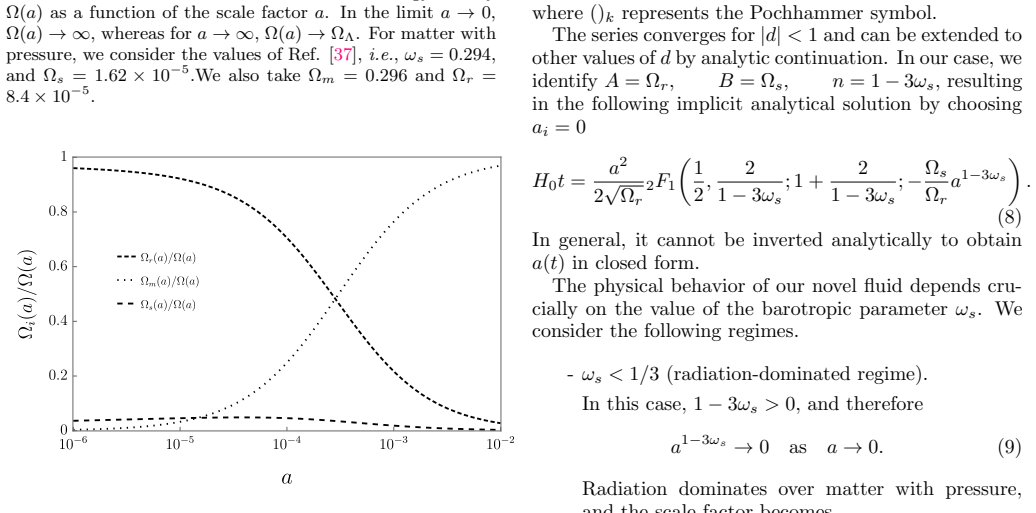
Matter with pressure and radiation We analyze the early-time regime where radiation and matter with pressure dominate, neglecting dust matter. In this limit, Eq. (4) reduces to Z a ai ˜a d˜a√Ωr + Ωs˜a1−3ωs =H 0t.(5) This integral can be evaluated analytically using the iden- tity Z ˜a d˜a√ A+B˜an = ˜a2 2 √ A 2F1 1 2 , 2 n; 1 + 2 n;− B A ˜an ,(6) valid for...
-
[2]
This is particularly important for our purposes since it permits us to characterize the fluid introduced in Eq
Matter with pressure versus dust We now consider a cosmological scenario in which the expansion is driven by dust matter andmatter with pres- sure, neglecting radiation. This is particularly important for our purposes since it permits us to characterize the fluid introduced in Eq. (1) as a relativistic matter-like species, different from ex- otic EDE mode...
-
[3]
matter with pressure
Full three-fluid early-time cosmology In order to quantify the impact of the additional barotropic component, we compare the numerical solu- tion of the early-time three-fluid cosmology with the ex- act analytical solution corresponding to a Universe com- posed only of radiation and dust. In the standard two-fluid case, the Hubble parameter is given by H(...
1996
-
[4]
V. F. Mukhanov, H. A. Feldman, and R. H. Branden- berger, Phys. Rept.215, 203 (1992)
1992
- [5]
- [6]
-
[7]
Massive neutrinos and cosmology
J. Lesgourgues and S. Pastor, Phys. Rept.429, 307 (2006), astro-ph/0603494
work page Pith review arXiv 2006
-
[8]
Weinberg, Rev
S. Weinberg, Rev. Mod. Phys.61, 1 (1989)
1989
-
[9]
P. J. E. Peebles and B. Ratra, Rev. Mod. Phys.75, 559 (2003), astro-ph/0207347
work page Pith review arXiv 2003
- [10]
-
[11]
Ratra and P
B. Ratra and P. J. E. Peebles, Phys. Rev. D37, 3406 (1988)
1988
-
[12]
M. Doran, J.-M. Schwindt, and C. Wetterich, Phys. Rev. D64, 123520 (2001), astro-ph/0107525
-
[13]
J. Martin, Comptes Rendus Physique13, 566 (2012), 1205.3365
work page Pith review arXiv 2012
-
[14]
J. Garriga and A. Vilenkin, Phys. Rev. D64, 023517 (2001), hep-th/0011262
- [15]
- [16]
-
[17]
Tensions between the Early and the Late Universe
L. Verde, T. Treu, and A. G. Riess, Nature Astron.3, 891 (2019), 1907.10625
work page internal anchor Pith review arXiv 2019
-
[18]
E. Di Valentino et al., Astropart. Phys.131, 102605 (2021), 2008.11284
-
[19]
E. Di Valentino et al., Astropart. Phys.131, 102604 (2021), 2008.11285
-
[20]
N. Sch¨ oneberg, G. Franco Abell´ an, A. P´ erez S´ anchez, S. J. Witte, V. Poulin, and J. Lesgourgues, Phys. Rept. 984, 1 (2022), 2107.10291
- [21]
-
[22]
2022, JHEAp, 34, 49, doi: 10.1016/j.jheap.2022.04.002
E. Abdalla et al., JHEAp34, 49 (2022), 2203.06142
work page internal anchor Pith review arXiv 2022
-
[23]
E. Di Valentino et al. (CosmoVerse Network), Phys. Dark Univ.49, 101965 (2025), 2504.01669
work page internal anchor Pith review arXiv 2025
- [24]
-
[25]
A. G. Adame et al. (DESI), JCAP02, 021 (2025), 2404.03002
work page internal anchor Pith review arXiv 2025
-
[26]
DESI DR2 Results II: Measurements of Baryon Acoustic Oscillations and Cosmological Constraints
M. Abdul Karim et al. (DESI) (2025), 2503.14738
work page internal anchor Pith review arXiv 2025
- [27]
-
[28]
M. Kamionkowski and A. G. Riess, Ann. Rev. Nucl. Part. Sci.73, 153 (2023), 2211.04492
- [29]
-
[30]
Early Dark Energy Can Resolve The Hubble Tension
V. Poulin, T. L. Smith, T. Karwal, and M. Kamionkowski, Phys. Rev. Lett.122, 221301 (2019), 1811.04083
work page Pith review arXiv 2019
- [31]
- [32]
- [33]
- [34]
- [35]
-
[36]
A. Arvanitaki, S. Dimopoulos, S. Dubovsky, N. Kaloper, and J. March-Russell, Phys. Rev. D81, 123530 (2010), 0905.4720
work page internal anchor Pith review arXiv 2010
-
[37]
D. J. E. Marsh, Phys. Rept.643, 1 (2016), 1510.07633
work page Pith review arXiv 2016
-
[38]
Cosmological window onto the string axiverse and the supersymmetry breaking scale
L. Visinelli and S. Vagnozzi, Phys. Rev. D99, 063517 (2019), 1809.06382
work page Pith review arXiv 2019
-
[39]
Double the axions, half the tension: multi-field early dark energy eases the Hubble tension
M. Bella, V. Poulin, S. Vagnozzi, and L. Knox (2026), 2604.13535
work page internal anchor Pith review Pith/arXiv arXiv 2026
-
[40]
Y. Carloni, O. Luongo, and M. Muccino, Astron. Astro- phys.707, A383 (2026), 2506.11531
-
[41]
Y. B. Zel’dovich, Zh. Eksp. Teor. Fiz.41, 1609 (1961)
1961
-
[42]
S. Anselmi, P.-S. Corasaniti, A. G. Sanchez, G. D. Stark- man, R. K. Sheth, and I. Zehavi, Phys. Rev. D99, 123515 (2019), 1811.12312
-
[43]
M. O’Dwyer, S. Anselmi, G. D. Starkman, P.-S. Corasan- iti, R. K. Sheth, and I. Zehavi, Phys. Rev. D101, 083517 (2020), 1910.10698
-
[44]
S. Anselmi, G. D. Starkman, and A. Renzi, Phys. Rev. D107, 123506 (2023), 2205.09098
-
[45]
D. Blas, J. Lesgourgues, and T. Tram, JCAP07, 034 (2011), 1104.2933
work page internal anchor Pith review arXiv 2011
-
[46]
E. J. Copeland, M. Sami, and S. Tsujikawa, Int. J. Mod. Phys. D15, 1753 (2006), hep-th/0603057
work page Pith review arXiv 2006
- [47]
-
[48]
S. Dutta and R. J. Scherrer, Phys. Rev. D82, 083501 (2010), 1006.4166
- [49]
-
[50]
O. Luongo and M. Muccino, Phys. Rev. D98, 103520 (2018), 1807.00180
-
[51]
A. Belfiglio, R. Giamb` o, and O. Luongo, Class. Quant. Grav.40, 105004 (2023), 2206.14158. 21
-
[52]
S. Vagnozzi, Universe9, 393 (2023), 2308.16628
- [53]
-
[54]
The Simons Observatory: Science goals and forecasts
P. Ade et al. (Simons Observatory), JCAP02, 056 (2019), 1808.07445
work page Pith review arXiv 2019
-
[55]
N. Aghanim et al. (Planck), Astron. Astrophys.641, A5 (2020), 1907.12875
-
[56]
Planck 2018 results. VI. Cosmological parameters
N. Aghanim et al. (Planck), Astron. Astrophys.641, A6 (2020), [Erratum: Astron.Astrophys. 652, C4 (2021)], 1807.06209
work page internal anchor Pith review arXiv 2020
-
[57]
Y. Akrami et al. (Planck), Astron. Astrophys.641, A4 (2020), 1807.06208
-
[58]
N. Aghanim et al. (Planck), Astron. Astrophys.641, A8 (2020), 1807.06210
-
[59]
D. M. Scolnic et al. (Pan-STARRS1), Astrophys. J.859, 101 (2018), 1710.00845
work page Pith review arXiv 2018
-
[60]
Constraining Cosmological Parameters Based on Relative Galaxy Ages
R. Jimenez and A. Loeb, Astrophys. J.573, 37 (2002), astro-ph/0106145
work page Pith review arXiv 2002
-
[61]
C. Zhang, H. Zhang, S. Yuan, T.-J. Zhang, and Y.-C. Sun, Res. Astron. Astrophys.14, 1221 (2014), 1207.4541
work page Pith review arXiv 2014
-
[62]
Constraints on the redshift dependence of the dark energy potential
J. Simon, L. Verde, and R. Jimenez, Phys. Rev. D71, 123001 (2005), astro-ph/0412269
work page Pith review arXiv 2005
-
[63]
M. Moresco et al., JCAP08, 006 (2012), 1201.3609
work page Pith review arXiv 2012
-
[64]
M. Moresco, L. Pozzetti, A. Cimatti, R. Jimenez, C. Maraston, L. Verde, D. Thomas, A. Citro, R. Tojeiro, and D. Wilkinson, JCAP05, 014 (2016), 1601.01701
work page Pith review arXiv 2016
-
[65]
A. L. Ratsimbazafy, S. I. Loubser, S. M. Crawford, C. M. Cress, B. A. Bassett, R. C. Nichol, and P. V¨ ais¨ anen, Mon. Not. Roy. Astron. Soc.467, 3239 (2017), 1702.00418
work page Pith review arXiv 2017
-
[66]
Cosmic Chronometers: Constraining the Equation of State of Dark Energy. I: H(z) Measurements
D. Stern, R. Jimenez, L. Verde, M. Kamionkowski, and S. A. Stanford, JCAP02, 008 (2010), 0907.3149
work page Pith review arXiv 2010
- [67]
-
[68]
Raising the bar: new constraints on the Hubble parameter with cosmic chronometers at z$\sim$2
M. Moresco, Mon. Not. Roy. Astron. Soc.450, L16 (2015), 1503.01116
work page Pith review arXiv 2015
-
[69]
Gelman and D
A. Gelman and D. Rubin,7, 457 (1992)
1992
-
[70]
M. Kunz, R. Trotta, and D. Parkinson, Phys. Rev. D74, 023503 (2006), astro-ph/0602378
work page Pith review arXiv 2006
-
[71]
A. R. Liddle, Mon. Not. Roy. Astron. Soc.377, L74 (2007), astro-ph/0701113
work page Pith review arXiv 2007
-
[72]
Biesiada, JCAP02, 003 (2007), astro-ph/0701721
M. Biesiada, JCAP02, 003 (2007), astro-ph/0701721
-
[73]
M. Szydlowski, T. Stachowiak, and R. Wojtak, Phys. Rev. D73, 063516 (2006), astro-ph/0511650
-
[74]
M. Szydlowski and A. Kurek, AIP Conf. Proc.861, 1031 (2006), astro-ph/0603538. Appendix A: MCMC contour plots for theΛ ωsCDM model In this Appendix, we present the MCMC contour plots obtained from the various analyses, which combine both early- and late-time cosmological probes in order to ex- plore the parameter space of the model. The different dataset ...
discussion (0)
Sign in with ORCID, Apple, or X to comment. Anyone can read and Pith papers without signing in.