Recognition: unknown
VerilogCL: A Contrastive Learning Framework for Robust LLM-Based Verilog Generation
Pith reviewed 2026-05-10 04:01 UTC · model grok-4.3
The pith
Contrastive learning on minimal-error Verilog pairs teaches LLMs a sharper boundary between valid and invalid RTL, lifting both compilation rates and functional correctness.
A machine-rendered reading of the paper's core claim, the machinery that carries it, and where it could break.
Core claim
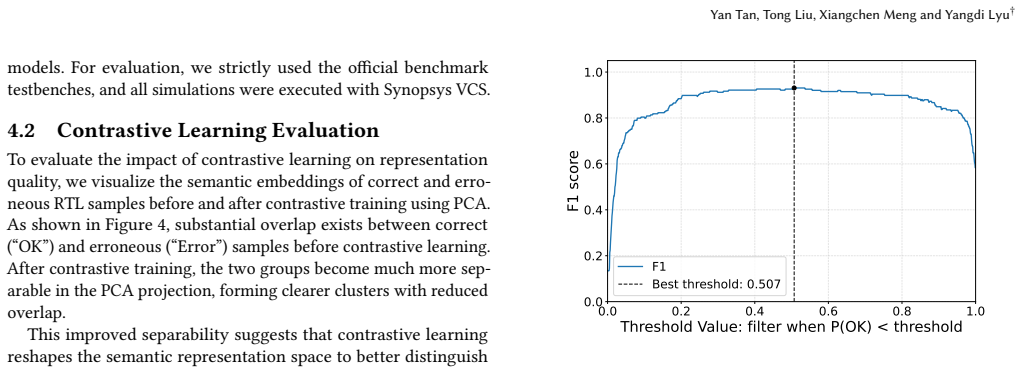
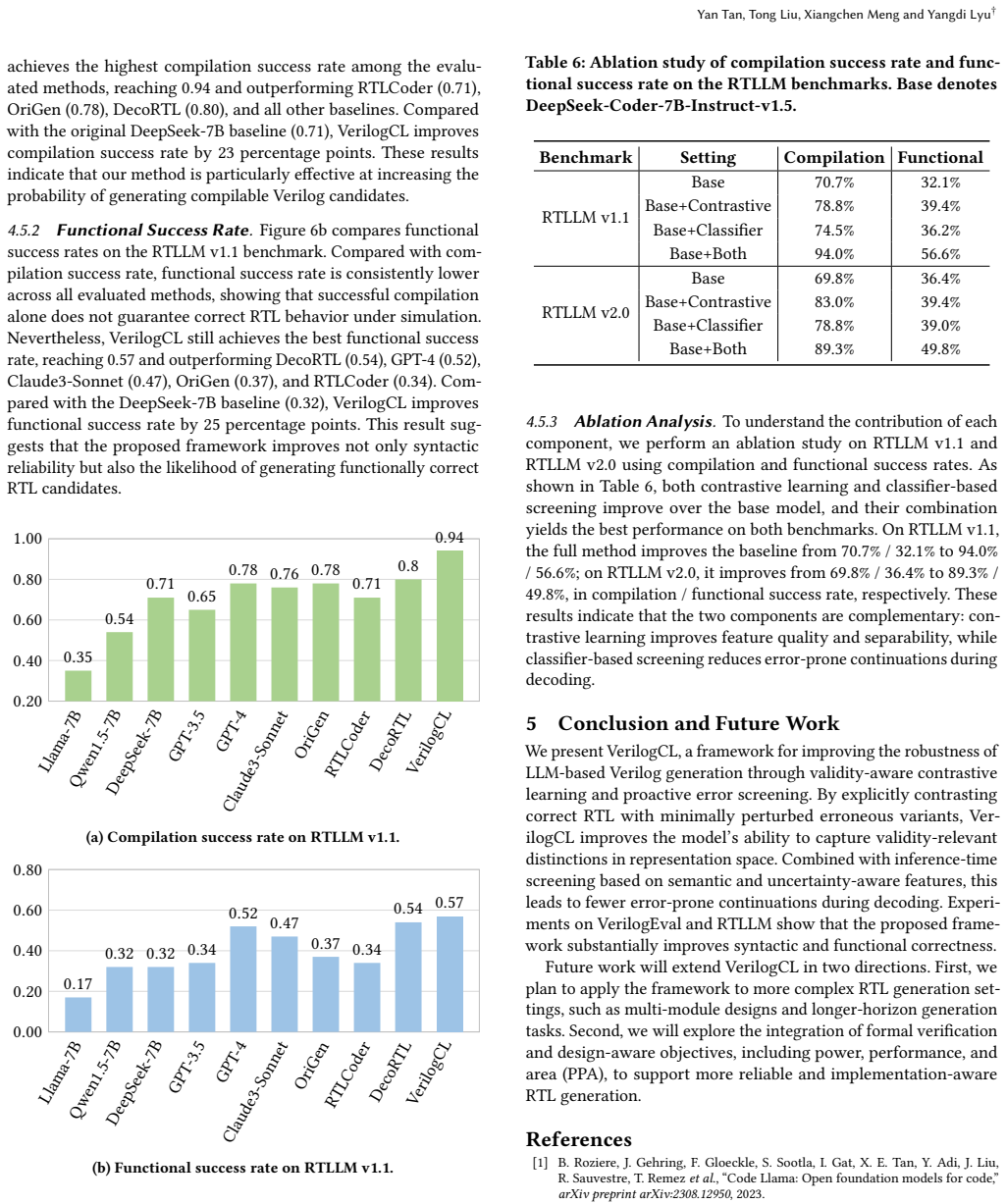
The central claim is that minimal-error data augmentation creates training pairs of correct RTL and minimally perturbed erroneous RTL, contrastive learning then enforces clearer separation between correct and erroneous code in representation space, and a proactive screening module that fuses semantic embeddings with token-level uncertainty filters low-confidence outputs at generation time. On benchmarks including VerilogEval and RTLLM this yields higher compilation success rates and functional correctness than open-source, Verilog-specialized, and commercial baselines even with a 7B-parameter model.
What carries the argument
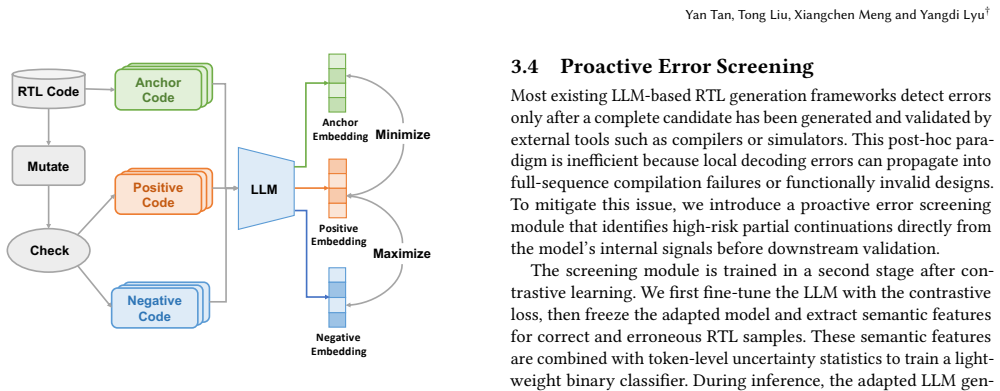
Minimal-error data augmentation that produces paired correct and slightly erroneous RTL samples, processed through contrastive learning to sharpen the validity boundary, combined with an inference-time screening filter based on embeddings and uncertainty scores.
If this is right
- A 7B model using the framework exceeds the performance of larger open-source and commercial baselines on both compilation success and functional correctness.
- The method improves separation between valid and invalid code without requiring additional post-hoc tuning on the public test sets.
- Proactive screening reduces the number of invalid candidates that reach the final output.
- The approach works on existing public benchmarks for Verilog generation tasks.
Where Pith is reading between the lines
- The same minimal-error pairing and contrastive boundary learning could be tested on other hardware description languages such as VHDL where data scarcity is also an issue.
- The screening module could be added as a lightweight post-processing step to existing LLM pipelines for hardware code to cut down on manual debugging iterations.
- Focusing training on boundary distinctions rather than sheer data volume may reduce the dataset size needed for reliable hardware code generation in other constrained domains.
Load-bearing premise
The assumption that the distinctions created by artificially introducing minimal errors during training data preparation match the actual failure modes that arise when LLMs generate Verilog from natural-language prompts.
What would settle it
Train an otherwise identical model without the contrastive loss or without the minimal-error paired samples and measure whether the gains in compilation success rate and functional correctness on VerilogEval and RTLLM disappear.
Figures



read the original abstract
Large Language Models (LLMs) have recently achieved strong performance in software code generation. However, applying them to hardware description languages (HDLs), such as Verilog, remains challenging because high-quality training data are relatively scarce. In practice, LLM-generated Verilog often contains syntactic or structural errors that either cause compilation failures or produce functionally incorrect designs, which limit its reliability in hardware design workflows. In this work, we propose VerilogCL, an integrated framework that enhances Verilog code generation by explicitly learning the boundary between correct and erroneous RTL through contrastive learning and proactive error screening. Our approach introduces minimal-error data augmentation, generating paired training samples of correct RTL and minimally perturbed erroneous RTL to teach the model to recognize fine-grained distinctions between correct and erroneous code. We then apply contrastive learning to learn a clearer validity boundary in the representation space, improving the separation between correct and erroneous RTL code. In addition, we introduce a proactive screening module that combines semantic embeddings with token-level uncertainty features to filter low-confidence candidates during generation. Experiments on public benchmarks, including VerilogEval and RTLLM, show that our 7B-parameter model outperforms the evaluated open-source, Verilog-specialized, and commercial baselines in both compilation success rate and functional correctness.
Editorial analysis
A structured set of objections, weighed in public.
Referee Report
Summary. The paper proposes VerilogCL, a framework for LLM-based Verilog generation that combines minimal-error data augmentation to create correct/erroneous RTL pairs, contrastive learning to sharpen the validity boundary in representation space, and a proactive screening module that fuses semantic embeddings with token-level uncertainty to filter low-confidence outputs. The central empirical claim is that the resulting 7B-parameter model outperforms open-source, Verilog-specialized, and commercial baselines on the VerilogEval and RTLLM benchmarks in both compilation success rate and functional correctness.
Significance. If the performance gains are shown to be robust via ablations and representative error distributions, the work could offer a practical route to more reliable automated HDL generation despite scarce high-quality training data. The explicit contrastive objective and uncertainty screening constitute a coherent integration that may generalize to other code-generation domains where syntactic validity and functional correctness must be jointly enforced.
major comments (3)
- [Abstract] Abstract: the outperformance claim is stated without any numerical deltas, absolute success rates, baseline scores, or statistical tests, which is load-bearing for the central empirical contribution and prevents verification of whether the reported gains exceed what standard fine-tuning already achieves.
- [Method] Method (minimal-error data augmentation): the assumption that minimally perturbed erroneous RTL constitute representative negative examples is not justified; real LLM Verilog failures commonly involve non-local structural mismatches, incorrect module instantiations, or timing violations that minimal local edits do not capture, risking that the contrastive objective learns an artificial rather than practically useful decision boundary.
- [Experiments] Experiments: no ablation results isolate the contribution of contrastive learning versus the screening module, nor are confidence intervals or significance tests reported for the benchmark improvements, leaving open whether the claimed superiority is attributable to the proposed components or to uncontrolled factors such as training data volume or prompt engineering.
minor comments (1)
- [Abstract] Abstract and method sections would benefit from explicit pseudocode or a small illustrative example of the minimal-error augmentation procedure and the exact form of the contrastive loss.
Simulated Author's Rebuttal
We thank the referee for the constructive feedback on our manuscript. The comments highlight important opportunities to strengthen the presentation of empirical results and the justification of our methodological choices. We respond to each major comment below and indicate the planned revisions.
read point-by-point responses
-
Referee: [Abstract] Abstract: the outperformance claim is stated without any numerical deltas, absolute success rates, baseline scores, or statistical tests, which is load-bearing for the central empirical contribution and prevents verification of whether the reported gains exceed what standard fine-tuning already achieves.
Authors: We agree that the abstract would be more informative with concrete metrics. The current version prioritizes brevity, but we will revise it to report absolute compilation success rates and functional correctness scores for VerilogCL and the primary baselines (open-source, Verilog-specialized, and commercial models), along with the observed relative improvements. Statistical significance tests will remain in the experiments section due to abstract length constraints, but the numerical deltas will allow readers to assess the gains directly. revision: yes
-
Referee: [Method] Method (minimal-error data augmentation): the assumption that minimally perturbed erroneous RTL constitute representative negative examples is not justified; real LLM Verilog failures commonly involve non-local structural mismatches, incorrect module instantiations, or timing violations that minimal local edits do not capture, risking that the contrastive objective learns an artificial rather than practically useful decision boundary.
Authors: We acknowledge that minimal local perturbations do not encompass every class of LLM error, particularly non-local structural or timing issues. Our design choice targets the fine-grained boundary cases that frequently arise from small syntactic or semantic slips in LLM outputs, which are precisely the errors that standard generation struggles to avoid. Larger structural failures are intended to be filtered by the proactive screening module and post-generation compilation checks. To address the concern, we will expand the method section with a characterization of common LLM Verilog error distributions drawn from our development set, demonstrating the prevalence of minimal-edit errors, and will add a limitations paragraph noting that the contrastive pairs focus on a practically relevant but not exhaustive subset of failure modes. revision: partial
-
Referee: [Experiments] Experiments: no ablation results isolate the contribution of contrastive learning versus the screening module, nor are confidence intervals or significance tests reported for the benchmark improvements, leaving open whether the claimed superiority is attributable to the proposed components or to uncontrolled factors such as training data volume or prompt engineering.
Authors: We agree that isolating component contributions and providing statistical rigor would strengthen the claims. In the revised manuscript we will add ablation studies that remove contrastive learning and the screening module independently, reporting their individual effects on both VerilogEval and RTLLM. We will also include confidence intervals for all reported metrics and apply appropriate statistical tests (e.g., McNemar’s test for paired success rates) to evaluate significance against baselines. These additions will help confirm that gains arise from the proposed techniques rather than extraneous factors. revision: yes
Circularity Check
No circularity: standard empirical ML pipeline with benchmark-driven results
full rationale
The paper describes a contrastive learning framework using minimal-error data augmentation to create positive/negative RTL pairs, followed by contrastive training and an uncertainty-based screening module. No equations, derivations, or predictions are presented that reduce the claimed outperformance to a fitted parameter or self-referential definition by construction. Results are reported directly from experiments on VerilogEval and RTLLM benchmarks rather than derived from the method itself. No load-bearing self-citations or uniqueness theorems are invoked. The derivation chain is self-contained and independent of its outputs.
Axiom & Free-Parameter Ledger
free parameters (2)
- Contrastive temperature and margin
- Uncertainty threshold for screening
axioms (2)
- domain assumption Minimal perturbations of correct RTL produce negative examples whose distinctions are learnable and generalize to LLM generation errors
- domain assumption Semantic embeddings plus token uncertainty form a reliable proxy for functional correctness
Reference graph
Works this paper leans on
-
[1]
Code Llama: Open Foundation Models for Code
B. Roziere, J. Gehring, F. Gloeckle, S. Sootla, I. Gat, X. E. Tan, Y. Adi, J. Liu, R. Sauvestre, T. Remezet al., “Code Llama: Open foundation models for code, ” arXiv preprint arXiv:2308.12950, 2023
work page internal anchor Pith review arXiv 2023
-
[2]
DeepSeek-Coder: When the Large Language Model Meets Programming -- The Rise of Code Intelligence
D. Guo, Q. Zhu, D. Yang, Z. Xie, K. Dong, W. Zhang, G. Chen, X. Bi, Y. Wu, Y. Li et al., “DeepSeek-Coder: When the large language model meets programming – the rise of code intelligence, ”arXiv preprint arXiv:2401.14196, 2024
work page internal anchor Pith review arXiv 2024
-
[3]
J. Bai, S. Bai, Y. Chu, Z. Cui, K. Dang, X. Deng, Y. Fan, W. Ge, Y. Han, F. Huang et al., “Qwen technical report, ”arXiv preprint arXiv:2309.16609, 2023. VerilogCL: A Contrastive Learning Framework for Robust LLM-Based Verilog Generation
work page internal anchor Pith review Pith/arXiv arXiv 2023
-
[4]
On the robustness of code generation techniques: An empirical study on github copilot,
A. Mastropaolo, L. Pascarella, E. Guglielmi, M. Ciniselli, S. Scalabrino, R. Oliveto, and G. Bavota, “On the robustness of code generation techniques: An empirical study on github copilot, ” in2023 IEEE/ACM 45th International Conference on Software Engineering (ICSE). IEEE, 2023, pp. 2149–2160
2023
-
[5]
Code- gen2: Lessons for training llms on programming and natural languages
E. Nijkamp, H. Hayashi, C. Xiong, S. Savarese, and Y. Zhou, “Codegen2: Lessons for training llms on programming and natural languages, ”arXiv preprint arXiv:2305.02309, 2023
-
[6]
Benchmarking large language models for automated verilog rtl code generation,
S. Thakur, B. Ahmad, Z. Fan, H. Pearce, B. Tan, R. Karri, B. Dolan-Gavitt, and S. Garg, “Benchmarking large language models for automated verilog rtl code generation, ” in2023 Design, Automation & Test in Europe Conference & Exhibition (DATE). IEEE, 2023, pp. 1–6
2023
-
[7]
A deep learning framework for verilog autocompletion towards design and verification automation,
E. Dehaerne, B. Dey, S. Halder, and S. De Gendt, “A deep learning framework for verilog autocompletion towards design and verification automation, ”arXiv preprint arXiv:2304.13840, 2023
-
[8]
OpenLLM-RTL: Open dataset and bench- mark for llm-aided design rtl generation(invited),
S. Liu, Y. Lu, W. Fang, M. Li, and Z. Xie, “OpenLLM-RTL: Open dataset and bench- mark for llm-aided design rtl generation(invited), ” in2024 IEEE/ACM International Conference on Computer-Aided Design (ICCAD). ACM, 2024
2024
-
[9]
Verilogeval: Evaluating large language models for verilog code generation,
M. Liu, N. Pinckney, B. Khailany, and H. Ren, “Verilogeval: Evaluating large language models for verilog code generation, ” in2023 IEEE/ACM International Conference on Computer Aided Design (ICCAD). IEEE, 2023, pp. 1–8
2023
-
[10]
RtlCoder: Outperforming gpt-3.5 in design rtl generation with our open-source dataset and lightweight solution,
S. Liu, W. Fang, Y. Lu, Q. Zhang, H. Zhang, and Z. Xie, “RtlCoder: Outperforming gpt-3.5 in design rtl generation with our open-source dataset and lightweight solution, ” in2024 IEEE LLM Aided Design Workshop (LAD). IEEE, 2024, pp. 1–5
2024
-
[11]
F. Cui, C. Yin, K. Zhou, Y. Xiao, G. Sun, Q. Xu, Q. Guo, D. Song, D. Lin, X. Zhang et al., “OriGen: Enhancing rtl code generation with code-to-code augmentation and self-reflection, ”arXiv preprint arXiv:2407.16237, 2024
-
[12]
Evaluating Large Language Models Trained on Code
M. Chen, J. Tworek, H. Jun, Q. Yuan, H. P. D. O. Pinto, J. Kaplan, H. Edwards, Y. Burda, N. Joseph, G. Brockmanet al., “Evaluating large language models trained on code, ”arXiv preprint arXiv:2107.03374, 2021
work page internal anchor Pith review Pith/arXiv arXiv 2021
-
[13]
AutoChip: Automating hdl generation using llm feedback,
S. Thakur, J. Blocklove, H. Pearce, B. Tan, S. Garg, and R. Karri, “Autochip: Automating hdl generation using llm feedback, ”arXiv preprint arXiv:2311.04887, 2023
-
[14]
RTLFixer: Automatically fixing rtl syntax errors with large language model,
Y. Tsai, M. Liu, and H. Ren, “RTLFixer: Automatically fixing rtl syntax errors with large language model, ” inProceedings of the 61st ACM/IEEE Design Automation Conference, 2024, pp. 1–6
2024
-
[15]
C.-T. Ho, H. Ren, and B. Khailany, “Verilogcoder: Autonomous verilog coding agents with graph-based planning and abstract syntax tree (ast)-based waveform tracing tool, ”arXiv preprint arXiv:2408.08927, 2024
-
[16]
HLSDebugger: Identification and correction of logic bugs in hls code with llm solutions,
J. Wang, S. Liu, Y. Lu, and Z. Xie, “HLSDebugger: Identification and correction of logic bugs in hls code with llm solutions, ”arXiv preprint arXiv:2507.21485, 2025
-
[17]
Betterv: Controlled verilog generation with discriminative guidance,
Z. Pei, H.-L. Zhen, M. Yuan, Y. Huang, and B. Yu, “Betterv: Controlled verilog generation with discriminative guidance, ”arXiv preprint arXiv:2402.03375, 2024
-
[18]
Christiaan Baaij, Matthijs Kooijman, Jan Kuper, Arjan Boeijink, and Marco Gerards
K. Chang, Y. Wang, H. Ren, M. Wang, S. Liang, Y. Han, H. Li, and X. Li, “Chipgpt: How far are we from natural language hardware design, ”arXiv preprint arXiv:2305.14019, 2023
-
[19]
Mage: A multi-agent engine for automated rtl code generation,
Y. Zhao, H. Zhang, H. Huang, Z. Yu, and J. Zhao, “Mage: A multi-agent engine for automated rtl code generation, ” in2025 62nd ACM/IEEE Design Automation Conference (DAC), 2025, pp. 1–7
2025
-
[20]
Vflow: Discovering optimal agentic workflows for verilog generation,
Y. Wei, Z. Huang, L. He, L. Huang, T.-J. Lin, and W. W. Xing, “Vflow: Discovering optimal agentic workflows for verilog generation, ” in2026 31st Asia and South Pacific Design Automation Conference (ASP-DAC), 2026, pp. 355–361
2026
-
[21]
DecoRTL: A run-time decoding framework for rtl code generation with llms,
M. Akyash, K. Azar, and H. Kamali, “DecoRTL: A run-time decoding framework for rtl code generation with llms, ” in2025 IEEE/ACM International Conference On Computer Aided Design (ICCAD), 2025, pp. 1–9
2025
-
[22]
Speculative decoding for verilog: Speed and quality, all in one,
C. Xu, Y. Liu, Y. Zhou, S. Huang, N. Xu, and Q. Xu, “Speculative decoding for verilog: Speed and quality, all in one, ” in2025 62nd ACM/IEEE Design Automation Conference (DAC), 2025, pp. 1–7
2025
-
[23]
An empirical study of training self-supervised vision transformers,
X. Chen, S. Xie, and K. He, “An empirical study of training self-supervised vision transformers, ” inProceedings of the IEEE/CVF international conference on computer vision, 2021, pp. 9640–9649
2021
-
[24]
Unsupervised embedding learning via invariant and spreading instance feature,
M. Ye, X. Zhang, P. C. Yuen, and S.-F. Chang, “Unsupervised embedding learning via invariant and spreading instance feature, ” inProceedings of the IEEE/CVF conference on computer vision and pattern recognition, 2019, pp. 6210–6219
2019
-
[25]
Big self- supervised models are strong semi-supervised learners,
T. Chen, S. Kornblith, K. Swersky, M. Norouzi, and G. E. Hinton, “Big self- supervised models are strong semi-supervised learners, ”Advances in neural information processing systems, vol. 33, pp. 22 243–22 255, 2020
2020
-
[26]
Contrastive code representation learning,
P. Jain, A. Jain, T. Zhang, P. Abbeel, J. Gonzalez, and I. Stoica, “Contrastive code representation learning, ” inProceedings of the 2021 conference on empirical methods in natural language processing, 2021, pp. 5954–5971
2021
-
[27]
Code representation learning at scale,
D. Zhang, W. U. Ahmad, M. Tan, H. Ding, R. Nallapati, D. Roth, X. Ma, and B. Xiang, “Code representation learning at scale, ” inThe Twelfth International Conference on Learning Representations, 2024. [Online]. Available: https://openreview.net/forum?id=vfzRRjumpX
2024
-
[28]
Unixcoder: Unified cross-modal pre-training for code representation,
D. Guo, S. Lu, N. Duan, Y. Wang, M. Zhou, and J. Yin, “Unixcoder: Unified cross- modal pre-training for code representation, ”arXiv preprint arXiv:2203.03850, 2022
-
[29]
Yosys open synthesis suite,
C. Wolf, “Yosys open synthesis suite, ” https://yosyshq.net/yosys/, 2013
2013
-
[30]
RTLLM: An open-source benchmark for design rtl generation with large language model,
Y. Lu, S. Liu, Q. Zhang, and Z. Xie, “RTLLM: An open-source benchmark for design rtl generation with large language model, ” in2024 29th Asia and South Pacific Design Automation Conference (ASP-DAC). IEEE, 2024, pp. 722–727
2024
-
[31]
A multi-expert large language model architecture for verilog code generation,
B. Nadimi and H. Zheng, “A multi-expert large language model architecture for verilog code generation, ” in2024 IEEE LLM Aided Design Workshop (LAD). IEEE, 2024, pp. 1–5
2024
-
[32]
Introducing the next generation of claude,
Anthropic, “Introducing the next generation of claude, ” https://www.anthropic. com/, 2024
2024
-
[33]
GPT-3.5-Turbo,
OpenAI, “GPT-3.5-Turbo, ” 2023, accessed: 2024. [Online]. Available: https: //platform.openai.com/docs/models/gpt-3-5
2023
-
[34]
GPT-4 Technical Report,
——, “GPT-4 Technical Report, ” 2023, accessed: 2024. [Online]. Available: https://openai.com/research/gpt-4
2023
discussion (0)
Sign in with ORCID, Apple, or X to comment. Anyone can read and Pith papers without signing in.