Recognition: unknown
Comment on "Specific heat of an ideal Bose gas above the Bose condensation temperature," [Am. J. Phys. 72(9), 1193--1194 (2004)]
Pith reviewed 2026-05-10 03:09 UTC · model grok-4.3
The pith
Einstein's formula for the specific heat of an ideal Bose gas above condensation temperature differs from the 2004 version and corrects errors in the English translation.
A machine-rendered reading of the paper's core claim, the machinery that carries it, and where it could break.
Core claim
Einstein's original calculations yield a specific heat formula for the ideal Bose gas above the Bose condensation temperature that is distinct from the formula presented in a 2004 paper, with the English translation containing numerical errors that are here corrected.
What carries the argument
The series of calculations for the specific heat using the Bose distribution integrals above the critical temperature, as originally outlined by Einstein.
If this is right
- The specific heat expression from Einstein's work should replace or be compared against the 2004 formula in discussions of Bose gases.
- Numerical corrections improve the precision of historical reconstructions of early quantum statistics.
- The history of acceptance of Bose-Einstein condensation theory benefits from these clarified calculations.
- Future studies of ideal quantum gases can reference the corrected Einstein formula directly.
Where Pith is reading between the lines
- Verifying translations of other seminal papers might reveal similar discrepancies affecting modern interpretations.
- This could lead to updates in physics textbooks that present the specific heat of Bose gases.
- Connecting these historical corrections to current experiments on ultracold atoms would test the enduring accuracy of the formulas.
Load-bearing premise
That the English translation accurately represents Einstein's original 1925 calculations and that the 2004 formula serves as a valid point of comparison.
What would settle it
Performing the specific heat calculation directly from Einstein's German 1925 paper and comparing the numerical results to both the translation and the 2004 formula.
Figures


read the original abstract
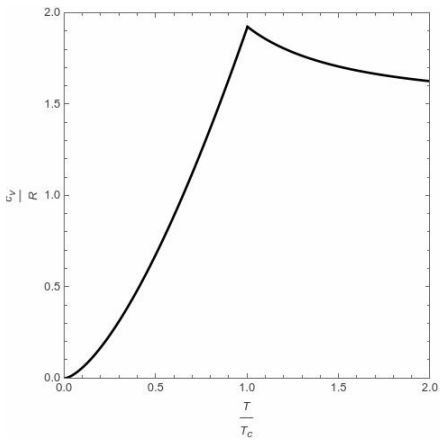
We examine the English translation of Albert Einstein's groundbreaking 1925 paper on Bose-Einstein condensation. We guide readers to execute the calculations Einstein outlined for the specific heat above the condensation temperature, correct some numerical errors, and compare his formula with a different one published in the American Journal of Physics in 2004. The history of the acceptance of Einstein's theory will be summarized.
Editorial analysis
A structured set of objections, weighed in public.
Referee Report
Summary. The manuscript examines the English translation of Albert Einstein's 1925 paper on Bose-Einstein condensation. It guides readers to execute the calculations for the specific heat of an ideal Bose gas above the condensation temperature, corrects numerical errors in the translation, compares Einstein's formula to a different one published in the American Journal of Physics in 2004, and summarizes the history of the acceptance of Einstein's theory.
Significance. If the explicit calculations, numerical corrections, and formula comparison hold after verification, the paper contributes to clarifying historical details in the development of quantum statistics. It may be useful for educators and historians by highlighting potential discrepancies between Einstein's outlined results and later published expressions, while providing context on theory acceptance.
major comments (1)
- The corrections to numerical errors in the English translation and the claimed difference between Einstein's formula and the 2004 AJP result rest on the unverified assumption that the translation faithfully reproduces Einstein's 1925 calculations (see abstract). The manuscript does not reference or compare against the original German text, which is load-bearing for both the error corrections and the historical comparison.
Simulated Author's Rebuttal
We thank the referee for their careful reading and valuable comment, which helps strengthen the historical accuracy of our work. We address the point raised below and outline the planned revisions.
read point-by-point responses
-
Referee: The corrections to numerical errors in the English translation and the claimed difference between Einstein's formula and the 2004 AJP result rest on the unverified assumption that the translation faithfully reproduces Einstein's 1925 calculations (see abstract). The manuscript does not reference or compare against the original German text, which is load-bearing for both the error corrections and the historical comparison.
Authors: We appreciate the referee's observation that our analysis relies on the English translation without direct verification against the original German. Our manuscript explicitly examines the translation as the version most commonly used by educators and readers today, and the numerical corrections we propose are those that arise when carrying out the calculations as presented in that translation. Nevertheless, we agree that referencing the original 1925 German text (Sitzungsberichte der Preussischen Akademie der Wissenschaften) is essential for confirming whether the discrepancies are translation artifacts or present in Einstein's own work. In the revised manuscript we will add a direct comparison, including key excerpts and formulas from the German original, to substantiate the error corrections and to clarify the precise form of Einstein's specific-heat expression for the comparison with the 2004 AJP result. This addition will also enhance the paper's utility for historians of physics. revision: yes
Circularity Check
No circularity: analysis relies on external historical references and reader-executed calculations.
full rationale
The paper is a historical comment that directs readers to perform Einstein's 1925 outlined calculations for specific heat above Tc, corrects numerical errors in the English translation, and contrasts the resulting formula against an independent 2004 AJP publication. No load-bearing step defines a quantity in terms of itself, fits a parameter then renames the fit as a prediction, or reduces the central claim to a self-citation chain. All comparisons and corrections are anchored to Einstein's external work and the separate 2004 result, making the derivation self-contained against external benchmarks.
Axiom & Free-Parameter Ledger
Reference graph
Works this paper leans on
-
[1]
Specific heat of an ideal Bose gas above the Bose condensation temperature,
F. Wang, “Specific heat of an ideal Bose gas above the Bose condensation temperature,” Am. J. Phys.72(9), 1193–1194 (2004)
2004
-
[2]
Einstein,The Essential Einsteinedited by D
A. Einstein,The Essential Einsteinedited by D. K. Buchwald and T. Sauer, (Princeton University Press, 2025)
2025
-
[3]
Quantentheorie des einatomigen idealen Gases. Zweite Abhandlung,
A. Einstein, “Quantentheorie des einatomigen idealen Gases. Zweite Abhandlung,” Sitzungsberichte der Preussischen Akademie der Wissenschaften zu Berlin, Physikalisch- Mathematische Klass, 3–14 (1925). Available at the University of M¨ unster web- sitehttps://www.uni-muenster.de/imperia/md/content/physik_ap/demokritov/ mbecfornonphysicists/einstein_1924_19...
1925
-
[4]
Planck’s law and the light quantum hypothesis,
S. N. Bose (translated by O. Theimer and B. Ram), “Planck’s law and the light quantum hypothesis,” Am. J. Phys.44(11), 1056–1057 (1976)
1976
-
[5]
leidenuniv.nl/history/Einstein_archive/news_of_discovery/Einstein_AP.txt
The original manuscript of Einstein’s 1925 paper was found in Leiden University’s Lorentz Institute in 2005; see the Associated Press report athttps://www.lorentz. leidenuniv.nl/history/Einstein_archive/news_of_discovery/Einstein_AP.txt. Dig- ital scans are available athttps://www.lorentz.leidenuniv.nl/history/Einstein_ archive/Einstein_1925_manuscript/(l...
1925
-
[6]
Theλ-phenomenon of liquid helium and the Bose-Einstein degeneracy,
F. London, “Theλ-phenomenon of liquid helium and the Bose-Einstein degeneracy,” Nature 141, 643–644 (1938)
1938
-
[7]
The usefulness of useless knowledge,
A. Flexner, “The usefulness of useless knowledge,” Harper’s Magazine179, 544–555 (1939). Available athttps://www.ias.edu/sites/default/files/library/UsefulnessHarpers. pdf(last access May 5, 2026)
1939
-
[8]
On the Bose-Einstein Condensation,
F. London, “On the Bose-Einstein Condensation,” Phys. Rev.54, 947–954 (1938)
1938
-
[9]
London,Superfluids, (Wiley, 1954), p
F. London,Superfluids, (Wiley, 1954), p. 48
1954
-
[10]
A. D. Stone,Einstein and the Quantum, (Princeton University Press, 2013), p. 237. 9
2013
discussion (0)
Sign in with ORCID, Apple, or X to comment. Anyone can read and Pith papers without signing in.