Recognition: unknown
Understanding the complex morphology of a CME II: how pre-eruptive conditions shape CME evolution
Pith reviewed 2026-05-10 03:59 UTC · model grok-4.3
The pith
The pre-eruptive magnetic configuration of a CME can be robustly determined by matching physics-based simulations to multi-viewpoint observations.
A machine-rendered reading of the paper's core claim, the machinery that carries it, and where it could break.
Core claim
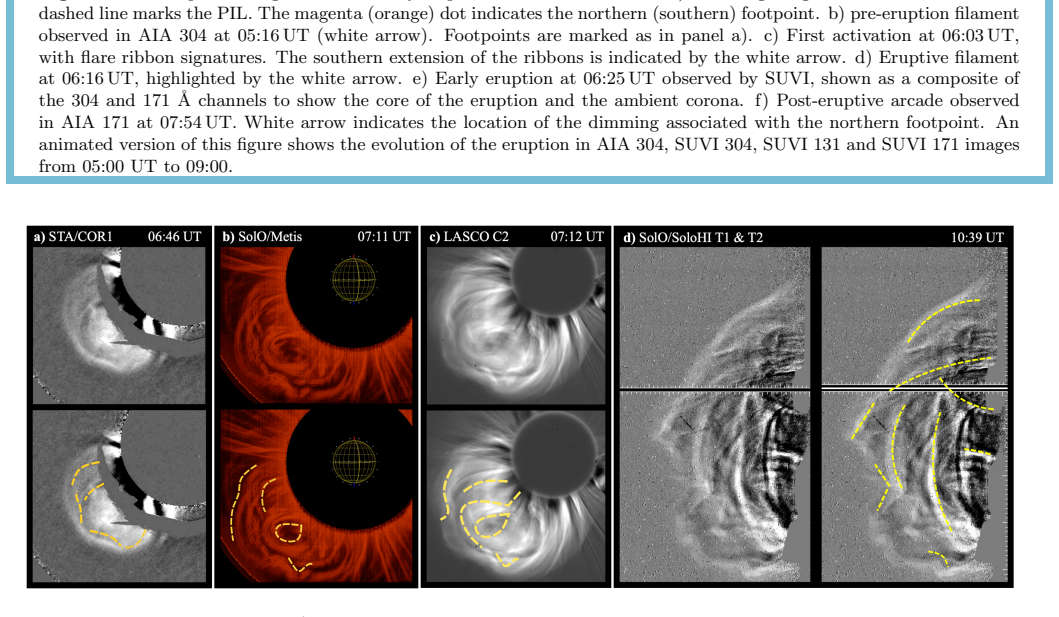
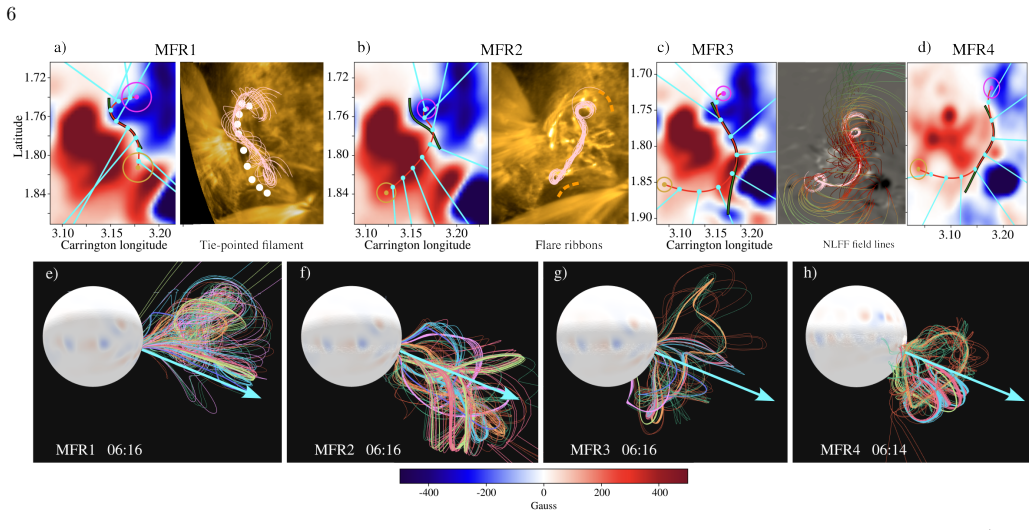
Using the CORHELCME magnetohydrodynamic model, multiple physically plausible realizations of the pre-eruptive magnetic flux rope and background magnetic field were tested against multiviewpoint remote sensing observations and in situ measurements of the 2024 October 26 CME. Modest changes in MFR footpoint location and force balance produce substantially different coronal trajectories, while only a near-dated background magnetic field yields realistic small-scale morphology. The resulting simulation reproduces key morphologies observed from three viewpoints without fine tuning, indicating that the inferred preeruptive configuration represents a robust, global solution and provides aphysically
What carries the argument
The CORHELCME physics-based magnetohydrodynamic model, which simulates the evolution of candidate pre-eruptive magnetic flux rope configurations and their interaction with the coronal environment to match observed CME morphologies.
Load-bearing premise
Agreement between simulated and observed large-scale propagation and small-scale morphology uniquely constrains the initial MFR footpoint location and force balance.
What would settle it
Finding another pre-eruptive configuration that matches the observed morphologies from three viewpoints and in situ data equally well would falsify the claim of a unique robust solution.
Figures




read the original abstract
The morphology and heliospheric impact of coronal mass ejections (CMEs) are strongly shaped by their preeruptive magnetic configuration and surrounding coronal environment, yet these influences remain difficult to constrain observationally. We analyze a complex CME that erupted on 2024 October 26 using multiviewpoint remote sensing observations and in situ measurements. Using the physics based CORHELCME magnetohydrodynamic model, we test multiple physically plausible realizations of the preeruptive magnetic flux rope (MFR) and background magnetic field, using agreement with the observed evolution as a constraint on the CMEs initial state. We find that modest changes in MFR footpoint location and force balance lead to substantially different coronal trajectories, enabling rapid discrimination among candidate initial states. While several configurations reproduce the CMEs large scale propagation, realistic small scale morphology is achieved only when a near dated background magnetic field is employed. The resulting simulation reproduces key morphologies observed from three viewpoints without fine tuning, indicating that the inferred preeruptive configuration represents a robust, global solution and provides a physically consistent interpretation of their magnetic origin. Comparison with in situ shock detections highlights the role of CME solar wind interactions in shaping heliospheric signatures, though shock arrival times remain uncertain at the 11 hr level. These results demonstrate that data informed, physics based modeling can meaningfully constrain CME preeruptive conditions and bridge remote and in situ observations, while emphasizing the need for timely magnetic field measurements to improve predictive capability.
Editorial analysis
A structured set of objections, weighed in public.
Referee Report
Summary. The paper analyzes a complex CME from 2024 October 26 using multi-viewpoint remote sensing and in-situ data. It employs the CORHELCME MHD model to test multiple pre-eruptive magnetic flux rope (MFR) realizations and background fields, finding that modest variations in MFR footpoint location and force balance produce divergent trajectories. Only one configuration, using a near-dated background field, reproduces both large-scale propagation and realistic small-scale morphology from three viewpoints without fine tuning, which the authors interpret as a robust global solution for the initial state. In-situ shock comparisons highlight solar wind interactions but note 11-hour arrival time uncertainties.
Significance. If validated quantitatively, the work would show that physics-based modeling can constrain CME pre-eruptive conditions from observations, offering a physically consistent link between remote morphology and magnetic origins while highlighting needs for timely magnetograms to improve heliospheric predictions.
major comments (3)
- [Abstract] Abstract and results sections: The central claim that the selected MFR configuration reproduces 'key morphologies... without fine tuning' and is a 'robust, global solution' rests on qualitative visual agreement with observed small-scale features; no quantitative metrics (e.g., overlap scores, RMS differences, or feature-specific error bars) are provided to measure agreement or demonstrate that post-hoc selection among tested states was avoided.
- [Abstract] Abstract and § on initial state testing: Several configurations are stated to match large-scale propagation, yet discrimination relies entirely on an unspecified notion of 'realistic small-scale morphology' from three viewpoints; without degeneracy tests (e.g., varying model resolution, resistivity, or projection effects) or explicit criteria for what constitutes a match, the uniqueness of the inferred footpoint location and force balance is not established.
- [In-situ comparison] In-situ comparison section: The 11-hour uncertainty in shock arrival times is large relative to typical predictive requirements and is presented without specific predicted vs. observed times or sensitivity analysis; this weakens the claim that the simulation bridges remote and in-situ observations in a predictive sense.
minor comments (1)
- [Abstract] Abstract: The phrasing 'near dated background magnetic field' is unclear; specify the exact time offset and data source used.
Simulated Author's Rebuttal
We thank the referee for their thorough and constructive review. We address each major comment below and will make revisions to strengthen the quantitative support and clarity of our claims.
read point-by-point responses
-
Referee: [Abstract] Abstract and results sections: The central claim that the selected MFR configuration reproduces 'key morphologies... without fine tuning' and is a 'robust, global solution' rests on qualitative visual agreement with observed small-scale features; no quantitative metrics (e.g., overlap scores, RMS differences, or feature-specific error bars) are provided to measure agreement or demonstrate that post-hoc selection among tested states was avoided.
Authors: We agree that quantitative metrics would improve objectivity. The current version emphasizes visual multi-viewpoint agreement because the tested configurations produced clearly divergent trajectories, with only one matching all observed features simultaneously. In revision we will add overlap scores (Jaccard index) for the CME envelope and RMS differences on key features (leading edge, internal dimple) in the three viewpoints, plus a table ranking all tested states by these metrics to show the selection was not post-hoc. revision: yes
-
Referee: [Abstract] Abstract and § on initial state testing: Several configurations are stated to match large-scale propagation, yet discrimination relies entirely on an unspecified notion of 'realistic small-scale morphology' from three viewpoints; without degeneracy tests (e.g., varying model resolution, resistivity, or projection effects) or explicit criteria for what constitutes a match, the uniqueness of the inferred footpoint location and force balance is not established.
Authors: We acknowledge the need for explicit criteria and degeneracy tests. The manuscript already shows that modest footpoint shifts produce visibly different paths, but we will expand the initial-state section with a bulleted list of matching criteria (front alignment, leg visibility, dimple reproduction from each viewpoint) and add new runs varying grid resolution, resistivity, and line-of-sight projection to confirm the solution remains unique within observational uncertainties. revision: yes
-
Referee: [In-situ comparison] In-situ comparison section: The 11-hour uncertainty in shock arrival times is large relative to typical predictive requirements and is presented without specific predicted vs. observed times or sensitivity analysis; this weakens the claim that the simulation bridges remote and in-situ observations in a predictive sense.
Authors: The 11-hour spread is indeed large and arises mainly from solar-wind variability between the modeled and actual background. We will revise the section to include a table of exact predicted versus observed shock times at each spacecraft and a short sensitivity study showing how ±10 % changes in solar-wind speed shift the arrival by several hours. This will better frame the remote-to-in-situ connection while transparently noting the current predictive limitation. revision: yes
Circularity Check
No significant circularity detected
full rationale
The paper tests discrete candidate initial states for the MFR and background field within the independent CORHELCME MHD model, then selects the configuration whose forward evolution best matches the observed large-scale propagation and small-scale morphology from multiple viewpoints. This is standard constrained inverse modeling rather than a derivation that reduces to its own inputs by construction. No equations or steps are presented as first-principles predictions that turn out to be tautological; the reproduction claim follows directly from running the selected simulation forward, and the robustness argument rests on the fact that only one of the tested plausible states succeeded without post-selection parameter adjustment. The provided text contains no self-citations, ansatzes smuggled via prior work, or renaming of known results that would trigger the enumerated patterns.
Axiom & Free-Parameter Ledger
free parameters (2)
- MFR footpoint location
- MFR force balance parameters
axioms (1)
- domain assumption The CORHELCME magnetohydrodynamic model accurately captures the relevant physics of CME propagation and morphology evolution
Reference graph
Works this paper leans on
-
[1]
2025, SSRv, 221, 12, doi: 10.1007/s11214-025-01138-w
Al-Haddad, N., & Lugaz, N. 2025, SSRv, 221, 12, doi: 10.1007/s11214-025-01138-w
-
[2]
Antonucci, E., Romoli, M., Andretta, V., et al. 2020, A&A, 642, A10, doi: 10.1051/0004-6361/201935338 Auch` ere, F., Soubri´ e, E., Pelouze, G., & Buchlin,´E. 2023, A&A, 670, A66, doi: 10.1051/0004-6361/202245345
-
[3]
Brueckner, G. E., Howard, R. A., Koomen, M. J., et al. 1995, SoPh, 162, 357, doi: 10.1007/BF00733434
-
[4]
Darnel, J. M., Seaton, D. B., Bethge, C., et al. 2022, Space Weather, 20, e2022SW003044, doi: 10.1029/2022SW00304410.1002/essoar.10510311.1
work page doi:10.1029/2022sw00304410.1002/essoar.10510311.1 2022
-
[5]
Domingo, V., Fleck, B., & Poland, A. I. 1995, SoPh, 162, 1, doi: 10.1007/BF00733425
-
[6]
Forbes, T. G., Linker, J. A., Chen, J., et al. 2006, SSRv, 123, 251, doi: 10.1007/s11214-006-9019-8
-
[7]
Fox, N. J., Velli, M. C., Bale, S. D., et al. 2016, SSRv, 204, 7, doi: 10.1007/s11214-015-0211-6
-
[8]
I., Chen, Y., Glocer, A., et al
Gombosi, T. I., Chen, Y., Glocer, A., et al. 2021, Journal of Space Weather and Space Climate, 11, 42, doi: 10.1051/swsc/2021020 14
-
[9]
A., Vourlidas, A., & Stenborg, G
Howard, R. A., Vourlidas, A., & Stenborg, G. 2023, Frontiers in Astronomy and Space Sciences, 10, 1264226, doi: 10.3389/fspas.2023.1264226
-
[10]
Howard, R. A., Moses, J. D., Vourlidas, A., et al. 2008, SSRv, 136, 67, doi: 10.1007/s11214-008-9341-4
-
[11]
A., Vourlidas, A., Colaninno, R
Howard, R. A., Vourlidas, A., Colaninno, R. C., et al. 2020, A&A, 642, A13, doi: 10.1051/0004-6361/201935202
-
[12]
2006, arXiv e-prints, astro, doi: 10.48550/arXiv.astro-ph/0612649
Inhester, B. 2006, arXiv e-prints, astro, doi: 10.48550/arXiv.astro-ph/0612649
-
[13]
Nature Astronomy , year = 2023, month = oct, volume =
Podladchikova, T. 2023, Nature Astronomy, 7, 1171, doi: 10.1038/s41550-023-02030-9
-
[14]
Kaiser, M. L., Kucera, T. A., Davila, J. M., et al. 2008, Space Sci. Rev., 136, 5, doi: 10.1007/s11214-007-9277-0
-
[15]
2024, Space Weather, 22, e2024SW003951, doi: 10.1029/2024SW003951
Kay, C., Palmerio, E., Riley, P., et al. 2024, Space Weather, 22, e2024SW003951, doi: 10.1029/2024SW003951
-
[16]
Lemen, J. R., Title, A. M., Akin, D. J., et al. 2012, SoPh, 275, 17, doi: 10.1007/s11207-011-9776-8
-
[17]
2025, A&A, 693, A229, doi: 10.1051/0004-6361/202451854
Linan, L., Baratashvili, T., Lani, A., et al. 2025, A&A, 693, A229, doi: 10.1051/0004-6361/202451854
-
[18]
2016, in American Institute of Physics Conference Series, Vol
Linker, J., Torok, T., Downs, C., et al. 2016, in American Institute of Physics Conference Series, Vol. 1720, Solar Wind 14 (AIP), 020002, doi: 10.1063/1.4943803
-
[19]
A., Torok, T., Downs, C., et al
Linker, J. A., Torok, T., Downs, C., et al. 2024, in Journal of Physics Conference Series, Vol. 2742, Journal of Physics Conference Series (IOP), 012012, doi: 10.1088/1742-6596/2742/1/012012 Mac Cormack, C., Sahade, A., Vourlidas, A., et al. 2025, ApJ, 988, 180, doi: 10.3847/1538-4357/ade311
-
[20]
2024, A&A, 691, A146, doi: 10.1051/0004-6361/202450459 M¨ uller, D., Nicula, B., Felix, S., et al
Maharana, A., Linan, L., Poedts, S., & Magdaleni´ c, J. 2024, A&A, 691, A146, doi: 10.1051/0004-6361/202450459 M¨ uller, D., Nicula, B., Felix, S., et al. 2017, A&A, 606, A10, doi: 10.1051/0004-6361/201730893 M¨ uller, D., St. Cyr, O. C., Zouganelis, I., et al. 2020, A&A, 642, A1, doi: 10.1051/0004-6361/202038467
-
[21]
Nieves-Chinchilla, T., Hidalgo, M. A., & Cremades, H. 2023a, ApJ, 947, 79, doi: 10.3847/1538-4357/acb3c1
-
[22]
Nieves-Chinchilla, T., Jian, L. K., Balmaceda, L., et al. 2019, SoPh, 294, 89, doi: 10.1007/s11207-019-1477-8
-
[23]
Vourlidas, A. 2018, ApJ, 861, 139, doi: 10.3847/1538-4357/aac951
-
[24]
Nieves-Chinchilla, T., Linton, M. G., Hidalgo, M. A., et al. 2016, ApJ, 823, 27, doi: 10.3847/0004-637X/823/1/27
-
[25]
Nieves-Chinchilla, T., Pal, S., Salman, T. M., et al. 2023b, Frontiers in Astronomy and Space Sciences, 10, 56, doi: 10.3389/fspas.2023.1114838
-
[26]
Odstrcil, D. 2003, Advances in Space Research, 32, 497, doi: 10.1016/S0273-1177(03)00332-6
-
[27]
2025, MNRAS, 536, 203, doi: 10.1093/mnras/stae2606
Palmerio, E., Kay, C., Al-Haddad, N., et al. 2025, MNRAS, 536, 203, doi: 10.1093/mnras/stae2606
-
[28]
2020, SSRv, 216, 131, doi: 10.1007/s11214-020-00757-9
Patsourakos, S., Vourlidas, A., T¨ or¨ ok, T., et al. 2020, SSRv, 216, 131, doi: 10.1007/s11214-020-00757-9
-
[29]
Pesnell, W. D., Thompson, B. J., & Chamberlin, P. C. 2012, SoPh, 275, 3, doi: 10.1007/s11207-011-9841-3
-
[30]
Pomoell, J., & Poedts, S. 2018, Journal of Space Weather and Space Climate, 8, A35, doi: 10.1051/swsc/2018020
-
[31]
Sahade, A., Vourlidas, A., Balmaceda, L. A., & C´ ecere, M. 2023, ApJ, 953, 150, doi: 10.3847/1538-4357/ace420
-
[32]
Scherrer, P. H., Schou, J., Bush, R. I., et al. 2012, SoPh, 275, 207, doi: 10.1007/s11207-011-9834-2
-
[33]
Thernisien, A., Vourlidas, A., & Howard, R. A. 2009, SoPh, 256, 111, doi: 10.1007/s11207-009-9346-5
-
[34]
Thernisien, A. F. R., Howard, R. A., & Vourlidas, A. 2006, ApJ, 652, 763, doi: 10.1086/508254
-
[35]
S., Downs, C., Miki´ c, Z., et al
Titov, V. S., Downs, C., Miki´ c, Z., et al. 2018, ApJL, 852, L21, doi: 10.3847/2041-8213/aaa3da T¨ or¨ ok, T., Downs, C., Linker, J. A., et al. 2018, ApJ, 856, 75, doi: 10.3847/1538-4357/aab36d
-
[36]
2014, Plasma Physics and Controlled Fusion, 56, 064001, doi: 10.1088/0741-3335/56/6/064001
Vourlidas, A. 2014, Plasma Physics and Controlled Fusion, 56, 064001, doi: 10.1088/0741-3335/56/6/064001
-
[37]
2021, Frontiers in Astronomy and Space Sciences, 8, 68, doi: 10.3389/fspas.2021.651527
Vourlidas, A. 2021, Frontiers in Astronomy and Space Sciences, 8, 68, doi: 10.3389/fspas.2021.651527
-
[38]
Vourlidas, A., Patsourakos, S., & Savani, N. P. 2019, Philosophical Transactions of the Royal Society of London Series A, 377, 20180096, doi: 10.1098/rsta.2018.0096
-
[39]
J., Nieves-Chinchilla, T., & M¨ ostl, C
Weiss, A. J., Nieves-Chinchilla, T., & M¨ ostl, C. 2024, ApJ, 975, 169, doi: 10.3847/1538-4357/ad7940
-
[40]
Winslow, R. M., Scolini, C., Jian, L. K., et al. 2022, Frontiers in Astronomy and Space Sciences, 9, 422, doi: 10.3389/fspas.2022.1064175
-
[41]
5171, Telescopes and Instrumentation for Solar Astrophysics, ed
Wuelser, J.-P., Lemen, J. R., Tarbell, T. D., et al. 2004, in Society of Photo-Optical Instrumentation Engineers (SPIE) Conference Series, Vol. 5171, Telescopes and Instrumentation for Solar Astrophysics, ed. S. Fineschi & M. A. Gummin, 111–122, doi: 10.1117/12.506877
discussion (0)
Sign in with ORCID, Apple, or X to comment. Anyone can read and Pith papers without signing in.