Recognition: unknown
Attraction, Repulsion, and Friction: Introducing DMF, a Friction-Augmented Drifting Model
Pith reviewed 2026-05-10 05:12 UTC · model grok-4.3
The pith
Augmenting drifting models with friction proves equilibrium identifiability under Gaussian kernels and delivers 16x training savings.
A machine-rendered reading of the paper's core claim, the machinery that carries it, and where it could break.
Core claim
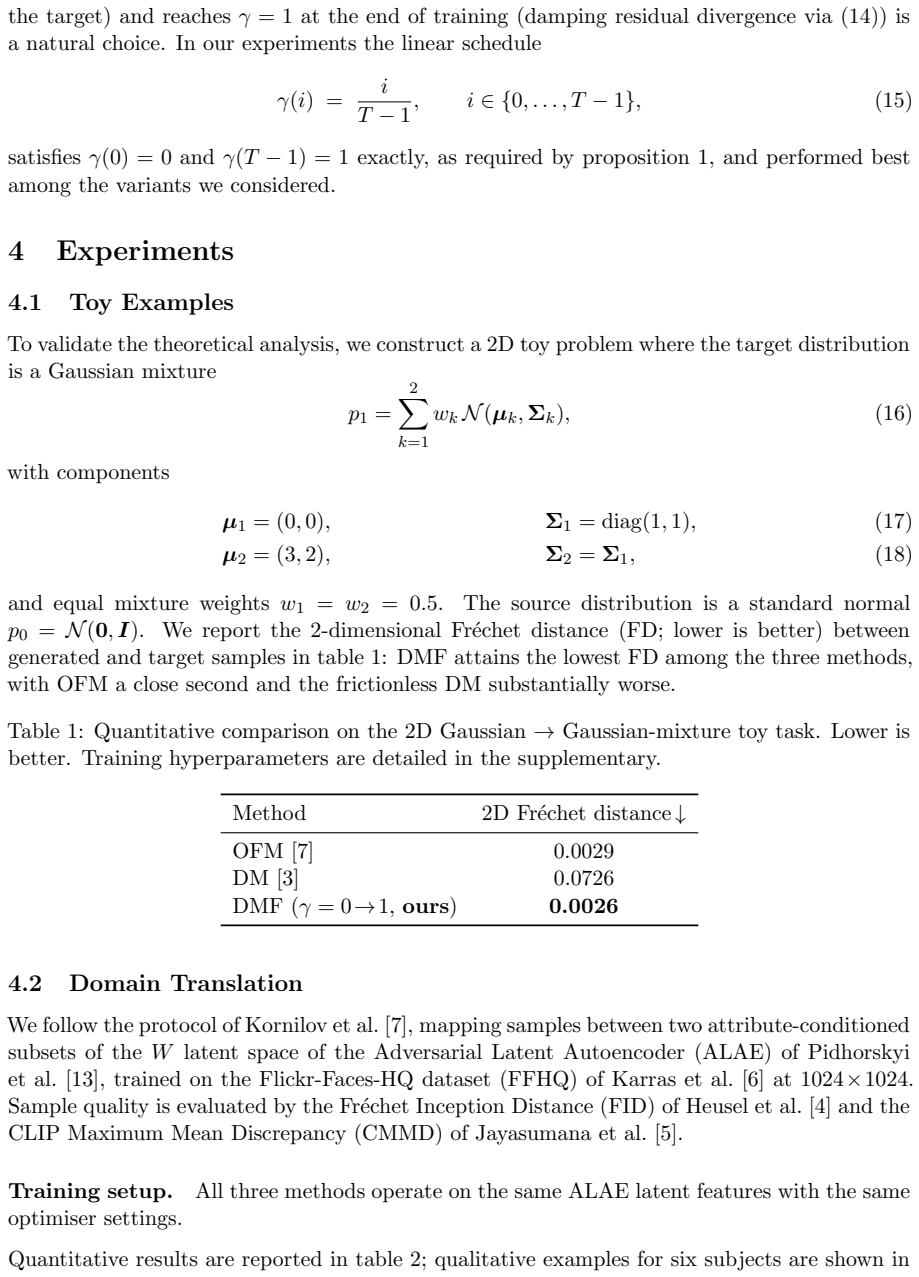
The friction-augmented drift field with linear scheduling contracts the two-particle error trajectory and yields a finite bound on the distance to the target. Under a Gaussian kernel, vanishing of the drift operator V_{p,q} on any open set forces the generated distribution q to equal the target p, establishing the missing converse to earlier identifiability statements. This construction, called DMF, matches or surpasses Optimal Flow Matching on FFHQ domain translation at sixteen times lower training cost.
What carries the argument
Linearly scheduled friction coefficient added to the kernel-based drift field, analyzed through a two-particle surrogate for contraction and an identifiability proof for Gaussian kernels.
If this is right
- Zero drift on an open set now implies exact distributional match for Gaussian kernels.
- Linear friction scheduling supplies an explicit finite-horizon error bound.
- One-step generation reaches flow-matching quality on face translation tasks.
- Training compute drops by a factor of sixteen relative to Optimal Flow Matching while preserving output fidelity.
Where Pith is reading between the lines
- If the two-particle contraction carries over, similar friction terms could stabilize other kernel-driven generative methods.
- The identifiability result suggests that drift-based training may be uniquely recoverable from observed vector fields in certain kernel families.
- Extending the proof beyond Gaussian kernels would clarify whether the same uniqueness holds for common alternatives such as Matérn kernels.
Load-bearing premise
Behavior observed in the two-particle surrogate model extends without change to the high-dimensional distributions used in the image experiments.
What would settle it
A concrete counter-example in which V_{p,q} is identically zero on an open set yet the generated distribution q differs from p, or an experiment where the high-dimensional error fails to contract despite the scheduled friction.
Figures


read the original abstract
Drifting Models [Deng et al., 2026] train a one-step generator by evolving samples under a kernel-based drift field, avoiding ODE integration at inference. The original analysis leaves two questions open. The drift-field iteration admits a locally repulsive regime in a two-particle surrogate, and vanishing of the drift ($V_{p,q}\equiv 0$) is not known to force the learned distribution $q$ to match the target $p$. We derive a contraction threshold for the surrogate and show that a linearly-scheduled friction coefficient gives a finite-horizon bound on the error trajectory. Under a Gaussian kernel we prove that the drift-field equilibrium is identifiable: vanishing of $V_{p,q}$ on any open set forces $q=p$, closing the converse of Proposition 3.1 of Deng et al. Our friction-augmented model, DMF (Drifting Model with Friction), matches or exceeds Optimal Flow Matching on FFHQ adult-to-child domain translation at 16x lower training compute.
Editorial analysis
A structured set of objections, weighed in public.
Referee Report
Summary. The paper augments drifting models (Deng et al., 2026) with a friction term to obtain DMF. It derives a contraction threshold and finite-horizon error bound for a two-particle surrogate under linearly scheduled friction, proves that under a Gaussian kernel the vanishing of the drift field V_{p,q} on any open set implies q = p (closing the converse of Deng et al. Prop. 3.1), and reports that DMF matches or exceeds Optimal Flow Matching on FFHQ adult-to-child translation while using 16x less training compute.
Significance. If the surrogate-to-distribution transfer holds, the identifiability result supplies a missing converse for drifting-model equilibria and the friction schedule supplies a concrete convergence guarantee; together they would strengthen the theoretical foundation of one-step kernel-based generators relative to ODE-based flow matching. The reported compute reduction on a standard domain-translation benchmark is practically relevant if reproducible.
major comments (2)
- [§3 (contraction analysis) and experimental section] The contraction threshold and finite-horizon bound are derived only for the two-particle surrogate (abstract and §3). No Lipschitz control, scaling argument, or numerical check is supplied showing that the same threshold governs the many-particle, high-dimensional regime used in the FFHQ experiments; this transfer is load-bearing for the practical performance claim.
- [Theorem on identifiability and §4 (experiments)] The identifiability theorem is stated only for the Gaussian kernel. The manuscript does not specify which kernel is used in the FFHQ runs, nor does it verify that the learned drift field satisfies the open-set vanishing condition required by the theorem; without this link the theoretical guarantee does not directly support the reported empirical results.
minor comments (2)
- [§4] Dataset splits, hyperparameter values, baseline implementation details, and error-bar reporting are absent from the experimental description, preventing direct reproduction of the 16x compute claim.
- [§3] Notation for the friction schedule and the surrogate error trajectory should be defined before the statement of the finite-horizon bound.
Simulated Author's Rebuttal
We thank the referee for the constructive comments, which highlight important gaps between the surrogate analysis and the high-dimensional experiments. We address each point below and indicate the revisions we will make.
read point-by-point responses
-
Referee: [§3 (contraction analysis) and experimental section] The contraction threshold and finite-horizon bound are derived only for the two-particle surrogate (abstract and §3). No Lipschitz control, scaling argument, or numerical check is supplied showing that the same threshold governs the many-particle, high-dimensional regime used in the FFHQ experiments; this transfer is load-bearing for the practical performance claim.
Authors: We agree that the contraction analysis is rigorously derived only for the two-particle surrogate. No general Lipschitz bound or scaling argument is provided for the many-particle case. The friction schedule used in the FFHQ experiments is chosen by applying the surrogate-derived threshold as a practical heuristic. We will revise §3 to explicitly state this limitation and add a brief discussion of the surrogate-to-full-model transfer. We will also include a small-scale numerical verification (e.g., 10-50 particles in moderate dimension) comparing the surrogate error trajectory to the observed drift-field evolution during training. revision: partial
-
Referee: [Theorem on identifiability and §4 (experiments)] The identifiability theorem is stated only for the Gaussian kernel. The manuscript does not specify which kernel is used in the FFHQ runs, nor does it verify that the learned drift field satisfies the open-set vanishing condition required by the theorem; without this link the theoretical guarantee does not directly support the reported empirical results.
Authors: The FFHQ experiments employ the Gaussian kernel, matching the setting of the identifiability theorem; we will add an explicit statement to this effect in §4.1. Verifying that the learned drift vanishes on an open set is not feasible in high dimensions and is not performed. The theorem establishes identifiability of equilibria under the Gaussian kernel, while the experiments demonstrate that the friction-augmented objective yields competitive performance. We will insert a clarifying remark in §4 noting that the theoretical result supports the model class and kernel choice, while the empirical gains are shown directly via the reported metrics. revision: yes
- A rigorous Lipschitz control or scaling argument that transfers the two-particle contraction threshold to the full many-particle, high-dimensional regime.
Circularity Check
Independent derivations close gaps in cited Deng et al. model without reducing to inputs
full rationale
The paper cites Deng et al. for the base drifting model and Proposition 3.1 but supplies its own derivations for the two-particle surrogate contraction threshold, the finite-horizon error bound under linear friction scheduling, and the Gaussian-kernel identifiability proof that vanishing V_{p,q} on an open set forces q = p. No equations are defined in terms of their outputs, no fitted parameters are relabeled as predictions, and no self-citation chain or ansatz is load-bearing for the central claims. The extension of the surrogate analysis to high-dimensional FFHQ distributions is stated as an assumption rather than derived, but this does not make the derivation chain circular by construction.
Axiom & Free-Parameter Ledger
axioms (2)
- domain assumption The drift field V_{p,q} is defined via a kernel that measures interactions between samples from p and q.
- standard math p and q are probability distributions on a metric space where the Gaussian kernel is positive definite.
Forward citations
Cited by 1 Pith paper
-
DriftXpress: Faster Drifting Models via Projected RKHS Fields
DriftXpress approximates drifting kernels via projected RKHS fields to lower training cost of one-step generative models while matching original FID scores.
Reference graph
Works this paper leans on
-
[1]
Albergo and Eric Vanden-Eijnden
Michael S. Albergo and Eric Vanden-Eijnden. Building normalizing flows with stochastic interpolants. InInternational Conference on Learning Representations (ICLR), 2023
2023
-
[2]
Zico Kolter
Brandon Amos, Lei Xu, and J. Zico Kolter. Input convex neural networks. InInternational Conference on Machine Learning (ICML), 2017
2017
-
[3]
Generative Modeling via Drifting
Mingyang Deng, He Li, Tianhong Li, Yilun Du, and Kaiming He. Generative modeling via drifting.arXiv preprint arXiv:2602.04770, February 2026
work page internal anchor Pith review arXiv 2026
-
[4]
GANs trained by a two time-scale update rule converge to a local Nash equi- librium
Martin Heusel, Hubert Ramsauer, Thomas Unterthiner, Bernhard Nessler, and Sepp Hochreiter. GANs trained by a two time-scale update rule converge to a local Nash equi- librium. InAdvances in Neural Information Processing Systems (NeurIPS), 2017
2017
-
[5]
Rethinking FID: Towards a better evaluation metric for image generation
Sadeep Jayasumana, Srikumar Ramalingam, Andreas Veit, Daniel Glasner, Ayan Chakrabarti, and Sanjiv Kumar. Rethinking FID: Towards a better evaluation metric for image generation. InIEEE/CVF Conference on Computer Vision and Pattern Recognition (CVPR), 2024
2024
-
[6]
A style-based generator architecture for gen- erative adversarial networks
Tero Karras, Samuli Laine, and Timo Aila. A style-based generator architecture for gen- erative adversarial networks. InIEEE/CVF Conference on Computer Vision and Pattern Recognition (CVPR), 2019
2019
-
[7]
Optimal flow matching: Learning straight trajectories in just one step
Nikita Kornilov, Petr Mokrov, Alexander Gasnikov, and Alexander Korotin. Optimal flow matching: Learning straight trajectories in just one step. InAdvances in Neural Information Processing Systems (NeurIPS), 2024
2024
-
[8]
Solomon, Alexander Filippov, and Evgeny Burnaev
Alexander Korotin, Lingxiao Li, Aude Genevay, Justin M. Solomon, Alexander Filippov, and Evgeny Burnaev. Do neural optimal transport solvers work? A continuous Wasserstein- 2 benchmark. InAdvances in Neural Information Processing Systems (NeurIPS), 2021
2021
-
[9]
Neural optimal transport
Alexander Korotin, Daniil Selikhanovych, and Evgeny Burnaev. Neural optimal transport. InInternational Conference on Learning Representations (ICLR), 2023
2023
-
[10]
Yaron Lipman, Ricky T. Q. Chen, Heli Ben-Hamu, Maximilian Nickel, and Matthew Le. Flow matching for generative modeling. InInternational Conference on Learning Repre- sentations (ICLR), 2023
2023
-
[11]
Flow straight and fast: Learning to generate and transfer data with rectified flow
Xingchao Liu, Chengyue Gong, and Qiang Liu. Flow straight and fast: Learning to generate and transfer data with rectified flow. InInternational Conference on Learning Representa- tions (ICLR), 2023
2023
-
[12]
Optimal transport mapping via input convex neural networks
Ashok Makkuva, Amirhossein Taghvaei, Sewoong Oh, and Jason Lee. Optimal transport mapping via input convex neural networks. InInternational Conference on Machine Learn- ing (ICML), 2020
2020
-
[13]
Adjeroh, and Gianfranco Doretto
Stanislav Pidhorskyi, Donald A. Adjeroh, and Gianfranco Doretto. Adversarial latent 14 autoencoders. InIEEE/CVF Conference on Computer Vision and Pattern Recognition (CVPR), 2020
2020
-
[14]
Boris T. Polyak. Some methods of speeding up the convergence of iteration methods.USSR Computational Mathematics and Mathematical Physics, 4(5):1–17, 1964
1964
-
[15]
Elaydi.An Introduction to Difference Equations
Saber N. Elaydi.An Introduction to Difference Equations. Springer, 3rd edition, 2005
2005
-
[16]
Kingma, Abhishek Kumar, Stefano Ermon, and Ben Poole
Yang Song, Jascha Sohl-Dickstein, Diederik P. Kingma, Abhishek Kumar, Stefano Ermon, and Ben Poole. Score-based generative modeling through stochastic differential equations. InInternational Conference on Learning Representations (ICLR), 2021
2021
-
[17]
Improving and generalizing flow-based generative models with minibatch optimal transport.Transactions on Machine Learning Research (TMLR), 2024
Alexander Tong, Kilian Fatras, Nikolay Malkin, Guillaume Huguet, Yanlei Zhang, Jarrid Rector-Brooks, Guy Wolf, and Yoshua Bengio. Improving and generalizing flow-based generative models with minibatch optimal transport.Transactions on Machine Learning Research (TMLR), 2024
2024
-
[18]
Bayesian learning via stochastic gradient Langevin dy- namics
Max Welling and Yee Whye Teh. Bayesian learning via stochastic gradient Langevin dy- namics. InInternational Conference on Machine Learning (ICML), 2011. 15
2011
discussion (0)
Sign in with ORCID, Apple, or X to comment. Anyone can read and Pith papers without signing in.