Recognition: unknown
Magnetotransport and Phase competition in three-dimensional Hubbard-Holstein model at half-filling
Pith reviewed 2026-05-10 03:47 UTC · model grok-4.3
The pith
The three-dimensional Hubbard-Holstein model at half-filling shows antiferromagnetic and charge-ordered insulating phases separated by a first-order transition with no metallic phase between them.
A machine-rendered reading of the paper's core claim, the machinery that carries it, and where it could break.
Core claim
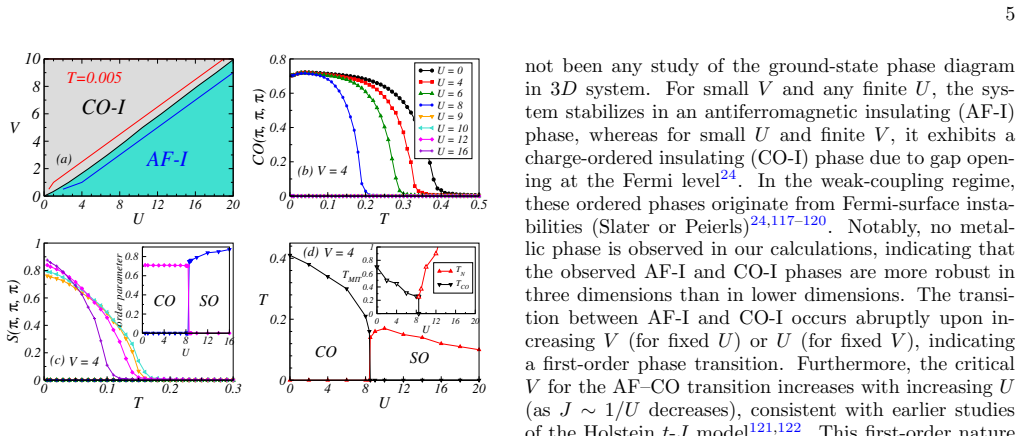
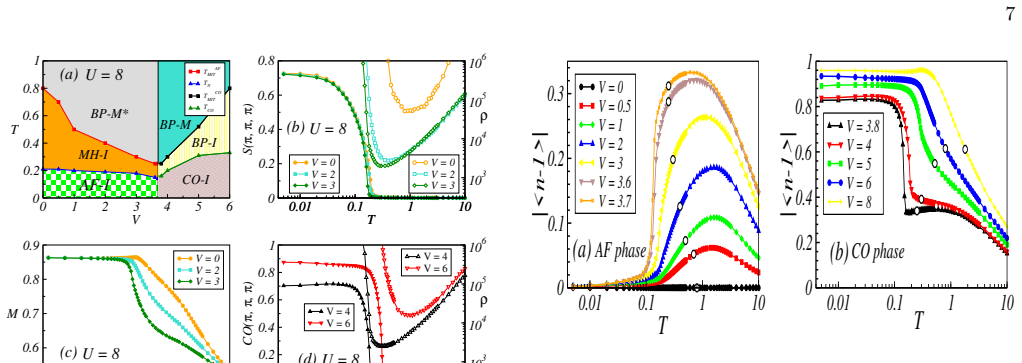
The low-temperature U versus V phase diagram of the 3D Hubbard-Holstein model at half-filling consists of an antiferromagnetic insulating phase and a charge-ordered insulating phase separated by a first-order transition line, with no metallic phase present at their intersection. This indicates that both ordered phases remain robust in three dimensions. For parameters where U is on the order of the electronic bandwidth, the V-T phase diagram includes multiple phases such as Mott-Hubbard and bipolaronic insulators together with bipolaronic metallic states, accompanied by several first-order transitions near V approximately 3.75.
What carries the argument
Exact diagonalization-based semi-classical Monte Carlo simulations with phonons treated in the adiabatic limit applied to the Hubbard-Holstein Hamiltonian.
If this is right
- The absence of a metallic phase at the AF-I/CO-I boundary shows that competing insulating orders dominate in 3D without a quantum critical point or metallic window.
- Multiple first-order transitions appear in the V-T plane near V ~ 3.75 when U is comparable to the bandwidth.
- Above the ordering temperature the density of states is dominated by electronic contributions and exhibits universal behavior.
- Proximity effects between phases appear in magnetic susceptibility and transport, offering routes to tune emergent states in correlated materials.
Where Pith is reading between the lines
- If dynamical phonon effects beyond the adiabatic approximation were included, the first-order character of the transitions might soften or a narrow metallic region could appear.
- The reported robustness of the insulating phases in 3D could imply that similar competition persists in real materials with strong electron-phonon coupling such as certain transition-metal oxides.
- Magnetotransport measurements along the phase boundary might detect signatures of the proximity effects through anomalous magnetoresistance behavior.
Load-bearing premise
The adiabatic treatment of phonons combined with semi-classical Monte Carlo on finite lattices faithfully reproduces the quantum phase competition and transition orders without substantial corrections from phonon dynamics or finite-size effects.
What would settle it
Detection of a metallic phase or continuous transition between the antiferromagnetic and charge-ordered insulators at the parameter values corresponding to their reported boundary in the U-V plane.
Figures



read the original abstract
We investigate the magnetotransport properties of the one-band Hubbard-Holstein model at half-filling in three dimensions (3D) using exact diagonalization based semi-classical Monte Carlo simulations with phonons treated in the adiabatic limit. The low-temperature electronic correlation $U$ vs electron-phonon coupling $V$ phase diagram reveals two insulating phases--antiferromagnetic (AF-I) and charge-ordered (CO-I)--separated by a first-order transition, with no metallic phase observed at their intersection, indicating robustness of these phases in 3D. For $U \sim bandwidth$, the $V$ vs temperature $T$ phase diagram exhibits multiple phases including AF-I, CO-I, Mott-Hubbard insulator, bipolaronic insulator, and two bipolaronic metallic states. Several first-order transitions occur near $V \sim 3.75$. Above the ordering temperature, the density of states shows universal behavior dominated by electronic contribution, while susceptibility and DOS analyses reveal pseudogap features. Magnetic and transport properties along the phase boundary highlight strong proximity effects between competing phases, suggesting routes for tuning correlated materials and emergent electronic states.
Editorial analysis
A structured set of objections, weighed in public.
Referee Report
Summary. The manuscript investigates magnetotransport and phase competition in the three-dimensional Hubbard-Holstein model at half-filling via exact-diagonalization-based semi-classical Monte Carlo simulations with phonons in the adiabatic limit. It reports a low-temperature U-V phase diagram featuring antiferromagnetic (AF-I) and charge-ordered (CO-I) insulating phases separated by a first-order transition with no intervening metallic phase, plus a V-T phase diagram showing multiple phases (AF-I, CO-I, Mott-Hubbard insulator, bipolaronic insulator, and bipolaronic metals) with several first-order transitions near V~3.75; additional analyses cover density of states, susceptibility, pseudogap features, and transport properties along phase boundaries.
Significance. If the numerical findings hold, the work adds to understanding of competing orders and transport in 3D electron-phonon systems relevant to correlated materials, with the direct 3D simulation and emphasis on proximity effects between phases as strengths. The absence of a metallic phase at the AF-I/CO-I boundary, if robust, would support phase robustness in three dimensions. However, the adiabatic approximation and finite-cluster method limit the strength of this conclusion relative to non-adiabatic or larger-scale approaches.
major comments (3)
- [Abstract and U-V phase diagram] Abstract and the U-V phase diagram section: the headline claim of two insulators separated by a first-order line with no metallic phase at their intersection rests on unspecified system sizes, absence of error bars, and no reported convergence checks or hysteresis data; without these, it is impossible to assess whether narrow metallic regions are resolved or missed due to finite-size effects.
- [Methods] Methods section on the semi-classical Monte Carlo with adiabatic phonons: treating phonons classically eliminates zero-point motion and quantum fluctuations that non-adiabatic Holstein treatments or finite-frequency DMFT have shown can stabilize metallic pockets or soften first-order lines near competing orders; the manuscript does not quantify the expected size of such corrections for the reported parameters.
- [Results on DOS and susceptibility] Results on DOS, susceptibility, and transport (near V~3.75 and above ordering temperature): the reported universal DOS behavior, pseudogap features, and proximity effects are presented without cluster-size dependence or finite-size scaling, making it unclear whether they survive in the thermodynamic limit or are influenced by the small-cluster ED used for electrons.
minor comments (2)
- [Figures] Figure captions and phase diagrams should explicitly state the linear cluster sizes employed and any criteria used to identify first-order vs continuous transitions.
- [Model definition] Notation for the electron-phonon coupling V should be compared to standard Holstein-model conventions to aid readers.
Simulated Author's Rebuttal
We thank the referee for the careful reading of our manuscript and the constructive comments. We address each major point below and outline the revisions we will make to strengthen the presentation of our results.
read point-by-point responses
-
Referee: [Abstract and U-V phase diagram] Abstract and the U-V phase diagram section: the headline claim of two insulators separated by a first-order line with no metallic phase at their intersection rests on unspecified system sizes, absence of error bars, and no reported convergence checks or hysteresis data; without these, it is impossible to assess whether narrow metallic regions are resolved or missed due to finite-size effects.
Authors: We agree that explicit documentation of the numerical parameters is required to substantiate the absence of an intervening metallic phase. In the revised manuscript we will state the linear cluster sizes employed (primarily 4^3 and 6^3), report statistical error bars on the order parameters, and include hysteresis loops together with convergence checks with respect to Monte Carlo sweeps and cluster size. These additions will make clear that, within the resolution of the simulations, the AF-I/CO-I boundary remains first-order with no metallic region. revision: yes
-
Referee: [Methods] Methods section on the semi-classical Monte Carlo with adiabatic phonons: treating phonons classically eliminates zero-point motion and quantum fluctuations that non-adiabatic Holstein treatments or finite-frequency DMFT have shown can stabilize metallic pockets or soften first-order lines near competing orders; the manuscript does not quantify the expected size of such corrections for the reported parameters.
Authors: The adiabatic (classical-phonon) limit is the regime we deliberately target to enable three-dimensional simulations at the system sizes needed to resolve competing orders. We acknowledge that zero-point motion and finite phonon frequency can modify phase boundaries in other treatments. Because a quantitative estimate of the correction would require an entirely different computational framework (quantum phonons or DMFT), we cannot provide a numerical bound within the present study. We will, however, add a concise paragraph in the Methods and Conclusions sections that cites the relevant non-adiabatic literature and states the limitation explicitly. revision: partial
-
Referee: [Results on DOS and susceptibility] Results on DOS, susceptibility, and transport (near V~3.75 and above ordering temperature): the reported universal DOS behavior, pseudogap features, and proximity effects are presented without cluster-size dependence or finite-size scaling, making it unclear whether they survive in the thermodynamic limit or are influenced by the small-cluster ED used for electrons.
Authors: We have verified that the reported DOS universality and pseudogap signatures remain qualitatively unchanged between the 4^3 and 6^3 clusters we employed. To make this explicit, the revised manuscript will include a supplementary figure displaying the cluster-size dependence of the DOS and local susceptibility at representative points above the ordering temperature. While a full finite-size scaling analysis lies beyond the scope of the current exact-diagonalization Monte Carlo approach, the added data will demonstrate that the main qualitative features are robust across the accessible sizes. revision: yes
Circularity Check
Direct numerical simulation of Hubbard-Holstein model yields phase diagram with no circularity
full rationale
The paper reports results from exact-diagonalization-based semi-classical Monte Carlo simulations applied directly to the Hubbard-Holstein Hamiltonian at half-filling in 3D, with phonons in the adiabatic limit. The U-V and V-T phase diagrams, first-order transitions, and transport properties are generated as outputs of this numerical procedure on finite clusters; no analytical derivation chain exists that reduces any claimed result to a fitted parameter or self-citation by construction. The central claims rest on the model definition and simulation outputs rather than any self-referential step.
Axiom & Free-Parameter Ledger
axioms (2)
- domain assumption Phonons can be treated in the adiabatic limit
- domain assumption Exact diagonalization combined with semi-classical Monte Carlo captures the essential low-energy physics of the model
Reference graph
Works this paper leans on
-
[1]
Science , volume =
Elbio Dagotto , title =. Science , volume =. 2005 , doi =
2005
-
[2]
Metal-insulator transitions , author =. Rev. Mod. Phys. , volume =. 1998 , month =. doi:10.1103/RevModPhys.70.1039 , url =
-
[3]
Angle-resolved photoemission studies of the cuprate superconductors , author =. Rev. Mod. Phys. , volume =. 2003 , month =. doi:10.1103/RevModPhys.75.473 , url =
-
[4]
Interplay of electron–phonon interaction and strong correlations: the possible way to high-temperature superconductivity , journal =. 2000 , issn =. doi:https://doi.org/10.1016/S0370-1573(00)00008-9 , url =
-
[5]
Capone, M. and Castellani, C. and Grilli, M. , title =. Advances in Condensed Matter Physics , volume =. doi:https://doi.org/10.1155/2010/920860 , url =
-
[6]
J. Mannhart and D. G. Schlom , title =. Science , volume =. 2010 , doi =. https://www.science.org/doi/pdf/10.1126/science.1181862 , abstract =
-
[7]
Colossal magnetoresistant materials: the key role of phase separation , journal =. 2001 , issn =. doi:https://doi.org/10.1016/S0370-1573(00)00121-6 , url =
-
[8]
Stanley and Chang, Young Jun and Rotenberg, Eli
Choi, Byoung Ki and Moreschini, Luca and Bostwick, Aaron and Williams, R. Stanley and Chang, Young Jun and Rotenberg, Eli. Correlation control of the Mott transition in LaTiO3/SrTiO3 heterostructures. Communications Materials. 2025. doi:10.1038/s43246-025-01032-6
-
[9]
Ahn, C. H. and Triscone, J.-M. and Mannhart, J. Electric field effect in correlated oxide systems. Nature. 2003. doi:10.1038/nature01878
-
[10]
Scheiderer, Philipp and Schmitt, Matthias and Gabel, Judith and Zapf, Michael and Stübinger, Martin and Schütz, Philipp and Dudy, Lenart and Schlueter, Christoph and Lee, Tien-Lin and Sing, Michael and Claessen, Ralph , title =. Advanced Materials , volume =. doi:https://doi.org/10.1002/adma.201706708 , url =
-
[11]
Mott Memory and Neuromorphic Devices , year=
Zhou, You and Ramanathan, Shriram , journal=. Mott Memory and Neuromorphic Devices , year=
-
[12]
Resistance random access memory , journal =. 2016 , issn =. doi:https://doi.org/10.1016/j.mattod.2015.11.009 , url =
-
[13]
Goteti and Ivan A
Uday S. Goteti and Ivan A. Zaluzhnyy and Shriram Ramanathan and Robert C. Dynes and Alex Frano , title =. Proceedings of the National Academy of Sciences , volume =. 2021 , doi =
2021
-
[14]
Wadley and B
P. Wadley and B. Howells and J. Železný and C. Andrews and V. Hills and R. P. Campion and V. Novák and K. Olejník and F. Maccherozzi and S. S. Dhesi and S. Y. Martin and T. Wagner and J. Wunderlich and F. Freimuth and Y. Mokrousov and J. Kuneš and J. S. Chauhan and M. J. Grzybowski and A. W. Rushforth and K. W. Edmonds and B. L. Gallagher and T. Jungwirth...
2016
-
[15]
Marti, X. and Fina, I. and Frontera, C. and Liu, Jian and Wadley, P. and He, Q. and Paull, R. J. and Clarkson, J. D. and Kudrnovsk \ A , J. and Turek, I. and Kune , J. and Yi, D. and Chu, J.-H. and Nelson, C. T. and You, L. and Arenholz, E. and Salahuddin, S. and Fontcuberta, J. and Jungwirth, T. and Ramesh, R. Room-temperature antiferromagnetic memory re...
-
[16]
Oxide Electronics Utilizing Ultrafast Metal-Insulator Transitions
Yang, Zheng and Ko, Changhyun and Ramanathan, Shriram. Oxide Electronics Utilizing Ultrafast Metal-Insulator Transitions. Annual Review of Materials Research. 2011. doi:https://doi.org/10.1146/annurev-matsci-062910-100347
-
[17]
Advanced Electronic Materials , volume =
Zhou, Guangdong and Wang, Zhongrui and Sun, Bai and Zhou, Feichi and Sun, Linfeng and Zhao, Hongbin and Hu, Xiaofang and Peng, Xiaoyan and Yan, Jia and Wang, Huamin and Wang, Wenhua and Li, Jie and Yan, Bingtao and Kuang, Dalong and Wang, Yuchen and Wang, Lidan and Duan, Shukai , title =. Advanced Electronic Materials , volume =. doi:https://doi.org/10.10...
-
[18]
Kwon, Ki Chang and Baek, Ji Hyun and Hong, Kootak and Kim, Soo Young and Jang, Ho Won. Memristive Devices Based on Two-Dimensional Transition Metal Chalcogenides for Neuromorphic Computing. Nano-Micro Letters. 2022. doi:10.1007/s40820-021-00784-3
-
[19]
Simulation of memristive synapses and neuromorphic computing on a quantum computer , author =. Phys. Rev. Res. , volume =. 2021 , month =. doi:10.1103/PhysRevResearch.3.023146 , url =
-
[20]
Neuromimetic Circuits with Synaptic Devices Based on Strongly Correlated Electron Systems , author =. Phys. Rev. Appl. , volume =. 2014 , month =. doi:10.1103/PhysRevApplied.2.064003 , url =
-
[21]
Boybat, Irem and Le Gallo, Manuel and Nandakumar, S. R. and Moraitis, Timoleon and Parnell, Thomas and Tuma, Tomas and Rajendran, Bipin and Leblebici, Yusuf and Sebastian, Abu and Eleftheriou, Evangelos. Neuromorphic computing with multi-memristive synapses. Nature Communications. 2018. doi:10.1038/s41467-018-04933-y
-
[22]
Franchini, Cesare and Reticcioli, Michele and Setvin, Martin and Diebold, Ulrike. Polarons in materials. Nature Reviews Materials. 2021. doi:10.1038/s41578-021-00289-w
-
[23]
Peng, Y. Y. and Husain, A. A. and Mitrano, M. and Sun, S. X.-L. and Johnson, T. A. and Zakrzewski, A. V. and MacDougall, G. J. and Barbour, A. and Jarrige, I. and Bisogni, V. and Abbamonte, P. , journal =. Enhanced Electron-Phonon Coupling for Charge-Density-Wave Formation in. 2020 , month =. doi:10.1103/PhysRevLett.125.097002 , url =
-
[25]
Alonso, J. A. and Garc\'. Charge Disproportionation in. Phys. Rev. Lett. , volume =. 1999 , month =. doi:10.1103/PhysRevLett.82.3871 , url =
-
[26]
Signatures of spin-orbital states of
Kim, Minjae , journal =. Signatures of spin-orbital states of. 2018 , month =. doi:10.1103/PhysRevB.97.155141 , url =
-
[27]
Polaron Problem by Diagrammatic Quantum Monte Carlo , author =. Phys. Rev. Lett. , volume =. 1998 , month =. doi:10.1103/PhysRevLett.81.2514 , url =
-
[28]
Continuous-Time Quantum Monte Carlo Algorithm for the Lattice Polaron , author =. Phys. Rev. Lett. , volume =. 1998 , month =. doi:10.1103/PhysRevLett.81.5382 , url =
-
[29]
Mobile Bipolaron , author =. Phys. Rev. Lett. , volume =. 2000 , month =. doi:10.1103/PhysRevLett.84.3153 , url =
-
[30]
Bai, Zhiying and He, Dawei and Fu, Shaohua and Miao, Qing and Liu, Shuangyan and Huang, Mohan and Zhao, Kun and Wang, Yongsheng and Zhang, Xiaoxian , title =. Nano Select , volume =. doi:https://doi.org/10.1002/nano.202100367 , url =
-
[31]
Chen, J. K. and Latham, W. P. and Beraun, J. E. , title =. Journal of Laser Applications , volume =. 2005 , month =. doi:10.2351/1.1848522 , url =
-
[32]
Carrier dynamics in semiconductors studied with time-resolved terahertz spectroscopy , author =. Rev. Mod. Phys. , volume =. 2011 , month =. doi:10.1103/RevModPhys.83.543 , url =
-
[33]
and Genco, Armando and Trovatello, Chiara and Conte, Stefano Dal and Khaustov, Vladislav O
Sayers, Charles J. and Genco, Armando and Trovatello, Chiara and Conte, Stefano Dal and Khaustov, Vladislav O. and Cervantes-Villanueva, Jorge and Sangalli, Davide and Molina-Sanchez, Alejandro and Coletti, Camilla and Gadermaier, Christoph and Cerullo, Giulio. Strong Coupling of Coherent Phonons to Excitons in Semiconducting Monolayer MoTe2. Nano Letters...
-
[34]
Benyamini, A. and Hamo, A. and Kusminskiy, S. Viola and von Oppen, F. and Ilani, S. Real-space tailoring of the electron \^a ??phonon coupling in ultraclean nanotube mechanical resonators. Nature Physics. 2014. doi:10.1038/nphys2842
-
[35]
Yan, Jun and Kim, M.-H. and Elle, J. A. and Sushkov, A. B. and Jenkins, G. S. and Milchberg, H. M. and Fuhrer, M. S. and Drew, H. D. Dual-gated bilayer graphene hot-electron bolometer. Nature Nanotechnology. 2012. doi:10.1038/nnano.2012.88
-
[36]
Strain Control of Exciton \^a ??Phonon Coupling in Atomically Thin Semiconductors
Niehues, Iris and Schmidt, Robert and Dr \ A ppel, Matthias and Marauhn, Philipp and Christiansen, Dominik and Selig, Malte and Bergh \ A user, Gunnar and Wigger, Daniel and Schneider, Robert and Braasch, Lisa and Koch, Rouven and Castellanos-Gomez, Andres and Kuhn, Tilmann and Knorr, Andreas and Malic, Ermin and Rohlfing, Michael and Michaelis de Vasconc...
-
[37]
Journal of Applied Physics , volume =
Tang, Dao-Sheng and Qin, Guang-Zhao and Hu, Ming and Cao, Bing-Yang , title =. Journal of Applied Physics , volume =. 2020 , month =. doi:10.1063/1.5133105 , url =
-
[38]
Lanzara, A. and Bogdanov, P. V. and Zhou, X. J. and Kellar, S. A. and Feng, D. L. and Lu, E. D. and Yoshida, T. and Eisaki, H. and Fujimori, A. and Kishio, K. and Shimoyama, J.-I. and Noda, T. and Uchida, S. and Hussain, Z. and Shen, Z.-X. Evidence for ubiquitous strong electron \^a ??phonon coupling in high-temperature superconductors. Nature. 2001. doi:...
-
[39]
Superconductivity in fullerides , author =. Rev. Mod. Phys. , volume =. 1997 , month =. doi:10.1103/RevModPhys.69.575 , url =
-
[40]
Mott Transition and Magnetism in Rare Earth Nickelates and its Fingerprint on the X-ray Scattering
Haule, Kristjan and Pascut, Gheorghe L. Mott Transition and Magnetism in Rare Earth Nickelates and its Fingerprint on the X-ray Scattering. Scientific Reports. 2017. doi:10.1038/s41598-017-10374-2
-
[41]
and Vandelli, Matteo and Lichtenstein, Alexander I
Stepanov, Evgeny A. and Vandelli, Matteo and Lichtenstein, Alexander I. and Lechermann, Frank. Charge density wave ordering in NdNiO2: effects of multiorbital nonlocal correlations. npj Computational Materials. 2024. doi:10.1038/s41524-024-01298-3
-
[42]
Tranquada, J. M. and Lorenzo, J. E. and Buttrey, D. J. and Sachan, V. , journal =. Cooperative ordering of holes and spins in. 1995 , month =. doi:10.1103/PhysRevB.52.3581 , url =
-
[43]
Millis, A. J. and Littlewood, P. B. and Shraiman, B. I. , journal =. Double Exchange Alone Does Not Explain the Resistivity of. 1995 , month =. doi:10.1103/PhysRevLett.74.5144 , url =
-
[44]
Millis, A. J. Lattice effects in magnetoresistive manganese perovskites. Nature. 1998. doi:10.1038/32348
-
[45]
Powell, B J and McKenzie, Ross H , title =. 2006 , month =. doi:10.1088/0953-8984/18/45/R03 , url =
-
[46]
Cooperation between Electron-Phonon Coupling and Electronic Interaction in Bilayer Nickelates
Zhan, Jun and Gu, Yuhao and Wu, Xianxin and Hu, Jiangping , journal =. Cooperation between Electron-Phonon Coupling and Electronic Interaction in Bilayer Nickelates. 2025 , month =. doi:10.1103/PhysRevLett.134.136002 , url =
-
[47]
Role of electronic correlation effect on charge ordering in -V2OPO4 , journal =. 2020 , issn =. doi:https://doi.org/10.1016/j.commatsci.2019.109433 , url =
-
[48]
Science Advances , volume =
Qisi Wang and Karin von Arx and Masafumi Horio and Deepak John Mukkattukavil and Julia Küspert and Yasmine Sassa and Thorsten Schmitt and Abhishek Nag and Sunseng Pyon and Tomohiro Takayama and Hidenori Takagi and Mirian Garcia-Fernandez and Ke-Jin Zhou and Johan Chang , title =. Science Advances , volume =. 2021 , doi =
2021
-
[49]
Georgescu, Alexandru B. and Millis, Andrew J. Quantifying the role of the lattice in metal \^a ??insulator phase transitions. Communications Physics. 2022. doi:10.1038/s42005-022-00909-z
-
[50]
Lattice-driven magnetoresistivity and metal-insulator transition in single-layered iridates , author =. Phys. Rev. B , volume =. 2011 , month =. doi:10.1103/PhysRevB.84.100402 , url =
-
[51]
Duan, Qingzhuo and Jia, Zixuan and Fan, Zenghui and Ma, Runyu and Meng, Jingyao and Huang, Bing and Ma, Tianxing , title =. 2025 , month =. doi:10.1088/0256-307X/42/9/090712 , url =
-
[52]
Ngai, J.H. and Walker, F.J. and Ahn, C.H. Correlated Oxide Physics and Electronics. Annual Review of Materials Research. 2014. doi:https://doi.org/10.1146/annurev-matsci-070813-113248
-
[53]
C. W. Bark and D. A. Felker and Y. Wang and Y. Zhang and H. W. Jang and C. M. Folkman and J. W. Park and S. H. Baek and H. Zhou and D. D. Fong and X. Q. Pan and E. Y. Tsymbal and M. S. Rzchowski and C. B. Eom , title =. Proceedings of the National Academy of Sciences , volume =. 2011 , doi =
2011
-
[54]
Watanabe, Yukio , volume=. DFT. Journal of Applied Physics , publisher=. 2024 , month=. doi:10.1063/5.0213487 , number=
-
[55]
Mirjolet, Mathieu and Rivadulla, Francisco and Marsik, Premysl and Borisov, Vladislav and Valentí, Roser and Fontcuberta, Josep , title =. Advanced Science , volume =. doi:https://doi.org/10.1002/advs.202004207 , url =
-
[56]
Ou, Zhenwei and Peng, Bin and Chu, Weibin and Li, Zhe and Wang, Cheng and Zeng, Yan and Chen, Hongyi and Wang, Qiuyu and Dong, Guohua and Wu, Yongyi and Qiu, Ruibin and Ma, Li and Zhang, Lili and Liu, Xiaoze and Li, Tao and Yu, Ting and Hu, Zhongqiang and Wang, Ti and Liu, Ming and Xu, Hongxing , title =. Advanced Science , volume =. doi:https://doi.org/1...
-
[57]
Edoardo Baldini and Michael A. Sentef and Swagata Acharya and Thomas Brumme and Evgeniia Sheveleva and Fryderyk Lyzwa and Ekaterina Pomjakushina and Christian Bernhard and Mark van Schilfgaarde and Fabrizio Carbone and Angel Rubio and Cédric Weber , title =. Proceedings of the National Academy of Sciences , volume =. 2020 , doi =
2020
-
[58]
Electron-phonon interactions and Helmholtz free energy in confined systems: Advancing low-dimensional superconductors for quantum technologies , journal =. 2025 , issn =. doi:https://doi.org/10.1016/j.rinp.2025.108270 , url =
-
[59]
Superconductivity, charge-density waves, antiferromagnetism, and phase separation in the Hubbard-Holstein model , author =. Phys. Rev. B , volume =. 2017 , month =. doi:10.1103/PhysRevB.96.205145 , url =
-
[60]
Strong Coupling Limit of the Holstein-Hubbard Model , author =. Phys. Rev. Lett. , volume =. 2020 , month =. doi:10.1103/PhysRevLett.125.167001 , url =
-
[61]
W. Koller and D. Meyer and Y. Ōno and A. C. Hewson , title =. 2004 , month =. doi:10.1209/epl/i2003-10228-6 , url =
-
[62]
Dynamic response functions for the Holstein-Hubbard model , author =. Phys. Rev. B , volume =. 2004 , month =. doi:10.1103/PhysRevB.70.155103 , url =
-
[63]
Polaronic Quasiparticles in a Strongly Correlated Electron Band , author =. Phys. Rev. Lett. , volume =. 2005 , month =. doi:10.1103/PhysRevLett.95.256401 , url =
-
[64]
and Seki, Kazuhiro and Yunoki, Seiji and Sorella, Sandro
Costa, Natanael C. and Seki, Kazuhiro and Yunoki, Seiji and Sorella, Sandro. Phase diagram of the two-dimensional Hubbard-Holstein model. Communications Physics. 2020. doi:10.1038/s42005-020-0342-2
-
[65]
Competition Between Antiferromagnetic and Charge-Density-Wave Order in the Half-Filled Hubbard-Holstein Model , author =. Phys. Rev. Lett. , volume =. 2012 , month =. doi:10.1103/PhysRevLett.109.246404 , url =
-
[66]
Determinant quantum Monte Carlo study of the two-dimensional single-band Hubbard-Holstein model , author =. Phys. Rev. B , volume =. 2013 , month =. doi:10.1103/PhysRevB.87.235133 , url =
-
[67]
Doping dependence of ordered phases and emergent quasiparticles in the doped Hubbard-Holstein model , author =. Phys. Rev. B , volume =. 2017 , month =. doi:10.1103/PhysRevB.96.205141 , url =
-
[68]
Competition among Superconducting, Antiferromagnetic, and Charge Orders with Intervention by Phase Separation in the 2D Holstein-Hubbard Model , author =. Phys. Rev. Lett. , volume =. 2017 , month =. doi:10.1103/PhysRevLett.119.197001 , url =
-
[69]
Electron-phonon vertex in the two-dimensional one-band Hubbard model , author =. Phys. Rev. B , volume =. 2003 , month =. doi:10.1103/PhysRevB.68.220507 , url =
-
[70]
Interplay of charge, spin, and lattice degrees of freedom in the spectral properties of the one-dimensional Hubbard-Holstein model , author =. Phys. Rev. B , volume =. 2014 , month =. doi:10.1103/PhysRevB.90.195134 , url =
-
[71]
Phase competition in a one-dimensional three-orbital Hubbard-Holstein model , author =. Phys. Rev. B , volume =. 2018 , month =. doi:10.1103/PhysRevB.97.195116 , url =
-
[72]
Competition between phase separation and spin density wave or charge density wave order: Role of long-range interactions , author =. Phys. Rev. B , volume =. 2019 , month =. doi:10.1103/PhysRevB.99.205145 , url =
-
[73]
One-dimensional Hubbard-Holstein model with finite-range electron-phonon coupling , author =. Phys. Rev. B , volume =. 2019 , month =. doi:10.1103/PhysRevB.99.075108 , url =
-
[74]
Lavanya, Ch Uma and Sankar, I. V. and Chatterjee, Ashok. Metallicity in a Holstein-Hubbard Chain at Half Filling with Gaussian Anharmonicity. Scientific Reports. 2017. doi:10.1038/s41598-017-03985-2
-
[75]
Excitation spectra and spin gap of the half-filled Holstein-Hubbard model , author =. Phys. Rev. B , volume =. 2013 , month =. doi:10.1103/PhysRevB.87.075149 , url =
-
[76]
Electron-phonon coupling and spin-charge separation in one-dimensional Mott insulators , author =. Phys. Rev. B , volume =. 2006 , month =. doi:10.1103/PhysRevB.74.241103 , url =
-
[77]
Phonon Effects on Spin-Charge Separation in One Dimension , author =. Phys. Rev. Lett. , volume =. 2006 , month =. doi:10.1103/PhysRevLett.96.156402 , url =
-
[78]
Density-Matrix Renormalization Group Study of Pairing when Electron-Electron and Electron-Phonon Interactions Coexist: Effect of the Electronic Band Structure , author =. Phys. Rev. Lett. , volume =. 2005 , month =. doi:10.1103/PhysRevLett.95.226401 , url =
-
[79]
Phase diagram for the one-dimensional Hubbard-Holstein model: A density-matrix renormalization group study , author =. Phys. Rev. B , volume =. 2007 , month =. doi:10.1103/PhysRevB.76.155114 , url =
-
[80]
Intermediate Phase of the One Dimensional Half-Filled Hubbard-Holstein Model , author =. Phys. Rev. Lett. , volume =. 2005 , month =. doi:10.1103/PhysRevLett.95.096401 , url =
-
[81]
Fehske, H. and Hager, G. and Jeckelmann, E. , title =. 2008 , month =. doi:10.1209/0295-5075/84/57001 , url =
discussion (0)
Sign in with ORCID, Apple, or X to comment. Anyone can read and Pith papers without signing in.