Recognition: unknown
Quantum many-body scars in random unitary circuits
Pith reviewed 2026-05-10 04:40 UTC · model grok-4.3
The pith
A single scar in an analytically tractable random unitary circuit thermalizes via fluctuating interfaces and imprints a transition on entanglement dynamics invisible to local observables.
A machine-rendered reading of the paper's core claim, the machinery that carries it, and where it could break.
Core claim
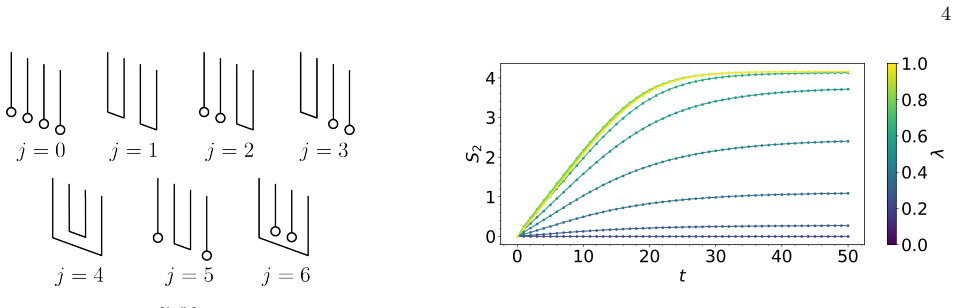
We construct an analytically tractable random unitary circuit hosting a single scar, and derive from first principles the thermalization mechanism governing perturbations thereof—described by a picture of fluctuating interfaces. Surprisingly, despite being thermodynamically irrelevant for local observables, the scar leaves a sharp fingerprint in the entanglement dynamics, driving a transition as a function of perturbation strength that is not probed by any local measurement.
What carries the argument
The fluctuating interfaces that describe how thermal regions invade the single scar under perturbation.
If this is right
- Perturbations around the scar thermalize through the motion and fluctuations of interfaces separating scarred and thermal regions.
- Entanglement entropy exhibits a transition in its growth rate controlled by perturbation strength.
- Local observables remain insensitive to the presence of the scar at long times.
- The transition in entanglement dynamics arises purely from the interface picture without requiring extra conservation laws.
Where Pith is reading between the lines
- The same interface mechanism may govern scar stability in other circuit models or in higher dimensions.
- Entanglement-based measurements could serve as a practical probe for scars in quantum simulators where local observables fail.
- The construction supplies a minimal setting for testing how non-thermal states survive in chaotic dynamics without fine-tuning.
Load-bearing premise
The chosen random unitary circuit remains analytically tractable after the scar is embedded and the fluctuating-interface description captures the leading thermalization channel without additional hidden conservation laws.
What would settle it
Numerical simulation of the circuit for a range of perturbation strengths that shows no change in the entanglement growth rate at any finite strength.
Figures




read the original abstract
Quantum many-body scars are rare exceptions to thermalization: they sustain non-thermal stationary states without the protection of any local conservation law, and are generally expected to be fragile. Here we construct an analytically tractable random unitary circuit hosting a single scar, and derive from first principles the thermalization mechanism governing perturbations thereof - described by a picture of fluctuating interfaces. Surprisingly, despite being thermodynamically irrelevant for local observables, the scar leaves a sharp fingerprint in the entanglement dynamics, driving a transition as a function of perturbation strength that is not probed by any local measurement.
Editorial analysis
A structured set of objections, weighed in public.
Referee Report
Summary. The manuscript constructs an analytically tractable random unitary circuit that hosts a single quantum many-body scar. From this model the authors derive, from first principles, the thermalization dynamics of perturbations around the scar state, which they describe via a fluctuating-interface picture. They further claim that the scar, while thermodynamically irrelevant for local observables, produces a sharp transition in entanglement dynamics as a function of perturbation strength that cannot be detected by any local measurement.
Significance. If the analytic tractability and first-principles derivation hold without hidden fine-tuning, the work supplies a rare exactly solvable instance of scars inside a random-circuit ensemble. The explicit interface description and the identification of a non-local entanglement transition constitute genuine strengths that could clarify scar fragility and the distinction between local and global diagnostics of thermalization.
major comments (2)
- [Model construction / Abstract] The central claim of analytic tractability after scar embedding (Abstract and the model-construction section) must be shown to preserve a fully random unitary ensemble. Explicit verification is needed that the chosen gates or initial-state constraints do not generate effective conservation laws or reduce the randomness of the circuit, as this would make the fluctuating-interface derivation dependent on those choices rather than generic.
- [Derivation of thermalization mechanism] The derivation of the interface picture as the leading thermalization channel (the section presenting the first-principles derivation) should include a clear statement of the circuit rules from which the interface dynamics follow, together with a demonstration that no additional hidden structure is required. Without this, the claim that the picture is parameter-free and independent of post-hoc assumptions remains unverified.
minor comments (1)
- [Abstract] The abstract states that the transition 'is not probed by any local measurement' but does not specify the precise entanglement quantity (e.g., half-chain entropy, mutual information) or the functional form of the transition; a brief clarification would improve readability.
Simulated Author's Rebuttal
We thank the referee for their careful reading of the manuscript and for the constructive comments. We appreciate the positive assessment of the analytic tractability and the interface picture. We have revised the manuscript to provide the explicit verifications requested on the ensemble properties and to clarify the derivation of the interface dynamics from the circuit rules. Our responses to the major comments are given below.
read point-by-point responses
-
Referee: [Model construction / Abstract] The central claim of analytic tractability after scar embedding (Abstract and the model-construction section) must be shown to preserve a fully random unitary ensemble. Explicit verification is needed that the chosen gates or initial-state constraints do not generate effective conservation laws or reduce the randomness of the circuit, as this would make the fluctuating-interface derivation dependent on those choices rather than generic.
Authors: We agree that explicit verification is required to substantiate the claim of analytic tractability within a random ensemble. In the revised manuscript we have added a dedicated paragraph in the model-construction section that verifies preservation of the Haar-random measure. The scar is embedded by constraining the action of a single two-site gate on one specific state while all gates (including that one) are otherwise drawn from the full Haar measure on U(4). Because the constraint applies to only one vector in a 2^L-dimensional space, it does not induce any local or global conservation law; the circuit remains ergodic on the orthogonal complement. The fluctuating-interface derivation follows solely from the statistical properties of the unmodified gates and the locality of the embedding, without dependence on further fine-tuning. revision: yes
-
Referee: [Derivation of thermalization mechanism] The derivation of the interface picture as the leading thermalization channel (the section presenting the first-principles derivation) should include a clear statement of the circuit rules from which the interface dynamics follow, together with a demonstration that no additional hidden structure is required. Without this, the claim that the picture is parameter-free and independent of post-hoc assumptions remains unverified.
Authors: We accept that a more explicit statement of the circuit rules strengthens the derivation. The revised derivation section now opens with a precise enumeration of the rules: a brickwork arrangement of two-site Haar-random unitaries, with the scar embedded at one fixed bond by requiring that a single gate maps the scar state to itself. From these rules we derive the interface dynamics by computing the leading-order action of the random gates on a domain wall separating the scar region from a thermalized region. The resulting Brownian motion of the interface is obtained directly from the second-moment properties of the Haar measure; no additional assumptions or hidden symmetries are invoked. This establishes that the picture is parameter-free within the stated ensemble. revision: yes
Circularity Check
No circularity: scar construction and interface derivation are independent of inputs
full rationale
The paper constructs a specific analytically tractable random unitary circuit embedding one scar and derives the fluctuating-interface thermalization mechanism directly from the circuit evolution rules. No step reduces a claimed prediction to a fitted parameter, self-citation chain, or definitional tautology. The entanglement transition is presented as an emergent consequence of the perturbation analysis rather than an input assumption. The derivation remains self-contained against the stated circuit ensemble without load-bearing reliance on prior author results or hidden conservations introduced by fiat.
Axiom & Free-Parameter Ledger
Forward citations
Cited by 1 Pith paper
-
Exact Quantum Many-Body Scars by a generalized Matrix-Product Ansatz
Exact eigenstates of non-frustration-free quantum many-body systems are constructed via a local error cancellation matrix-product ansatz.
Reference graph
Works this paper leans on
-
[1]
Quantum many-body scars in random unitary circuits
(also employed in Ref. [30] for dual unitary circuits) with the framework of random circuits with symmetries. It also displays analytical tractability, which allows us to derive a membrane picture, underlying a large-scale phe- nomenon associated with local observables, and identify a novel entanglement transition, induced by the presence of the scar. The...
work page internal anchor Pith review Pith/arXiv arXiv 2026
-
[2]
From Quantum Dynamics to the Canonical Distribution: General Picture and a Rigorous Example,
Hal Tasaki, “From Quantum Dynamics to the Canonical Distribution: General Picture and a Rigorous Example,” Phys. Rev. Lett.80, 1373–1376 (1998)
1998
-
[3]
Quantum mechanical evolution to- wards thermal equilibrium,
Noah Linden, Sandu Popescu, Anthony J. Short, and Andreas Winter, “Quantum mechanical evolution to- wards thermal equilibrium,” Phys. Rev. E79(2009), 10.1103/physreve.79.061103
-
[4]
Typicality of Thermal Equilibrium and Thermalization in Isolated Macroscopic Quantum Sys- tems,
Hal Tasaki, “Typicality of Thermal Equilibrium and Thermalization in Isolated Macroscopic Quantum Sys- tems,” J. Stat. Phys.163, 937–997 (2016)
2016
-
[5]
Complete Generalized Gibbs En- sembles in an Interacting Theory,
E. Ilievski, J. De Nardis, B. Wouters, J.-S. Caux, F.H.L. Essler, and T. Prosen, “Complete Generalized Gibbs En- sembles in an Interacting Theory,” Phys. Rev. Lett.115 (2015), 10.1103/physrevlett.115.157201
-
[6]
Quenchdynam- ics and relaxation in isolated integrable quantum spin chains,
FabianHLEsslerandMaurizioFagotti,“Quenchdynam- ics and relaxation in isolated integrable quantum spin chains,” J. Stat. Mech.2016, 064002 (2016)
2016
-
[7]
Emergent Hydrodynamics in Integrable Quantum Systems Out of Equilibrium,
Olalla A. Castro-Alvaredo, Benjamin Doyon, and Takato Yoshimura, “Emergent Hydrodynamics in Integrable Quantum Systems Out of Equilibrium,” Phys. Rev. X 6, 041065 (2016)
2016
-
[8]
Transport in Out-of-Equilibrium XXZChains: Exact Profiles of Charges and Currents,
Bruno Bertini, Mario Collura, Jacopo De Nardis, and Maurizio Fagotti, “Transport in Out-of-Equilibrium XXZChains: Exact Profiles of Charges and Currents,” Phys. Rev. Lett.117, 207201 (2016)
2016
-
[9]
Quantum statistical mechanics in a closed system,
Josh M Deutsch, “Quantum statistical mechanics in a closed system,” Phys. Rev. A43, 2046 (1991)
2046
-
[10]
Regular and irregular semiclassical wavefunctions,
Michael V Berry, “Regular and irregular semiclassical wavefunctions,” J. Phys. A: Math. Gen.10, 2083 (1977)
2083
-
[11]
The approach to thermal equilibrium in quantized chaotic systems,
Mark Srednicki, “The approach to thermal equilibrium in quantized chaotic systems,” J. Phys. A: Math. Gen.32, 1163 (1999)
1999
-
[12]
From quantum chaos and eigenstate thermalization to statistical mechanics and thermody- namics,
Luca D’Alessio, Yariv Kafri, Anatoli Polkovnikov, and Marcos Rigol, “From quantum chaos and eigenstate thermalization to statistical mechanics and thermody- namics,” Adv. Phys.65, 239–362 (2016)
2016
-
[13]
Probing many-body dynamics on a 51-atom quantum simulator,
Hannes Bernien, Sylvain Schwartz, A Keesling, H Levine, Ahmed Omran, Hannes Pichler, Soonwon Choi, A. S. Zibrov, Manuel Endres, Markus Greiner, Vladan Vuletić, and Mikhail D. Lukin, “Probing many-body dynamics on a 51-atom quantum simulator,” Nature551, 579–584 (2017)
2017
-
[14]
Weak ergodicity breaking from quantum many-body scars,
C. J. Turner, A. A. Michailidis, D. A. Abanin, M. Serbyn, and Z. Papić, “Weak ergodicity breaking from quantum many-body scars,” Nat. Phys.14, 745–749 (2018)
2018
-
[15]
Quantummany-bodyscarsandweakbreakingofergodi- city,
Maksym Serbyn, Dmitry A. Abanin, and Zlatko Papić, “Quantummany-bodyscarsandweakbreakingofergodi- city,” Nat. Phys.17, 675–685 (2021)
2021
-
[16]
Quantum many-body scars and Hilbert space fragmentation: a review of exact results,
Sanjay Moudgalya, B Andrei Bernevig, and Nicolas Reg- nault, “Quantum many-body scars and Hilbert space fragmentation: a review of exact results,” Rep. Prog. Phys.85, 086501 (2022)
2022
-
[17]
Quantum Many-Body Scars: A Quasiparticle Perspective,
Anushya Chandran, Thomas Iadecola, Vedika Khemani, and Roderich Moessner, “Quantum Many-Body Scars: A Quasiparticle Perspective,” Annual Rev. of Cond. Matt. Phys.14, 443–469 (2023)
2023
-
[18]
Genuine quantum scars in many-body spin systems,
Andrea Pizzi, Long-Hei Kwan, Bertrand Evrard, Ceren B. Dag, and Johannes Knolle, “Genuine quantum scars in many-body spin systems,” Nat. Commun.16 (2025), 10.1038/s41467-025-61765-3
-
[19]
Controlling quantum many-body dynamics in driven Rydberg atom arrays,
D. Bluvstein, A. Omran, H. Levine, A. Keesling, G. Se- meghini, S. Ebadi, T. T. Wang, A. A. Michailidis, N. Maskara, W. W. Ho, S. Choi, M. Serbyn, M. Greiner, V. Vuletić, and M. D. Lukin, “Controlling quantum many-body dynamics in driven Rydberg atom arrays,” Science371, 1355–1359 (2021)
2021
-
[20]
Topological pumping of a 1D dipolar gas into strongly correlated prethermal states,
Wil Kao, Kuan-Yu Li, Kuan-Yu Lin, Sarang Go- palakrishnan, and Benjamin Lev, “Topological pumping of a 1D dipolar gas into strongly correlated prethermal states,” Science371, 296–300 (2021)
2021
-
[21]
Long-lived phantom helix states in Heisenberg quantum magnets,
Paul Jepsen, Yoo Lee, Hanzhen Lin, Ivana Dimitrova, Yair Margalit, Wen Wei Ho, and Wolfgang Ketterle, “Long-lived phantom helix states in Heisenberg quantum magnets,” Nat. Phys.18, 1–6 (2022)
2022
-
[22]
Guo-Xian Su, Hui Sun, Ana Hudomal, Jean-Yves De- saules, Zhao-Yu Zhou, Bing Yang, Jad Halimeh, Zhen- Sheng Yuan, Zlatko Papić, and Jian-Wei Pan, “Observa- tion of many-body scarring in a Bose-Hubbard quantum simulator,” Phys. Rev. Research5(2023), 10.1103/Phys- RevResearch.5.023010
-
[23]
Wen Wei Ho, Soonwon Choi, Hannes Pichler, and Mikhail Lukin, “Periodic Orbits, Entanglement, and Quantum Many-Body Scars in Constrained Models: Matrix Product State Approach,” Phys. Rev. Lett.122 (2019), 10.1103/PhysRevLett.122.040603
-
[24]
Lat- tice Gauge Theories and String Dynamics in Rydberg Atom Quantum Simulators,
Federica Surace, Paolo Mazza, Giuliano Giudici, Alessio Lerose, Andrea Gambassi, and Marcello Dalmonte, “Lat- tice Gauge Theories and String Dynamics in Rydberg Atom Quantum Simulators,” Phys. Rev. X10(2020), 10.1103/PhysRevX.10.021041
-
[25]
Unified structure for exact towers of scar states in the Affleck-Kennedy-Lieb-Tasaki and other models,
Daniel K. Mark, Cheng-Ju Lin, and Olexei I. Motru- nich, “Unified structure for exact towers of scar states in the Affleck-Kennedy-Lieb-Tasaki and other models,” Phys. Rev. B101, 195131 (2020)
2020
-
[26]
Exceptional Station- 8 ary State in a Dephasing Many-Body Open Quantum System,
Alice Marché, Gianluca Morettini, Leonardo Mazza, Lorenzo Gotta, and Luca Capizzi, “Exceptional Station- 8 ary State in a Dephasing Many-Body Open Quantum System,” Phys. Rev. Lett.135, 020406 (2025)
2025
-
[27]
Quantum Entanglement Growth un- der Random Unitary Dynamics,
Adam Nahum, Jonathan Ruhman, Sagar Vijay, and Jeongwan Haah, “Quantum Entanglement Growth un- der Random Unitary Dynamics,” Phys. Rev. X7, 031016 (2017)
2017
-
[28]
Oper- ator Spreading in Random Unitary Circuits,
Adam Nahum, Sagar Vijay, and Jeongwan Haah, “Oper- ator Spreading in Random Unitary Circuits,” Phys. Rev. X8(2018), 10.1103/physrevx.8.021014
-
[29]
Entanglement Mem- brane in Chaotic Many-Body Systems,
Tianci Zhou and Adam Nahum, “Entanglement Mem- brane in Chaotic Many-Body Systems,” Phys. Rev. X 10, 031066 (2020)
2020
-
[30]
SystematicConstruc- tion of Counterexamples to the Eigenstate Thermaliza- tion Hypothesis,
NaotoShiraishiandTakashiMori,“SystematicConstruc- tion of Counterexamples to the Eigenstate Thermaliza- tion Hypothesis,” Phys. Rev. Lett.119, 030601 (2017)
2017
-
[31]
Quantum Many-Body Scars in Dual- Unitary Circuits,
Leonard Logaric, Shane Dooley, Silvia Pappalardi, and John Goold, “Quantum Many-Body Scars in Dual- Unitary Circuits,” Phys. Rev. Lett.132, 010401 (2024)
2024
-
[32]
Tibor Rakovszky, Frank Pollmann, and C.W. von Keyserlingk, “Diffusive Hydrodynamics of Out-of-Time- Ordered Correlators with Charge Conservation,” Phys. Rev. X8(2018), 10.1103/physrevx.8.031058
-
[33]
Operator Spreading and the Emergence of Dis- sipative Hydrodynamics under Unitary Evolution with Conservation Laws,
Vedika Khemani, Ashvin Vishwanath, and David A. Huse, “Operator Spreading and the Emergence of Dis- sipative Hydrodynamics under Unitary Evolution with Conservation Laws,” Phys. Rev. X8, 031057 (2018)
2018
-
[34]
Nonequilibrium Dynamics of Charged Dual- Unitary Circuits,
Alessandro Foligno, Pasquale Calabrese, and Bruno Bertini, “Nonequilibrium Dynamics of Charged Dual- Unitary Circuits,” PRX Quantum6, 010324 (2025)
2025
-
[35]
Malte Henkel, Haye Hinrichsen, and Sven Lübeck,Non- Equilibrium Phase Transitions: Volume 1: Absorbing Phase Transitions, Theoretical and Mathematical Phys- ics (Springer, Dordrecht, 2008)
2008
-
[36]
Slow thermalization of exact quantum many-body scar states under perturbations,
Cheng-Ju Lin, Anushya Chandran, and Olexei I. Motru- nich, “Slow thermalization of exact quantum many-body scar states under perturbations,” Phys. Rev. Research2 (2020), 10.1103/physrevresearch.2.033044
-
[37]
Random Quantum Circuits,
Matthew P.A. Fisher, Vedika Khemani, Adam Nahum, and Sagar Vijay, “Random Quantum Circuits,” Annual Rev. of Cond. Matt. Phys.14, 335–379 (2023)
2023
-
[38]
Chaos and com- plexity by design,
Daniel A. Roberts and Beni Yoshida, “Chaos and com- plexity by design,” J. High Energ. Phys.2017(2017), 10.1007/jhep04(2017)121
-
[39]
S. Aravinda, Suhail Ahmad Rather, and Arul Laksh- minarayan, “From dual-unitary to quantum Bernoulli circuits: Role of the entangling power in constructing a quantum ergodic hierarchy,” Phys. Rev. Research3 (2021), 10.1103/physrevresearch.3.043034
-
[40]
Felix Fritzsch and Pieter W. Claeys, “Free Probabil- ity in a Minimal Quantum Circuit Model,” (2025), arXiv:2506.11197 [quant-ph]
-
[41]
Eigenstate Thermalization Hypothesis and Free Prob- ability,
Silvia Pappalardi, Laura Foini, and Jorge Kurchan, “Eigenstate Thermalization Hypothesis and Free Prob- ability,” Phys. Rev. Lett.129(2022), 10.1103/physrev- lett.129.170603
-
[42]
Operator Hydrodynamics, OTOCs, and Entanglement Growth in Systems without Conservation Laws,
C. W. von Keyserlingk, Tibor Rakovszky, Frank Poll- mann, and S. L. Sondhi, “Operator Hydrodynamics, OTOCs, and Entanglement Growth in Systems without Conservation Laws,” Phys. Rev. X8, 021013 (2018)
2018
-
[43]
Entanglement dy- namics and Page curves in random permutation circuits,
Dávid Szász-Schagrin, Michele Mazzoni, Bruno Bertini, Katja Klobas, and Lorenzo Piroli, “Entanglement dy- namics and Page curves in random permutation circuits,” Phys. Rev. Res.8, L012061 (2026)
2026
-
[44]
Growing Schrödinger’s cat states by local unitary time evol- ution of product states,
Saverio Bocini and Maurizio Fagotti, “Growing Schrödinger’s cat states by local unitary time evol- ution of product states,” Phys. Rev. Research6(2024), 10.1103/physrevresearch.6.033108
-
[45]
Ob- serving quantum many-body scars in random quantum circuits,
Bárbara Andrade, Utso Bhattacharya, Ravindra W. Ch- hajlany, Tobias Graß, and Maciej Lewenstein, “Ob- serving quantum many-body scars in random quantum circuits,” Phys. Rev. A109, 052602 (2024)
2024
-
[46]
UnravelingPXPMany-BodyScarsthroughFlo- quet Dynamics,
Giuliano Giudici, Federica Maria Surace, and Hannes Pichler,“UnravelingPXPMany-BodyScarsthroughFlo- quet Dynamics,” Phys. Rev. Lett.133, 190404 (2024)
2024
-
[47]
Average entropy of a subsystem,
Don N. Page, “Average entropy of a subsystem,” Phys. Rev. Lett.71, 1291–1294 (1993)
1993
-
[48]
Dykema, and Alexandru Nica,Free Random Variables, CRM Monograph Series, Vol
Dan-Virgil Voiculescu, Ken J. Dykema, and Alexandru Nica,Free Random Variables, CRM Monograph Series, Vol. 1 (American Mathematical Society, Providence, RI, 1992)
1992
-
[49]
This is a slight abuse of terminology: technically, we per- form the limitt→ ∞of the expectation value, of the al- gebra. For instance, it is worth stressing that, by locality, O(t)∈ Afor any finitet; therefore, strictly speaking, the algebra obtained with evolution at finite timetcoincides always withA
discussion (0)
Sign in with ORCID, Apple, or X to comment. Anyone can read and Pith papers without signing in.