Recognition: unknown
Medical Image Understanding Improves Survival Prediction via Visual Instruction Tuning
Pith reviewed 2026-05-10 04:33 UTC · model grok-4.3
The pith
Pre-training a vision-language model on CT-report pairs via instruction tuning improves survival prediction from scans plus clinical data.
A machine-rendered reading of the paper's core claim, the machinery that carries it, and where it could break.
Core claim
By pre-training on open-sourced CT-report pairs through visual instruction tuning, the model acquires clinically meaningful visual-textual representations; attaching a survival head to these representations then yields better patient-outcome forecasts from CT images and clinical data than baseline approaches, with the largest gains occurring when clinical data alone is weakly predictive.
What carries the argument
visual instruction tuning on paired 3D CT images and radiology reports, which builds aligned multimodal representations that transfer to a survival-prediction head
If this is right
- Survival-prediction accuracy rises compared with methods that use only clinical variables or untuned image features.
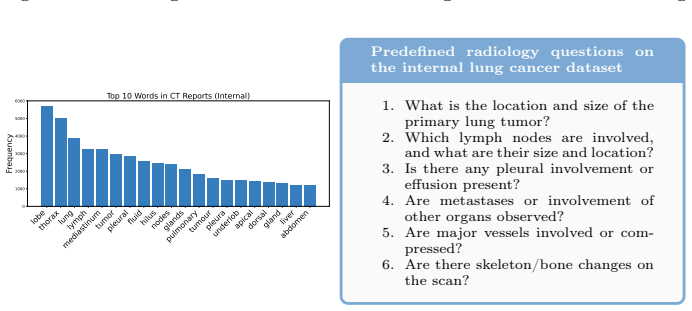
- The model generates clinically meaningful textual answers to predefined questions about the input CT scans.
- Gains are largest precisely in the regimes where clinical data by itself has limited predictive value.
- The pre-trained representations can be reused across related clinical tasks with modest additional fine-tuning.
Where Pith is reading between the lines
- The same pre-training pipeline could be tested on other modalities such as MRI to check whether comparable gains appear in prognosis tasks.
- The generated language responses might function as built-in explanations that clinicians can inspect to judge whether the model's reasoning matches their own assessment of the images.
- Widespread adoption might reduce variability in risk estimates across hospitals by supplying a consistent image-interpretation layer on top of local clinical data.
Load-bearing premise
The visual-textual features learned from general open CT-report data remain clinically relevant and transfer to the specific survival-prediction task without large domain shift or loss of prognostic information.
What would settle it
An experiment on an independent patient cohort in which adding the instruction-tuned image features to clinical data produces no improvement in survival-prediction metrics over a clinical-data-only baseline.
Figures


read the original abstract
Accurate prognostication and risk estimation are essential for guiding clinical decision-making and optimizing patient management. While radiologist-assessed features from CT scans provide valuable indicators of disease severity and outcomes, interpreting such images requires expert knowledge, and translating rich visual information into textual summaries inevitably leads to information loss. In this work, we propose a vision-language framework for 3D CT image understanding that leverages large-scale open-sourced CT images paired with radiology reports through visual instruction tuning. This pre-training enables the model to learn clinically meaningful visual-textual representations, which can then be adapted to downstream survival prediction tasks. By incorporating a survival prediction head on top of the pre-trained model, our approach improves survival prediction from CT images and clinical data while generating clinically meaningful language responses to predefined questions. Experimental results demonstrate that our method outperforms baseline methods in survival prediction, particularly, when clinical data alone is less predictive. The code will be released upon acceptance.
Editorial analysis
A structured set of objections, weighed in public.
Referee Report
Summary. The manuscript proposes a vision-language framework for 3D CT image understanding that performs visual instruction tuning on large-scale open-sourced CT-report pairs to learn clinically meaningful representations; these are then adapted via a survival prediction head for improved prognostication from CT images plus clinical data, while also generating language responses to predefined questions. It claims to outperform baselines, especially when clinical data alone is less predictive.
Significance. If the results hold with proper validation, the work could be significant for multimodal medical AI by demonstrating that instruction-tuned visual encoders from radiology reports can reduce information loss and enhance survival models over clinical-data-only baselines. The commitment to release code upon acceptance supports reproducibility, which is a clear strength.
major comments (2)
- [Abstract] Abstract: the central claim that the method 'outperforms baseline methods in survival prediction' is unsupported by any quantitative metrics, dataset sizes, patient cohort details, cross-validation procedure, or statistical significance tests. Without these, the performance improvement cannot be evaluated and is load-bearing for the paper's contribution.
- [Abstract] Abstract: the transfer assumption that visual representations learned from open-sourced CT-report pairs are clinically meaningful and transfer without major domain shift to the target survival task is not addressed; no analysis of data distribution overlap, scanner protocols, cancer subtypes, or ablation on pre-training data is provided, directly undermining the claim that the tuned encoder (rather than clinical data alone) drives the improvement.
minor comments (1)
- [Abstract] Abstract: the phrasing 'particularly, when clinical data alone is less predictive' contains an extraneous comma after 'particularly'.
Simulated Author's Rebuttal
We thank the referee for the constructive feedback on our manuscript. We agree that the abstract requires strengthening to better support our claims with quantitative details and to address the transfer assumptions more explicitly. We will revise the manuscript accordingly and provide point-by-point responses below.
read point-by-point responses
-
Referee: [Abstract] Abstract: the central claim that the method 'outperforms baseline methods in survival prediction' is unsupported by any quantitative metrics, dataset sizes, patient cohort details, cross-validation procedure, or statistical significance tests. Without these, the performance improvement cannot be evaluated and is load-bearing for the paper's contribution.
Authors: We agree that the abstract, constrained by length, does not include specific quantitative details. The full manuscript provides these in the Experiments and Results sections, including patient cohort sizes, cross-validation procedures (e.g., 5-fold), and statistical significance testing showing improvements over baselines, particularly when clinical data is less predictive. To address this directly, we will revise the abstract to incorporate key performance metrics and dataset details, making the central claim self-contained and verifiable. revision: yes
-
Referee: [Abstract] Abstract: the transfer assumption that visual representations learned from open-sourced CT-report pairs are clinically meaningful and transfer without major domain shift to the target survival task is not addressed; no analysis of data distribution overlap, scanner protocols, cancer subtypes, or ablation on pre-training data is provided, directly undermining the claim that the tuned encoder (rather than clinical data alone) drives the improvement.
Authors: We acknowledge that a more explicit discussion of potential domain shifts would strengthen the paper. The pre-training uses large-scale open-sourced CT-report pairs from public datasets that align with the target task's clinical context (CT imaging for cancer prognostication). To better substantiate the transfer, we will add a dedicated analysis in the revised manuscript covering data distribution overlap, available scanner protocol information, cancer subtype comparisons, and an ablation on the pre-training component to isolate its contribution beyond clinical data alone. revision: yes
Circularity Check
No circularity in empirical vision-language pre-training for survival prediction
full rationale
The paper describes an empirical pipeline: visual instruction tuning on external open-sourced CT-report pairs to learn representations, followed by adding a survival head and fine-tuning on the target task. No equations, uniqueness theorems, or ansatzes are invoked that reduce by construction to fitted parameters or self-citations. The central claim rests on experimental outperformance rather than any self-referential derivation, making the chain self-contained against external benchmarks.
Axiom & Free-Parameter Ledger
axioms (1)
- domain assumption Visual instruction tuning on paired CT volumes and radiology reports produces clinically meaningful representations that transfer to survival prediction.
Reference graph
Works this paper leans on
-
[1]
Research Square (2024)
Blankemeier, L., Cohen, J.P., Kumar, A., Van Veen, D., Gardezi, S.J.S., Paschali, M., Chen, Z., Delbrouck, J.B., Reis, E., Truyts, C., et al.: Merlin: A vision language foundation model for 3d computed tomography. Research Square (2024)
2024
-
[2]
In: MICCAI (2021)
Braman, N., Gordon, J.W.H., Goossens, E.T., Willis, C., Stumpe, M.C., Venkataraman, J.: Deep orthogonal fusion: Multimodal prognostic biomarker dis- covery integrating radiology, pathology, genomic, and clinical data. In: MICCAI (2021)
2021
-
[3]
Bioinformatics pp
Cheerla, A., Gevaert, O.: Deep learning with multimodal representation for pan- cancer prognosis prediction. Bioinformatics pp. i446–i454 (2019)
2019
-
[4]
IEEE Transactions on Medical Imaging (2020)
Chen, R.J., Lu, M.Y., Wang, J., Williamson, D.F., Rodig, S.J., Lindeman, N.I., Mahmood, F.: Pathomic fusion: An integrated framework for fusing histopathology and genomic features for cancer diagnosis and prognosis. IEEE Transactions on Medical Imaging (2020)
2020
-
[5]
In: ICCV
Chen, R.J., Lu, M.Y., Weng, W.H., Chen, T.Y., Williamson, D.F., Manz, T., Shady, M., Mahmood, F.: Multimodal co-attention transformer for survival pre- diction in gigapixel whole slide images. In: ICCV. pp. 4015–4025 (2021)
2021
-
[6]
Cancer Cell40(8), 865–878 (2022)
Chen, R.J., Lu, M.Y., Williamson, D.F., Chen, T.Y., Lipkova, J., Noor, Z., Shaban, M., Shady, M., Williams, M., Joo, B., et al.: Pan-cancer integrative histology- genomic analysis via multimodal deep learning. Cancer Cell40(8), 865–878 (2022)
2022
-
[7]
Chen, Z., Varma, M., Delbrouck, J.B., Paschali, M., Blankemeier, L., Veen, D.V., Valanarasu, J.M.J., Youssef, A., Cohen, J.P., Reis, E.P., Tsai, E.B., Johnston, A., Olsen, C., Abraham, T.M., Gatidis, S., Chaudhari, A.S., Langlotz, C.: Chexa- gent: Towards a foundation model for chest x-ray interpretation. arXiv:2401.12208 (2024)
-
[8]
Journal of the Royal Statistical So- ciety
Cox, D.R.: Regression models and life-tables. Journal of the Royal Statistical So- ciety. Series B (Methodological)34(1972) 10 X. Liu et al
1972
-
[9]
In: MICCAI
Gervelmeyer, J., Müller, S., Djoumessi, K., Merle, D., Clark, S.J., Koch, L., Berens, P.: Interpretable-by-design Deep Survival Analysis for Disease Progression Mod- eling . In: MICCAI. pp. 502–512 (2024)
2024
-
[10]
Computational and structural biotechnology journal (2021)
Győrffy, B.: Survival analysis across the entire transcriptome identifies biomarkers with the highest prognostic power in breast cancer. Computational and structural biotechnology journal (2021)
2021
-
[11]
Hamamci, I.E., Er, S., Simsek, F.A.F.A.G., Esirgun, S.N., Dogan, I., Dasdelen, M.F., Durugol, O.F., Wittmann, B., Amiranashvili, T., Simsar, E., Simsar, M., Erdemir, E.B., Alanbay, A., Sekuboyina, A., Lafci, B., Bluethgen, C., Ozdemir, M.K., Menze, B.: Developing generalist foundation models from a multimodal dataset for 3d computed tomography. arXiv.2403...
-
[12]
In: ICML (2019)
Houlsby, N., Giurgiu, A., Jastrzebski, S., Morrone, B., De Laroussilhe, Q., Ges- mundo, A., Attariyan, M., Gelly, S.: Parameter-efficient transfer learning for NLP. In: ICML (2019)
2019
-
[13]
LoRA: Low-Rank Adaptation of Large Language Models
Hu, E.J., Shen, Y., Wallis, P., Allen-Zhu, Z., Li, Y., Wang, S., Wang, L., Chen, W.: Lora: Low-rank adaptation of large language models. arXiv:2106.09685 (2021)
work page internal anchor Pith review Pith/arXiv arXiv 2021
-
[14]
Huang, S.C., Huo, Z., Steinberg, E., Chiang, C.C., Lungren, M.P., Langlotz, C.P., Yeung, S., Shah, N.H., Fries, J.A.: Inspect: A multimodal dataset for pulmonary embolism diagnosis and prognosis. arXiv.2311.10798 (2023)
-
[15]
Jiang, A.Q., Sablayrolles, A., Mensch, A., Bamford, C., Chaplot, D.S., de las Casas, D., Bressand, F., Lengyel, G., Lample, G., Saulnier, L., Lavaud, L.R., Lachaux, M.A., Stock, P., Scao, T.L., Lavril, T., Wang, T., Lacroix, T., Sayed, W.E.: Mistral 7b. arXiv.2310.06825 (2023)
work page internal anchor Pith review Pith/arXiv arXiv 2023
-
[16]
Scientific data (2016)
Johnson, A.E., Pollard, T.J., Shen, L., Lehman, L.w.H., Feng, M., Ghassemi, M., Moody,B.,Szolovits,P.,AnthonyCeli,L.,Mark,R.G.:Mimic-iii,afreelyaccessible critical care database. Scientific data (2016)
2016
-
[17]
Kaplan, E.L., Meier, P.: Nonparametric Estimation from Incomplete Observations, pp. 319–337. Breakthroughs in Statistics: Methodology and Distribution (1992)
1992
-
[18]
BMC Medical Research Methodology (2018)
Katzman, J.L., Shaham, U., Cloninger, A., Bates, J., Jiang, T., Kluger, Y.: Deep- surv:personalizedtreatmentrecommendersystemusingacoxproportionalhazards deep neural network. BMC Medical Research Methodology (2018)
2018
-
[19]
In: MICCAI (2024)
Kim, K., Lee, Y., Park, D., Eo, T., Youn, D., Lee, H., Hwang, D.: LLM-guided Multi-modal Multiple Instance Learning for 5-year Overall Survival Prediction of Lung Cancer . In: MICCAI (2024)
2024
-
[20]
AAAI Conf on AI (2018)
Lee,C.,Zame,W.,Yoon,J.,vanderSchaar,M.:Deephit:Adeeplearningapproach to survival analysis with competing risks. AAAI Conf on AI (2018)
2018
-
[21]
Llava-med: Training a large language-and-vision assistant for biomedicine
Li, C., Wong, C., Zhang, S., Usuyama, N., Liu, H., Yang, J., Naumann, T., Poon, H., Gao, J.: Llava-med: Training a large language-and-vision assistant for biomedicine in one day. arXiv:2306.00890 (2023)
-
[22]
Liu, H., Li, C., Wu, Q., Lee, Y.J.: Visual instruction tuning (2023)
2023
-
[23]
Ming, Y., Sun, Y., Dia, O., Li, Y.: How to exploit hyperspherical embeddings for out-of-distribution detection? In: ICLR (2023)
2023
-
[24]
Scientific reports (2021)
Nagy,Á.,Munkácsy,G.,Győrffy,B.:Pancancersurvivalanalysisofcancerhallmark genes. Scientific reports (2021)
2021
-
[25]
OpenAI: Gpt-4 technical report (2024)
2024
-
[26]
Touvron, H., et al.: Llama 2: Open foundation and fine-tuned chat models (2023)
2023
-
[27]
International Journal of Mathematics and Mathematical Sciences (2021) Title Suppressed Due to Excessive Length 11
Turkson, A.J., Ayiah-Mensah, F., Nimoh, V.: Handling censoring and censored data in survival analysis: A standalone systematic literature review. International Journal of Mathematics and Mathematical Sciences (2021) Title Suppressed Due to Excessive Length 11
2021
-
[28]
Statistics in Medicine pp
Uno, H., Cai, T., Pencina, M.J., D’Agostino, R.B., Wei, L.J.: On the c-statistics for evaluating overall adequacy of risk prediction procedures with censored survival data. Statistics in Medicine pp. 1105–1117 (2011)
2011
-
[29]
Wang, R., He, K.: Diffuse and disperse: Image generation with representation reg- ularization (2025)
2025
-
[30]
In: ICCV
Xu, Y., Chen, H.: Multimodal optimal transport-based co-attention transformer with global structure consistency for survival prediction. In: ICCV. pp. 21241– 21251 (2023)
2023
-
[31]
BERTScore: Evaluating Text Generation with BERT
Zhang, T., Kishore, V., Wu, F., Weinberger, K.Q., Artzi, Y.: Bertscore: Evaluating text generation with bert. arXiv:1904.09675 (2019)
work page internal anchor Pith review arXiv 1904
-
[32]
Zhang,Y.,Xu,Y.,Chen,J.,Xie,F.,Chen,H.:Prototypicalinformationbottleneck- ing and disentangling for multimodal cancer survival prediction. arXiv:2401.01646 (2024)
-
[33]
Radiotherapy and Oncology180, 109483 (2023)
Zheng, S., Guo, J., Langendijk, J.A., Both, S., Veldhuis, R.N., Oudkerk, M., van Ooijen, P.M., Wijsman, R., Sijtsema, N.M.: Survival prediction for stage i-iiia non- small cell lung cancer using deep learning. Radiotherapy and Oncology180, 109483 (2023)
2023
-
[34]
In: ICCV
Zhou, F., Chen, H.: Cross-modal translation and alignment for survival analysis. In: ICCV. pp. 21485–21494 (2023)
2023
discussion (0)
Sign in with ORCID, Apple, or X to comment. Anyone can read and Pith papers without signing in.