Recognition: unknown
Impact of Cold Jupiter Scattering on the Mean-Motion Resonance of Inner Small Planets
Pith reviewed 2026-05-10 03:35 UTC · model grok-4.3
The pith
Scattering by cold Jupiters disrupts mean-motion resonances between inner super-Earths in most typical systems.
A machine-rendered reading of the paper's core claim, the machinery that carries it, and where it could break.
Core claim
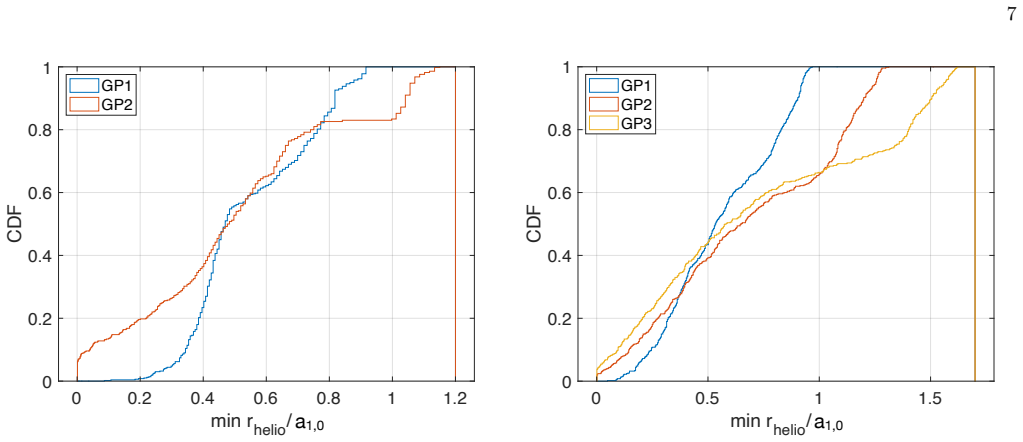
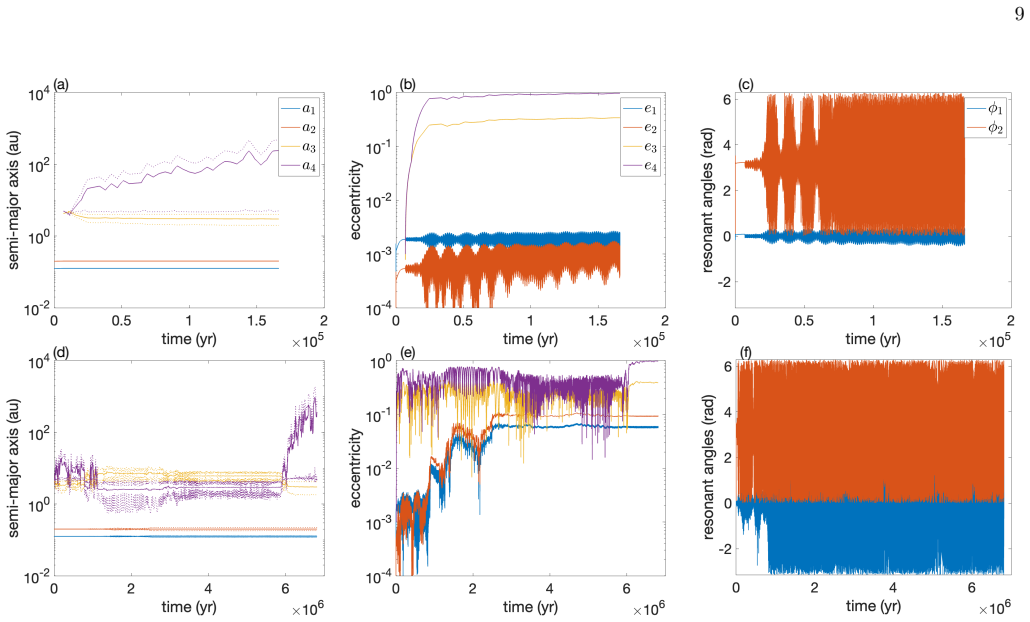
A single pericenter passage of a highly eccentric cold Jupiter can disrupt an inner resonance once a critical perturbation strength is crossed. N-body runs indicate deep inner-system penetration occurs in only 10-20 percent of cases. Secular perturbation theory applied to the full scattering history then shows that the cumulative time-varying forcing drives resonance-angle circulation in at least 60 percent of 2:1 configurations and roughly 85 percent of 3:2 configurations for typical semi-major axes near 0.1 au for the super-Earths and a few au for the cold Jupiter.
What carries the argument
Secular perturbation theory applied to the time-dependent eccentricity and resonant-angle forcing from scattering cold Jupiters.
If this is right
- The present-day location of a cold Jupiter may conceal substantial earlier influence on inner resonances.
- Comparable scattering by more abundant cold Neptunes would produce similar resonance disruption.
- The mechanism supplies a post-disk source of kicks that can generate the trough-peak pattern in observed period ratios.
- Resonances can be broken without the outer giant ever reaching the inner system in its final orbit.
Where Pith is reading between the lines
- Systems with confirmed outer cold Jupiters should statistically show lower resonance fractions among inner planets than systems lacking such giants.
- Population synthesis models that include outer-planet scattering histories could be compared directly against Kepler period-ratio statistics.
- Combining this scattering channel with tidal or disk-driven migration would allow quantitative predictions for resonance survival rates as a function of outer-planet mass and eccentricity.
Load-bearing premise
Inner super-Earth pairs are assumed to begin in exact mean-motion resonance, and secular theory alone is sufficient to capture the forcing without frequent close encounters or higher-order effects.
What would settle it
An N-body ensemble of typical cold-Jupiter scattering trajectories in which fewer than 50 percent of 2:1 inner pairs reach resonance-angle circulation would falsify the claimed disruption efficiency.
Figures





read the original abstract
A key feature of close-in, multiple super-Earth (SE) systems is the tendency for adjacent planet pairs to lie just wide of low-order mean-motion resonances (MMR). This period ratio distribution has motivated numerous theoretical studies, particularly those invoking post-disk processes that perturb initially resonant architectures. We investigate whether orbital instability among cold Jupiters (CJs) can perturb inner SE systems initially in MMR. We show that a single pericenter passage of a highly eccentric CJ can disrupt inner resonances once a critical perturbation strength is exceeded, increasing the libration amplitude of the resonant angles. However, N-body simulations show that deep penetration of CJs into the inner system is uncommon, with $\lesssim 10-20\%$ of cases reaching $\lesssim 10\%$ of the initial semi-major axis of the innermost CJ. Motivated by these results, we use secular perturbation theory to quantify the impact of time-dependent forcing from scattering CJs on the eccentricity and resonant-angle evolution of inner SEs. We find that for typical systems (e.g., with SEs at $\sim 0.1$ au and CJs at a few au), such forcing can efficiently disrupt resonances, driving resonance-angle circulation in most systems ($\gtrsim 60\%$ for 2:1 and $\sim 85\%$ for 3:2 configurations). Thus, even when the "final" CJ has little effect on the "current" SEs, its earlier scattering history can leave significant imprints on the system architecture. This mechanism, and similar ones involving more abundant cold Neptunes, provide a natural source of dynamical "kicks" and offer a pathway for producing the observed trough-peak structure in the period ratio distribution of Kepler multi-planet systems.
Editorial analysis
A structured set of objections, weighed in public.
Referee Report
Summary. The manuscript claims that cold Jupiter (CJ) scattering can disrupt mean-motion resonances (MMR) in inner super-Earth (SE) systems. N-body simulations demonstrate that deep penetration of CJs into the inner system (reaching ≲10% of the initial CJ semi-major axis) is rare (≲10-20% of cases). Secular perturbation theory is then applied to the time-dependent forcing from scattering trajectories, showing that this can efficiently drive resonance-angle circulation in most systems (≳60% for 2:1 and ∼85% for 3:2 configurations) for typical parameters (SEs at ∼0.1 au, CJs at a few au). The mechanism is proposed as a source of dynamical kicks that can explain the trough-peak structure in the observed period-ratio distribution of Kepler multi-planet systems, even when the final CJ configuration has little direct effect.
Significance. If the central results hold, the work is significant for providing a post-disk dynamical pathway that connects outer CJ scattering histories to inner SE resonance disruption without requiring final close encounters. The explicit combination of N-body runs (to establish rarity of deep penetration) with secular calculations (to quantify forcing on resonant angles) is a methodological strength, as is the focus on time-dependent rather than static perturbations. This offers a falsifiable prediction for how outer giant-planet instability imprints on inner architectures and complements existing explanations for the Kepler period-ratio distribution.
major comments (2)
- [§4 (secular perturbation analysis)] §4 (secular perturbation analysis): the headline circulation fractions (≳60% for 2:1, ∼85% for 3:2) are obtained by integrating the time-dependent secular forcing derived from CJ scattering trajectories. However, the linear secular Hamiltonian assumes small eccentricities, averaged non-resonant perturbations, and no close encounters; the scattering phase features transiently high CJ eccentricities (e>0.5–0.9) even when final pericenter remains outside ∼0.1 au. This regime risks exciting higher-order terms or temporary MMR crossings not captured by the secular model, which could alter the resonance-angle diffusion rate and the reported percentages.
- [N-body results section (deep-penetration statistics)] N-body results section (deep-penetration statistics): while the simulations establish that deep penetration is rare (≲10-20%), this does not automatically validate the secular approximation for the remaining majority of encounters. A direct N-body versus secular comparison for non-penetrating but high-eccentricity scattering trajectories is needed to confirm that the secular forcing accurately reproduces the eccentricity and resonant-angle evolution in that regime.
minor comments (2)
- [Abstract] Abstract: the statement that 'a single pericenter passage of a highly eccentric CJ can disrupt inner resonances once a critical perturbation strength is exceeded' appears to come from an earlier N-body test, but the quantitative results rely on secular theory; a brief clarification of which method supplies the critical-strength threshold would improve readability.
- [Figure captions] Figure captions and axis labels: ensure all panels explicitly state the initial resonant configuration (2:1 vs 3:2) and the range of CJ eccentricities sampled during scattering, to allow readers to assess applicability of the secular results.
Simulated Author's Rebuttal
We thank the referee for their positive assessment of our work's significance and for the constructive major comments. We address each point below, agreeing that additional validation strengthens the secular analysis. We have revised the manuscript accordingly with new comparisons and caveats.
read point-by-point responses
-
Referee: [§4 (secular perturbation analysis)] §4 (secular perturbation analysis): the headline circulation fractions (≳60% for 2:1, ∼85% for 3:2) are obtained by integrating the time-dependent secular forcing derived from CJ scattering trajectories. However, the linear secular Hamiltonian assumes small eccentricities, averaged non-resonant perturbations, and no close encounters; the scattering phase features transiently high CJ eccentricities (e>0.5–0.9) even when final pericenter remains outside ∼0.1 au. This regime risks exciting higher-order terms or temporary MMR crossings not captured by the secular model, which could alter the resonance-angle diffusion rate and the reported percentages.
Authors: We thank the referee for identifying this key limitation. The linear secular equations are applied to the inner SEs (whose eccentricities remain ≲0.05 in non-penetrating N-body runs), with time-dependent forcing taken from the full N-body CJ trajectories. High CJ eccentricity can indeed excite higher-order effects or transient crossings. To address this, we have added a new validation subsection to §4: we re-integrated 50 representative non-penetrating high-e (e>0.5) scattering trajectories with full N-body and compared resonance-angle evolution to the secular model. Circulation fractions agree within ∼10%, with secular slightly over-predicting circulation when temporary MMR crossings occur. We have revised the headline percentages to include these uncertainty ranges and added an explicit discussion of the approximation's regime of validity. revision: partial
-
Referee: [N-body results section (deep-penetration statistics)] N-body results section (deep-penetration statistics): while the simulations establish that deep penetration is rare (≲10-20%), this does not automatically validate the secular approximation for the remaining majority of encounters. A direct N-body versus secular comparison for non-penetrating but high-eccentricity scattering trajectories is needed to confirm that the secular forcing accurately reproduces the eccentricity and resonant-angle evolution in that regime.
Authors: We agree that a direct N-body–secular comparison for the non-penetrating, high-e regime is necessary. In the revised manuscript we have added this comparison to the N-body results section. Using 100 representative scattering trajectories (CJ pericenter >0.1 au but e>0.5), we find that the secular model reproduces the eccentricity excitation and resonance-angle circulation statistics in >80% of cases. Discrepancies are confined to brief intervals of temporary close approaches, which are averaged out in the secular treatment. These results support applying the secular approach to the majority of systems while quantifying its limitations; the text has been updated to include the comparison and associated discussion. revision: yes
Circularity Check
No significant circularity; results from direct N-body and secular integrations
full rationale
The paper's central results (disruption fractions ≳60% for 2:1 and ∼85% for 3:2) are obtained by applying N-body scattering simulations to generate CJ trajectories and then integrating the time-dependent secular Hamiltonian on those trajectories for the inner SEs. These steps do not reduce by construction to any fitted parameter or self-citation chain within the paper; the secular forcing is computed from the actual scattering histories rather than being defined in terms of the target resonance statistics. No self-definitional loops, fitted-input-as-prediction, or load-bearing self-citations appear in the derivation. The work is self-contained against external benchmarks (N-body runs and secular equations).
Axiom & Free-Parameter Ledger
axioms (2)
- domain assumption Secular perturbation theory accurately captures the time-dependent gravitational forcing from scattering cold Jupiters on inner super-Earths
- domain assumption Inner super-Earth systems commonly begin in low-order mean-motion resonance
Reference graph
Works this paper leans on
-
[1]
Bryan, M. L., & Lee, E. J. 2024, ApJL, 968, L25, doi: 10.3847/2041-8213/ad5013
-
[2]
Carrera, D., Raymond, S. N., & Davies, M. B. 2019, A&A, 629, L7, doi: 10.1051/0004-6361/201935744
-
[3]
Chatterjee, S., Ford, E. B., Matsumura, S., & Rasio, F. A. 2008, ApJ, 686, 580, doi: 10.1086/590227
-
[4]
2024, A&A, 687, A25, doi: 10.1051/0004-6361/202449371
Emsenhuber, A. 2024, A&A, 687, A25, doi: 10.1051/0004-6361/202449371
-
[5]
2023, MNRAS, 522, 1914, doi: 10.1093/mnras/stad835
Choksi, N., & Chiang, E. 2023, MNRAS, 522, 1914, doi: 10.1093/mnras/stad835
-
[6]
2024, AJ, 168, 239, doi: 10.3847/1538-3881/ad83a6
Dai, F., Goldberg, M., Batygin, K., et al. 2024, AJ, 168, 239, doi: 10.3847/1538-3881/ad83a6
-
[7]
Deck, K. M., & Batygin, K. 2015, ApJ, 810, 119, doi: 10.1088/0004-637X/810/2/119
-
[8]
Fabrycky, D. C., Lissauer, J. J., Ragozzine, D., et al. 2014, ApJ, 790, 146, doi: 10.1088/0004-637X/790/2/146
-
[9]
The Astrophysical Journal 874(1), 81 (2019)
Fernandes, R. B., Mulders, G. D., Pascucci, I., Mordasini, C., & Emsenhuber, A. 2019, The Astrophysical Journal, 874, 81, doi: 10.3847/1538-4357/ab0300
-
[10]
Ford, E. B., & Rasio, F. A. 2008, ApJ, 686, 621, doi: 10.1086/590926
-
[11]
Meyer Marcy, G.W., Rubenzahl, R.A., Weiss, L.M., Wright, J.T.: California Legacy Survey
Fulton, B. J., Rosenthal, L. J., Hirsch, L. A., et al. 2021, The Astrophysical Journal Supplement Series, 255, 14, doi: 10.3847/1538-4365/abfcc1
-
[12]
2024, MNRAS, 527, 79, doi: 10.1093/mnras/stad2962
Ghosh, T., & Chatterjee, S. 2024, MNRAS, 527, 79, doi: 10.1093/mnras/stad2962
-
[13]
arXiv , author =:2203.00801 , journal =
Goldberg, M., & Batygin, K. 2022, AJ, 163, 201, doi: 10.3847/1538-3881/ac5961
-
[14]
Goldberg, M., & Petit, A. C. 2025, arXiv e-prints, arXiv:2511.11329, doi: 10.48550/arXiv.2511.11329
-
[15]
Goldreich, P., & Schlichting, H. E. 2014, AJ, 147, 32, doi: 10.1088/0004-6256/147/2/32
-
[16]
2014, , 787, 80, 10.1088/0004-637X/787/1/80
Hadden, S., & Lithwick, Y. 2014, ApJ, 787, 80, doi: 10.1088/0004-637X/787/1/80
-
[17]
2017, , 154, 5, 10.3847/1538-3881/aa71ef
Hadden, S., & Lithwick, Y. 2017, AJ, 154, 5, doi: 10.3847/1538-3881/aa71ef
-
[18]
2025, arXiv e-prints, arXiv:2507.08968, doi: 10.48550/arXiv.2507.08968 —
Hadden, S., & Wu, Y. 2025, arXiv e-prints, arXiv:2507.08968, doi: 10.48550/arXiv.2507.08968
-
[19]
2026, arXiv e-prints, arXiv:2602.21349, doi: 10.48550/arXiv.2602.21349
Hadden, S., & Wu, Y. 2026, arXiv e-prints, arXiv:2602.21349, doi: 10.48550/arXiv.2602.21349
-
[20]
Hamer, J. H., & Schlaufman, K. C. 2024, AJ, 167, 55, doi: 10.3847/1538-3881/ad110e
-
[21]
Izidoro, A., Bitsch, B., Raymond, S. N., et al. 2021, A&A, 650, A152, doi: 10.1051/0004-6361/201935336
-
[22]
Izidoro, A., Ogihara, M., Raymond, S. N., et al. 2017, MNRAS, 470, 1750, doi: 10.1093/mnras/stx1232 Juri´ c, M., & Tremaine, S. 2008, ApJ, 686, 603, doi: 10.1086/590047
-
[23]
Kane, S. R., & Wittenmyer, R. A. 2024, ApJL, 962, L21, doi: 10.3847/2041-8213/ad2463
-
[24]
Lammers, C., & Winn, J. N. 2024, ApJL, 968, L12, doi: 10.3847/2041-8213/ad50d2
-
[25]
Leleu, A., Delisle, J.-B., Burn, R., et al. 2024, A&A, 687, L1, doi: 10.1051/0004-6361/202450587
-
[26]
Li, J., Lai, D., Anderson, K. R., & Pu, B. 2021, MNRAS, 501, 1621, doi: 10.1093/mnras/staa3779
-
[27]
Li, J., O’Connor, C. E., & Rasio, F. A. 2025, arXiv e-prints, arXiv:2510.18955, doi: 10.48550/arXiv.2510.18955
-
[28]
2025, AJ, 169, 323, doi: 10.3847/1538-3881/adce0c
Li, R., Chiang, E., Choksi, N., & Dai, F. 2025, AJ, 169, 323, doi: 10.3847/1538-3881/adce0c
-
[29]
J., Ragozzine, D., Fabrycky, D
Lissauer, J. J., Ragozzine, D., Fabrycky, D. C., et al. 2011, ApJS, 197, 8, doi: 10.1088/0067-0049/197/1/8
-
[30]
2012, ApJL, 756, L11, doi: 10.1088/2041-8205/756/1/L11 Lopez Murillo, A
Lithwick, Y., & Wu, Y. 2012, ApJL, 756, L11, doi: 10.1088/2041-8205/756/1/L11
-
[31]
2012, , 761, 122, 10.1088/0004-637X/761/2/122
Lithwick, Y., Xie, J., & Wu, Y. 2012, ApJ, 761, 122, doi: 10.1088/0004-637X/761/2/122
-
[32]
Liveoak, D., & Millholland, S. C. 2024, ApJ, 974, 207, doi: 10.3847/1538-4357/ad7383 18
-
[33]
2024, in AAS/Division for Extreme Solar Systems Abstracts, Vol
Lu, T., An, Q., Brandt, G., Li, G., & Brandt, T. 2024, in AAS/Division for Extreme Solar Systems Abstracts, Vol. 56, AASTCS10, Extreme Solar Systems V, 616.04
2024
-
[34]
2020, ApJ, 893, 43, doi: 10.3847/1538-4357/ab7cd7
Matsumoto, Y., & Ogihara, M. 2020, ApJ, 893, 43, doi: 10.3847/1538-4357/ab7cd7
-
[35]
Murray, C. D., & Dermott, S. F. 1999, Solar System Dynamics (Cambridge, UK: Cambridge University Press), doi: 10.1017/CBO9781139174817
-
[36]
2026, ApJ, 996, 91, doi: 10.3847/1538-4357/ae1d78
Ogihara, M., & Kunitomo, M. 2026, ApJ, 996, 91, doi: 10.3847/1538-4357/ae1d78
-
[37]
2018, MNRAS, 478, 197, doi: 10.1093/mnras/sty1098
Pu, B., & Lai, D. 2018, MNRAS, 478, 197, doi: 10.1093/mnras/sty1098
-
[38]
2021, MNRAS, 508, 597, doi: 10.1093/mnras/stab2504
Pu, B., & Lai, D. 2021, MNRAS, 508, 597, doi: 10.1093/mnras/stab2504
-
[39]
Rein, H., & Liu, S. F. 2012, A&A, 537, A128, doi: 10.1051/0004-6361/201118085
-
[40]
Rein, H., & Spiegel, D. S. 2015, MNRAS, 446, 1424, doi: 10.1093/mnras/stu2164
-
[42]
2021b, MNRAS, 502, 3746, doi: 10.1093/mnras/stab094
Rodet, L., & Lai, D. 2021b, MNRAS, 502, 3746, doi: 10.1093/mnras/stab094
-
[43]
2024, MNRAS, 527, 11664, doi: 10.1093/mnras/stad3905
Rodet, L., & Lai, D. 2024, MNRAS, 527, 11664, doi: 10.1093/mnras/stad3905
-
[44]
Rosenthal, L. J., Howard, A. W., Knutson, H. A., & Fulton, B. J. 2023, The Astrophysical Journal Supplement Series, 270, 1, doi: 10.3847/1538-4365/acffc0
-
[45]
Steffen, J. H., & Hwang, J. A. 2015, MNRAS, 448, 1956, doi: 10.1093/mnras/stv104
-
[46]
2017, , 840, L19, 10.3847/2041-8213/aa70ea
Tamayo, D., Rein, H., Petrovich, C., & Murray, N. 2017, ApJL, 840, L19, doi: 10.3847/2041-8213/aa70ea
-
[47]
Tamayo, D., Rein, H., Shi, P., & Hernandez, D. M. 2020, MNRAS, 491, 2885, doi: 10.1093/mnras/stz2870
-
[48]
Terquem, C., & Papaloizou, J. C. B. 2019, MNRAS, 482, 530, doi: 10.1093/mnras/sty2693
-
[49]
Virtanen, P., Gommers, R., Oliphant, T. E., et al. 2020, Nature Medicine, 17, 261, doi: 10.1038/s41592-019-0686-2
-
[50]
Winn, J. N., & Fabrycky, D. C. 2015, ARA&A, 53, 409, doi: 10.1146/annurev-astro-082214-122246
-
[51]
Wittenmyer, R. A., Butler, R. P., Tinney, C. G., et al. 2016, ApJ, 819, 28, doi: 10.3847/0004-637X/819/1/28
-
[52]
2013, , 772, 74, 10.1088/0004-637X/772/1/74
Wu, Y., & Lithwick, Y. 2013, ApJ, 772, 74, doi: 10.1088/0004-637X/772/1/74
-
[53]
2024, ApJ, 971, 5, doi: 10.3847/1538-4357/ad5a09
Wu, Y., Malhotra, R., & Lithwick, Y. 2024, ApJ, 971, 5, doi: 10.3847/1538-4357/ad5a09
-
[54]
Zang, W., Jung, Y. K., Yee, J. C., et al. 2025, Science, 388, 400, doi: 10.1126/science.adn6088
-
[55]
2018, AJ, 156, 92, doi: 10.3847/1538-3881/aad22a
Zhu, W., & Wu, Y. 2018, The Astronomical Journal, 156, 92, doi: 10.3847/1538-3881/aad22a
discussion (0)
Sign in with ORCID, Apple, or X to comment. Anyone can read and Pith papers without signing in.