Recognition: unknown
Characterizing the velocity anisotropy of the Milky Way's stellar halo
Pith reviewed 2026-05-10 04:39 UTC · model grok-4.3
The pith
The Milky Way stellar halo's velocity anisotropy increases from the center and stays radially dominated at all radii once known accreted structures are removed.
A machine-rendered reading of the paper's core claim, the machinery that carries it, and where it could break.
Core claim
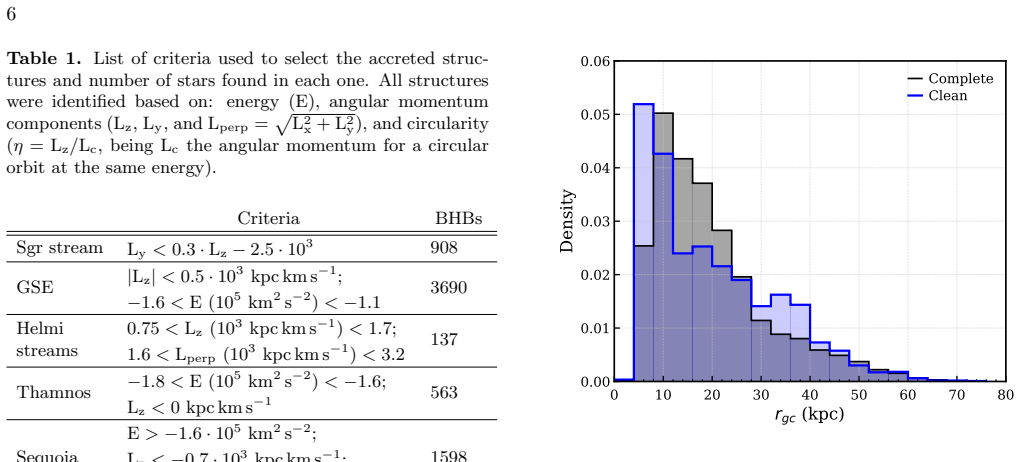
The authors report that the velocity anisotropy parameter rises smoothly from the Galactic center, matching the trend seen in cosmological simulations, and that excising the dominant known accreted components leaves a radially anisotropic velocity distribution at all radii from ten to seventy kiloparsecs. In the uncleaned sample the anisotropy decreases and then drops sharply beyond thirty kiloparsecs to negative values indicating tangential dominance, but this outer feature disappears after the cleaning step. The cleaned sample exhibits no correlation between anisotropy and metallicity, which the authors interpret as evidence that such correlations are produced by merger debris, while an初步색
What carries the argument
The velocity anisotropy parameter β, which measures the relative strength of radial versus tangential velocity dispersions and thereby quantifies the orbital character of the halo stars.
If this is right
- The underlying halo, stripped of major substructures, follows a radially increasing anisotropy profile that any formation model must reproduce.
- Links between metallicity and orbital anisotropy arise from discrete merger events rather than from the smooth halo component.
- Stellar age, traced by color, correlates with orbit type, with older stars showing colder and less radial motions in the inner halo.
- Simulations of Milky Way assembly gain a new constraint once they are required to match the cleaned radial-anisotropy profile at all radii.
Where Pith is reading between the lines
- The cleaned profile could serve as a direct test for hydrodynamical simulations that separate in-situ and accreted halo stars.
- An independent age indicator beyond color would strengthen the claimed link between stellar population age and orbital anisotropy.
- Extending the same analysis to even larger radii with future surveys could reveal whether the radial dominance continues or eventually transitions.
Load-bearing premise
Blue horizontal-branch stars provide an unbiased tracer of halo kinematics from ten to seventy kiloparsecs and that removing catalogued accreted structures does not preferentially eliminate stars from the underlying population.
What would settle it
Measuring the identical anisotropy profile with an independent tracer such as RR Lyrae stars or K giants over the same radial range and checking whether radial dominance persists after the same cleaning procedure.
Figures





read the original abstract
Modeling the Milky Way stellar halo requires well-determined density and velocity anisotropy profiles. However, it has been challenging to gather a large sample of stars with six-dimensional data that extend beyond 40 kpc to map the outer halo. Our work investigates the velocity anisotropy in the Milky Way stellar halo with more than 10,000 blue horizontal-branch stars, combining Gaia astrometric data and spectroscopic data from SEGUE, DESI and LAMOST. This large sample allows us to obtain a detailed profile of up to $\sim$70 kpc. Radial velocities are predominant in the inner halo ($< 30$ kpc), and the anisotropy presents a smooth decrease before rapidly dropping to negative values, becoming dominated by tangential dispersion velocities. Removing the main known accreted structures of the Milky Way, makes the anisotropy profile radially-dominated at all radii. Our profile clearly shows an increase in the anisotropy from the center of the Galaxy, in accordance to the simulations. We also investigate the correlation of anisotropy with metallicity and with color. The lack of correlation between metallicity and anisotropy in our clean sample reinforces that this relation is driven by merger events. The initial exploration with color indicates a relation between kinematics and age, showing that older stars are dynamically colder and present less radial orbits than younger stars in the inner halo.
Editorial analysis
A structured set of objections, weighed in public.
Referee Report
Summary. The paper claims to measure the velocity anisotropy profile β(r) of the Milky Way stellar halo out to ~70 kpc using >10,000 blue horizontal-branch stars with Gaia astrometry combined with radial velocities from SEGUE, DESI, and LAMOST. It reports radially anisotropic orbits in the inner halo that become tangentially dominated at larger radii, but finds that excising known accreted structures yields a radially anisotropic profile at all radii, consistent with simulations. The work also reports no metallicity-anisotropy correlation in the cleaned sample and an initial exploration of color (age proxy) correlations with kinematics.
Significance. If the central results survive scrutiny of selection effects, this dataset would provide one of the most radially extended observational constraints on halo anisotropy, directly testing simulation predictions for the inner-to-outer halo transition and the role of mergers. The large sample size, the finding of no metallicity-anisotropy link after structure removal, and the extension beyond 40 kpc are clear strengths that could inform Milky Way assembly models.
major comments (3)
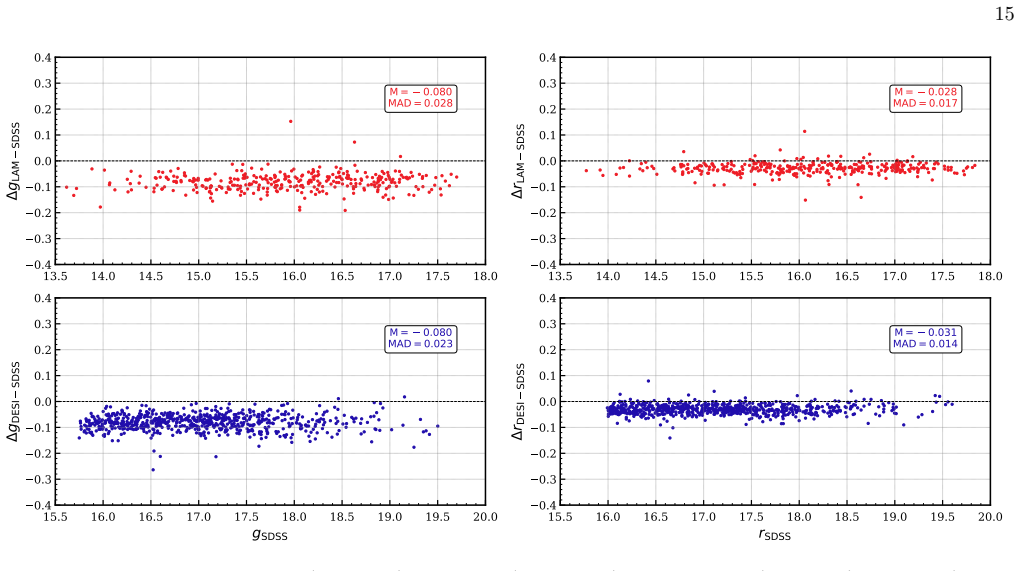
- [§2] §2 (Sample Construction): The manuscript provides no quantitative description of the BHB selection cuts, magnitude/color limits, or survey-specific completeness corrections for the combined SEGUE+DESI+LAMOST sample. Spectroscopic targeting functions vary with distance and can preferentially sample radial or tangential orbits beyond ~30 kpc, directly affecting the measured β(r) profile and the claimed transition to tangential anisotropy.
- [§4.2] §4.2 (Structure Removal): The claim that the cleaned sample is radially anisotropic at all radii rests on the assumption that structure excision (via integrals of motion or metallicity) is orthogonal to the velocity moments. No before/after β(r) comparison or test for induced bias is shown; because merger debris is preferentially radial, the removal step may artificially enhance radial anisotropy in the residual population.
- [§3.3] §3.3 (Error Propagation): There is no explicit propagation of distance uncertainties or radial-velocity errors into the binned anisotropy parameter β(r). The rapid drop to negative β values near 30–40 kpc is sensitive to these uncertainties; without Monte-Carlo error bands or covariance treatment, the significance of the tangential regime and the post-removal radial dominance cannot be assessed.
minor comments (3)
- [Figure 3] Figure 3: The anisotropy profile panels should include the number of stars per radial bin and the formal uncertainty on each β point to allow readers to judge the robustness of the outer-halo behavior.
- [§3] Notation: The definition of the anisotropy parameter β (standard or modified) should be written explicitly in the text rather than assumed from prior literature.
- [Abstract] The abstract states that the profile 'clearly shows an increase in the anisotropy from the center,' yet the plotted trend appears flat or decreasing in the innermost bins; a brief reconciliation would improve clarity.
Simulated Author's Rebuttal
We thank the referee for the constructive and detailed comments, which help improve the robustness of our analysis of the Milky Way stellar halo velocity anisotropy profile using BHB stars. We address each major point below and will revise the manuscript to incorporate the suggested clarifications and tests.
read point-by-point responses
-
Referee: [§2] §2 (Sample Construction): The manuscript provides no quantitative description of the BHB selection cuts, magnitude/color limits, or survey-specific completeness corrections for the combined SEGUE+DESI+LAMOST sample. Spectroscopic targeting functions vary with distance and can preferentially sample radial or tangential orbits beyond ~30 kpc, directly affecting the measured β(r) profile and the claimed transition to tangential anisotropy.
Authors: We agree that the manuscript would benefit from a more quantitative presentation of the sample selection. In the revised version, we will add explicit details on the color and magnitude cuts applied for BHB identification across the surveys, including any survey-specific magnitude limits and completeness corrections or weights. We will also include a discussion of potential biases from spectroscopic targeting functions, supported by subsample comparisons or mock catalog tests to evaluate their impact on β(r) beyond 30 kpc. revision: yes
-
Referee: [§4.2] §4.2 (Structure Removal): The claim that the cleaned sample is radially anisotropic at all radii rests on the assumption that structure excision (via integrals of motion or metallicity) is orthogonal to the velocity moments. No before/after β(r) comparison or test for induced bias is shown; because merger debris is preferentially radial, the removal step may artificially enhance radial anisotropy in the residual population.
Authors: This is a valid concern regarding potential bias in the structure removal step. Although our excision relies on integrals of motion and metallicity, which are chosen to be largely independent of the velocity dispersion moments, we will revise the manuscript to include explicit before-and-after β(r) profile comparisons. We will also add tests using simulated radial merger debris to quantify any artificial enhancement of radial anisotropy in the residual population, thereby strengthening the interpretation that the cleaned sample remains radially anisotropic at all radii. revision: yes
-
Referee: [§3.3] §3.3 (Error Propagation): There is no explicit propagation of distance uncertainties or radial-velocity errors into the binned anisotropy parameter β(r). The rapid drop to negative β values near 30–40 kpc is sensitive to these uncertainties; without Monte-Carlo error bands or covariance treatment, the significance of the tangential regime and the post-removal radial dominance cannot be assessed.
Authors: We acknowledge the importance of rigorous uncertainty propagation for assessing the features in the β(r) profile. In the revision, we will implement Monte Carlo simulations to propagate both distance and radial-velocity uncertainties into the binned β(r) values. This will provide error bands and allow quantitative evaluation of the significance of the tangential anisotropy near 30–40 kpc as well as the radial dominance in the cleaned sample. revision: yes
Circularity Check
No significant circularity; derivation is direct from observational data
full rationale
The paper derives the anisotropy profile β(r) by binning observed radial and tangential velocity dispersions from >10,000 BHB stars with combined Gaia astrometry and spectroscopic radial velocities from SEGUE/DESI/LAMOST. The standard definition β = 1 − (σ_θ² + σ_φ²)/(2σ_r²) is applied directly to the data in radial bins up to ~70 kpc, with no intermediate fitting, modeling, or ansatz that reduces the output to the input measurements by construction. Structure removal uses externally identified accreted components (e.g., via integrals of motion or metallicity) whose selection criteria are independent of the final β values being reported. No self-citations are invoked as load-bearing uniqueness theorems, no parameters are fitted to a subset and then relabeled as predictions, and the central claims remain falsifiable against the raw velocity catalog. The derivation chain is therefore self-contained against the input astrometric and spectroscopic observations.
Axiom & Free-Parameter Ledger
axioms (2)
- domain assumption Blue horizontal-branch stars are reliable tracers of the stellar halo kinematics at all radii sampled.
- domain assumption Known accreted structures can be cleanly identified and removed without biasing the remaining velocity distribution.
Reference graph
Works this paper leans on
-
[1]
H., Helmi, A., Massari, D., et al.\ 2019, , 625, A5
Characterization and history of the Helmi streams with Gaia DR2. , keywords =. doi:10.1051/0004-6361/201834769 , archivePrefix =. 1812.00846 , primaryClass =
-
[2]
The velocity field of our Milky Way outer stellar halo based on DESI DR2. arXiv e-prints , keywords =. doi:10.48550/arXiv.2604.01628 , archivePrefix =. 2604.01628 , primaryClass =
-
[3]
Deason and Vasily Belokurov and Sergey E
Alis J. Deason and Vasily Belokurov and Sergey E. Koposov and Facundo A. Gómez and Robert J. Grand and Federico Marinacci and Rüdiger Pakmor , doi =. The slight spin of the old stellar halo , volume =. Monthly Notices of the Royal Astronomical Society , keywords =
-
[4]
Koposov and Vasily Belokurov and N
Lachlan Lancaster and Sergey E. Koposov and Vasily Belokurov and N. Wyn Evans and Alis J. Deason , doi =. The Halo's Ancient Metal-Rich Progenitor Revealed with BHB Stars , url =
-
[5]
Characterizing stellar halo populations II: The age gradient in blue horizontal-branch stars , volume =
Payel Das and Angus Williams and James Binney , doi =. Characterizing stellar halo populations II: The age gradient in blue horizontal-branch stars , volume =. Monthly Notices of the Royal Astronomical Society , keywords =
-
[6]
Probing the Galactic halo with RR Lyrae stars - III
Gaochao Liu and Yang Huang and Sarah Ann Bird and Huawei Zhang and Fei Wang and Haijun Tian , doi =. Probing the Galactic halo with RR Lyrae stars - III. The chemical and kinematic properties of the stellar halo , url =
-
[7]
Vickers and Zhao-Yu Li and Martin C
John J. Vickers and Zhao-Yu Li and Martin C. Smith and Juntai Shen , doi =. A LAMOST BHB Catalog and Kinematics Therein. I. Catalog and Halo Properties , volume =. The Astrophysical Journal , month =
-
[8]
Mapping the anisotropic Galactic stellar halo with blue horizontal branch stars. , keywords =. doi:10.1051/0004-6361/202450351 , archivePrefix =. 2404.09825 , primaryClass =
-
[9]
The gravitational force field of the Galaxy measured from the kinematics of RR Lyrae in Gaia , volume =
Christopher Wegg and Ortwin Gerhard and Marie Bieth , doi =. The gravitational force field of the Galaxy measured from the kinematics of RR Lyrae in Gaia , volume =. Monthly Notices of the Royal Astronomical Society , keywords =
-
[10]
Siebert and O
A. Siebert and O. Bienaymé and J. Binney and J. Bland-Hawthorn and R. Campbell and K. C. Freeman and B. K. Gibson and G. Gilmore and E. K. Grebel and A. Helmi and U. Munari and J. F. Navarro and Q. A. Parker and G. Seabroke and A. Siviero and M. Steinmetz and M. Williams and R. F.G. Wyse and T. Zwitter , doi =. Estimation of the tilt of the stellar veloci...
-
[11]
Grebel and Amina Helmi and Julio Navarro and Quentin Parker and Warren A
James Binney and Ben Burnett and Georges Kordopatis and Matthias Steinmetz and Gerry Gilmore and Olivier Bienayme and Joss Bland-Hawthorn and Benoit Famaey and Eva K. Grebel and Amina Helmi and Julio Navarro and Quentin Parker and Warren A. Reid and George Seabroke and Fred Watson and Mary E. K. Williams and Rosie F. G. Wyse and Tomaz Zwitter , doi =. Gal...
-
[12]
J. H.J. Hagen and A. Helmi and P. T. De Zeeuw and L. Posti , doi =. The tilt of the velocity ellipsoid in the Milky Way with Gaia DR2 , volume =. Astronomy and Astrophysics , keywords =
-
[13]
Smith and N
Martin C. Smith and N. Wyn Evans and Jin H. An , doi =. The tilt of the halo velocity ellipsoid and the shape of the milky way halo , volume =. Astrophysical Journal , keywords =
-
[14]
Breddels , doi =
Lorenzo Posti and Amina Helmi and Jovan Veljanoski and Maarten A. Breddels , doi =. The dynamically selected stellar halo of the Galaxy with Gaia and the tilt of the velocity ellipsoid , volume =. Astronomy and Astrophysics , keywords =
-
[15]
Gaia and the dynamics of the Galaxy , url =
Benoit Famaey , month =. Gaia and the dynamics of the Galaxy , url =
-
[16]
Utkin and Andrei K
Nikita D. Utkin and Andrei K. Dambis , doi =. Calibrating the BHB star distance scale and the halo kinematic distance to the Galactic Centre , volume =. Monthly Notices of the Royal Astronomical Society , keywords =
-
[17]
Kafle and Sanjib Sharma and Geraint F
Prajwal R. Kafle and Sanjib Sharma and Geraint F. Lewis and Joss Bland-Hawthorn , doi =. Kinematics of the stellar halo and the mass distribution of the Milky Way using blue horizontal branch stars , volume =. Astrophysical Journal , keywords =
-
[18]
James M. M. Lane and Jo Bovy , month =. Distribution functions for the modelling of accretion remnants in Milky Way-like galaxies: insights from IllustrisTNG , url =
-
[19]
Cunningham and Alis J
Emily C. Cunningham and Alis J. Deason and Puragra Guhathakurta and Constance M. Rockosi and Roeland P. van der Marel and Elisa Toloba and Karoline M. Gilbert and Sangmo Tony Sohn and Claire E. Dorman , doi =. ISOTROPIC AT THE BREAK? 3D KINEMATICS OF MILKY WAY HALO STARS IN THE FOREGROUND OF M31 , volume =. The Astrophysical Journal , month =
-
[20]
McKinnon and Emily C
Kevin A. McKinnon and Emily C. Cunningham and Constance M. Rockosi and Puragra Guhathakurta and Ivanna Escala and Evan N. Kirby and Alis J. Deason , doi =. HALO7D. III. Chemical Abundances of Milky Way Halo Stars from Medium-resolution Spectra , volume =. The Astrophysical Journal , month =
-
[21]
Cunningham and Alis J
Emily C. Cunningham and Alis J. Deason and Robyn E. Sanderson and Sangmo Tony Sohn and Jay Anderson and Puragra Guhathakurta and Constance M. Rockosi and Roeland P. van der Marel and Sarah R. Loebman and Andrew Wetzel , doi =. HALO7D II: The Halo Velocity Ellipsoid and Velocity Anisotropy with Distant Main-sequence Stars , volume =. The Astrophysical Jour...
-
[22]
Measuring the inclination and mass-to-light ratio of axisymmetric galaxies via anisotropic Jeans models of stellar kinematics , volume =
Michele Cappellari , doi =. Measuring the inclination and mass-to-light ratio of axisymmetric galaxies via anisotropic Jeans models of stellar kinematics , volume =. Monthly Notices of the Royal Astronomical Society , keywords =
-
[23]
Efficient solution of the anisotropic spherically aligned axisymmetric Jeans equations of stellar hydrodynamics for galactic dynamics , volume =
Michele Cappellari , doi =. Efficient solution of the anisotropic spherically aligned axisymmetric Jeans equations of stellar hydrodynamics for galactic dynamics , volume =. Monthly Notices of the Royal Astronomical Society , keywords =
-
[24]
Milky Way dynamics in light of Gaia. , keywords =. doi:10.1016/j.newar.2024.101721 , archivePrefix =. 2501.04075 , primaryClass =
-
[25]
佳士 Speagle 沈 and Jorge Moreno and Charles Alcock and Shy Genel and John C
Razieh Emami and Lars Hernquist and Mark Vogelsberger and Xuejian Shen and Joshua S. 佳士 Speagle 沈 and Jorge Moreno and Charles Alcock and Shy Genel and John C. Forbes and Federico Marinacci and Paul Torrey , doi =. On the Robustness of the Velocity Anisotropy Parameter in Probing the Stellar Kinematics in Milky Way–Like Galaxies: Takeaway from TNG50 Simul...
-
[26]
Olszewski and Mario Mateo and Kenneth C
Giuseppina Battaglia and Amina Helmi and Heather Morrison and Paul Harding and Edward W. Olszewski and Mario Mateo and Kenneth C. Freeman and John Norris and Stephen A. Shectman , doi =. The radial velocity dispersion profile of the Galactic halo: Constraining the density profile of the dark halo of the Milky Way , volume =. Monthly Notices of the Royal A...
-
[27]
Baes and E
M. Baes and E. Van Hese , doi =. Dynamical models with a general anisotropy profile , volume =. Astronomy and Astrophysics , keywords =
-
[28]
Allende Prieto and Yuqin Chen and Xiang-Xiang Xue and Gang Zhao and Jingkun Zhao and David S
Wenbo Wu and Xianhao Ye and C. Allende Prieto and Yuqin Chen and Xiang-Xiang Xue and Gang Zhao and Jingkun Zhao and David S. Aguado and Jonay I. González Hernández and Rafael Rebolo , month =. Mapping the Milky Way with Gaia Bp/Rp spectra II: The inner stellar halo traced by a large sample of blue horizontal branch stars , url =
-
[29]
Charles King Iii and Warren R Brown and Margaret J Geller and Scott J Kenyon , title =
-
[30]
How Do the Velocity Anisotropies of Halo Stars, Dark Matter, and Satellite Galaxies Depend on Host Halo Properties? , volume =
Jiaxin He and Wenting Wang and Zhaozhou Li and Jiaxin Han and Vicente Rodriguez-Gomez and Donghai Zhao and Xianguang Meng and Yipeng Jing and Shi Shao and Rui Shi and Zhenlin Tan , doi =. How Do the Velocity Anisotropies of Halo Stars, Dark Matter, and Satellite Galaxies Depend on Host Halo Properties? , volume =. The Astrophysical Journal , month =
-
[31]
Umiamaka and Joshua E
Tatum M. Umiamaka and Joshua E. Barnes , month =. Effects of Halo Anisotropy on Disc Galaxy Encounters , url =
-
[32]
James M. M. Lane and Jo Bovy , month =. The orbital anisotropy profile of the Gaia-Sausage/Enceladus accretion remnant , url =
-
[33]
A. J. Deason and R. P. Van Der Marel and P. Guhathakurta and S. T. Sohn and T. M. Brown , doi =. The velocity anisotropy of distant milky way halo stars from hubble space telescope proper motions , volume =. Astrophysical Journal , keywords =
-
[34]
Brown and Margaret J
Charles King and Warren R. Brown and Margaret J. Geller and Scott J. Kenyon , doi =. STELLAR VELOCITY DISPERSION and ANISOTROPY of the MILKY WAY INNER HALO , volume =. Astrophysical Journal , keywords =
-
[35]
Tau and Antonela Monachesi and Facundo A
Elisa A. Tau and Antonela Monachesi and Facundo A. Gomez and Robert J.J. Grand and Rüdiger Pakmor and Freeke Van De Voort and Jenny Gonzalez-Jara and Patricia B. Tissera and Federico Marinacci and Rebekka Bieri , doi =. The role of accreted and in situ populations in shaping the stellar halos of low-mass galaxies , volume =. Astronomy and Astrophysics , k...
-
[36]
Barnes , doi =
Lucas Saleh and Joshua E. Barnes , doi =. Orbit decay in encounters between anisotropic spherical galaxies of equal mass , volume =. Monthly Notices of the Royal Astronomical Society , keywords =
-
[37]
A Dynamical and Kinematic Model of the Galactic Stellar Halo and Possible Implications for Galaxy Formation Scenarios. , keywords =. doi:10.1086/304081 , archivePrefix =. astro-ph/9610178 , primaryClass =
-
[38]
Loebman and Monica Valluri and Kohei Hattori and Victor P
Sarah R. Loebman and Monica Valluri and Kohei Hattori and Victor P. Debattista and Eric F. Bell and Greg Stinson and Charlotte R. Christensen and Alyson Brooks and Thomas R. Quinn and Fabio Governato , doi =. Beta Dips in the Gaia Era: Simulation Predictions of the Galactic Velocity Anisotropy Parameter (β) for Stellar Halos , volume =. The Astrophysical ...
-
[39]
Deason and Piero Madau and Constance M
Valery Rashkov and Annalisa Pillepich and Alis J. Deason and Piero Madau and Constance M. Rockosi and Javiera Guedes and Lucio Mayer , doi =. A "light," centrally concentrated milky way halo? , volume =. Astrophysical Journal Letters , keywords =
-
[40]
Navarro and Aaron Ludlow and Volker Springel and Jie Wang and Mark Vogelsberger and Simon D.M
Julio F. Navarro and Aaron Ludlow and Volker Springel and Jie Wang and Mark Vogelsberger and Simon D.M. White and Adrian Jenkins and Carlos S. Frenk and Amina Helmi , doi =. The diversity and similarity of simulated cold dark matter haloes , volume =. Monthly Notices of the Royal Astronomical Society , keywords =
-
[41]
Cooper and Shaun Cole and Carlos Frenk and Ben Lowing , doi =
Wenting Wang and Jiaxin Han and Andrew P. Cooper and Shaun Cole and Carlos Frenk and Ben Lowing , doi =. Estimating the dark matter halo mass of our Milky Way using dynamical tracers , volume =. Monthly Notices of the Royal Astronomical Society , keywords =
-
[42]
The SEGUE K Giant Survey. II. A Catalog of Distance Determinations for the SEGUE K Giants in the Galactic Halo. , keywords =. doi:10.1088/0004-637X/784/2/170 , archivePrefix =. 1211.0549 , primaryClass =
-
[43]
Orbital anisotropy in cosmological haloes revisited. , keywords =. doi:10.1093/mnras/stt1113 , archivePrefix =. 1303.2056 , primaryClass =
-
[44]
Probing the spatial and velocity anisotropies in stellar haloes from the Aquarius simulations. , keywords =. doi:10.1093/mnras/stae2027 , archivePrefix =. 2309.10798 , primaryClass =
-
[45]
Reliability of the Measured Velocity Anisotropy of the Milky Way Stellar Halo. , keywords =. doi:10.3847/1538-4357/aa71aa , archivePrefix =. 1704.06286 , primaryClass =
-
[46]
Metallicity bias in the kinematics of the Milky Way stellar halo. , keywords =. doi:10.1093/mnras/stt101 , archivePrefix =. 1212.4576 , primaryClass =
-
[47]
Very Metal-poor Outer-halo Stars with Round Orbits. , keywords =. doi:10.1088/2041-8205/763/1/L17 , archivePrefix =. 1212.4296 , primaryClass =
-
[48]
Contribution of Gaia Sausage to the Galactic Stellar Halo Revealed by K Giants and Blue Horizontal Branch Stars from the Large Sky Area Multi-Object Fiber Spectroscopic Telescope, Sloan Digital Sky Survey, and Gaia. , keywords =. doi:10.3847/1538-4357/ac31ac , archivePrefix =. 2110.15571 , primaryClass =
-
[49]
On the Shoulders of Giants: Properties of the Stellar Halo and the Milky Way Mass Distribution. , keywords =. doi:10.1088/0004-637X/794/1/59 , archivePrefix =. 1408.1787 , primaryClass =
-
[50]
Anisotropy of the Milky Way s Stellar Halo Using K Giants from LAMOST and Gaia. , keywords =. doi:10.3847/1538-3881/aafd2e , archivePrefix =. 1805.04503 , primaryClass =
-
[51]
The merger that led to the formation of the Milky Way's inner stellar halo and thick disk. , keywords =. doi:10.1038/s41586-018-0625-x , archivePrefix =. 1806.06038 , primaryClass =
-
[52]
Dynamical Relics of the Ancient Galactic Halo. , keywords =. doi:10.3847/1538-4357/ab6ef7 , archivePrefix =. 1910.07538 , primaryClass =
-
[53]
The R-Process Alliance: Chemodynamically Tagged Groups of Halo r-process-enhanced Stars Reveal a Shared Chemical-evolution History. , keywords =. doi:10.3847/1538-4357/abd7ed , archivePrefix =. 2012.13808 , primaryClass =
-
[54]
Substructure in the stellar halo near the Sun. II. Characterisation of independent structures. , keywords =. doi:10.1051/0004-6361/202243061 , archivePrefix =. 2201.02405 , primaryClass =
-
[55]
Discovery of new retrograde substructures: the shards of Centauri?. , keywords =. doi:10.1093/mnras/sty1403 , adsurl =
-
[56]
Halo substructure in the SDSS-Gaia catalogue: streams and clumps. , keywords =. doi:10.1093/mnras/stx3262 , archivePrefix =. 1712.04071 , primaryClass =
-
[57]
Contributions to the accreted stellar halo: an atlas of stellar deposition. , keywords =. doi:10.1093/mnras/stw2229 , archivePrefix =. 1511.08806 , primaryClass =
-
[58]
F., Capozziello, S., & Dainotti, M
Substructure revealed by RRLyraes in SDSS Stripe 82. , keywords =. doi:10.1111/j.1365-2966.2009.15242.x , archivePrefix =. 0906.0498 , primaryClass =
-
[59]
The Shape and Profile of the Milky Way Halo as Seen by the Canada-France-Hawaii Telescope Legacy Survey. , keywords =. doi:10.1088/0004-637X/731/1/4 , archivePrefix =. 1011.4487 , primaryClass =
-
[60]
RR Lyrae stars and the distant galactic halo : distribution, chemical composition, kinematics and dynamics. , keywords =. doi:10.1086/162890 , adsurl =
-
[61]
The Horizontal-Branch Stars in Globular Clusters. II. The Second Parameter Phenomenon. , keywords =. doi:10.1086/173803 , adsurl =
-
[62]
1978, ApJ, 225, 357, doi: 10.1086/156499
Composition of halo clusters and the formation of the galactic halo. , keywords =. doi:10.1086/156499 , adsurl =
-
[63]
Core condensation in heavy halos: a two-stage theory for galaxy formation and clustering. , keywords =. doi:10.1093/mnras/183.3.341 , adsurl =
-
[64]
, year = 1994, month = jul, volume =
A dwarf satellite galaxy in Sagittarius. , year = 1994, month = jul, volume =. doi:10.1038/370194a0 , adsurl =
-
[65]
The age structure of the Milky Way's halo. Nature Physics , keywords =. doi:10.1038/nphys3874 , archivePrefix =. 1607.08628 , primaryClass =
-
[66]
AB stars in the southern galactic halo. III - Kinematics of the halo. , keywords =. doi:10.1086/162095 , adsurl =
-
[67]
, year = 1994, month = nov, volume =
Kinematics of the system of blue horizontal branch field stars of the outer Galactic halo. , year = 1994, month = nov, volume =. doi:10.1093/mnras/271.1.94 , adsurl =
-
[68]
The Milky Way Tomography with SDSS. III. Stellar Kinematics. , keywords =. doi:10.1088/0004-637X/716/1/1 , archivePrefix =. 0909.0013 , primaryClass =
-
[69]
Early Evolution of the Galactic Halo Revealed from Hipparcos Observations of Metal-poor Stars. , keywords =. doi:10.1086/300177 , archivePrefix =. astro-ph/9710151 , primaryClass =
-
[70]
Detection of a Galactic Color Gradient for Blue Horizontal-Branch Stars of the Halo Field and Implications for the Halo Age and Density Distributions. , keywords =. doi:10.1086/170175 , adsurl =
-
[71]
Gaia DR3 view of dynamical substructure in the stellar halo near the Sun. , keywords =. doi:10.1051/0004-6361/202244546 , archivePrefix =. 2206.11248 , primaryClass =
-
[72]
Dynamically Tagged Groups of Very Metal-poor Halo Stars from the HK and Hamburg/ESO Surveys. , keywords =. doi:10.3847/1538-4357/abcb87 , archivePrefix =. 2011.08305 , primaryClass =
-
[73]
Asymmetric velocity anisotropies in remnants of collisionless mergers. , keywords =. doi:10.1088/1475-7516/2012/07/042 , archivePrefix =. 1205.1799 , primaryClass =
-
[74]
Haloes light and dark: dynamical models of the stellar halo and constraints on the mass of the Galaxy. , keywords =. doi:10.1093/mnras/stv1967 , archivePrefix =. 1508.02584 , primaryClass =
-
[75]
The ACS Survey of Galactic Globular Clusters. IX. Horizontal Branch Morphology and the Second Parameter Phenomenon. , keywords =. doi:10.1088/0004-637X/708/1/698 , archivePrefix =. 0911.2469 , primaryClass =
-
[76]
The Accretion Origin of the Milky Way's Stellar Halo. , keywords =. doi:10.1086/588032 , archivePrefix =. 0706.0004 , primaryClass =
-
[77]
Blind source separation of the stellar halo. , keywords =. doi:10.1093/mnras/staf558 , archivePrefix =. 2410.21365 , primaryClass =
-
[78]
, archivePrefix = "arXiv", eprint =
The Milky Way stellar halo out to 40 kpc: squashed, broken but smooth. , keywords =. doi:10.1111/j.1365-2966.2011.19237.x , archivePrefix =. 1104.3220 , primaryClass =
-
[79]
doi:10.1111/j.1745-3933.2012.01338.x , Eprint =
Broken degeneracies: the rotation curve and velocity anisotropy of the Milky Way halo. , keywords =. doi:10.1111/j.1745-3933.2012.01283.x , archivePrefix =. 1204.5189 , primaryClass =
-
[80]
Galactic Archaeology with Gaia. , keywords =. doi:10.1016/j.newar.2024.101706 , archivePrefix =. 2402.12443 , primaryClass =
discussion (0)
Sign in with ORCID, Apple, or X to comment. Anyone can read and Pith papers without signing in.