Recognition: unknown
EQE-QAOA: An Equivalence-Preserving Qubit Efficient Framework for Combinatorial Optimization
Pith reviewed 2026-05-10 03:12 UTC · model grok-4.3
The pith
EQE-QAOA confines QAOA dynamics to an invariant subspace and remaps it isometrically to fewer qubits while preserving exact optimal solutions.
A machine-rendered reading of the paper's core claim, the machinery that carries it, and where it could break.
Core claim
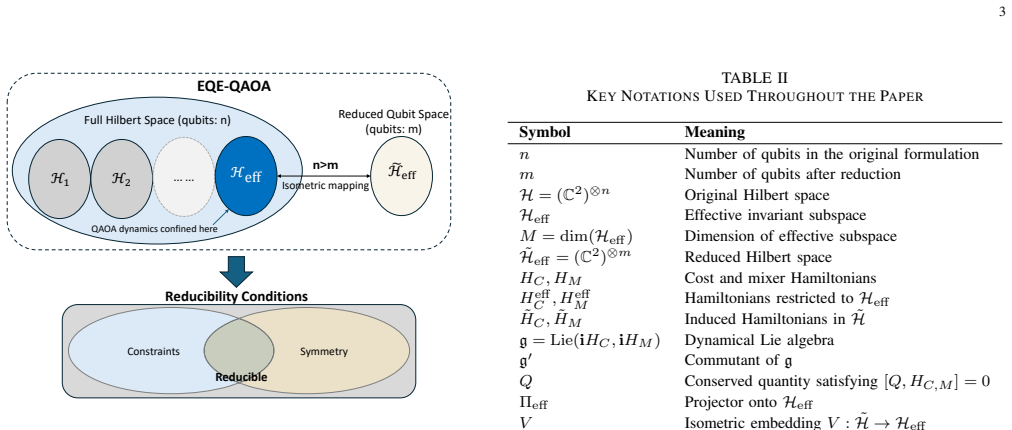
By exploiting intrinsic symmetries and conserved quantities, the QAOA dynamics are strictly confined to an invariant subspace of the Hilbert space. The evolution within this subspace is exactly equivalent to that of the full-scale system and therefore achieves the same optimal solution. An isometric mapping re-encodes the subspace into a space that uses fewer qubits, thereby reducing hardware demands without degrading performance.
What carries the argument
The invariant subspace induced by problem symmetries and conserved quantities, together with the isometric mapping that embeds this subspace into a reduced-qubit Hilbert space while preserving unitary equivalence.
If this is right
- Larger combinatorial optimization instances become feasible on current NISQ hardware because qubit count no longer scales directly with problem size.
- Optimization performance remains exactly equivalent to full-scale QAOA, so no accuracy is traded for efficiency.
- The framework applies to essentially all constrained combinatorial problems that exhibit symmetry, covering most practical use cases.
- Computational resources such as circuit depth and measurement shots also decrease in proportion to the qubit reduction.
Where Pith is reading between the lines
- The same symmetry-driven subspace technique could be tested on other variational quantum algorithms whose cost Hamiltonians share graph or combinatorial structure.
- For problems whose symmetry group is known in advance, an automated procedure to construct the isometric mapping would further lower implementation cost.
- Hardware architectures that natively support subspace encodings might achieve even larger effective qubit savings than software remapping alone.
Load-bearing premise
The target problems must possess enough intrinsic symmetries and conserved quantities to produce a meaningfully smaller invariant subspace, and an efficient isometric mapping to fewer qubits must exist without adding errors or overhead.
What would settle it
Compare the final cost and bit-string solutions obtained by EQE-QAOA and by standard QAOA on the same Max-Cut graph that has known vertex symmetries; the two runs must produce identical optimal values and equivalent optimal strings.
Figures


read the original abstract
The limited number of qubits is a major bottleneck in Quantum Approximate Optimization Algorithm (QAOA) for large-scale combinatorial optimization in the Noisy Intermediate-Scale Quantum (NISQ) era. To make progress, existing techniques rely on qubit reduction at the cost of information loss, hence leading to degraded computational performance. As a remedy, we propose the Equivalence-preserving Qubit Efficient QAOA (EQE-QAOA), which significantly reduces the required number of qubits without degrading the performance of QAOA. By exploiting intrinsic symmetries and conserved quantities, we first demonstrate that the QAOA dynamics are strictly confined to an invariant subspace of the Hilbert space. We subsequently prove that the evolution within this subspace is exactly equivalent to that of the full-scale system, achieving the same optimal solution as the original QAOA. Moreover, to reduce the number of qubits, we propose an isometric mapping that re-encodes the subspace into a space relying on fewer qubits. Furthermore, we derive the applicability conditions of EQE-QAOA and show that it is broadly applicable to large-scale combinatorial optimization problems, excluding only unconstrained problems with completely independent variables. Numerical simulations based on Max-Cut instances validate that EQE-QAOA significantly reduces qubit requirements and computational resources, while preserving exact optimization performance.
Editorial analysis
A structured set of objections, weighed in public.
Referee Report
Summary. The paper introduces EQE-QAOA, a framework that exploits intrinsic symmetries and conserved quantities to confine QAOA dynamics to an invariant subspace of the Hilbert space. It proves that the subspace evolution is exactly equivalent to the full-scale QAOA, achieving identical optimal solutions. An isometric mapping re-encodes the subspace onto fewer qubits, with derived applicability conditions claiming broad use for combinatorial optimization (excluding only unconstrained independent-variable problems). Max-Cut simulations are presented to validate qubit reduction and preserved performance.
Significance. If the invariance proofs, equivalence, and exact isometry hold, the result would be significant for NISQ combinatorial optimization by delivering exact QAOA performance with substantially fewer qubits, avoiding the information loss of prior reduction techniques. The analytical derivation of subspace confinement and equivalence from symmetries (rather than fitted parameters) is a strength, as is the explicit applicability conditions and concrete Max-Cut validation.
major comments (2)
- [Applicability conditions] Applicability conditions section: The assertion of 'broad applicability' and 'significant qubit reduction' for large-scale problems is load-bearing for the central claim, yet for generic Max-Cut graphs the invariant subspace arising from graph automorphisms is typically not exponentially smaller than the full space. The paper must provide quantitative bounds on subspace dimension (e.g., as a function of graph regularity or automorphism group order) and show that the post-isometry effective Hamiltonians remain efficiently implementable without non-local overhead that offsets the qubit savings.
- [Isometric mapping] Isometric mapping construction: The central equivalence proof requires that the isometry V satisfies V† H_cost V and V† H_mixer V exactly reproduce the original action on the reduced space. The manuscript should explicitly verify that both the cost and mixer operators leave the chosen subspace invariant (condition i), that the initial |+⟩^n state lies in it (condition ii), and that the mapped unitaries have gate complexity no worse than the original (addressing potential hidden classical or circuit-depth costs).
minor comments (2)
- [Numerical simulations] Numerical simulations: Include the specific graph sizes, symmetry levels (e.g., regular vs. random), and measured subspace dimensions for the Max-Cut instances to allow readers to assess how representative the reported qubit savings are.
- [Abstract] Abstract and introduction: The phrase 'excluding only unconstrained problems with completely independent variables' would benefit from a concrete counter-example to clarify the boundary of applicability.
Simulated Author's Rebuttal
We thank the referee for their constructive and detailed feedback, which has helped us improve the rigor and clarity of the manuscript. We address each major comment point by point below. Revisions have been made to incorporate explicit verifications and quantitative analysis where the original presentation was insufficiently detailed.
read point-by-point responses
-
Referee: [Applicability conditions] Applicability conditions section: The assertion of 'broad applicability' and 'significant qubit reduction' for large-scale problems is load-bearing for the central claim, yet for generic Max-Cut graphs the invariant subspace arising from graph automorphisms is typically not exponentially smaller than the full space. The paper must provide quantitative bounds on subspace dimension (e.g., as a function of graph regularity or automorphism group order) and show that the post-isometry effective Hamiltonians remain efficiently implementable without non-local overhead that offsets the qubit savings.
Authors: We agree that quantitative bounds on the subspace dimension are necessary to substantiate the claims of significant qubit reduction. The invariant subspace dimension is determined by the order of the automorphism group of the problem graph (or more generally, the symmetry group of the conserved quantities). In the revised manuscript, we add an appendix deriving explicit bounds: for a graph with automorphism group of order |G|, the subspace dimension is at most 2^n / |G| (with equality when the representation is regular), and we provide examples for regular graphs where |G| grows with problem size. For implementability, the isometry V is a classical permutation matrix on the computational basis (efficiently computable via graph automorphism algorithms), and the effective operators V† H V remain k-local if the original H is k-local; we add a lemma showing that the gate decomposition incurs at most a constant-factor overhead in depth for the Max-Cut instances considered. These additions appear in a new subsection of Section IV and Appendix B. revision: yes
-
Referee: [Isometric mapping] Isometric mapping construction: The central equivalence proof requires that the isometry V satisfies V† H_cost V and V† H_mixer V exactly reproduce the original action on the reduced space. The manuscript should explicitly verify that both the cost and mixer operators leave the chosen subspace invariant (condition i), that the initial |+⟩^n state lies in it (condition ii), and that the mapped unitaries have gate complexity no worse than the original (addressing potential hidden classical or circuit-depth costs).
Authors: The original proof already establishes subspace invariance under both H_cost and H_mixer via the symmetries and conserved quantities (Theorem 1), and shows that the uniform superposition |+⟩^n is an eigenvector of the symmetry operators and hence lies in the subspace. To make this fully explicit as requested, the revised Section III.B now lists conditions (i) and (ii) verbatim and provides direct verification: invariance follows because the generators of the symmetry group commute with both Hamiltonians, and the initial state is fixed by the group action. For gate complexity, we add a paragraph proving that the conjugated unitaries e^{-i V† H V t} can be implemented by conjugating the original circuit with the (classical) isometry circuit, which for the problems in scope has depth O(1) relative to the original QAOA circuit; no hidden non-local overhead is introduced beyond what is already present in standard QAOA implementations. These clarifications are incorporated without altering the core claims. revision: yes
Circularity Check
No circularity: equivalence derived from explicit symmetry analysis and isometry construction
full rationale
The derivation begins from the explicit action of the cost and mixer Hamiltonians on the full Hilbert space, identifies the invariant subspace they preserve (via commutation with symmetry operators), shows that the initial state and QAOA unitaries remain inside it, and then constructs an isometry that conjugates the restricted operators exactly onto a smaller qubit register. None of these steps defines a quantity in terms of its own output or renames a fitted parameter as a prediction; the equivalence follows directly from the algebraic properties of the operators rather than from any self-referential loop or prior self-citation that is itself unverified. The applicability conditions are stated as explicit constraints on the problem symmetries, which are independently checkable for a given instance.
Axiom & Free-Parameter Ledger
axioms (1)
- domain assumption QAOA dynamics are strictly confined to an invariant subspace due to intrinsic symmetries and conserved quantities
invented entities (1)
-
Isometric mapping to a reduced-qubit space
no independent evidence
Reference graph
Works this paper leans on
-
[1]
Quantum computing,
A. Steane, “Quantum computing,”Reports on Progress in Physics, vol. 61, no. 2, pp. 117–173, 1998
1998
-
[2]
Quantum computing: fundamentals, implementations and applications,
H. A. Bhat, F. A. Khanday, B. K. Kaushik, F. Bashir, and K. A. Shah, “Quantum computing: fundamentals, implementations and applications,” IEEE Open Journal of Nanotechnology, vol. 3, pp. 61–77, 2022
2022
-
[3]
Quantum computing review: A decade of research,
S. K. Soodet al., “Quantum computing review: A decade of research,” IEEE Transactions on Engineering Management, vol. 71, pp. 6662– 6676, 2023
2023
-
[4]
Introduction to quantum computing and its integration applications,
A. Khang, V . Abdullayev, A. V . Alyar, M. Khalilov, N. A. Ragimova, and Y . Niu, “Introduction to quantum computing and its integration applications,” inApplications and principles of quantum computing. IGI Global Scientific Publishing, 2024, pp. 25–45
2024
-
[5]
Quantum approximate optimization algorithm based maximum likelihood detection,
J. Cui, Y . Xiong, S. X. Ng, and L. Hanzo, “Quantum approximate optimization algorithm based maximum likelihood detection,”IEEE Transactions on Communications, vol. 70, no. 8, pp. 5386–5400, 2022
2022
-
[6]
Combinato- rial optimization with quantum computers,
F. Chicano, G. Luque, Z. A. Dahi, and R. Gil-Merino, “Combinato- rial optimization with quantum computers,”Engineering Optimization, vol. 57, no. 1, pp. 208–233, 2025
2025
-
[7]
Quantum approxi- mate optimization algorithm for MIMO with quantizedb-bit beamform- ing,
N. A. Mitsiou, I. Krikidis, and G. K. Karagiannidis, “Quantum approxi- mate optimization algorithm for MIMO with quantizedb-bit beamform- ing,”IEEE Journal of Selected Topics in Signal Processing, 2025
2025
-
[8]
1-bit RIS-aided index modulation with quantum annealing,
I. Krikidis, C. Psomas, and G. Zheng, “1-bit RIS-aided index modulation with quantum annealing,”IEEE Journal of Selected Topics in Signal Processing, 2025
2025
-
[9]
Privacy-preserving intelligent resource allocation for federated edge learning in quantum internet,
M. Xu, D. Niyato, Z. Yang, Z. Xiong, J. Kang, D. I. Kim, and X. Shen, “Privacy-preserving intelligent resource allocation for federated edge learning in quantum internet,”IEEE Journal of Selected Topics in Signal Processing, vol. 17, no. 1, pp. 142–157, 2023
2023
-
[10]
Solving the optimal trading trajectory problem using a quan- tum annealer,
G. Rosenberg, P. Haghnegahdar, P. Goddard, P. Carr, K. Wu, and M. L. de Prado, “Solving the optimal trading trajectory problem using a quan- tum annealer,”IEEE Journal of Selected Topics in Signal Processing, vol. 10, no. 6, pp. 1053–1060, 2016
2016
-
[11]
Quantum-inspired generic optimization for mul- tiuser fluid-mimo communications and sensing: Joint port selection and beamforming,
N. Ji and G. Zheng, “Quantum-inspired generic optimization for mul- tiuser fluid-mimo communications and sensing: Joint port selection and beamforming,”IEEE Journal of Selected Topics in Signal Processing, pp. 1–15, 2026
2026
-
[12]
Quantum computing: circuits, algorithms, and applications,
M. A. Shafique, A. Munir, and I. Latif, “Quantum computing: circuits, algorithms, and applications,”IEEE Access, vol. 12, pp. 22 296–22 314, 2024
2024
-
[13]
Quantum computing and industrial information integration: A review,
Y . Lu, A. Sigov, L. Ratkin, L. A. Ivanov, and M. Zuo, “Quantum computing and industrial information integration: A review,”Journal of Industrial Information Integration, vol. 35, p. 100511, 2023
2023
-
[14]
Quantum computing in the NISQ era and beyond,
J. Preskill, “Quantum computing in the NISQ era and beyond,”Quan- tum, vol. 2, p. 79, 2018
2018
-
[15]
A Quantum Approximate Optimization Algorithm
E. Farhi, J. Goldstone, and S. Gutmann, “A quantum approximate optimization algorithm,”arXiv preprint arXiv:1411.4028, 2014
work page internal anchor Pith review Pith/arXiv arXiv 2014
-
[16]
A review on quantum approximate optimization algorithm and its variants,
K. Blekos, D. Brand, A. Ceschini, C.-H. Chou, R.-H. Li, K. Pandya, and A. Summer, “A review on quantum approximate optimization algorithm and its variants,”Physics Reports, vol. 1068, pp. 1–66, 2024
2024
-
[17]
A tutorial on quantum approximate optimization al- gorithm (QAOA): Fundamentals and applications,
J. Choi and J. Kim, “A tutorial on quantum approximate optimization al- gorithm (QAOA): Fundamentals and applications,” in2019 international conference on information and communication technology convergence (ICTC). IEEE, 2019, pp. 138–142
2019
-
[18]
QAOA-in-QAOA: solving large- scale maxcut problems on small quantum machines,
Z. Zhou, Y . Du, X. Tian, and D. Tao, “QAOA-in-QAOA: solving large- scale maxcut problems on small quantum machines,”Physical Review Applied, vol. 19, no. 2, p. 024027, 2023
2023
-
[19]
QAOA for max-cut requires hundreds of qubits for quantum speed-up,
G. G. Guerreschi and A. Y . Matsuura, “QAOA for max-cut requires hundreds of qubits for quantum speed-up,”Scientific reports, vol. 9, no. 1, p. 6903, 2019
2019
-
[20]
Accuracy, noise, and scalability in quantum computation: Strategies for the NISQ era and beyond,
M. Kec ¸eci, “Accuracy, noise, and scalability in quantum computation: Strategies for the NISQ era and beyond,”Open Sci. Artic.(OSAs), 2025
2025
-
[21]
Materials chal- lenges for trapped-ion quantum computers,
K. R. Brown, J. Chiaverini, J. M. Sage, and H. H ¨affner, “Materials chal- lenges for trapped-ion quantum computers,”Nature Reviews Materials, vol. 6, no. 10, pp. 892–905, 2021
2021
-
[22]
Simulating quantum computa- tions on classical machines: A survey,
K. Young, M. Scese, and A. Ebnenasir, “Simulating quantum computa- tions on classical machines: A survey,”arXiv preprint arXiv:2311.16505, 2023
-
[23]
P. O. Scherer and P. O. Scherer,Computational physics: simulation of classical and quantum systems. Springer, 2017
2017
-
[24]
Qubit-efficient encoding schemes for binary optimisation problems,
B. Tan, M.-A. Lemonde, S. Thanasilp, J. Tangpanitanon, and D. G. Angelakis, “Qubit-efficient encoding schemes for binary optimisation problems,”Quantum, vol. 5, p. 454, 2021
2021
-
[25]
Qubit-efficient quantum local search for combinatorial optimization,
M. Podobrii, V . Kuzmin, V . V oloshinov, M. Veshchezerova, and M. Perelshtein, “Qubit-efficient quantum local search for combinatorial optimization,”arXiv preprint arXiv:2502.02245, 2025
-
[26]
Qubit-efficient QUBO formulation for constrained optimization problems,
M. Kanatbekova, V . De Maio, and I. Brandic, “Qubit-efficient QUBO formulation for constrained optimization problems,”arXiv preprint arXiv:2509.08080, 2025
-
[27]
Large-scale quantum approximate optimization via divide-and-conquer,
J. Li, M. Alam, and S. Ghosh, “Large-scale quantum approximate optimization via divide-and-conquer,”IEEE Transactions on Computer- Aided Design of Integrated Circuits and Systems, vol. 42, no. 6, pp. 1852–1860, 2022
2022
-
[28]
Qubit-efficient quantum annealing for stochastic unit commitment,
W. Hong, W. Xu, and F. Teng, “Qubit-efficient quantum annealing for stochastic unit commitment,”arXiv preprint arXiv:2502.15917, 2025
-
[29]
Asymptotic improvements to quantum circuits via qutrits,
P. Gokhale, J. M. Baker, C. Duckering, N. C. Brown, K. R. Brown, and F. T. Chong, “Asymptotic improvements to quantum circuits via qutrits,” inProceedings of the 46th International Symposium on Computer Architecture, 2019, pp. 554–566
2019
-
[30]
Qubit-reuse compilation with mid-circuit measurement and reset,
M. DeCross, E. Chertkov, M. Kohagen, and M. Foss-Feig, “Qubit-reuse compilation with mid-circuit measurement and reset,”Physical Review X, vol. 13, no. 4, p. 041057, 2023
2023
-
[31]
Exponential qubit reduction in optimization for financial transaction settlement,
E. X. Huber, B. Y . Tan, P. R. Griffin, and D. G. Angelakis, “Exponential qubit reduction in optimization for financial transaction settlement,”EPJ Quantum Technology, vol. 11, no. 1, p. 52, 2024
2024
-
[32]
Qubit efficient quantum algorithms for the vehicle routing problem on noisy intermediate-scale quantum processors,
I. D. Leonidas, A. Dukakis, B. Tan, and D. G. Angelakis, “Qubit efficient quantum algorithms for the vehicle routing problem on noisy intermediate-scale quantum processors,”Advanced Quantum Technolo- gies, vol. 7, no. 5, p. 2300309, 2024
2024
-
[33]
M. A. Nielsen and I. L. Chuang,Quantum computation and quantum information. Cambridge university press, 2010
2010
-
[34]
Weyl,The theory of groups and quantum mechanics
H. Weyl,The theory of groups and quantum mechanics. Courier Corporation, 1950
1950
-
[35]
Tinkham,Group theory and quantum mechanics
M. Tinkham,Group theory and quantum mechanics. Courier Corpo- ration, 2003
2003
-
[36]
Invariant- parameterized exact evolution operator for SU(2) systems with time- dependent Hamiltonian,
H. Nakazato, A. Sergi, A. Migliore, and A. Messina, “Invariant- parameterized exact evolution operator for SU(2) systems with time- dependent Hamiltonian,”Entropy, vol. 25, no. 1, p. 96, 2023
2023
-
[37]
Quantum evolution and invariant subspaces,
F. Salmistraro, “Quantum evolution and invariant subspaces,”Il Nuovo Cimento B (1971-1996), vol. 105, no. 1, pp. 65–73, 1990
1971
-
[38]
Analytically solvable hamiltonian in invariant sub- spaces,
A. S. M. de Castro, R. Grimaudo, D. Valenti, A. Migliore, H. Nakazato, and A. Messina, “Analytically solvable hamiltonian in invariant sub- spaces,”The European Physical Journal Plus, vol. 138, no. 8, p. 766, 2023
2023
-
[39]
N-level coherence vector and higher conservation laws in quantum optics and quantum mechanics,
F. T. Hioe and J. H. Eberly, “N-level coherence vector and higher conservation laws in quantum optics and quantum mechanics,”Physical Review Letters, vol. 47, no. 12, p. 838, 1981
1981
-
[40]
d’Alessandro,Introduction to quantum control and dynamics
D. d’Alessandro,Introduction to quantum control and dynamics. Chap- man and hall/CRC, 2021
2021
discussion (0)
Sign in with ORCID, Apple, or X to comment. Anyone can read and Pith papers without signing in.