Recognition: unknown
Sensitivity of Dry Lava Planet Atmospheric Emission Spectra to Changes in Lava Compositions
Pith reviewed 2026-05-10 03:56 UTC · model grok-4.3
The pith
TiO2 abundance in lava controls atmospheric TiO and emission spectra on dry hot rocky exoplanets, creating a degeneracy with heat redistribution that observations can break.
A machine-rendered reading of the paper's core claim, the machinery that carries it, and where it could break.
Core claim
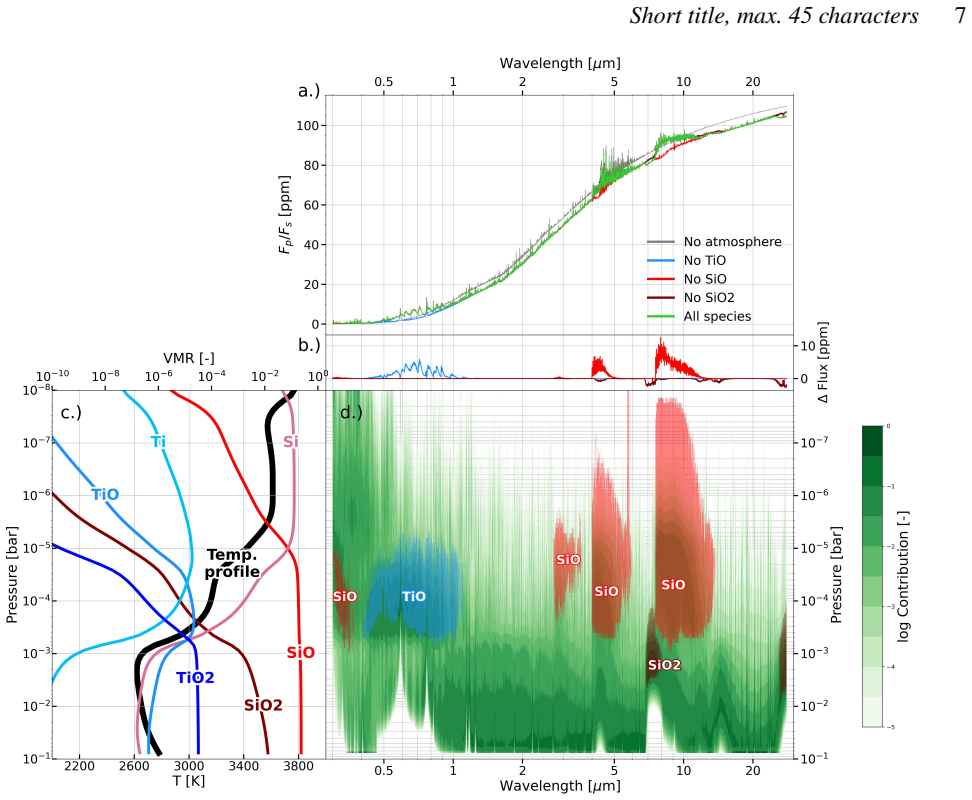
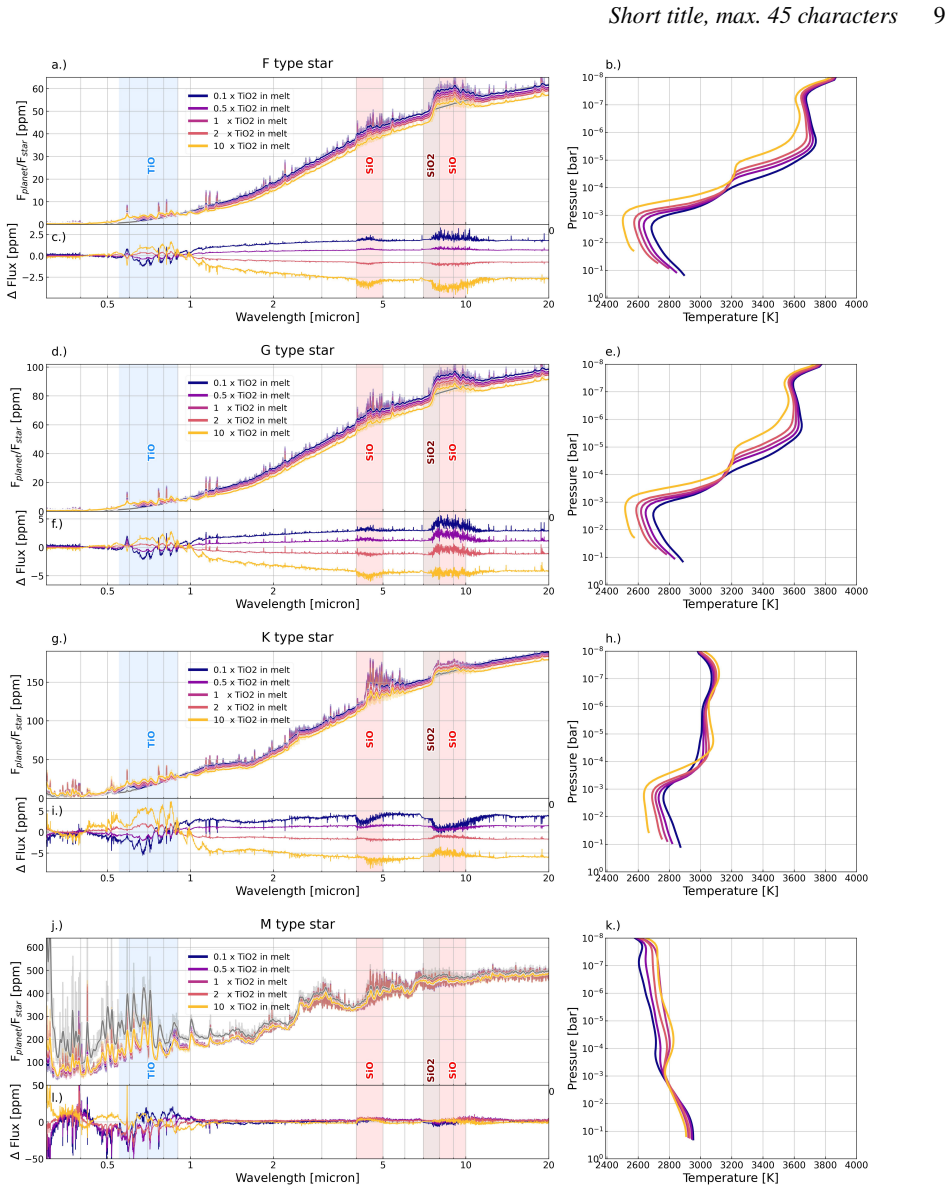
TiO2 melt abundance dictates atmospheric TiO, which strongly influences surface temperature and emission spectra due to its short-wave opacity. This creates a degeneracy with heat redistribution efficiency, potentially broken by observing the optical TiO emission feature. Atmospheric SiO and SiO2 abundances depend on melt SiO2 content, with stronger SiO and SiO2 emission features at higher melt abundances. For the currently best observable hot rocky exoplanets, changes in TiO2 and SiO2 abundance of about an order of magnitude with respect to bulk silicate Earth could potentially be observable with 12 JWST eclipse observations.
What carries the argument
A self-consistent chain of a vaporisation code for the melt-gas interface, a gas chemical equilibrium solver, and a radiative transfer code that computes atmospheric chemistry and temperature structure from varying lava oxide abundances.
If this is right
- Higher TiO2 in the melt increases atmospheric TiO, lowers surface temperature, and changes the overall emission spectrum.
- Higher SiO2 in the melt produces stronger SiO and SiO2 emission features.
- The TiO opacity effect is degenerate with heat redistribution efficiency, but the optical TiO feature can distinguish between them.
- Order-of-magnitude changes in TiO2 or SiO2 abundances relative to bulk silicate Earth are potentially detectable with 12 JWST eclipse observations.
- Host star spectral type also modulates the emission spectra in addition to lava composition.
Where Pith is reading between the lines
- If the models hold, spectra could eventually be inverted to estimate lava composition on observed exoplanets.
- The same modeling chain could be applied to planets around different stellar types to map how composition signals vary with irradiation.
- The degeneracy noted here implies that temperature retrievals for hot rocky worlds will need to marginalise over possible lava compositions.
Load-bearing premise
The vaporisation code, gas chemical equilibrium solver, and radiative transfer model together accurately capture the physics of dry lava-planet atmospheres, including the assumption that the atmosphere is in chemical equilibrium and contains no additional volatiles or clouds.
What would settle it
JWST eclipse spectra of a currently observable hot rocky exoplanet that show either no optical TiO emission feature or SiO/SiO2 band strengths that do not scale with the expected melt abundances for any plausible lava composition.
Figures





read the original abstract
The atmospheres of hot rocky exoplanets are among the first primary targets of the JWST. Interpreting their atmospheric spectra requires understanding the link between silicate lava compositions and overlying atmospheres. We investigate the sensitivity of simulated emission spectra of dry lava planets to variations in oxide abundances in silicate melt. Our goal is to determine which molten surface features could be distinguishable with future observations. We combine our vaporisation code with gas chemical equilibrium and radiative transfer codes to self-consistently compute atmospheric chemistry and thermal structure. Alongside varying lava compositions, we assess the impact of host star spectral type on emission spectra. TiO2 melt abundance dictates atmospheric TiO, which strongly influences surface temperature and emission spectra due to its short-wave opacity. This creates a degeneracy with heat redistribution efficiency, potentially broken by observing the optical TiO emission feature. Atmospheric SiO and SiO2 abundances depend on melt SiO2 content, with stronger SiO and SiO2 emission features at higher melt abundances. For the currently best observable HREs, changes in TiO2 and SiO2 abundance of about an order of magnitude with respect to BSE, could potentially be observable with 12 JWST eclipse observations.
Editorial analysis
A structured set of objections, weighed in public.
Referee Report
Summary. The manuscript presents a forward-modeling study linking silicate melt oxide abundances on dry lava planets to atmospheric chemistry, thermal structure, and emission spectra via coupled vaporization, chemical equilibrium, and radiative transfer codes. It finds that TiO2 melt abundance controls atmospheric TiO (via short-wave opacity), surface temperature, and spectra, creating a degeneracy with heat redistribution efficiency that may be resolved by the optical TiO emission feature; SiO and SiO2 gas abundances scale with melt SiO2 content, strengthening corresponding emission features; host star spectral type also affects results; and order-of-magnitude deviations in TiO2/SiO2 from bulk silicate Earth (BSE) could be detectable with ~12 JWST eclipse observations for the best-observable hot rocky exoplanets.
Significance. If the modeling chain holds, the work provides a useful framework for interpreting JWST emission spectra of hot rocky exoplanets by connecting observable atmospheric features to surface lava composition. It explicitly identifies a key degeneracy and a potential observational diagnostic, which is valuable for the growing field of rocky exoplanet characterization. The self-consistent forward-modeling pipeline is a strength, as it allows direct exploration of parameter sensitivities without circular fitting.
major comments (2)
- [Methods (vaporization code)] Methods (vaporization code subsection): The central claims—that TiO2 melt abundance dictates atmospheric TiO abundance and spectra, and that SiO/SiO2 features scale directly with melt SiO2—depend on the vaporization code correctly mapping oxide mass fractions to gas partial pressures. If the code assumes ideal solution behavior or fixed activity coefficients (as is common in such models), this mapping may break for order-of-magnitude deviations from BSE in TiO2 or SiO2, where non-ideal mixing effects in silicate melts are known to be significant. This directly undermines the robustness of the predicted spectral sensitivities and JWST observability conclusion. Please specify the activity coefficient treatment used and provide validation against experimental vapor-pressure data for non-BSE compositions.
- [Results (degeneracy discussion)] Results (degeneracy and TiO feature discussion): The claim that the TiO2–heat redistribution degeneracy can be broken by observing the optical TiO emission feature is load-bearing for the interpretability argument. However, the manuscript does not show explicit spectral comparisons at fixed TiO2 abundance but varying redistribution efficiencies, nor quantify the contrast or wavelength range of the TiO feature relative to the continuum. Without these, it is unclear whether the feature remains distinguishable under realistic noise and temperature variations.
minor comments (3)
- [Methods] Clarify the exact BSE reference composition (oxide mass fractions) used as baseline and how deviations are parameterized (e.g., which oxides are held fixed when varying TiO2 or SiO2).
- [Results (observability)] The JWST observability claim (12 eclipses) should include the precise metric (e.g., SNR per bin, chi-squared difference, or feature detection threshold) and the assumed instrument noise model or resolution.
- [Methods] Add a brief statement on the chemical equilibrium solver assumptions (e.g., whether condensation or additional volatiles are excluded) to support the 'dry' atmosphere premise.
Simulated Author's Rebuttal
We thank the referee for their constructive and positive review, which has helped clarify several aspects of our modeling approach and presentation. We address each major comment in detail below and have revised the manuscript accordingly to strengthen the robustness of our results.
read point-by-point responses
-
Referee: Methods (vaporization code subsection): The central claims—that TiO2 melt abundance dictates atmospheric TiO abundance and spectra, and that SiO/SiO2 features scale directly with melt SiO2—depend on the vaporization code correctly mapping oxide mass fractions to gas partial pressures. If the code assumes ideal solution behavior or fixed activity coefficients (as is common in such models), this mapping may break for order-of-magnitude deviations from BSE in TiO2 or SiO2, where non-ideal mixing effects in silicate melts are known to be significant. This directly undermines the robustness of the predicted spectral sensitivities and JWST observability conclusion. Please specify the activity coefficient treatment used and provide validation against experimental vapor-pressure data for non-BSE compositions.
Authors: We agree that explicit specification of the activity coefficient treatment and discussion of its limitations for non-BSE compositions is necessary to support the central claims. Our vaporization code (Section 2.1) assumes ideal solution behavior with activity coefficients of unity for all components, consistent with standard approaches in prior lava planet atmosphere models. In the revised manuscript, we have added a dedicated paragraph in the Methods section detailing this assumption, citing literature on non-ideal mixing effects in silicate melts (e.g., experimental activity coefficient data for TiO2-SiO2 systems), and discussing the range of validity. We have also incorporated a sensitivity analysis showing that plausible variations in activity coefficients (drawn from experimental studies) do not eliminate the order-of-magnitude scaling of gas abundances with melt composition. Where experimental vapor-pressure data for extreme compositions exist, we reference them to validate the trends; for compositions lacking direct data, we note the extrapolation as a limitation but demonstrate that the spectral distinctions remain robust. These changes do not alter our main conclusions but improve transparency. revision: yes
-
Referee: Results (degeneracy and TiO feature discussion): The claim that the TiO2–heat redistribution degeneracy can be broken by observing the optical TiO emission feature is load-bearing for the interpretability argument. However, the manuscript does not show explicit spectral comparisons at fixed TiO2 abundance but varying redistribution efficiencies, nor quantify the contrast or wavelength range of the TiO feature relative to the continuum. Without these, it is unclear whether the feature remains distinguishable under realistic noise and temperature variations.
Authors: We concur that explicit spectral comparisons and quantification are required to substantiate the claim that the optical TiO feature can break the degeneracy. In the revised manuscript, we have added a new figure (Figure 7) presenting emission spectra computed at fixed TiO2 melt abundance but with two different heat redistribution efficiencies (f = 1/4 and f = 1/2). The figure highlights the TiO emission feature in the optical range (~0.6–0.8 μm), quantifies its contrast relative to the local continuum (typically 10–20% for the cases shown), and includes error bars representing realistic JWST noise levels for the brightest targets after 12 eclipses. We have also expanded the accompanying text to discuss how temperature variations affect the feature's visibility while preserving its diagnostic utility. These additions directly address the concern and reinforce the interpretability argument. revision: yes
Circularity Check
No significant circularity: forward simulations with explicit input variation
full rationale
The paper's derivation chain consists entirely of forward modeling. Lava oxide abundances (e.g., TiO2, SiO2 fractions relative to BSE) are treated as independent input parameters that are varied explicitly. These feed into a vaporization code, gas chemical equilibrium solver, and radiative transfer model to produce atmospheric abundances, thermal structures, and emission spectra as outputs. No step fits model outputs back to the same data, renames a fitted quantity as a prediction, or invokes a self-citation chain to justify a uniqueness theorem or ansatz. The central claims (TiO opacity effects, SiO/SiO2 feature scaling, JWST observability with 12 eclipses) are direct consequences of the varied inputs under the stated assumptions, with no reduction by construction. This matches the reader's assessment of non-circular forward simulation work.
Axiom & Free-Parameter Ledger
free parameters (2)
- Lava oxide mass fractions
- Heat redistribution efficiency
axioms (2)
- domain assumption Atmospheric gas chemistry is in local thermodynamic equilibrium
- domain assumption No water or other volatiles are present
Forward citations
Cited by 1 Pith paper
-
The Rocky Planet Picture Show: Implementation of Surface Reflection and Emission in $\texttt{POSEIDON}$ with Application to and Interpretation of JWST Data
POSEIDON now includes lab-derived rocky surface albedos, enabling JWST emission spectra to separate thin versus thick atmospheres and potentially identify granite-like versus basaltic surfaces.
Reference graph
Works this paper leans on
-
[1]
Physicochemical basis of the analysis of the paragenesis of minerals , url =
Korzhinskii, Dmitri Sergeevich , collaborator =. Physicochemical basis of the analysis of the paragenesis of minerals , url =. 1959 , keywords =
1959
-
[2]
Journal of Petrology , author =
The. Journal of Petrology , author =. 2004 , pages =. doi:10.1093/petrology/egh042 , abstract =
-
[3]
doi:10.1146/annurev-earth-042711-105503 , journal =
Magma. Annual Review of Earth and Planetary Sciences , author =. 2012 , note =. doi:10.1146/annurev-earth-042711-105503 , abstract =
-
[4]
Geochemical constraints on core-mantle differentiation in. Icarus , author =. 2020 , keywords =. doi:10.1016/j.icarus.2020.113621 , abstract =
-
[5]
Journal of Geophysical Research: Planets , author =
Core-mantle differentiation in. Journal of Geophysical Research: Planets , author =. 2013 , note =. doi:10.1002/jgre.20093 , abstract =
-
[6]
P., Piet, H., Siebert, J., & Ryerson, F
Core formation and core composition from coupled geochemical and geophysical constraints , volume =. Proceedings of the National Academy of Sciences , author =. 2015 , note =. doi:10.1073/pnas.1505672112 , abstract =
-
[7]
Earth and Planetary Science Letters , author =
Core formation and the oxidation state of the. Earth and Planetary Science Letters , author =. 2005 , keywords =. doi:10.1016/j.epsl.2005.05.017 , abstract =
-
[8]
Astronomy & Astrophysics , author =. 2025 , note =. doi:10.1051/0004-6361/202450992 , abstract =
-
[9]
Astronomy & Astrophysics , author =
Characterising the atmosphere of 55. Astronomy & Astrophysics , author =. 2025 , pages =. doi:10.1051/0004-6361/202554062 , abstract =
-
[10]
Astronomy & Astrophysics , author =. 2024 , note =. doi:10.1051/0004-6361/202450748 , abstract =
-
[12]
Origins of. Annual Review of Astronomy and Astrophysics , author =. 2018 , note =. doi:10.1146/annurev-astro-081817-051853 , abstract =
work page Pith review doi:10.1146/annurev-astro-081817-051853 2018
-
[13]
Journal of Geophysical Research (Planets) , keywords =
The. Journal of Geophysical Research: Planets , author =. 2021 , note =. doi:10.1029/2020JE006639 , abstract =
-
[14]
Astronomy , author =
Making sense of the exoplanetary zoo: astronomers see a menagerie of planetary systems orbiting other stars, but they're just beginning to figure out how these structures arise , volume =. Astronomy , author =. 2017 , note =
2017
-
[15]
The Astrophysical Journal , author =
The. The Astrophysical Journal , author =. 1905 , note =. doi:10.1086/141205 , urldate =
-
[16]
Monthly Notices of the Royal Astronomical Society , author =
Observability of molecular species in a nitrogen dominated atmosphere for 55. Monthly Notices of the Royal Astronomical Society , author =. doi:10.1093/mnras/sty2803 , abstract =
-
[17]
Rapid calculation of radiative heating rates and photodissociation rates in inhomogeneous multiple scattering atmospheres , volume =. Journal of Geophysical Research: Atmospheres , author =. doi:https://doi.org/10.1029/JD094iD13p16287 , number =
-
[18]
The Astrophysical Journal , author =
Comparative. The Astrophysical Journal , author =. 2005 , note =. doi:10.1086/431952 , abstract =
-
[19]
The Astrophysical Journal , author =
Theoretical. The Astrophysical Journal , author =. 2003 , pages =. doi:10.1086/374331 , abstract =
-
[20]
Journal of the Atmospheric Sciences , author =
Thermal. Journal of the Atmospheric Sciences , author =. 1964 , note =. doi:10.1175/1520-0469(1964)021<0361:TEOTAW>2.0.CO;2 , abstract =
-
[21]
and Helled, Ravit and Ikoma, Masahiro and Line, Michael R
Guillot, Tristan and Fletcher, Leigh N. and Helled, Ravit and Ikoma, Masahiro and Line, Michael R. and Parmentier, Vivien , month = may, year =. Giant. doi:10.48550/arXiv.2205.04100 , abstract =
-
[22]
Reviews of Geophysics , author =
Study of planetary atmospheres by absorptive occultations , volume =. Reviews of Geophysics , author =. 1990 , note =. doi:10.1029/RG028i002p00117 , abstract =
-
[23]
Nightside clouds and disequilibrium chemistry on the hot. Nature Astronomy , author =. 2024 , note =. doi:10.1038/s41550-024-02230-x , abstract =
-
[24]
Denbigh, Kenneth , year =. The
-
[25]
, year =
Aris, R. , year =. Elementary
-
[26]
Gandhi, Siddharth and Regt, Sam de and Snellen, Ignas and Palma-Bifani, Paulina and Abdoulwahab, Idriss and Chauvin, Gaël and Picos, Darío González and Zhang, Yapeng and Landman, Rico and Stolker, Tomas and Kesseli, Aurora and Mulder, Willeke and Chomez, Antoine and Lagrange, Anne-Marie and Zurlo, Alice , month = jan, year =. The. doi:10.48550/arXiv.2501....
-
[27]
Azzam, Ala'a. A. A. and Tennyson, Jonathan and Yurchenko, Sergei N. and Naumenko, Olga V. , month = aug, year =. doi:10.1093/mnras/stw1133 , number =
-
[28]
and van der Avoird, Ad and Baranov, Yury I
Karman, Tijs and Gordon, Iouli E. and van der Avoird, Ad and Baranov, Yury I. and Boulet, Christian and Drouin, Brian J. and Groenenboom, Gerrit C. and Gustafsson, Magnus and Hartmann, Jean-Michel and Kurucz, Robert L. and Rothman, Laurence S. and Sun, Kang and Sung, Keeyoon and Thalman, Ryan and Tran, Ha and Wishnow, Edward H. and Wordsworth, Robin and V...
-
[29]
2002, A&A, 390, 779, doi: 10.1051/0004-6361:20020555
Borysow, A. , month = aug, year =. Collision-induced absorption coefficients of. doi:10.1051/0004-6361:20020555 , journal =
-
[30]
The Astrophysical Journal , author =
Burrows, A. and Dulick, M. and Bauschlicher, C. W., Jr. and Bernath, P. F. and Ram, R. S. and Sharp, C. M. and Milsom, J. A. , month = may, year =. Spectroscopic. doi:10.1086/429366 , number =
-
[31]
Borysow, Aleksandra and Jorgensen, Uffe G. and Fu, Yi , month = feb, year =. High-temperature (1000-7000. doi:10.1016/S0022-4073(00)00023-6 , journal =
-
[32]
and Tennyson, Jonathan and Yurchenko, Sergei N
Upadhyay, Apoorva and Conway, Eamon K. and Tennyson, Jonathan and Yurchenko, Sergei N. , month = jun, year =. doi:10.1093/mnras/sty998 , number =
-
[33]
Underwood, Daniel S. and Yurchenko, Sergei N. and Tennyson, Jonathan and Al-Refaie, Ahmed F. and Clausen, Sønnik and Fateev, Alexander , month = nov, year =. doi:10.1093/mnras/stw1828 , number =
-
[34]
S., Tennyson, J., Yurchenko, S
Underwood, Daniel S. and Tennyson, Jonathan and Yurchenko, Sergei N. and Huang, Xinchuan and Schwenke, David W. and Lee, Timothy J. and Clausen, Sønnik and Fateev, Alexander , month = jul, year =. doi:10.1093/mnras/stw849 , number =
-
[35]
Brady, Ryan P. and Yurchenko, Sergei N. and Tennyson, Jonathan and Kim, Gap-Sue , month = jan, year =. doi:10.1093/mnras/stad3508 , number =
-
[36]
and Kim, Gap-Sue and Tennyson, Jonathan , month = oct, year =
Semenov, Mikhail and Clark, Nicholas and Yurchenko, Sergei N. and Kim, Gap-Sue and Tennyson, Jonathan , month = oct, year =. doi:10.1093/mnras/stac2004 , number =
-
[37]
and Lodi, Lorenzo and Tennyson, Jonathan , month = dec, year =
Yorke, Leo and Yurchenko, Sergei N. and Lodi, Lorenzo and Tennyson, Jonathan , month = dec, year =. Exomol molecular line lists -. doi:10.1093/mnras/stu1854 , number =
-
[38]
The rotation-vibration spectrum of silane up to 1200 K
Owens, A. and Yachmenev, A. and Thiel, W. and Tennyson, J. and Yurchenko, S. N. , month = nov, year =. doi:10.1093/mnras/stx1952 , number =
-
[39]
Clark, Victoria H. J. and Owens, Alec and Tennyson, Jonathan and Yurchenko, Sergei N. , month = may, year =. The high-temperature rotation-vibration spectrum and rotational clustering of silylene (. doi:10.1016/j.jqsrt.2020.106929 , journal =
-
[40]
Prajapat, Laxmi and Jagoda, Pawel and Lodi, Lorenzo and Gorman, Maire N. and Yurchenko, Sergei N. and Tennyson, Jonathan , month = dec, year =. doi:10.1093/mnras/stx2229 , number =
-
[41]
and Tennyson, Jonathan and Yurchenko, Sergei N
Sousa-Silva, Clara and Al-Refaie, Ahmed F. and Tennyson, Jonathan and Yurchenko, Sergei N. , month = jan, year =. doi:10.1093/mnras/stu2246 , number =
-
[42]
and Bernath, Peter , month = sep, year =
Langleben, Jonathan and Tennyson, Jonathan and Yurchenko, Sergei N. and Bernath, Peter , month = sep, year =. doi:10.1093/mnras/stz1856 , number =
-
[43]
Qin, Zhi and Bai, Tianrui and Liu, Linhua , month = jan, year =. Line lists for the. doi:10.1016/j.jqsrt.2020.107352 , journal =
-
[44]
Ram, R. S. and Brooke, J. S. A. and Western, C. M. and Bernath, P. F. , month = may, year =. Einstein. doi:10.1016/j.jqsrt.2014.01.030 , journal =
-
[45]
and Tennyson, Jonathan , month = jul, year =
Qu, Qianwei and Yurchenko, Sergei N. and Tennyson, Jonathan , month = jul, year =. doi:10.1093/mnras/stab1154 , number =
-
[46]
and Bernath, Peter and Müller, Holger S
Wong, Andy and Yurchenko, Sergei N. and Bernath, Peter and Müller, Holger S. P. and McConkey, Stephanie and Tennyson, Jonathan , month = sep, year =. doi:10.1093/mnras/stx1211 , number =
-
[47]
Coles, Phillip A. and Yurchenko, Sergei N. and Tennyson, Jonathan , month = dec, year =. doi:10.1093/mnras/stz2778 , number =
-
[48]
Fernando, Anton M. and Bernath, Peter F. and Hodges, James N. and Masseron, Thomas , month = sep, year =. A new linelist for the. doi:10.1016/j.jqsrt.2018.05.021 , journal =
-
[49]
Mitev, G. B. and Taylor, S. and Tennyson, Jonathan and Yurchenko, S. N. and Buchachenko, A. A. and Stolyarov, A. V. , month = apr, year =. doi:10.1093/mnras/stab3357 , number =
-
[50]
Hodges, James N. and Bernath, Peter F. , month = may, year =. Fourier. doi:10.3847/1538-4357/aa6bf5 , number =
-
[51]
Rothman, L. S. and Gordon, I. E. and Barber, R. J. and Dothe, H. and Gamache, R. R. and Goldman, A. and Perevalov, V. I. and Tashkun, S. A. and Tennyson, J. , month = oct, year =. doi:10.1016/j.jqsrt.2010.05.001 , journal =
-
[52]
and Tennyson, Jonathan and Le Roy, Robert J
Rivlin, Tom and Lodi, Lorenzo and Yurchenko, Sergei N. and Tennyson, Jonathan and Le Roy, Robert J. , month = jul, year =. doi:10.1093/mnras/stv979 , number =
-
[53]
Hargreaves, Robert J. and Gordon, Iouli E. and Rothman, Laurence S. and Tashkun, Sergey A. and Perevalov, Valery I. and Lukashevskaya, Anastasiya A. and Yurchenko, Sergey N. and Tennyson, Jonathan and Müller, Holger S. P. , month = jul, year =. Spectroscopic line parameters of. doi:10.1016/j.jqsrt.2019.04.040 , journal =
-
[54]
and Carter-Blatchford, Luke and Crozet, Patrick and Ross, Amanda J
Western, Colin M. and Carter-Blatchford, Luke and Crozet, Patrick and Ross, Amanda J. and Morville, Jérôme and Tokaryk, Dennis W. , month = nov, year =. The spectrum of. doi:10.1016/j.jqsrt.2018.07.017 , journal =
-
[55]
Owens, A. and Tennyson, J. and Yurchenko, S. N. , month = mar, year =. doi:10.1093/mnras/staa4041 , number =
-
[56]
Gorman, Maire N. and Yurchenko, Sergei N. and Tennyson, Jonathan , month = dec, year =. doi:10.1093/mnras/stz2517 , number =
-
[57]
Barber, R. J. and Strange, J. K. and Hill, C. and Polyansky, O. L. and Mellau, G. Ch. and Yurchenko, S. N. and Tennyson, Jonathan , month = jan, year =. doi:10.1093/mnras/stt2011 , number =
-
[58]
Al-Refaie, Ahmed F. and Polyansky, Oleg L. and Ovsyannikov, Roman I. and Tennyson, Jonathan and Yurchenko, Sergei N. , month = sep, year =. doi:10.1093/mnras/stw1295 , number =
-
[59]
Polyansky, Oleg L. and Kyuberis, Aleksandra A. and Zobov, Nikolai F. and Tennyson, Jonathan and Yurchenko, Sergei N. and Lodi, Lorenzo , month = oct, year =. doi:10.1093/mnras/sty1877 , number =
-
[60]
GharibNezhad, Ehsan and Shayesteh, Alireza and Bernath, Peter F. , month = jul, year =. Einstein. doi:10.1093/mnras/stt510 , number =
-
[61]
Pavlyuchko, A. I. and Yurchenko, S. N. and Tennyson, Jonathan , month = sep, year =. doi:10.1093/mnras/stv1376 , number =
-
[62]
Amaral, Paulo H. R. and Diniz, Leonardo G. and Jones, Keith A. and Stanke, Monika and Alijah, Alexander and Adamowicz, Ludwik and Mohallem, José R. , month = jun, year =. Benchmark. doi:10.3847/1538-4357/ab1f65 , number =
-
[63]
Paulose, Geethu and Barton, Emma J. and Yurchenko, Sergei N. and Tennyson, Jonathan , month = dec, year =. doi:10.1093/mnras/stv1543 , number =
-
[64]
Yurchenko, S. N. and Tennyson, Jonathan and Miller, Steve and Melnikov, V. V. and O'Donoghue, J. and Moore, L. , month = sep, year =. doi:10.1093/mnras/staa2034 , number =
-
[65]
Li, Gang and Gordon, Iouli E. and Rothman, Laurence S. and Tan, Yan and Hu, Shui-Ming and Kassi, Samir and Campargue, Alain and Medvedev, Emile S. , month = jan, year =. Rovibrational. doi:10.1088/0067-0049/216/1/15 , number =
-
[66]
Journal of Physical Chemistry A , author =
Variationally. Journal of Physical Chemistry A , author =. 2019 , note =. doi:10.1021/acs.jpca.9b02919 , number =
-
[67]
and Yachmenev, Andrey and Tennyson, Jonathan and Yurchenko, Sergei N
Al-Refaie, Ahmed F. and Yachmenev, Andrey and Tennyson, Jonathan and Yurchenko, Sergei N. , month = apr, year =. doi:10.1093/mnras/stv091 , number =
-
[68]
Dulick, M. and Bauschlicher, C. W., Jr. and Burrows, Adam and Sharp, C. M. and Ram, R. S. and Bernath, Peter , month = sep, year =. Line. doi:10.1086/376791 , number =
-
[69]
Syme, Anna-Maree and McKemmish, Laura K. , month = aug, year =. Full spectroscopic model and trihybrid experimental-perturbative-variational line list for. doi:10.1093/mnras/stab1551 , number =
-
[70]
Yurchenko, Sergei N. and Amundsen, David S. and Tennyson, Jonathan and Waldmann, Ingo P. , month = sep, year =. A hybrid line list for. doi:10.1051/0004-6361/201731026 , journal =
-
[71]
Masseron, T. and Plez, B. and Van Eck, S. and Colin, R. and Daoutidis, I. and Godefroid, M. and Coheur, P. -F. and Bernath, P. and Jorissen, A. and Christlieb, N. , month = nov, year =. doi:10.1051/0004-6361/201423956 , journal =
-
[72]
and Tennyson, Jonathan , month = nov, year =
Owens, Alec and Mitrushchenkov, Alexander and Yurchenko, Sergei N. and Tennyson, Jonathan , month = nov, year =. doi:10.1093/mnras/stac2462 , number =
-
[73]
Bernath, Peter F. , month = jan, year =. doi:10.1016/j.jqsrt.2019.106687 , journal =
-
[74]
Li, Gang and Harrison, Jeremy J. and Ram, Ram S. and Western, Colin M. and Bernath, Peter F. , month = jan, year =. Einstein. doi:10.1016/j.jqsrt.2011.09.010 , number =
-
[75]
and Yachmenev, Andrey and Tennyson, Jonathan and Yurchenko, Sergei N
Mant, Barry P. and Yachmenev, Andrey and Tennyson, Jonathan and Yurchenko, Sergei N. , month = aug, year =. doi:10.1093/mnras/sty1239 , number =
-
[76]
L., Tennyson, J., & Yurchenko, S
Chubb, Katy L. and Tennyson, Jonathan and Yurchenko, Sergei N. , month = apr, year =. doi:10.1093/mnras/staa229 , number =
-
[77]
and Szabó, István and Pyatenko, Elizaveta and Tennyson, Jonathan , month = nov, year =
Yurchenko, Sergei N. and Szabó, István and Pyatenko, Elizaveta and Tennyson, Jonathan , month = nov, year =. doi:10.1093/mnras/sty2050 , number =
-
[78]
and Bond, Wesley and Gorman, Maire N
Yurchenko, Sergei N. and Bond, Wesley and Gorman, Maire N. and Lodi, Lorenzo and McKemmish, Laura K. and Nunn, William and Shah, Rohan and Tennyson, Jonathan , month = jul, year =. doi:10.1093/mnras/sty939 , number =
-
[80]
and Sinden, Frances and Lodi, Lorenzo and Hill, Christian and Gorman, Maire N
Yurchenko, Sergei N. and Sinden, Frances and Lodi, Lorenzo and Hill, Christian and Gorman, Maire N. and Tennyson, Jonathan , month = feb, year =. doi:10.1093/mnras/stx2738 , number =
-
[81]
Astronomy & Astrophysics , author =
Observability of silicates in volatile atmospheres of super-. Astronomy & Astrophysics , author =. 2023 , note =. doi:10.1051/0004-6361/202245521 , abstract =
-
[82]
2022, Astronomy & Astrophysics, 664, A79, 10.1051/0004-6361/202142912
K2 and. Astronomy & Astrophysics , author =. 2022 , note =. doi:10.1051/0004-6361/202142912 , abstract =
discussion (0)
Sign in with ORCID, Apple, or X to comment. Anyone can read and Pith papers without signing in.