Recognition: unknown
From Gaia to GaiaNIR: II. A new view of the Milky Way bar
Pith reviewed 2026-05-10 04:35 UTC · model grok-4.3
The pith
Biases in Gaia DR3 data inflate the Milky Way bar pattern speed by about 14 km/s/kpc, yielding a corrected value near 29 km/s/kpc.
A machine-rendered reading of the paper's core claim, the machinery that carries it, and where it could break.
Core claim
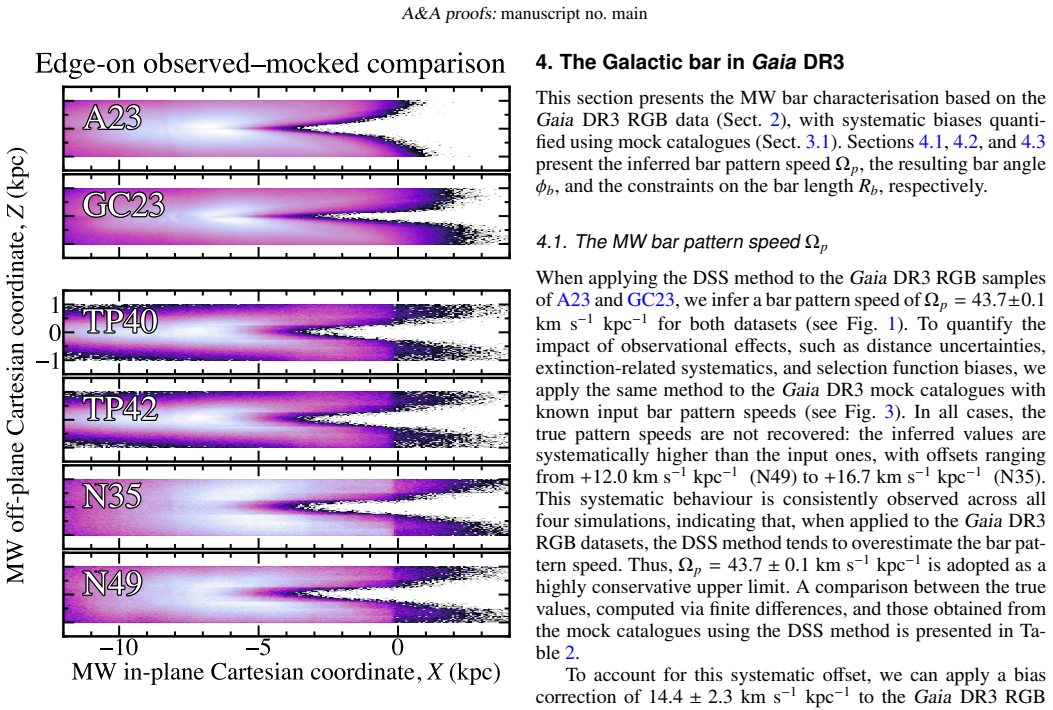
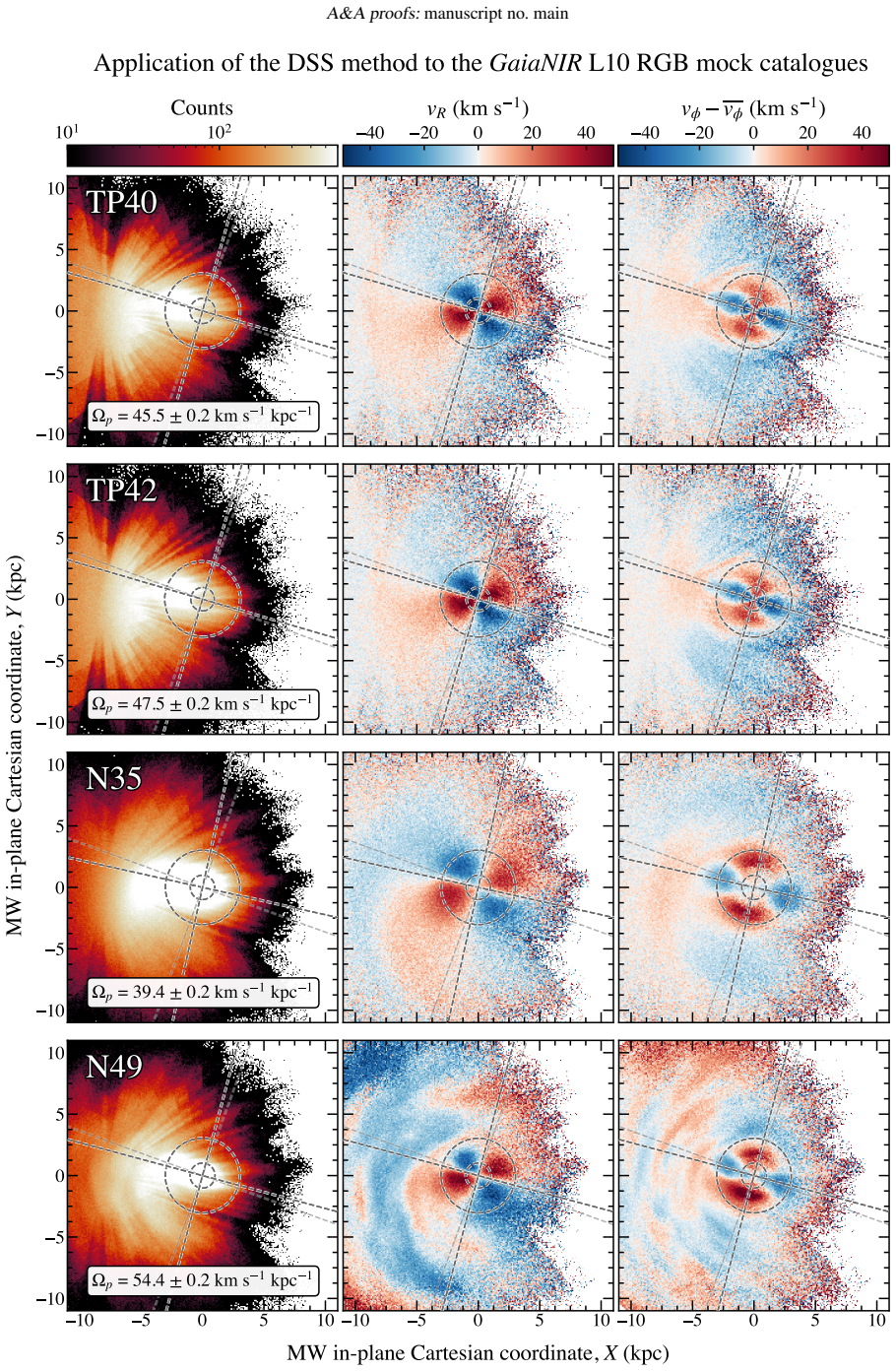
Using Gaia DR3 red-giant samples together with line-of-sight velocities and realistic mock catalogues that incorporate incompleteness and astrometric uncertainties, the analysis recovers a raw bar pattern speed of 43.7 ± 0.1 km s^{-1} kpc^{-1}. This figure is interpreted as a conservative upper limit because the mocks reveal a consistent +14.4 ± 2.3 km s^{-1} kpc^{-1} upward bias. Subtracting the offset produces a bias-corrected pattern speed of 29.3 ± 2.3 km s^{-1} kpc^{-1}. The same data show bisymmetric perturbations in azimuthal velocity and radial-to-total speed ratio with phase angles 19–24° inside the bar region.
What carries the argument
Realistic Gaia and GaiaNIR mock catalogues built from the same selection and uncertainty model as the DR3 RGB sample, used to measure and subtract the systematic offset in pattern-speed inference.
If this is right
- Current Gaia DR3 measurements of the bar pattern speed should be treated as upper limits until biases are corrected.
- The bias-corrected pattern speed of 29.3 km s^{-1} kpc^{-1} implies a slower, longer-lived bar than many models assume.
- Gaia DR4, DR5 and GaiaNIR are predicted to reduce the same systematic offset to roughly +5 km s^{-1} kpc^{-1}.
- Bisymmetric perturbations in v_φ and |v_R / v_tot| are detectable in the bar region with phase angles 19–24°.
- Wider spatial coverage and sub-0.001 mas yr^{-1} proper-motion precision from GaiaNIR will tighten constraints on bar length and orientation.
Where Pith is reading between the lines
- A slower bar pattern speed would shift the locations of the outer Lindblad resonance and affect models of spiral-arm and outer-disk dynamics.
- If the bias persists in other tracers, earlier pattern-speed estimates from gas and star-forming regions may also need downward revision.
- Improved future data could allow the bar's length and orientation to be measured simultaneously with pattern speed, testing whether these quantities are coupled.
- The limited number of mock realisations used here suggests that repeating the exercise with larger simulation suites would tighten the uncertainty on the corrected value.
Load-bearing premise
The mock catalogues correctly reproduce the actual incompleteness, astrometric errors, and selection effects present in the real Gaia DR3 red-giant data.
What would settle it
A new set of mock catalogues that produce a systematically different offset when the same pattern-speed method is applied to them would falsify the reported 14.4 km/s/kpc bias.
Figures



read the original abstract
The Milky Way (MW) hosts a central bar whose pattern speed, orientation, and length remain uncertain, largely due to observational biases and selection effects, despite the transformative data provided by the Gaia mission. We aim to reassess the MW bar properties using Gaia DR3, explicitly accounting for incompleteness and astrometric uncertainties, and to quantify the expected improvements from future Gaia DR4, DR5, and GaiaNIR data. We combine Gaia DR3 RGB samples with line-of-sight velocities and realistic Gaia and GaiaNIR mock catalogues to characterise observational biases. We then apply standard techniques to infer the bar pattern speed and structural properties, and evaluate their performance for upcoming data releases. Using Gaia DR3 RGB mock catalogues, we find that the bar pattern speed exhibits a systematic offset of $+14.4 \pm 2.3$ km$~$s$^{-1}~$kpc$^{-1}$. Applying this approach to the data yields $\Omega_p = 43.7 \pm 0.1$ km$~$s$^{-1}~$kpc$^{-1}$, which we interpret as a conservative upper limit. Correcting for this bias gives $\Omega_p = 29.3 \pm 2.3$ km$~$s$^{-1}~$kpc$^{-1}$, although this estimate should be treated with caution given the limited number of mock realizations. We also detect bisymmetric perturbations in $v_\phi$ and $\langle |v_R / v_{\rm tot}| \rangle$, with phase angles $\phi_b = 19$-$24^\circ$ in the bar region. Future Gaia data releases, together with GaiaNIR, are expected to reduce systematic offsets in the pattern speed to $\sim +5$ km$~$s$^{-1}~$kpc$^{-1}$. In addition, GaiaNIR will further improve proper motion precision to below $0.001$ mas$~$yr$^{-1}$ for bright sources and extend the spatial coverage. Our results indicate that current measurements of the MW bar pattern speed are significantly affected by systematics, but that forthcoming Gaia and GaiaNIR data will substantially improve both accuracy and robustness.
Editorial analysis
A structured set of objections, weighed in public.
Referee Report
Summary. The manuscript analyzes Gaia DR3 red giant branch (RGB) stars with line-of-sight velocities, using realistic mock catalogues to quantify observational biases and selection effects on Milky Way bar measurements. It reports a raw pattern speed of Ω_p = 43.7 ± 0.1 km s^{-1} kpc^{-1} from the data, identifies a systematic offset of +14.4 ± 2.3 km s^{-1} kpc^{-1} from the mocks, and derives a bias-corrected value of 29.3 ± 2.3 km s^{-1} kpc^{-1} (treated as a conservative upper limit with explicit caution due to limited mock realizations). The work also identifies bisymmetric perturbations in v_φ and |v_R / v_tot| with phase angles 19–24° and projects reduced systematics (~+5 km s^{-1} kpc^{-1}) for future Gaia releases and GaiaNIR.
Significance. If the bias correction proves robust, the paper would offer a concrete advance in constraining the Milky Way bar pattern speed by explicitly modeling Gaia-specific incompleteness and astrometric errors, an approach that addresses a persistent source of discrepancy in the literature. The quantitative forecasts for DR4/DR5 and GaiaNIR improvements are useful for planning, and the detection of phase-aligned perturbations adds supporting kinematic evidence. The use of mocks to derive an empirical offset is a methodological strength, though the limited realizations (as the authors themselves flag) constrain the current reliability of the corrected numerical result.
major comments (2)
- [Abstract and mock-catalogue results section] Abstract and mock-catalogue results section: the central corrected value Ω_p = 29.3 ± 2.3 km s^{-1} kpc^{-1} is obtained by subtracting an offset of +14.4 ± 2.3 km s^{-1} kpc^{-1} derived from an explicitly small number of mock realizations; the manuscript does not demonstrate convergence of this offset with additional realizations nor show that the mocks reproduce the observed spatial, proper-motion covariance, and line-of-sight velocity distributions in the real Gaia DR3 RGB sample at the level needed to support a 2 km s^{-1} kpc^{-1} correction.
- [Results on pattern-speed inference] Results on pattern-speed inference: the quoted uncertainty on the corrected Ω_p does not incorporate possible additional systematics arising from incomplete validation of the mocks against the joint selection function and error covariances of the actual data; this makes the claim that 29.3 ± 2.3 represents a conservative upper limit dependent on an unquantified residual bias.
minor comments (2)
- [Title] The title's phrasing 'a new view' overstates the current result given the explicit caution on the corrected value; a more measured title would better reflect the manuscript's own assessment.
- [Figure captions] Figure captions and text should explicitly state the exact number of mock realizations used to derive the +14.4 ± 2.3 offset and any convergence tests performed.
Simulated Author's Rebuttal
We thank the referee for their constructive and detailed review. We appreciate the positive assessment of the methodological approach using realistic mocks to quantify Gaia-specific biases and the value of the forecasts for future data releases. We respond point-by-point to the major comments below, indicating the revisions we will implement.
read point-by-point responses
-
Referee: [Abstract and mock-catalogue results section] Abstract and mock-catalogue results section: the central corrected value Ω_p = 29.3 ± 2.3 km s^{-1} kpc^{-1} is obtained by subtracting an offset of +14.4 ± 2.3 km s^{-1} kpc^{-1} derived from an explicitly small number of mock realizations; the manuscript does not demonstrate convergence of this offset with additional realizations nor show that the mocks reproduce the observed spatial, proper-motion covariance, and line-of-sight velocity distributions in the real Gaia DR3 RGB sample at the level needed to support a 2 km s^{-1} kpc^{-1} correction.
Authors: We agree that the number of mock realizations is limited and that explicit demonstration of convergence and detailed distribution matching would strengthen the result, as we already note in the manuscript. In the revised version we will add an appendix with (i) the offset values obtained from each individual realization to illustrate stability and (ii) side-by-side comparisons of the mock and observed samples in Galactocentric radius, azimuthal angle, proper-motion components, and line-of-sight velocity distributions. These additions will support the quoted bias correction while retaining the existing cautionary language. revision: partial
-
Referee: [Results on pattern-speed inference] Results on pattern-speed inference: the quoted uncertainty on the corrected Ω_p does not incorporate possible additional systematics arising from incomplete validation of the mocks against the joint selection function and error covariances of the actual data; this makes the claim that 29.3 ± 2.3 represents a conservative upper limit dependent on an unquantified residual bias.
Authors: We accept that the reported ±2.3 km s^{-1} kpc^{-1} reflects only the variance of the mock-derived offset and does not yet include all possible residual systematics from imperfect mock-data agreement in the joint selection function and error covariances. In the revision we will (i) explicitly state that the uncertainty on the corrected value is dominated by the mock offset and (ii) qualify the interpretation of 29.3 ± 2.3 km s^{-1} kpc^{-1} as an estimate subject to additional unquantified systematics, while preserving the raw measurement as a conservative upper limit. revision: yes
Circularity Check
No circularity: bias offset calibrated from independent mocks with known true pattern speed
full rationale
The paper measures a raw pattern speed of 43.7 km s^{-1} kpc^{-1} on real Gaia DR3 RGB data using standard techniques, then subtracts a +14.4 km s^{-1} kpc^{-1} offset obtained by applying the identical pipeline to separate mock catalogues whose true input Ω_p is known by construction. This is an external calibration step, not a self-referential fit or redefinition. No equations reduce the reported result to the input data by construction, no load-bearing self-citations justify the core method, and the mocks are described as realistic but independent of the real-data measurement. The limited number of realizations affects uncertainty but does not create circularity.
Axiom & Free-Parameter Ledger
free parameters (1)
- systematic offset in pattern speed =
+14.4 ± 2.3 km s^{-1} kpc^{-1}
axioms (2)
- domain assumption Mock catalogues accurately represent real Gaia DR3 observational biases and selection effects for RGB samples with line-of-sight velocities
- domain assumption Standard techniques for inferring bar pattern speed remain valid after applying the mock-derived bias correction
Reference graph
Works this paper leans on
-
[1]
Aguerri, J. A. L., Méndez-Abreu, J., & Corsini, E. M. 2009, A&A, 495, 491
2009
-
[2]
& Santillan, A
Allen, C. & Santillan, A. 1991, Rev. Mexicana Astron. Astrofis., 22, 255
1991
-
[3]
Anders, F., Khalatyan, A., Queiroz, A. B. A., et al. 2022, A&A, 658, A91
2022
-
[4]
2025, A&A, 703, L1
Araya, V ., Chemin, L., Jiménez-Arranz, Ó., & Romero-Gómez, M. 2025, A&A, 703, L1
2025
-
[5]
2002, ApJ, 569, L83
Athanassoula, E. 2002, ApJ, 569, L83
2002
-
[6]
2003, MNRAS, 341, 1179
Athanassoula, E. 2003, MNRAS, 341, 1179
2003
-
[7]
2014, MNRAS, 438, L81
Athanassoula, E. 2014, MNRAS, 438, L81
2014
-
[8]
Bailer-Jones, C. A. L., Rybizki, J., Fouesneau, M., Demleitner, M., & Andrae, R. 2021, AJ, 161, 147 Bédorf, J., Gaburov, E., Fujii, M. S., et al. 2014, in Proceedings of the Interna- tional Conference for High Performance Computing, 54–65 Bédorf, J., Gaburov, E., & Portegies Zwart, S. 2012, Journal of Computational Physics, 231, 2825
2021
-
[9]
2020, MNRAS, 495, 895
Binney, J. 2020, MNRAS, 495, 895
2020
-
[10]
E., Stark, A
Binney, J., Gerhard, O. E., Stark, A. A., Bally, J., & Uchida, K. I. 1991, MNRAS, 252, 210
1991
-
[11]
& Gerhard, O
Bland-Hawthorn, J. & Gerhard, O. 2016, ARA&A, 54, 529
2016
-
[12]
2023, ApJ, 947, 80
Bland-Hawthorn, J., Tepper-Garcia, T., Agertz, O., & Freeman, K. 2023, ApJ, 947, 80
2023
-
[13]
& Spergel, D
Blitz, L. & Spergel, D. N. 1991, ApJ, 379, 631
1991
-
[14]
W., Hunt, J
Bovy, J., Leung, H. W., Hunt, J. A. S., et al. 2019, MNRAS, 490, 4740
2019
-
[15]
Brown, A. G. A., Leiden University, & Gaia DPAC. 2012, PyGaia
2012
-
[16]
M., Weiler, M., Jordi, C., et al
Carrasco, J. M., Weiler, M., Jordi, C., et al. 2021, A&A, 652, A86
2021
-
[17]
XGBoost: A Scalable Tree Boosting System
Chen, T. & Guestrin, C. 2016, arXiv e-prints, arXiv:1603.02754
work page Pith review arXiv 2016
-
[18]
& Schönrich, R
Chiba, R. & Schönrich, R. 2021, MNRAS, 505, 2412
2021
-
[19]
Clarke, J. P. & Gerhard, O. 2022, MNRAS, 512, 2171 De Angeli, F., Weiler, M., Montegriffo, P., et al. 2023, A&A, 674, A2 de Vaucouleurs, G., de Vaucouleurs, A., Corwin, Jr., H. G., et al. 1991, Third Reference Catalogue of Bright Galaxies
2022
-
[20]
P., Mayer, L., Carollo, C
Debattista, V . P., Mayer, L., Carollo, C. M., et al. 2006, ApJ, 645, 209
2006
-
[21]
Debattista, V . P. & Sellwood, J. A. 2000, ApJ, 543, 704
2000
-
[22]
2023, MNRAS, 518, 2712
Dehnen, W., Semczuk, M., & Schönrich, R. 2023, MNRAS, 518, 2712
2023
-
[23]
G., Hauser, M
Dwek, E., Arendt, R. G., Hauser, M. G., et al. 1995, ApJ, 445, 716
1995
-
[24]
2018, MNRAS, 474, 5372
Erwin, P. 2018, MNRAS, 474, 5372
2018
-
[25]
B., Frogel, J
Eskridge, P. B., Frogel, J. A., Pogge, R. W., et al. 2000, AJ, 119, 536
2000
-
[26]
& Boubert, D
Everall, A. & Boubert, D. 2022, MNRAS, 509, 6205
2022
-
[27]
2021, A&A, 649, A5
Fabricius, C., Luri, X., Arenou, F., et al. 2021, A&A, 649, A5
2021
-
[28]
1877, Q.J
Ferrers, N. 1877, Q.J. Pure Appl. Math, 14, 1 Gaia Collaboration, Brown, A. G. A., Vallenari, A., et al. 2018, A&A, 616, A1 Gaia Collaboration, Brown, A. G. A., Vallenari, A., et al. 2021, A&A, 649, A1 Gaia Collaboration, Drimmel, R., Romero-Gómez, M., et al. 2023a, A&A, 674, A37 Gaia Collaboration, Prusti, T., de Bruijne, J. H. J., et al. 2016, A&A, 595,...
2018
-
[29]
Gao, J., Li, A., & Jiang, B. W. 2013, Earth, Planets and Space, 65, 1127
2013
-
[30]
& Di Matteo, P
Ghosh, S. & Di Matteo, P. 2024, A&A, 683, A100 GRA VITY Collaboration, Abuter, R., Aimar, N., et al. 2022, A&A, 657, L12
2024
-
[31]
2025, ApJ, 985, 181
Guo, Y ., Jogee, S., Wise, E., et al. 2025, ApJ, 985, 181
2025
-
[32]
M., Sakai, S., et al
Haggard, Z., Ghez, A. M., Sakai, S., et al. 2024, AJ, 168, 166
2024
-
[33]
R., Millman, K
Harris, C. R., Millman, K. J., van der Walt, S. J., et al. 2020, Nature, 585, 357
2020
-
[34]
Hawkins, K., Leistedt, B., Bovy, J., & Hogg, D. W. 2017, MNRAS, 471, 722
2017
-
[35]
1990, ApJ, 356, 359
Hernquist, L. 1990, ApJ, 356, 359
1990
-
[36]
R., Huber, D., Shappee, B
Hey, D. R., Huber, D., Shappee, B. J., et al. 2023, AJ, 166, 249
2023
-
[37]
2021, Experimental Astronomy, 51, 783
Hobbs, D., Brown, A., Høg, E., et al. 2021, Experimental Astronomy, 51, 783
2021
-
[38]
Hunt, J. A. S. & Bovy, J. 2018, MNRAS, 477, 3945
2018
-
[39]
Hunt, J. A. S., Petersen, M. S., Weinberg, M. D., et al. 2026, MNRAS, 545, staf2118
2026
-
[40]
Hunt, J. A. S., Price-Whelan, A. M., Johnston, K. V ., et al. 2024, MNRAS, 527, 11393
2024
-
[41]
Hunt, J. A. S., Stelea, I. A., Johnston, K. V ., et al. 2021, MNRAS, 508, 1459
2021
-
[42]
Hunt, J. A. S. & Vasiliev, E. 2025, New A Rev., 100, 101721
2025
-
[43]
Hunter, J. D. 2007, Computing in Science & Engineering, 9, 90 Jiménez-Arranz, Ó., Chemin, L., Romero-Gómez, M., et al. 2024a, A&A, 683, A102 Jiménez-Arranz, Ó. & Roca-Fàbrega, S. 2025, A&A, 698, L7 Jiménez-Arranz, Ó., Roca-Fàbrega, S., Romero-Gómez, M., et al. 2024b, A&A, 688, A51
2007
-
[44]
Kalnajs, A. J. 1972, ApJ, 175, 63
1972
-
[45]
R., Famaey, B., Monari, G., et al
Khalil, Y . R., Famaey, B., Monari, G., et al. 2025, A&A, 699, A263
2025
-
[46]
2025, A&A, 701, A270
Khanna, S., Yu, J., Drimmel, R., et al. 2025, A&A, 701, A270
2025
-
[47]
2016, in Positioning and Power in Academic Publishing: Players, Agents and Agendas, ed
Kluyver, T., Ragan-Kelley, B., Pérez, F., et al. 2016, in Positioning and Power in Academic Publishing: Players, Agents and Agendas, ed. F. Loizides & B. Scmidt (Netherlands: IOS Press), 87–90
2016
-
[48]
L., Babusiaux, C., & Cox, N
Lallement, R., Vergely, J. L., Babusiaux, C., & Cox, N. L. J. 2022, A&A, 661, A147
2022
-
[49]
Laporte, C. F. P., Johnston, K. V ., Gómez, F. A., Garavito-Camargo, N., & Besla, G. 2018, MNRAS, 481, 286 Le Conte, Z. A., Gadotti, D. A., Ferreira, L., et al. 2024, MNRAS, 530, 1984
2018
-
[50]
H., Ann, H
Lee, Y . H., Ann, H. B., & Park, M.-G. 2019, ApJ, 872, 97
2019
-
[51]
W., Bovy, J., Mackereth, J
Leung, H. W., Bovy, J., Mackereth, J. T., et al. 2023, MNRAS, 519, 948
2023
-
[52]
Lucey, M., Pearson, S., Hunt, J. A. S., et al. 2023, MNRAS, 520, 4779
2023
-
[53]
Luri, X., Brown, A. G. A., Sarro, L. M., et al. 2018, A&A, 616, A9
2018
-
[54]
2014, A&A, 566, A119
Luri, X., Palmer, M., Arenou, F., et al. 2014, A&A, 566, A119
2014
-
[55]
& Kalnajs, A
Lynden-Bell, D. & Kalnajs, A. J. 1972, MNRAS, 157, 1
1972
-
[56]
J., Robin, A
Marshall, D. J., Robin, A. C., Reylé, C., Schultheis, M., & Picaud, S. 2006, A&A, 453, 635
2006
-
[57]
L., Nichol, R
Masters, K. L., Nichol, R. C., Hoyle, B., et al. 2011, MNRAS, 411, 2026
2011
-
[58]
2010, in Proceedings of the 9th Python in Science Conference, ed
McKinney, W. 2010, in Proceedings of the 9th Python in Science Conference, ed. S. van der Walt & J. Millman, 56 – 61
2010
-
[59]
& Nagai, R
Miyamoto, M. & Nagai, R. 1975, PASJ, 27, 533
1975
-
[60]
2023, A&A, 674, A3
Montegriffo, P., De Angeli, F., Andrae, R., et al. 2023, A&A, 674, A3
2023
-
[61]
F., Frenk, C
Navarro, J. F., Frenk, C. S., & White, S. D. M. 1997, ApJ, 490, 493
1997
-
[62]
Ostriker, J. P. & Peebles, P. J. E. 1973, ApJ, 186, 467 Pérez, F. & Granger, B. E. 2007, Computing in Science and Engineering, 9, 21
1973
-
[63]
S., Weinberg, M
Petersen, M. S., Weinberg, M. D., & Katz, N. 2021, MNRAS, 500, 838
2021
-
[64]
2017, MNRAS, 465, 1621
Portail, M., Gerhard, O., Wegg, C., & Ness, M. 2017, MNRAS, 465, 1621
2017
-
[65]
2008, MNRAS, 388, 1803
Rautiainen, P., Salo, H., & Laurikainen, E. 2008, MNRAS, 388, 1803
2008
-
[66]
2020, pandas-dev/pandas: Pan- das 1.0.3
Reback, J., McKinney, W., jbrockmendel, et al. 2020, pandas-dev/pandas: Pan- das 1.0.3
2020
-
[67]
H., Rieke, M
Rieke, G. H., Rieke, M. J., & Paul, A. E. 1989, ApJ, 336, 752 Romero-Gómez, M., Figueras, F., Antoja, T., Abedi, H., & Aguilar, L. 2015, MNRAS, 447, 218
1989
-
[68]
2018, A&A, 609, A116
Ruiz-Dern, L., Babusiaux, C., Arenou, F., Turon, C., & Lallement, R. 2018, A&A, 609, A116
2018
-
[69]
M., Rix, H.-W., et al
Rybizki, J., Green, G. M., Rix, H.-W., et al. 2022, MNRAS, 510, 2597 Schölch, M., Jiménez-Arranz, Ó., Romero-Gómez, M., et al. 2025, A&A, 701, A227
2022
-
[70]
Z., Stolovy, S
Scoville, N. Z., Stolovy, S. R., Rieke, M., Christopher, M., & Yusef-Zadeh, F. 2003, ApJ, 594, 294
2003
-
[71]
Sellwood, J. A. 1980, A&A, 89, 296
1980
-
[72]
Sellwood, J. A. 2014, Reviews of Modern Physics, 86, 1
2014
-
[73]
Sellwood, J. A. & Wilkinson, A. 1993, Reports on Progress in Physics, 56, 173
1993
-
[74]
2024, A&A, 692, A159
Semczuk, M., Dehnen, W., Schönrich, R., & Athanassoula, E. 2024, A&A, 692, A159
2024
-
[75]
& Zheng, X.-W
Shen, J. & Zheng, X.-W. 2020, Research in Astronomy and Astrophysics, 20, 159
2020
-
[76]
M., Elmegreen, B
Sheth, K., Elmegreen, D. M., Elmegreen, B. G., et al. 2008, ApJ, 675, 1141
2008
-
[77]
A., Hunt, J
Stelea, I. A., Hunt, J. A. S., & Johnston, K. V . 2024, ApJ, 977, 252
2024
-
[78]
& Weinberg, M
Tremaine, S. & Weinberg, M. D. 1984, ApJ, 282, L5 van der Velden, E. 2020, The Journal of Open Source Software, 5, 2004
1984
-
[79]
2019, MNRAS, 482, 1525
Vasiliev, E. 2019, MNRAS, 482, 1525
2019
-
[80]
2021, MNRAS, 501, 2279
Vasiliev, E., Belokurov, V ., & Erkal, D. 2021, MNRAS, 501, 2279
2021
discussion (0)
Sign in with ORCID, Apple, or X to comment. Anyone can read and Pith papers without signing in.