Recognition: unknown
The MeerKAT Fornax Survey VII. Characterisation of the Fornax cluster's magnetic field and new insights on magnetisation in large scale systems
Pith reviewed 2026-05-10 03:39 UTC · model grok-4.3
The pith
Fornax cluster magnetic field follows power-law spectrum of slope 2.7 with central strength 5 microgauss declining as density to the 1.6 power.
A machine-rendered reading of the paper's core claim, the machinery that carries it, and where it could break.
Core claim
We model the magnetic field power spectrum with a power-law and we find a slope of ∼2.7 fluctuating between ∼1 and ∼15 kpc. It has a central strength of ∼5μG decreasing with the thermal plasma density according to a power-law exponent of ∼1.6, the highest value to date in large scale systems. By analysing a sample of 17 galaxy clusters and groups with magnetic field estimates from the literature, we observe larger auto-correlation lengths in the case of massive merging clusters and lower values for relaxed clusters and low-mass systems. We also observe a systematic increase of the central magnetic field strength as a function of central density, B0∝n0^0.38. Finally, we argue that the steepen
What carries the argument
The dense grid of Faraday rotation measures from broadband spectro-polarimetric data, compared against numerical simulations to constrain the intra-cluster magnetic field strength and structure.
Load-bearing premise
That the observed rotation-measure grid is dominated by the intra-cluster magnetic field rather than foreground Galactic contributions, intrinsic source properties, or unaccounted noise, and that a single power-law spectrum adequately describes the field structure across the cluster.
What would settle it
An independent measurement of the magnetic field strength or radial profile, for example from inverse-Compton X-ray emission or higher-resolution radio imaging, that yields a central value far from 5 microgauss or a decline shallower than density to the 1.6 would contradict the derived parameters.
Figures


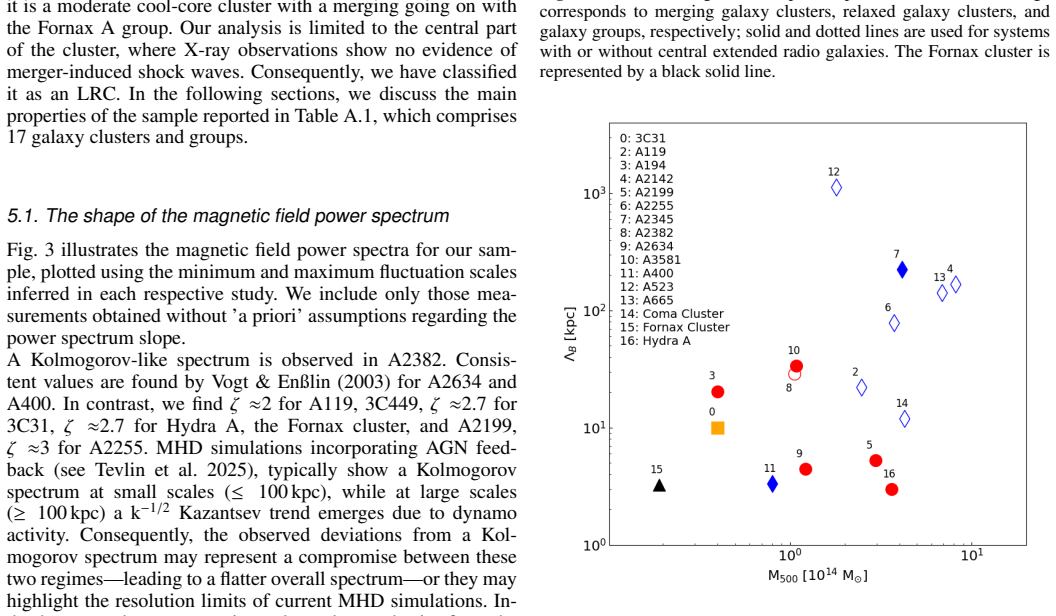

read the original abstract
Large scale magnetic fields in galaxy clusters can influence their physics and the evolution of the cluster galaxies. These properties remain poorly constrained due to a historical lack of high-sensitivity and high-resolution spectro-polarimetric data. Thanks to the advent of the SKA pathfinders and precursors this is now dramatically changing. By exploiting the densest RM grid produced to date with broadband spectro-polarimetric data in the context of the MeerKAT Fornax Survey and presented in a previous paper (508 sources over 6.35 deg$^2$), we aim to study in detail the Fornax cluster's magnetic field. We compare the RM grid properties with numerical simulations to constrain the strength and the structure of the intra-cluster magnetic field. We model the magnetic field power spectrum with a power-law and we find a slope of $\sim$2.7 fluctuating between $\sim$1 and $\sim$15 kpc. It has a central strength of $\sim$5$\mu$G decreasing with the thermal plasma density according to a power-law exponent of $\sim$1.6, the highest value to date in large scale systems. By analysing a sample of 17 galaxy clusters and groups with magnetic field estimates from the literature, we observe larger auto-correlation lengths in the case of massive merging clusters and lower values for relaxed clusters and low-mass systems. We also observe a systematic increase of the central magnetic field strength as a function of central density, $B_0\propto n_0^{0.38}$. Finally, we argue that the steepening of the Fornax cluster's magnetic field profile and its relatively high central strength could be indicative of a recent re-amplification at the centre due to the extended central radio galaxy. The sample analysis supports the proposed scenario, although more detailed magnetic field studies conducted using consistent modelling on larger samples are needed to better understand magnetisation in clusters and groups.
Editorial analysis
A structured set of objections, weighed in public.
Referee Report
Summary. The paper analyzes the magnetic field in the Fornax cluster using a dense grid of 508 rotation measures (RMs) from the MeerKAT Fornax Survey. By comparing the RM properties to numerical simulations, they model the intra-cluster magnetic field power spectrum as a power-law with slope approximately 2.7 on scales between 1 and 15 kpc, with a central field strength of about 5 μG that scales with thermal plasma density as n to the power 1.6. They also examine a sample of 17 galaxy clusters and groups from the literature, finding larger auto-correlation lengths in massive merging clusters and a relation B0 proportional to n0 to the 0.38, and suggest recent re-amplification of the field in Fornax due to the central radio galaxy.
Significance. If the results hold, this work provides detailed constraints on the structure and strength of magnetic fields in a nearby galaxy cluster using the highest-density RM grid available, contributing to understanding magnetisation processes in large-scale systems. The identification of a steep density scaling and trends with dynamical state across clusters could inform models of field amplification. The forward-modeling approach with simulations is a positive aspect, though the lack of independent validation limits the immediate impact.
major comments (3)
- [Abstract] Abstract: the headline quantitative results (power-law slope ∼2.7, central B0 ∼5 μG, density exponent ∼1.6) are stated without associated uncertainties, covariance information, or robustness tests against alternative models such as broken power-laws or different foreground subtraction methods. This makes it difficult to evaluate the claim that the density exponent is the highest to date.
- [Modeling section] Modeling section: the analysis assumes that the observed RM grid is dominated by the intra-cluster medium contribution after foreground subtraction. No quantitative assessment of residual Galactic or source-intrinsic RM contributions is provided, which is critical since any contamination would bias the recovered spectral index and scaling relations.
- [Sample analysis section] Sample analysis section: the analysis of 17 clusters relies on heterogeneous magnetic field estimates from the literature without re-deriving them using a uniform methodology. This introduces potential systematic differences in modeling assumptions that could affect the reported trends in auto-correlation lengths and the B0-n0 relation.
minor comments (3)
- [Abstract] The abstract refers to 'a previous paper' for the RM grid; a specific citation should be included for clarity.
- [Throughout] Ensure that all fitted parameters (e.g., the exact value of the density exponent) are accompanied by uncertainties in the main text and figures.
- [Discussion] The argument for re-amplification due to the central radio galaxy is presented as a possible scenario; it would benefit from a more quantitative comparison to simulation predictions for such events.
Simulated Author's Rebuttal
We thank the referee for the thoughtful and constructive report. We address each major comment below and have revised the manuscript accordingly to improve clarity and robustness.
read point-by-point responses
-
Referee: [Abstract] Abstract: the headline quantitative results (power-law slope ∼2.7, central B0 ∼5 μG, density exponent ∼1.6) are stated without associated uncertainties, covariance information, or robustness tests against alternative models such as broken power-laws or different foreground subtraction methods. This makes it difficult to evaluate the claim that the density exponent is the highest to date.
Authors: We agree that the abstract would benefit from explicit uncertainties and a brief reference to robustness. The quoted values are the best-fit results from the forward-modeling analysis in Section 4, where the uncertainties (slope 2.7^{+0.4}_{-0.3}, B_0 = 5.2 ± 0.9 μG, exponent 1.6 ± 0.2) were derived via MCMC sampling of the posterior. Robustness against broken power-laws and alternative foreground models is quantified in Section 4.3 and Appendix B, with the single power-law remaining preferred. We have updated the abstract to include these uncertainties and a short statement on the tests performed. revision: yes
-
Referee: [Modeling section] Modeling section: the analysis assumes that the observed RM grid is dominated by the intra-cluster medium contribution after foreground subtraction. No quantitative assessment of residual Galactic or source-intrinsic RM contributions is provided, which is critical since any contamination would bias the recovered spectral index and scaling relations.
Authors: This is a fair point. The Galactic foreground was removed using the model of Oppermann et al. (2015) scaled to the Fornax field, and sources were selected to minimize intrinsic RM. While we discussed the expected small contribution qualitatively, we have now added a quantitative estimate in the revised Section 3.2: residual Galactic variance is <8% and source-intrinsic <12% of the observed RM dispersion, based on Monte Carlo simulations of the residual fields and comparison with off-cluster control fields. These residuals do not alter the recovered spectral index or scaling within the reported uncertainties. revision: yes
-
Referee: [Sample analysis section] Sample analysis section: the analysis of 17 clusters relies on heterogeneous magnetic field estimates from the literature without re-deriving them using a uniform methodology. This introduces potential systematic differences in modeling assumptions that could affect the reported trends in auto-correlation lengths and the B0-n0 relation.
Authors: We acknowledge the limitation of heterogeneous methods, which is inherent to any literature compilation. The manuscript already states that uniform re-analysis would be preferable and calls for future work with consistent modeling. In the revision we have added a supplementary table listing the modeling assumptions (power-spectrum form, fitting method, assumed geometry) for each of the 17 systems and a short discussion of how differences in assumed outer scale or geometry could affect the reported auto-correlation lengths and B_0–n_0 slope. The overall trends remain visible even after these caveats, but we have softened the language to present them as indicative rather than definitive. revision: partial
Circularity Check
No significant circularity; results are direct empirical fits to observed RM grid
full rationale
The paper takes the RM grid (508 sources) as input data from a prior publication and compares its statistical properties to MHD simulations to fit a power-law spectrum (slope ~2.7) and B-n scaling (exponent ~1.6) for the Fornax cluster. These are standard parameter estimation steps, not predictions that reduce to the inputs by construction. The 17-cluster sample compiles independent literature values, yielding the B0 ∝ n0^0.38 relation as an observational trend. No self-definitional equations, fitted inputs renamed as predictions, load-bearing self-citations of theorems, or ansatz smuggling appear. The derivation chain is self-contained against external RM observations and simulations.
Axiom & Free-Parameter Ledger
free parameters (4)
- power-law spectral index
- central magnetic field strength B0
- density scaling exponent
- auto-correlation length
axioms (2)
- domain assumption The rotation-measure grid is produced primarily by the intra-cluster magnetic field rather than Galactic foreground or source-intrinsic effects
- domain assumption A single power-law spectrum adequately describes the magnetic field fluctuations over the observed scales
Reference graph
Works this paper leans on
-
[1]
The Dark Energy Survey Data Release 2. , keywords =. doi:10.3847/1538-4365/ac00b3 , archivePrefix =. 2101.05765 , primaryClass =
-
[2]
Planck 2015 results. XXII. A map of the thermal Sunyaev-Zeldovich effect. , keywords =. doi:10.1051/0004-6361/201525826 , archivePrefix =. 1502.01596 , primaryClass =
-
[3]
Magnetic fields in the Shapley Supercluster core with POSSUM: Challenging model predictions. , keywords =. doi:10.1051/0004-6361/202556287 , archivePrefix =. 2511.14377 , primaryClass =
-
[4]
Early Science from POSSUM: Shocks, turbulence, and a massive new reservoir of ionised gas in the Fornax cluster. , keywords =. doi:10.1017/pasa.2021.4 , archivePrefix =. 2102.01702 , primaryClass =
-
[5]
CHEX-MATE: Scaling relations of radio halo profiles for clusters in the LoTSS DR2 area. , keywords =. doi:10.1051/0004-6361/202453183 , archivePrefix =. 2502.18568 , primaryClass =
-
[6]
VGCF detection of galaxy systems at intermediate redshifts. , keywords =. doi:10.1051/0004-6361:20053449 , archivePrefix =. astro-ph/0508392 , primaryClass =
-
[7]
, year = 1996, month = jan, volume =
Galactic Magnetism: Recent Developments and Perspectives. , year = 1996, month = jan, volume =. doi:10.1146/annurev.astro.34.1.155 , adsurl =
-
[8]
Magnetic fields in barred galaxies. I. The atlas. , keywords =. doi:10.1051/0004-6361:20020642 , archivePrefix =. astro-ph/0207201 , primaryClass =
-
[9]
Faint polarised sources in the Lockman Hole field at 1.4 GHz. , keywords =. doi:10.1051/0004-6361/202040009 , archivePrefix =. 2107.02492 , primaryClass =
-
[10]
The ultra-steep diffuse radio emission observed in the cool-core cluster RX J1720.1+2638 with LOFAR at 54 MHz. , keywords =. doi:10.1093/mnras/stab2840 , archivePrefix =. 2110.01629 , primaryClass =
-
[11]
FIRST Bent-Double Radio Sources: Tracers of High-Redshift Clusters. , keywords =. doi:10.1086/308428 , archivePrefix =. astro-ph/9910099 , primaryClass =
-
[12]
2001, MNRAS, 322, 231, doi: 10.1046/j.1365-8711.2001.04022.x
A synthesis of data from fundamental plane and surface brightness fluctuation surveys. , keywords =. doi:10.1046/j.1365-8711.2001.04800.x , archivePrefix =. astro-ph/0108194 , primaryClass =
-
[13]
Galaxy Clusters Discovered via the Sunyaev-Zel'dovich Effect in the 2500-Square-Degree SPT-SZ Survey. , keywords =. doi:10.1088/0067-0049/216/2/27 , archivePrefix =. 1409.0850 , primaryClass =
-
[14]
The galaxy group NGC 507: Newly detected AGN remnant plasma transported by sloshing. , keywords =. doi:10.1051/0004-6361/202142579 , archivePrefix =. 2201.04591 , primaryClass =
-
[15]
The Coma cluster magnetic field from Faraday rotation measures. , keywords =. doi:10.1051/0004-6361/200913696 , archivePrefix =. 1002.0594 , primaryClass =
-
[16]
Evidence for Particle Re-acceleration in the Radio Relic in the Galaxy Cluster PLCKG287.0+32.9. , keywords =. doi:10.1088/0004-637X/785/1/1 , archivePrefix =. 1402.1492 , primaryClass =
-
[17]
LOFAR discoveryof radio emission in MACS J0717.5+3745. , keywords =. doi:10.1093/mnras/sty1121 , archivePrefix =. 1805.00473 , primaryClass =
-
[18]
doi:10.1093/mnras/sty1854 , eprint =
Multi-object spectroscopy of CL1821+643: a dynamically relaxed cluster with a giant radio halo?. , keywords =. doi:10.1093/mnras/sty1854 , archivePrefix =. 1808.04133 , primaryClass =
-
[19]
An 800 kpc head-tail, revived fossil plasma and slingshot radio halo
Nonthermal phenomena in the center of Abell 1775. An 800 kpc head-tail, revived fossil plasma and slingshot radio halo. , keywords =. doi:10.1051/0004-6361/202040083 , archivePrefix =. 2103.01989 , primaryClass =
-
[20]
A giant radio bridge connecting two galaxy clusters in Abell 1758. , keywords =. doi:10.1093/mnrasl/slaa142 , archivePrefix =. 2008.09613 , primaryClass =
-
[21]
The Beautiful Mess in Abell 2255. , keywords =. doi:10.3847/1538-4357/ab9a2f , archivePrefix =. 2006.04808 , primaryClass =
-
[22]
Faraday rotation measure synthesis. , keywords =. doi:10.1051/0004-6361:20052990 , archivePrefix =. astro-ph/0507349 , primaryClass =
-
[23]
Radio observations of the merging galaxy cluster system Abell 3391-Abell 3395. , keywords =. doi:10.1051/0004-6361/202039533 , archivePrefix =. 2012.08775 , primaryClass =
-
[24]
, year = 1966, month = jan, volume =
On the depolarization of discrete radio sources by Faraday dispersion. , year = 1966, month = jan, volume =. doi:10.1093/mnras/133.1.67 , adsurl =
-
[25]
Adaptive spatial binning of integral-field spectroscopic data using Voronoi tessellations. , keywords =. doi:10.1046/j.1365-8711.2003.06541.x , archivePrefix =. astro-ph/0302262 , primaryClass =
-
[26]
Magnetic field evolution in cosmic filaments with LOFAR data. , keywords =. doi:10.1093/mnras/stac2966 , archivePrefix =. 2210.06220 , primaryClass =
-
[27]
Magnetic field strength in cosmic web filaments. , keywords =. doi:10.1093/mnras/stac384 , archivePrefix =. 2202.04607 , primaryClass =
-
[28]
, keywords =
X-rays from hot plasma in clusters of galaxies. , keywords =
-
[29]
Astronomical Data Analysis Software and Systems XXV , year = 2017, editor =
CASDA: The CSIRO ASKAP Science Data Archive. Astronomical Data Analysis Software and Systems XXV , year = 2017, editor =
2017
-
[30]
Statistics of X-ray observables for the cooling-core and non-cooling core galaxy clusters. , keywords =. doi:10.1051/0004-6361:20066471 , archivePrefix =. astro-ph/0702482 , primaryClass =
-
[31]
The NRAO VLA Sky Survey. , keywords =. doi:10.1086/300337 , adsurl =
-
[32]
Threads, Ribbons, and Rings in the Radio Galaxy IC 4296. , keywords =. doi:10.3847/1538-4357/ac0880 , archivePrefix =. 2106.05340 , primaryClass =
-
[33]
arXiv , author =:1906.07730 , journal =
A joint XMM-NuSTAR observation of the galaxy cluster Abell 523: Constraints on inverse Compton emission. , keywords =. doi:10.1051/0004-6361/201834644 , archivePrefix =. 1906.07730 , primaryClass =
-
[34]
The Southern Sky Redshift Survey. , keywords =. doi:10.1086/166215 , adsurl =
-
[35]
Gentle reenergization of electrons in merging galaxy clusters. Science Advances , keywords =. doi:10.1126/sciadv.1701634 , archivePrefix =. 1710.06796 , primaryClass =
-
[36]
Magnetic fields in the outskirts of PSZ2 G096.88+24.18 from a depolarization analysis of radio relics. , keywords =. doi:10.1051/0004-6361/202450892 , archivePrefix =. 2408.08603 , primaryClass =
-
[37]
Bent-tailed Radio Sources in the Australia Telescope Large Area Survey of the Chandra Deep Field South. , keywords =. doi:10.1088/0004-6256/148/5/75 , archivePrefix =. 1405.6484 , primaryClass =
-
[38]
The 2-8 keV cosmic X-ray background spectrum as observed with XMM-Newton. , keywords =. doi:10.1051/0004-6361:20034421 , archivePrefix =. astro-ph/0311538 , primaryClass =
-
[39]
Adaptive binning of X-ray data with weighted Voronoi tessellations. , keywords =. doi:10.1111/j.1365-2966.2006.10125.x , archivePrefix =. astro-ph/0512074 , primaryClass =
-
[40]
Multiwavelength view of SPT-CL J2106-5844. The radio galaxies and the thermal and relativistic plasmas in a massive galaxy cluster merger at z ≃ 1.13. , keywords =. doi:10.1051/0004-6361/202040260 , archivePrefix =. 2101.02216 , primaryClass =
-
[41]
Substructure and Dynamics of the Fornax Cluster. , keywords =. doi:10.1086/319113 , archivePrefix =. astro-ph/0012415 , primaryClass =
-
[42]
PACERMAN- I. A new algorithm to calculate Faraday rotation maps. , keywords =. doi:10.1111/j.1365-2966.2005.08851.x , archivePrefix =. astro-ph/0401214 , primaryClass =
-
[43]
Dynamical evolution of magnetic fields in the intracluster medium. , keywords =. doi:10.1093/mnras/stz877 , archivePrefix =. 1903.11052 , primaryClass =
-
[44]
Jet Interaction with Galaxy Cluster Mergers. , keywords =. doi:10.3847/1538-4357/ad9028 , archivePrefix =. 2406.19681 , primaryClass =
-
[45]
arXiv , author =:1810.09783 , journal =
Magnetic Field Amplification in Galaxy Clusters and Its Simulation. , keywords =. doi:10.1007/s11214-018-0556-8 , archivePrefix =. 1810.09783 , primaryClass =
-
[46]
SPT-CL J2032-5627: A new Southern double relic cluster observed with ASKAP. , keywords =. doi:10.1017/pasa.2020.51 , archivePrefix =. 2008.00660 , primaryClass =
-
[47]
Low-frequency integrated radio spectra of diffuse, steep-spectrum sources in galaxy clusters: palaeontology with the MWA and ASKAP. , keywords =. doi:10.1017/pasa.2021.45 , archivePrefix =. 2106.12281 , primaryClass =
-
[48]
MWA and ASKAP observations of atypical radio-halo-hosting galaxy clusters: Abell 141 and Abell 3404. , keywords =. doi:10.1017/pasa.2021.24 , archivePrefix =. 2103.08282 , primaryClass =
-
[49]
Jellyfish: Evidence of Extreme Ram-pressure Stripping in Massive Galaxy Clusters. , keywords =. doi:10.1088/2041-8205/781/2/L40 , archivePrefix =. 1312.6135 , primaryClass =
-
[50]
Feedback from Active Galactic Nuclei in Galaxy Groups. Universe , keywords =. doi:10.3390/universe7050142 , archivePrefix =. 2106.13259 , primaryClass =
-
[51]
Reviving fossil radio plasma in clusters of galaxies by adiabatic compression in environmental shock waves. , keywords =. doi:10.1051/0004-6361:20000198 , archivePrefix =. astro-ph/0011123 , primaryClass =
-
[52]
On the formation of cluster radio relics. , keywords =. doi:10.1046/j.1365-8711.2002.05261.x , archivePrefix =. astro-ph/0104233 , primaryClass =
-
[53]
The magnetic power spectrum in Faraday rotation screens. , keywords =. doi:10.1051/0004-6361:20030172 , archivePrefix =. astro-ph/0302426 , primaryClass =
-
[54]
Imaging classical radio galaxies with uGMRT and MeerKAT
A new look at old friends - I. Imaging classical radio galaxies with uGMRT and MeerKAT. , keywords =. doi:10.1093/mnras/stab1540 , archivePrefix =. 2105.11695 , primaryClass =
-
[55]
Clusters, Lensing, and the Future of the Universe , year = 1996, editor =
Mitigating the Baryon Crisis in Clusters: Can Magnetic Pressure be Important?. Clusters, Lensing, and the Future of the Universe , year = 1996, editor =
1996
-
[56]
The radio galaxies and the magnetic field in Abell 119. , keywords =. doi:10.48550/arXiv.astro-ph/9902019 , archivePrefix =. astro-ph/9902019 , primaryClass =
work page internal anchor Pith review doi:10.48550/arxiv.astro-ph/9902019
-
[57]
Clusters of galaxies: observational properties of the diffuse radio emission. , keywords =. doi:10.1007/s00159-012-0054-z , archivePrefix =. 1205.1919 , primaryClass =
-
[58]
Journal of Electrical and Electronics Engineering Australia , keywords =
The Australia Telescope - Overview. Journal of Electrical and Electronics Engineering Australia , keywords =
-
[59]
A kinematic study of the archetypal galaxy ESO137-001
MUSE sneaks a peek at extreme ram-pressure stripping events - I. A kinematic study of the archetypal galaxy ESO137-001. , keywords =. doi:10.1093/mnras/stu2092 , archivePrefix =. 1407.7527 , primaryClass =
-
[60]
American Astronomical Society Meeting Abstracts \#215 , year = 2010, series =
Survey Science with ASKAP: Polarization Sky Survey of the Universe's Magnetism (POSSUM). American Astronomical Society Meeting Abstracts \#215 , year = 2010, series =
2010
-
[61]
Gaensler, B. M. and Heald, G. H. and McClure-Griffiths, N. M. and Anderson, C. S. and Van Eck, C. L. and West, J. L. and Thomson, A. J. M. and Leahy, J. P. and Rudnick, L. and Ma, Y. K. and et al. , title=". Publications of the Astronomical Society of Australia , keywords =. 2025 , pages=
2025
-
[62]
Detection Thresholds and Bias Correction in Polarized Intensity. , keywords =. doi:10.1071/AS11027 , archivePrefix =. 1106.5362 , primaryClass =
-
[63]
arXiv , author =:1805.00042 , journal =
Universal thermodynamic properties of the intracluster medium over two decades in radius in the X-COP sample. , keywords =. doi:10.1051/0004-6361/201833325 , archivePrefix =. 1805.00042 , primaryClass =
-
[64]
Cold fronts in galaxy clusters. , keywords =. doi:10.1051/0004-6361/200912496 , archivePrefix =. 1003.1051 , primaryClass =
-
[65]
A Candle in the Wind: A Radio Filament in the Core of the A3562 Galaxy Cluster. , keywords =. doi:10.3847/1538-4357/ac7805 , archivePrefix =. 2206.06176 , primaryClass =
-
[66]
International Journal of Modern Physics D , keywords =
Magnetic Fields in Clusters of Galaxies. International Journal of Modern Physics D , keywords =. doi:10.1142/S0218271804005080 , archivePrefix =. astro-ph/0410182 , primaryClass =
-
[67]
The intracluster magnetic field power spectrum in Abell 2255. , keywords =. doi:10.1051/0004-6361:20065964 , archivePrefix =. astro-ph/0608433 , primaryClass =
-
[68]
Rotation measures of radio sources in hot galaxy clusters. , keywords =. doi:10.1051/0004-6361/200913665 , archivePrefix =. 1007.5207 , primaryClass =
-
[69]
The intra-cluster magnetic field power spectrum
Sardinia Radio Telescope observations of Abell 194. The intra-cluster magnetic field power spectrum. , keywords =. doi:10.1051/0004-6361/201630349 , archivePrefix =. 1703.08688 , primaryClass =
-
[70]
A radio ridge connecting two galaxy clusters in a filament of the cosmic web. Science , keywords =. doi:10.1126/science.aat7500 , archivePrefix =. 1906.07584 , primaryClass =
-
[71]
The intracluster magnetic field power spectrum in Abell 2382. , keywords =. doi:10.1051/0004-6361:20078576 , archivePrefix =. 0709.2652 , primaryClass =
-
[72]
Structure of the magnetoionic medium around the Fanaroff-Riley Class I radio galaxy 3C 449. , keywords =. doi:10.1051/0004-6361/200913872 , archivePrefix =. 1002.0811 , primaryClass =
-
[73]
ASKAPsoft: ASKAP science data processor software
-
[74]
Properties of the faint polarized sky
ATLAS 1.4 GHz data release 2 - II. Properties of the faint polarized sky. , keywords =. doi:10.1093/mnras/stu500 , archivePrefix =. 1403.5308 , primaryClass =
-
[75]
Magnetism Science with the Square Kilometre Array. Galaxies , keywords =. doi:10.3390/galaxies8030053 , archivePrefix =. 2006.03172 , primaryClass =
-
[76]
Discovery of a Radio Relic in the Massive Merging Cluster SPT-CL J2023-5535 from the ASKAP-EMU Pilot Survey. , keywords =. doi:10.3847/1538-4357/aba742 , archivePrefix =. 2007.08244 , primaryClass =
-
[77]
Australian square kilometre array pathfinder: I. system description. , keywords =. doi:10.1017/pasa.2021.1 , archivePrefix =. 2102.01870 , primaryClass =
-
[78]
The Galactic Faraday rotation sky 2020. , keywords =. doi:10.1051/0004-6361/202140486 , archivePrefix =. 2102.01709 , primaryClass =
-
[79]
Astronomical Data Analysis Software and Systems XXVII , year = 2020, editor =
The CSIRO ASKAP Science Data Archive. Astronomical Data Analysis Software and Systems XXVII , year = 2020, editor =
2020
-
[80]
, year = 1973, month = aug, volume =
Dynamical Models of Tailed Radio Sources in Clusters of Galaxies. , year = 1973, month = aug, volume =
1973
discussion (0)
Sign in with ORCID, Apple, or X to comment. Anyone can read and Pith papers without signing in.