Recognition: unknown
Probing the 3D Structures of Supernovae through IR Signatures of CO and SiO
Pith reviewed 2026-05-10 04:08 UTC · model grok-4.3
The pith
A new fitting tool uses CO and SiO infrared bands to map three-dimensional clump structures in supernova ejecta.
A machine-rendered reading of the paper's core claim, the machinery that carries it, and where it could break.
Core claim
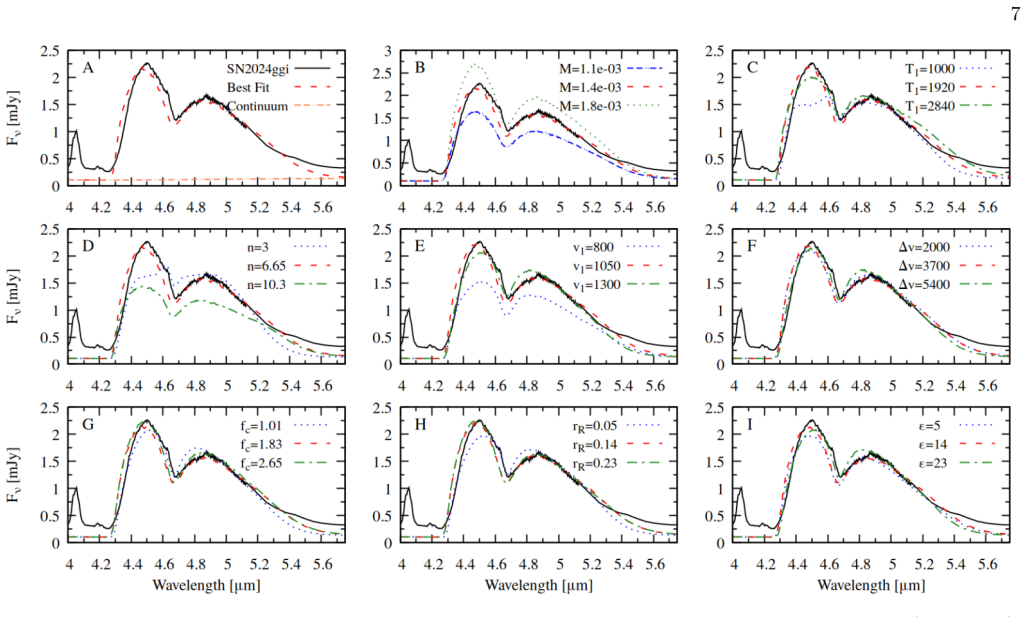
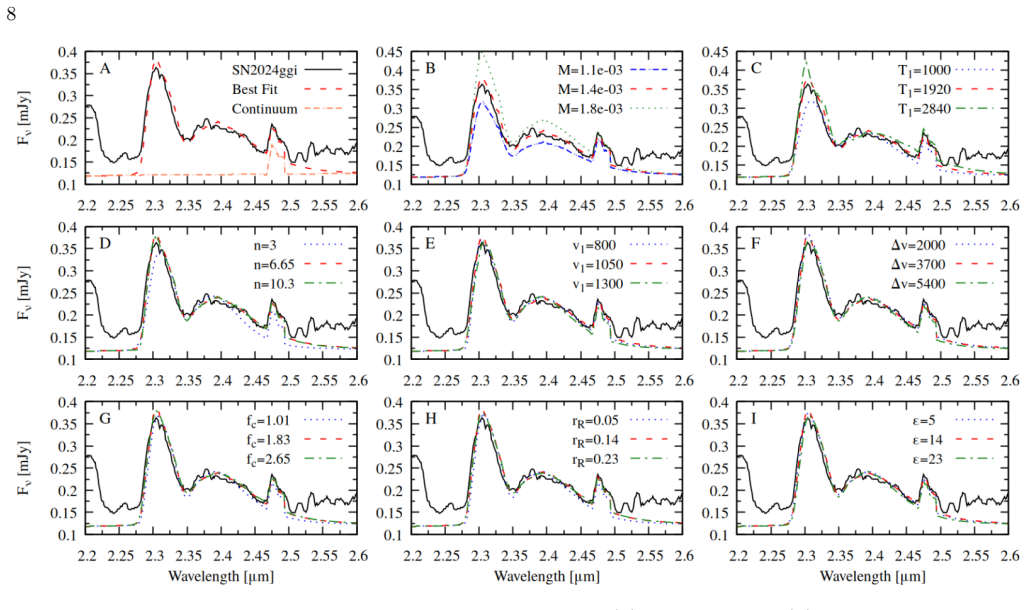
MOFAT employs time-independent radiative transfer simulations that include multidimensional, clump-like structures to fit observed CO and SiO features in supernova spectra. This enables reconstruction of overall abundances and temperatures while determining parameterized small-scale structures associated with physical instabilities. Applied to SN2024ggi, CO formation triggers SiO formation in the inner layers of the CO-rich region. The inner edge of the SiO-emitting region recedes from velocities of 1500 to 1000 km/s, the SiO mass decreases from about (2-6) x 10^-3 solar masses by roughly an order of magnitude, SiO features indicate clumping but most flux originates from optically thin areas
What carries the argument
MOFAT, a spectral fitting tool that compares observations to radiative transfer models containing parameterized multidimensional clump-like structures in order to constrain abundances, temperatures, and small-scale ejecta instabilities.
Load-bearing premise
Time-independent radiative transfer simulations that add multidimensional clump-like structures can accurately reproduce the observed flux ratios between molecular bands and recover the true physical parameters without large optical-depth biases.
What would settle it
An independent determination of molecular column densities and spatial scales in a supernova, for example through high-resolution interferometry or fully time-dependent hydrodynamic-plus-chemistry simulations, that yields band flux ratios or abundances inconsistent with any MOFAT fit using clump structures.
Figures






read the original abstract
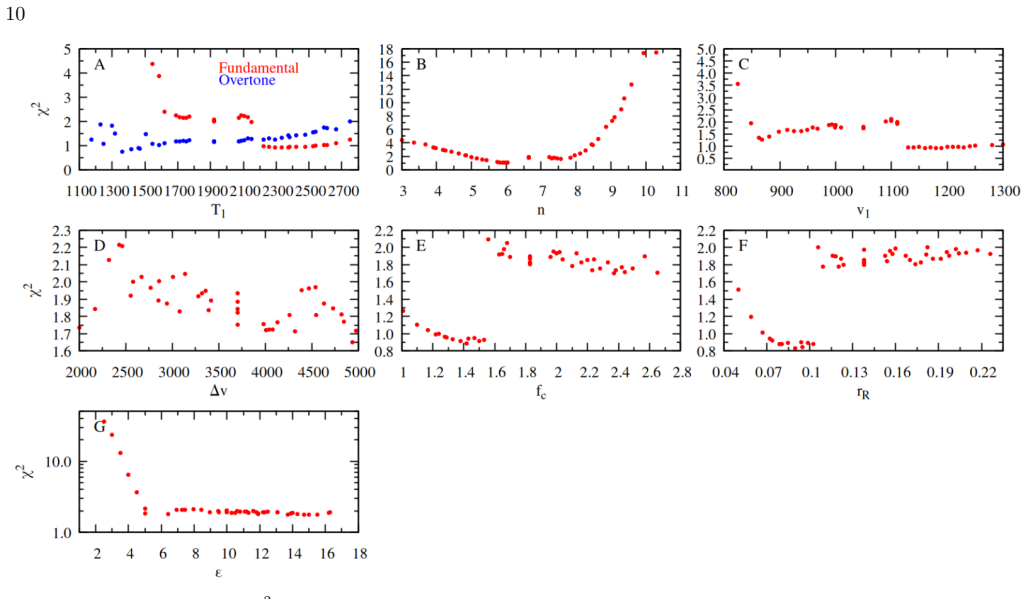
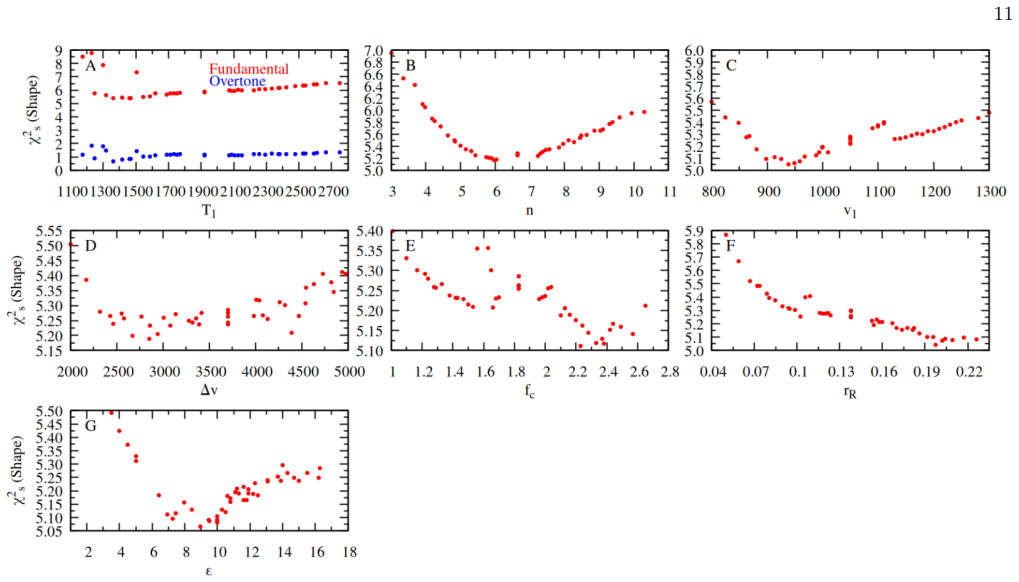
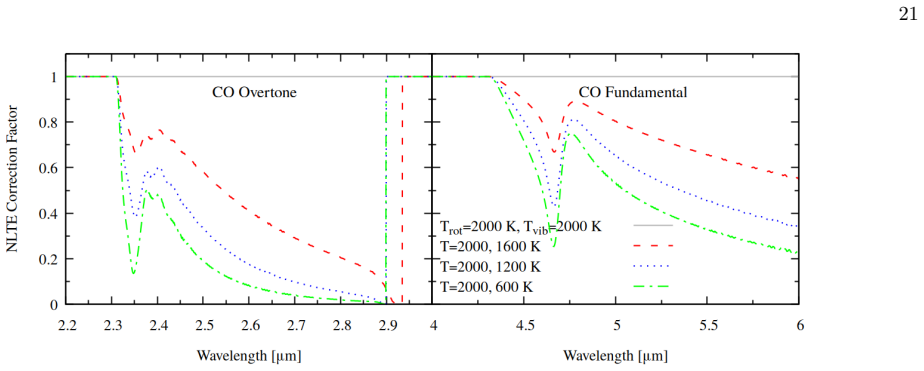
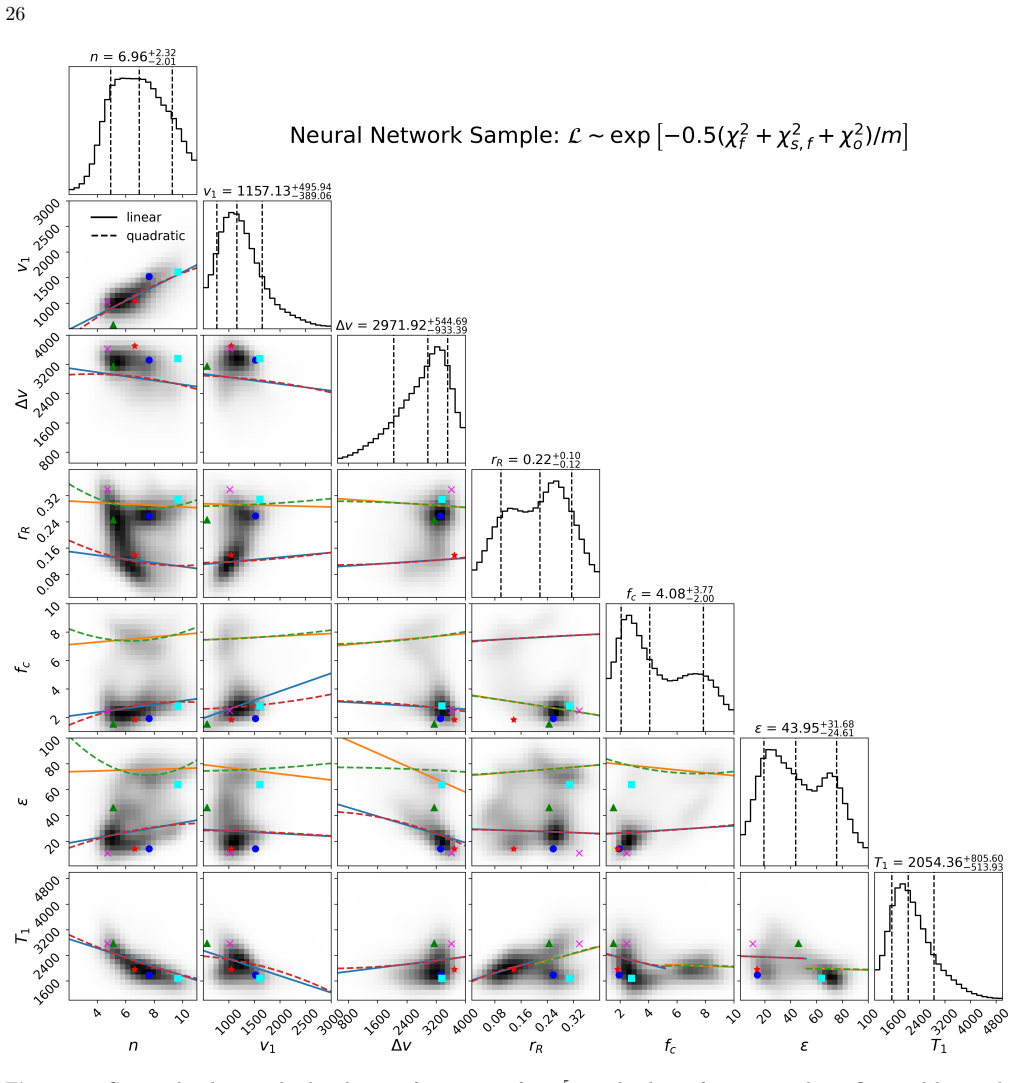
We present a new public-domain MOlecular Fitting Analysis Tool (MOFAT) designed to probe molecule-forming regions in supernovae (SNe) through analysis of molecular features in the near- and mid-infrared. MOFAT employs a novel data-driven approach to explore the physical properties of these regions using time-independent radiative transfer simulations that include multidimensional, clump-like structures, constrained by high-precision observations. Such structures are required to reproduce the flux ratio between fundamental and overtone bands, overcoming limitations of traditional one-zone forward-modeling, such as optical-depth effects and initial configurations. Our approach enables spectral fits that can reconstruct overall abundances and temperatures and determine parameterized small-scale structures associated with physical instabilities. We systematically study the relationship between physical parameters and the profiles of CO and SiO, showing that free parameters are constrained, while detection of small-scale structure requires optically thick bands. As a demonstration, MOFAT is applied to SN2024ggi at +285 and +385 days post-explosion. We find that CO formation triggers SiO formation in the inner layers of the CO-rich region previously studied. The inner edge of the SiO-emitting region recedes from velocities of v1 from 1500 to 1000 km/s, indicating continued SiO formation. The SiO mass decreases from about (2-6)E-3 Mo by roughly an order of magnitude, suggesting ongoing evaporation. SiO features indicate clumping, but most of the flux originates from optically thin regions. SiO contributes negligibly to cooling, and we find no evidence for dust formation. Finally, we discuss observational strategies to trace the evolution of molecule formation and its connection to dust formation.
Editorial analysis
A structured set of objections, weighed in public.
Referee Report
Summary. The manuscript introduces MOFAT, a public-domain tool for fitting near- and mid-IR spectra of supernovae that employs time-independent radiative transfer simulations incorporating multidimensional clump-like structures. It claims these structures are required to reproduce observed flux ratios between fundamental and overtone bands of CO and SiO, overcoming optical-depth limitations inherent to traditional one-zone models. The tool is applied to SN2024ggi at +285 and +385 days post-explosion, yielding results that CO formation triggers SiO in inner layers, the SiO-emitting region's inner edge recedes from 1500 to 1000 km/s, SiO mass decreases by an order of magnitude from (2-6)×10^{-3} M_⊙, SiO shows clumping but is mostly optically thin, SiO contributes negligibly to cooling, and there is no evidence for dust formation.
Significance. If the central claims hold, MOFAT would provide a new framework for constraining parameterized small-scale structures and molecular abundances in supernova ejecta via IR observations, with direct implications for linking molecule formation to dust production. The public release of the tool and its application to a recent, well-observed event like SN2024ggi represent concrete strengths that could enable reproducible follow-up studies.
major comments (3)
- [Abstract] Abstract: the assertion that multidimensional clump-like structures are required to reproduce the fundamental/overtone flux ratios (overcoming one-zone optical-depth effects) is not supported by any explicit comparison to flexible one-zone alternatives, such as models with radial temperature gradients, velocity-dependent excitation, or adjusted optical-depth scaling; without this, the necessity claim remains untested.
- [Abstract] Abstract and application section: the reported evolutionary changes in SiO mass, inner-edge velocity recession, and clumping are derived from fits in which clump structure parameters, abundances, and temperatures are simultaneously adjusted to match the same observed band ratios, creating a circularity risk that is not mitigated by independent constraints or synthetic recovery tests.
- [Abstract] Abstract: the time-independent radiative transfer assumption is adopted without discussion of how it might alias temporal evolution between the +285 d and +385 d epochs into the derived clump parameters or SiO recession; this is load-bearing for the evolutionary conclusions.
minor comments (1)
- [Abstract] The abstract refers to 'high-precision observations' and 'systematic study' of parameter relationships but does not identify the specific IR datasets, instruments, or reduction procedures used for SN2024ggi.
Simulated Author's Rebuttal
We thank the referee for their constructive and detailed comments, which have identified areas where the manuscript can be strengthened. We address each major comment point by point below, indicating the revisions we will implement.
read point-by-point responses
-
Referee: [Abstract] Abstract: the assertion that multidimensional clump-like structures are required to reproduce the fundamental/overtone flux ratios (overcoming one-zone optical-depth effects) is not supported by any explicit comparison to flexible one-zone alternatives, such as models with radial temperature gradients, velocity-dependent excitation, or adjusted optical-depth scaling; without this, the necessity claim remains untested.
Authors: We agree that the necessity claim in the abstract would be more robust with an explicit side-by-side comparison. The manuscript discusses the optical-depth limitations of standard one-zone models in the introduction and methods, but does not include a direct test against one-zone models incorporating radial gradients or velocity-dependent effects. We will add a dedicated comparison subsection (likely in the results or methods) that runs equivalent one-zone models with these flexibilities against the same SN2024ggi data to demonstrate that clump structures remain necessary to reproduce the observed band ratios. revision: yes
-
Referee: [Abstract] Abstract and application section: the reported evolutionary changes in SiO mass, inner-edge velocity recession, and clumping are derived from fits in which clump structure parameters, abundances, and temperatures are simultaneously adjusted to match the same observed band ratios, creating a circularity risk that is not mitigated by independent constraints or synthetic recovery tests.
Authors: The two epochs are fitted independently, and the multiple band ratios (fundamental and overtone for both CO and SiO) provide several independent constraints on the parameter space. However, we acknowledge the value of additional validation to address potential circularity. We will add synthetic recovery tests in a new subsection of the methods or results: mock spectra will be generated with known input parameters (including clump properties and SiO mass), noise-added to match the observations, and then recovered with MOFAT to quantify biases and demonstrate that the reported evolutionary trends are robust. revision: yes
-
Referee: [Abstract] Abstract: the time-independent radiative transfer assumption is adopted without discussion of how it might alias temporal evolution between the +285 d and +385 d epochs into the derived clump parameters or SiO recession; this is load-bearing for the evolutionary conclusions.
Authors: The time-independent radiative transfer is adopted because the dynamical timescale at these late epochs greatly exceeds the 100-day interval between observations, making the approximation reasonable for the spectral modeling. We agree, however, that the potential for aliasing should be explicitly discussed given its importance to the evolutionary claims. We will expand the methods section with a paragraph (and possibly a short appendix) that quantifies the approximation's validity, estimates possible biases on the SiO inner-edge recession and clump parameters, and notes how future time-dependent extensions could refine the results. revision: yes
Circularity Check
Fitted clump parameters and band-ratio matches presented as evidence that multidimensional structures are required, without shown necessity vs. one-zone alternatives
specific steps
-
fitted input called prediction
[Abstract]
"Such structures are required to reproduce the flux ratio between fundamental and overtone bands, overcoming limitations of traditional one-zone forward-modeling, such as optical-depth effects and initial configurations. Our approach enables spectral fits that can reconstruct overall abundances and temperatures and determine parameterized small-scale structures associated with physical instabilities. ... We find that CO formation triggers SiO formation in the inner layers of the CO-rich region previously studied. The inner edge of the SiO-emitting region recedes from velocities of v1 from 1500 "
The model is constructed with clump-like structures as free parameters; fitting them to match the observed fundamental/overtone ratios then yields the reported SiO masses, velocities, and clumping. The claim that the structures are 'required' follows directly from the success of this fit rather than from an independent test that no one-zone reparameterization can achieve equivalent ratios.
full rationale
The paper's core chain fits a time-independent RT model that already incorporates parameterized multidimensional clump-like structures to observed CO/SiO band ratios in SN2024ggi spectra. It then reports the resulting SiO masses, velocities, and clumping as physical findings while asserting that such structures are required to overcome one-zone optical-depth biases. This reduces the necessity claim to the modeling ansatz itself: the fit succeeds by construction when clumps are included, but no explicit comparison demonstrates that flexible one-zone reparameterizations (e.g., radial gradients or adjusted optical-depth scaling) cannot reproduce the same flux ratios within uncertainties. The specific results (inner-edge recession from 1500 to 1000 km/s, SiO mass drop by ~order of magnitude) are direct outputs of the same constrained fits rather than independent derivations. This produces moderate circularity confined to the justification step; the parameter-recovery procedure itself remains standard and self-contained once the model is adopted.
Axiom & Free-Parameter Ledger
free parameters (2)
- clump structure parameters
- abundances and temperatures
axioms (1)
- domain assumption Time-independent radiative transfer accurately describes late-time (+285 d, +385 d) molecular emission
Reference graph
Works this paper leans on
-
[1]
J., Indebetouw, R., Marcaide, J
Abell \'a n, F. J., Indebetouw, R., Marcaide, J. M., et al. 2017, title Very Deep inside the SN 1987A Core Ejecta : Molecular Structures Seen in 3D , , 842, L24, 10.3847/2041-8213/aa784c
-
[2]
Arnett, W. D., Bahcall, J. N., Kirshner, R. P., & Woosley, S. E. 1989, title Supernova 1987A ., , 27, 629, 10.1146/annurev.aa.27.090189.003213
-
[3]
D., Meakin, C., Viallet, M., et al
Arnett, W. D., Meakin, C., Viallet, M., et al. 2015, title Beyond Mixing-length Theory : A Step Toward 321D , , 809, 30, 10.1088/0004-637X/809/1/30
-
[4]
Banerjee, D. P. K., Joshi, V., Evans, A., et al. 2018, title Early Formation of Carbon Monoxide in the Centaurus A Supernova SN 2016adj, , 481, 806, 10.1093/mnras/sty2255
-
[5]
Baron, E., Ashall, C., DerKacy, J. M., et al. 2025, title JWST Observations of SN 2024ggi I : Interpretation and Model Comparison of the Type II Supernova 2024ggi at 55 Days Past Explosion , arXiv e-prints, arXiv:2507.18753, 10.48550/arXiv.2507.18753
-
[6]
1994, title Nickel Bubble Instability and Mixing in SN 1987A , , 425, 264, 10.1086/173983
Basko, M. 1994, title Nickel Bubble Instability and Mixing in SN 1987A , , 425, 264, 10.1086/173983
-
[7]
Bethe, H. A., & Wilson, J. R. 1985, title Revival of a Stalled Supernova Shock by Neutrino Heating, , 295, 14, 10.1086/163343
-
[8]
Stability of Standing Accretion Shocks, with an Eye toward Core-Collapse Supernovae
Blondin, J. M., Mezzacappa, A., & DeMarino, C. 2003, title Stability of Standing Accretion Shocks , with an Eye toward Core-Collapse Supernovae , , 584, 971, 10.1086/345812
-
[9]
Boccioli, L., Gogilashvili, M., Murphy, J., & O'Connor, E. P. 2025 a , title Quantifying the Impact of the Si / O Interface in CCSN Explosions Using the Force Explosion Condition , , 537, 1182, 10.1093/mnras/staf066
-
[10]
Boccioli, L., Roberti, L., Limongi, M., Mathews, G. J., & Chieffi, A. 2023, title Explosion Mechanism of Core-collapse Supernovae : Role of the Si / Si-O Interface , , 949, 17, 10.3847/1538-4357/acc06a
-
[11]
Boccioli, L., Vartanyan, D., O'Connor, E. P., & Kasen, D. 2025 b , title Neutrino Heating in 1D , 2D , and 3D Core-Collapse Supernovae: Characterizing the Explosion of High-Compactness Stars, , 540, 3885, 10.1093/mnras/staf963
-
[12]
Burrows, A., Radice, D., & Vartanyan, D. 2019, title Three-Dimensional Supernova Explosion Simulations of 9-, 10-, 11-, 12-, and 13- M \_ dot Stars, , 485, 3153, 10.1093/mnras/stz543
-
[13]
Burrows, A., Radice, D., Vartanyan, D., et al. 2020, title The Overarching Framework of Core-Collapse Supernova Explosions as Revealed by 3D FORNAX Simulations, , 491, 2715, 10.1093/mnras/stz3223
-
[14]
Burrows, A., Wang, T., & Vartanyan, D. 2024, title Physical Correlations and Predictions Emerging from Modern Core-collapse Supernova Theory , , 964, L16, 10.3847/2041-8213/ad319e
-
[15]
2009, title The Chemistry of Population III Supernova Ejecta
Cherchneff, I., & Dwek, E. 2009, title The Chemistry of Population III Supernova Ejecta . I . Formation of Molecules in the Early Universe , , 703, 642, 10.1088/0004-637X/703/1/642
-
[16]
Cherchneff, I., Talbi, D., & Cernicharo, J. 2025, title Revisiting the Formation of Molecules and Dust in Core Collapse Supernovae, arXiv e-prints, arXiv:2510.01079, 10.48550/arXiv.2510.01079
-
[17]
2013, ApJ, 764, 21, doi: 10.1088/0004-637X/764/1/21
Chieffi, A., & Limongi, M. 2013, title Pre-Supernova Evolution of Rotating Solar Metallicity Stars in the Mass Range 13-120 M \_ dot and Their Explosive Yields , , 764, 21, 10.1088/0004-637X/764/1/21
-
[18]
Constantine , P. G., Dow , E., & Wang , Q. 2014, title Active Subspace Methods in Theory and Practice: Applications to Kriging Surfaces , SIAM Journal on Scientific Computing, 36, A1500, 10.1137/130916138
-
[19]
Couch, S. M., Warren, M. L., & O'Connor, E. P. 2020, title Simulating Turbulence-aided Neutrino-driven Core-collapse Supernova Explosions in One Dimension , , 890, 127, 10.3847/1538-4357/ab609e
-
[20]
Couch, S. M., Wheeler, J. C., & Milosavljevi \'c , M. 2009, title Aspherical Core-Collapse Supernovae in Red Supergiants Powered by Nonrelativistic Jets , , 696, 953, 10.1088/0004-637X/696/1/953
-
[21]
2019, title PUSHing Core-collapse Supernovae to Explosions in Spherical Symmetry
Curtis, S., Ebinger, K., Fr \"o hlich, C., et al. 2019, title PUSHing Core-collapse Supernovae to Explosions in Spherical Symmetry . III . Nucleosynthesis Yields , , 870, 2, 10.3847/1538-4357/aae7d2
-
[22]
Das, R. K., Banerjee, D. P. K., & Ashok, N. M. 2009, title Detection and Evolution of the CO ( v = 2) Emission in Nova V2615 Ophiuchi (2007), Monthly Notices of the Royal Astronomical Society, 398, 375, 10.1111/j.1365-2966.2009.15141.x
-
[23]
Dessart, L., Hillier, D. J., & Wilk, K. D. 2018, title Impact of Clumping on Core-Collapse Supernova Radiation, p, 619, A30, 10.1051/0004-6361/201833278
-
[24]
Dessart, L., Kotak, R., Jacobson-Gal \'a n , W., et al. 2025, title An Optical-to-Infrared Study of Type II SN 2024ggi at Nebular Times, Astronomy and Astrophysics, 704, L6, 10.1051/0004-6361/202556304
-
[25]
Density estimation using Real NVP
Dinh , L., Sohl-Dickstein , J., & Bengio , S. 2016, title Density estimation using Real NVP , arXiv e-prints, arXiv:1605.08803, 10.48550/arXiv.1605.08803
work page internal anchor Pith review doi:10.48550/arxiv.1605.08803 2016
-
[26]
R., Milisavljevic, D., Parrent, J., et al
Drout, M. R., Milisavljevic, D., Parrent, J., et al. 2016, title The Double-peaked SN 2013ge: A Type Ib /c SN with an Asymmetric Mass Ejection or an Extended Progenitor Envelope , , 821, 57, 10.3847/0004-637X/821/1/57
-
[27]
Dwek, E., Galliano, F., & Jones, A. P. 2007, title The Evolution of Dust in the Early Universe with Applications to the Galaxy SDSS J1148 +5251, , 662, 927, 10.1086/518430
-
[28]
2020, title PUSHing Core-collapse Supernovae to Explosions in Spherical Symmetry
Ebinger, K., Curtis, S., Ghosh, S., et al. 2020, title PUSHing Core-collapse Supernovae to Explosions in Spherical Symmetry . IV . Explodability , Remnant Properties , and Nucleosynthesis Yields of Low-metallicity Stars , , 888, 91, 10.3847/1538-4357/ab5dcb
-
[29]
Ekstr \"o m, S., Meynet, G., Chiappini, C., Hirschi, R., & Maeder, A. 2008, title Effects of Rotation on the Evolution of Primordial Stars, p, 489, 685, 10.1051/0004-6361:200809633
-
[30]
E., Sukhbold, T., & Ugliano, M
Ertl, T., Janka, H.-T., Woosley, S. E., Sukhbold, T., & Ugliano, M. 2016, title A Two-parameter Criterion for Classifying the Explodability of Massive Stars by the Neutrino-driven Mechanism , , 818, 124, 10.3847/0004-637X/818/2/124
-
[31]
Farmer, R., Laplace, E., Ma, J.-z., de Mink , S. E., & Justham, S. 2023, title Nucleosynthesis of Binary-stripped Stars , , 948, 111, 10.3847/1538-4357/acc315
-
[32]
Fields, C. E., & Couch, S. M. 2021, title Three-Dimensional Hydrodynamic Simulations of Convective Nuclear Burning in Massive Stars Near Iron Core Collapse , , 921, 28, 10.3847/1538-4357/ac24fb
-
[33]
Foglizzo, T., Scheck, L., & Janka, H.-T. 2006, title Neutrino-Driven Convection versus Advection in Core-Collapse Supernovae , , 652, 1436, 10.1086/508443
-
[34]
2016, corner.py: Scatterplot matrices in Python, Zenodo, 10.5281/zenodo.45906
Foreman-Mackey, D. 2016, corner.py: Scatterplot matrices in Python, Zenodo, 10.5281/zenodo.45906
-
[35]
1991, title Instabilities and Clumping in SN 1987A
Fryxell, B., Mueller, E., & Arnett, D. 1991, title Instabilities and Clumping in SN 1987A . I . Early Evolution in Two Dimensions , , 367, 619, 10.1086/169657
-
[36]
Gamache, R. R., & Rothman, L. S. 1992, title Extension of the HITRAN Database to Non- LTE Applications, , 48, 519, 10.1016/0022-4073(92)90117-M
-
[37]
Gerardy, C. L., Fesen, R. A., H \"o flich, P., & Wheeler, J. C. 2000, title Detection of CO and Dust Emission in Near-Infrared Spectra of SN 1998S , The Astronomical Journal, 119, 2968, 10.1086/301390
-
[38]
Gerardy, C. L., Fesen, R. A., Nomoto, K., et al. 2002, title Carbon Monoxide in the Type Ic Supernova 2000ew*, Publications of the Astronomical Society of Japan, 54, 905, 10.1093/pasj/54.6.905
-
[39]
Hanke, F., Marek, A., M \"u ller, B., & Janka, H.-T. 2012, title Is Strong SASI Activity the Key to Successful Neutrino-driven Supernova Explosions ? , 755, 138, 10.1088/0004-637X/755/2/138
-
[40]
W., & Dachs, J
Hanuschik, R. W., & Dachs, J. 1988, title Absolute Fluxes for Supernova 1987A . I . The First 50 Days., Astronomy and Astrophysics, 205, 135
1988
-
[41]
Hartigan, J. A., & Wong, M. A. 1979, title Algorithm AS 136: A K-Means Clustering Algorithm, Journal of the Royal Statistical Society. Series C (Applied Statistics), 28, 100. http://www.jstor.org/stable/2346830
-
[42]
Heger, A., & Woosley, S. E. 2010, title Nucleosynthesis and Evolution of Massive Metal-free Stars , , 724, 341, 10.1088/0004-637X/724/1/341
-
[43]
Hirschi, R., Kaiser, E., Eggenberger, P., et al. 2024, title Stellar Structure and Evolution of Massive Rotating Single Stars , in IAU Symposium , Vol. 361, Massive Stars Near and Far , ed. J. Mackey, J. S. Vink, & N. St-Louis , 343, 10.1017/S1743921322003349
-
[44]
Hoeflich, P. 2017, title Explosion Physics of Thermonuclear Supernovae and Their Signatures , in Handbook of Supernovae , ed. A. W. Alsabti & P. Murdin (Berlin: Springer), 1151, 10.1007/978-3-319-21846-5_56
-
[45]
Hoeflich , P., Fereidouni , E., & Mera , T. B. 2024, title Type Ia supernovae in the age of JWST: Finding the 'right' questions and the path to answers , in Journal of Physics Conference Series, Vol. 2742, Journal of Physics Conference Series (IOP), 012024, 10.1088/1742-6596/2742/1/012024
-
[46]
Hoeflich, P., Ashall, C., Bose, S., et al. 2021, title Measuring an Off-center Detonation through Infrared Line Profiles : The Peculiar Type Ia Supernova SN 2020qxp/ ASASSN-20jq , , 922, 186, 10.3847/1538-4357/ac250d
-
[47]
Hoeflich, P., Yang, Y., Baade, D., et al. 2023, title The Core Normal Type Ia Supernova 2019np - An Overall Spherical Explosion with an Aspherical Surface Layer and an Aspherical 56 Ni Core , , 10.1093/mnras/stad172
-
[48]
Hoeflich , P., Fereidouni , E., Fisher , A., et al. 2025, title Numerical and Physical Challenges to Nebular Spectroscopy in Thermonuclear Supernovae , in Journal of Physics Conference Series, Vol. 2997, Journal of Physics Conference Series (IOP), 012017, 10.1088/1742-6596/2997/1/012017
-
[49]
H \"o flich, P. 1988, title Spectral Analysis of SN 1987A : The First 7 Months , Publications of the Astronomical Society of Australia, 7, 434, 10.1017/S1323358000022608
-
[50]
H \"o flich, P. 2009, title Multi-Dimensional Radiation Transport in Rapidly Expanding Envelopes , in American Institute of Physics Conference Series , Vol. 1171, Recent Directions in Astrophysical Quantitative Spectroscopy and Radiation Hydrodynamics , ed. I. Hubeny, J. M. Stone, K. MacGregor, & K. Werner, 161--172, 10.1063/1.3250057
-
[51]
H \"o flich, P., Gerardy, C. L., Fesen, R. A., & Sakai, S. 2002, title Infrared Spectra of the Subluminous Type Ia Supernova SN 1999by, , 568, 791, 10.1086/339063
-
[52]
2024, title Early Spectrum of SN 2024ggi from SCAT shows a Type II SN with Flash Ionized Features , Transient Name Server AstroNote, 103, 1
Hoogendam , W., Auchettl , K., Tucker , M., et al. 2024, title Early Spectrum of SN 2024ggi from SCAT shows a Type II SN with Flash Ionized Features , Transient Name Server AstroNote, 103, 1
2024
-
[53]
2014, Theory of Stellar Atmospheres
Hubeny, I., & Mihalas, D. 2014, Theory of Stellar Atmospheres
2014
-
[54]
Hummer, D. G., & Rybicki, G. B. 1971, title Radiative Transfer in Spherically Symmetric Systems. The Conservative Grey Case, , 152, 1, 10.1093/mnras/152.1.1
-
[55]
J., Valenti, S., Kotak, R., et al
Hunter, D. J., Valenti, S., Kotak, R., et al. 2009, title Extensive Optical and Near-Infrared Observations of the Nearby, Narrow-Lined Type Ic < ASTROBJ > SN 2007gr < / ASTROBJ > : Days 5 to 415, p, 508, 371, 10.1051/0004-6361/200912896
-
[56]
Janka, H. T. 2025, title Long- Term Multidimensional Models of Core-Collapse Supernovae : Progress and Challenges , arXiv e-prints, arXiv:2502.14836, 10.48550/arXiv.2502.14836
-
[57]
T., Langanke, K., Marek, A., Mart \'i nez-Pinedo , G., & M \"u ller, B
Janka, H. T., Langanke, K., Marek, A., Mart \'i nez-Pinedo , G., & M \"u ller, B. 2007, title Theory of Core-Collapse Supernovae, , 442, 38, 10.1016/j.physrep.2007.02.002
-
[58]
Janka, H.-T., Melson, T., & Summa, A. 2016, title Physics of Core-Collapse Supernovae in Three Dimensions : A Sneak Preview , Annual Review of Nuclear and Particle Science, 66, 341, 10.1146/annurev-nucl-102115-044747
-
[59]
Jerkstrand, A., Timmes, F. X., Magkotsios, G., et al. 2015, title Constraints on Explosive Silicon Burning in Core-collapse Supernovae from Measured Ni / Fe Ratios , , 807, 110, 10.1088/0004-637X/807/1/110
-
[60]
2023, Galaxies, 11, 75, doi: 10.3390/galaxies11030075 Kib´ edi, T., Alshahrani, B., Stuchbery, A
Joyce, M., & Tayar, J. 2023, title A Review of the Mixing Length Theory of Convection in 1D Stellar Modeling , Galaxies, 11, 75, 10.3390/galaxies11030075
-
[61]
Kellerer, A. M. 1984, title Chord- Length Distributions and Related Quantities for Spheroids , Radiation Research, 98, 425, 10.2307/3576477
-
[62]
Khokhlov, A. M., H \"o flich, P. A., Oran, E. S., et al. 1999, title Jet-Induced Explosions of Core Collapse Supernovae , , 524, L107, 10.1086/312305
-
[63]
2003, title Non-Spherical Core Collapse Supernovae
Kifonidis, K., Plewa, T., Janka, H.-T., & M \"u ller, E. 2003, title Non-Spherical Core Collapse Supernovae. I . Neutrino-driven Convection, Rayleigh-Taylor Instabilities, and the Formation and Propagation of Metal Clumps, p, 408, 621, 10.1051/0004-6361:20030863
-
[64]
Kotak, R., Meikle, P., van Dyk, S. D., H \"o flich, P. A., & Mattila, S. 2005, title Early- Time Spitzer Observations of the Type II Plateau Supernova SN 2004dj, The Astrophysical Journal, 628, L123, 10.1086/432719
-
[65]
Kotak, R., Meikle, W. P. S., Farrah, D., et al. 2009, title DUST AND THE TYPE II-PLATEAU SUPERNOVA 2004et, The Astrophysical Journal, 704, 306, 10.1088/0004-637X/704/1/306
-
[66]
Kumar, S., & Boccioli, L. 2024, title To Explode or Not Explode ? An Analysis of the Explodability of Binary and Single Stars , Research Notes of the American Astronomical Society, 8, 302, 10.3847/2515-5172/ad9baa
-
[67]
2012, ARA&A, 50, 107, doi: 10.1146/annurev-astro-081811-125534
Langer, N. 2012, title Presupernova Evolution of Massive Single and Binary Stars , , 50, 107, 10.1146/annurev-astro-081811-125534
-
[68]
2021, A&A, 656, A58, doi: 10.1051/0004-6361/202140506
Laplace, E., Justham, S., Renzo, M., et al. 2021, title Different to the Core: The Pre-Supernova Structures of Massive Single and Binary-Stripped Stars, p, 656, A58, 10.1051/0004-6361/202140506
-
[69]
Law, C. J., Milisavljevic, D., Patnaude, D. J., et al. 2020, title Three-Dimensional Kinematic Reconstruction of the Optically Emitting , High-velocity , Oxygen-rich Ejecta of Supernova Remnant N132D , , 894, 73, 10.3847/1538-4357/ab873a
-
[70]
Li, H., McCray, R., & Sunyaev, R. A. 1993, title Iron, Cobalt , and Nickel in SN 1987A , , 419, 824, 10.1086/173534
-
[71]
Liljegren, S., Jerkstrand, A., Barklem, P. S., et al. 2023, title The Molecular Chemistry of Type Ibc Supernovae and Diagnostic Potential with the James Webb Space Telescope , p, 674, A184, 10.1051/0004-6361/202243491
-
[72]
Liljegren, S., Jerkstrand, A., & Grumer, J. 2020, title Carbon Monoxide Formation and Cooling in Supernovae, p, 642, A135, 10.1051/0004-6361/202038116
-
[73]
2018, ApJS, 237, 13, doi: 10.3847/1538-4365/aacb24
Limongi, M., & Chieffi, A. 2018, title Presupernova Evolution and Explosive Nucleosynthesis of Rotating Massive Stars in the Metallicity Range -3 eq [ Fe / H ] eq 0, , 237, 13, 10.3847/1538-4365/aacb24
-
[74]
2020, title Hydrodynamical Modeling of the Light Curves of Core-collapse Supernovae with HYPERION
Limongi, M., & Chieffi, A. 2020, title Hydrodynamical Modeling of the Light Curves of Core-collapse Supernovae with HYPERION . I . The Mass Range 13-25 M \_ dot, the Metallicities -3 eq [ Fe / H ] eq 0, and the Case of SN 1999em, , 902, 95, 10.3847/1538-4357/abb4e8
-
[75]
Limongi, M., Roberti, L., Falla, A., Chieffi, A., & Nomoto, K. 2025, title The Chemical Yields of Stars in the Mass Range 9--15 M \_ dot, , 279, 41, 10.3847/1538-4365/addf34
-
[76]
1994, title Silicon Monoxide in SN 1987A , , 428, 769, 10.1086/174285
Liu, W., & Dalgarno, A. 1994, title Silicon Monoxide in SN 1987A , , 428, 769, 10.1086/174285
-
[77]
1992, title Carbon Monoxide in SN 1987A , , 396, 679, 10.1086/171749
Liu, W., Dalgarno, A., & Lepp, S. 1992, title Carbon Monoxide in SN 1987A , , 396, 679, 10.1086/171749
-
[78]
2009, Physics, Formation and Evolution of Rotating Stars (Springer), doi: 10.1007/978-3-540-76949-1
Maeder, A. 2009, Physics, Formation and Evolution of Rotating Stars , 10.1007/978-3-540-76949-1
-
[79]
2003, title Stellar Evolution with Rotation and Magnetic Fields
Maeder, A., & Meynet, G. 2003, title Stellar Evolution with Rotation and Magnetic Fields. I . The Relative Importance of Rotational and Magnetic Effects, p, 411, 543, 10.1051/0004-6361:20031491
-
[80]
2005, title Stellar Evolution with Rotation and Magnetic Fields
Maeder, A., & Meynet, G. 2005, title Stellar Evolution with Rotation and Magnetic Fields. III . The Interplay of Circulation and Dynamo, p, 440, 1041, 10.1051/0004-6361:20053261
discussion (0)
Sign in with ORCID, Apple, or X to comment. Anyone can read and Pith papers without signing in.