Recognition: unknown
Temporal Retention of Information as a Biosignature
Pith reviewed 2026-05-10 03:38 UTC · model grok-4.3
The pith
Long-lasting evolutions in Conway's Game of Life indicate temporal retention of information as a biosignature.
A machine-rendered reading of the paper's core claim, the machinery that carries it, and where it could break.
Core claim
By reversing the prior approach of extracting biosignatures from the Game of Life ruleset, the work starts from the known outlier of very long-lasting evolutions and identifies temporal retention of information as a general informational biosignature concept.
What carries the argument
Temporal retention of information, the capacity of a system to maintain and propagate informational states over extended time scales, observed through the persistent evolutions generated by the Conway's Game of Life ruleset.
If this is right
- Biosignature searches could examine other complex systems for patterns that remain active over long durations.
- Informational criteria alone could identify life-like behavior in computational or abstract rule-based domains.
- Rulesets producing sustained activity would be prioritized when screening for lifelike properties in cellular automata.
Where Pith is reading between the lines
- Similar persistence measures might distinguish living from non-living states in neural or ecological models.
- Quantitative tests could compare average evolution lengths across many different rulesets to isolate the effect.
- Links to biology could involve checking for temporal stability in genetic regulatory networks or population dynamics.
Load-bearing premise
The exceptionally long-lasting evolutions in Game of Life reflect a property tied to livingness rather than a neutral mathematical feature of the chosen rules.
What would settle it
Observing that many non-lifelike cellular automata rulesets generate evolutions of equal or greater duration would undermine the connection between long persistence and an informational biosignature.
Figures

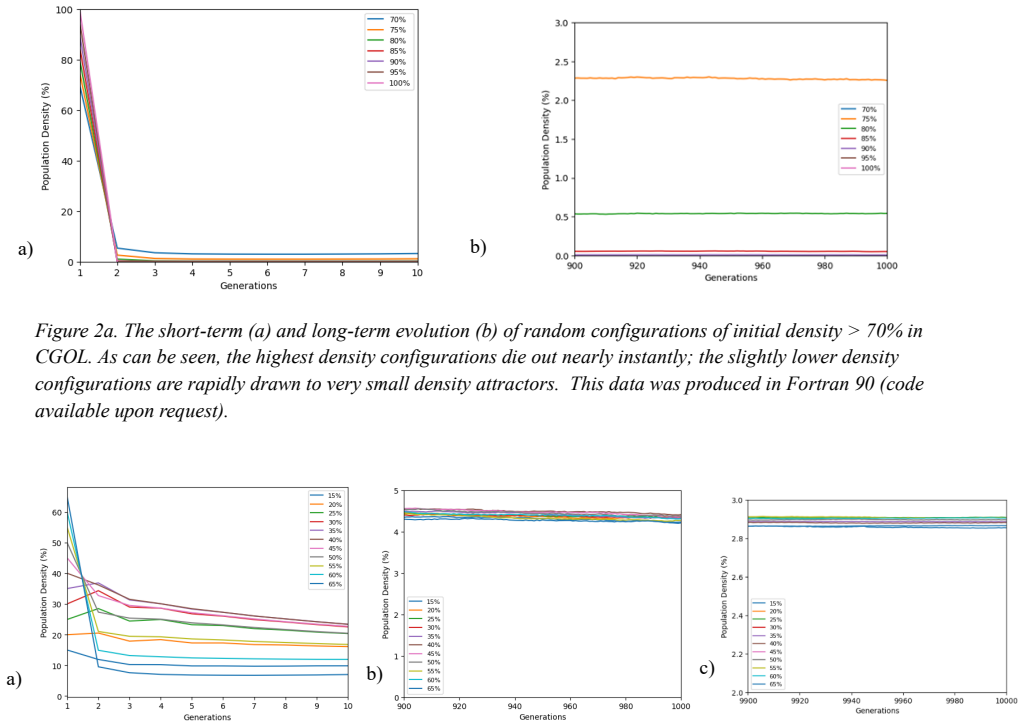
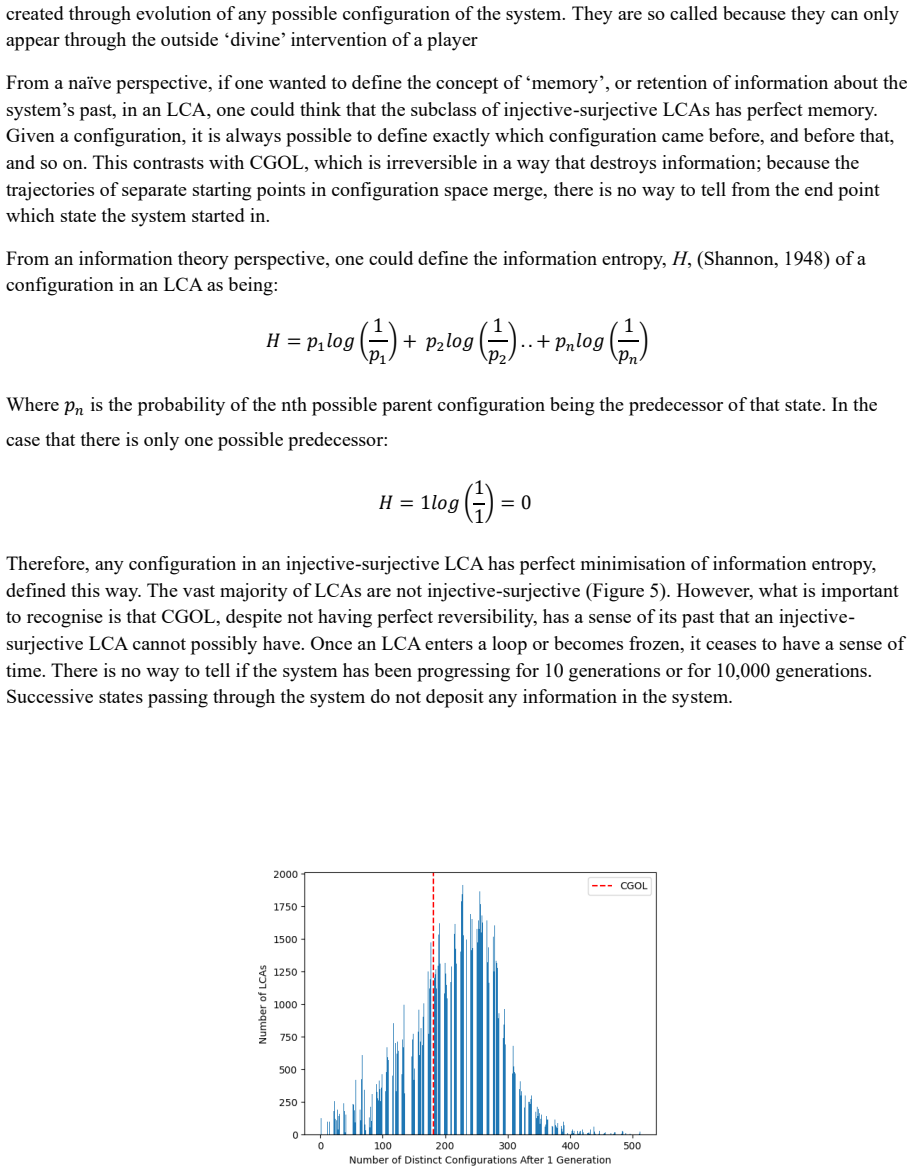
read the original abstract
Previous publications by the authors put forward the argument that Lifelike Cellular Automata can be treated as a bona fide example of livingness in and of themselves, not simply a toy analogue to biological life. Traits known to be indicative of biological life, biosignatures, were identified in informational form as particular outlier traits of the ruleset for the lifelike cellular automata known as Conways Game of Life. This publication reverses that logic, looking at a known outlier trait of Conways Game of Life, its very long-lasting evolutions, and using this to point towards temporal retention as an informational biosignature concept.
Editorial analysis
A structured set of objections, weighed in public.
Referee Report
Summary. The manuscript reverses the authors' prior argument that lifelike cellular automata (specifically Conway's Game of Life) exhibit livingness via outlier traits, instead treating the known longevity of certain GoL evolutions as direct evidence that 'temporal retention of information' constitutes an informational biosignature. The central claim is presented at a high conceptual level without formal definitions, metrics, or cross-system tests.
Significance. If the proposal were developed with a rigorous, falsifiable metric for temporal retention (e.g., mutual information across state trajectories or compressibility measures) and shown to be distinctive rather than rule-specific, it could contribute to discussions of biosignatures in artificial and informational systems. As written, however, the absence of any quantitative grounding or independent validation limits its immediate impact.
major comments (3)
- [Abstract] Abstract: The notion of 'temporal retention of information' is introduced solely by reference to 'very long-lasting evolutions' in GoL, yet no operational definition is supplied (e.g., via mutual information I(S_t; S_{t+k}) for lag k, Kolmogorov complexity of the space-time diagram, or any other information-theoretic quantity). Without this, the claim that longevity encodes retained information rather than being a neutral consequence of the deterministic rule cannot be evaluated.
- [Abstract] Abstract and introduction: The argument is explicitly constructed as a reversal of the authors' earlier publications on lifelike CA as bona fide livingness. This creates a circular dependency: the biosignature status of temporal retention is asserted to follow from the same outlier trait previously used to support livingness, without providing external grounding or comparison to other deterministic dynamical systems (e.g., other CA rulesets, logistic maps, or Turing machines) that would establish distinctiveness.
- [Abstract] The manuscript supplies neither a quantitative metric for retention nor any error analysis, data, or specific examples of how the trait would be measured or falsified. This renders the central claim an assertion rather than a demonstrated result, directly undermining the proposal that longevity qualifies as a biosignature.
Simulated Author's Rebuttal
We thank the referee for the constructive report and for identifying areas where the conceptual proposal requires greater formalization. We address each major comment below and commit to revisions that add operational clarity and comparative discussion without altering the manuscript's core reversal of our prior logic.
read point-by-point responses
-
Referee: [Abstract] Abstract: The notion of 'temporal retention of information' is introduced solely by reference to 'very long-lasting evolutions' in GoL, yet no operational definition is supplied (e.g., via mutual information I(S_t; S_{t+k}) for lag k, Kolmogorov complexity of the space-time diagram, or any other information-theoretic quantity). Without this, the claim that longevity encodes retained information rather than being a neutral consequence of the deterministic rule cannot be evaluated.
Authors: We agree that an explicit operational definition is needed to move beyond the conceptual framing. In the revised manuscript we will define temporal retention operationally as the sustained persistence of non-trivial, non-periodic structures across multiple time scales in the space-time diagram, and we will relate this to information-theoretic notions such as the decay rate of mutual information between states separated by large lag k. This will allow direct evaluation of whether longevity reflects retained information rather than a generic property of the rule. revision: yes
-
Referee: [Abstract] Abstract and introduction: The argument is explicitly constructed as a reversal of the authors' earlier publications on lifelike CA as bona fide livingness. This creates a circular dependency: the biosignature status of temporal retention is asserted to follow from the same outlier trait previously used to support livingness, without providing external grounding or comparison to other deterministic dynamical systems (e.g., other CA rulesets, logistic maps, or Turing machines) that would establish distinctiveness.
Authors: The reversal is intentional and does not create circularity: the prior work used the trait to argue for livingness within a specific ruleset, whereas the present work extracts the trait itself as a candidate biosignature that could apply more broadly. We nevertheless accept that external grounding is required. The revision will add a dedicated subsection comparing long-term pattern persistence in GoL to other elementary cellular automata, the logistic map at the edge of chaos, and simple Turing-machine simulations, thereby showing that the informational interpretation is not rule-specific. revision: yes
-
Referee: [Abstract] The manuscript supplies neither a quantitative metric for retention nor any error analysis, data, or specific examples of how the trait would be measured or falsified. This renders the central claim an assertion rather than a demonstrated result, directly undermining the proposal that longevity qualifies as a biosignature.
Authors: The current version is deliberately conceptual and therefore lacks quantitative metrics and falsification protocols. We will revise by supplying concrete GoL examples (e.g., the persistence statistics of methuselahs), proposing a simple retention metric based on the half-life of pattern complexity in the space-time diagram, and stating explicit falsification criteria (e.g., absence of retention when initial conditions are drawn from a maximum-entropy ensemble). Full error analysis and large-scale statistics will be noted as directions for follow-up work. revision: partial
Circularity Check
Biosignature claim constructed as reversal of authors' prior self-referential framework on CA livingness
specific steps
-
self citation load bearing
[Abstract]
"Previous publications by the authors put forward the argument that Lifelike Cellular Automata can be treated as a bona fide example of livingness in and of themselves, not simply a toy analogue to biological life. Traits known to be indicative of biological life, biosignatures, were identified in informational form as particular outlier traits of the ruleset for the lifelike cellular automata known as Conways Game of Life. This publication reverses that logic, looking at a known outlier trait of Conways Game of Life, its very long-lasting evolutions, and using this to point towards temporal re"
The new biosignature proposal is defined as the reversal of the authors' own prior claim that lifelike CA are livingness. The 'prediction' that long evolutions indicate temporal retention of information therefore inherits its status as a biosignature directly from the self-citation rather than from any independent derivation, metric, or external comparison shown in the text.
full rationale
The paper's central derivation explicitly reverses the authors' own previous publications that treat lifelike CA as bona fide livingness and identify biosignatures in their outlier traits. This reversal supplies the justification for elevating GoL longevity into a new 'temporal retention' biosignature concept. No independent formal definition (e.g., mutual information or trajectory compressibility), cross-CA comparison, or external falsifiable benchmark is supplied to ground the claim outside the self-citation chain. The load-bearing premise therefore reduces directly to the authors' prior unverified framework.
Axiom & Free-Parameter Ledger
axioms (1)
- domain assumption Lifelike Cellular Automata can be treated as a bona fide example of livingness in and of themselves
invented entities (1)
-
temporal retention of information
no independent evidence
Reference graph
Works this paper leans on
-
[1]
https://doi.org/10.3389/fphys.2012.00163 Benner, S.A. (2010). Defining life. Astrobiology, 10(10),1021-30. doi:10.1089/ast.2010.0524 Christensen, K. and Moloney, N.R. (2005). Complexity and Criticality. World Scientific Publishing Company. Cleland, C.E. (2007). Epistemological issues in the study of microbial life: alternative Terran biospheres? Stud Hist...
-
[2]
https://doi.org/10.3390/e12071733 Klincewicz, M., Cheng, T., Schmitz, M., Sebastián, M. Á., Snyder, J. S., Arnold, D. H., Baxter, M. G., Bekinschtein, T. A., Bengio, Y ., Bisley, J. W., Browning, J., Buonomano, D., Carmel, D., Carrasco, M., Carruthers, P., Carter, O., Chang, D. H. F., Charest, I., Cherkaoui, M., . . . Wheatley, T. (2025). What makes a the...
-
[3]
https://philsci-archive.pitt.edu/27105/ Khajehabdollahi, S., Prosi, J., Giannakakis, E., Martius, G., & Levina, A. (2022). When to be critical? performance and evolvability in different regimes of neural ising agents. Artificial Life, 28(4), 458–
2022
-
[4]
https://doi.org/10.1162/artl_a_00383 Kim, H., & Lee, U. (2019). Criticality as a determinant of integrated information Φ in human brain networks. Entropy, 21(10), 981. https://doi.org/10.3390/e21100981 Koonin, E.V . (2012). Defining Life: An Exercise in Semantics or A Route to Biological Insights? Journal of Biomolecular Structure and Dynamics, 29(4), pp....
- [5]
-
[6]
https://doi.org/10.1016/0004-6981(72)90076-5 Lwoff, A. (1957). The concept of virus. Microbiology, 17(2), 239–253. https://doi.org/10.1099/00221287-17-2- 239 Benoît Mandelbrot (1982). The fractal geometry of nature. New York: W.H. Freeman And Company. Matloff, G. L. (2016). Can panpsychism become an observational science? Journal of Consciousness Explorat...
-
[7]
https://doi.org/10.1162/netn_a_00269 Tononi, G. (2004). An information integration theory of consciousness. BMC Neuroscience, 5(1),
-
[8]
https://doi.org/10.1186/1471-2202-5-42 Trifonov, E. N. (2011). V ocabulary of definitions of life suggests a definition. Journal of Biomolecular Structure and Dynamics, 29(2), 259–266. https://doi.org/10.1080/073911011010524992 Uthamacumaran, A., Abrahão, F.S., Kiani, N.A. and Zenil, H. (2024). On the salient limitations of the methods of assembly theory ...
-
[9]
https://doi.org/10.1016/j.actaastro.2016.06.038 Vidal, C. (2020) Energy rate density as a technosignature: The case for stellivores, presentation at Life in the Universe: Big History, SETI and the Future of Humankind: IBHA & INAF-IASF MI Symposium 15–16 July 2019, [Online], http://www.clemvidal.com/s/Vidal-2020-ERD-as-a-technosignature-case-forstellivores...
discussion (0)
Sign in with ORCID, Apple, or X to comment. Anyone can read and Pith papers without signing in.