Recognition: unknown
Neutrally Evolving Interlocking Complexity in the Quandary Den
Pith reviewed 2026-05-10 03:11 UTC · model grok-4.3
The pith
A new artificial life model shows neutral evolution alone can generate interlocking complexity in protein complexes.
A machine-rendered reading of the paper's core claim, the machinery that carries it, and where it could break.
Core claim
The Quandary Den model reveals that neutral evolution can produce interlocking complexity through subfunctionalization, which diffuses functionality throughout the complex, and masking, which permits intracomplex genetic interference to accumulate while requiring that it be blocked at the expression level.
What carries the argument
The Quandary Den artificial life model organism, which tracks neutral mutational processes in simulated protein-like complexes to observe subfunctionalization and masking.
If this is right
- Subfunctionalization can spread functionality across protein complexes under purely neutral conditions.
- Masking allows genetic interference within complexes to accumulate and be resolved only at the expression level.
- Molecular complexity can increase without any corresponding increase in informational requirements.
- Neutral processes provide a sufficient explanation for some forms of interlocking complexity in molecular systems.
Where Pith is reading between the lines
- Biologists examining real protein complexes should test for neutral signatures rather than assuming every interlocking feature is adaptive.
- The model suggests similar neutral dynamics may apply to other genetic systems where components interact without obvious selective advantage.
- This opens the possibility of designing experiments that distinguish neutral interlocking complexity from adaptive forms in living cells.
Load-bearing premise
The Quandary Den model captures the essential dynamics of neutral evolution in real molecular biology systems well enough to support general conclusions about the origins of interlocking complexity.
What would settle it
Demonstrating that every observed interlocking protein complex in actual organisms requires specific adaptive mutations and shows no neutral subfunctionalization or masking signatures would falsify the central claim.
Figures


read the original abstract
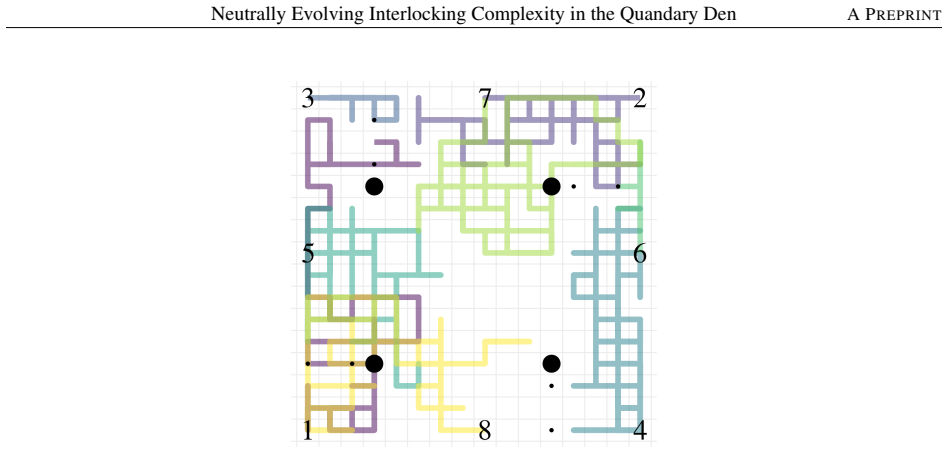
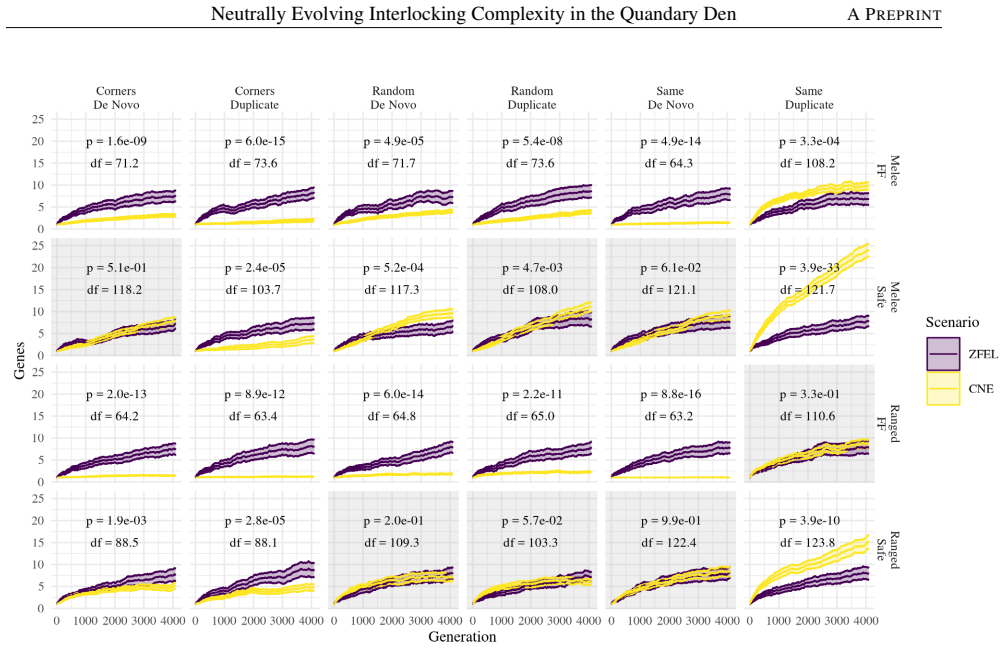
Molecular biology features numerous complexes of proteins that coordinate in an interlocking fashion to fulfill different functions. Adaptive evolution explains some of this complexity, but needn't be the default when neutral explanations suffice. A new artificial life model ``organism,'' the Quandary Den, is introduced to explore different neutral evolution scenarios where complexity increases in the absence of greater informational needs. Two interlocking complexity scenarios emerge. Subfunctionalization leads to functionality diffusing through the complex. Masking allows intracomplex interference to accumulate genetically, requiring that it be blocked at the level of expression.
Editorial analysis
A structured set of objections, weighed in public.
Referee Report
Summary. The manuscript introduces the Quandary Den artificial-life model to explore neutral evolution scenarios that produce interlocking complexity in protein complexes without any increase in informational requirements. It reports two emergent scenarios: subfunctionalization, in which functionality diffuses through the complex, and masking, in which intracomplex interference accumulates genetically but is blocked at the level of expression.
Significance. If the simulation results hold, the work supplies a controlled, parameter-free demonstration that neutral processes alone can generate interlocking molecular complexity. This strengthens neutral explanations in evolutionary biology and reduces the default reliance on adaptive accounts for such systems. The model-based isolation of neutral dynamics is a clear strength.
major comments (1)
- The central claim that the two scenarios arise without increased informational needs is load-bearing; the manuscript should explicitly show (in the model definition or results section) how informational content is quantified and remains constant across the reported runs.
minor comments (3)
- The abstract and introduction use the term 'interlocking complexity' without a concise operational definition; add one sentence early in the text to clarify the metric used.
- No comparison is drawn to existing artificial-life platforms (e.g., Avida or Tierra) that have examined neutral evolution; a brief related-work paragraph would help situate the Quandary Den.
- Figure captions and axis labels should be expanded to include the exact parameter settings and number of replicates so that the reported outcomes can be reproduced from the text alone.
Simulated Author's Rebuttal
We thank the referee for their supportive summary and recommendation of minor revision. The single major comment is addressed point-by-point below; we will incorporate the requested clarification in the revised manuscript.
read point-by-point responses
-
Referee: The central claim that the two scenarios arise without increased informational needs is load-bearing; the manuscript should explicitly show (in the model definition or results section) how informational content is quantified and remains constant across the reported runs.
Authors: We agree that explicit quantification strengthens the central claim. The Quandary Den model uses a fixed-length genome encoding a constant number of protein components and interaction rules; complexity emerges via neutral redistribution (subfunctionalization) or accumulation of masked deleterious interactions rather than addition of genetic material. In the revised manuscript we will add a dedicated paragraph to the Model section defining informational content as the total sequence length in bits (or equivalently the number of functional domains and regulatory sites), which is invariant by construction. We will also include a supplementary table or figure in the Results section confirming that this measure remains constant across all reported runs for both emergent scenarios. revision: yes
Circularity Check
No circularity: simulation outcomes independent of inputs
full rationale
The paper introduces the Quandary Den artificial-life model as a simulation framework to explore neutral evolution of interlocking complexity. The two scenarios (subfunctionalization with diffused functionality; masking with accumulated interference) are presented as emergent simulation results rather than as mathematical derivations, fitted parameters renamed as predictions, or self-referential definitions. No equations, parameter-fitting steps, uniqueness theorems, or self-citations appear in the provided text that would reduce the claims to their own inputs by construction. The argument is self-contained as a model-based exploration with no load-bearing circular steps.
Axiom & Free-Parameter Ledger
axioms (1)
- domain assumption Neutral evolution can lead to increased complexity without fitness benefits
invented entities (1)
-
Quandary Den
no independent evidence
Reference graph
Works this paper leans on
-
[1]
, title =
Krakauer, D. , title =. Complexity and the Arrow of Time , pages =
-
[2]
and Aziz, R
Akhter, S. and Aziz, R. K. and Kashef, M. T. and Ibrahim, E. S. and Bailey, B. and Edwards, R. A. , title =
-
[3]
Mitchell, Melanie , title =
-
[4]
, title =
Page, Scott E. , title =
-
[5]
Bedau, M. A. and Snyder, E. and Brown, C. T. and Packard, N. H. , title =. Proceedings of the Fourth European Conference on Artificial Life,
-
[6]
, title =
Taylor, T. , title =. Artificial Life 13: Proceedings of the Thirteenth International Conference on the Simulation and Synthesis of Living Systems , year =
-
[7]
Hintze, A. , title = ". Artificial Life , volume =. 2019 , month =. doi:10.1162/artl_a_00289 , url =
-
[8]
Lukeš, Julius and Archibald, John M. and Keeling, Patrick J. and Doolittle, W. Ford and Gray, Michael W. , title =. IUBMB Life , volume =. doi:https://doi.org/10.1002/iub.489 , url =. https://iubmb.onlinelibrary.wiley.com/doi/pdf/10.1002/iub.489 , abstract =
-
[9]
Philippe C. Després and Alexandre K. Dubé and Marie-Ève Picard and Jordan Grenier and Rong Shi and Christian R. Landry , title =. Science , volume =. 2024 , doi =. https://www.science.org/doi/pdf/10.1126/science.ado5719 , abstract =
-
[10]
, title =
Bedau, Mark A. , title =. Trends in Cognitive Sciences , volume =. 2003 , doi =
2003
-
[11]
Complexity, Artificial Life, and Artificial Intelligence , year=
Gershenson, Carlos , journal=. Complexity, Artificial Life, and Artificial Intelligence , year=. doi:10.1162/artl_a_00462 , ISSN=
-
[12]
Larry S. Yaeger , title =. HFSP Journal , volume =. 2009 , publisher =. doi:10.2976/1.3233712 , note =. https://doi.org/10.2976/1.3233712 , abstract =
-
[13]
Miconi, Thomas , title =. Artificial Life , volume =. 2008 , month =. doi:10.1162/artl.2008.14.3.14307 , url =
-
[14]
and Bernard, Samuel and Beslon, Guillaume and Bryson, David M
Lehman, Joel and Clune, Jeff and Misevic, Dusan and Adami, Christoph and Altenberg, Lee and Beaulieu, Julie and Bentley, Peter J. and Bernard, Samuel and Beslon, Guillaume and Bryson, David M. and Cheney, Nick and Chrabaszcz, Patryk and Cully, Antoine and Doncieux, Stephane and Dyer, Fred C. and Ellefsen, Kai Olav and Feldt, Robert and Fischer, Stephan an...
-
[15]
Scandinavian Journal of Immunology , volume =
Borowicz, Paweł and Chan, Hanna and Hauge, Anette and Spurkland, Anne , title =. Scandinavian Journal of Immunology , volume =. doi:https://doi.org/10.1111/sji.12951 , url =. https://onlinelibrary.wiley.com/doi/pdf/10.1111/sji.12951 , abstract =
-
[16]
Gray and Julius Lukeš and John M
Michael W. Gray and Julius Lukeš and John M. Archibald and Patrick J. Keeling and W. Ford Doolittle , title =. Science , volume =. 2010 , doi =. https://www.science.org/doi/pdf/10.1126/science.1198594 , abstract =
-
[17]
Cebecauer, Marek and Spitaler, Martin and Sergé, Arnauld and Magee, Anthony I. , title =. Journal of Cell Science , volume =. 2010 , month =. doi:10.1242/jcs.061739 , url =
-
[18]
Houtman, Jon C. D. and Barda-Saad, Mira and Samelson, Lawrence E. , title =. The FEBS Journal , volume =. doi:https://doi.org/10.1111/j.1742-4658.2005.04972.x , url =. https://febs.onlinelibrary.wiley.com/doi/pdf/10.1111/j.1742-4658.2005.04972.x , abstract =
-
[19]
Pillai, Arvind S. and Chandler, Shane A. and Liu, Yang and Signore, Anthony V. and Cortez-Romero, Carlos R. and Benesch, Justin L. P. and Laganowsky, Arthur and Storz, Jay F. and Hochberg, Georg K. A. and Thornton, Joseph W. , title =. Nature , year =. doi:https://doi.org/10.1038/s41586-020-2292-y , abstract =
-
[20]
Hochberg, Georg K. A. and Liu, Yang and Marklund, Erik G. and Metzger, Brian P. H. and Laganowsky, Arthur and Thornton, Joseph W. , title =. Nature , year =
-
[21]
Muller, Hermann J , title =. Genetics , volume =. 1918 , month =. doi:10.1093/genetics/3.5.422 , url =
-
[22]
Stoltzfus, Arlin , title =. Biology Direct , year =. doi:https://doi.org/10.1186/1745-6150-7-35 , url =
-
[23]
, title =
Lee, Stan and Kirby, Jack and Reinman, Paul and Rosen, S. , title =
-
[24]
McShea, Daniel W. and Wang, Steve C. and Brandon, Robert N. , title =. Evolution , volume =. 2019 , month =. doi:10.1111/evo.13735 , url =
-
[25]
Proceedings of the National Academy of Sciences , volume =
Michael Lynch , title =. Proceedings of the National Academy of Sciences , volume =. 2013 , doi =. https://www.pnas.org/doi/pdf/10.1073/pnas.1310980110 , abstract =
-
[26]
Journal of Molecular Evolution , year =
Stoltzfus, Arlin , title =. Journal of Molecular Evolution , year =
-
[27]
and Bilolikar, Gaurav and Wideman, Jeremy G
Muñoz-Gómez, Sergio A. and Bilolikar, Gaurav and Wideman, Jeremy G. and Geiler-Samerotte, Kerry , title =. Journal of Molecular Evolution , year =
-
[28]
Artificial life , pages=
Artificial life , author=. Artificial life , pages=. 2019 , publisher=
2019
-
[29]
Exact and randomization distributions of Kolmogorov-Smirnov tests two or three samples , journal =
Gunar Schröer and Dietrich Trenkler , keywords =. Exact and randomization distributions of Kolmogorov-Smirnov tests two or three samples , journal =. 1995 , issn =. doi:https://doi.org/10.1016/0167-9473(94)00040-P , url =
-
[30]
doi:10.5281/zenodo.19545727 , url =
Walsh, Andrew , title =. doi:10.5281/zenodo.19545727 , url =
-
[31]
2024 , url =
R: A Language and Environment for Statistical Computing , author =. 2024 , url =
2024
-
[32]
2025 , note =
V8: Embedded JavaScript and WebAssembly Engine for R , author =. 2025 , note =
2025
-
[33]
Welcome to the
Hadley Wickham and Mara Averick and Jennifer Bryan and Winston Chang and Lucy D'Agostino McGowan and Romain François and Garrett Grolemund and Alex Hayes and Lionel Henry and Jim Hester and Max Kuhn and Thomas Lin Pedersen and Evan Miller and Stephan Milton Bache and Kirill Müller and Jeroen Ooms and David Robinson and Dana Paige Seidel and Vitalie Spinu ...
-
[34]
2016 , isbn =
Hadley Wickham , title =. 2016 , isbn =
2016
discussion (0)
Sign in with ORCID, Apple, or X to comment. Anyone can read and Pith papers without signing in.