Recognition: unknown
Molecular Clouds at the Edge of the Galaxy II. Physical properties and scaling relations
Pith reviewed 2026-05-10 04:30 UTC · model grok-4.3
The pith
Molecular clumps at the Galaxy's edge follow inner-disk turbulence scaling but show virial parameters declining exponentially with radius.
A machine-rendered reading of the paper's core claim, the machinery that carries it, and where it could break.
Core claim
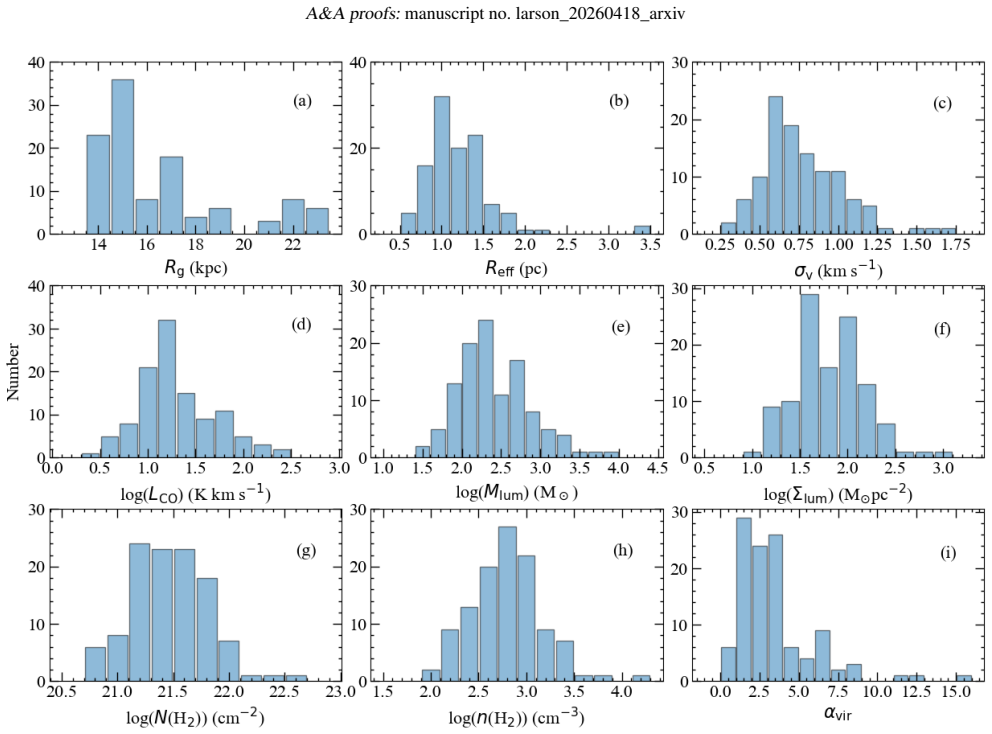
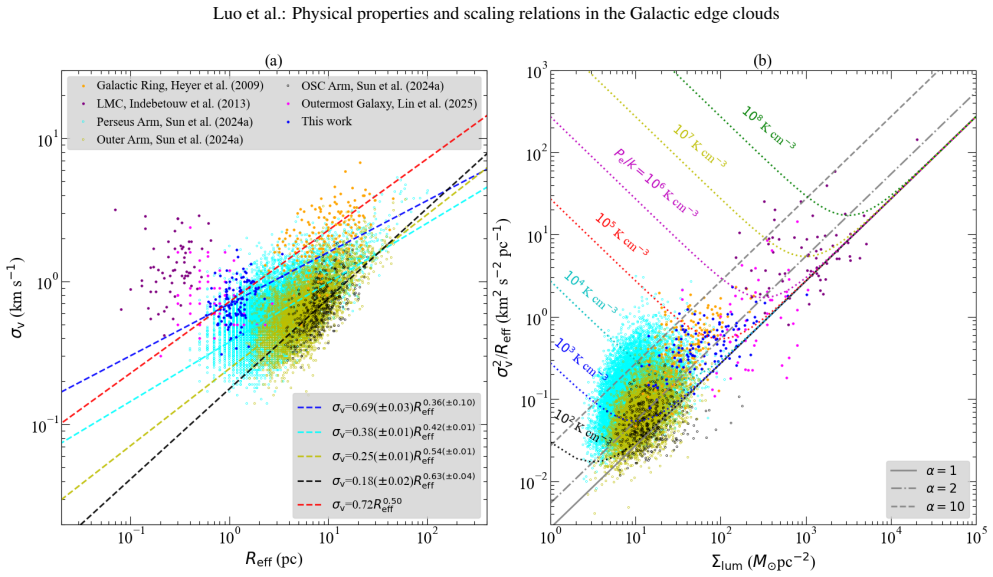
The velocity dispersion-size relationship is modeled as σ_v = 0.69(±0.03) R_eff^{0.36(±0.10)}; the luminous mass-size relation is M_lum = 196(±17) R_eff^{2.18(±0.26)}; virial parameters range 0.6-15.3 (median 2.8±0.6) and follow α_vir = 33.0(±10.4) e^{-R_g/6.7(±0.9)} with no systematic variation in other parameters over 14-23 kpc.
What carries the argument
The power-law scaling relations for velocity dispersion versus size and luminous mass versus size, plus the exponential fit of virial parameter versus Galactocentric radius, all derived from CO(2-1) line data on 112 clumps.
If this is right
- Turbulence is present within the Galactic edge clumps akin to inner Galactic disk clouds.
- The average column density remains almost constant for clouds of different sizes.
- Most clumps are gravitationally unbound.
- The virial parameters decrease with increasing Galactocentric distances.
Where Pith is reading between the lines
- The outward decline in virial parameters may point to lower average star-formation efficiency at larger radii.
- If the conversion factor changes with radius, the mass and binding estimates would require recalibration.
- These outer clumps could serve as local templates for molecular gas in low-metallicity environments at high redshift.
Load-bearing premise
Derivation of luminous masses and virial parameters assumes a constant CO-to-H2 conversion factor and accurate kinematic distances to convert observed intensities and angular sizes into physical quantities.
What would settle it
Independent measurements showing that the CO-to-H2 conversion factor or kinematic distances vary systematically with Galactocentric radius in the 14-23 kpc range would shift the reported scaling relations and virial trend.
Figures




read the original abstract
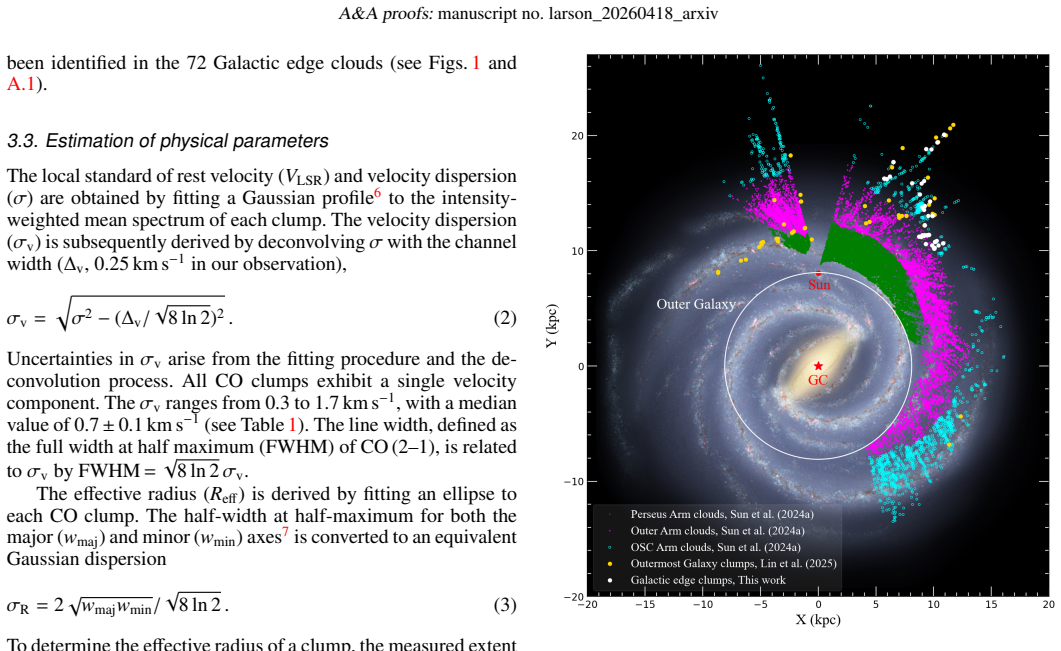
The outer Galaxy presents an optimal setting for investigating molecular clouds and star formation in environments with low metallicity. A total of 72 Galactic edge clouds were surveyed using the CO\,(2--1) line with the IRAM\,30\,m telescope, leading to the identification of 112 CO clumps within molecular clouds with linear resolutions of 0.5--0.9\,pc. Parameters such as size, mass, surface density, and velocity dispersion of these CO clumps, derived from CO\,(2--1) observations, exhibit ranges of 0.6--3.4\,pc, 34--8250\,M$_\odot$, 12--1025\,M$_{\odot}$\,pc$^{-2}$, and 0.3--1.7\,km\,s$^{-1}$, respectively. Over the Galactocentric distance range of 14--23\,kpc, no systematic variations are found in these parameters. The velocity dispersion-size relationship of the Galactic edge clumps is modeled as $\sigma_{\rm v}$\,=\,0.69($\pm$0.03)$R_{\rm eff}^{0.36(\pm0.10)}$, indicating that turbulence is present within the Galactic edge clumps, akin to observations in the inner Galactic disk clouds. Furthermore, the luminous mass-size relation of the Galactic edge clumps is described by $M_{\rm lum}$\,=\,196($\pm$17)$R_{\rm eff}^{\,2.18\,(\pm0.26)}$, suggesting the average column density remains almost constant for clouds of different sizes. The virial parameters range from 0.6 to 15.3, with a median value of 2.8\,$\pm$\,0.6, suggesting that most clumps are gravitationally unbound. Furthermore, the virial parameters of our Galactic edge clumps show a decreasing trend with increasing Galactocentric distances, described by an exponential relation $\alpha_{\rm vir}$\,=\,33.0($\pm$\,10.4)\,e$^{-R_{\rm g}/6.7(\pm0.9)}$, consistent with previous results.
Editorial analysis
A structured set of objections, weighed in public.
Referee Report
Summary. The paper reports CO(2-1) observations of 72 molecular clouds at the Galactic edge (R_g = 14-23 kpc) with the IRAM 30 m telescope, identifying 112 clumps at 0.5-0.9 pc resolution. It gives observed ranges for clump size (0.6-3.4 pc), luminous mass (34-8250 M_⊙), surface density (12-1025 M_⊙ pc^{-2}), and velocity dispersion (0.3-1.7 km s^{-1}), finds no systematic radial trends in these quantities, and presents power-law fits σ_v = 0.69(±0.03) R_eff^{0.36(±0.10)} and M_lum = 196(±17) R_eff^{2.18(±0.26)}. Virial parameters range 0.6-15.3 (median 2.8±0.6) and follow the exponential α_vir = 33.0(±10.4) exp(-R_g/6.7(±0.9)).
Significance. If the central results hold, the work supplies new empirical constraints on molecular-cloud properties in a low-metallicity outer-Galaxy environment, demonstrating that turbulence scaling and roughly constant column density persist while the fraction of bound clumps appears to increase with radius. The direct observational basis for the reported power-law indices and the α_vir trend constitutes a clear strength.
major comments (2)
- [Methods and § on virial parameters] The luminous-mass and virial-parameter calculations adopt a fixed Galactic X_CO (methods section). Because outer-Galaxy metallicity declines with R_g, the true X_CO is expected to rise; a constant X_CO therefore underestimates M_lum progressively at larger R_g and inflates α_vir, working against the claimed exponential decline. A quantitative test with a radially varying X_CO (or at minimum an explicit statement of the adopted value and its uncertainty) is required to establish that the α_vir-R_g relation is robust.
- [Distance determination and results on radial trends] Kinematic distances enter R_g, R_eff, and M_lum (M_lum ∝ d²). The manuscript does not quantify the impact of non-circular motions or rotation-curve uncertainties on the derived radial trends; coherent distance errors could introduce or mask the reported α_vir decline and the statement of “no systematic variations” in raw parameters.
minor comments (2)
- [Abstract] The abstract states the exponential fit for α_vir but does not indicate whether the fit accounts for measurement uncertainties in both α_vir and R_g or whether the quoted uncertainties are formal or bootstrap-derived.
- [Methods] Clump-finding algorithm and any optical-depth or excitation corrections applied to the CO(2-1) intensities should be stated explicitly in the methods so that the reported parameter ranges can be reproduced.
Simulated Author's Rebuttal
We thank the referee for the positive evaluation and constructive comments, which have helped us improve the manuscript. We address each major point below and have made revisions to enhance the robustness of our analysis on the X_CO factor and distance uncertainties.
read point-by-point responses
-
Referee: [Methods and § on virial parameters] The luminous-mass and virial-parameter calculations adopt a fixed Galactic X_CO (methods section). Because outer-Galaxy metallicity declines with R_g, the true X_CO is expected to rise; a constant X_CO therefore underestimates M_lum progressively at larger R_g and inflates α_vir, working against the claimed exponential decline. A quantitative test with a radially varying X_CO (or at minimum an explicit statement of the adopted value and its uncertainty) is required to establish that the α_vir-R_g relation is robust.
Authors: We agree that the X_CO choice merits explicit attention given the metallicity gradient. The manuscript adopts the standard Galactic X_CO = 2.0 × 10^{20} cm^{-2} (K km s^{-1})^{-1} throughout, as stated in the methods. To quantify the effect, we have added a sensitivity test in the revised version assuming X_CO increases linearly with R_g (following the observed metallicity decline of ~0.05 dex kpc^{-1}). Under this assumption the α_vir decline becomes steeper (exponent ~ -R_g/5.8), confirming that the reported trend is conservative and robust. We also now explicitly state the adopted X_CO value and its typical 30-50% uncertainty in the outer Galaxy. revision: yes
-
Referee: [Distance determination and results on radial trends] Kinematic distances enter R_g, R_eff, and M_lum (M_lum ∝ d²). The manuscript does not quantify the impact of non-circular motions or rotation-curve uncertainties on the derived radial trends; coherent distance errors could introduce or mask the reported α_vir decline and the statement of “no systematic variations” in raw parameters.
Authors: We appreciate the emphasis on distance uncertainties. Kinematic distances were derived from the standard Galactic rotation curve (as referenced in the methods). While a full Monte-Carlo propagation of non-circular motions and rotation-curve variants is beyond the scope of this observational paper, random distance errors would primarily scatter the data points rather than produce the observed systematic α_vir decline. In the revision we add a new paragraph in the discussion section that (i) cites outer-Galaxy kinematic studies showing typical distance uncertainties of ~15-25%, (ii) notes that the lack of trends in raw parameters (size, mass, σ_v) persists even when distances are perturbed within these bounds, and (iii) argues that any coherent bias would have to be finely tuned across the 14-23 kpc range to mimic the exponential α_vir trend. This addition clarifies the robustness without altering the conclusions. revision: partial
Circularity Check
No significant circularity; all relations are direct empirical fits to new data
full rationale
The paper derives its scaling relations by fitting functional forms directly to the measured parameters (size, velocity dispersion, luminous mass, virial parameter) of the 112 CO clumps identified in the new CO(2-1) observations. The quoted relations σ_v = 0.69(±0.03) R_eff^{0.36(±0.10)}, M_lum = 196(±17) R_eff^{2.18(±0.26)}, and α_vir = 33.0(±10.4) e^{-R_g/6.7(±0.9)} are obtained by standard least-squares fitting to the observed points over 14-23 kpc; none reduces by the paper's own equations to a previously fitted input or self-citation. Virial parameters are computed from the standard formula using observed σ_v, R_eff, and M_lum (with fixed X_CO and kinematic distances stated as assumptions), then fitted separately. No self-citation is invoked to justify uniqueness, ansatz, or load-bearing premises. The derivation chain is therefore self-contained and non-circular.
Axiom & Free-Parameter Ledger
free parameters (1)
- CO-to-H2 conversion factor (X_CO)
axioms (3)
- domain assumption CO(2-1) emission reliably traces total molecular gas mass via a fixed conversion factor
- domain assumption Kinematic distances derived from galactic rotation curve accurately place the clouds at 14-23 kpc
- domain assumption Virial parameter calculation assumes approximate equilibrium between kinetic and gravitational energy
Reference graph
Works this paper leans on
-
[1]
A., Ackermann , M., Ajello , M., et al
Abdo , A. A., Ackermann , M., Ajello , M., et al. 2010, , 710, 133
2010
-
[2]
Amor \' n , R., Mu \ n oz-Tu \ n \'o n , C., Aguerri , J. A. L., & Planesas , P. 2016, , 588, A23
2016
-
[3]
D., Armentrout , W
Anderson , L. D., Armentrout , W. P., Johnstone , B. M., et al. 2015, , 221, 26
2015
-
[4]
1996, , 48, 275
Arimoto , N., Sofue , Y., & Tsujimoto , T. 1996, , 48, 275
1996
-
[5]
P., Anderson , L
Armentrout , W. P., Anderson , L. D., Balser , D. S., et al. 2017, , 841, 121
2017
-
[6]
2020, , 216, 76
Ballesteros-Paredes , J., Andr \'e , P., Hennebelle , P., et al. 2020, , 216, 76
2020
-
[7]
Ballesteros-Paredes , J., Rom \'a n-Z \'u \ n iga , C., Salom \'e , Q., Zamora-Avil \'e s , M., & Jim \'e nez-Donaire , M. J. 2019, , 490, 2648
2019
-
[8]
T., Henshaw , J
Barnes , A. T., Henshaw , J. D., Fontani , F., et al. 2021, , 503, 4601
2021
-
[9]
Bergin , E. A. & Tafalla , M. 2007, , 45, 339
2007
-
[10]
& McKee , C
Bertoldi , F. & McKee , C. F. 1992, , 395, 140
1992
-
[11]
1993, in Protostars and Planets III, ed
Blitz , L. 1993, in Protostars and Planets III, ed. E. H. Levy & J. I. Lunine , 125
1993
-
[12]
D., Wolfire , M., & Leroy , A
Bolatto , A. D., Wolfire , M., & Leroy , A. K. 2013, , 51, 207
2013
-
[13]
2023, , 676, A27
Braine , J., Sun , Y., Shimajiri , Y., et al. 2023, , 676, A27
2023
-
[14]
& Wouterloot , J
Brand , J. & Wouterloot , J. G. A. 1995, , 303, 851
1995
-
[15]
Brand , J., Wouterloot , J. G. A., Rudolph , A. L., & de Geus , E. J. 2001, , 377, 644
2001
-
[16]
2012, , 758, L28
Bressert , E., Ginsburg , A., Bally , J., et al. 2012, , 758, L28
2012
-
[17]
& Myers , P
Caselli , P. & Myers , P. C. 1995, , 446, 665
1995
-
[18]
Q., Liu , X
Chen , B. Q., Liu , X. W., Yuan , H. B., Huang , Y., & Xiang , M. S. 2015, , 448, 2187
2015
-
[19]
C., Andersen , M., et al
Cheng , Y., Tan , J. C., Andersen , M., et al. 2025, , 990, 173
2025
-
[20]
2014, , 784, 3
Colombo , D., Hughes , A., Schinnerer , E., et al. 2014, , 784, 3
2014
-
[21]
Dame , T. M. & Thaddeus , P. 2011, , 734, L24
2011
-
[22]
J., Vogel , S
de Geus , E. J., Vogel , S. N., Digel , S. W., & Gruendl , R. A. 1993, , 413, L97
1993
-
[23]
2025, , 538, 2445
Deng , Y., Li , Z., Li , Z., et al. 2025, , 538, 2445
2025
-
[24]
1994, , 422, 92
Digel , S., de Geus , E., & Thaddeus , P. 1994, , 422, 92
1994
-
[25]
2016, , 224, 7
Du , X., Xu , Y., Yang , J., et al. 2016, , 224, 7
2016
-
[26]
M., Lada , C
Faesi , C. M., Lada , C. J., & Forbrich , J. 2018, , 857, 19
2018
-
[27]
2024, Research in Astronomy and Astrophysics, 24, 115018
Feng , H., Chen , Z., Jiang , Z., et al. 2024, Research in Astronomy and Astrophysics, 24, 115018
2024
-
[28]
& Blitz , L
Fich , M. & Blitz , L. 1984, , 279, 125
1984
-
[29]
B., Blackman , E
Field , G. B., Blackman , E. G., & Keto , E. R. 2011, , 416, 710
2011
-
[30]
K., Indebetouw , R., Johnson , K
Finn , M. K., Indebetouw , R., Johnson , K. E., et al. 2022, , 164, 64
2022
-
[31]
K., Indebetouw , R., Johnson , K
Finn , M. K., Indebetouw , R., Johnson , K. E., et al. 2021, , 917, 106
2021
-
[32]
K., Johnson , K
Finn , M. K., Johnson , K. E., Indebetouw , R., et al. 2024, , 964, 12
2024
-
[33]
Fuller , G. A. & Myers , P. C. 1992, , 384, 523
1992
-
[34]
2017, , 606, L12
Giannetti , A., Leurini , S., K \"o nig , C., et al. 2017, , 606, L12
2017
-
[35]
Q., Fang , M., et al
Gong , Y., Mao , R. Q., Fang , M., et al. 2016, , 588, A104
2016
-
[36]
N., Rugel , M
Gong , Y., Ortiz-Le \'o n , G. N., Rugel , M. R., et al. 2023, , 678, A130
2023
-
[37]
2025, , 994, 158
Gong , Y., Zhang , Z.-y., Henkel , C., et al. 2025, , 994, 158
2025
-
[38]
A., Barranco , J
Goodman , A. A., Barranco , J. A., Wilner , D. J., & Heyer , M. H. 1998, , 504, 223
1998
-
[39]
K., & Izotov , Y
Henkel , C., Hunt , L. K., & Izotov , Y. I. 2022, Galaxies, 10, 11
2022
-
[40]
& Dame , T
Heyer , M. & Dame , T. M. 2015, , 53, 583
2015
-
[41]
Heyer , M., Krawczyk , C., Duval , J., & Jackson , J. M. 2009, , 699, 1092
2009
-
[42]
H., Carpenter , J
Heyer , M. H., Carpenter , J. M., & Snell , R. L. 2001, , 551, 852
2001
-
[43]
K., Belfiore , F., Lelli , F., et al
Hunt , L. K., Belfiore , F., Lelli , F., et al. 2023, , 675, A64
2023
-
[44]
K., Tortora , C., Ginolfi , M., & Schneider , R
Hunt , L. K., Tortora , C., Ginolfi , M., & Schneider , R. 2020, , 643, A180
2020
-
[45]
2025, , 988, 111
Ikeda , T., Shimonishi , T., Izumi , N., et al. 2025, , 988, 111
2025
-
[46]
Indebetouw , R., Brogan , C., Chen , C. H. R., et al. 2013, , 774, 73
2013
-
[47]
Indebetouw , R., Wong , T., Chen , C. H. R., et al. 2020, , 888, 56
2020
-
[48]
2017, , 154, 163
Izumi , N., Kobayashi , N., Yasui , C., Saito , M., & Hamano , S. 2017, , 154, 163
2017
-
[49]
2022, , 936, 181
Izumi , N., Kobayashi , N., Yasui , C., et al. 2022, , 936, 181
2022
-
[50]
2014, , 795, 66
Izumi , N., Kobayashi , N., Yasui , C., et al. 2014, , 795, 66
2014
-
[51]
E., Lau , R
Izumi , N., Ressler , M. E., Lau , R. M., et al. 2024, , 168, 68
2024
-
[52]
2025, , 701, A152
Jiao , S., Wu , J., Zhang , Z.-Y., et al. 2025, , 701, A152
2025
-
[53]
& Pillai , T
Kauffmann , J. & Pillai , T. 2010, , 723, L7
2010
-
[54]
Kauffmann , J., Pillai , T., & Goldsmith , P. F. 2013, , 779, 185
2013
-
[55]
C., & Goodman , A
Kauffmann , J., Pillai , T., Shetty , R., Myers , P. C., & Goodman , A. A. 2010 a , , 712, 1137
2010
-
[56]
C., & Goodman , A
Kauffmann , J., Pillai , T., Shetty , R., Myers , P. C., & Goodman , A. A. 2010 b , , 716, 433
2010
-
[57]
2017, , 603, A89
Kauffmann , J., Pillai , T., Zhang , Q., et al. 2017, , 603, A89
2017
-
[58]
Kelly , B. C. 2007, , 665, 1489
2007
-
[59]
1998 a , , 36, 189
Kennicutt , Robert C., J. 1998 a , , 36, 189
1998
-
[60]
1998 b , , 498, 541
Kennicutt , Robert C., J. 1998 b , , 498, 541
1998
-
[61]
2006, , 646, 1009
Kirk , H., Johnstone , D., & Di Francesco , J. 2006, , 646, 1009
2006
-
[62]
S., Spaans , M., & Jappsen , A.-K
Klessen , R. S., Spaans , M., & Jappsen , A.-K. 2007, , 374, L29
2007
-
[63]
T., & Saito , M
Kobayashi , N., Yasui , C., Tokunaga , A. T., & Saito , M. 2008, , 683, 178
2008
-
[64]
K., Indebetouw , R., et al
Krahm , G., Finn , M. K., Indebetouw , R., et al. 2024, , 964, 166
2024
-
[65]
Lada , C. J. & Dame , T. M. 2020, , 898, 3
2020
-
[66]
J., Forbrich , J., Petitpas , G., & Viaene , S
Lada , C. J., Forbrich , J., Petitpas , G., & Viaene , S. 2024, , 966, 193
2024
-
[67]
D., Velusamy , T., Pineda , J
Langer , W. D., Velusamy , T., Pineda , J. L., Willacy , K., & Goldsmith , P. F. 2014, , 561, A122
2014
-
[68]
Larson , R. B. 1981, , 194, 809
1981
-
[69]
M., Koda , J., Hirota , A., Egusa , F., & Heyer , M
Lee , A. M., Koda , J., Hirota , A., Egusa , F., & Heyer , M. 2024, , 968, 97
2024
-
[70]
K., Bolatto , A., Gordon , K., et al
Leroy , A. K., Bolatto , A., Gordon , K., et al. 2011, , 737, 12
2011
-
[71]
& Zhang , C.-P
Li , G.-X. & Zhang , C.-P. 2020, , 897, 89
2020
-
[72]
2023, , 949, 109
Li , S., Sanhueza , P., Zhang , Q., et al. 2023, , 949, 109
2023
-
[73]
2015, , 150, 60
Li , Y., Xu , Y., Yang , J., et al. 2015, , 150, 60
2015
-
[74]
2025, Nature Astronomy, 9, 406
Lin , L., Zhang , Z.-Y., Wang , J., et al. 2025, Nature Astronomy, 9, 406
2025
-
[75]
2012, , 202, 4
Liu , T., Wu , Y., & Zhang , H. 2012, , 202, 4
2012
-
[76]
2024, , 962, 39
Lu , X., Liu , J., Pillai , T., et al. 2024, , 962, 39
2024
-
[77]
2019, , 872, 171
Lu , X., Zhang , Q., Kauffmann , J., et al. 2019, , 872, 171
2019
-
[78]
2024 a , Research in Astronomy and Astrophysics, 24, 065003
Luo , A.-X., Liu , H.-L., Li , G.-X., Pan , S., & Yang , D.-T. 2024 a , Research in Astronomy and Astrophysics, 24, 065003
2024
-
[79]
2024 b , , 167, 228
Luo , A.-X., Liu , H.-L., Qin , S.-L., Yang , D.-t., & Pan , S. 2024 b , , 167, 228
2024
-
[80]
S., Tang , X
Luo , C. S., Tang , X. D., Henkel , C., et al. 2025, , 698, A54
2025
discussion (0)
Sign in with ORCID, Apple, or X to comment. Anyone can read and Pith papers without signing in.