Recognition: unknown
Transition path sampling in Ising models on heterogeneous graphs
Pith reviewed 2026-05-10 03:04 UTC · model grok-4.3
The pith
An instance-dependent temperature rescaling restores consistent finite-size scaling of dynamical rates in the Ising model on Erdős-Rényi graphs.
A machine-rendered reading of the paper's core claim, the machinery that carries it, and where it could break.
Core claim
For Erdős-Rényi graphs, an instance-dependent temperature rescaling restores a consistent finite-size scaling of dynamical rates and enables a direct comparison with the corresponding static free-energy barrier, as shown by transition path sampling in the Ising model.
What carries the argument
Instance-dependent temperature rescaling that aligns dynamical rates with static free-energy barriers in disordered graph Ising models.
If this is right
- Sample-to-sample fluctuations of transition rates are weak on random regular graphs but sizable on Erdős-Rényi graphs.
- The rescaled dynamical rates exhibit consistent scaling with system size.
- Direct comparison between dynamical rates and static free-energy barriers becomes possible.
- The three-state model explains the transient behavior in transition probability curves.
Where Pith is reading between the lines
- This rescaling technique could be tested on other heterogeneous graph structures or disordered systems.
- It suggests that topological disorder dominates variability in metastable dynamics.
- Extensions might include applying the method to study transitions in real-world networks with similar heterogeneity.
Load-bearing premise
The minimal three-state kinetic description accurately captures the role of intermediate configurations in the transient onset of the transition probability curve.
What would settle it
Simulations on Erdős-Rényi graphs showing that after instance-dependent temperature rescaling the dynamical rates still vary significantly across instances or do not match the static free-energy barrier.
Figures






read the original abstract
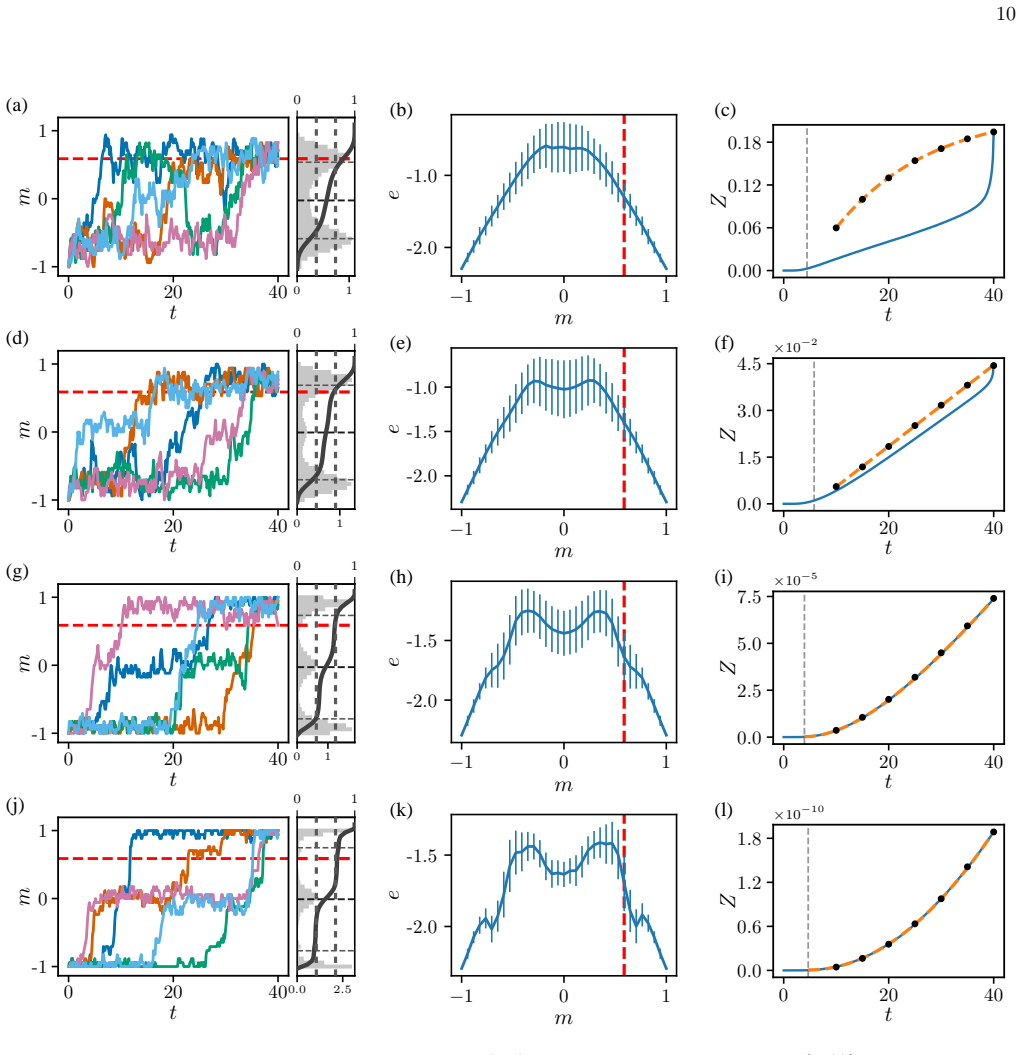
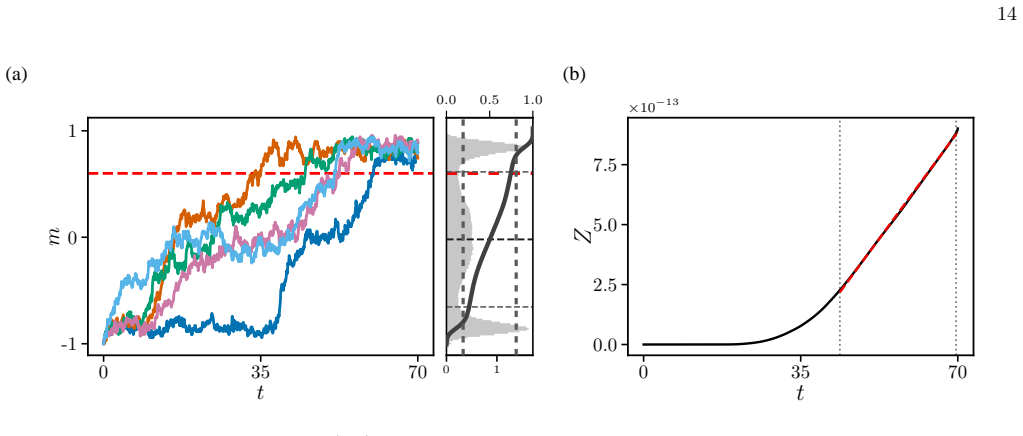
Activated transitions have rates that are often exponentially small in system size. Extracting the associated activation barriers is challenging in practice, especially in the deeply metastable regimes and in the presence of disorder. Here, we use transition path sampling to evaluate transition probabilities between ferromagnetic states in the Ising model on finite sparse random graphs, which are perhaps the simplest example of a disordered system with metastable states. To interpret the transient onset of the transition probability curve, we introduce a minimal three-state kinetic description that highlights the role of intermediate configurations. We validate the method on the heterogeneous Zachary Karate Club network, where distinct dynamical regimes emerge as temperature varies. We then apply the method to random regular graphs and Erd\H{o}s-R\'{e}nyi graphs, showing that sample-to-sample fluctuations are weak in the former but that quenched topological disorder induces sizable instance variability in the latter. For Erd\H{o}s-R\'{e}nyi graphs, we introduce an instance-dependent temperature rescaling that restores a consistent finite-size scaling of dynamical rates and enables a direct comparison with the corresponding static free-energy barrier.
Editorial analysis
A structured set of objections, weighed in public.
Referee Report
Summary. The manuscript develops transition path sampling (TPS) to evaluate transition probabilities between ferromagnetic states in the Ising model on finite sparse random graphs. It introduces a minimal three-state kinetic model to interpret the transient onset of these probabilities, validates the method on the Zachary Karate Club network (identifying distinct dynamical regimes with temperature), and applies it to random regular graphs (weak sample-to-sample fluctuations) and Erdős-Rényi graphs (sizable instance variability). For ER graphs, an instance-dependent temperature rescaling is introduced to restore consistent finite-size scaling of dynamical rates, enabling direct comparison to the corresponding static free-energy barrier.
Significance. If the three-state model and rescaling hold up under scrutiny, the work offers a practical rare-event sampling route to activation barriers in disordered metastable systems, where direct methods fail. The contrast between regular and ER graphs, plus the empirical restoration of scaling, highlights how quenched topology affects dynamics; this could extend to other heterogeneous networks. The TPS implementation on small graphs and the kinetic reduction are strengths that ground the claims in computable quantities.
major comments (2)
- [Application to Erdős-Rényi graphs (abstract and corresponding results section)] The central claim for ER graphs rests on an instance-dependent temperature rescaling introduced specifically to restore finite-size scaling of dynamical rates for each realization. This adjustment is presented as enabling comparison to the static free-energy barrier, but by construction it makes the dynamical rates dependent on a per-instance fit rather than an independent prediction; the manuscript should derive or test the rescaling form (e.g., via explicit dependence on graph moments) to show it is not post-hoc.
- [Three-state kinetic model (methods and validation sections)] The minimal three-state kinetic description is invoked to capture the role of intermediate configurations in the transient onset of the transition probability curve. This assumption is load-bearing for interpreting the TPS data across temperatures and graphs, yet the manuscript provides no quantitative test (e.g., comparison of predicted vs. observed onset shapes against four-state or full master-equation solutions on the Karate Club or small ER instances) to establish minimality.
minor comments (2)
- [Validation on Karate Club network] The abstract and validation section mention distinct dynamical regimes on the Karate Club network but omit error bars, sample counts, or convergence diagnostics for the TPS trajectories; these should be added to all rate and probability plots.
- [Methods] Notation for the rescaling parameter and the three-state rates should be defined explicitly with equations, and any free parameters (beyond the instance-dependent temperature) should be listed to clarify the model's parsimony.
Simulated Author's Rebuttal
We thank the referee for their positive summary of our work and for the constructive major comments, which have prompted us to strengthen the manuscript. We respond to each point below and will revise accordingly.
read point-by-point responses
-
Referee: [Application to Erdős-Rényi graphs (abstract and corresponding results section)] The central claim for ER graphs rests on an instance-dependent temperature rescaling introduced specifically to restore finite-size scaling of dynamical rates for each realization. This adjustment is presented as enabling comparison to the static free-energy barrier, but by construction it makes the dynamical rates dependent on a per-instance fit rather than an independent prediction; the manuscript should derive or test the rescaling form (e.g., via explicit dependence on graph moments) to show it is not post-hoc.
Authors: We appreciate the referee's observation that the rescaling, while effective for data collapse, requires stronger justification to avoid appearing post-hoc. In the manuscript the rescaling is motivated by the need to normalize for instance-specific topological fluctuations that affect the effective barrier height; it is not arbitrary but chosen to align the dynamical rates with the independently computed static free-energy barriers on the same realizations. To address the concern directly, the revised manuscript will include an explicit derivation of the rescaling prefactor in terms of the first two moments of the degree distribution, together with additional numerical tests on small ER instances that demonstrate the form's predictive accuracy when applied out-of-sample. These additions will appear in the ER graphs results section. revision: yes
-
Referee: [Three-state kinetic model (methods and validation sections)] The minimal three-state kinetic description is invoked to capture the role of intermediate configurations in the transient onset of the transition probability curve. This assumption is load-bearing for interpreting the TPS data across temperatures and graphs, yet the manuscript provides no quantitative test (e.g., comparison of predicted vs. observed onset shapes against four-state or full master-equation solutions on the Karate Club or small ER instances) to establish minimality.
Authors: We agree that a quantitative test of minimality would make the three-state reduction more robust. The model was selected because it reproduces the essential sigmoidal onset shape seen in the TPS data with only one additional parameter (the intermediate-state lifetime) and yields consistent temperature trends across all graphs examined. In the revision we will add, in the methods and validation sections, direct comparisons of the three-state predictions to both a four-state extension and to numerical integration of the full master equation on the Zachary Karate Club network and on small ER instances. We will report quantitative measures (e.g., root-mean-square deviation of the onset curves) to confirm that further states yield only marginal improvement. revision: yes
Circularity Check
No significant circularity detected
full rationale
The paper's workflow relies on transition path sampling to compute rare-event probabilities in Ising models on graphs, a minimal three-state kinetic model to interpret onset curves, and an explicit instance-dependent temperature rescaling applied only to Erdős-Rényi realizations to recover consistent finite-size scaling before comparing rates to the independently computed static free-energy barrier. No step reduces by construction to its own inputs: the rescaling is presented as an empirical adjustment to handle quenched disorder variability rather than a fitted parameter renamed as a prediction, and the comparison remains external to the dynamical sampling. The derivation chain is self-contained against the static benchmark and the Karate Club validation case, with no self-citation load-bearing or ansatz smuggling required for the central claims.
Axiom & Free-Parameter Ledger
free parameters (1)
- instance-dependent temperature rescaling =
per instance
axioms (2)
- domain assumption Ising model on finite sparse random graphs possesses metastable ferromagnetic states separated by activated transitions.
- ad hoc to paper The minimal three-state kinetic description captures the essential transient dynamics of the transition probability curve.
Reference graph
Works this paper leans on
-
[1]
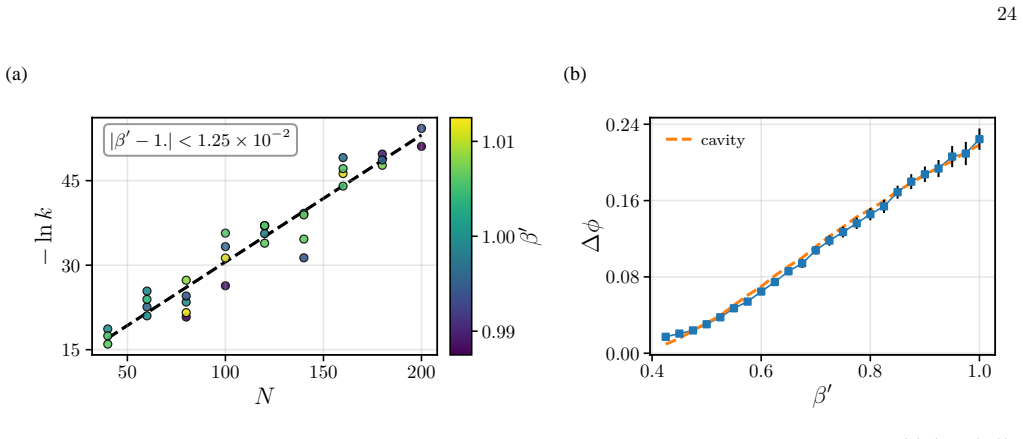
For each graphgwe estimateβ M(g) from the re- tained TI dataset (satisfyingT > τ(β= 1)) se- lected according to the criterion described above, and set βM ≡median g {βM(g)}(each graph counted once), a robust reference scale against un- even size sampling and occasional outliers
-
[2]
To compare data across different graphs we intro- duce the rescaled inverse temperature β′ ≡β βM βM(g) .(45)
-
[3]
channels
The mapping in Eq. (45) transforms the com- mon discreteβ-ladder used in the simulations to 16 a graph-dependent set ofβ ′ values, so that differ- ent instances typically do not share the sameβ ′. We therefore introduce a uniform grid of tempera- ture{ ˜βn =nϵ} n∈N0 and bin all measurements with β′ ∈[ ˜βn −ϵ/2, ˜βn +ϵ/2], assigning them the repre- sentati...
-
[4]
H¨ anggi, P
P. H¨ anggi, P. Talkner, and M. Borkovec, Reviews of Mod- ern Physics62, 251 (1990)
1990
-
[5]
P. G. Bolhuis, D. Chandler, C. Dellago, and P. L. Geissler, Annual Review of Physical Chemistry53, 291 (2002)
2002
-
[6]
Dellago, P
C. Dellago, P. G. Bolhuis, F. S. Csajka, and D. Chandler, The Journal of Chemical Physics108, 1964 (1998)
1964
-
[7]
R. J. Allen, C. Valeriani, and P. R. ten Wolde, Journal of Physics: Condensed Matter21, 463102 (2009)
2009
-
[8]
R. J. Allen, P. B. Warren, and P. R. ten Wolde, Physical Review Letters94, 018104 (2005)
2005
-
[9]
Tailleur, S
J. Tailleur, S. Tanase-Nicola, and J. Kurchan, Journal of Statistical Physics122, 557 (2006)
2006
-
[10]
Giardina, J
C. Giardina, J. Kurchan, V. Lecomte, and J. Tailleur, Journal of Statistical Physics145, 787–811 (2011)
2011
-
[11]
T. Mora, A. M. Walczak, and F. Zamponi, Physical Re- view E85, 10.1103/physreve.85.036710 (2012)
-
[12]
M. E. J. Newman, SIAM Review45, 167 (2003)
2003
-
[13]
Aharony and A
A. Aharony and A. B. Harris, Phys. Rev. Lett.77, 3700 (1996)
1996
-
[14]
W. W. Zachary, Journal of Anthropological Research33, 452 (1977)
1977
-
[15]
Girvan and M
M. Girvan and M. E. J. Newman, Proceedings of the National Academy of Sciences99, 7821 (2002)
2002
-
[16]
S. N. Dorogovtsev, A. V. Goltsev, and J. F. F. Mendes, Rev. Mod. Phys.80, 1275 (2008)
2008
-
[17]
Transition Path Sampling in Ising Models on Heterogeneous Graphs
R. Cipolloni, F. Ricci-Tersenghi, and F. Zamponi, Sup- plementary videos for “Transition Path Sampling in Ising Models on Heterogeneous Graphs”: Representative Tra- jectory Animations on the Zachary Karate Club Graph (2026)
2026
-
[18]
Bernaschi, M
M. Bernaschi, M. Bisson, M. Fatica, E. Marinari, V. Martin-Mayor, G. Parisi, and F. Ricci-Tersenghi, Eu- rophysics Letters133, 60005 (2021)
2021
-
[19]
Lucibello, F
C. Lucibello, F. Morone, G. Parisi, F. Ricci-Tersenghi, and T. Rizzo, Phys. Rev. E90, 012146 (2014)
2014
-
[20]
M´ ezard and A
M. M´ ezard and A. Montanari,Information, Physics, and Computation(Oxford University Press, 2009)
2009
-
[21]
Saade, F
A. Saade, F. Krzakala, and L. Zdeborov´ a, Europhysics Letters107, 50005 (2014)
2014
-
[22]
Krzakala, C
F. Krzakala, C. Moore, E. Mossel, J. Neeman, A. Sly, L. Zdeborov´ a, and P. Zhang, Proceedings of the National Academy of Sciences110, 20935–20940 (2013)
2013
-
[23]
A. Dembo and A. Montanari, The Annals of Applied Probability20, 10.1214/09-aap627 (2010). Appendix A: Computational advantage over direct dynamics We provide here an order-of-magnitude comparison il- lustrating the computational advantage of the TPS+TI strategy overplaindirect dynamical estimates for the rare transition rates targeted in this work. As a r...
-
[24]
As discussed in Sec
Low-βdiagnostic: threshold sensitivity (M ⋆ = 6) In the low-βregime, the transition probabilityZ(t) quickly reaches a plateau. As discussed in Sec. IV, the plateau value depends on theoperationaldefinition of the final basin through the thresholdM ⋆ entering the indicatorχ (+) = Θ(M−M ⋆). To assess the sensitivity to this choice, we repeat the analysis at...
-
[25]
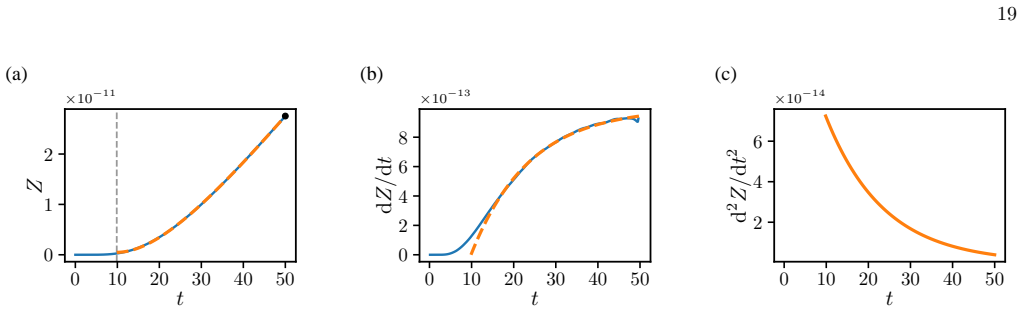
Derivatives and transition-time statistics We discuss how time derivatives of the transition prob- ability encode information onfirst-entryandcompletion time scales. Throughout this subsection we assume a persistencecondition: once the trajectory has entered the (+) basin (according to the chosen operational indi- cator), the probability of leaving it aga...
discussion (0)
Sign in with ORCID, Apple, or X to comment. Anyone can read and Pith papers without signing in.